Japan Self-Guided Systems Market Size & Growth Rate
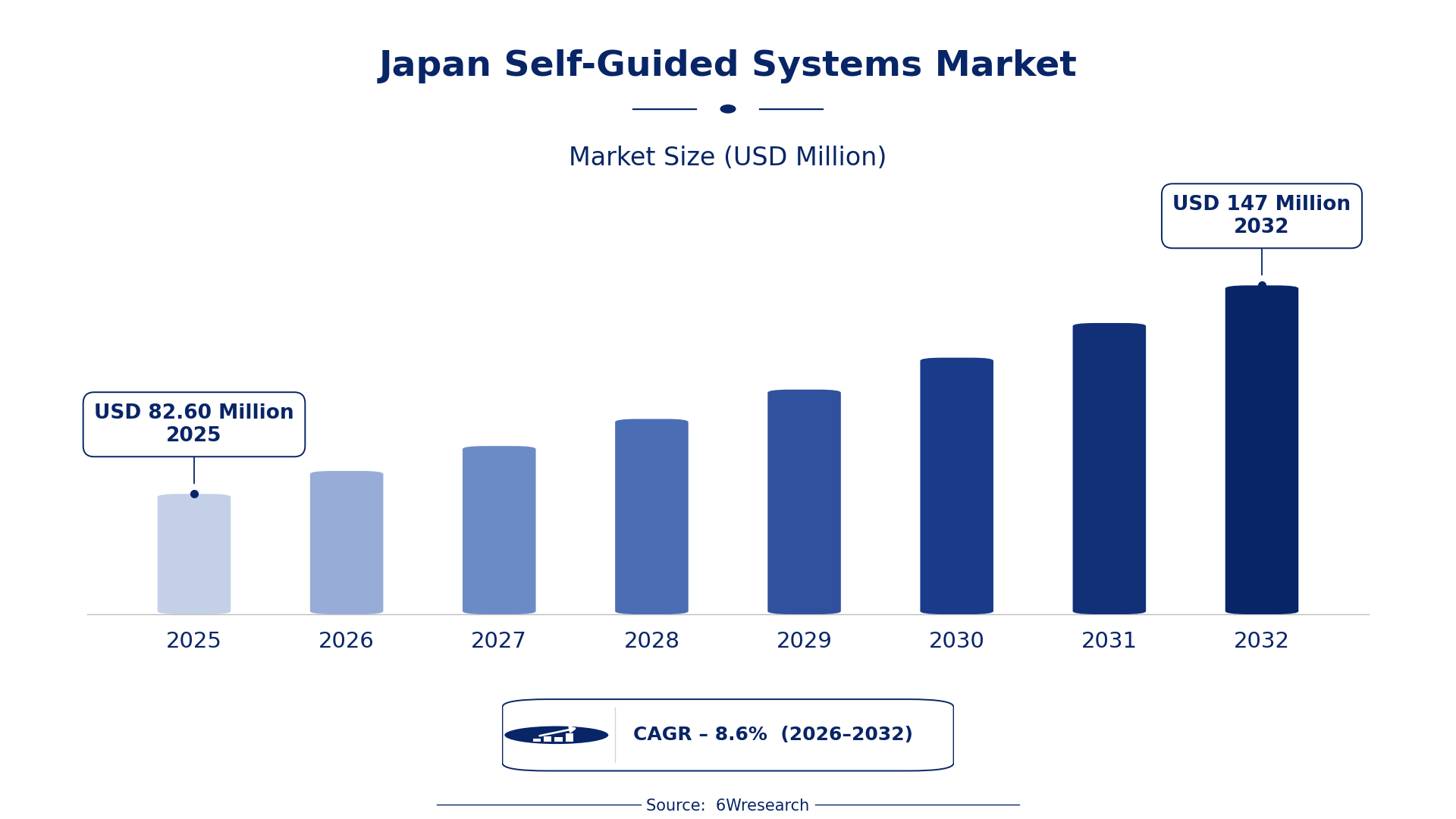
According to 6Wresearch internal database and industry insights, the Japan Self-Guided Systems Market was valued at USD 82.60 Million in 2025 and is projected to reach USD 147 Million by 2032, growing at a CAGR of approximately 8.6% during 2026–2032.
Japan Self-Guided Systems Market Highlights
| Report Metric | Details |
| Report Name | Japan Self-Guided Systems Market (2026-2032) |
| Market Size 2025 | USD 82.60 Million |
| Market Size 2032 | USD 147 Million |
| Absolute Growth 2025–2032 | USD 64.40 Million |
| CAGR 2026–2032 | 8.6% |
| Peak Annual Growth | 11.4% in 2026 |
| Forecast Period | 2026–2032 |
| Historical Data | 2022–2025 |
| Base Year | 2025 |
| Leading Platform Type, 2025 | Self-Guided Missiles (39% share) |
| Leading Application Area, 2025 | Targeting (44% share) |
| Leading Technology Stack, 2025 | IR + Radar Seeker (39% share) |
| Leading End User, 2025 | Military Agencies (37% share) |
| Fastest-Growing Platform Type | Autonomous Robots (12.4% CAGR) |
| Fastest-Growing Application Area | Reconnaissance (9.8% CAGR) |
| Fastest-Growing Technology Stack | AI + Computer Vision (11.8% CAGR) |
| Fastest-Growing End User | Defense Contractors (10.6% CAGR) |
| Growing Sector | Defense Technologies |
| Key End Users | Military Agencies, Defense Contractors, Homeland Security, Naval Authorities |
Japan Self-Guided Systems Market Year-wise Growth Rate and Key Drivers (2022–2032)
This graph illustrates the annual growth rates of the market from 2022 to 2032, highlighting a steady upward trajectory and projected market expansion over the forecast period.
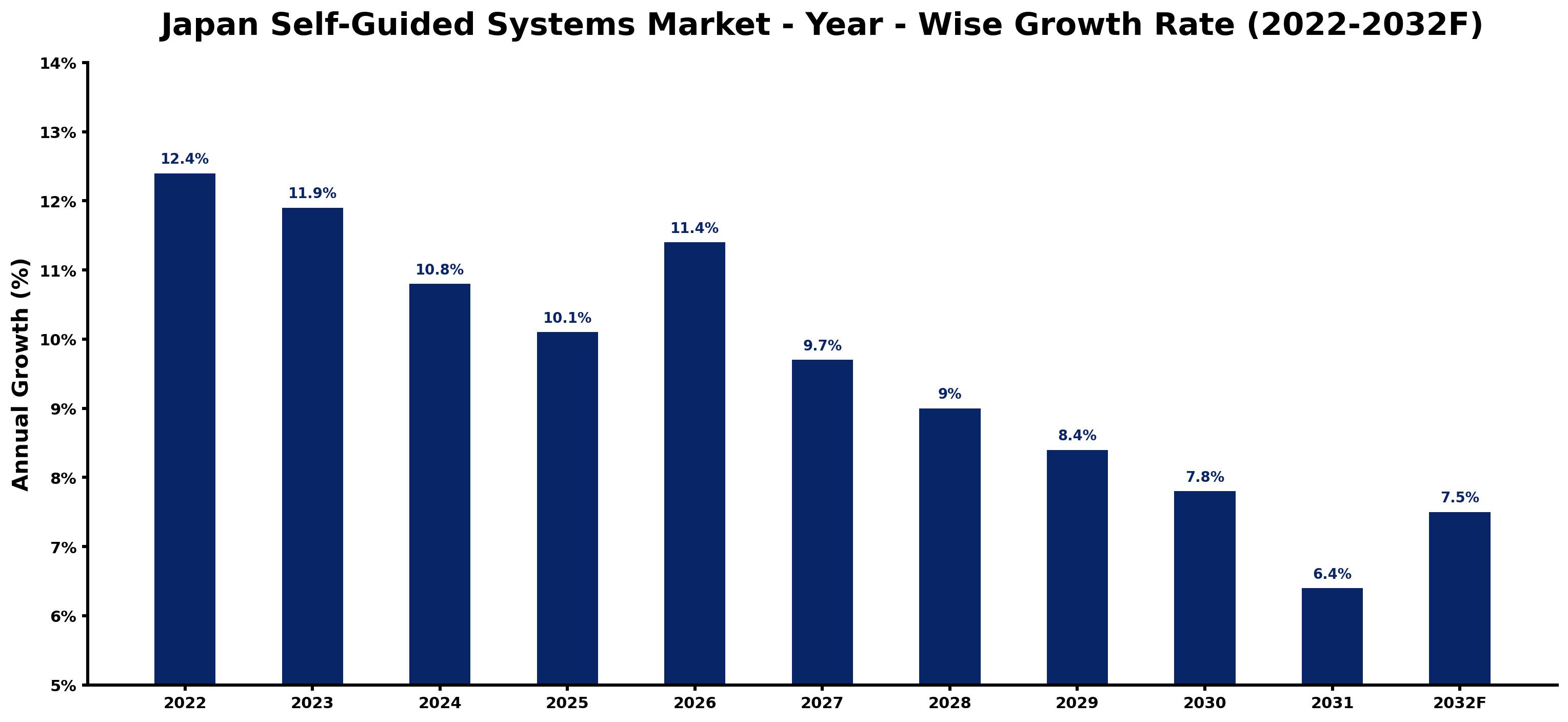
Year by year, the estimates below pair each growth rate with the development that shaped it.
| Year | Estimated Annual Growth (%) | Market Rationale |
| 2022 | 12.4 | The market experienced strong demand from military agencies for advanced technologies. |
| 2023 | 11.9 | Demand continued to grow, but at a slower pace due to market saturation effects. |
| 2024 | 10.8 | The market maintained growth, driven by ongoing investments in defense technologies. |
| 2025 | 10.1 | Demand slowed further as military agencies focused on integrating existing systems. |
| 2026 | 11.4 | Growth is expected to accelerate as new autonomous projects are initiated by the Ministry of Defense. |
| 2027 | 9.7 | The market is projected to see a slowdown as the focus shifts to system upgrades and maintenance. |
| 2028 | 9.0 | Demand is expected to continue decelerating as budget allocations are reassessed by agencies. |
| 2029 | 8.4 | The market will experience further slowdown as competition intensifies among suppliers. |
| 2030 | 7.8 | Growth is projected to decelerate as military agencies prioritise cost-effective solutions. |
| 2031 | 6.4 | The market is expected to slow down due to a focus on existing capabilities rather than new acquisitions. |
| 2032 | 7.5 | Demand is expected to rise again as new autonomous systems are deployed. |
Note: Market size estimations and growth projections presented in this report are based on 6Wresearch's proprietary forecasting methodology, utilizing the latest available industry data, government publications, and primary research inputs.
Japan Self-Guided Systems Market Synopsis
Self-Guided Systems encompass autonomous technologies such as self-guided missiles, unmanned vehicles, and robots, primarily used for military operations and border security. The Japan Self-Defense Forces are increasing their investment in these systems, with a 2023 defense budget of ¥6 trillion focusing on advanced military technologies. Demand arises from the need for improved reconnaissance and surveillance capabilities, supported by initiatives like the Ministry of Defense's program to advance autonomous systems by 2025.
Market Dynamics Impact Analysis (2026–2032)
| Factor | Type | Impact | Primary Segment Affected |
| Increased defense spending | Driver | High | Self-Guided Missiles |
| Technological advancements in AI and robotics | Driver | High | Autonomous Robots |
| Growing focus on border security | Opportunity | High | Border Patrol |
| Rising demand for reconnaissance capabilities | Opportunity | Medium | Reconnaissance |
| High development costs for advanced systems | Restraint | High | Unmanned Ground Vehicle |
| Regulatory hurdles in technology integration | Restraint | Medium | Autonomous Underwater Vehicle |
| Supply chain disruptions affecting production | Challenge | High | Self-Guided Missiles |
| Competition from international defense contractors | Challenge | Medium | Defense Contractors |
Evaluation of Drivers in Japan Self-Guided Systems Market (2026–2032)
The table below links each growth driver to the segment it affects and the evidence for it.
| Drivers | Primary Segment Affected | Why It Matters (Evidence) |
| Increased defense budget allocations | Self-Guided Missiles | In 2023, Japan allocated ¥6 trillion for defense, boosting demand for precision strike technologies. |
| Advancements in AI technologies | Autonomous Robots | Military agencies are investing in AI for operational capabilities, increasing purchases of autonomous robots. |
| Focus on national security | Border Patrol | The initiative to advance autonomous systems emphasises unmanned systems for border monitoring, driving demand from homeland security agencies. |
| Integration of advanced technologies | Unmanned Ground Vehicle | The program to advance autonomous systems by 2025 is increasing demand for ground vehicles. |
| Growing need for surveillance capabilities | Reconnaissance | Military agencies are expanding their reconnaissance operations, leading to higher demand for autonomous systems. |
The strongest pull on demand comes from increased defense budget allocations, with Japan allocating ¥6 trillion for defense in 2023, driving purchases of self-guided missiles. Military agencies are investing in AI for operational capabilities, boosting demand for autonomous robots. National security priorities lead to a rising need for border patrol systems, as the initiative to advance autonomous systems emphasises unmanned technologies. The Ministry of Defense's initiative to improve reconnaissance capabilities is increasing demand for unmanned ground vehicles, while military agencies are expanding operations, further driving demand for these technologies.
Evaluation of Restraints in Japan Self-Guided Systems Market
The following restraints limit how fast demand can grow.
| Market Restraint | Primary Segment Affected | Why It Matters (Evidence) |
| High development costs for advanced systems | Self-Guided Missiles | Development costs for precision strike technologies can exceed budgets, limiting procurement by agencies. |
| Regulatory hurdles in technology integration | Autonomous Underwater Vehicle | Strict compliance with JIS standards can delay the deployment of new technologies. |
| Supply chain disruptions affecting production | Unmanned Ground Vehicle | Global supply chain issues can lead to delays in manufacturing and delivery of systems. |
| Limited domestic production capacity | Autonomous Robots | Japan's defense industry faces challenges in scaling up production to meet rising demand. |
| Competition from international defense contractors | Defense Contractors | Intense competition can drive prices down, affecting profit margins for local producers. |
Japan Self-Guided Systems Market Challenges
Producers face a shortage of skilled engineers in advanced technologies, which hampers the development of self-guided systems and delays project timelines for defence firms. Buyers encounter difficulties sourcing reliable components, as a limited number of domestic suppliers leads to lead times extending by up to six months, impacting military readiness. Manufacturers struggle with integrating outdated technology, which affects the deployment of new autonomous systems and compromises operational capabilities. Rising costs of advanced materials are straining production budgets, forcing buyers to allocate an additional ¥500 billion for procurement in 2023.
Trends in the Japan Self-Guided Systems Market
The following changes are redrawing the Japan Self-Guided Systems Market.
- Transition to Autonomous Systems: Japan is shifting towards autonomous systems, as seen in the Ministry of Defense's focus on advancing capabilities by 2025, with a budget increase of ¥6 trillion.
- Growing Investment in AI Technologies: Military agencies are prioritising AI technologies, resulting in a surge in demand for autonomous robots, with projected growth of 12.4% in the coming years.
- Expansion of Border Security Initiatives: The initiative to advance autonomous systems is driving the deployment of unmanned systems for border patrol, reflecting a growing investment in surveillance technologies across Japan.
- Emphasis on Reconnaissance Capabilities: There is a rising focus on reconnaissance capabilities, with military agencies increasing investments in autonomous systems to gather intelligence more effectively.
Investment Opportunities in the Japan Self-Guided Systems Market
Several openings in the Japan Self-Guided Systems Market merit attention from investors.
- Military Agencies Seeking Advanced Solutions: Military agencies are actively looking for advanced self-guided systems, with a projected market size of ¥82.60 million by 2025, creating opportunities for suppliers.
- Growing Need for Technology Partnerships: There is a demand for partnerships in technology sharing, particularly with international defense agencies, to improve capabilities and meet demand for autonomous systems.
- Ideal Timing for Investment in Autonomous Technologies: With Japan's defense budget increasing, now is an ideal time for investment in autonomous technologies, especially in the Tokyo region, a hub for defense contractors.
- Gap in Domestic Production Capacity: As Japan's defense industry seeks to expand, there is a gap in domestic production capacity for autonomous systems, creating opportunities for local partnerships and investments.
Government Initiatives in the Japan Self-Guided Systems Market
The AI Promotion Act, established in 2025, aims to create a national framework for AI research and development, building on earlier laws like the New Robot Strategy from 2015. This new act focuses on integrating AI into military technologies, ensuring compliance with JIS standards for quality assurance in defense equipment.
The Acquisition, Technology & Logistics Agency (ATLA) plays a critical role in approving and funding projects related to autonomous systems. In 2023, ATLA supported initiatives to improve reconnaissance capabilities, reflecting the government's commitment to advancing military technologies.
Future Insight of the Japan Self-Guided Systems Market
The Defence Innovation Program aimed at fostering innovation in military technologies will reshape operations by 2032, providing advantages for both buyers and suppliers. Investment in AI for improved reconnaissance will streamline military processes and increase operational efficiency. Collaborations with international defence agencies will promote technology sharing, accelerating innovation. The concentration of defence technology firms in the Tokyo region will drive the development of self-guided systems, with a projected increase in investment of ¥1 trillion by 2030.
Market Segmentation Analysis
Japan Self-Guided Systems Market report covers a detailed analysis of the following market segments:
By Platform Type – Self-Guided Missiles Lead, Autonomous Robots Expected to Grow Fastest
According to Saurav Kr Singh, Senior Research Analyst at 6Wresearch, Self-Guided Missiles took 39% of platform type revenue in 2025, more than any other category. Self-Guided Missiles dominate the market because they are essential for military operations, providing precision strikes that are critical for national security. The Japan Self-Defense Forces heavily rely on these systems, which form a cornerstone of their defence strategy. Autonomous Robots are set to record the highest CAGR in this split, 12.4% over 2026–2032. Autonomous Robots are experiencing rapid growth as they are increasingly used for reconnaissance and logistics, with military agencies allocating more resources to these technologies. The Defence Innovation Program highlights the focus on enhancing capabilities in this area, which is fuelling demand. Suppliers should focus on developing autonomous robots to align with the growing needs of military agencies.
By Application Area – Targeting Leads, Reconnaissance Expected to Grow Fastest
With 44% of application area revenue in 2025, Targeting was the largest category. Targeting holds the largest share as it is vital for military operations, significantly improving strike accuracy and operational success. The Japan Self-Defense Forces prioritise this application to ensure effective mission outcomes. Over 2026–2032, Reconnaissance is expected to post the fastest growth, at a CAGR of 9.8%. Reconnaissance is the fastest-growing area, driven by the urgent need for intelligence gathering in military and security operations. The National Security Strategy emphasises the importance of unmanned systems for this purpose, leading to increased investments. Buyers will increasingly seek advanced reconnaissance solutions to enhance intelligence capabilities in military operations.
By Technology Stack – IR + Radar Seeker Leads, AI + Computer Vision Expected to Grow Fastest
IR + Radar Seeker held 39% of the Japan Self-Guided Systems Market by technology stack in 2025. IR + Radar Seeker technology leads the market as it is crucial for missile guidance and target acquisition, ensuring high precision in military engagements. This technology is a standard in self-guided missile systems utilised by the Japan Self-Defense Forces. AI + Computer Vision is projected to grow fastest, at a CAGR of 11.8% during 2026–2032. AI + Computer Vision is rapidly expanding, enhancing autonomous navigation and decision-making capabilities across various applications. The integration of advanced technologies in military systems is a key focus area, driving this segment's growth. Suppliers must invest in advanced technologies to remain competitive in the evolving defence market.
By End User – Military Agencies Lead, Defense Contractors Expected to Grow Fastest
In 2025, Military Agencies led the end user split with a 37% share. Military Agencies are the primary users of self-guided systems, extensively employing them for defence and operational readiness. Their substantial investment in advanced technologies ensures a consistent demand for these systems. The quickest growth will come from Defense Contractors, forecast to expand at a CAGR of 10.6% between 2026 and 2032. Defense Contractors are experiencing the fastest growth as they are essential in the production and integration of autonomous systems. The increasing collaboration with military agencies for technology development is propelling this segment forward. Buyers in the defence sector will increasingly depend on contractors for advanced self-guided systems.
Key Attractiveness of the Report
- 10 Years of Market Numbers
- Historical Data Starting from 2022 to 2025
- Base Year 2025
- Forecast Data until 2032
- Key Performance Indicators Impacting the Market
- Major Upcoming Developments and Projects
Key Highlights of the Report:
- Japan Self-Guided Systems Market Outlook
- Market Size of Japan Self-Guided Systems Market, 2025
- Forecast of Japan Self-Guided Systems Market, 2032
- Historical Data and Forecast of Japan Self-Guided Systems Revenues & Volume for the Period 2022-2032F
- Japan Self-Guided Systems Market Trend Evolution
- Japan Self-Guided Systems Market Drivers and Challenges
- Japan Self-Guided Systems Price Trends
- Japan Self-Guided Systems Porter's Five Forces
- Japan Self-Guided Systems Industry Life Cycle
- Historical Data and Forecast of Japan Self-Guided Systems Market Revenues & Volume By Platform Type for the Period 2022-2032F
- Historical Data and Forecast of Japan Self-Guided Systems Market Revenues & Volume By Self-Guided Missiles for the Period 2022-2032F
- Historical Data and Forecast of Japan Self-Guided Systems Market Revenues & Volume By Autonomous Robots for the Period 2022-2032F
- Historical Data and Forecast of Japan Self-Guided Systems Market Revenues & Volume By Unmanned Ground Vehicle for the Period 2022-2032F
- Historical Data and Forecast of Japan Self-Guided Systems Market Revenues & Volume By Autonomous Underwater Vehicle for the Period 2022-2032F
- Historical Data and Forecast of Japan Self-Guided Systems Market Revenues & Volume By Application Area for the Period 2022-2032F
- Historical Data and Forecast of Japan Self-Guided Systems Market Revenues & Volume By Targeting for the Period 2022-2032F
- Historical Data and Forecast of Japan Self-Guided Systems Market Revenues & Volume By Reconnaissance for the Period 2022-2032F
- Historical Data and Forecast of Japan Self-Guided Systems Market Revenues & Volume By Border Patrol for the Period 2022-2032F
- Historical Data and Forecast of Japan Self-Guided Systems Market Revenues & Volume By Surveillance for the Period 2022-2032F
- Historical Data and Forecast of Japan Self-Guided Systems Market Revenues & Volume By Technology Stack for the Period 2022-2032F
- Historical Data and Forecast of Japan Self-Guided Systems Market Revenues & Volume By IR + Radar Seeker for the Period 2022-2032F
- Historical Data and Forecast of Japan Self-Guided Systems Market Revenues & Volume By AI + Computer Vision for the Period 2022-2032F
- Historical Data and Forecast of Japan Self-Guided Systems Market Revenues & Volume By GPS + Obstacle Detection for the Period 2022-2032F
- Historical Data and Forecast of Japan Self-Guided Systems Market Revenues & Volume By Sonar + Mapping for the Period 2022-2032F
- Historical Data and Forecast of Japan Self-Guided Systems Market Revenues & Volume By End User for the Period 2022-2032F
- Historical Data and Forecast of Japan Self-Guided Systems Market Revenues & Volume By Military Agencies for the Period 2022-2032F
- Historical Data and Forecast of Japan Self-Guided Systems Market Revenues & Volume By Defense Contractors for the Period 2022-2032F
- Historical Data and Forecast of Japan Self-Guided Systems Market Revenues & Volume By Homeland Security for the Period 2022-2032F
- Historical Data and Forecast of Japan Self-Guided Systems Market Revenues & Volume By Naval Authorities for the Period 2022-2032F
- Japan Self-Guided Systems Import Export Trade Statistics
- Market Opportunity Assessment By Platform Type
- Market Opportunity Assessment By Application Area
- Market Opportunity Assessment By Technology Stack
- Market Opportunity Assessment By End User
- Japan Self-Guided Systems Top Companies Market Share
- Japan Self-Guided Systems Competitive Benchmarking By Technical and Operational Parameters
- Japan Self-Guided Systems Company Profiles
- Japan Self-Guided Systems Key Strategic Recommendations
Market Covered
The study includes the following segmentation.
By Platform Type
- Self-Guided Missiles
- Autonomous Robots
- Unmanned Ground Vehicle
- Autonomous Underwater Vehicle
By Application Area
- Targeting
- Reconnaissance
- Border Patrol
- Surveillance
By Technology Stack
- IR + Radar Seeker
- AI + Computer Vision
- GPS + Obstacle Detection
- Sonar + Mapping
By End User
- Military Agencies
- Defense Contractors
- Homeland Security
- Naval Authorities






































