Japan Self-Learning Systems Market Size & Growth Rate
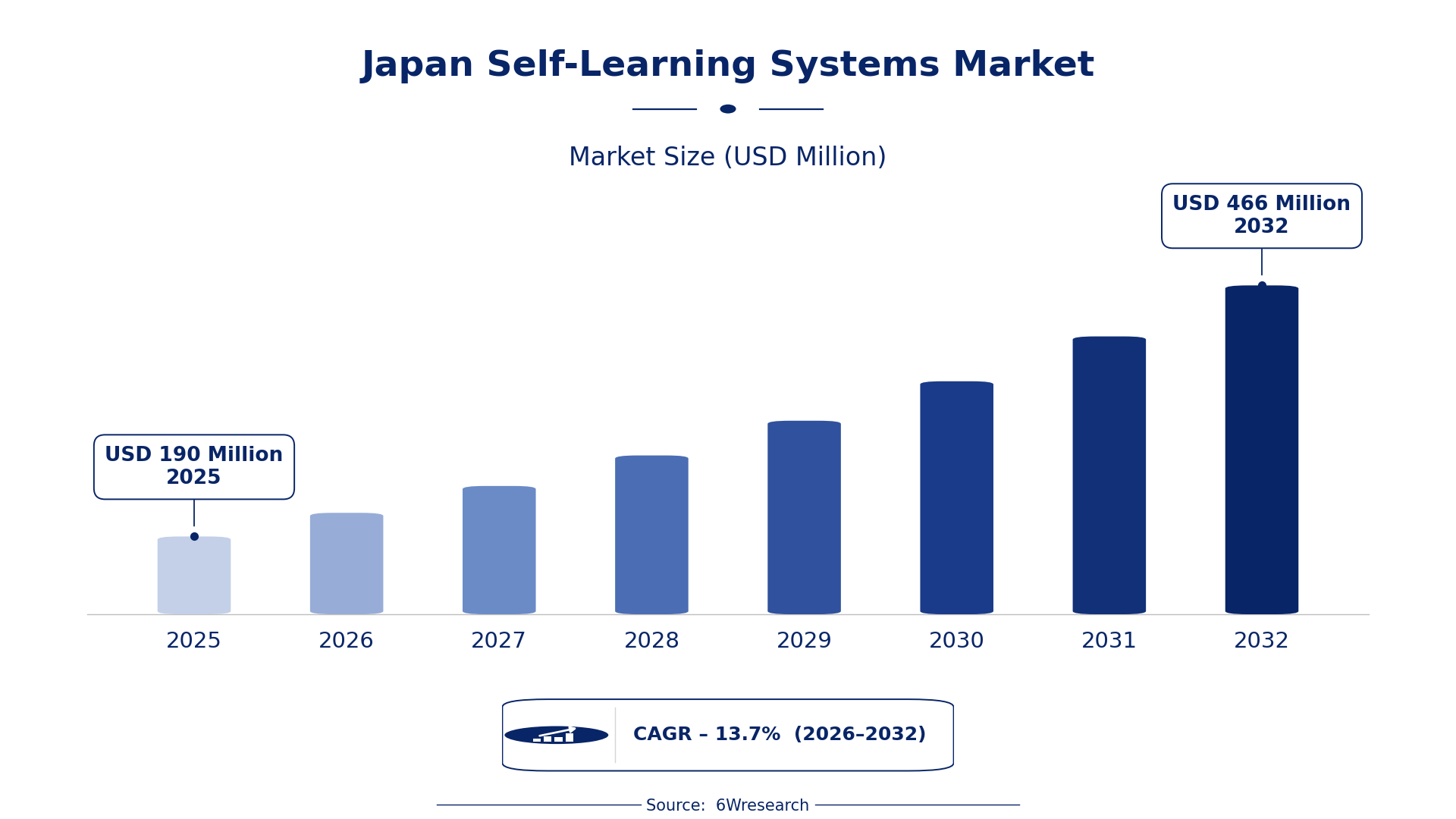
According to 6Wresearch internal database and industry insights, the Japan Self-Learning Systems Market was valued at USD 190 Million in 2025 and is projected to reach USD 466 Million by 2032, growing at a CAGR of approximately 13.7% during 2026–2032.
Japan Self-Learning Systems Market Highlights
| Report Metric | Details |
| Report Name | Japan Self-Learning Systems Market (2026-2032) |
| Market Size 2025 | USD 190 Million |
| Market Size 2032 | USD 466 Million |
| Absolute Growth 2025–2032 | USD 276 Million |
| CAGR 2026–2032 | 13.7% |
| Peak Annual Growth | 18.1% in 2032 |
| Forecast Period | 2026–2032 |
| Historical Data | 2022–2025 |
| Base Year | 2025 |
| Leading Learning Type, 2025 | Supervised Learning (41% share) |
| Leading Application Area, 2025 | Customer Analytics (50% share) |
| Leading Technology Stack, 2025 | AI + Big Data (44% share) |
| Leading End User, 2025 | E-Commerce Firms (47% share) |
| Fastest-Growing Learning Type | Reinforcement Learning (19.4% CAGR) |
| Fastest-Growing Application Area | Autonomous Robotics (18.3% CAGR) |
| Fastest-Growing Technology Stack | Edge AI (20.6% CAGR) |
| Fastest-Growing End User | SaaS Providers (18.8% CAGR) |
| Growing Sector | Autonomous Robotics |
| Key End Users | Customer Analytics, Cyber Threat Detection, Autonomous Robotics, Data Privacy Management |
Japan Self-Learning Systems Market Year-wise Growth Rate and Key Drivers (2022–2032)
This graph illustrates the annual growth rates of the market from 2022 to 2032, highlighting a steady upward trajectory and projected market expansion over the forecast period.
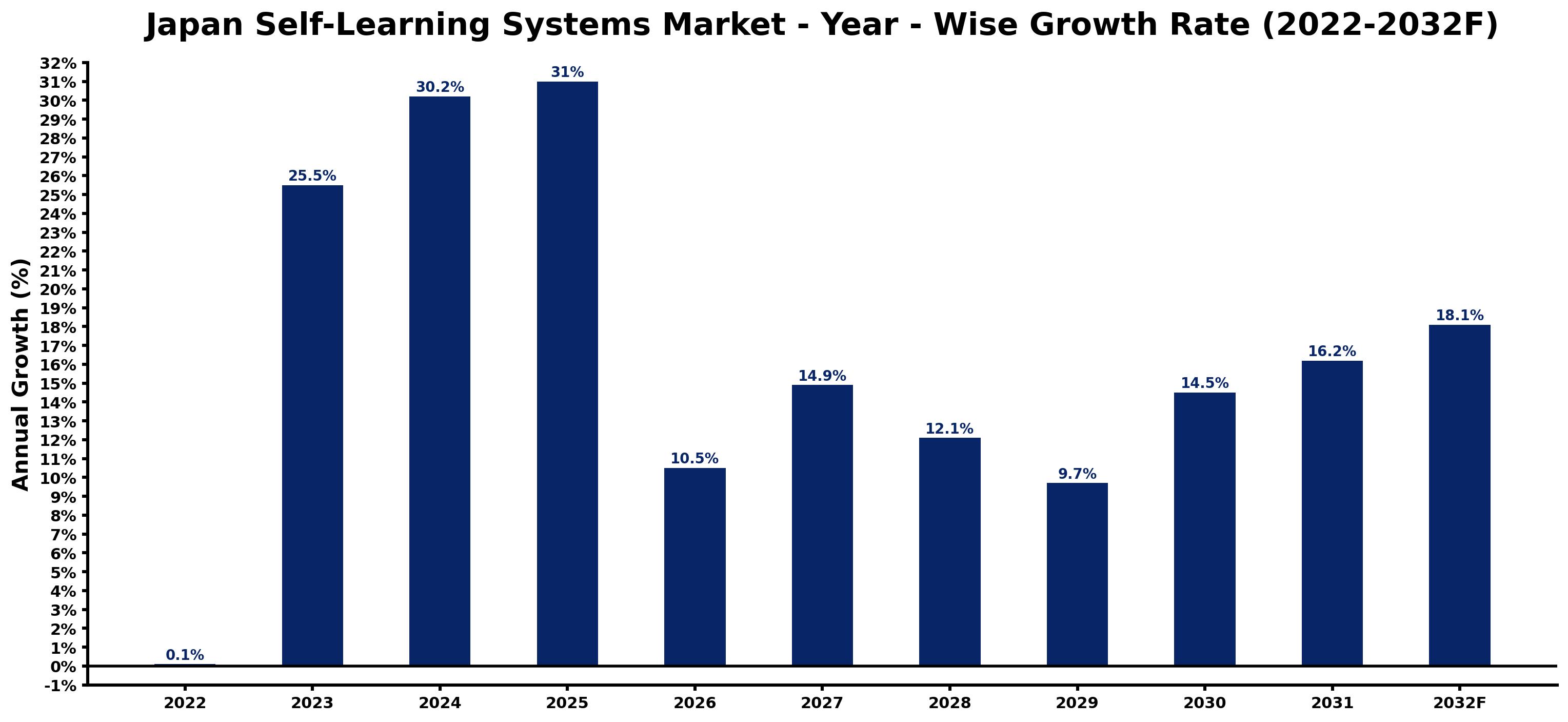
The yearly estimates that follow link every growth rate to its principal driver, so readers can see why the pace changed in each period.
| Year | Estimated Annual Growth (%) | Market Rationale |
| 2022 | 0.1 | The market exhibited minimal activity with a slight growth rate. |
| 2023 | 25.5 | Demand surged as businesses increasingly adopted AI technologies for operational efficiency. |
| 2024 | 30.2 | Growth accelerated as more sectors recognised the benefits of self-learning systems. |
| 2025 | 31.0 | The peak growth year saw extensive investments in AI across various industries. |
| 2026 | 10.5 | Growth is expected to slow as the market stabilises after rapid expansion. |
| 2027 | 14.9 | Demand is projected to increase again as companies seek to improve operational capabilities. |
| 2028 | 12.1 | Growth is anticipated to moderate as the market adjusts to previous high levels. |
| 2029 | 9.7 | A further slowdown is expected as the market reaches a more mature phase. |
| 2030 | 14.5 | Demand is projected to rebound as technological advancements spark renewed interest. |
| 2031 | 16.2 | Growth will continue to rise as more sectors integrate AI into their operations. |
| 2032 | 18.1 | The market is expected to peak with significant investments in advanced AI technologies. |
Note: Market size estimations and growth projections presented in this report are based on 6Wresearch's proprietary forecasting methodology, utilizing the latest available industry data, government publications, and primary research inputs.
Japan Self-Learning Systems Market Synopsis
Self-Learning Systems are advanced AI technologies that enable machines to learn from data autonomously. These systems improve customer experience, strengthen cybersecurity measures, and automate industrial processes. The Japan Self-Learning Systems Market is expanding rapidly, driven by a surge in AI adoption, particularly in e-commerce and cybersecurity sectors, with the number of AI startups exceeding 1,000 in 2023. This growth is supported by initiatives like the AI Strategy launched by the Ministry of Economy, Trade and Industry in 2021, aiming to boost AI integration across industries.
Market Dynamics Impact Analysis (2026–2032)
| Factor | Type | Impact | Primary Segment Affected |
| Increasing demand for customer insights drives the need for Customer Analytics. | Driver | High | Customer Analytics |
| Growing focus on cybersecurity measures enhances demand for Cyber Threat Detection. | Driver | High | Cyber Threat Detection |
| Rising investments in AI technology create opportunities in Autonomous Robotics. | Opportunity | High | Autonomous Robotics |
| The need for compliance with data privacy regulations opens avenues in Data Privacy Management. | Opportunity | Medium | Data Privacy Management |
| Limited skilled workforce in AI development constrains market growth. | Restraint | High | Supervised Learning |
| High initial investment costs deter smaller firms from adopting self-learning systems. | Restraint | Medium | Supervised Learning |
| Supply chain disruptions in technology components challenge production capabilities. | Challenge | High | Supervised Learning |
| Rapid technological advancements create pressure to keep systems updated. | Challenge | Medium | Supervised Learning |
Evaluation of Drivers in Japan Self-Learning Systems Market (2026–2032)
These are the developments adding the most demand over the forecast period.
| Drivers | Primary Segment Affected | Why It Matters (Evidence) |
| Growing e-commerce sector increases demand for Customer Analytics. | Customer Analytics | The e-commerce market in Japan is expanding rapidly, with a projected growth rate of 10% annually. |
| Rising cyber threats necessitate advanced Cyber Threat Detection systems. | Cyber Threat Detection | Cybersecurity incidents in Japan increased by 20% in 2022, prompting businesses to invest in AI solutions. |
| Advancements in AI technology drive interest in Autonomous Robotics. | Autonomous Robotics | The industrial automation sector in Japan is valued at over $10 billion, increasing demand for robotics. |
| The need for data compliance boosts Data Privacy Management solutions. | Data Privacy Management | The JIS Q 15001 standard mandates strict personal information protection measures. |
| Increased funding for AI startups boosts market capacity. | Supervised Learning | The Tokyo Metropolitan Government supports AI innovation through funding programs, enhancing local development. |
The strongest pull on demand comes from the expanding e-commerce sector, projected to grow by 10% annually, prompting businesses to invest more in Customer Analytics. Cybersecurity threats surged, with incidents increasing by 20% in 2022, leading companies to seek advanced Cyber Threat Detection systems. The industrial automation sector, valued at over $10 billion, drives interest in robotics, as firms look to improve operational capabilities. The JIS Q 15001 standard mandates strict personal information protection, increasing the need for Data Privacy Management solutions.
Evaluation of Restraints in Japan Self-Learning Systems Market
Several factors work against faster growth; the main ones are summarised below.
| Market Restraint | Primary Segment Affected | Why It Matters (Evidence) |
| High implementation costs limit adoption of self-learning systems. | Customer Analytics | Integration costs can reach up to 30% of annual IT budgets for e-commerce firms. |
| Complex regulatory environment delays system delivery. | Cyber Threat Detection | The JIS Q 15001 standard can extend project timelines by six months. |
| Shortage of skilled professionals hampers supplier capabilities. | Autonomous Robotics | This results in potential revenue losses of up to $2 billion for the industry. |
| Fragmented AI research complicates collaboration. | Data Privacy Management | This leads to inefficiencies for buyers seeking effective solutions. |
| Limited awareness of self-learning systems among potential users. | Supervised Learning | Many businesses are unaware of the benefits these systems can provide. |
Japan Self-Learning Systems Market Challenges
E-commerce firms in Japan face high implementation costs for self-learning systems, consuming up to 30% of their annual IT budgets. Suppliers experience delays in system delivery due to the JIS Q 15001 standard, which can extend project timelines by six months. A shortage of skilled professionals hampers suppliers' ability to meet demand, risking potential revenue losses of $2 billion for the industry. Fragmented AI research among over 1,000 startups complicates collaboration, leading to inefficiencies for buyers seeking effective solutions.
Trends in the Japan Self-Learning Systems Market
Several trends are reshaping the Japan Self-Learning Systems Market; the most important are set out below.
- Shift towards AI-Driven Cybersecurity Solutions: The Cybersecurity Strategy 2023 emphasises the need for AI in threat detection, with a projected increase in AI adoption by 30% in the sector.
- Transition to Autonomous Robotics: The industrial automation sector is increasingly adopting Autonomous Robotics, with growth driven by the need for efficiency, expected to rise by 15% annually.
- Emergence of Edge AI Technologies: Since 2022, Edge AI has gained traction in self-learning systems, driven by the demand for real-time data processing, with an expected growth rate of 20.6%.
- Growing Importance of Data Privacy Management: The JIS Q 15001 standard has led to a surge in demand for Data Privacy Management solutions, with compliance-related investments projected to increase by 25%.
Investment Opportunities in the Japan Self-Learning Systems Market
The openings below show where demand in the Japan Self-Learning Systems Market is visible and how suppliers can enter.
- Supply of Advanced Cyber Threat Detection Systems: With a 20% increase in cyber incidents, there is a strong demand for advanced detection systems, particularly from cybersecurity firms in Tokyo.
- Investment in Autonomous Robotics Solutions: The industrial automation sector's growth presents opportunities for suppliers of Autonomous Robotics, especially in manufacturing hubs like Aichi Prefecture.
- Development of Data Privacy Management Tools: As compliance becomes critical, investing in Data Privacy Management solutions is essential for e-commerce firms in Japan, particularly in urban areas.
- Partnerships for AI Integration Services: Collaborating with local AI startups can improve service offerings for e-commerce firms, tapping into the growing market for self-learning systems.
Government Initiatives in the Japan Self-Learning Systems Market
The Semiconductor and Digital Industry Strategy, launched by METI in June 2021, aims to secure domestic semiconductor manufacturing, which is vital for the production of self-learning systems. This measure ensures that local producers can meet the growing demand for advanced AI technologies.
The AI and Data Strategy Council, established in 2022, oversees AI initiatives and funds projects that promote AI integration across industries. This includes approving grants for training programs aimed at developing a skilled workforce in AI, targeting 100,000 professionals by 2030.
Future Insight of the Japan Self-Learning Systems Market
By 2032, buyers in various sectors will benefit from enhanced AI integration driven by the AI Strategy launched by the Ministry of Economy, Trade and Industry. The training of 100,000 AI professionals will provide suppliers with a skilled workforce, improving system development capabilities. The establishment of the AI and Data Strategy Council will ensure effective oversight of AI initiatives, encouraging innovation. With Tokyo's funding programs supporting AI research, suppliers will likely see increased investment in advanced technologies, driving advancements in self-learning systems.
Market Segmentation Analysis
Japan Self-Learning Systems Market report covers a detailed analysis of the following market segments:
By Learning Type – Supervised Learning Leads, Reinforcement Learning Expected to Grow Fastest
According to Saurav Kr Singh, Senior Research Analyst at 6Wresearch, in 2025, Supervised Learning led the learning type split with a 41% share. Supervised Learning holds the largest share due to its extensive application in training models with labelled data, essential for sectors like e-commerce. This method is particularly valued for enhancing customer experience through data-driven insights that inform business strategies. The quickest growth will come from Reinforcement Learning, forecast to expand at a CAGR of 19.4% between 2026 and 2032. Reinforcement Learning is rapidly gaining traction as it finds increasing use in applications such as gaming and robotics, where adaptive learning is crucial. The surge in startups focusing on these areas indicates a robust interest and investment in this technology. Suppliers should prioritise developing solutions that cater to the growing demand for advanced learning techniques.
By Application Area – Customer Analytics Leads, Autonomous Robotics Expected to Grow Fastest
Customer Analytics held 50% of the Japan Self-Learning Systems Market by application area in 2025. Customer Analytics leads the application area as it is vital for understanding consumer behaviour, especially for e-commerce firms in Japan. Its effectiveness in analysing customer data drives strategic decisions and improves user engagement across platforms. Autonomous Robotics are set to record the highest CAGR in this split, 18.3% over 2026–2032. Autonomous Robotics is the fastest-growing segment, propelled by advancements that facilitate the development of self-operating machines. The increasing investment in automation technologies highlights the significant growth potential within this area. Buyers should consider investing in autonomous solutions to maintain competitiveness in a rapidly evolving market.
By Technology Stack – AI + Big Data Leads, Edge AI Expected to Grow Fastest
The largest technology stack category in 2025 was AI + Big Data, at 44% of revenue. AI + Big Data dominates the technology stack as it enables the processing and analysis of large datasets, which is crucial for effective self-learning systems. This combination supports various applications across multiple industries, driving overall demand. Over 2026–2032, Edge AI is expected to post the fastest growth, at a CAGR of 20.6%. Edge AI is witnessing the fastest growth due to its ability to process data locally, significantly reducing latency and improving real-time decision-making capabilities. The increasing need for efficient systems across sectors is fuelling this trend. Suppliers must concentrate on developing edge computing solutions to address the rising demand for efficiency.
By End User – E-Commerce Firms Lead, SaaS Providers Expected to Grow Fastest
E-Commerce Firms accounted for 47% of the market by end user in 2025. E-Commerce Firms represent the largest end-user segment, relying heavily on self-learning systems to optimise operations and enhance customer interactions. The growth of the online market in Japan significantly contributes to this demand. SaaS Providers are projected to grow fastest, at a CAGR of 18.8% during 2026–2032. SaaS Providers are the fastest-growing end-user group, as the shift towards cloud-based solutions accelerates the need for self-learning capabilities. The increasing reliance on software as a service suggests strong growth potential in this segment. Vendors should customise their offerings to meet the specific needs of SaaS providers to capitalise on this growth opportunity.
Key Attractiveness of the Report
- 10 Years of Market Numbers
- Historical Data Starting from 2022 to 2025
- Base Year 2025
- Forecast Data until 2032
- Key Performance Indicators Impacting the Market
- Major Upcoming Developments and Projects
Key Highlights of the Report:
- Japan Self-Learning Systems Market Outlook
- Market Size of Japan Self-Learning Systems Market, 2025
- Forecast of Japan Self-Learning Systems Market, 2032
- Historical Data and Forecast of Japan Self-Learning Systems Revenues & Volume for the Period 2022-2032F
- Japan Self-Learning Systems Market Trend Evolution
- Japan Self-Learning Systems Market Drivers and Challenges
- Japan Self-Learning Systems Price Trends
- Japan Self-Learning Systems Porter's Five Forces
- Japan Self-Learning Systems Industry Life Cycle
- Historical Data and Forecast of Japan Self-Learning Systems Market Revenues & Volume By Learning Type for the Period 2022-2032F
- Historical Data and Forecast of Japan Self-Learning Systems Market Revenues & Volume By Supervised Learning for the Period 2022-2032F
- Historical Data and Forecast of Japan Self-Learning Systems Market Revenues & Volume By Unsupervised Learning for the Period 2022-2032F
- Historical Data and Forecast of Japan Self-Learning Systems Market Revenues & Volume By Reinforcement Learning for the Period 2022-2032F
- Historical Data and Forecast of Japan Self-Learning Systems Market Revenues & Volume By Federated Learning for the Period 2022-2032F
- Historical Data and Forecast of Japan Self-Learning Systems Market Revenues & Volume By Application Area for the Period 2022-2032F
- Historical Data and Forecast of Japan Self-Learning Systems Market Revenues & Volume By Customer Analytics for the Period 2022-2032F
- Historical Data and Forecast of Japan Self-Learning Systems Market Revenues & Volume By Cyber Threat Detection for the Period 2022-2032F
- Historical Data and Forecast of Japan Self-Learning Systems Market Revenues & Volume By Autonomous Robotics for the Period 2022-2032F
- Historical Data and Forecast of Japan Self-Learning Systems Market Revenues & Volume By Data Privacy Management for the Period 2022-2032F
- Historical Data and Forecast of Japan Self-Learning Systems Market Revenues & Volume By Technology Stack for the Period 2022-2032F
- Historical Data and Forecast of Japan Self-Learning Systems Market Revenues & Volume By AI + Big Data for the Period 2022-2032F
- Historical Data and Forecast of Japan Self-Learning Systems Market Revenues & Volume By ML + Neural Networks for the Period 2022-2032F
- Historical Data and Forecast of Japan Self-Learning Systems Market Revenues & Volume By Deep Learning + Sensors for the Period 2022-2032F
- Historical Data and Forecast of Japan Self-Learning Systems Market Revenues & Volume By Edge AI for the Period 2022-2032F
- Historical Data and Forecast of Japan Self-Learning Systems Market Revenues & Volume By End User for the Period 2022-2032F
- Historical Data and Forecast of Japan Self-Learning Systems Market Revenues & Volume By E-Commerce Firms for the Period 2022-2032F
- Historical Data and Forecast of Japan Self-Learning Systems Market Revenues & Volume By Cybersecurity Companies for the Period 2022-2032F
- Historical Data and Forecast of Japan Self-Learning Systems Market Revenues & Volume By Industrial Automation Firms for the Period 2022-2032F
- Historical Data and Forecast of Japan Self-Learning Systems Market Revenues & Volume By SaaS Providers for the Period 2022-2032F
- Japan Self-Learning Systems Import Export Trade Statistics
- Market Opportunity Assessment By Learning Type
- Market Opportunity Assessment By Application Area
- Market Opportunity Assessment By Technology Stack
- Market Opportunity Assessment By End User
- Japan Self-Learning Systems Top Companies Market Share
- Japan Self-Learning Systems Competitive Benchmarking By Technical and Operational Parameters
- Japan Self-Learning Systems Company Profiles
- Japan Self-Learning Systems Key Strategic Recommendations
Market Covered
The following segment groups are covered in the report.
By Learning Type
- Supervised Learning
- Unsupervised Learning
- Reinforcement Learning
- Federated Learning
By Application Area
- Customer Analytics
- Cyber Threat Detection
- Autonomous Robotics
- Data Privacy Management
By Technology Stack
- AI + Big Data
- ML + Neural Networks
- Deep Learning + Sensors
- Edge AI
By End User
- E-Commerce Firms
- Cybersecurity Companies
- Industrial Automation Firms
- SaaS Providers































