Japan Self-Operating Data Management Market Size & Growth Rate
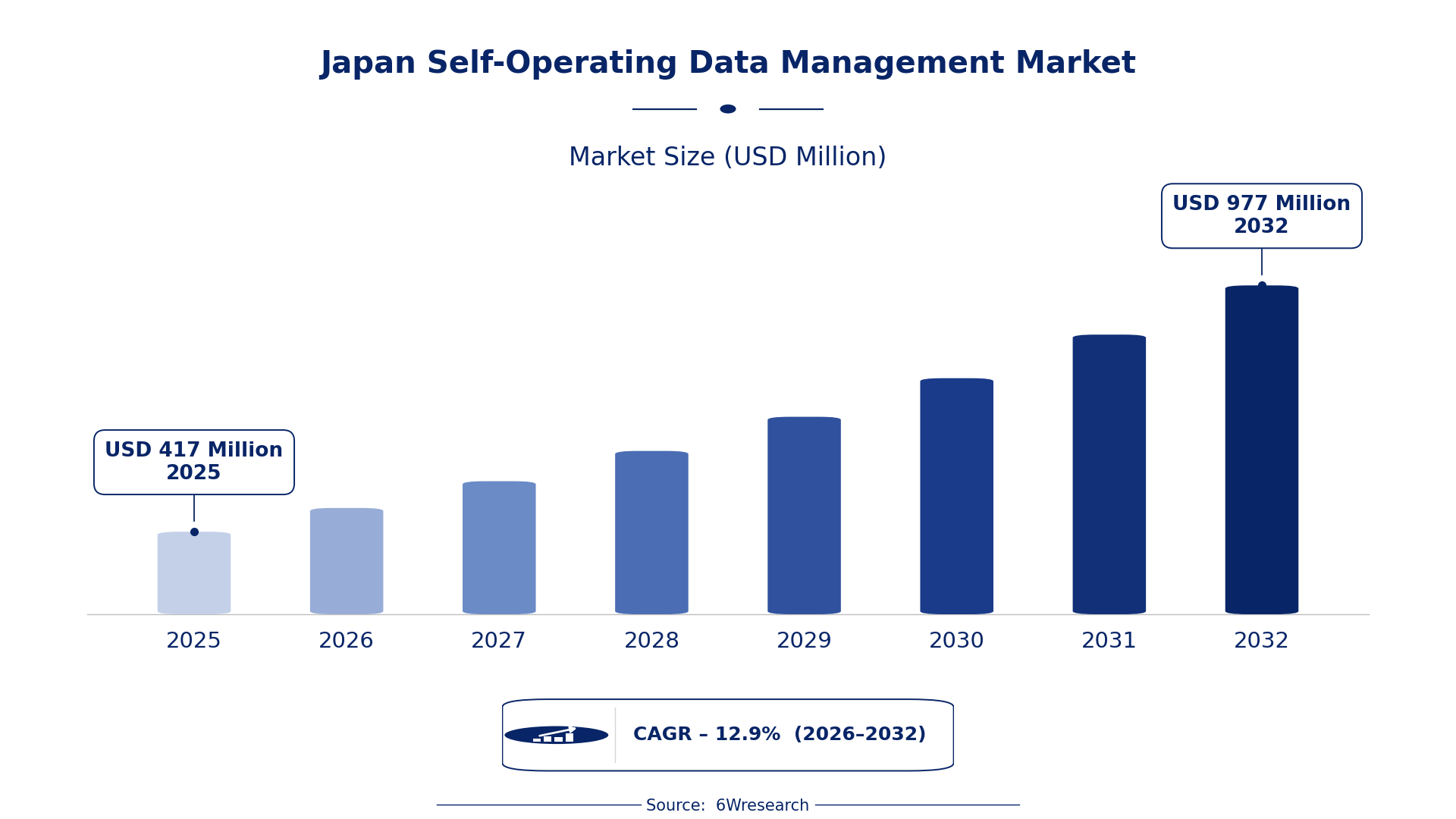
According to 6Wresearch internal database and industry insights, the Japan Self-Operating Data Management Market was valued at USD 417 Million in 2025 and is projected to reach USD 977 Million by 2032, growing at a CAGR of approximately 12.9% during 2026–2032.
Japan Self-Operating Data Management Market Highlights
| Report Metric | Details |
| Report Name | Japan Self-Operating Data Management Market (2026-2032) |
| Market Size 2025 | USD 417 Million |
| Market Size 2032 | USD 977 Million |
| Absolute Growth 2025–2032 | USD 560 Million |
| CAGR 2026–2032 | 12.9% |
| Peak Annual Growth | 15.1% in 2027 |
| Forecast Period | 2026–2032 |
| Historical Data | 2022–2025 |
| Base Year | 2025 |
| Leading Function Type, 2025 | Real-Time Analytics (44% share) |
| Leading Data Type, 2025 | Structured Data (37% share) |
| Leading Deployment Mode, 2025 | Cloud-Based (41% share) |
| Leading End User, 2025 | Enterprise IT (39% share) |
| Fastest-Growing Function Type | AI-Powered Governance (19.9% CAGR) |
| Fastest-Growing Data Type | Unstructured Data (19.0% CAGR) |
| Fastest-Growing Deployment Mode | AI-Optimized Storage (19.3% CAGR) |
| Fastest-Growing End User | Big Data Firms (17.6% CAGR) |
| Growing Sector | Data Management |
| Key End Users | Financial Institutions, Compliance Teams, Big Data Firms, Enterprise IT |
Japan Self-Operating Data Management Market Year-wise Growth Rate and Key Drivers (2022–2032)
This graph illustrates the annual growth rates of the market from 2022 to 2032, highlighting a steady upward trajectory and projected market expansion over the forecast period.
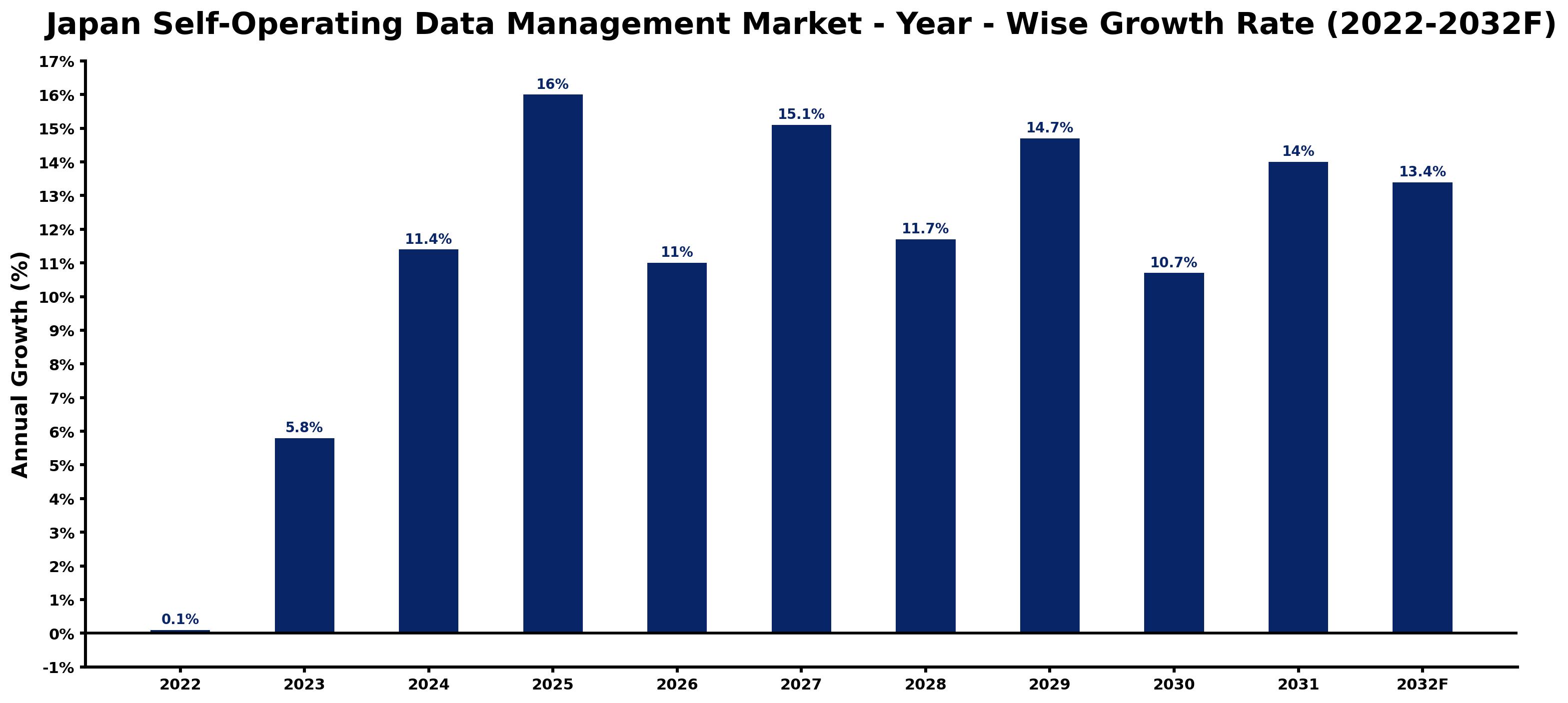
Year by year, the estimates below pair each growth rate with the development that shaped it.
| Year | Estimated Annual Growth (%) | Market Rationale |
| 2022 | 0.1 | The market showed minimal growth as companies began adopting data management systems. |
| 2023 | 5.8 | Growth accelerated as firms recognised the importance of data governance. |
| 2024 | 11.4 | Increased investment in AI technologies drove further adoption of data management solutions. |
| 2025 | 16.0 | A peak in growth occurred as financial institutions rapidly implemented advanced data systems. |
| 2026 | 11.0 | Growth is projected to slow slightly as the market matures and competition intensifies. |
| 2027 | 15.1 | Demand is expected to surge again with the introduction of new AI-powered data management tools. |
| 2028 | 11.7 | The market is anticipated to experience a slowdown as companies focus on optimising existing systems. |
| 2029 | 14.7 | Growth is likely to rebound as big data firms expand their analytics capabilities. |
| 2030 | 10.7 | A slowdown is anticipated as the market stabilises and matures further. |
| 2031 | 14.0 | Demand is expected to increase again as compliance requirements intensify across industries. |
| 2032 | 13.4 | Growth is projected to slow as the market reaches a more mature phase with established players. |
Note: Market size estimations and growth projections presented in this report are based on 6Wresearch's proprietary forecasting methodology, utilizing the latest available industry data, government publications, and primary research inputs.
Japan Self-Operating Data Management Market Synopsis
Self-Operating Data Management automates data handling through advanced algorithms and AI technologies, ensuring compliance and optimising governance. The Japan Self-Operating Data Management Market is projected to reach 1 trillion yen by 2025, driven by the increasing need for efficient data management across industries such as finance and IT. The Tokyo region serves as a key hub for technology development, propelling market growth as firms adopt AI-powered solutions for compliance and operational efficiency.
Market Dynamics Impact Analysis (2026–2032)
| Factor | Type | Impact | Primary Segment Affected |
| Growing adoption of AI technologies in data management | Driver | High | AI-Powered Governance |
| Increasing demand for real-time analytics solutions | Driver | High | Real-Time Analytics |
| Emerging need for efficient data management solutions | Opportunity | High | AI-Optimized Storage |
| Rising importance of compliance in data handling | Opportunity | Medium | AI-Powered Governance |
| Competition among data management providers | Restraint | High | Cloud-Based |
| Challenges in integrating legacy systems with new technologies | Restraint | Medium | Hybrid |
| Limited availability of skilled professionals in data management | Challenge | High | Enterprise IT |
| High costs associated with implementing advanced data solutions | Challenge | Medium | Financial Institutions |
Evaluation of Drivers in Japan Self-Operating Data Management Market (2026–2032)
Key forces behind demand, with the segment each one moves most, are listed below.
| Drivers | Primary Segment Affected | Why It Matters (Evidence) |
| Increased investment in AI technologies | AI-Powered Governance | This investment enhances compliance and data integrity, leading to higher purchases by compliance teams. |
| Growing need for real-time analytics | Real-Time Analytics | Businesses in competitive sectors like finance purchase more analytics tools to support timely decision-making. |
| Expansion of big data firms | Unstructured Data | As big data firms grow, they require more unstructured data solutions for effective analytics. |
| Rising importance of data governance | AI-Powered Governance | Financial institutions are adopting more automated governance tools to ensure regulatory compliance. |
| Increasing cloud adoption for flexibility | Cloud-Based | Over 60% of the market is cloud-based, as enterprises seek scalable solutions. |
Most of the extra volume comes from increased investment in AI technologies, which improves compliance and data integrity for compliance teams. In 2023, the number of big data firms in Japan grew, leading to a higher demand for unstructured data solutions. Real-time analytics is becoming essential, particularly in competitive sectors like finance, where timely decision-making is critical. The Tokyo region, as a major hub for data management firms, supports this growth by encouraging innovation in data handling. Cloud-based solutions account for over 60% of the market, as enterprises seek flexibility and scalability in their data management approaches.
Evaluation of Restraints in Japan Self-Operating Data Management Market
The main factors holding the market back are set out below.
| Market Restraint | Primary Segment Affected | Why It Matters (Evidence) |
| Intense competition among data management providers | Cloud-Based | This competition can lead to pricing pressures, impacting profitability for providers. |
| Integration challenges with legacy systems | Hybrid | Many firms struggle to integrate new solutions with existing systems, delaying implementation. |
| Limited availability of skilled professionals | Enterprise IT | The shortage of qualified personnel can hinder the effective deployment of data management systems. |
| High costs of advanced data solutions | Financial Institutions | These costs can deter smaller firms from adopting necessary technologies. |
| Regulatory compliance requirements | AI-Powered Governance | Stricter regulations increase the complexity and cost of compliance for firms. |
Japan Self-Operating Data Management Market Challenges
Many firms in Japan struggle with compliance to the ISO/IEC 27001 standard, which requires rigorous data security measures. This regulation stems from an increase in data breaches, causing compliance teams to face project delays that can consume up to 20% of their annual budgets. Technology adoption lags as numerous companies rely on outdated systems, resulting in inefficiencies that inflate operational costs by 15% for data management providers. Rising expenses for advanced data solutions limit smaller firms, forcing them to allocate 30% more of their budgets to remain competitive in the market.
Trends in the Japan Self-Operating Data Management Market
The trends below show where the Japan Self-Operating Data Management Market is heading.
- Shift towards AI-Optimized Storage: The trend towards AI-Optimized Storage began in 2023 as firms sought efficient data management solutions. With a projected CAGR of 19.3%, this shift is visible in the increasing number of enterprises adopting AI technologies for data handling.
- Growing focus on real-time analytics: Since 2024, businesses have prioritised real-time analytics to remain competitive. This shift is highlighted by the rising demand for analytics tools, particularly in the finance sector, where timely decision-making is critical.
- Increase in automated governance tools: The adoption of automated governance tools has surged since 2023, driven by the need for compliance. Financial institutions are increasingly investing in these tools to streamline their regulatory processes.
- Expansion of cloud-based solutions: The cloud-based deployment of data management systems has gained momentum since 2022, accounting for over 60% of the market. This trend is particularly strong in the Tokyo region, where flexibility and scalability are highly valued.
Investment Opportunities in the Japan Self-Operating Data Management Market
Where to invest in the Japan Self-Operating Data Management Market: the main openings are set out below.
- Gap in AI-Optimized Storage solutions: With the market projected to grow, there is a gap in AI-Optimized Storage solutions. Big data firms in Tokyo are seeking innovative products to enhance their data management capabilities.
- Demand for real-time analytics tools: The increasing need for real-time analytics presents a significant opportunity. Financial institutions are looking for advanced solutions to improve decision-making processes.
- Investment in automated governance tools: As compliance requirements rise, there is a strong demand for automated governance tools. Compliance teams across Japan are eager to invest in solutions that streamline their processes.
- Expansion of cloud-based service offerings: With cloud-based solutions dominating the market, there is an opportunity to expand service offerings. Enterprises in Japan are actively seeking flexible and scalable data management solutions.
Government Initiatives in the Japan Self-Operating Data Management Market
The AI Promotion Act, established in 2025, is important for buyers of self-operating data management systems, as it creates a national framework for AI research and development. This act encourages firms to adopt AI technologies, improving their data management capabilities and compliance processes. Additionally, the Digital Agency, established in 2021, leads government digital transformation efforts, promoting common system standards that benefit data management practices.
The Digital Agency facilitates the implementation of data management innovations through funding programs. Compliance teams in various sectors can access these funds to adopt advanced data management solutions, ensuring adherence to regulatory requirements. The agency's initiatives aim to improve governance across industries, supporting firms in their digital transformation journeys.
Future Insight of the Japan Self-Operating Data Management Market
By 2032, automation in data management systems will transform demand as the Japanese government's digital transformation initiative accelerates. This shift will enable buyers to implement more efficient governance solutions. Increased funding from the Ministry of Internal Affairs and Communications will drive innovation, allowing suppliers to create new technologies. The growing emphasis on analytics capabilities will help firms quickly respond to industry changes, ensuring they maintain a competitive edge in a fast-paced environment.
Market Segmentation Analysis
Japan Self-Operating Data Management Market report covers a detailed analysis of the following market segments:
By Function Type – Real-Time Analytics Leads, AI-Powered Governance Expected to Grow Fastest
According to Saurav Kr Singh, Senior Research Analyst at 6Wresearch, Real-Time Analytics took 44% of function type revenue in 2025, more than any other category. Real-Time Analytics holds the largest share as it is essential for timely decision-making in industries like finance and retail. For instance, financial institutions rely on real-time analytics to swiftly respond to market changes and regulatory requirements. The quickest growth will come from AI-Powered Governance, forecast to expand at a CAGR of 19.9% between 2026 and 2032. AI-Powered Governance is experiencing rapid growth as compliance teams adopt automated tools to ensure data integrity. The government's digital transformation initiative has intensified the need for effective governance solutions, further driving this segment's expansion. Suppliers must adapt their offerings to align with the increasing demand for automated governance solutions.
By Data Type – Structured Data Leads, Unstructured Data Expected to Grow Fastest
Structured Data held 37% of the Japan Self-Operating Data Management Market by data type in 2025. Structured Data leads the market because it is foundational for traditional databases widely used across various sectors. This segment is critical for organisations that efficiently manage large volumes of data and maintain operational effectiveness. Unstructured Data is projected to grow fastest, at a CAGR of 19.0% during 2026–2032. Unstructured Data is growing swiftly due to the rising diversity of data sources that require advanced management techniques. The increasing focus on big data analytics compels firms to implement solutions that effectively handle unstructured information. Buyers should prioritise technologies capable of processing unstructured data to stay competitive.
By Deployment Mode – Cloud-Based Leads, AI-Optimized Storage Expected to Grow Fastest
Cloud-Based accounted for 41% of the market by deployment mode in 2025. Cloud-Based solutions dominate the market owing to their flexibility and scalability, making them ideal for businesses looking to optimise data management. Over 60% of the market share being attributed to cloud technologies underscores their widespread adoption. AI-Optimized Storage is set to record the highest CAGR in this split, 19.3% over 2026–2032. AI-Optimized Storage is gaining momentum as organisations seek more effective methods for data management. The increasing complexity of data tasks necessitates advanced storage solutions that can utilise the latest technologies effectively. Suppliers should focus on developing AI-optimised storage solutions to seize emerging market opportunities.
By End User – Enterprise IT Leads, Big Data Firms Expected to Grow Fastest
The largest end user category in 2025 was Enterprise IT, at 39% of revenue. Enterprise IT is the leading segment as it is integral to the data management strategies of many organisations. Its strong reliance on data governance and compliance reinforces its dominant position in the market. Over 2026–2032, Big Data Firms are expected to post the fastest growth, at a CAGR of 17.6%. Big Data Firms are experiencing the fastest growth as they are the main users of advanced data management technologies. The escalating volume of generated data necessitates sophisticated solutions tailored to their unique needs. Buyers in the big data sector should seek partnerships with suppliers that provide advanced data management technologies.
Key Attractiveness of the Report
- 10 Years of Market Numbers
- Historical Data Starting from 2022 to 2025
- Base Year 2025
- Forecast Data until 2032
- Key Performance Indicators Impacting the Market
- Major Upcoming Developments and Projects
Key Highlights of the Report:
- Japan Self-Operating Data Management Market Outlook
- Market Size of Japan Self-Operating Data Management Market, 2025
- Forecast of Japan Self-Operating Data Management Market, 2032
- Historical Data and Forecast of Japan Self-Operating Data Management Revenues & Volume for the Period 2022-2032F
- Japan Self-Operating Data Management Market Trend Evolution
- Japan Self-Operating Data Management Market Drivers and Challenges
- Japan Self-Operating Data Management Price Trends
- Japan Self-Operating Data Management Porter's Five Forces
- Japan Self-Operating Data Management Industry Life Cycle
- Historical Data and Forecast of Japan Self-Operating Data Management Market Revenues & Volume By Function Type for the Period 2022-2032F
- Historical Data and Forecast of Japan Self-Operating Data Management Market Revenues & Volume By Automated Backup for the Period 2022-2032F
- Historical Data and Forecast of Japan Self-Operating Data Management Market Revenues & Volume By AI-Powered Governance for the Period 2022-2032F
- Historical Data and Forecast of Japan Self-Operating Data Management Market Revenues & Volume By Real-Time Analytics for the Period 2022-2032F
- Historical Data and Forecast of Japan Self-Operating Data Management Market Revenues & Volume By Autonomous Data Lakes for the Period 2022-2032F
- Historical Data and Forecast of Japan Self-Operating Data Management Market Revenues & Volume By Data Type for the Period 2022-2032F
- Historical Data and Forecast of Japan Self-Operating Data Management Market Revenues & Volume By Structured Data for the Period 2022-2032F
- Historical Data and Forecast of Japan Self-Operating Data Management Market Revenues & Volume By Unstructured Data for the Period 2022-2032F
- Historical Data and Forecast of Japan Self-Operating Data Management Market Revenues & Volume By Transactional Data for the Period 2022-2032F
- Historical Data and Forecast of Japan Self-Operating Data Management Market Revenues & Volume By Multi-Source Data for the Period 2022-2032F
- Historical Data and Forecast of Japan Self-Operating Data Management Market Revenues & Volume By Deployment Mode for the Period 2022-2032F
- Historical Data and Forecast of Japan Self-Operating Data Management Market Revenues & Volume By Cloud-Based for the Period 2022-2032F
- Historical Data and Forecast of Japan Self-Operating Data Management Market Revenues & Volume By Hybrid for the Period 2022-2032F
- Historical Data and Forecast of Japan Self-Operating Data Management Market Revenues & Volume By On-Premise for the Period 2022-2032F
- Historical Data and Forecast of Japan Self-Operating Data Management Market Revenues & Volume By AI-Optimized Storage for the Period 2022-2032F
- Historical Data and Forecast of Japan Self-Operating Data Management Market Revenues & Volume By End User for the Period 2022-2032F
- Historical Data and Forecast of Japan Self-Operating Data Management Market Revenues & Volume By Enterprise IT for the Period 2022-2032F
- Historical Data and Forecast of Japan Self-Operating Data Management Market Revenues & Volume By Compliance Teams for the Period 2022-2032F
- Historical Data and Forecast of Japan Self-Operating Data Management Market Revenues & Volume By Financial Institutions for the Period 2022-2032F
- Historical Data and Forecast of Japan Self-Operating Data Management Market Revenues & Volume By Big Data Firms for the Period 2022-2032F
- Japan Self-Operating Data Management Import Export Trade Statistics
- Market Opportunity Assessment By Function Type
- Market Opportunity Assessment By Data Type
- Market Opportunity Assessment By Deployment Mode
- Market Opportunity Assessment By End User
- Japan Self-Operating Data Management Top Companies Market Share
- Japan Self-Operating Data Management Competitive Benchmarking By Technical and Operational Parameters
- Japan Self-Operating Data Management Company Profiles
- Japan Self-Operating Data Management Key Strategic Recommendations
Market Covered
Segments analysed in this report are listed below.
By Function Type
- Automated Backup
- AI-Powered Governance
- Real-Time Analytics
- Autonomous Data Lakes
By Data Type
- Structured Data
- Unstructured Data
- Transactional Data
- Multi-Source Data
By Deployment Mode
- Cloud-Based
- Hybrid
- On-Premise
- AI-Optimized Storage
By End User
- Enterprise IT
- Compliance Teams
- Financial Institutions
- Big Data Firms































