Japan Self-Propelled Harvesting Equipment Market Size & Growth Rate
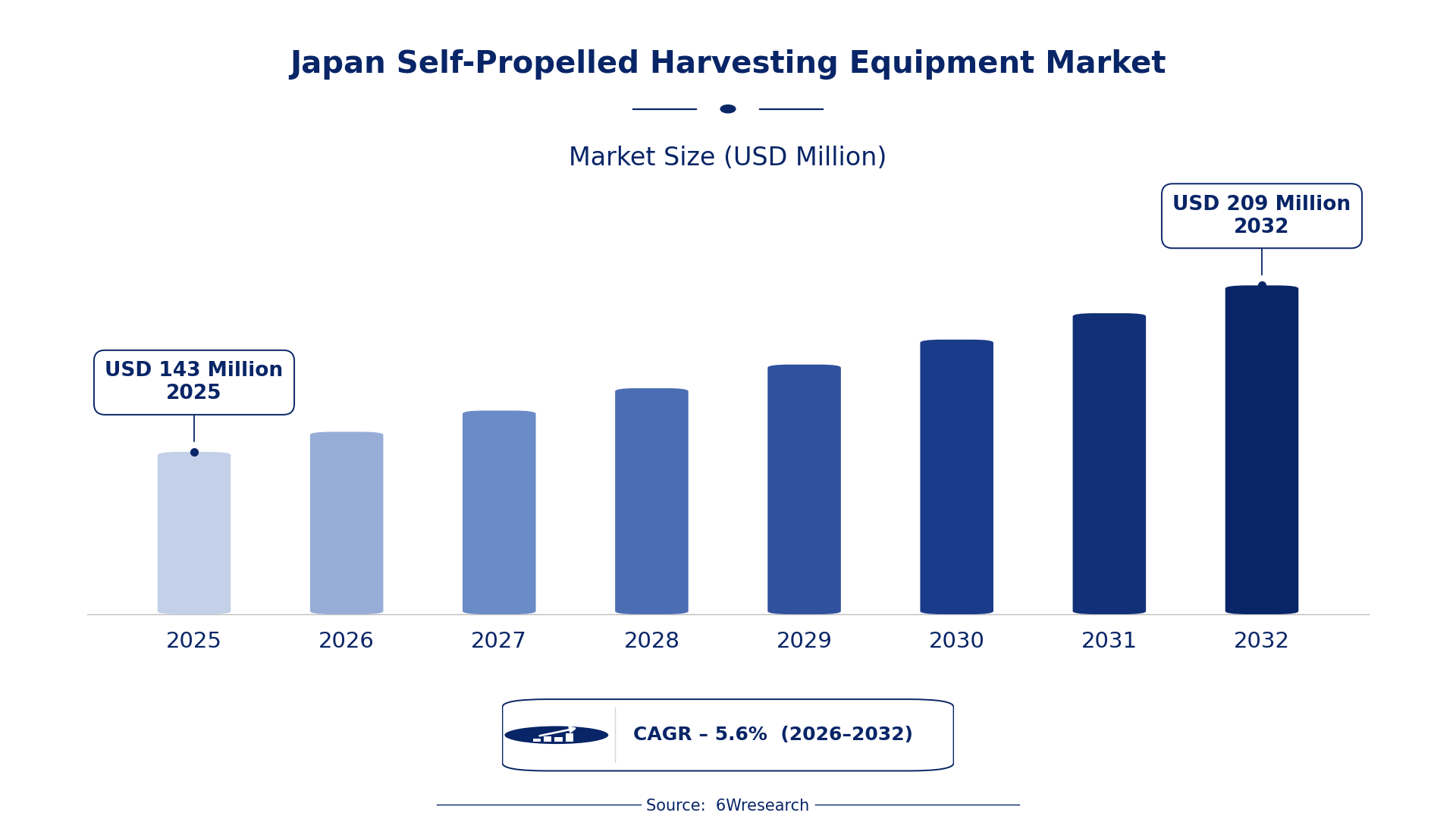
According to 6Wresearch internal database and industry insights, the Japan Self-Propelled Harvesting Equipment Market was valued at USD 143 Million in 2025 and is projected to reach USD 209 Million by 2032, growing at a CAGR of approximately 5.6% during 2026–2032.
Japan Self-Propelled Harvesting Equipment Market Highlights
| Report Metric | Details |
| Report Name | Japan Self-Propelled Harvesting Equipment Market (2026-2032) |
| Market Size 2025 | USD 143 Million |
| Market Size 2032 | USD 209 Million |
| Absolute Growth 2025–2032 | USD 66 Million |
| CAGR 2026–2032 | 5.6% |
| Peak Annual Growth | 6.4% in 2032 |
| Forecast Period | 2026–2032 |
| Historical Data | 2022–2025 |
| Base Year | 2025 |
| Leading Equipment Type, 2025 | Combine Harvesters (42% share) |
| Leading Crop Type, 2025 | Grains (35% share) |
| Leading Fuel Type, 2025 | Diesel (37% share) |
| Leading End User, 2025 | Commercial Farms (42% share) |
| Fastest-Growing Equipment Type | Sugarcane Harvesters (7.9% CAGR) |
| Fastest-Growing Crop Type | Fodder Crops (8.3% CAGR) |
| Fastest-Growing Fuel Type | Hybrid (8.4% CAGR) |
| Fastest-Growing End User | Agro-Cooperatives (7.3% CAGR) |
| Growing Sector | Agro-Cooperatives |
| Key End Users | Commercial Farms, Agro-Cooperatives, Cattle Feed Producers, Textile Crop Farmers |
Japan Self-Propelled Harvesting Equipment Market Year-wise Growth Rate and Key Drivers (2022–2032)
This graph illustrates the annual growth rates of the market from 2022 to 2032, highlighting a steady upward trajectory and projected market expansion over the forecast period.
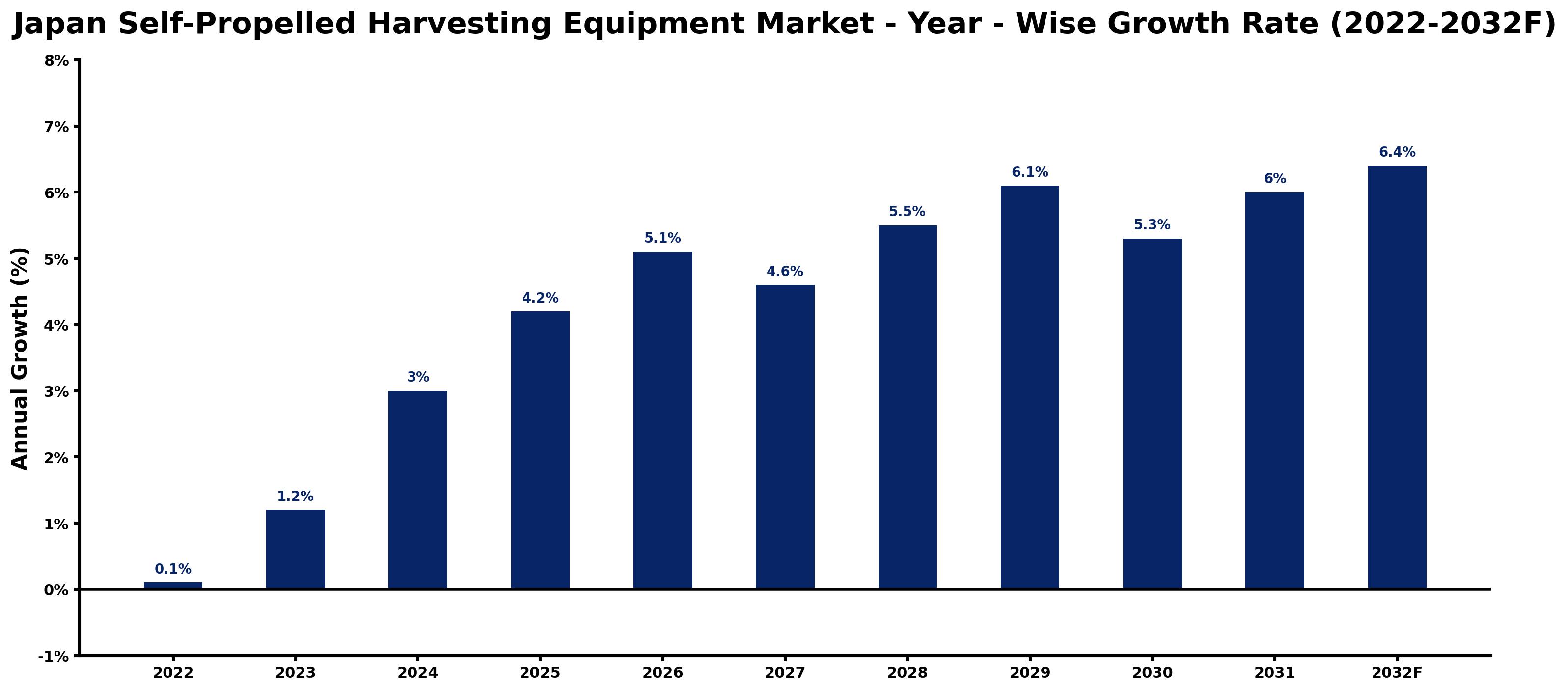
Below, each year's estimated growth is shown next to the factor that most influenced it.
| Year | Estimated Annual Growth (%) | Market Rationale |
| 2022 | 0.1 | The market showed minimal growth due to a stable agricultural environment. |
| 2023 | 1.2 | Increased investment in agricultural technology spurred faster growth compared to the previous year. |
| 2024 | 3.0 | Demand rose as farmers sought efficient harvesting solutions amid rising labour costs. |
| 2025 | 4.2 | The introduction of advanced machinery led to notable growth in the market. |
| 2026 | 5.1 | Growing interest in hybrid technologies is projected to contribute to continued market expansion. |
| 2027 | 4.6 | A slight slowdown is anticipated as market growth stabilises after rapid increases. |
| 2028 | 5.5 | Investment in advanced harvesting solutions is expected to drive growth faster than before. |
| 2029 | 6.1 | The trend towards automation in agriculture will support increased demand for equipment. |
| 2030 | 5.3 | A slowdown is expected as growth rates normalise after peak demand periods. |
| 2031 | 6.0 | The market is likely to rebound with renewed interest in advanced harvesting technologies. |
| 2032 | 6.4 | The peak growth rate is anticipated as the sector embraces new technologies. |
Note: Market size estimations and growth projections presented in this report are based on 6Wresearch's proprietary forecasting methodology, utilizing the latest available industry data, government publications, and primary research inputs.
Japan Self-Propelled Harvesting Equipment Market Synopsis
Self-Propelled Harvesting Equipment refers to machines designed for efficient crop harvesting, powered by diesel or hybrid engines. These advanced machines are primarily used for harvesting grains, sugarcane, cotton, and fodder crops. The Japan Self-Propelled Harvesting Equipment Market is expanding due to rising agricultural investments, particularly in the Kanto region, where commercial farms increasingly adopt advanced harvesting technologies. With over 1 million registered commercial farms, the demand for efficient harvesting solutions continues to rise, supported by government initiatives promoting agricultural modernization and sustainability.
Market Dynamics Impact Analysis (2026–2032)
| Factor | Type | Impact | Primary Segment Affected |
| Rising agricultural investments | Driver | High | Combine Harvesters |
| Technological advancements in harvesting equipment | Driver | High | Sugarcane Harvesters |
| Growing demand for efficient harvesting solutions | Opportunity | High | Commercial Farms |
| Increased interest in hybrid harvesting technologies | Opportunity | Medium | Agro-Cooperatives |
| High average age of farmers | Restraint | High | Cotton Pickers |
| Limited adoption of biofuels in machinery | Restraint | Medium | Forage Harvesters |
| High operational costs for farmers | Challenge | High | Grains |
| Difficulty in accessing advanced technology | Challenge | Medium | Sugarcane Harvesters |
Evaluation of Drivers in Japan Self-Propelled Harvesting Equipment Market (2026–2032)
These are the developments adding the most demand over the forecast period.
| Drivers | Primary Segment Affected | Why It Matters (Evidence) |
| Increased investment in agricultural technology | Commercial Farms | Investment in advanced machinery boosts productivity, resulting in higher purchases of self-propelled harvesting equipment. |
| Technological advancements in harvesting equipment | Forage Harvesters | Innovations improve efficiency, prompting farmers to upgrade their machinery and increasing sales. |
| Rising labour costs | Sugarcane Harvesters | Farmers seek to reduce reliance on manual labour, which drives demand for automated harvesting solutions. |
| Government support for agricultural modernization | Cotton Pickers | Funding initiatives encourage farmers to adopt modern equipment, which boosts sales in the sector. |
| Growing awareness of sustainability | Hybrid | Farmers are increasingly investing in eco-friendly harvesting options, resulting in higher demand for hybrid technologies. |
The strongest pull on demand comes from increased investment in agricultural technology, with over 1 million registered commercial farms in Japan seeking efficient solutions. In 2023, ¥50 billion was allocated for agricultural modernization, prompting farmers to upgrade their machinery. Rising labour costs have also led to a push for automated solutions, especially in the Kanto region. Innovations in harvesting equipment have improved operational efficiency, encouraging farmers to purchase new models. Consequently, the market for self-propelled harvesting equipment is expanding rapidly, particularly for combine and sugarcane harvesters.
Evaluation of Restraints in Japan Self-Propelled Harvesting Equipment Market
The table below lists the restraints and the evidence behind each.
| Market Restraint | Primary Segment Affected | Why It Matters (Evidence) |
| High operational costs for farmers | Grains | Increased costs limit the ability of farmers to invest in new harvesting equipment, affecting overall market growth. |
| Limited adoption of biofuels in machinery | Forage Harvesters | The slow uptake of biofuel technology restricts options for sustainable harvesting solutions, impacting demand. |
| Aging farmer population | Cotton Pickers | The average age of farmers in Japan exceeds 67 years, leading to a potential labour shortage and reduced equipment purchases. |
| Insufficient access to advanced technology | Sugarcane Harvesters | Many farmers lack the resources to invest in the latest equipment, which restricts market expansion. |
| Complexity of machinery operation | Combine Harvesters | The need for skilled operators can deter farmers from purchasing advanced harvesting equipment. |
Japan Self-Propelled Harvesting Equipment Market Challenges
Strict regulatory standards complicate compliance for manufacturers, leading to delays that can extend product availability by up to six months for suppliers. Local producers face intense competition from imported equipment, forcing them to lower prices and risking profit margins, which can stifle innovation efforts. Rising production costs, driven by Japan's minimum wage increase to JPY 1,055 per hour, exert pressure on buyers, particularly smaller farms that struggle to invest in new technology. An aging farmer population, with an average age exceeding 67 years, limits the workforce's ability to adopt modern harvesting solutions, creating inefficiencies for buyers.
Trends in the Japan Self-Propelled Harvesting Equipment Market
Several trends are reshaping the Japan Self-Propelled Harvesting Equipment Market; the most important are set out below.
- Shift towards Hybrid Technologies: The Japanese agricultural sector is increasingly embracing hybrid harvesting technologies, with a projected growth rate of 8.4% for hybrids by 2032. This shift is driven by the need for efficiency and sustainability in farming practices.
- Increased Automation in Farming: Commercial farms are prioritising automation, resulting in a surge in demand for self-propelled harvesting equipment. In 2023, ¥50 billion was allocated for agricultural modernisation, supporting this trend.
- Focus on Sustainable Practices: The year 2025 marked a shift towards sustainable harvesting practices, with the government encouraging the use of biofuels in agricultural machinery. This initiative aims to reduce carbon emissions by 30% by 2030.
- Expansion of Agricultural Modernisation Initiatives: In 2023, the Japanese government launched various agricultural modernisation initiatives, allocating ¥50 billion to enhance farming efficiency. This funding is expected to drive demand for advanced harvesting equipment.
Investment Opportunities in the Japan Self-Propelled Harvesting Equipment Market
The following opportunities in the Japan Self-Propelled Harvesting Equipment Market pair current demand with a clear way in.
- Investment in Hybrid Harvesting Equipment: With the projected growth of hybrid technologies at 8.4%, there is an opportunity for suppliers to invest in hybrid harvesting equipment. Agro-cooperatives are actively seeking efficient solutions to modernise their operations.
- Supply of Advanced Combine Harvesters: As demand for combine harvesters rises, suppliers can capitalise on this trend by offering advanced models. The Kanto region's commercial farms are increasingly in need of efficient harvesting solutions.
- Development of Sustainable Harvesting Solutions: Given the push for sustainability, there is an opportunity to develop and supply biofuel-compatible harvesting equipment. This aligns with government initiatives aimed at reducing carbon emissions in agriculture.
- Expansion into Forage Harvesters Market: The Tohoku region has a growing demand for forage harvesters, presenting an opportunity for suppliers to enter this market. Collaborating with local agro-cooperatives can facilitate market entry.
Government Initiatives in the Japan Self-Propelled Harvesting Equipment Market
The Industrial Standardization Act, amended in 2019, governs the standards for agricultural machinery in Japan. This law ensures that manufacturers adhere to quality and safety regulations, impacting the production of self-propelled harvesting equipment. The GX Basic Policy, adopted in 2023, aims for substantial public-private investment in decarbonisation, encouraging the adoption of sustainable technologies in agriculture.
The Ministry of Agriculture, Forestry and Fisheries oversees the approval of agricultural machinery standards and funds modernisation initiatives. In 2023, the ministry allocated ¥50 billion to support the adoption of advanced harvesting technologies, benefiting producers and buyers in the agricultural sector.
Future Insight of the Japan Self-Propelled Harvesting Equipment Market
The introduction of electric-diesel hybrid harvesting equipment will reshape the market by 2032, supporting a 30% reduction in carbon emissions. Government initiatives aimed at agricultural modernisation will stimulate advancements in harvesting technologies. The growing emphasis on biofuels will align with environmental objectives, encouraging suppliers to innovate. Developments showcased at the annual Agricultural Machinery Expo will ensure buyers have access to efficient equipment that meets evolving standards and improves productivity.
Market Segmentation Analysis
Japan Self-Propelled Harvesting Equipment Market report covers a detailed analysis of the following market segments:
By Equipment Type – Combine Harvesters Lead, Sugarcane Harvesters Expected to Grow Fastest
According to Saurav Kr Singh, Senior Research Analyst at 6Wresearch, Combine Harvesters held 42% of the Japan Self-Propelled Harvesting Equipment Market by equipment type in 2025. Combine harvesters dominate the market as they are essential for efficient grain harvesting, especially in the Kanto region known for its significant grain production. Their widespread adoption among Japan's commercial farms illustrates their critical role in agricultural productivity. Sugarcane Harvesters are set to record the highest CAGR in this split, 7.9% over 2026–2032. The surge in sugarcane harvesters is driven by Japan's production of around 8 million tons of sugarcane in 2023, necessitating specialised harvesting equipment. This segment's growth is expected to continue as sugarcane cultivation expands further. Suppliers must enhance sugarcane harvester features to cater to the increasing demand in this segment.
By Crop Type – Grains Lead, Fodder Crops Expected to Grow Fastest
In 2025, Grains led the crop type split with a 35% share. Grains are the leading crop harvested by self-propelled equipment, highlighting their essential role in Japan's agricultural landscape. The extensive grain cultivation across various regions reinforces their significance for commercial farming operations. Fodder Crops are projected to grow fastest, at a CAGR of 8.3% during 2026–2032. Fodder crops are experiencing rapid growth due to rising demands from livestock farming, which requires efficient harvesting techniques. This trend is particularly pronounced in regions with substantial livestock operations, increasing the need for specialised harvesting equipment. Buyers should consider investing in advanced harvesting solutions tailored for fodder crops to meet the growing demand.
By Fuel Type – Diesel Leads, Hybrid Expected to Grow Fastest
Diesel accounted for 37% of the market by fuel type in 2025. Diesel remains the most common fuel type for self-propelled harvesting equipment, primarily due to its reliability and efficiency in agricultural applications. The established infrastructure for diesel refuelling supports its continued dominance in the market. Over 2026–2032, Hybrid is expected to post the fastest growth, at a CAGR of 8.4%. Hybrid fuel types are gaining traction as farmers seek more efficient and environmentally friendly options, driven by government initiatives promoting hybrid technologies. This shift is expected to accelerate as the market adapts to evolving energy standards. Suppliers must adapt their product offerings to include hybrid options to meet the changing preferences of buyers.
By End User – Commercial Farms Lead, Agro-Cooperatives Expected to Grow Fastest
The largest end user category in 2025 was Commercial Farms, at 42% of revenue. Commercial farms represent the largest end-user segment, utilising self-propelled harvesting equipment to boost productivity across their operations. With over 1 million registered commercial farms in Japan, their considerable demand for efficient machinery is evident. The quickest growth will come from Agro-Cooperatives, forecast to expand at a CAGR of 7.3% between 2026 and 2032. Agro-cooperatives are rapidly expanding as they facilitate collective farming efforts, resulting in increased demand for advanced harvesting solutions. This trend towards collaborative agriculture is becoming increasingly important in Japan. Suppliers should concentrate on providing customised solutions to agro-cooperatives to enhance collective farming efficiency.
Key Attractiveness of the Report
- 10 Years of Market Numbers
- Historical Data Starting from 2022 to 2025
- Base Year 2025
- Forecast Data until 2032
- Key Performance Indicators Impacting the Market
- Major Upcoming Developments and Projects
Key Highlights of the Report:
- Japan Self-Propelled Harvesting Equipment Market Outlook
- Market Size of Japan Self-Propelled Harvesting Equipment Market, 2025
- Forecast of Japan Self-Propelled Harvesting Equipment Market, 2032
- Historical Data and Forecast of Japan Self-Propelled Harvesting Equipment Revenues & Volume for the Period 2022-2032F
- Japan Self-Propelled Harvesting Equipment Market Trend Evolution
- Japan Self-Propelled Harvesting Equipment Market Drivers and Challenges
- Japan Self-Propelled Harvesting Equipment Price Trends
- Japan Self-Propelled Harvesting Equipment Porter's Five Forces
- Japan Self-Propelled Harvesting Equipment Industry Life Cycle
- Historical Data and Forecast of Japan Self-Propelled Harvesting Equipment Market Revenues & Volume By Equipment Type for the Period 2022-2032F
- Historical Data and Forecast of Japan Self-Propelled Harvesting Equipment Market Revenues & Volume By Combine Harvesters for the Period 2022-2032F
- Historical Data and Forecast of Japan Self-Propelled Harvesting Equipment Market Revenues & Volume By Sugarcane Harvesters for the Period 2022-2032F
- Historical Data and Forecast of Japan Self-Propelled Harvesting Equipment Market Revenues & Volume By Cotton Pickers for the Period 2022-2032F
- Historical Data and Forecast of Japan Self-Propelled Harvesting Equipment Market Revenues & Volume By Forage Harvesters for the Period 2022-2032F
- Historical Data and Forecast of Japan Self-Propelled Harvesting Equipment Market Revenues & Volume By Crop Type for the Period 2022-2032F
- Historical Data and Forecast of Japan Self-Propelled Harvesting Equipment Market Revenues & Volume By Grains for the Period 2022-2032F
- Historical Data and Forecast of Japan Self-Propelled Harvesting Equipment Market Revenues & Volume By Sugarcane for the Period 2022-2032F
- Historical Data and Forecast of Japan Self-Propelled Harvesting Equipment Market Revenues & Volume By Cotton for the Period 2022-2032F
- Historical Data and Forecast of Japan Self-Propelled Harvesting Equipment Market Revenues & Volume By Fodder Crops for the Period 2022-2032F
- Historical Data and Forecast of Japan Self-Propelled Harvesting Equipment Market Revenues & Volume By Fuel Type for the Period 2022-2032F
- Historical Data and Forecast of Japan Self-Propelled Harvesting Equipment Market Revenues & Volume By Diesel for the Period 2022-2032F
- Historical Data and Forecast of Japan Self-Propelled Harvesting Equipment Market Revenues & Volume By Hybrid for the Period 2022-2032F
- Historical Data and Forecast of Japan Self-Propelled Harvesting Equipment Market Revenues & Volume By Electric-Diesel for the Period 2022-2032F
- Historical Data and Forecast of Japan Self-Propelled Harvesting Equipment Market Revenues & Volume By Biofuel for the Period 2022-2032F
- Historical Data and Forecast of Japan Self-Propelled Harvesting Equipment Market Revenues & Volume By End User for the Period 2022-2032F
- Historical Data and Forecast of Japan Self-Propelled Harvesting Equipment Market Revenues & Volume By Commercial Farms for the Period 2022-2032F
- Historical Data and Forecast of Japan Self-Propelled Harvesting Equipment Market Revenues & Volume By Agro-Cooperatives for the Period 2022-2032F
- Historical Data and Forecast of Japan Self-Propelled Harvesting Equipment Market Revenues & Volume By Textile Crop Farmers for the Period 2022-2032F
- Historical Data and Forecast of Japan Self-Propelled Harvesting Equipment Market Revenues & Volume By Cattle Feed Producers for the Period 2022-2032F
- Japan Self-Propelled Harvesting Equipment Import Export Trade Statistics
- Market Opportunity Assessment By Equipment Type
- Market Opportunity Assessment By Crop Type
- Market Opportunity Assessment By Fuel Type
- Market Opportunity Assessment By End User
- Japan Self-Propelled Harvesting Equipment Top Companies Market Share
- Japan Self-Propelled Harvesting Equipment Competitive Benchmarking By Technical and Operational Parameters
- Japan Self-Propelled Harvesting Equipment Company Profiles
- Japan Self-Propelled Harvesting Equipment Key Strategic Recommendations
Market Covered
Segments analysed in this report are listed below.
By Equipment Type
- Combine Harvesters
- Sugarcane Harvesters
- Cotton Pickers
- Forage Harvesters
By Crop Type
- Grains
- Sugarcane
- Cotton
- Fodder Crops
By Fuel Type
- Diesel
- Hybrid
- Electric-Diesel
- Biofuel
By End User
- Commercial Farms
- Agro-Cooperatives
- Textile Crop Farmers
- Cattle Feed Producers































