Japan Self-Service Laundry Systems Market Size & Growth Rate
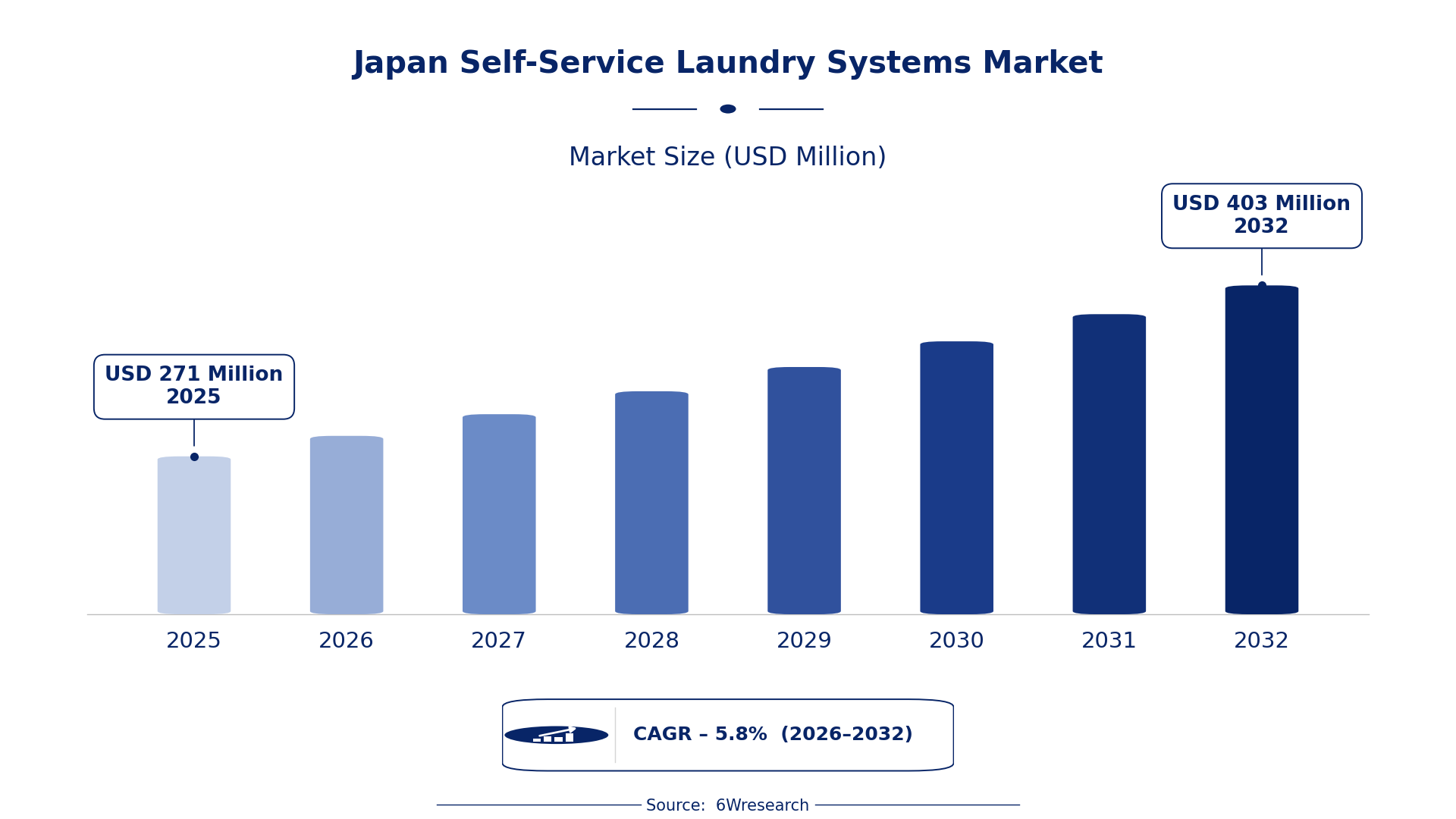
According to 6Wresearch internal database and industry insights, the Japan Self-Service Laundry Systems Market was valued at USD 271 Million in 2025 and is projected to reach USD 403 Million by 2032, growing at a CAGR of approximately 5.8% during 2026–2032.
Japan Self-Service Laundry Systems Market Highlights
| Report Metric | Details |
| Report Name | Japan Self-Service Laundry Systems Market (2026-2032) |
| Market Size 2025 | USD 271 Million |
| Market Size 2032 | USD 403 Million |
| Absolute Growth 2025–2032 | USD 132 Million |
| CAGR 2026–2032 | 5.8% |
| Peak Annual Growth | 7.0% in 2032 |
| Forecast Period | 2026–2032 |
| Historical Data | 2022–2025 |
| Base Year | 2025 |
| Leading System Type, 2025 | Coin-Operated Washers (39% share) |
| Leading Operation Type, 2025 | Manual Start (38% share) |
| Leading Payment Mode, 2025 | Coin/Card (37% share) |
| Leading End User, 2025 | Urban Laundromats (46% share) |
| Fastest-Growing System Type | Smart Wash Stations (8.5% CAGR) |
| Fastest-Growing Operation Type | App-Controlled (8.2% CAGR) |
| Fastest-Growing Payment Mode | UPI/Wallet (7.9% CAGR) |
| Fastest-Growing End User | Student Hostels (7.7% CAGR) |
| Growing Sector | Urban Laundromats |
| Key End Users | Urban Laundromats, Student Hostels, Residential Complexes |
Japan Self-Service Laundry Systems Market Year-wise Growth Rate and Key Drivers (2022–2032)
This graph illustrates the annual growth rates of the market from 2022 to 2032, highlighting a steady upward trajectory and projected market expansion over the forecast period.
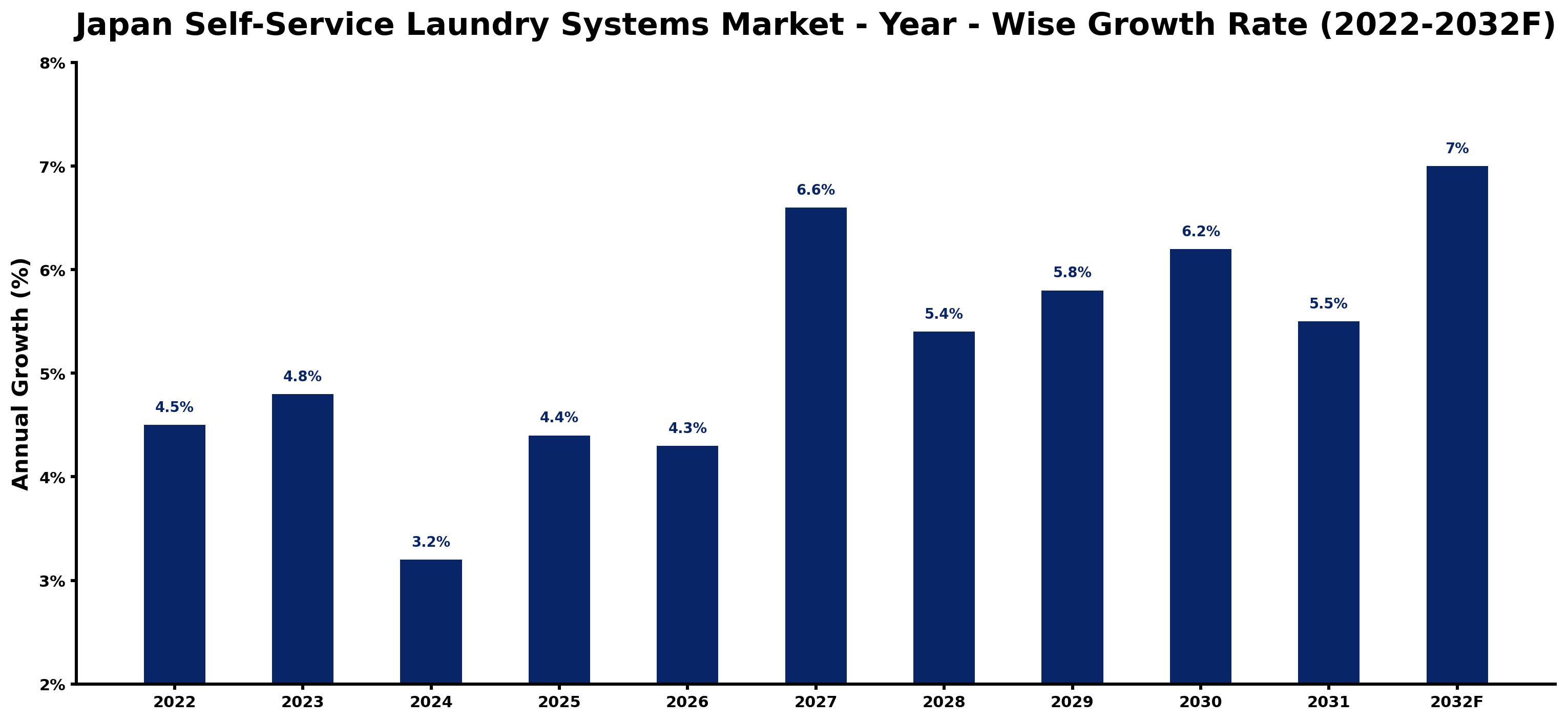
The table below sets out the estimated growth rate for each year and the main factor behind it.
| Year | Estimated Annual Growth (%) | Market Rationale |
| 2022 | 4.5 | The market was characterised by steady demand from urban laundromats and residential complexes. |
| 2023 | 4.8 | Growth accelerated due to increased adoption of smart wash stations in urban areas. |
| 2024 | 3.2 | A slowdown occurred as the market adjusted to saturation in some urban locations. |
| 2025 | 4.4 | Demand picked up again, driven by rising installations in urban laundromats. |
| 2026 | 4.3 | Growth is expected to slow as market maturation begins for certain segments. |
| 2027 | 6.6 | A surge in demand is projected, particularly for app-controlled systems. |
| 2028 | 5.4 | Growth is anticipated to decelerate slightly as competition intensifies among service providers. |
| 2029 | 5.8 | Demand is expected to rise again, supported by the increasing popularity of contactless payments. |
| 2030 | 6.2 | Continued growth will be driven by technological advancements in laundry systems. |
| 2031 | 5.5 | A slowdown is likely as the market stabilises after rapid growth. |
| 2032 | 7.0 | The market is projected to peak, driven by heightened demand for fully automated units. |
Note: Market size estimations and growth projections presented in this report are based on 6Wresearch's proprietary forecasting methodology, utilizing the latest available industry data, government publications, and primary research inputs.
Japan Self-Service Laundry Systems Market Synopsis
Self-Service Laundry Systems provide automated solutions for washing and drying clothes, primarily serving urban laundromats, student hostels, and residential complexes. The Japan Self-Service Laundry Systems Market is expanding due to urbanisation and busy lifestyles, with over 20,000 laundromats across the country. Key drivers include the rising adoption of smart wash stations and a growing demand for energy-efficient appliances, both supported by government initiatives.
Market Dynamics Impact Analysis (2026–2032)
| Factor | Type | Impact | Primary Segment Affected |
| Urbanisation and busy lifestyles drive demand for convenient laundry solutions. | Driver | High | Urban Laundromats |
| The trend towards app-controlled systems is gaining traction among users. | Driver | High | App-Controlled |
| Growing urban housing trends create opportunities for residential laundry services. | Opportunity | High | Residential Complexes |
| Increasing demand for energy-efficient appliances opens new market avenues. | Opportunity | Medium | Smart Wash Stations |
| Market saturation in urban areas limits growth potential for new laundromats. | Restraint | High | Urban Laundromats |
| High initial investment costs for fully automated units deter some buyers. | Restraint | Medium | Fully Automated Units |
| Competition among service providers can lead to price wars affecting margins. | Challenge | High | Urban Laundromats |
| Technological advancements require continuous investment, straining budgets. | Challenge | Medium | Smart Wash Stations |
Evaluation of Drivers in Japan Self-Service Laundry Systems Market (2026–2032)
The main growth drivers and the segments they affect most are set out below.
| Drivers | Primary Segment Affected | Why It Matters (Evidence) |
| Increasing urban population drives demand for self-service laundry. | Urban Laundromats | With an average population of 10,000 served by each laundromat, demand for services rises. |
| Smart wash stations improve user convenience and efficiency. | Smart Wash Stations | The 20% penetration rate in student hostels indicates growing acceptance among users. |
| Rising adoption of contactless payments improves customer experience. | Contactless NFC | The 40% increase in contactless payment options since 2022 reflects changing consumer preferences. |
| Energy efficiency initiatives support modernisation of laundry facilities. | Coin-Operated Washers | The government's 2023 programme promotes energy-efficient appliances, encouraging upgrades. |
| Technological advancements lead to more efficient laundry systems. | Fully Automated Units | The average cost of ¥1,000,000 for fully automated units reflects their growing demand. |
A wider customer base explains much of the growth, as urbanisation increases the number of laundromats serving populations of around 10,000. The rising adoption of smart wash stations, particularly in student hostels, is reflected in a penetration rate of 20%. The surge in contactless payment options, which increased significantly since 2022, shows changing consumer preferences. Technological advancements continue to shape the market, leading to increased efficiency and customer satisfaction.
Evaluation of Restraints in Japan Self-Service Laundry Systems Market
The main factors holding the market back are set out below.
| Market Restraint | Primary Segment Affected | Why It Matters (Evidence) |
| Market saturation in urban areas limits new laundromat openings. | Urban Laundromats | With over 20,000 laundromats, the market faces challenges in finding new locations. |
| High initial investment costs deter some potential buyers. | Fully Automated Units | The average cost of ¥1,000,000 for fully automated units can be prohibitive. |
| Intense competition can erode profit margins. | Urban Laundromats | Competition among service providers leads to price wars, affecting sustainability. |
| Technological advancements require continuous investment. | Smart Wash Stations | Upgrading to the latest technology strains budgets for operators, limiting expansion. |
| Consumer preference for cashless transactions may exclude some users. | Coin/Card | As cashless options grow, traditional payment methods may decline in usage. |
Japan Self-Service Laundry Systems Market Challenges
Over 20,000 laundromats operate in Japan, yet many face supply chain disruptions, delaying essential parts for new machines. This issue arises from a reliance on a limited number of suppliers, increasing operational costs for laundromat owners. Intense competition in urban areas like Tokyo and Osaka forces operators to reduce prices, with 60% of installations being coin-operated washers, which diminishes profit margins. Rising expenses for buyers stem from the demand for energy-efficient appliances, as fully automated units average ¥1,000,000, making them less affordable for residential complexes. A lack of skilled technicians hampers the adoption of advanced technologies, restricting service upgrades and affecting customer satisfaction.
Trends in the Japan Self-Service Laundry Systems Market
Below are the shifts with the largest effect on the Japan Self-Service Laundry Systems Market.
- Shift to Smart Wash Stations in Student Hostels: Student hostels are increasingly adopting smart wash stations, with a penetration rate of 20% as of 2023. This shift reflects a growing need for convenience and efficiency among younger users.
- Rise of Contactless Payment Options: Contactless payment options have surged by 40% in laundromats since 2022, indicating a shift towards more convenient transaction methods. This trend is reshaping how customers interact with laundry services.
- Increased Focus on Energy Efficiency: The 2023 government programme promoting energy-efficient appliances is driving laundromats to modernise. This initiative aligns with broader sustainability goals and is projected to improve operational effectiveness.
- Growing Demand for Fully Automated Units: The average cost of fully automated units is approximately ¥1,000,000, reflecting a rising need for advanced laundry solutions. This trend is particularly evident in commercial settings where efficiency is paramount.
Investment Opportunities in the Japan Self-Service Laundry Systems Market
The opportunities below stand out in the Japan Self-Service Laundry Systems Market for new entrants and existing suppliers.
- Partner with Local Laundromats for Smart Solutions: Local laundromats are increasingly seeking smart wash stations, with a projected 30% increase in installations by 2025. Collaborating with them can fill the demand gap for advanced systems.
- Supply Energy-Efficient Appliances to Laundromats: The government's 2023 programme supports energy-efficient appliances, creating a market opportunity. Suppliers can engage with urban laundromats looking to modernise their facilities.
- Invest in App-Controlled Laundry Systems: The demand for app-controlled systems is expected to rise by 2025, driven by convenience. Targeting urban laundromats can yield substantial returns.
- Explore UPI/Wallet Payment Solutions: UPI/Wallet payment options are growing rapidly, with a significant increase since 2022. Suppliers can tap into this trend by offering compatible solutions to laundromats.
Government Initiatives in the Japan Self-Service Laundry Systems Market
The Green Growth Strategy Through Achieving Carbon Neutrality in 2050, updated in 2021, impacts self-service laundry systems by encouraging the adoption of energy-efficient appliances. This strategy aims to reduce carbon emissions in laundromats, leading to increased investments in modern equipment. The Ministry of Economy, Trade and Industry supports initiatives that promote these energy-efficient solutions, fostering a more sustainable laundry sector in Japan. As a result, laundromat owners are incentivised to upgrade their systems to meet environmental standards, enhancing their competitiveness.
In 2023, the Japanese government launched a programme to promote energy-efficient appliances in laundromats, with a funding allocation of ¥5 billion. The Ministry of Economy, Trade and Industry oversees this initiative, which aims to modernise facilities and reduce energy consumption. This funding supports the acquisition of advanced laundry systems, enabling operators to improve service quality and efficiency. Compliance with ISO 14001 certification is also encouraged, ensuring that self-service laundry providers meet environmental management standards.
Future Insight of the Japan Self-Service Laundry Systems Market
The introduction of app-controlled systems will transform demand for self-service laundry solutions, driven by urbanisation trends. By 2032, the integration of load sensing technology in new machines will enhance operational efficiency and attract environmentally conscious buyers. Urban laundromats are projected to see a 30% increase in installations by 2025, indicating growth opportunities for suppliers. Contactless payment options will continue to streamline transactions, appealing to tech-savvy customers and improving user experience.
Market Segmentation Analysis
Japan Self-Service Laundry Systems Market report covers a detailed analysis of the following market segments:
By System Type – Coin-Operated Washers Lead, Smart Wash Stations Expected to Grow Fastest
According to Saurav Kr Singh, Senior Research Analyst at 6Wresearch, the largest system type category in 2025 was Coin-Operated Washers, at 39% of revenue. Coin-operated washers lead the market due to their widespread use in laundromats, which cater to various customers seeking cash payment options. This system type effectively meets the high demand for convenient laundry services, particularly in urban areas where laundromats are prevalent. Smart Wash Stations are projected to grow fastest, at a CAGR of 8.5% during 2026–2032. Smart wash stations are rapidly gaining popularity, particularly in student hostels, where their advanced features greatly enhance user convenience. The growing trend towards app-controlled systems and increased contactless payment options is driving this segment's impressive growth. Suppliers should invest in developing smart technologies to meet the rising demand for modern laundry solutions.
By Operation Type – Manual Start Leads, App-Controlled Expected to Grow Fastest
Manual Start took 38% of operation type revenue in 2025, more than any other category. Manual start systems remain prevalent despite a shift towards automation, as they are still found in many existing laundromats. Their simplicity appeals to users who prefer straightforward operation without the need for technology. App-Controlled is set to record the highest CAGR in this split, 8.2% over 2026–2032. App-controlled systems are becoming increasingly popular as they offer users greater convenience and flexibility, particularly among younger demographics. This trend is expected to continue as more facilities adopt modern technologies to attract customers. Buyers should consider upgrading to app-controlled systems to stay competitive and meet evolving consumer preferences.
By Payment Mode – Coin/Card Leads, UPI/Wallet Expected to Grow Fastest
With 37% of payment mode revenue in 2025, Coin/Card was the largest category. Coin and card payments are the most common methods in laundromats, providing a familiar and accessible option for users. This payment mode caters to a broad demographic, ensuring ease of use for both locals and visitors. The quickest growth will come from UPI/Wallet, forecast to expand at a CAGR of 7.9% between 2026 and 2032. UPI and wallet payments are rapidly gaining traction as more customers prefer cashless transactions for convenience. The 40% increase in contactless payment options highlights a shift towards digital solutions in the laundry sector. Suppliers need to integrate advanced payment solutions to align with consumer preferences for cashless transactions.
By End User – Urban Laundromats Lead, Student Hostels Expected to Grow Fastest
Urban Laundromats held 46% of the Japan Self-Service Laundry Systems Market by end user in 2025. Urban laundromats hold the largest share as they serve densely populated areas with a steady need for self-service laundry solutions. With an average of 10,000 people served per laundromat, they are essential for urban living and convenience. Over 2026–2032, Student Hostels are expected to post the fastest growth, at a CAGR of 7.7%. Student hostels are experiencing significant growth in adopting self-service laundry systems, fuelled by the increasing number of students requiring accessible laundry facilities. The current 20% penetration rate indicates substantial opportunities for further expansion in this segment. Suppliers must target student hostels to capitalise on the growing demand for self-service laundry services in educational environments.
Key Attractiveness of the Report
- 10 Years of Market Numbers
- Historical Data Starting from 2022 to 2025
- Base Year 2025
- Forecast Data until 2032
- Key Performance Indicators Impacting the Market
- Major Upcoming Developments and Projects
Key Highlights of the Report:
- Japan Self-Service Laundry Systems Market Outlook
- Market Size of Japan Self-Service Laundry Systems Market, 2025
- Forecast of Japan Self-Service Laundry Systems Market, 2032
- Historical Data and Forecast of Japan Self-Service Laundry Systems Revenues & Volume for the Period 2022-2032F
- Japan Self-Service Laundry Systems Market Trend Evolution
- Japan Self-Service Laundry Systems Market Drivers and Challenges
- Japan Self-Service Laundry Systems Price Trends
- Japan Self-Service Laundry Systems Porter's Five Forces
- Japan Self-Service Laundry Systems Industry Life Cycle
- Historical Data and Forecast of Japan Self-Service Laundry Systems Market Revenues & Volume By System Type for the Period 2022-2032F
- Historical Data and Forecast of Japan Self-Service Laundry Systems Market Revenues & Volume By Coin-Operated Washers for the Period 2022-2032F
- Historical Data and Forecast of Japan Self-Service Laundry Systems Market Revenues & Volume By Smart Wash Stations for the Period 2022-2032F
- Historical Data and Forecast of Japan Self-Service Laundry Systems Market Revenues & Volume By Fully Automated Units for the Period 2022-2032F
- Historical Data and Forecast of Japan Self-Service Laundry Systems Market Revenues & Volume By Industrial Wash Systems for the Period 2022-2032F
- Historical Data and Forecast of Japan Self-Service Laundry Systems Market Revenues & Volume By Operation Type for the Period 2022-2032F
- Historical Data and Forecast of Japan Self-Service Laundry Systems Market Revenues & Volume By Manual Start for the Period 2022-2032F
- Historical Data and Forecast of Japan Self-Service Laundry Systems Market Revenues & Volume By App-Controlled for the Period 2022-2032F
- Historical Data and Forecast of Japan Self-Service Laundry Systems Market Revenues & Volume By Load Sensing for the Period 2022-2032F
- Historical Data and Forecast of Japan Self-Service Laundry Systems Market Revenues & Volume By Heavy-Duty for the Period 2022-2032F
- Historical Data and Forecast of Japan Self-Service Laundry Systems Market Revenues & Volume By Payment Mode for the Period 2022-2032F
- Historical Data and Forecast of Japan Self-Service Laundry Systems Market Revenues & Volume By Coin/Card for the Period 2022-2032F
- Historical Data and Forecast of Japan Self-Service Laundry Systems Market Revenues & Volume By UPI/Wallet for the Period 2022-2032F
- Historical Data and Forecast of Japan Self-Service Laundry Systems Market Revenues & Volume By Contactless NFC for the Period 2022-2032F
- Historical Data and Forecast of Japan Self-Service Laundry Systems Market Revenues & Volume By Membership-Based for the Period 2022-2032F
- Historical Data and Forecast of Japan Self-Service Laundry Systems Market Revenues & Volume By End User for the Period 2022-2032F
- Historical Data and Forecast of Japan Self-Service Laundry Systems Market Revenues & Volume By Urban Laundromats for the Period 2022-2032F
- Historical Data and Forecast of Japan Self-Service Laundry Systems Market Revenues & Volume By Student Hostels for the Period 2022-2032F
- Historical Data and Forecast of Japan Self-Service Laundry Systems Market Revenues & Volume By Residential Complexes for the Period 2022-2032F
- Historical Data and Forecast of Japan Self-Service Laundry Systems Market Revenues & Volume By Hotels & Hospitals for the Period 2022-2032F
- Japan Self-Service Laundry Systems Import Export Trade Statistics
- Market Opportunity Assessment By System Type
- Market Opportunity Assessment By Operation Type
- Market Opportunity Assessment By Payment Mode
- Market Opportunity Assessment By End User
- Japan Self-Service Laundry Systems Top Companies Market Share
- Japan Self-Service Laundry Systems Competitive Benchmarking By Technical and Operational Parameters
- Japan Self-Service Laundry Systems Company Profiles
- Japan Self-Service Laundry Systems Key Strategic Recommendations
Market Covered
The study includes the following segmentation.
By System Type
- Coin-Operated Washers
- Smart Wash Stations
- Fully Automated Units
- Industrial Wash Systems
By Operation Type
- Manual Start
- App-Controlled
- Load Sensing
- Heavy-Duty
By Payment Mode
- Coin/Card
- UPI/Wallet
- Contactless NFC
- Membership-Based
By End User
- Urban Laundromats
- Student Hostels
- Residential Complexes
- Hotels & Hospitals































