Japan Semiconductor Fabrication Equipment Market Size & Growth Rate
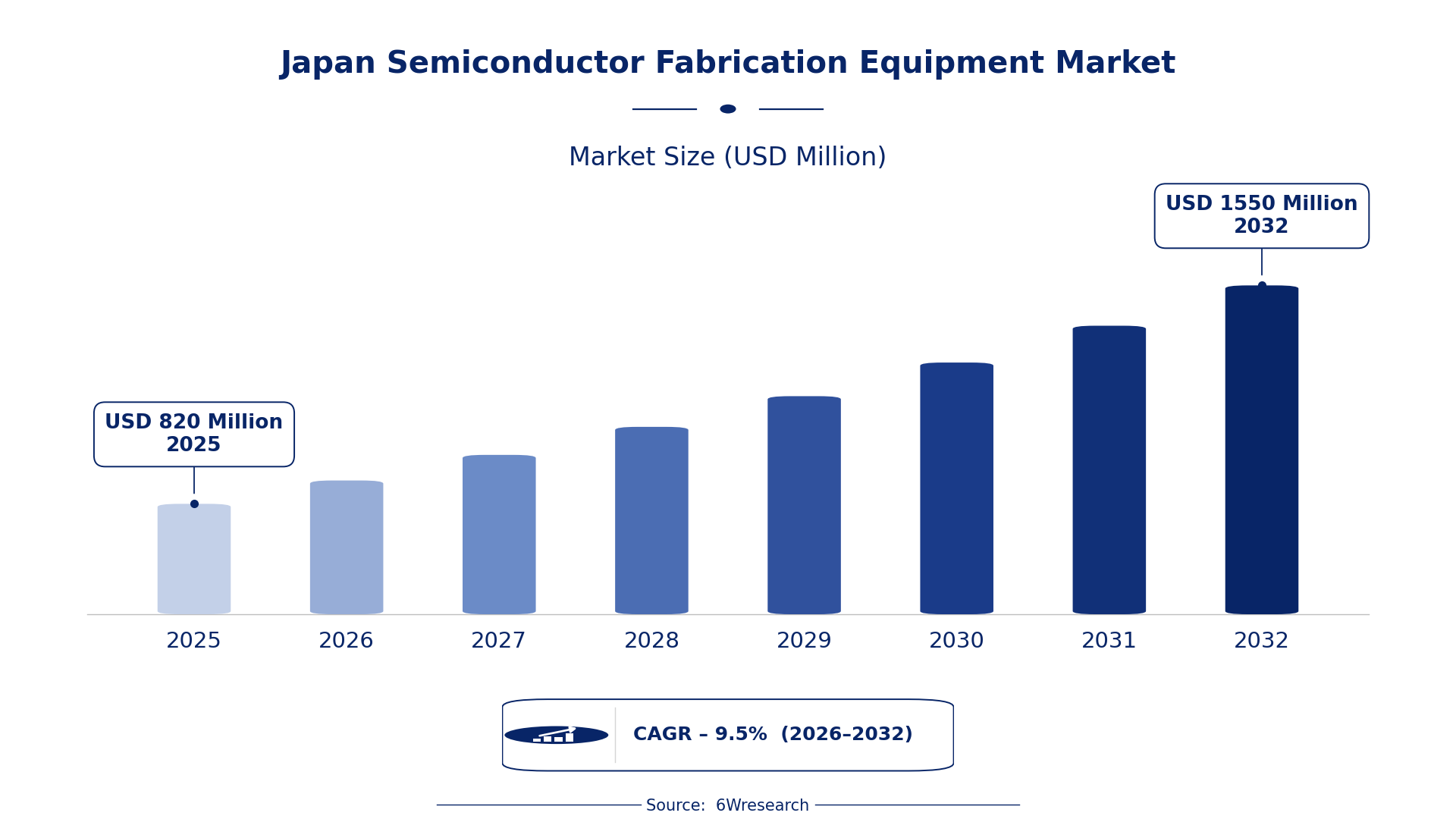
According to 6Wresearch internal database and industry insights, the Japan Semiconductor Fabrication Equipment Market was valued at USD 820 Million in 2025 and is projected to reach USD 1,550 Million by 2032, growing at a CAGR of approximately 9.5% during 2026–2032.
Japan Semiconductor Fabrication Equipment Market Highlights
| Report Metric | Details |
| Report Name | Japan Semiconductor Fabrication Equipment Market (2026-2032) |
| Market Size 2025 | USD 820 Million |
| Market Size 2032 | USD 1,550 Million |
| Absolute Growth 2025–2032 | USD 730 Million |
| CAGR 2026–2032 | 9.5% |
| Peak Annual Growth | 14.0% in 2032 |
| Forecast Period | 2026–2032 |
| Historical Data | 2022–2025 |
| Base Year | 2025 |
| Leading Equipment Type, 2025 | Lithography Systems (45% share) |
| Leading Process Step, 2025 | Pattern Transfer (38% share) |
| Leading Automation Level, 2025 | Fully Automated (51% share) |
| Leading End User, 2025 | Foundries (38% share) |
| Fastest-Growing Equipment Type | Etching Equipment (13.4% CAGR) |
| Fastest-Growing Process Step | Pattern Etch (13.8% CAGR) |
| Fastest-Growing Automation Level | Dry/Wet Etching (13.1% CAGR) |
| Fastest-Growing End User | IDM Players (12.4% CAGR) |
| Growing Sector | IDM Players |
| Key End Users | Foundries, IDM Players, Chip Fabricators, Equipment Integrators |
Japan Semiconductor Fabrication Equipment Market Year-wise Growth Rate and Key Drivers (2022–2032)
This graph illustrates the annual growth rates of the market from 2022 to 2032, highlighting a steady upward trajectory and projected market expansion over the forecast period.
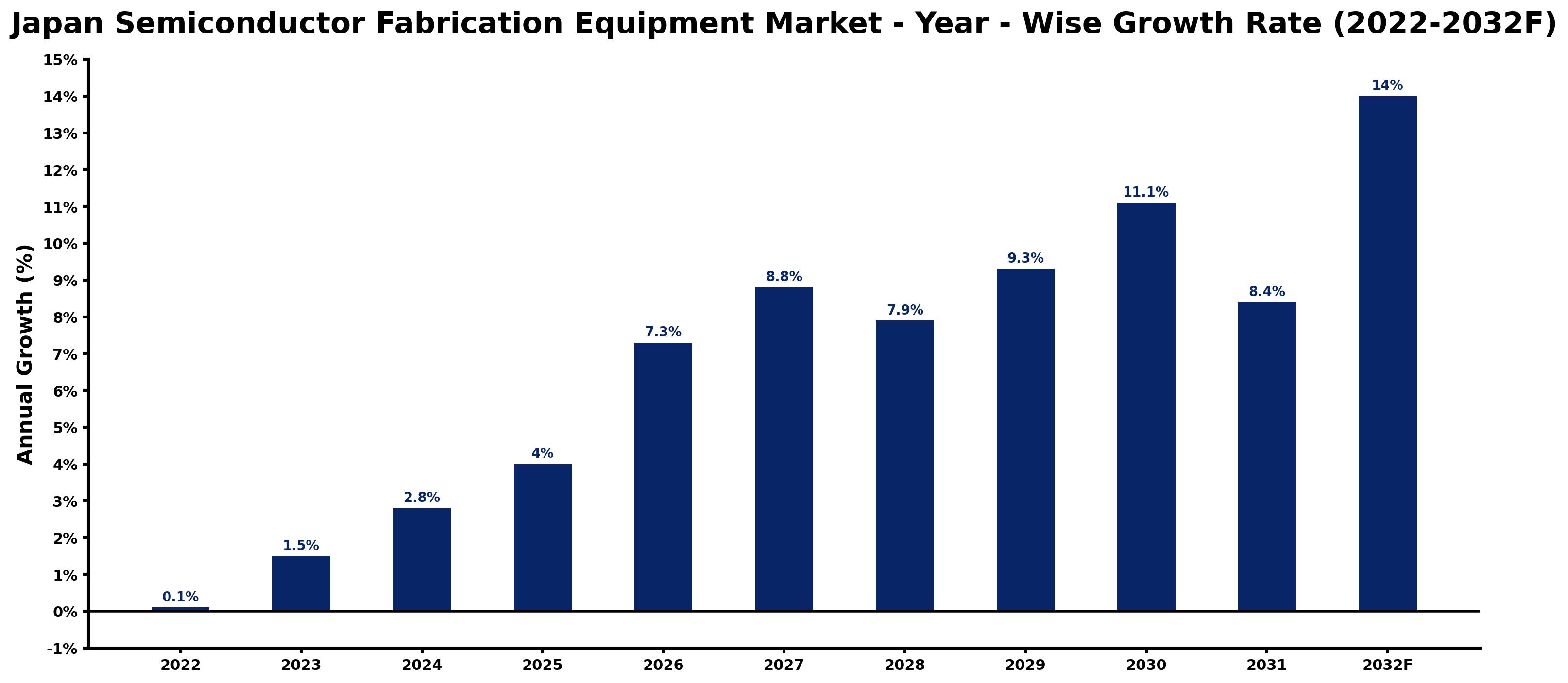
Annual growth estimates for each year appear below with the principal reason behind them, explaining the shifts that set the pace of the market.
| Year | Estimated Annual Growth (%) | Market Rationale |
| 2022 | 0.1 | The market experienced slight growth amid stable demand from domestic manufacturers. |
| 2023 | 1.5 | Demand for semiconductor fabrication equipment increased due to rising investments in technology. |
| 2024 | 2.8 | Growth continued as manufacturers expanded production capabilities to meet global needs. |
| 2025 | 4.0 | The market reached a historical peak as domestic demand surged. |
| 2026 | 7.3 | Demand is projected to rise as new technologies are adopted in production. |
| 2027 | 8.8 | The market will grow further as manufacturers invest in automation. |
| 2028 | 7.9 | Growth is expected to slow slightly as the market stabilises. |
| 2029 | 9.3 | Demand will increase again as global semiconductor needs expand. |
| 2030 | 11.1 | Growth will accelerate as new fabrication technologies are implemented. |
| 2031 | 8.4 | The market is expected to see a slowdown as it approaches saturation. |
| 2032 | 14.0 | A peak growth rate is anticipated as major projects come online. |
Note: Market size estimations and growth projections presented in this report are based on 6Wresearch's proprietary forecasting methodology, utilizing the latest available industry data, government publications, and primary research inputs.
Japan Semiconductor Fabrication Equipment Market Synopsis
Semiconductor fabrication equipment encompasses the machinery necessary for producing semiconductor devices, including lithography and etching systems. The Japan Semiconductor Fabrication Equipment Market is growing due to increasing domestic demand and exports, with ¥300 billion worth of semiconductor equipment exported in 2022. The Kanto region serves as a central hub, bolstered by government initiatives that aim to strengthen supply chain resilience and advance semiconductor technologies.
Market Dynamics Impact Analysis (2026–2032)
| Factor | Type | Impact | Primary Segment Affected |
| Increased domestic production capabilities | Driver | High | Lithography Systems |
| Growing global semiconductor demand | Driver | High | Etching Equipment |
| Investment in advanced manufacturing facilities | Opportunity | High | Deposition Equipment |
| Rising demand for energy-efficient technologies | Opportunity | High | Metrology Tools |
| High costs of advanced equipment | Restraint | High | Lithography Systems |
| Long lead times for equipment delivery | Restraint | Medium | Etching Equipment |
| Competition from lower-cost markets | Challenge | High | Deposition Equipment |
| Technological obsolescence of older equipment | Challenge | Medium | Metrology Tools |
Evaluation of Drivers in Japan Semiconductor Fabrication Equipment Market (2026–2032)
The main growth drivers and the segments they affect most are set out below.
| Drivers | Primary Segment Affected | Why It Matters (Evidence) |
| Rising investments in semiconductor manufacturing | Lithography Systems | Japan's semiconductor industry saw over ¥200 billion invested annually in R&D, increasing demand for lithography systems. |
| Export growth in semiconductor technologies | Etching Equipment | Japan exported semiconductor equipment worth ¥300 billion in 2022, driving demand for etching equipment. |
| Expansion of domestic semiconductor facilities | Deposition Equipment | The Kanto region's semiconductor manufacturing hub is expanding, increasing the need for deposition equipment. |
| Focus on advanced semiconductor processes | Metrology Tools | The implementation of the JIS Z 8721 standard increases the need for precise metrology tools. |
| Automation trends in manufacturing | Pattern Transfer | The shift towards fully automated processes drives demand for advanced pattern transfer systems. |
Buyers are adding capacity as demand for semiconductor fabrication equipment rises. In 2023, Japan's semiconductor industry saw over ¥200 billion invested in R&D, prompting manufacturers to enhance their production capabilities. The expansion of facilities in the Kanto region is increasing the need for advanced deposition equipment. The implementation of the JIS Z 8721 standard is driving demand for precise metrology tools, as manufacturers focus on advanced processes to meet evolving market requirements.
Evaluation of Restraints in Japan Semiconductor Fabrication Equipment Market
The following restraints limit how fast demand can grow.
| Market Restraint | Primary Segment Affected | Why It Matters (Evidence) |
| Outdated technology in production equipment | Lithography Systems | The average age of semiconductor fabrication equipment is five years, leading to inefficiencies. |
| Intense competition from international markets | Etching Equipment | Local manufacturers face pressure to lower prices, which can reduce profit margins. |
| Skills shortages in advanced manufacturing techniques | Deposition Equipment | Producers struggle to meet demand due to a lack of skilled workers in semiconductor production. |
| Rising operational costs due to wage increases | Metrology Tools | Japan's minimum wage increase to JPY 1,055 per hour strains both producers and buyers. |
| Supply chain disruptions affecting production timelines | Pattern Transfer | Global events have caused delays in the availability of critical components. |
Japan Semiconductor Fabrication Equipment Market Challenges
Producers of semiconductor fabrication equipment are dealing with outdated technology, as the average age of equipment is five years, leading to production delays for buyers. Local manufacturers face intense competition from international markets, which pressures them to lower prices, resulting in reduced profit margins and diminished R&D investment for suppliers. A shortage of skilled workers in advanced semiconductor manufacturing techniques restricts producers' ability to meet demand, causing longer delivery times for buyers. Rising operational costs, driven by Japan's minimum wage increase to JPY 1,055 per hour, force both producers and buyers to allocate more resources to maintain profitability.
Trends in the Japan Semiconductor Fabrication Equipment Market
Several trends are reshaping the Japan Semiconductor Fabrication Equipment Market; the most important are set out below.
- Shift Towards Advanced Lithography Techniques: The Kanto region is increasingly adopting advanced lithography techniques to enhance production efficiency, with over 300 lithography systems installed as of 2023. This trend is transforming manufacturing processes and improving output quality.
- Transition to Fully Automated Systems: Manufacturers are moving towards fully automated systems, which are projected to comprise over 51% of the market by 2025. This transition boosts efficiency and minimises human error in semiconductor fabrication.
- Emergence of New Semiconductor Research Institutes: New semiconductor research institutes are being established in Tokyo, backed by government initiatives. This focus on R&D is likely to drive innovation and enhance production capabilities in the industry.
- Increased Demand for Metrology Tools: Foundries are prioritising advanced metrology tools to ensure quality control. The implementation of standards like JIS Z 8721 is fuelling this demand, resulting in more precise manufacturing processes.
Investment Opportunities in the Japan Semiconductor Fabrication Equipment Market
The opportunities below stand out in the Japan Semiconductor Fabrication Equipment Market for new entrants and existing suppliers.
- Kanto Region Expansion: The Kanto region is expanding its semiconductor manufacturing facilities, creating opportunities for suppliers of fabrication equipment. With ¥300 billion in exports in 2022, local manufacturers are seeking advanced equipment to satisfy rising demand.
- Investment in Automation: Foundries are making substantial investments in automation to boost production efficiency. This trend offers opportunities for suppliers of fully automated systems, especially in regions with high semiconductor production.
- Focus on Advanced Manufacturing Processes: The emphasis on advanced manufacturing processes generates demand for modern deposition equipment. Suppliers can penetrate this market by collaborating with local manufacturers in the Kanto region.
- Government Support for R&D: Government initiatives aimed at enhancing semiconductor R&D present opportunities for investment in new technologies. Suppliers can partner with research institutes in Tokyo to develop novel fabrication solutions.
Government Initiatives in the Japan Semiconductor Fabrication Equipment Market
The Semiconductor and Digital Industry Strategy, launched by METI in June 2021, establishes measures to secure domestic semiconductor manufacturing, complementing the Economic Security Promotion Act of 2022. This strategy aims to strengthen supply chain resilience for critical products and materials, ensuring a stable production environment for semiconductor fabrication equipment.
The Ministry of Economy, Trade and Industry (METI) approves funding for semiconductor technology development projects. This includes support for initiatives aimed at improving supply chain resilience, which benefits manufacturers and buyers in the semiconductor fabrication equipment market.
Future Insight of the Japan Semiconductor Fabrication Equipment Market
New semiconductor fabrication projects will launch by 2032, spurred by government initiatives aimed at advancing technology in the sector. The METI program focused on strengthening supply chain resilience will facilitate better collaboration between local manufacturers and suppliers. As a result, Japan's semiconductor equipment exports are projected to reach ¥500 billion by 2032. Enhanced standards will further optimise manufacturing processes, enabling buyers and suppliers to achieve improved efficiency and productivity.
Market Segmentation Analysis
Japan Semiconductor Fabrication Equipment Market report covers a detailed analysis of the following market segments:
By Equipment Type – Lithography Systems Lead, Etching Equipment Expected to Grow Fastest
According to Saurav Kr Singh, Senior Research Analyst at 6Wresearch, Lithography Systems held 45% of the Japan Semiconductor Fabrication Equipment Market by equipment type in 2025. Lithography systems hold the largest share as they are vital for patterning semiconductor wafers, a fundamental step in the production of integrated circuits. Their extensive installed base of around 300 units in Japan demonstrates their critical role among domestic manufacturers. Etching Equipment is set to record the highest CAGR in this split, 13.4% over 2026–2032. Etching equipment is growing rapidly due to its essential function in removing material to create intricate circuit patterns, spurred by increasing demand for advanced semiconductor devices. The substantial annual R&D investments exceeding ¥200 billion are likely to further fuel this segment's growth. Suppliers must focus on enhancing etching equipment capabilities to meet the rising market demand.
By Process Step – Pattern Transfer Leads, Pattern Etch Expected to Grow Fastest
With 38% of process step revenue in 2025, Pattern Transfer was the largest category. Pattern transfer leads the market as it is crucial for accurately transferring designs onto wafers, forming the basis of semiconductor manufacturing. Its importance is underscored by its role in ensuring the precision of integrated circuit production. The quickest growth will come from Pattern Etch, forecast to expand at a CAGR of 13.8% between 2026 and 2032. Pattern etch is the fastest-growing process step, essential for defining intricate circuit patterns on semiconductor materials, as manufacturers strive for higher precision. The increasing complexity of semiconductor designs is driving the demand for advanced etching techniques, propelling this segment's growth. Buyers should prioritise suppliers who provide advanced pattern etch technologies to maintain their competitive edge.
By Automation Level – Fully Automated Leads, Dry/Wet Etching Expected to Grow Fastest
In 2025, Fully Automated led the automation level split with a 51% share. Fully automated systems dominate the market as they significantly improve efficiency and reduce human error in manufacturing, making them indispensable for high-volume production. This trend aligns with Japan's strategic focus on advancing semiconductor technology. Over 2026–2032, Dry/Wet Etching is expected to post the fastest growth, at a CAGR of 13.1%. Dry/wet etching is the fastest-growing automation level due to its precision in material removal, increasingly necessary for complex semiconductor designs. The shift towards sophisticated manufacturing processes is driving the demand for these etching techniques. Suppliers should concentrate on developing advanced dry/wet etching technologies to capitalise on the expanding market.
By End User – Foundries Lead, IDM Players Expected to Grow Fastest
Foundries took 38% of end user revenue in 2025, more than any other category. Foundries are the primary users of fabrication equipment for chip production, holding the largest market share due to their pivotal role in the semiconductor supply chain. Their substantial investments in new fabrication technologies highlight their significance in the industry. IDM Players are projected to grow fastest, at a CAGR of 12.4% during 2026–2032. IDM players are experiencing the fastest growth as they extensively utilise fabrication tools to streamline their integrated device manufacturing processes. The trend towards vertical integration in the semiconductor industry is driving this segment's rapid expansion. Buyers should seek partnerships with suppliers who understand the specific requirements of IDM players to enhance their production capabilities.
Key Attractiveness of the Report
- 10 Years of Market Numbers
- Historical Data Starting from 2022 to 2025
- Base Year 2025
- Forecast Data until 2032
- Key Performance Indicators Impacting the Market
- Major Upcoming Developments and Projects
Key Highlights of the Report:
- Japan Semiconductor Fabrication Equipment Market Outlook
- Market Size of Japan Semiconductor Fabrication Equipment Market, 2025
- Forecast of Japan Semiconductor Fabrication Equipment Market, 2032
- Historical Data and Forecast of Japan Semiconductor Fabrication Equipment Revenues & Volume for the Period 2022-2032F
- Japan Semiconductor Fabrication Equipment Market Trend Evolution
- Japan Semiconductor Fabrication Equipment Market Drivers and Challenges
- Japan Semiconductor Fabrication Equipment Price Trends
- Japan Semiconductor Fabrication Equipment Porter's Five Forces
- Japan Semiconductor Fabrication Equipment Industry Life Cycle
- Historical Data and Forecast of Japan Semiconductor Fabrication Equipment Market Revenues & Volume By Equipment Type for the Period 2022-2032F
- Historical Data and Forecast of Japan Semiconductor Fabrication Equipment Market Revenues & Volume By Lithography Systems for the Period 2022-2032F
- Historical Data and Forecast of Japan Semiconductor Fabrication Equipment Market Revenues & Volume By Etching Equipment for the Period 2022-2032F
- Historical Data and Forecast of Japan Semiconductor Fabrication Equipment Market Revenues & Volume By Deposition Equipment for the Period 2022-2032F
- Historical Data and Forecast of Japan Semiconductor Fabrication Equipment Market Revenues & Volume By Metrology Tools for the Period 2022-2032F
- Historical Data and Forecast of Japan Semiconductor Fabrication Equipment Market Revenues & Volume By Process Step for the Period 2022-2032F
- Historical Data and Forecast of Japan Semiconductor Fabrication Equipment Market Revenues & Volume By Pattern Transfer for the Period 2022-2032F
- Historical Data and Forecast of Japan Semiconductor Fabrication Equipment Market Revenues & Volume By Pattern Etch for the Period 2022-2032F
- Historical Data and Forecast of Japan Semiconductor Fabrication Equipment Market Revenues & Volume By Film Coating for the Period 2022-2032F
- Historical Data and Forecast of Japan Semiconductor Fabrication Equipment Market Revenues & Volume By Defect Inspection for the Period 2022-2032F
- Historical Data and Forecast of Japan Semiconductor Fabrication Equipment Market Revenues & Volume By Automation Level for the Period 2022-2032F
- Historical Data and Forecast of Japan Semiconductor Fabrication Equipment Market Revenues & Volume By Fully Automated for the Period 2022-2032F
- Historical Data and Forecast of Japan Semiconductor Fabrication Equipment Market Revenues & Volume By Dry/Wet Etching for the Period 2022-2032F
- Historical Data and Forecast of Japan Semiconductor Fabrication Equipment Market Revenues & Volume By ALD/CVD/PVD for the Period 2022-2032F
- Historical Data and Forecast of Japan Semiconductor Fabrication Equipment Market Revenues & Volume By Inline Measurement for the Period 2022-2032F
- Historical Data and Forecast of Japan Semiconductor Fabrication Equipment Market Revenues & Volume By End User for the Period 2022-2032F
- Historical Data and Forecast of Japan Semiconductor Fabrication Equipment Market Revenues & Volume By Foundries for the Period 2022-2032F
- Historical Data and Forecast of Japan Semiconductor Fabrication Equipment Market Revenues & Volume By IDM Players for the Period 2022-2032F
- Historical Data and Forecast of Japan Semiconductor Fabrication Equipment Market Revenues & Volume By Chip Fabricators for the Period 2022-2032F
- Historical Data and Forecast of Japan Semiconductor Fabrication Equipment Market Revenues & Volume By Equipment Integrators for the Period 2022-2032F
- Japan Semiconductor Fabrication Equipment Import Export Trade Statistics
- Market Opportunity Assessment By Equipment Type
- Market Opportunity Assessment By Process Step
- Market Opportunity Assessment By Automation Level
- Market Opportunity Assessment By End User
- Japan Semiconductor Fabrication Equipment Top Companies Market Share
- Japan Semiconductor Fabrication Equipment Competitive Benchmarking By Technical and Operational Parameters
- Japan Semiconductor Fabrication Equipment Company Profiles
- Japan Semiconductor Fabrication Equipment Key Strategic Recommendations
Market Covered
Coverage by segment is as follows.
By Equipment Type
- Lithography Systems
- Etching Equipment
- Deposition Equipment
- Metrology Tools
By Process Step
- Pattern Transfer
- Pattern Etch
- Film Coating
- Defect Inspection
By Automation Level
- Fully Automated
- Dry/Wet Etching
- ALD/CVD/PVD
- Inline Measurement
By End User
- Foundries
- IDM Players
- Chip Fabricators
- Equipment Integrators































