Japan Semiconductor IP Core Market Size & Growth Rate
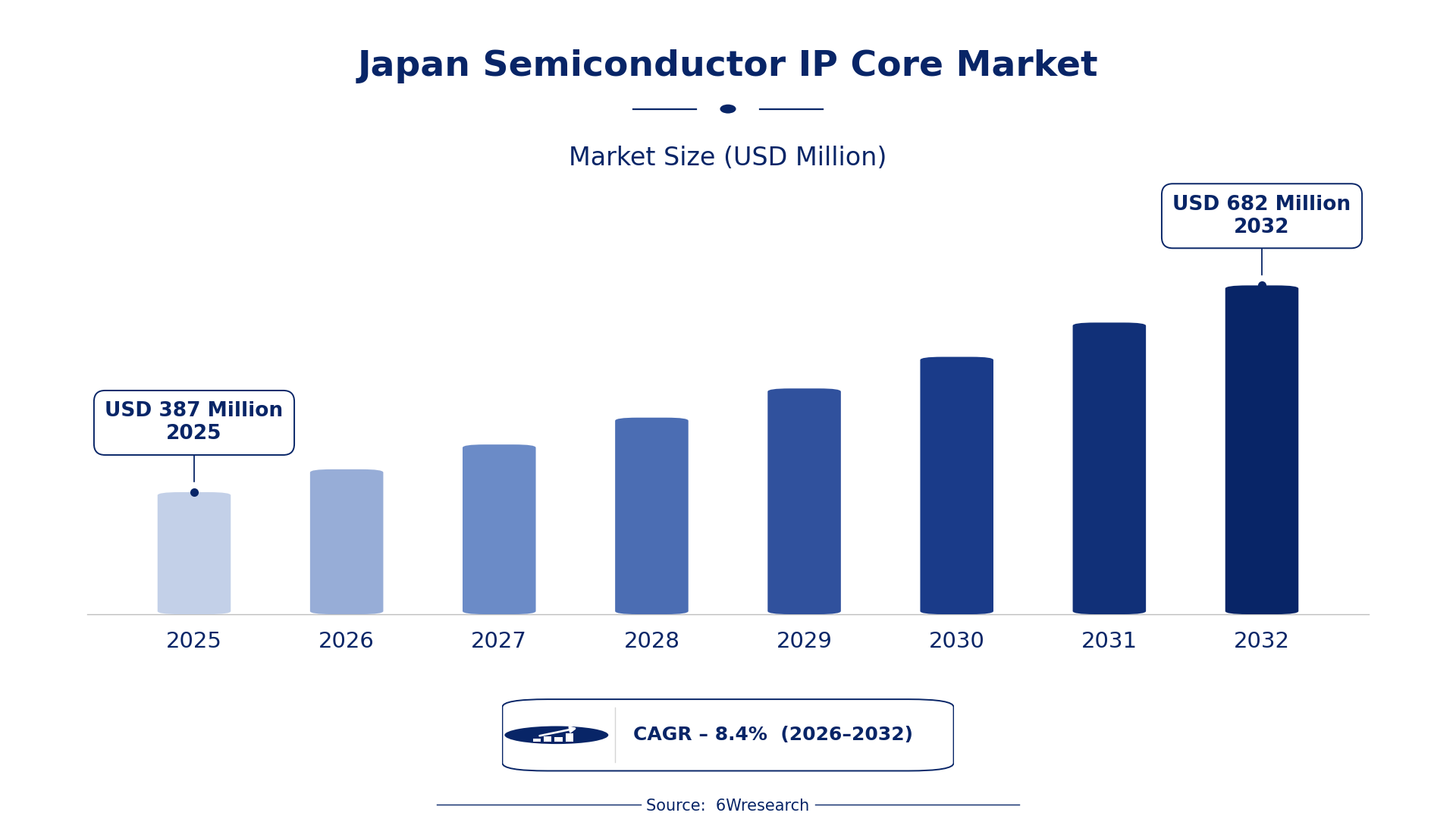
According to 6Wresearch internal database and industry insights, the Japan Semiconductor IP Core Market was valued at USD 387 Million in 2025 and is projected to reach USD 682 Million by 2032, growing at a CAGR of approximately 8.4% during 2026–2032.
Japan Semiconductor IP Core Market Highlights
| Report Metric | Details |
| Report Name | Japan Semiconductor IP Core Market (2026-2032) |
| Market Size 2025 | USD 387 Million |
| Market Size 2032 | USD 682 Million |
| Absolute Growth 2025–2032 | USD 295 Million |
| CAGR 2026–2032 | 8.4% |
| Peak Annual Growth | 9.7% in 2029 |
| Forecast Period | 2026–2032 |
| Historical Data | 2022–2025 |
| Base Year | 2025 |
| Leading IP Core Type, 2025 | Processor Cores (41% share) |
| Leading Functionality, 2025 | Computation Engine (41% share) |
| Leading Licensing Model, 2025 | Royalty-Based (43% share) |
| Leading End User, 2025 | SoC Designers (42% share) |
| Fastest-Growing IP Core Type | Memory Cores (11.2% CAGR) |
| Fastest-Growing Functionality | Storage Blocks (10.6% CAGR) |
| Fastest-Growing Licensing Model | One-Time License (10.9% CAGR) |
| Fastest-Growing End User | Chipmakers (10.3% CAGR) |
| Growing Sector | semiconductor manufacturing |
| Key End Users | SoC Designers, Chipmakers, Embedded Device Makers |
Japan Semiconductor IP Core Market Year-wise Growth Rate and Key Drivers (2022–2032)
This graph illustrates the annual growth rates of the market from 2022 to 2032, highlighting a steady upward trajectory and projected market expansion over the forecast period.
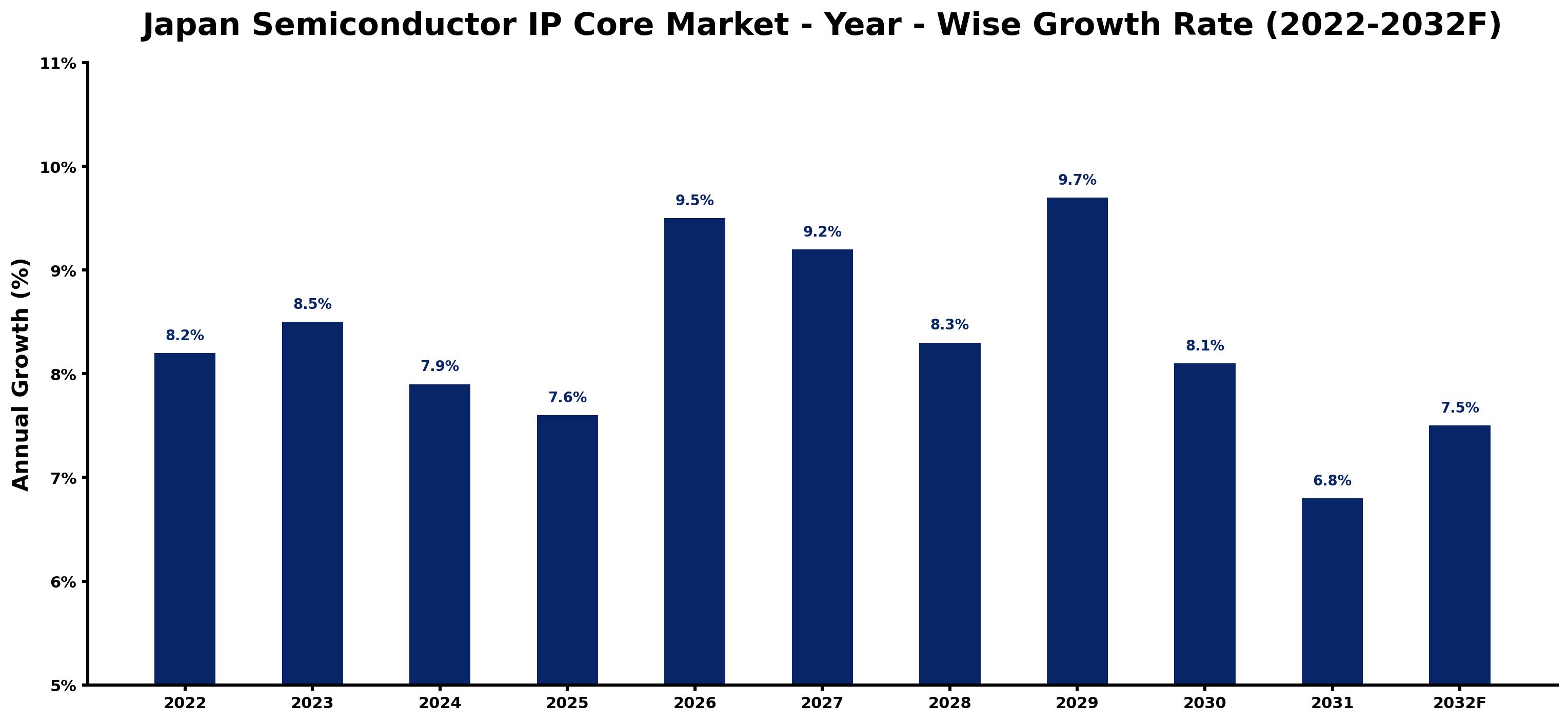
The following figures match every annual growth estimate with the main market development of that year, giving the reasoning behind each rise or slowdown.
| Year | Estimated Annual Growth (%) | Market Rationale |
| 2022 | 8.2 | The semiconductor industry generated substantial revenue, reflecting steady demand from various sectors. |
| 2023 | 8.5 | Growth accelerated as domestic chipmakers increased production capacities and innovation. |
| 2024 | 7.9 | Growth slowed slightly due to market saturation in certain segments, yet demand remained strong. |
| 2025 | 7.6 | The market continued to expand, driven by ongoing investments in semiconductor technologies. |
| 2026 | 9.5 | Demand surged as new applications for semiconductor IP cores emerged in advanced devices. |
| 2027 | 9.2 | Growth is expected to decelerate slightly as competition intensifies among local manufacturers. |
| 2028 | 8.3 | The market is projected to experience a further slowdown, yet remain buoyed by steady demand. |
| 2029 | 9.7 | Growth is anticipated to peak as major advancements in semiconductor technology spur high demand. |
| 2030 | 8.1 | The market growth rate will decrease as the industry adjusts to new technological standards. |
| 2031 | 6.8 | Demand will continue to rise, albeit at a slower pace, as innovation persists. |
| 2032 | 7.5 | Growth is expected to pick up again due to renewed investments in semiconductor capabilities. |
Note: Market size estimations and growth projections presented in this report are based on 6Wresearch's proprietary forecasting methodology, utilizing the latest available industry data, government publications, and primary research inputs.
Japan Semiconductor IP Core Market Synopsis
Semiconductor IP cores are reusable functional blocks essential for integrated circuits, enabling faster chip design and specialized functionalities. The Japan Semiconductor IP Core Market is expanding due to strong demand from domestic chipmakers and embedded device manufacturers, alongside a focus on advanced technologies. The Ministry of Economy, Trade and Industry's 2023 initiative to improve semiconductor capabilities is further driving this growth, indicating a solid investment pipeline and increasing technological advancements.
Market Dynamics Impact Analysis (2026–2032)
| Factor | Type | Impact | Primary Segment Affected |
| Rising demand for advanced semiconductor technologies | Driver | High | Processor Cores |
| Increased focus on security cores for IoT applications | Driver | High | Security Cores |
| Growing need for efficient chip design solutions | Opportunity | Medium | Memory Cores |
| Expansion of SoC designers in Japan | Opportunity | Medium | SoC Designers |
| High competition among local manufacturers | Restraint | High | Chipmakers |
| Limited access to cutting-edge technology | Restraint | Medium | Foundries |
| Rising costs of semiconductor materials | Challenge | High | Embedded Device Makers |
| Compliance with evolving industry standards | Challenge | Medium | Chipmakers |
Evaluation of Drivers in Japan Semiconductor IP Core Market (2026–2032)
Key forces behind demand, with the segment each one moves most, are listed below.
| Drivers | Primary Segment Affected | Why It Matters (Evidence) |
| Increased production capabilities of domestic chipmakers | Processor Cores | Japan's semiconductor industry generated approximately 3 trillion JPY in 2022, driving demand for advanced cores. |
| Growing adoption of IoT devices | Security Cores | Japan has a strong focus on developing security cores for IoT devices, increasing demand for these functionalities. |
| Rising demand for memory storage solutions | Memory Cores | The Semiconductor Industry Association of Japan reported a rise in demand for memory cores, reflecting industry needs. |
| Emergence of new SoC design firms | SoC Designers | The number of SoC designers in Japan is estimated at over 1,000 firms, boosting the market for IP cores. |
| Investment in semiconductor capabilities | Embedded Device Makers | The Ministry of Economy, Trade and Industry launched a program in 2023 to improve semiconductor capabilities. |
Purchasing is picking up as Tokyo's semiconductor industry generated approximately 3 trillion JPY in 2022, leading to increased demand for advanced functionalities. The adoption of IoT devices has resulted in a strong focus on developing security features, further driving market expansion. A rise in demand for memory solutions reflects the industry's evolving needs. The emergence of over 1,000 SoC designers has boosted interest in semiconductor IP cores, while ongoing investments in capabilities are expected to improve production capacities.
Evaluation of Restraints in Japan Semiconductor IP Core Market
The main factors holding the market back are set out below.
| Market Restraint | Primary Segment Affected | Why It Matters (Evidence) |
| Intense competition among local manufacturers | Chipmakers | High competition can lead to price wars, impacting profitability for chipmakers in Japan. |
| Limited access to advanced technology | Foundries | Foundries face challenges in acquiring advanced technology, hindering production capabilities. |
| Rising costs of raw materials | Embedded Device Makers | Increasing material costs can affect the pricing strategies of embedded device makers. |
| Compliance with stringent industry standards | Chipmakers | Adhering to evolving standards can increase operational costs for chipmakers. |
| Dependence on specific technology suppliers | SoC Designers | Reliance on a few suppliers can create vulnerabilities in the supply chain for SoC designers. |
Japan Semiconductor IP Core Market Challenges
Producers encounter a shortage of skilled designers, limiting the number of SoC designers to over 1,000 firms. This expertise gap extends project timelines for producers, often delaying development cycles by up to six months. Regulatory requirements, such as compliance with JIS standards, complicate the design process and can inflate project budgets by an additional 15% for producers. Slow technology integration hinders innovation, as advanced design tools are not adopted quickly enough, which restricts functionality in new products and diminishes competitiveness for producers in the market.
Trends in the Japan Semiconductor IP Core Market
Four trends stand out in the Japan Semiconductor IP Core Market.
- Shift towards Advanced Memory Solutions: SoC Designers are increasingly adopting advanced memory cores to improve performance, with the Semiconductor Industry Association of Japan reporting a rise in demand. This trend is set to drive innovation in chip design.
- Growing Focus on IoT Security: Demand for security cores is surging as IoT device adoption rises, with Japan prioritising the development of these technologies to protect data transmissions.
- Increase in SoC Design Firms: The number of SoC designers in Japan has surpassed 1,000, reflecting a growing interest in advanced chip design and resulting in increased demand for semiconductor IP cores.
- Emergence of Subscription-Based Licensing Models: A notable shift towards subscription-based licensing models is occurring, with the One-Time License segment projected to grow at a CAGR of 10.9%, indicating changing preferences in IP core licensing.
Investment Opportunities in the Japan Semiconductor IP Core Market
The openings below show where demand in the Japan Semiconductor IP Core Market is visible and how suppliers can enter.
- Investment in Advanced Semiconductor Technologies: Now is the time to invest in advanced semiconductor technologies, as Japan's semiconductor exports reached 1.5 trillion JPY in 2023, indicating strong market potential. Collaborating with local SoC designers can facilitate entry.
- Expansion of Security Core Development: With Japan's strong focus on IoT security, there is a notable opportunity to supply security cores, driven by the increasing need for data protection. Partnering with embedded device makers can improve market presence.
- Growing Demand for Memory Cores: The rising demand for memory cores presents an opportunity for suppliers to provide innovative solutions, as the Semiconductor Industry Association of Japan highlights this trend. Engaging with local chipmakers can lead to fruitful collaborations.
- Adoption of New Licensing Models: The shift towards subscription-based licensing models creates an opportunity for providers to offer flexible solutions. Engaging with SoC designers can facilitate entry into this evolving market.
Government Initiatives in the Japan Semiconductor IP Core Market
The Semiconductor and Digital Industry Strategy, established by METI in June 2021, secures domestic semiconductor manufacturing by implementing measures that protect supply chains and promote innovation. This strategy complements the Economic Security Promotion Act of 2022, which supports resilience for critical products, ensuring that semiconductor producers can maintain competitiveness and adapt to market changes.
The Ministry of Economy, Trade and Industry oversees the implementation of various programs, including funding for semiconductor research and development. The agency's initiatives aim to strengthen domestic production capabilities, focusing on improving the semiconductor supply chain and approving projects that align with national objectives.
Future Insight of the Japan Semiconductor IP Core Market
Investment in semiconductor capabilities will increase, creating a strong pipeline for innovation. This will lead to heightened demand for advanced semiconductor IP cores, particularly for security applications in IoT devices. The average number of IP cores used in a single SoC design is projected to rise from 50 to 70, reflecting the increasing complexity of integrated circuits. New programmes will encourage collaboration among designers, facilitating quicker time-to-market for buyers and improving opportunities for suppliers.
Market Segmentation Analysis
Japan Semiconductor IP Core Market report covers a detailed analysis of the following market segments:
By IP Core Type – Processor Cores Lead, Memory Cores Expected to Grow Fastest
According to Saurav Kr Singh, Senior Research Analyst at 6Wresearch, Processor Cores held 41% of the Japan Semiconductor IP Core Market by ip core type in 2025. Processor cores dominate the market because they are integral to various applications, including mobile devices and computing systems, which are crucial for Japan's semiconductor industry. The high number of SoC designers, exceeding 1,000 firms, contributes to the sustained demand for these cores. Memory Cores are set to record the highest CAGR in this split, 11.2% over 2026–2032. Memory cores are experiencing rapid growth due to the increasing necessity for data storage in chips, especially as technology advances. The Semiconductor Industry Association of Japan has reported a notable rise in demand for these cores, indicating a strong growth trajectory. Suppliers need to focus on enhancing their memory core offerings to meet the escalating demand from chipmakers.
By Functionality – Computation Engine Leads, Storage Blocks Expected to Grow Fastest
In 2025, Computation Engine led the functionality split with a 41% share. Computation engines dominate the market as they are critical for processing tasks within chips, making them essential for SoC designers. Their importance across various applications reinforces their leading position in the sector. The quickest growth will come from Storage Blocks, forecast to expand at a CAGR of 10.6% between 2026 and 2032. Storage blocks are experiencing the fastest growth due to the increasing necessity for efficient memory management in complex systems. This trend reflects the heightened demand for advanced data handling capabilities in modern applications. Buyers should focus on acquiring storage blocks to optimise performance in their chip designs.
By Licensing Model – Royalty-Based Leads, One-Time License Expected to Grow Fastest
Royalty-Based accounted for 43% of the market by licensing model in 2025. The royalty-based model is prevalent as it aligns with the ongoing practices in the semiconductor industry, allowing for flexible payment structures. This model is particularly attractive to SoC designers who frequently utilise IP cores in their projects. Over 2026–2032, One-Time License is expected to post the fastest growth, at a CAGR of 10.9%. The one-time license model is gaining traction due to its appeal for specific projects where upfront costs are preferred over ongoing royalties. This shift reflects a changing preference among certain buyers for more predictable budgeting. Suppliers may need to adapt their licensing strategies to cater to the increasing interest in one-time licenses.
By End User – SoC Designers Lead, Chipmakers Expected to Grow Fastest
The largest end user category in 2025 was SoC Designers, at 42% of revenue. SoC designers lead the market as they are the primary users of IP cores, essential for integrating them into system-on-chip designs. The presence of over 1,000 firms in this sector highlights their substantial demand for these components. Chipmakers are projected to grow fastest, at a CAGR of 10.3% during 2026–2032. Chipmakers are growing at the fastest rate as their dependence on semiconductor IP increases to enhance production capabilities. The notable rise in semiconductor exports reflects their critical role in the market, driving this growth. Suppliers should establish strong relationships with chipmakers to capitalise on the increasing demand.
Key Attractiveness of the Report
- 10 Years of Market Numbers
- Historical Data Starting from 2022 to 2025
- Base Year 2025
- Forecast Data until 2032
- Key Performance Indicators Impacting the Market
- Major Upcoming Developments and Projects
Key Highlights of the Report:
- Japan Semiconductor IP Core Market Outlook
- Market Size of Japan Semiconductor IP Core Market, 2025
- Forecast of Japan Semiconductor IP Core Market, 2032
- Historical Data and Forecast of Japan Semiconductor IP Core Revenues & Volume for the Period 2022-2032F
- Japan Semiconductor IP Core Market Trend Evolution
- Japan Semiconductor IP Core Market Drivers and Challenges
- Japan Semiconductor IP Core Price Trends
- Japan Semiconductor IP Core Porter's Five Forces
- Japan Semiconductor IP Core Industry Life Cycle
- Historical Data and Forecast of Japan Semiconductor IP Core Market Revenues & Volume By IP Core Type for the Period 2022-2032F
- Historical Data and Forecast of Japan Semiconductor IP Core Market Revenues & Volume By Processor Cores for the Period 2022-2032F
- Historical Data and Forecast of Japan Semiconductor IP Core Market Revenues & Volume By Memory Cores for the Period 2022-2032F
- Historical Data and Forecast of Japan Semiconductor IP Core Market Revenues & Volume By Interface Cores for the Period 2022-2032F
- Historical Data and Forecast of Japan Semiconductor IP Core Market Revenues & Volume By Security Cores for the Period 2022-2032F
- Historical Data and Forecast of Japan Semiconductor IP Core Market Revenues & Volume By Functionality for the Period 2022-2032F
- Historical Data and Forecast of Japan Semiconductor IP Core Market Revenues & Volume By Computation Engine for the Period 2022-2032F
- Historical Data and Forecast of Japan Semiconductor IP Core Market Revenues & Volume By Storage Blocks for the Period 2022-2032F
- Historical Data and Forecast of Japan Semiconductor IP Core Market Revenues & Volume By I/O Integration for the Period 2022-2032F
- Historical Data and Forecast of Japan Semiconductor IP Core Market Revenues & Volume By Encryption/Authentication for the Period 2022-2032F
- Historical Data and Forecast of Japan Semiconductor IP Core Market Revenues & Volume By Licensing Model for the Period 2022-2032F
- Historical Data and Forecast of Japan Semiconductor IP Core Market Revenues & Volume By Royalty-Based for the Period 2022-2032F
- Historical Data and Forecast of Japan Semiconductor IP Core Market Revenues & Volume By One-Time License for the Period 2022-2032F
- Historical Data and Forecast of Japan Semiconductor IP Core Market Revenues & Volume By Subscription-Based for the Period 2022-2032F
- Historical Data and Forecast of Japan Semiconductor IP Core Market Revenues & Volume By Per Unit Royalty for the Period 2022-2032F
- Historical Data and Forecast of Japan Semiconductor IP Core Market Revenues & Volume By End User for the Period 2022-2032F
- Historical Data and Forecast of Japan Semiconductor IP Core Market Revenues & Volume By SoC Designers for the Period 2022-2032F
- Historical Data and Forecast of Japan Semiconductor IP Core Market Revenues & Volume By Chipmakers for the Period 2022-2032F
- Historical Data and Forecast of Japan Semiconductor IP Core Market Revenues & Volume By Foundries for the Period 2022-2032F
- Historical Data and Forecast of Japan Semiconductor IP Core Market Revenues & Volume By Embedded Device Makers for the Period 2022-2032F
- Japan Semiconductor IP Core Import Export Trade Statistics
- Market Opportunity Assessment By IP Core Type
- Market Opportunity Assessment By Functionality
- Market Opportunity Assessment By Licensing Model
- Market Opportunity Assessment By End User
- Japan Semiconductor IP Core Top Companies Market Share
- Japan Semiconductor IP Core Competitive Benchmarking By Technical and Operational Parameters
- Japan Semiconductor IP Core Company Profiles
- Japan Semiconductor IP Core Key Strategic Recommendations
Market Covered
The report covers the following segments.
By IP Core Type
- Processor Cores
- Memory Cores
- Interface Cores
- Security Cores
By Functionality
- Computation Engine
- Storage Blocks
- I/O Integration
- Encryption/Authentication
By Licensing Model
- Royalty-Based
- One-Time License
- Subscription-Based
- Per Unit Royalty
By End User
- SoC Designers
- Chipmakers
- Foundries
- Embedded Device Makers































