Japan Semiconductor Power Devices Market Size & Growth Rate
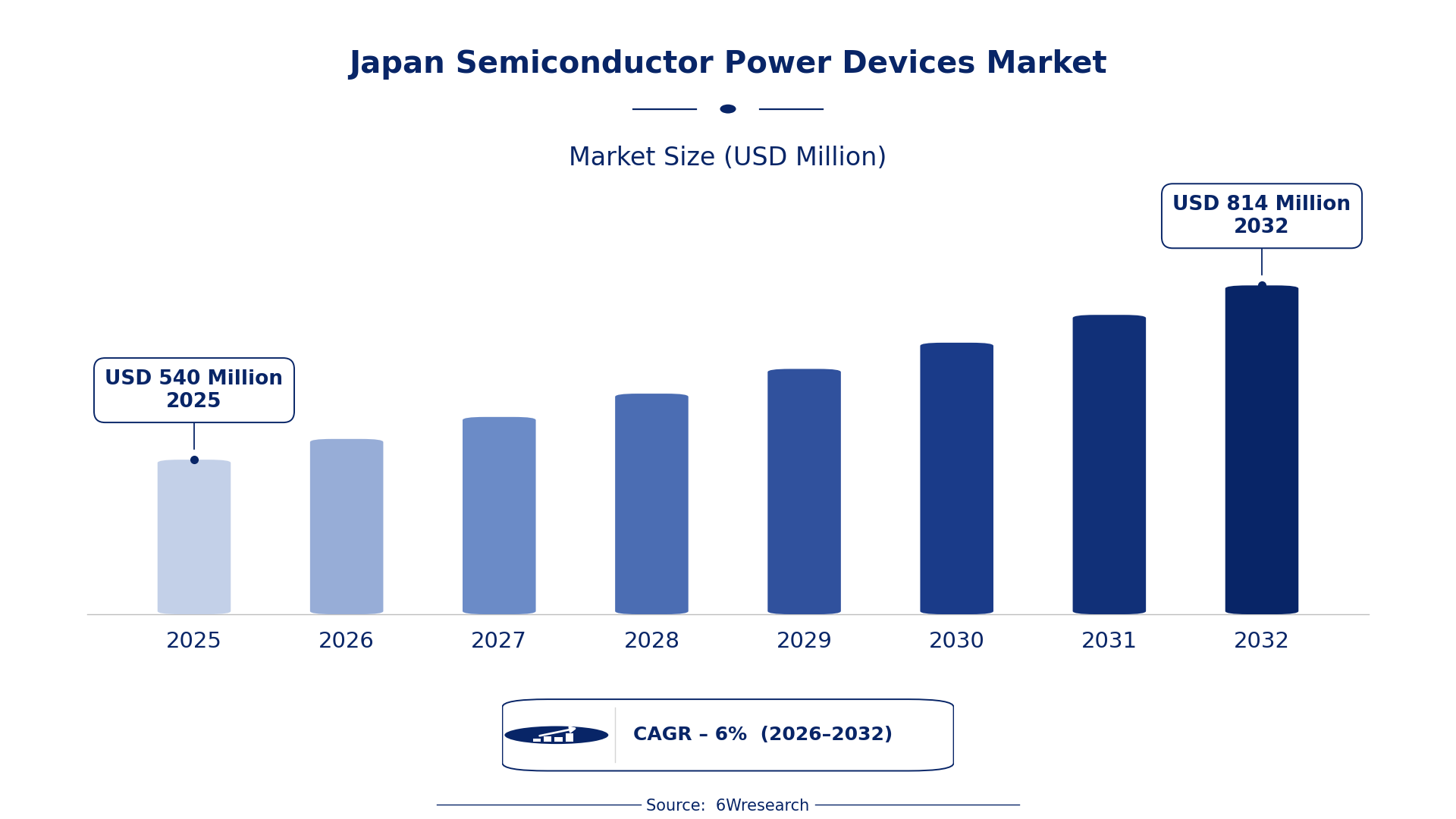
According to 6Wresearch internal database and industry insights, the Japan Semiconductor Power Devices Market was valued at USD 540 Million in 2025 and is projected to reach USD 814 Million by 2032, growing at a CAGR of approximately 6% during 2026–2032.
Japan Semiconductor Power Devices Market Highlights
| Report Metric | Details |
| Report Name | Japan Semiconductor Power Devices Market (2026-2032) |
| Market Size 2025 | USD 540 Million |
| Market Size 2032 | USD 814 Million |
| Absolute Growth 2025–2032 | USD 274 Million |
| CAGR 2026–2032 | 6% |
| Peak Annual Growth | 7.3% in 2028 |
| Forecast Period | 2026–2032 |
| Historical Data | 2022–2025 |
| Base Year | 2025 |
| Leading Device Type, 2025 | Power MOSFET (44% share) |
| Leading Material Type, 2025 | Silicon (51% share) |
| Leading Application Area, 2025 | Consumer Electronics (48% share) |
| Leading End User, 2025 | Power Supply Manufacturers (40% share) |
| Fastest-Growing Device Type | IGBT (8.5% CAGR) |
| Fastest-Growing Material Type | Silicon Carbide (9.0% CAGR) |
| Fastest-Growing Application Area | EV Inverters (7.5% CAGR) |
| Fastest-Growing End User | Renewable Energy Firms (8.1% CAGR) |
| Growing Sector | Electric Vehicles |
| Key End Users | Power Supply Manufacturers, Automotive OEMs, Renewable Energy Firms, Consumer Electronics |
Japan Semiconductor Power Devices Market Year-wise Growth Rate and Key Drivers (2022–2032)
This graph illustrates the annual growth rates of the market from 2022 to 2032, highlighting a steady upward trajectory and projected market expansion over the forecast period.

The table below sets out the estimated growth rate for each year and the main factor behind it.
| Year | Estimated Annual Growth (%) | Market Rationale |
| 2022 | 4.5 | The market experienced solid growth due to strong demand from the automotive sector. |
| 2023 | 4.3 | Growth slowed as supply chain issues affected semiconductor availability for manufacturers. |
| 2024 | 3.2 | The market continued to slow as demand stabilised following previous peaks. |
| 2025 | 4.1 | Growth accelerated again as consumer electronics demand rebounded strongly. |
| 2026 | 5.1 | The market is expected to grow as investments in electric vehicles increase. |
| 2027 | 5.6 | Demand is projected to rise further as new industrial applications emerge. |
| 2028 | 7.3 | The market will peak due to heightened demand from the EV sector. |
| 2029 | 6.0 | Growth is expected to slow as the market begins to stabilise. |
| 2030 | 6.2 | Demand will increase again as new technologies are adopted in manufacturing. |
| 2031 | 5.4 | Growth is projected to slow as market saturation begins in key areas. |
| 2032 | 6.7 | The market is expected to grow as renewable energy applications expand. |
Note: Market size estimations and growth projections presented in this report are based on 6Wresearch's proprietary forecasting methodology, utilizing the latest available industry data, government publications, and primary research inputs.
Japan Semiconductor Power Devices Market Synopsis
Semiconductor power devices are electronic components that control and convert electrical power, primarily made from silicon, silicon carbide, or gallium nitride. Japan's semiconductor market reached ¥4 trillion in 2022, with automotive demand accounting for approximately 20%. Growth is driven by rising investments in electric vehicles, expanding consumer electronics, and increased adoption of renewable energy technologies, all contributing to a positive market outlook.
Market Dynamics Impact Analysis (2026–2032)
| Factor | Type | Impact | Primary Segment Affected |
| Rising demand for electric vehicles drives the need for power devices. | Driver | High | EV Inverters |
| Increasing adoption of renewable energy technologies creates demand for efficient power management. | Driver | High | Power Conversion |
| The automotive sector's growth presents opportunities for power supply manufacturers. | Opportunity | High | Power Supply Manufacturers |
| Investment in semiconductor manufacturing facilities in Tokyo and Osaka opens new avenues for growth. | Opportunity | Medium | Consumer Electronics |
| Supply chain disruptions have affected the availability of semiconductor components. | Restraint | High | Power MOSFET |
| High production costs for advanced materials like silicon carbide limit market expansion. | Restraint | Medium | Silicon Carbide |
| Technological advancements in competing materials challenge silicon's dominance. | Challenge | High | Silicon |
| The need for compliance with international standards can delay product approvals. | Challenge | Medium | IGBT |
Evaluation of Drivers in Japan Semiconductor Power Devices Market (2026–2032)
Below are the drivers that matter most for revenue growth, with supporting evidence.
| Drivers | Primary Segment Affected | Why It Matters (Evidence) |
| Increased electric vehicle production boosts demand for power devices. | EV Inverters | The automotive industry produced 8.3 million vehicles in 2022, increasing demand for semiconductor components. |
| Growing consumer electronics market drives power device sales. | Consumer Electronics | Japan's population of approximately 125 million fuels high demand for electronic devices. |
| Investment in semiconductor R&D improves domestic production capabilities. | Power Supply Manufacturers | The government allocated ¥200 billion for semiconductor industry support in 2023, promoting innovation. |
| Expansion of renewable energy projects increases need for power management solutions. | Power Conversion | The Semiconductor and Digital Industry Strategy encourages the integration of power electronics in green technologies. |
| Technological advancements in semiconductor materials improve performance. | Silicon Carbide | Silicon carbide devices are projected to grow in demand due to EV market expansion. |
What keeps demand rising is the substantial increase in electric vehicle production, which surged in recent years, driving the need for power devices. The consumer electronics market continues to expand, leading to higher semiconductor sales, supported by Japan's population of around 125 million. Advancements in silicon carbide technology are expected to boost demand in the electric vehicle sector, while the integration of power electronics in renewable energy projects supports overall market growth.
Evaluation of Restraints in Japan Semiconductor Power Devices Market
These restraints slow adoption and weigh on supplier margins.
| Market Restraint | Primary Segment Affected | Why It Matters (Evidence) |
| Supply chain disruptions hinder the availability of semiconductor components. | Power MOSFET | Japan's semiconductor exports were valued at ¥1.5 trillion in 2022, affected by global supply issues. |
| High production costs for advanced materials limit market growth. | Silicon Carbide | Production costs for silicon carbide have risen by 15%, restricting wider adoption in various applications. |
| Technological advancements in competing materials challenge market share. | Silicon | Emerging materials like gallium nitride are gaining traction for specific high-frequency uses. |
| Compliance with international standards can delay product approvals. | IGBT | Standards like ISO/IEC 60747 require rigorous testing, extending time to market. |
| Market saturation in key areas may limit future growth opportunities. | Consumer Electronics | The installed base of power devices in Japan is estimated at over 1 billion units. |
Japan Semiconductor Power Devices Market Challenges
In Japan, semiconductor producers face intense competition from international markets, which forces local manufacturers to reduce prices and compress profit margins. This competition stems from lower production costs abroad, leading to delays in product launches for Japanese firms by up to six months. Technological advancements in semiconductor design are not keeping pace with global trends, limiting local suppliers' ability to exploit new applications and resulting in a loss of market share. Rising production costs, driven by increased energy prices, can elevate manufacturing expenses by up to 15%, affecting buyers reliant on affordable components for consumer electronics.
Trends in the Japan Semiconductor Power Devices Market
Four trends stand out in the Japan Semiconductor Power Devices Market.
- Shift towards Silicon Carbide in EV Applications: The demand for silicon carbide devices is increasing as electric vehicle manufacturers seek higher efficiency. In 2022, the automotive sector accounted for approximately 20% of semiconductor demand, driving this trend.
- Transition to Advanced Power Devices: Manufacturers are moving towards advanced power devices to improve performance and efficiency. The Japan Semiconductor Manufacturing Association promotes industry standards to support this shift, which is important for maintaining competitiveness.
- Consumer Electronics Prioritised over Industrial Applications: Consumer electronics are becoming the leading application area for power devices, with a share of 48% in 2025. This shift reflects changing consumer preferences and technological advancements in personal devices.
- Renewable Energy Firms Increasing Demand for Power Electronics: Renewable energy firms are increasingly adopting power electronics for efficient energy management. Government initiatives support this trend, encouraging the integration of power devices in solar and wind applications.
Investment Opportunities in the Japan Semiconductor Power Devices Market
Investors looking at the Japan Semiconductor Power Devices Market should consider the following areas.
- Gap in Supply for Advanced Semiconductor Materials: With a projected growth of 9.0% for silicon carbide, there is a notable supply gap. Investing in manufacturing facilities in Osaka can effectively meet this demand.
- Investment in EV Inverter Technology: The electric vehicle sector is set to grow, with EV inverters projected to expand at 7.5%. Collaborating with automotive OEMs in Tokyo can facilitate market entry and growth.
- Growing Demand for Power Conversion Solutions: The power conversion segment is important for efficient energy management, with increasing adoption in various sectors. Partnering with power supply manufacturers can provide lucrative opportunities.
- Expansion of Renewable Energy Projects: The renewable energy sector is rapidly growing, with government support encouraging technology adoption. Engaging with renewable energy firms can open new avenues for investment.
Government Initiatives in the Japan Semiconductor Power Devices Market
The Semiconductor and Digital Industry Strategy, established by METI in June 2021, aims to secure domestic semiconductor manufacturing capabilities. This strategy includes measures to support research and development, ensuring that local manufacturers can compete effectively in the global market. The Economic Security Promotion Act of 2022 further supports supply-chain resilience for critical products, ensuring stability in the semiconductor sector.
Power supply manufacturers benefit from the Economic Security Promotion Act, which helps ensure a stable supply of critical materials. This act promotes collaboration among industry players and facilitates funding for projects aimed at improving production efficiency. The Semiconductor Strategy Council, established in 2023, also plays a crucial role in coordinating efforts to boost domestic semiconductor production.
Future Insight of the Japan Semiconductor Power Devices Market
By 2032, buyers in the semiconductor power devices market will experience a surge in demand for gallium nitride technology, enhancing efficiency in fast-charging applications. The government's JPY 150 trillion investment in decarbonisation will drive the need for energy-efficient solutions. The establishment of the Semiconductor Strategy Council will promote collaboration and expedite R&D initiatives. With over 1 billion installed devices, the focus on renewable energy will create opportunities for suppliers to integrate power electronics into sustainable technologies.
Market Segmentation Analysis
Japan Semiconductor Power Devices Market report covers a detailed analysis of the following market segments:
By Device Type – Power MOSFET Leads, IGBT Expected to Grow Fastest
According to Saurav Kr Singh, Senior Research Analyst at 6Wresearch, in 2025, Power MOSFET led the device type split with a 44% share. Power MOSFETs dominate the market as they are widely used in power management applications, particularly in mobile phone chargers and adapters. Their extensive application across consumer electronics ensures a robust installed base, driving consistent demand. The quickest growth will come from IGBT, forecast to expand at a CAGR of 8.5% between 2026 and 2032. The IGBT segment is experiencing rapid growth due to its critical role in high-efficiency power conversion, particularly in renewable energy systems. This surge is supported by increasing investments in energy-efficient technologies and ambitious decarbonisation targets. Suppliers should focus on enhancing IGBT technology to capitalise on the expanding market opportunities.
By Material Type – Silicon Leads, Silicon Carbide Expected to Grow Fastest
Silicon held 51% of the Japan Semiconductor Power Devices Market by material type in 2025. Silicon is the leading material in semiconductor devices, primarily due to its established manufacturing processes and widespread application across various sectors. Its reliability and cost-effectiveness make it the material of choice for power device manufacturers. Over 2026–2032, Silicon Carbide is expected to post the fastest growth, at a CAGR of 9.0%. Silicon Carbide is rapidly gaining traction for high-power applications, especially in electric vehicles where efficiency is crucial. The growth of the EV market significantly boosts the demand for Silicon Carbide devices. Buyers should consider investing in Silicon Carbide technology to meet the increasing demands of high-power applications.
By Application Area – Consumer Electronics Leads, EV Inverters Expected to Grow Fastest
The largest application area category in 2025 was Consumer Electronics, at 48% of revenue. Consumer Electronics is the primary application area for power devices, driven by Japan's large population and high demand for electronic products. The prevalent use of power devices in mobile phones, laptops, and home appliances solidifies this segment's leading position. EV Inverters are set to record the highest CAGR in this split, 7.5% over 2026–2032. EV Inverters are experiencing swift growth as they are essential components in electric vehicle systems, which are gaining popularity due to environmental policies and changing consumer preferences. The shift towards greener technologies is significantly fuelling demand for EV Inverters. Suppliers must adjust their strategies to align with the rising demands of the electric vehicle sector.
By End User – Power Supply Manufacturers Lead, Renewable Energy Firms Expected to Grow Fastest
Power Supply Manufacturers took 40% of end user revenue in 2025, more than any other category. Power Supply Manufacturers are the main users of power devices, relying on these components for efficient energy conversion and management across various applications. Their established role in the market ensures a consistent demand for semiconductor power devices. Renewable Energy Firms are projected to grow fastest, at a CAGR of 8.1% during 2026–2032. Renewable Energy Firms are increasingly adopting power devices for solar and wind applications, spurred by government incentives and the global transition towards sustainable energy solutions. This trend is anticipated to accelerate as investments in green technologies increase. Suppliers should strengthen collaborations with renewable energy firms to capitalise on the growing market potential.
Key Attractiveness of the Report
- 10 Years of Market Numbers
- Historical Data Starting from 2022 to 2025
- Base Year 2025
- Forecast Data until 2032
- Key Performance Indicators Impacting the Market
- Major Upcoming Developments and Projects
Key Highlights of the Report:
- Japan Semiconductor Power Devices Market Outlook
- Market Size of Japan Semiconductor Power Devices Market, 2025
- Forecast of Japan Semiconductor Power Devices Market, 2032
- Historical Data and Forecast of Japan Semiconductor Power Devices Revenues & Volume for the Period 2022-2032F
- Japan Semiconductor Power Devices Market Trend Evolution
- Japan Semiconductor Power Devices Market Drivers and Challenges
- Japan Semiconductor Power Devices Price Trends
- Japan Semiconductor Power Devices Porter's Five Forces
- Japan Semiconductor Power Devices Industry Life Cycle
- Historical Data and Forecast of Japan Semiconductor Power Devices Market Revenues & Volume By Device Type for the Period 2022-2032F
- Historical Data and Forecast of Japan Semiconductor Power Devices Market Revenues & Volume By Power MOSFET for the Period 2022-2032F
- Historical Data and Forecast of Japan Semiconductor Power Devices Market Revenues & Volume By IGBT for the Period 2022-2032F
- Historical Data and Forecast of Japan Semiconductor Power Devices Market Revenues & Volume By Schottky Diodes for the Period 2022-2032F
- Historical Data and Forecast of Japan Semiconductor Power Devices Market Revenues & Volume By Thyristors for the Period 2022-2032F
- Historical Data and Forecast of Japan Semiconductor Power Devices Market Revenues & Volume By Material Type for the Period 2022-2032F
- Historical Data and Forecast of Japan Semiconductor Power Devices Market Revenues & Volume By Silicon for the Period 2022-2032F
- Historical Data and Forecast of Japan Semiconductor Power Devices Market Revenues & Volume By Silicon Carbide for the Period 2022-2032F
- Historical Data and Forecast of Japan Semiconductor Power Devices Market Revenues & Volume By GaN for the Period 2022-2032F
- Historical Data and Forecast of Japan Semiconductor Power Devices Market Revenues & Volume By Silicon for the Period 2022-2032F
- Historical Data and Forecast of Japan Semiconductor Power Devices Market Revenues & Volume By Application Area for the Period 2022-2032F
- Historical Data and Forecast of Japan Semiconductor Power Devices Market Revenues & Volume By Consumer Electronics for the Period 2022-2032F
- Historical Data and Forecast of Japan Semiconductor Power Devices Market Revenues & Volume By EV Inverters for the Period 2022-2032F
- Historical Data and Forecast of Japan Semiconductor Power Devices Market Revenues & Volume By Power Conversion for the Period 2022-2032F
- Historical Data and Forecast of Japan Semiconductor Power Devices Market Revenues & Volume By Industrial Controls for the Period 2022-2032F
- Historical Data and Forecast of Japan Semiconductor Power Devices Market Revenues & Volume By End User for the Period 2022-2032F
- Historical Data and Forecast of Japan Semiconductor Power Devices Market Revenues & Volume By Power Supply Manufacturers for the Period 2022-2032F
- Historical Data and Forecast of Japan Semiconductor Power Devices Market Revenues & Volume By Automotive OEMs for the Period 2022-2032F
- Historical Data and Forecast of Japan Semiconductor Power Devices Market Revenues & Volume By Renewable Energy Firms for the Period 2022-2032F
- Historical Data and Forecast of Japan Semiconductor Power Devices Market Revenues & Volume By Motor Drive Manufacturers for the Period 2022-2032F
- Japan Semiconductor Power Devices Import Export Trade Statistics
- Market Opportunity Assessment By Device Type
- Market Opportunity Assessment By Material Type
- Market Opportunity Assessment By Application Area
- Market Opportunity Assessment By End User
- Japan Semiconductor Power Devices Top Companies Market Share
- Japan Semiconductor Power Devices Competitive Benchmarking By Technical and Operational Parameters
- Japan Semiconductor Power Devices Company Profiles
- Japan Semiconductor Power Devices Key Strategic Recommendations
Market Covered
Coverage by segment is as follows.
By Device Type
- Power MOSFET
- IGBT
- Schottky Diodes
- Thyristors
By Material Type
- Silicon
- Silicon Carbide
- GaN
By Application Area
- Consumer Electronics
- EV Inverters
- Power Conversion
- Industrial Controls
By End User
- Power Supply Manufacturers
- Automotive OEMs
- Renewable Energy Firms
- Motor Drive Manufacturers































