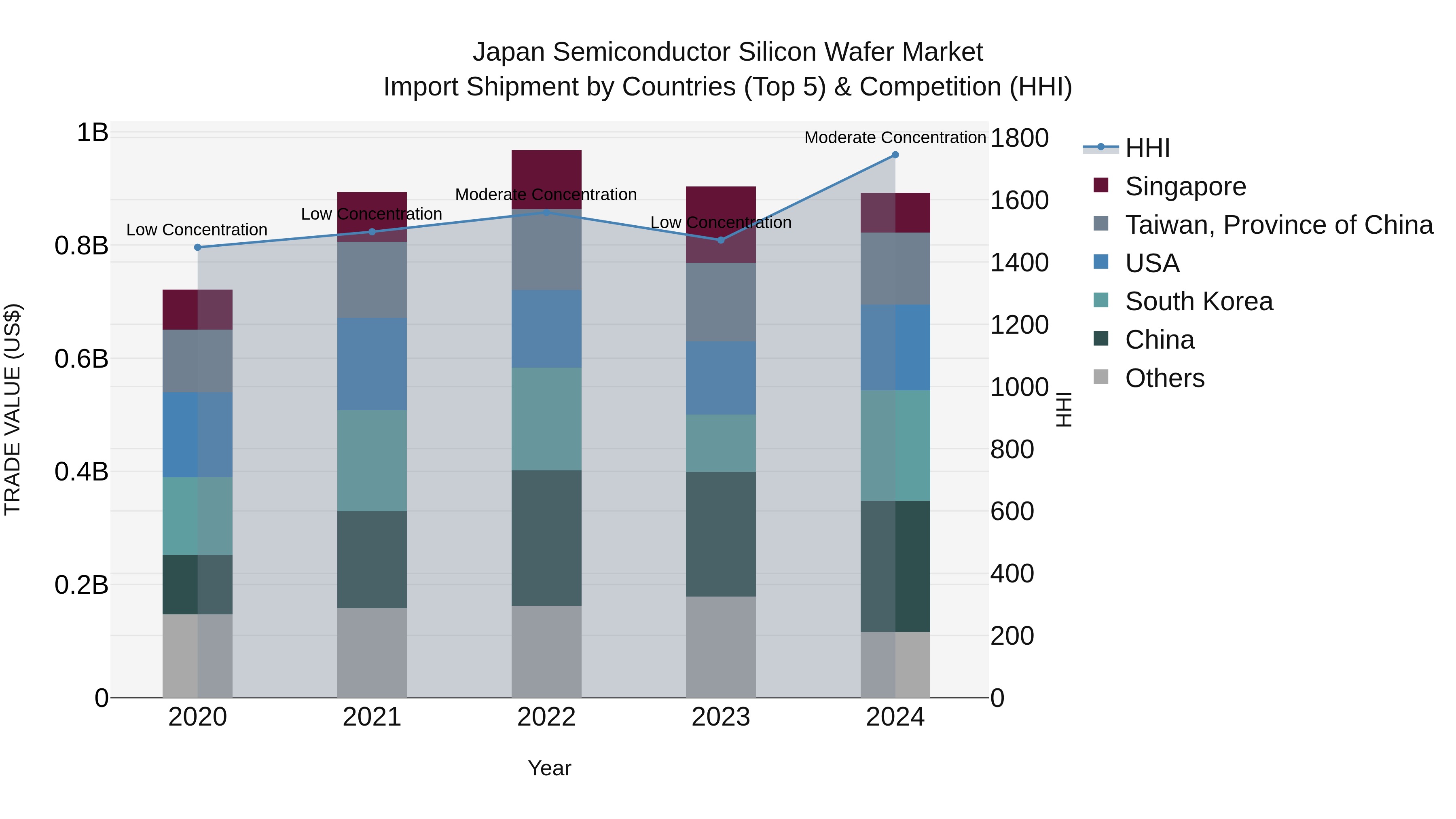
Japan Semiconductor Silicon Wafer Market Import Shipment by Countries (Top 5) & Competition (HHI)
Japan's semiconductor silicon wafer import shipments in 2024 were primarily sourced from China, South Korea, USA, Taiwan, and Singapore. The market exhibited a shift from low to moderate concentration, indicating a more balanced import distribution. With a compound annual growth rate of 5.45% from 2020 to 2024, the industry showed steady expansion. However, there was a slight decline in growth rate from 2023 to 2024 at -1.29%, possibly influenced by market dynamics or external factors. Overall, the import landscape for semiconductor silicon wafers in Japan remains dynamic and competitive.
Japan Semiconductor Silicon Wafer Market Overview
The Japan Semiconductor Silicon Wafer Market is a key player in the global semiconductor industry, with a strong focus on high-quality and advanced technology products. The market is driven by the increasing demand for silicon wafers in the production of integrated circuits and electronic devices. Japan is home to several major semiconductor manufacturers, such as Shin-Etsu Chemical Co., Ltd., SUMCO Corporation, and Siltronic Japan Corporation. These companies are continuously investing in research and development to enhance wafer technology and meet the growing demands of various industries. The market is also influenced by technological advancements in areas like IoT, AI, and automotive electronics, which are driving the need for more sophisticated semiconductor solutions. Overall, the Japan Semiconductor Silicon Wafer Market is poised for steady growth and innovation in the coming years.
Japan Semiconductor Silicon Wafer Market Trends and Opportunities
The Japan Semiconductor Silicon Wafer Market is witnessing significant growth driven by the increasing demand for advanced electronic devices, such as smartphones, automotive components, and IoT devices. With Japan being a key player in the global semiconductor industry, there are ample opportunities for market expansion through technological advancements, collaborations with key players, and investments in research and development. The market is also benefitting from the growing trend of miniaturization and integration of semiconductor components in various industries. Additionally, the shift towards 5G technology, artificial intelligence, and automation is expected to further propel the demand for semiconductor silicon wafers in Japan, presenting a favorable landscape for market players to capitalize on these opportunities and drive innovation in the industry.
Japan Semiconductor Silicon Wafer Market Challenges
In the Japan Semiconductor Silicon Wafer Market, one major challenge is the increasing competition from other global players, particularly from countries like South Korea and Taiwan. These competitors often offer lower prices and more advanced technologies, putting pressure on Japanese silicon wafer manufacturers to stay competitive. Additionally, the market is characterized by high production costs and stringent quality requirements, which can pose challenges for domestic manufacturers in terms of maintaining profitability and meeting the demanding standards of semiconductor manufacturers. Furthermore, the industry is highly dependent on global economic conditions and fluctuations in demand for electronic devices, making it susceptible to market volatility and potential disruptions in supply chains. Overall, Japanese silicon wafer manufacturers need to continuously innovate, improve efficiency, and adapt to changing market dynamics to overcome these challenges and sustain their competitiveness in the industry.
Japan Semiconductor Silicon Wafer Market Drivers
The Japan Semiconductor Silicon Wafer Market is primarily driven by the increasing demand for semiconductor devices in various industries such as electronics, automotive, and telecommunications. The growing adoption of technologies like 5G, IoT, and artificial intelligence is fueling the need for advanced semiconductor devices, leading to a higher demand for silicon wafers. Additionally, the presence of major semiconductor manufacturers in Japan, along with government initiatives to support the semiconductor industry, contributes to the market growth. Technological advancements in semiconductor manufacturing processes, such as the development of smaller and more efficient chips, also drive the demand for silicon wafers in Japan. Overall, factors like increasing technological advancements, demand for high-performance devices, and supportive government policies are key drivers propelling the growth of the Japan Semiconductor Silicon Wafer Market.
Japan Semiconductor Silicon Wafer Market Government Policies
The Japan Semiconductor Silicon Wafer Market is influenced by various government policies aimed at promoting technological innovation and maintaining competitiveness in the global semiconductor industry. The Japanese government has been actively supporting the development of the semiconductor sector through initiatives such as research and development grants, tax incentives for semiconductor manufacturers, and investments in semiconductor infrastructure. Additionally, Japan has implemented regulations to ensure the security and reliability of semiconductor supply chains, particularly in critical industries like automotive and electronics. Overall, government policies in Japan are focused on fostering a favorable environment for semiconductor companies to thrive, enhancing domestic production capabilities, and strengthening the country`s position as a key player in the global semiconductor market.
Japan Semiconductor Silicon Wafer Market Future Outlook
The Japan Semiconductor Silicon Wafer Market is expected to witness steady growth in the coming years due to increasing demand for electronic devices such as smartphones, laptops, and automotive components. The market is also likely to benefit from the growing adoption of advanced technologies like artificial intelligence, Internet of Things (IoT), and 5G networks. Additionally, the Japanese government`s initiatives to promote innovation and research in the semiconductor industry will further drive the market growth. However, factors such as fluctuations in raw material prices, intense competition from other semiconductor manufacturing hubs, and the impact of global economic conditions may pose challenges to the market`s growth trajectory. Overall, the Japan Semiconductor Silicon Wafer Market is poised for expansion, driven by technological advancements and evolving consumer preferences.
Key Highlights of the Report:
- Japan Semiconductor Silicon Wafer Market Outlook
- Market Size of Japan Semiconductor Silicon Wafer Market, 2024
- Forecast of Japan Semiconductor Silicon Wafer Market, 2031
- Historical Data and Forecast of Japan Semiconductor Silicon Wafer Revenues & Volume for the Period 2021- 2031
- Japan Semiconductor Silicon Wafer Market Trend Evolution
- Japan Semiconductor Silicon Wafer Market Drivers and Challenges
- Japan Semiconductor Silicon Wafer Price Trends
- Japan Semiconductor Silicon Wafer Porter's Five Forces
- Japan Semiconductor Silicon Wafer Industry Life Cycle
- Historical Data and Forecast of Japan Semiconductor Silicon Wafer Market Revenues & Volume By Diameter for the Period 2021- 2031
- Historical Data and Forecast of Japan Semiconductor Silicon Wafer Market Revenues & Volume By Less Than 150 Mm for the Period 2021- 2031
- Historical Data and Forecast of Japan Semiconductor Silicon Wafer Market Revenues & Volume By 200 Mm for the Period 2021- 2031
- Historical Data and Forecast of Japan Semiconductor Silicon Wafer Market Revenues & Volume By 300 Mm and Above for the Period 2021- 2031
- Historical Data and Forecast of Japan Semiconductor Silicon Wafer Market Revenues & Volume By Product for the Period 2021- 2031
- Historical Data and Forecast of Japan Semiconductor Silicon Wafer Market Revenues & Volume By Logic for the Period 2021- 2031
- Historical Data and Forecast of Japan Semiconductor Silicon Wafer Market Revenues & Volume By Memory for the Period 2021- 2031
- Historical Data and Forecast of Japan Semiconductor Silicon Wafer Market Revenues & Volume By Analog for the Period 2021- 2031
- Historical Data and Forecast of Japan Semiconductor Silicon Wafer Market Revenues & Volume By Application for the Period 2021- 2031
- Historical Data and Forecast of Japan Semiconductor Silicon Wafer Market Revenues & Volume By Consumer Electronics for the Period 2021- 2031
- Historical Data and Forecast of Japan Semiconductor Silicon Wafer Market Revenues & Volume By Industrial for the Period 2021- 2031
- Historical Data and Forecast of Japan Semiconductor Silicon Wafer Market Revenues & Volume By Telecommunication for the Period 2021- 2031
- Historical Data and Forecast of Japan Semiconductor Silicon Wafer Market Revenues & Volume By Automotive for the Period 2021- 2031
- Japan Semiconductor Silicon Wafer Import Export Trade Statistics
- Market Opportunity Assessment By Diameter
- Market Opportunity Assessment By Product
- Market Opportunity Assessment By Application
- Japan Semiconductor Silicon Wafer Top Companies Market Share
- Japan Semiconductor Silicon Wafer Competitive Benchmarking By Technical and Operational Parameters
- Japan Semiconductor Silicon Wafer Company Profiles
- Japan Semiconductor Silicon Wafer Key Strategic Recommendations






































