Japan Semiconductor Supply Chain Market Size & Growth Rate
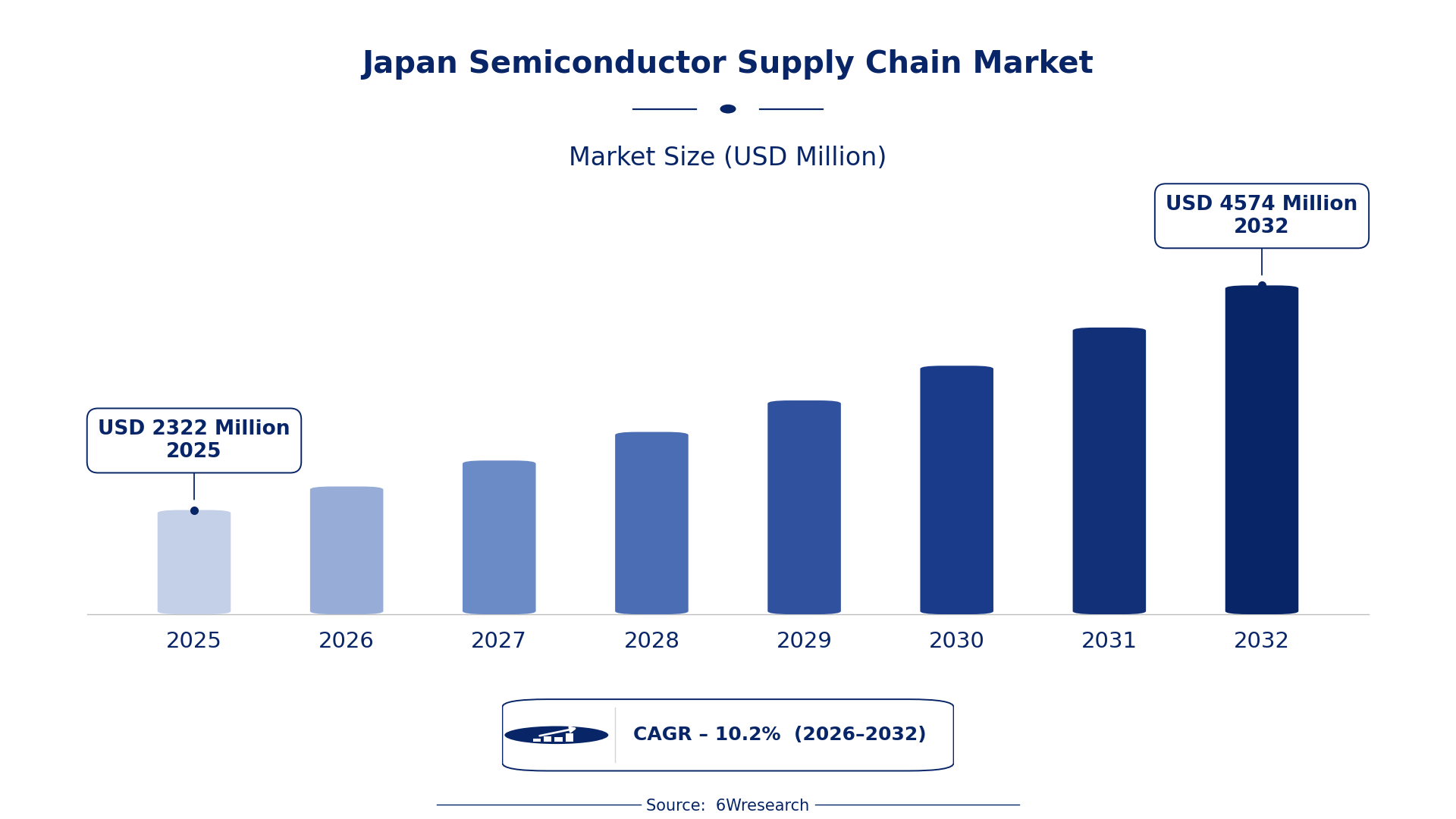
According to 6Wresearch internal database and industry insights, the Japan Semiconductor Supply Chain Market was valued at USD 2,322 Million in 2025 and is projected to reach USD 4,574 Million by 2032, growing at a CAGR of approximately 10.2% during 2026–2032.
Japan Semiconductor Supply Chain Market Highlights
| Report Metric | Details |
| Report Name | Japan Semiconductor Supply Chain Market (2026-2032) |
| Market Size 2025 | USD 2,322 Million |
| Market Size 2032 | USD 4,574 Million |
| Absolute Growth 2025–2032 | USD 2,252 Million |
| CAGR 2026–2032 | 10.2% |
| Peak Annual Growth | 11.3% in 2028 |
| Forecast Period | 2026–2032 |
| Historical Data | 2022–2025 |
| Base Year | 2025 |
| Leading Segment Type, 2025 | Design Houses (45% share) |
| Leading Activity Type, 2025 | IP/Chip Design (43% share) |
| Leading End User, 2025 | Fabless Companies (45% share) |
| Fastest-Growing Segment Type | Foundries (14.0% CAGR) |
| Fastest-Growing Activity Type | Wafer Fabrication (14.4% CAGR) |
| Fastest-Growing End User | Integrated Device Makers (13.8% CAGR) |
| Growing Sector | automotive applications |
| Key End Users | technology firms, automotive manufacturers, electronics OEMs, semiconductor fabs |
Japan Semiconductor Supply Chain Market Year-wise Growth Rate and Key Drivers (2022–2032)
This graph illustrates the annual growth rates of the market from 2022 to 2032, highlighting a steady upward trajectory and projected market expansion over the forecast period.
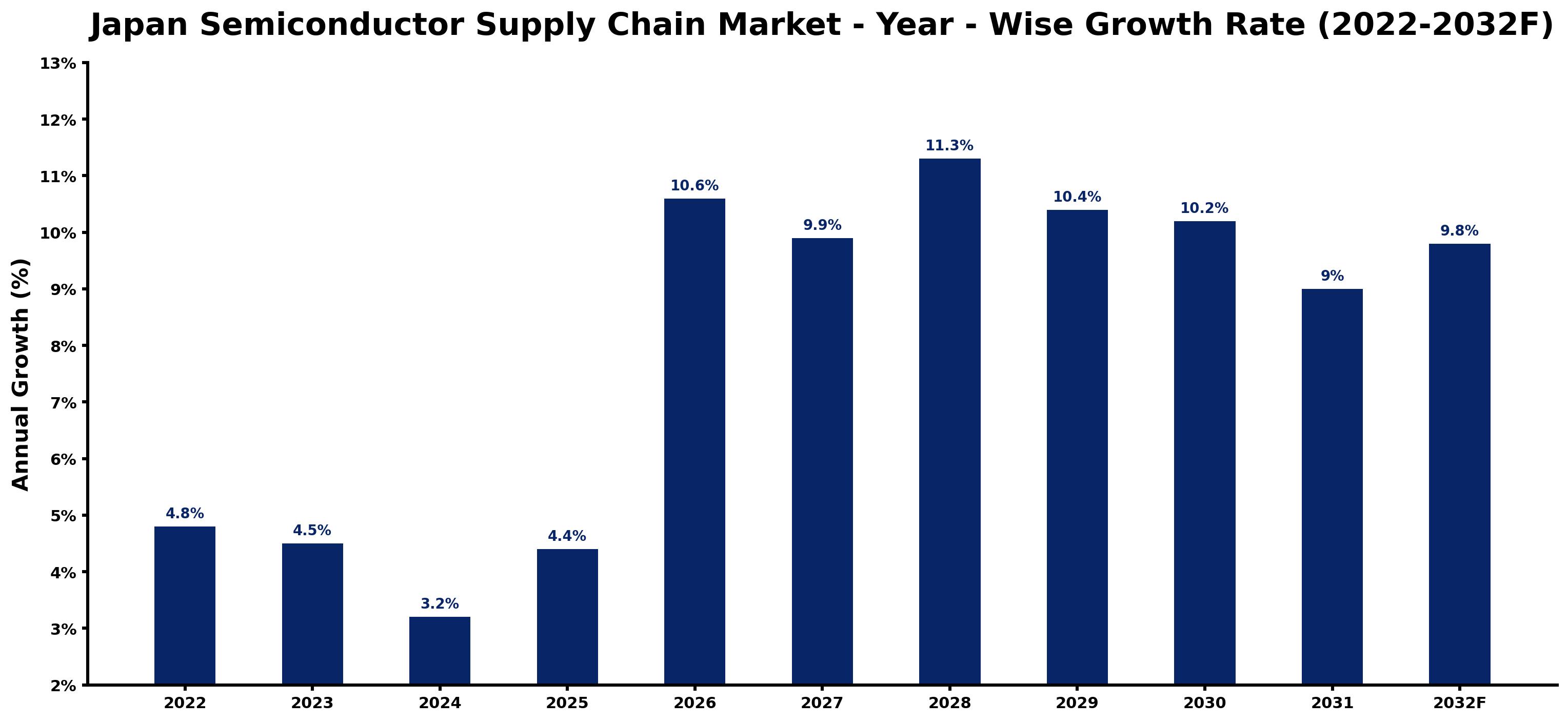
For each year, the table pairs the estimated growth rate with the leading influence on demand, showing how the drivers changed across the period.
| Year | Estimated Annual Growth (%) | Market Rationale |
| 2022 | 4.8 | The market showed solid growth due to strong domestic demand from technology firms. |
| 2023 | 4.5 | Growth slowed as semiconductor manufacturers faced supply chain disruptions and inflationary pressures. |
| 2024 | 3.2 | The market continued to slow as firms adjusted to shifts in global economic conditions. |
| 2025 | 4.4 | Demand increased as automotive manufacturers ramped up production following delays from earlier disruptions. |
| 2026 | 10.6 | Growth is expected to accelerate with advanced semiconductor technologies widely adopted in the industry. |
| 2027 | 9.9 | The market is projected to experience a slowdown as firms consolidate operations and focus on efficiency. |
| 2028 | 11.3 | Demand is expected to surge as new automotive applications drive semiconductor requirements to new heights. |
| 2029 | 10.4 | Growth is projected to slow as the market stabilises after the previous year's peak demand. |
| 2030 | 10.2 | The market will continue to grow, supported by ongoing investments in semiconductor R&D and production. |
| 2031 | 9.0 | Growth is expected to slow as firms face challenges in scaling operations to meet demand. |
| 2032 | 9.8 | Demand is projected to rise as domestic production targets are pursued aggressively. |
Note: Market size estimations and growth projections presented in this report are based on 6Wresearch's proprietary forecasting methodology, utilizing the latest available industry data, government publications, and primary research inputs.
Japan Semiconductor Supply Chain Market Synopsis
The Semiconductor Supply Chain in Japan encompasses the entire process of designing, fabricating, assembling, and testing semiconductor devices, essential for powering electronics, automotive applications, and telecommunications. Domestic demand is driven by technology firms and automotive manufacturers, alongside investments in R&D, with the government allocating 200 billion JPY for industry support in 2023. This combination of factors is propelling growth in the semiconductor supply chain, ensuring Japan remains a key player in the global market.
Market Dynamics Impact Analysis (2026–2032)
| Factor | Type | Impact | Primary Segment Affected |
| Strong domestic demand from technology firms | Driver | High | Design Houses |
| Increased automotive semiconductor requirements | Driver | High | Foundries |
| Rising demand for advanced semiconductor technologies | Opportunity | High | Wafer Fabrication |
| Growing investments in semiconductor R&D | Opportunity | High | OSAT |
| Supply chain disruptions affecting production | Restraint | High | Equipment Suppliers |
| Inflationary pressures impacting operational costs | Restraint | Medium | Integrated Device Makers |
| Challenges in scaling production capacity | Challenge | High | Semiconductor Fabs |
| Competition from international semiconductor markets | Challenge | Medium | Fabless Companies |
Evaluation of Drivers in Japan Semiconductor Supply Chain Market (2026–2032)
Below are the drivers that matter most for revenue growth, with supporting evidence.
| Drivers | Primary Segment Affected | Why It Matters (Evidence) |
| Increased demand for consumer electronics | Foundries | The rise in consumer electronics demand, particularly in Tokyo, drives foundries to ramp up chip production, leading to a 30% increase in orders. |
| Growth in automotive applications | Design Houses | The automotive sector, accounting for 30% of demand, pushes design houses to innovate, increasing their project timelines by 20%. |
| Investment in advanced manufacturing technologies | Wafer Fabrication | The adoption of advanced technologies in wafer fabrication has surpassed 70%, leading to improved production efficiency and higher output. |
| Government support for semiconductor initiatives | OSAT | The 200 billion JPY allocated in 2023 for semiconductor support enhances OSAT capabilities, allowing for a 15% increase in testing capacity. |
| Rising global semiconductor exports | Integrated Device Makers | Japan's semiconductor exports valued at 1.5 trillion JPY in 2022 boost integrated device makers' production to meet international demand. |
Volumes grow on the back of increasing demand for consumer electronics, particularly in Tokyo, where orders surged by 30%. The automotive sector, accounting for 30% of semiconductor demand, pushes design houses to innovate, extending project timelines significantly. Adoption of advanced manufacturing technologies in wafer fabrication exceeds 70%, improving production efficiency. Japan's semiconductor exports valued at 1.5 trillion JPY in 2022 motivate integrated device makers to boost production to meet global demand.
Evaluation of Restraints in Japan Semiconductor Supply Chain Market
These are the pressures that could keep growth below its potential.
| Market Restraint | Primary Segment Affected | Why It Matters (Evidence) |
| Supply chain disruptions affecting production timelines | Equipment Suppliers | Supply chain issues have delayed equipment deliveries, causing production timelines to extend by up to 25%. |
| Inflationary pressures on operational costs | Integrated Device Makers | Rising material costs have increased operational expenses by 15%, impacting profit margins for integrated device makers. |
| Challenges in sourcing raw materials | Foundries | Foundries face difficulties in obtaining essential raw materials, leading to production delays of around 10%. |
| Limited workforce availability in semiconductor fabs | Semiconductor Fabs | A shortage of skilled workers has constrained production capacity, reducing output by approximately 20%. |
| Regulatory compliance costs for new technologies | OSAT | Compliance with new standards has increased operational costs for OSAT providers by 12%, affecting profitability. |
Japan Semiconductor Supply Chain Market Challenges
Rising costs burden buyers in the tech sector, as supply chain disruptions inflate prices across the semiconductor market, valued at approximately 4 trillion JPY in 2022. A shortage of skilled workers, with around 200,000 employed in the industry, leads to project delays and higher labour costs for suppliers. Compliance with complex regulations, such as ISO/IEC 27001 for data security, imposes additional financial burdens on manufacturers. Rapid adoption of advanced technologies, over 70%, strains infrastructure, resulting in potential production delays that hinder suppliers' ability to meet demand.
Trends in the Japan Semiconductor Supply Chain Market
These developments are changing demand patterns in the Japan Semiconductor Supply Chain Market.
- Shift from Traditional to Advanced Semiconductor Technologies: Tokyo is experiencing a shift towards advanced semiconductor technologies, with over 70% adoption in the industry. This change improves production efficiency and meets the rising demand for high-performance electronics.
- Transition from Manual to Automated Testing: The semiconductor testing sector is moving towards automation, driven by increased demand for efficiency. In 2023, automated testing services are projected to rise by 25%, streamlining operations for OSAT providers.
- Emergence of Eco-Friendly Semiconductor Solutions: The focus on sustainability is leading to the development of eco-friendly semiconductor solutions. The Green Growth Strategy aims for carbon neutrality by 2050, influencing design practices across the industry.
- Prioritisation of Domestic Production: Japan is prioritising domestic semiconductor production to reduce reliance on imports. The government aims for a 20% increase in local production by 2025, encouraging investments in new fabs.
Investment Opportunities in the Japan Semiconductor Supply Chain Market
The opportunities below stand out in the Japan Semiconductor Supply Chain Market for new entrants and existing suppliers.
- Growing Demand from Automotive Manufacturers: Automotive manufacturers are increasingly seeking advanced semiconductor solutions, with the automotive sector accounting for about 30% of demand. Investing in R&D for automotive applications can yield substantial returns, especially in regions like Osaka.
- Investment in Semiconductor R&D: With 200 billion JPY allocated for semiconductor support in 2023, there is a substantial opportunity for firms to invest in R&D. Collaborating with local universities can facilitate access to new technologies, enhancing competitive advantage.
- Expansion of Semiconductor Fabs: The need for increased domestic production presents an opportunity to expand semiconductor fabs. Targeting regions like Tokyo can enhance production capabilities, addressing the growing market demand.
- Supply of Advanced Testing Services: As demand for semiconductor testing rises, there is an opportunity to provide advanced testing services. Engaging with OSAT providers can create partnerships to meet this demand effectively.
Government Initiatives in the Japan Semiconductor Supply Chain Market
The Semiconductor and Digital Industry Strategy, established by the Ministry of Economy, Trade and Industry in June 2021, outlines measures to secure domestic semiconductor manufacturing capabilities. This strategy aims to ensure a stable supply chain and reduce reliance on imports, which directly benefits the Semiconductor Supply Chain by promoting local production and innovation. The government allocated 200 billion JPY for semiconductor industry support in 2023, focusing on enhancing R&D and production capabilities, promoting collaboration between industry and academia to drive innovation.
In 2023, the government allocated 200 billion JPY for semiconductor industry support, administered by the Ministry of Economy, Trade and Industry. This funding aims to boost R&D and improve production capabilities, focusing on fostering collaboration between industry and academia to drive innovation in the Semiconductor Supply Chain. The Japan Semiconductor Manufacturing Association plays a key role in promoting industry growth and facilitating partnerships.
Future Insight of the Japan Semiconductor Supply Chain Market
A policy-driven shift towards increased domestic semiconductor production will reshape the market by 2032. The Ministry of Economy, Trade and Industry's new programme will stimulate research and development, encouraging innovation. Enhanced collaboration among industry associations will streamline processes and improve supply chain responsiveness. By 2030, advancements outlined in the Semiconductor Technology Roadmap will elevate efficiency and reduce operational costs, benefiting both buyers and suppliers.
Market Segmentation Analysis
Japan Semiconductor Supply Chain Market report covers a detailed analysis of the following market segments:
By Segment Type – Design Houses Lead, Foundries Expected to Grow Fastest
According to Saurav Kr Singh, Senior Research Analyst at 6Wresearch, Design Houses held 45% of the Japan Semiconductor Supply Chain Market by segment type in 2025. Design houses hold the largest share because they play a crucial role in creating semiconductor chip designs tailored to various industry needs. Their influence is particularly strong in regions like Tokyo and Osaka, where a dense network of semiconductor fabs relies on their expertise. Foundries are set to record the highest CAGR in this split, 14.0% over 2026–2032. Foundries are witnessing rapid growth as they scale up operations to satisfy the increasing demand for semiconductor manufacturing. The government's recent programme to support semiconductor R&D is expected to further enhance their production capabilities, allowing them to maintain a competitive edge. This indicates that suppliers should prioritise building strong relationships with design houses to ensure consistent demand for their services.
By Activity Type – IP/Chip Design Leads, Wafer Fabrication Expected to Grow Fastest
In 2025, IP/Chip Design led the activity type split with a 43% share. IP/chip design leads the market as it is fundamental in developing the intellectual property that drives advancements in semiconductor technology. With over 70% adoption of advanced semiconductor technologies in Japan, this segment is vital for meeting the evolving needs of the tech sector. Wafer Fabrication is projected to grow fastest, at a CAGR of 14.4% during 2026–2032. Wafer fabrication is experiencing swift growth due to rising demand for semiconductor chips across various sectors, especially automotive and electronics. The substantial installed base of semiconductor manufacturing equipment, surpassing 500 billion JPY, highlights the industry's commitment to increasing wafer production capacity. This suggests that buyers should focus on investing in advanced wafer fabrication technologies to maintain competitiveness in the semiconductor market.
By End User – Fabless Companies Lead, Integrated Device Makers Expected to Grow Fastest
Fabless Companies took 45% of end user revenue in 2025, more than any other category. Fabless companies dominate the market as they effectively utilise design capabilities while outsourcing manufacturing to foundries, enabling them to focus on innovation. This business model thrives in Japan, bolstered by strong domestic demand from technology firms that rely on their designs. The quickest growth will come from Integrated Device Makers, forecast to expand at a CAGR of 13.8% between 2026 and 2032. Integrated device makers are rapidly growing as they adopt in-house manufacturing to gain better control over production and quality. This trend is likely to continue as the government aims to increase domestic semiconductor production by 20% by 2025, further supporting their expansion. This means that suppliers should tailor their offerings to meet the specific requirements of integrated device makers as they enhance their manufacturing capabilities.
Key Attractiveness of the Report
- 10 Years of Market Numbers
- Historical Data Starting from 2022 to 2025
- Base Year 2025
- Forecast Data until 2032
- Key Performance Indicators Impacting the Market
- Major Upcoming Developments and Projects
Key Highlights of the Report:
- Japan Semiconductor Supply Chain Market Outlook
- Market Size of Japan Semiconductor Supply Chain Market, 2025
- Forecast of Japan Semiconductor Supply Chain Market, 2032
- Historical Data and Forecast of Japan Semiconductor Supply Chain Revenues & Volume for the Period 2022-2032F
- Japan Semiconductor Supply Chain Market Trend Evolution
- Japan Semiconductor Supply Chain Market Drivers and Challenges
- Japan Semiconductor Supply Chain Price Trends
- Japan Semiconductor Supply Chain Porter's Five Forces
- Japan Semiconductor Supply Chain Industry Life Cycle
- Historical Data and Forecast of Japan Semiconductor Supply Chain Market Revenues & Volume By Segment Type for the Period 2022-2032F
- Historical Data and Forecast of Japan Semiconductor Supply Chain Market Revenues & Volume By Design Houses for the Period 2022-2032F
- Historical Data and Forecast of Japan Semiconductor Supply Chain Market Revenues & Volume By Foundries for the Period 2022-2032F
- Historical Data and Forecast of Japan Semiconductor Supply Chain Market Revenues & Volume By OSAT for the Period 2022-2032F
- Historical Data and Forecast of Japan Semiconductor Supply Chain Market Revenues & Volume By Equipment Suppliers for the Period 2022-2032F
- Historical Data and Forecast of Japan Semiconductor Supply Chain Market Revenues & Volume By Activity Type for the Period 2022-2032F
- Historical Data and Forecast of Japan Semiconductor Supply Chain Market Revenues & Volume By IP/Chip Design for the Period 2022-2032F
- Historical Data and Forecast of Japan Semiconductor Supply Chain Market Revenues & Volume By Wafer Fabrication for the Period 2022-2032F
- Historical Data and Forecast of Japan Semiconductor Supply Chain Market Revenues & Volume By Assembly & Test for the Period 2022-2032F
- Historical Data and Forecast of Japan Semiconductor Supply Chain Market Revenues & Volume By Tool Manufacturing for the Period 2022-2032F
- Historical Data and Forecast of Japan Semiconductor Supply Chain Market Revenues & Volume By End User for the Period 2022-2032F
- Historical Data and Forecast of Japan Semiconductor Supply Chain Market Revenues & Volume By Fabless Companies for the Period 2022-2032F
- Historical Data and Forecast of Japan Semiconductor Supply Chain Market Revenues & Volume By Integrated Device Makers for the Period 2022-2032F
- Historical Data and Forecast of Japan Semiconductor Supply Chain Market Revenues & Volume By Automotive/Electronics OEMs for the Period 2022-2032F
- Historical Data and Forecast of Japan Semiconductor Supply Chain Market Revenues & Volume By Semiconductor Fabs for the Period 2022-2032F
- Japan Semiconductor Supply Chain Import Export Trade Statistics
- Market Opportunity Assessment By Segment Type
- Market Opportunity Assessment By Activity Type
- Market Opportunity Assessment By End User
- Japan Semiconductor Supply Chain Top Companies Market Share
- Japan Semiconductor Supply Chain Competitive Benchmarking By Technical and Operational Parameters
- Japan Semiconductor Supply Chain Company Profiles
- Japan Semiconductor Supply Chain Key Strategic Recommendations
Market Covered
This report examines the market across the segments below.
By Segment Type
- Design Houses
- Foundries
- OSAT
- Equipment Suppliers
By Activity Type
- IP/Chip Design
- Wafer Fabrication
- Assembly & Test
- Tool Manufacturing
By End User
- Fabless Companies
- Integrated Device Makers
- Automotive/Electronics OEMs
- Semiconductor Fabs































