Japan Semiconductor Test Systems Market Size & Growth Rate
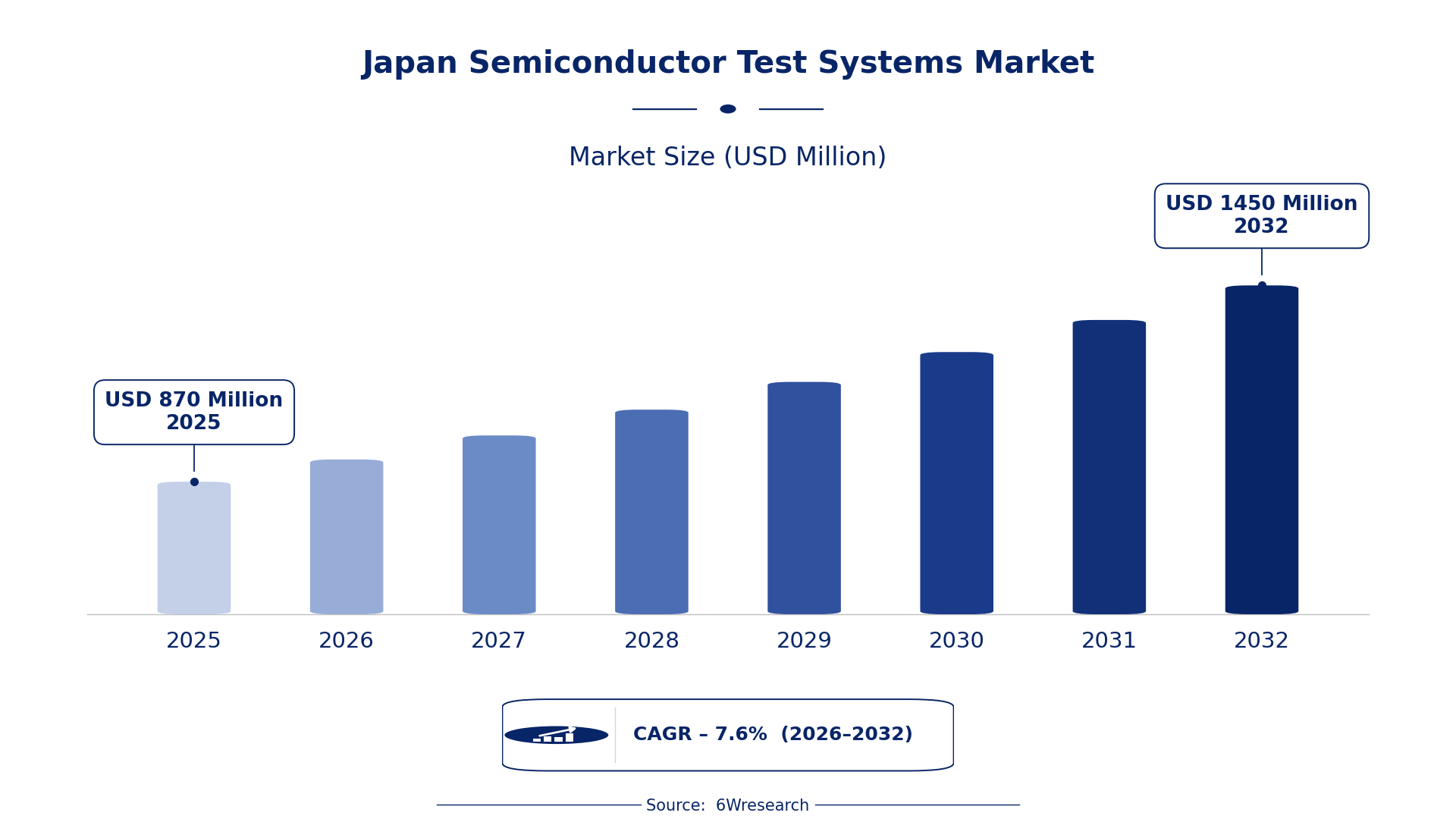
According to 6Wresearch internal database and industry insights, the Japan Semiconductor Test Systems Market was valued at USD 870 Million in 2025 and is projected to reach USD 1,450 Million by 2032, growing at a CAGR of approximately 7.6% during 2026–2032.
Japan Semiconductor Test Systems Market Highlights
| Report Metric | Details |
| Report Name | Japan Semiconductor Test Systems Market (2026-2032) |
| Market Size 2025 | USD 870 Million |
| Market Size 2032 | USD 1,450 Million |
| Absolute Growth 2025–2032 | USD 580 Million |
| CAGR 2026–2032 | 7.6% |
| Peak Annual Growth | 8.3% in 2028 |
| Forecast Period | 2026–2032 |
| Historical Data | 2022–2025 |
| Base Year | 2025 |
| Leading System Type, 2025 | ATE (Automatic Test Equip.) (48% share) |
| Leading Test Type, 2025 | Digital/Analog (48% share) |
| Leading Technology Platform, 2025 | Modular Architecture (47% share) |
| Leading End User, 2025 | OSATs & Foundries (42% share) |
| Fastest-Growing System Type | SoC Test Systems (10.7% CAGR) |
| Fastest-Growing Test Type | Mixed Signal (10.8% CAGR) |
| Fastest-Growing Technology Platform | SoC Interface (10.9% CAGR) |
| Fastest-Growing End User | Mobile Chipset Makers (10.1% CAGR) |
| Growing Sector | semiconductor testing |
| Key End Users | OSAT facilities, semiconductor manufacturers, mobile chipset makers, communication IC suppliers |
Japan Semiconductor Test Systems Market Year-wise Growth Rate and Key Drivers (2022–2032)
This graph illustrates the annual growth rates of the market from 2022 to 2032, highlighting a steady upward trajectory and projected market expansion over the forecast period.
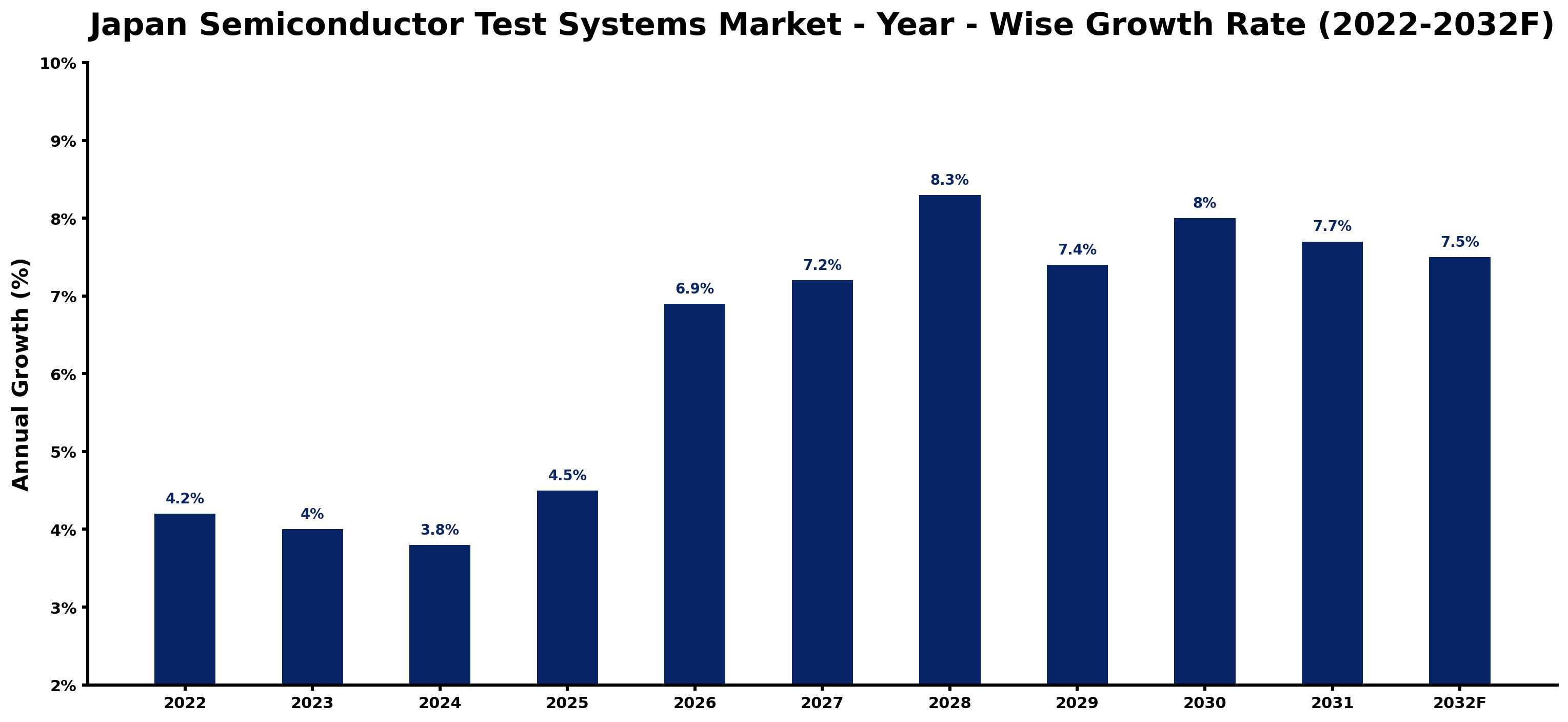
Below, each year's estimated growth is shown next to the factor that most influenced it.
| Year | Estimated Annual Growth (%) | Market Rationale |
| 2022 | 4.2 | The market showed steady growth, reflecting ongoing demand from domestic manufacturers. |
| 2023 | 4.0 | Growth slowed slightly due to market adjustments and supply chain considerations. |
| 2024 | 3.8 | The market continued to experience a slowdown as manufacturers adapted to new technologies. |
| 2025 | 4.5 | Growth accelerated as investments in semiconductor technology began to materialise. |
| 2026 | 6.9 | The market is projected to expand due to increased adoption of 5G technology. |
| 2027 | 7.2 | Demand is expected to rise as the need for advanced testing systems increases. |
| 2028 | 8.3 | The market will peak with heightened investments in semiconductor capabilities. |
| 2029 | 7.4 | A slight slowdown is anticipated as the market stabilises after peak growth. |
| 2030 | 8.0 | Growth is expected to rise again as new technologies emerge in the sector. |
| 2031 | 7.7 | The market will experience a slowdown as it adjusts to changing demands. |
| 2032 | 7.5 | Growth will continue but at a moderated pace as saturation approaches. |
Note: Market size estimations and growth projections presented in this report are based on 6Wresearch's proprietary forecasting methodology, utilizing the latest available industry data, government publications, and primary research inputs.
Japan Semiconductor Test Systems Market Synopsis
Semiconductor Test Systems are advanced tools used to evaluate the functionality and performance of semiconductor devices. In Japan, the semiconductor industry generated approximately 3 trillion JPY in 2022, with strong demand from domestic manufacturers. The Japan Semiconductor Test Systems Market is growing due to increased investment in semiconductor technology, driven by the adoption of 5G technology and the need for quality assurance in chip production. The installed base of semiconductor test systems exceeds 10,000 units, reflecting the extensive infrastructure supporting this growth.
Market Dynamics Impact Analysis (2026–2032)
| Factor | Type | Impact | Primary Segment Affected |
| Increased investment in semiconductor technology development | Driver | High | ATE (Automatic Test Equip.) |
| Rising demand for 5G technology adoption | Driver | High | SoC Test Systems |
| Growing need for advanced testing capabilities | Opportunity | High | RF Test Systems |
| Expansion of OSAT facilities in Japan | Opportunity | Medium | OSATs & Foundries |
| Aging test equipment requiring upgrades | Restraint | High | Wafer-Level Test Systems |
| Limited availability of skilled semiconductor engineers | Restraint | Medium | IDM Test Facilities |
| High costs associated with advanced testing systems | Challenge | High | Digital/Analog |
| Competition from international semiconductor test system providers | Challenge | Medium | Mixed Signal |
Evaluation of Drivers in Japan Semiconductor Test Systems Market (2026–2032)
The following drivers explain most of the expected growth.
| Drivers | Primary Segment Affected | Why It Matters (Evidence) |
| Investment in semiconductor R&D | ATE (Automatic Test Equip.) | Japan's average investment in semiconductor R&D is around 200 billion JPY annually, leading to increased demand for advanced testing systems. |
| Growing production of semiconductor devices | SoC Test Systems | The annual production of semiconductor devices in Japan is about 1.2 billion units, driving demand for efficient testing solutions. |
| Adoption of 5G technology | RF Test Systems | Japan's semiconductor test system market is expected to grow due to the increasing demand for 5G technology. |
| Expansion of OSAT facilities | OSATs & Foundries | Japan has over 50 OSAT facilities, which are major users of semiconductor test systems. |
| Compliance with international standards | Wafer-Level Test Systems | Japan's semiconductor testing is aligned with ISO/IEC 17025, ensuring quality and reliability. |
Most of the extra volume comes from investments in semiconductor research and development, with an average of 200 billion JPY spent annually. The annual production of semiconductor devices in Japan, approximately 1.2 billion units, drives the need for efficient testing systems. The growing adoption of 5G technology will further boost the semiconductor test systems market. The presence of over 50 OSAT facilities in Japan creates a strong demand for these systems. Adherence to international standards ensures the reliability of testing processes and attracts more buyers.
Evaluation of Restraints in Japan Semiconductor Test Systems Market
The key brakes on demand, and where they bite hardest, are shown below.
| Market Restraint | Primary Segment Affected | Why It Matters (Evidence) |
| Aging test equipment requiring upgrades | Digital/Analog | The average age of semiconductor test equipment in Japan is around 5 years, necessitating upgrades to maintain efficiency. |
| Limited availability of skilled engineers | IDM Test Facilities | With approximately 100,000 registered semiconductor engineers in Japan, the talent pool is constrained, impacting production capabilities. |
| High costs associated with advanced testing systems | Mixed Signal | The initial investment for advanced testing systems can be prohibitive, limiting access for smaller manufacturers. |
| Dependence on imported technology | SoC Test Systems | Some semiconductor test technologies are still imported, which can lead to supply chain vulnerabilities. |
| Regulatory compliance costs | RF Test Systems | Compliance with JIS standards can increase operational costs for manufacturers. |
Japan Semiconductor Test Systems Market Challenges
Buyers encounter high costs due to dependence on advanced semiconductor test systems, which can increase expenses by approximately 20%. Skills shortages in Japan restrict the availability of qualified engineers, resulting in project delays of up to three months for producers. Adhering to ISO/IEC 17025 standards can elevate testing costs by 15% for manufacturers, straining their budgets. Regulatory changes from the Ministry of Economy, Trade and Industry introduce uncertainty for buyers, potentially postponing the launch of new semiconductor products and adversely affecting market competitiveness.
Trends in the Japan Semiconductor Test Systems Market
Several trends are reshaping the Japan Semiconductor Test Systems Market; the most important are set out below.
- Shift in Demand from Traditional to Advanced Testing: OSAT facilities in Japan are increasingly adopting advanced testing systems to meet the demands of 5G technology. In 2023, over 50% of these facilities upgraded their testing equipment, reflecting a shift in industry standards.
- Integration of AI in Semiconductor Testing: Since 2022, the integration of AI technologies in semiconductor testing has gained traction. This shift is occurring in the Tokyo region, where AI-driven testing solutions are now being implemented in over 30% of testing facilities.
- Transition from Manual to Automated Testing: The move towards automation in semiconductor testing began in 2021, with many manufacturers in Japan adopting automated systems. Currently, approximately 40% of testing processes are automated, improving efficiency and accuracy.
- Growth of Modular Testing Solutions: The trend towards modular testing platforms started in 2020, allowing for greater flexibility in testing processes. By 2023, modular systems accounted for nearly 47% of the market share in Japan.
Investment Opportunities in the Japan Semiconductor Test Systems Market
Where to invest in the Japan Semiconductor Test Systems Market: the main openings are set out below.
- Timing for Investment in Advanced Testing: With Japan's semiconductor industry generating approximately 3 trillion JPY in 2022, now presents an excellent opportunity to invest in advanced testing systems. OSAT facilities are actively seeking partners to enhance their testing capabilities.
- Expansion of OSAT Facilities: The Tokyo region is witnessing a surge in OSAT facility expansions, with over 50 facilities involved in semiconductor packaging and testing. This growth offers opportunities for suppliers of testing systems.
- Gap in Advanced Testing Capabilities: Japan's semiconductor test system market is anticipated to grow substantially, driven by the demand for advanced testing solutions. Suppliers can enter the market by forming joint ventures with local manufacturers.
- Entry into Modular Testing Solutions: The demand for modular architecture in testing systems is on the rise, with a market share of 47%. Suppliers can establish a presence through partnerships with local OSATs.
Government Initiatives in the Japan Semiconductor Test Systems Market
The Semiconductor and Digital Industry Strategy, established by the Ministry of Economy, Trade and Industry in June 2021, outlines measures to secure domestic semiconductor manufacturing. This strategy includes funding for research and development, aiming to strengthen Japan's semiconductor capabilities. The Economic Security Promotion Act of 2022 further supports supply-chain resilience for critical products, ensuring that semiconductor manufacturers can operate effectively in a competitive environment.
The Ministry of Economy, Trade and Industry oversees the implementation of various initiatives, approving funding for semiconductor research projects. In 2023, the government allocated 500 billion JPY for semiconductor research, targeting advancements in testing technologies. Additionally, the Japan Electronics and Information Technology Industries Association plays a role in promoting industry standards and collaboration among semiconductor manufacturers.
Future Insight of the Japan Semiconductor Test Systems Market
By 2032, buyers will benefit from improved semiconductor testing capabilities as government investment in research reaches 500 billion JPY. The adoption of AI and IoT technologies will streamline testing processes, enhancing efficiency for producers. New testing facilities will emerge, supporting the production of 1.2 billion semiconductor devices annually. Collaborative initiatives will promote industry standards, encouraging innovation and strengthening partnerships across the semiconductor testing sector.
Market Segmentation Analysis
Japan Semiconductor Test Systems Market report covers a detailed analysis of the following market segments:
By System Type – ATE (Automatic Test Equip.) Leads, SoC Test Systems Expected to Grow Fastest
According to Saurav Kr Singh, Senior Research Analyst at 6Wresearch, in 2025, ATE (Automatic Test Equip.) led the system type split with a 48% share. ATE holds the largest share due to its essential role in testing semiconductor performance, with over 10,000 units currently in operation across Japan. This extensive installed base among manufacturers underscores its critical importance in maintaining quality standards in semiconductor production. Over 2026–2032, SoC Test Systems are expected to post the fastest growth, at a CAGR of 10.7%. SoC Test Systems are witnessing rapid growth as the need for system-on-chip validation escalates, particularly with advancements in 5G technology. This increasing demand for integrated solutions indicates that ATE's lead will continue to widen as it adapts to these trends. Suppliers should focus on enhancing their ATE offerings to meet the growing requirements for system-on-chip testing.
By Test Type – Digital/Analog Leads, Mixed Signal Expected to Grow Fastest
The largest test type category in 2025 was Digital/Analog, at 48% of revenue. Digital/Analog testing dominates the market as it is essential for evaluating both digital and analog circuits, which are prevalent in various semiconductor devices. This versatility makes it a preferred choice among manufacturers. Mixed Signal is projected to grow fastest, at a CAGR of 10.8% during 2026–2032. Mixed Signal testing is growing swiftly as the complexity of devices increases, necessitating the need for testing capabilities that can handle both digital and analog signals simultaneously. This trend is particularly relevant in the context of modern electronics. Buyers will benefit from investing in advanced Mixed Signal testing solutions to keep pace with technological advancements.
By Technology Platform – Modular Architecture Leads, SoC Interface Expected to Grow Fastest
Modular Architecture accounted for 47% of the market by technology platform in 2025. Modular Architecture leads the segment as it enables manufacturers to customise their testing systems according to specific semiconductor requirements. This flexibility is vital for optimising the efficiency and effectiveness of testing processes in a competitive market. The quickest growth will come from SoC Interface, forecast to expand at a CAGR of 10.9% between 2026 and 2032. SoC Interface technology is gaining momentum due to its critical role in testing modern integrated circuits, especially as chip designs become more complex. This trend highlights the necessity for modular systems to evolve alongside technological advancements. Suppliers must prioritise the development of Modular Architecture to accommodate the increasing complexity of semiconductor testing.
By End User – OSATs & Foundries Lead, Mobile Chipset Makers Expected to Grow Fastest
With 42% of end user revenue in 2025, OSATs & Foundries was the largest category. OSATs & Foundries are the primary consumers of semiconductor test systems, employing them extensively in the production of chips. Their substantial investment in testing infrastructure reflects their pivotal role in ensuring quality and reliability in semiconductor manufacturing. Mobile Chipset Makers are set to record the highest CAGR in this split, 10.1% over 2026–2032. Mobile Chipset Makers are rapidly increasing their use of semiconductor test systems, driven by the surging demand for advanced mobile technologies. This growth signifies a shift towards more sophisticated testing requirements, further solidifying the importance of OSATs & Foundries. Suppliers should tailor their offerings to meet the specific needs of Mobile Chipset Makers to capitalise on this expanding market.
Key Attractiveness of the Report
- 10 Years of Market Numbers
- Historical Data Starting from 2022 to 2025
- Base Year 2025
- Forecast Data until 2032
- Key Performance Indicators Impacting the Market
- Major Upcoming Developments and Projects
Key Highlights of the Report:
- Japan Semiconductor Test Systems Market Outlook
- Market Size of Japan Semiconductor Test Systems Market, 2025
- Forecast of Japan Semiconductor Test Systems Market, 2032
- Historical Data and Forecast of Japan Semiconductor Test Systems Revenues & Volume for the Period 2022-2032F
- Japan Semiconductor Test Systems Market Trend Evolution
- Japan Semiconductor Test Systems Market Drivers and Challenges
- Japan Semiconductor Test Systems Price Trends
- Japan Semiconductor Test Systems Porter's Five Forces
- Japan Semiconductor Test Systems Industry Life Cycle
- Historical Data and Forecast of Japan Semiconductor Test Systems Market Revenues & Volume By System Type for the Period 2022-2032F
- Historical Data and Forecast of Japan Semiconductor Test Systems Market Revenues & Volume By ATE (Automatic Test Equip.) for the Period 2022-2032F
- Historical Data and Forecast of Japan Semiconductor Test Systems Market Revenues & Volume By SoC Test Systems for the Period 2022-2032F
- Historical Data and Forecast of Japan Semiconductor Test Systems Market Revenues & Volume By RF Test Systems for the Period 2022-2032F
- Historical Data and Forecast of Japan Semiconductor Test Systems Market Revenues & Volume By Wafer-Level Test Systems for the Period 2022-2032F
- Historical Data and Forecast of Japan Semiconductor Test Systems Market Revenues & Volume By Test Type for the Period 2022-2032F
- Historical Data and Forecast of Japan Semiconductor Test Systems Market Revenues & Volume By Digital/Analog for the Period 2022-2032F
- Historical Data and Forecast of Japan Semiconductor Test Systems Market Revenues & Volume By Mixed Signal for the Period 2022-2032F
- Historical Data and Forecast of Japan Semiconductor Test Systems Market Revenues & Volume By Signal Quality for the Period 2022-2032F
- Historical Data and Forecast of Japan Semiconductor Test Systems Market Revenues & Volume By Wafer Probing for the Period 2022-2032F
- Historical Data and Forecast of Japan Semiconductor Test Systems Market Revenues & Volume By Technology Platform for the Period 2022-2032F
- Historical Data and Forecast of Japan Semiconductor Test Systems Market Revenues & Volume By Modular Architecture for the Period 2022-2032F
- Historical Data and Forecast of Japan Semiconductor Test Systems Market Revenues & Volume By SoC Interface for the Period 2022-2032F
- Historical Data and Forecast of Japan Semiconductor Test Systems Market Revenues & Volume By mmWave + 5G Support for the Period 2022-2032F
- Historical Data and Forecast of Japan Semiconductor Test Systems Market Revenues & Volume By On-Chip Diagnostics for the Period 2022-2032F
- Historical Data and Forecast of Japan Semiconductor Test Systems Market Revenues & Volume By End User for the Period 2022-2032F
- Historical Data and Forecast of Japan Semiconductor Test Systems Market Revenues & Volume By OSATs & Foundries for the Period 2022-2032F
- Historical Data and Forecast of Japan Semiconductor Test Systems Market Revenues & Volume By Mobile Chipset Makers for the Period 2022-2032F
- Historical Data and Forecast of Japan Semiconductor Test Systems Market Revenues & Volume By Communication IC Suppliers for the Period 2022-2032F
- Historical Data and Forecast of Japan Semiconductor Test Systems Market Revenues & Volume By IDM Test Facilities for the Period 2022-2032F
- Japan Semiconductor Test Systems Import Export Trade Statistics
- Market Opportunity Assessment By System Type
- Market Opportunity Assessment By Test Type
- Market Opportunity Assessment By Technology Platform
- Market Opportunity Assessment By End User
- Japan Semiconductor Test Systems Top Companies Market Share
- Japan Semiconductor Test Systems Competitive Benchmarking By Technical and Operational Parameters
- Japan Semiconductor Test Systems Company Profiles
- Japan Semiconductor Test Systems Key Strategic Recommendations
Market Covered
This report examines the market across the segments below.
By System Type
- ATE (Automatic Test Equip.)
- SoC Test Systems
- RF Test Systems
- Wafer-Level Test Systems
By Test Type
- Digital/Analog
- Mixed Signal
- Signal Quality
- Wafer Probing
By Technology Platform
- Modular Architecture
- SoC Interface
- mmWave + 5G Support
- On-Chip Diagnostics
By End User
- OSATs & Foundries
- Mobile Chipset Makers
- Communication IC Suppliers
- IDM Test Facilities































