Japan Semiconductor Testing Equipment Market Size & Growth Rate
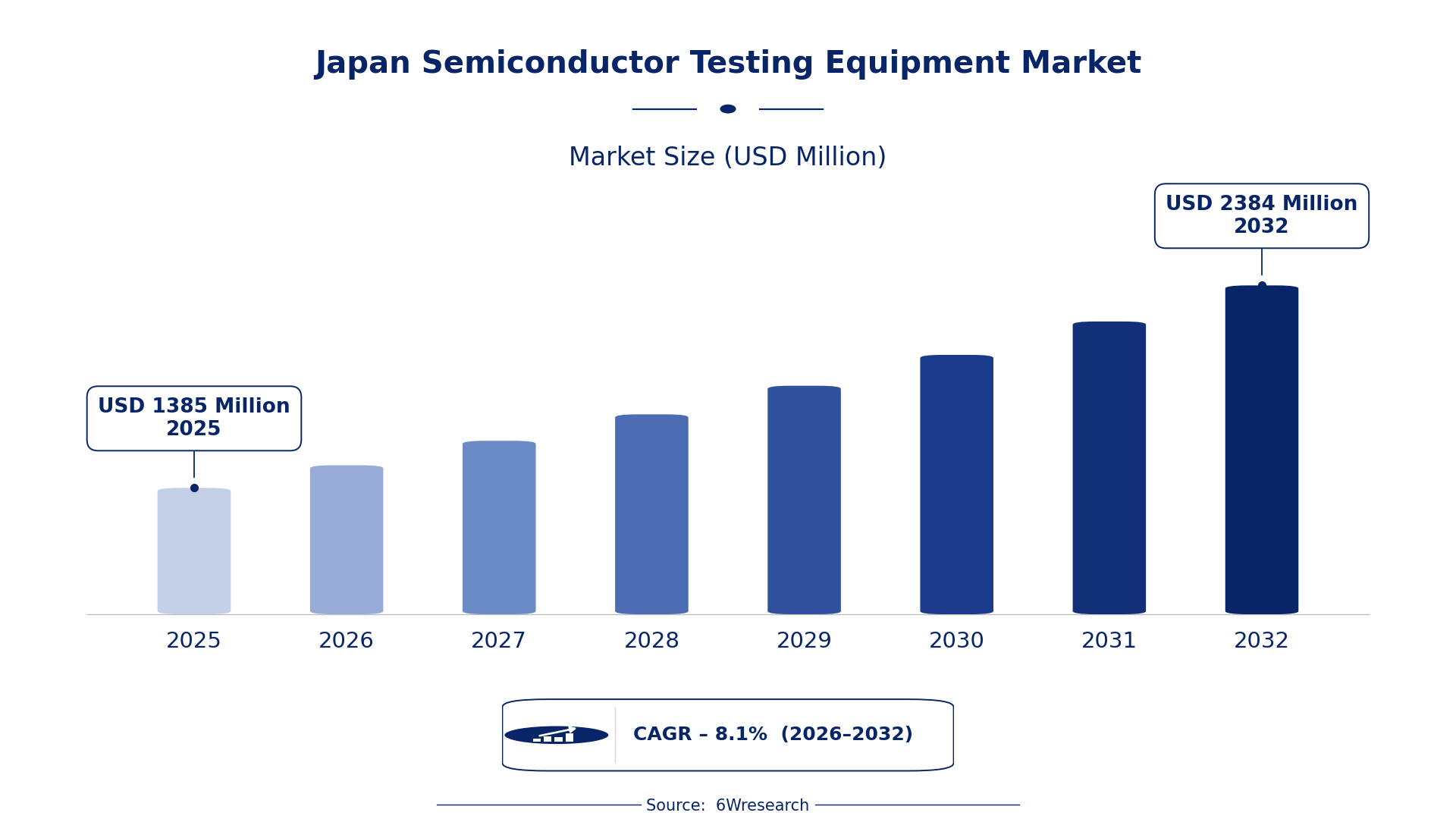
According to 6Wresearch internal database and industry insights, the Japan Semiconductor Testing Equipment Market was valued at USD 1,385 Million in 2025 and is projected to reach USD 2,384 Million by 2032, growing at a CAGR of approximately 8.1% during 2026–2032.
Japan Semiconductor Testing Equipment Market Highlights
| Report Metric | Details |
| Report Name | Japan Semiconductor Testing Equipment Market (2026-2032) |
| Market Size 2025 | USD 1,385 Million |
| Market Size 2032 | USD 2,384 Million |
| Absolute Growth 2025–2032 | USD 999 Million |
| CAGR 2026–2032 | 8.1% |
| Peak Annual Growth | 9.2% in 2032 |
| Forecast Period | 2026–2032 |
| Historical Data | 2022–2025 |
| Base Year | 2025 |
| Leading Equipment Type, 2025 | Final Test Handlers (47% share) |
| Leading Testing Phase, 2025 | Front-End (45% share) |
| Leading Integration Level, 2025 | Automated (45% share) |
| Leading End User, 2025 | Wafer Fabs (35% share) |
| Fastest-Growing Equipment Type | Wafer Probers (11.4% CAGR) |
| Fastest-Growing Testing Phase | Post-Packaging (11.2% CAGR) |
| Fastest-Growing End User | OSAT Vendors (10.5% CAGR) |
| Growing Sector | automotive sector |
| Key End Users | wafer fabs, OSAT vendors, automotive IC suppliers, memory chip producers |
Japan Semiconductor Testing Equipment Market Year-wise Growth Rate and Key Drivers (2022–2032)
This graph illustrates the annual growth rates of the market from 2022 to 2032, highlighting a steady upward trajectory and projected market expansion over the forecast period.
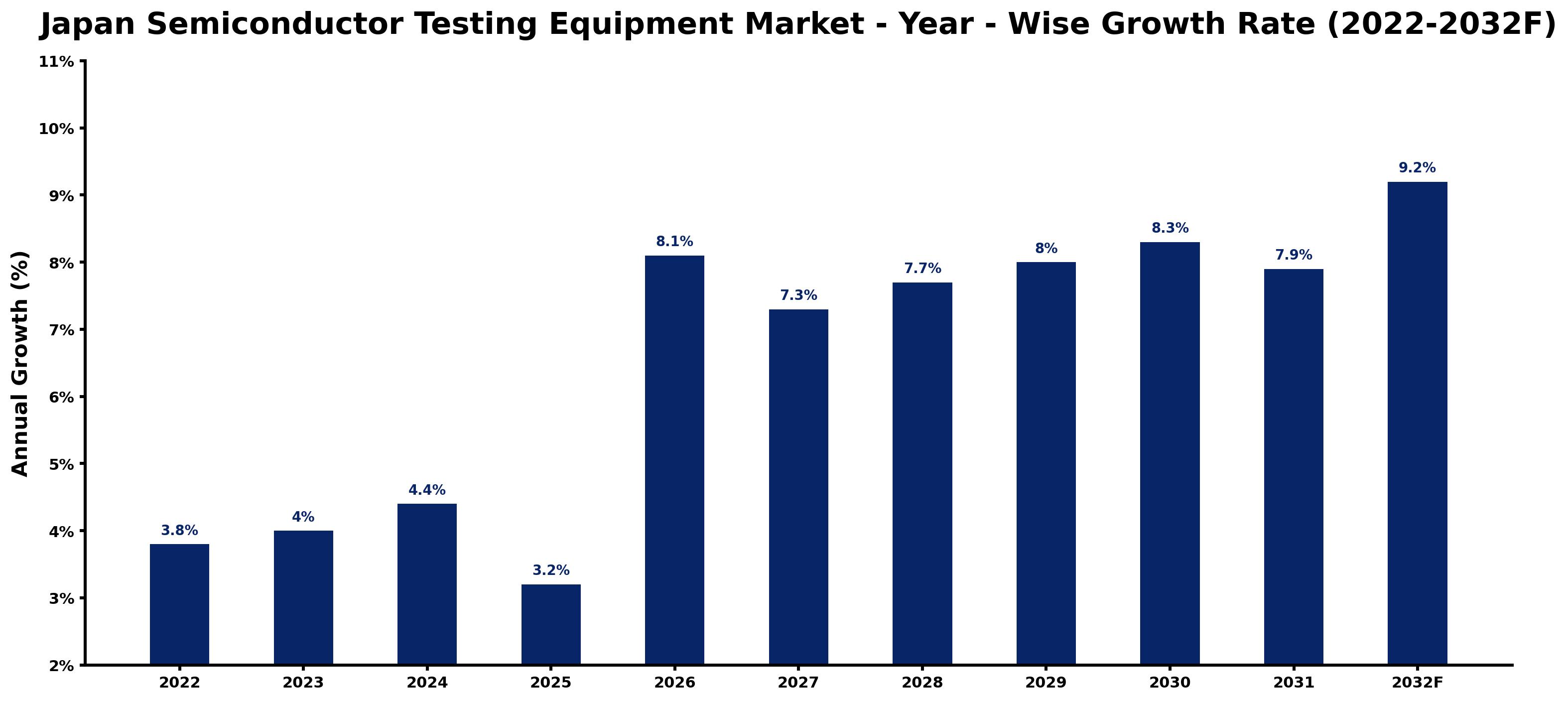
The following figures match every annual growth estimate with the main market development of that year, giving the reasoning behind each rise or slowdown.
| Year | Estimated Annual Growth (%) | Market Rationale |
| 2022 | 3.8 | The market showed steady growth due to ongoing demand from semiconductor manufacturers. |
| 2023 | 4.0 | Growth accelerated as domestic semiconductor production expanded and exports increased. |
| 2024 | 4.4 | Continued investments in technology and capacity led to faster growth than in previous years. |
| 2025 | 3.2 | Growth slowed as the market adjusted to previous rapid expansions and demand stabilised. |
| 2026 | 8.1 | A surge in demand for advanced semiconductor applications is expected to drive growth. |
| 2027 | 7.3 | Growth is projected to slow slightly, reflecting a normalisation after the previous year's surge. |
| 2028 | 7.7 | Increased adoption of automated testing systems will contribute to renewed growth. |
| 2029 | 8.0 | Demand for semiconductor testing equipment is expected to rise as production capacity expands further. |
| 2030 | 8.3 | Technological advancements in testing methods will support continued market growth. |
| 2031 | 7.9 | Growth will moderate as the market approaches saturation in several segments. |
| 2032 | 9.2 | A strong push towards innovation and efficiency in semiconductor testing will drive peak growth. |
Note: Market size estimations and growth projections presented in this report are based on 6Wresearch's proprietary forecasting methodology, utilizing the latest available industry data, government publications, and primary research inputs.
Japan Semiconductor Testing Equipment Market Synopsis
Semiconductor testing equipment is essential for verifying the performance and reliability of semiconductor devices, manufactured using advanced technologies. The Japan Semiconductor Testing Equipment Market is experiencing growth driven by demand from domestic manufacturers and exports, particularly to Asia. The automotive sector, accounting for 30% of semiconductor demand, is a key contributor. The government has allocated $1 billion for semiconductor technology development, further stimulating market expansion.
Market Dynamics Impact Analysis (2026–2032)
| Factor | Type | Impact | Primary Segment Affected |
| Growing demand for advanced semiconductor applications drives equipment purchases. | Driver | High | Wafer Probers |
| Increasing production capacity in semiconductor fabs enhances testing equipment needs. | Driver | High | Final Test Handlers |
| The shift towards automated testing systems presents investment opportunities. | Opportunity | High | Automated |
| Rising exports of semiconductor testing equipment to Asia create market potential. | Opportunity | Medium | Post-Packaging |
| High initial costs of advanced testing equipment may deter smaller manufacturers. | Restraint | High | Burn-In Systems |
| Compliance with stringent testing standards can limit equipment adoption. | Restraint | Medium | Parametric Testers |
| Cost pressures from rising wages may impact profitability for manufacturers. | Challenge | High | Reliability Testing |
| Capacity constraints in semiconductor fabs could delay equipment orders. | Challenge | Medium | Electrical Specs |
Evaluation of Drivers in Japan Semiconductor Testing Equipment Market (2026–2032)
These are the developments adding the most demand over the forecast period.
| Drivers | Primary Segment Affected | Why It Matters (Evidence) |
| Increased semiconductor production capacity necessitates more testing equipment. | Wafer Probers | Japan has over 100 operational semiconductor fabs, boosting demand for testing tools. |
| The automotive sector's growth drives demand for reliable semiconductor testing. | Final Test Handlers | The automotive sector accounts for 30% of Japan's semiconductor demand. |
| Adoption of automated testing systems improves efficiency and accuracy. | Automated | The market for automated testing is expanding as manufacturers seek to improve throughput. |
| Rising exports to Asia create additional demand for testing equipment. | Post-Packaging | Japan's semiconductor exports reached $15 billion in 2023, highlighting global demand. |
| Compliance with industry standards increases the need for reliable testing. | Parametric Testers | The JIS Z 8401 standard is widely adopted, necessitating rigorous testing protocols. |
A wider customer base explains much of the growth, as increased production capacity in Japan's semiconductor fabs drives demand for testing equipment. The automotive sector, representing 30% of semiconductor demand, fuels this growth, as manufacturers require reliable testing solutions. The adoption of automated testing systems improves efficiency, with a growing focus on throughput in production lines. In 2023, Japan's semiconductor exports reached $15 billion, indicating strong global demand for testing equipment. The ongoing expansion of semiconductor manufacturing facilities in Tokyo is expected to further boost equipment purchases.
Evaluation of Restraints in Japan Semiconductor Testing Equipment Market
Several factors work against faster growth; the main ones are summarised below.
| Market Restraint | Primary Segment Affected | Why It Matters (Evidence) |
| High initial costs of advanced testing equipment limit access for smaller firms. | Burn-In Systems | Smaller manufacturers struggle with the investment required for advanced testing solutions. |
| Stringent compliance requirements can slow down equipment adoption. | Parametric Testers | Manufacturers must meet rigorous standards, which complicate procurement processes. |
| Rising operational costs due to increased wages may affect profitability. | Reliability Testing | Japan's national minimum wage rose to JPY 1,055 per hour in October 2024. |
| Limited availability of skilled technicians can hinder effective testing operations. | Electrical Specs | The semiconductor industry faces a talent shortage, impacting testing capabilities. |
| Supply chain disruptions can delay equipment delivery and increase costs. | Final Test Handlers | Global supply chain issues have affected timely procurement of essential components. |
Japan Semiconductor Testing Equipment Market Challenges
Japan's strict regulations on semiconductor testing present compliance challenges for buyers, potentially delaying product launches by up to six months. Suppliers are grappling with rising operational costs due to the national minimum wage increase to JPY 1,055 per hour, which may inflate manufacturing costs by 15%. Supply chain disruptions, worsened by global semiconductor shortages, impede timely access to essential testing equipment, affecting production schedules for manufacturers. A shortage of skilled technicians in the semiconductor sector restricts suppliers' capacity to meet demand, leading to longer lead times and potential revenue losses of up to 20% for buyers.
Trends in the Japan Semiconductor Testing Equipment Market
The shifts below are changing how Japan Semiconductor Testing Equipment Market products are bought and supplied.
- Shift towards Automated Testing Systems: The adoption of automated testing systems accelerated in 2023, enhancing efficiency in semiconductor production. This trend is underscored by the increasing market share of automated testing equipment, which is projected to rise significantly.
- Transition from Manual to Inline Testing: The shift towards inline testing has gained traction, particularly in Tokyo's semiconductor fabs. This transition facilitates real-time quality assurance, boosting production efficiency and minimising downtime.
- Emergence of High-Temperature Testing: High-temperature testing has gained prominence, especially for automotive applications. This trend stems from the need for reliable performance under extreme conditions, with more manufacturers adopting relevant testing protocols.
- Prioritisation of Compliance with JIS Standards: The JIS Z 8401 standard has become increasingly important for semiconductor manufacturers in Japan. Compliance ensures reliability and safety, which are crucial for maintaining competitiveness in the market.
Investment Opportunities in the Japan Semiconductor Testing Equipment Market
The following areas offer the clearest openings for investors and suppliers in the Japan Semiconductor Testing Equipment Market.
- Gap in Automated Testing Solutions: With a projected growth rate of 11.4% for Wafer Probers, a notable gap exists in automated testing solutions. Investing in partnerships with local semiconductor fabs can facilitate market entry.
- Rising Demand for Compliance Testing: The growing emphasis on compliance with electrical specifications presents investment opportunities. Collaborating with OSAT vendors in Tokyo can provide access to this expanding segment.
- Expansion of Semiconductor Manufacturing Facilities: The ongoing expansion of semiconductor manufacturing facilities in Osaka generates demand for testing equipment. Suppliers can enter the market through joint ventures with local manufacturers.
- Timing for Advanced Testing Equipment: The current increase in semiconductor exports presents a timely opportunity for investment in advanced testing equipment. Partnering with the Semiconductor Industry Association of Japan can yield valuable insights.
Government Initiatives in the Japan Semiconductor Testing Equipment Market
The Semiconductor and Digital Industry Strategy, established by METI in June 2021, aims to secure domestic semiconductor manufacturing. This strategy includes measures to enhance research and development capabilities, ensuring producers meet the evolving industry demands. The Economic Security Promotion Act of 2022 supports supply-chain resilience for critical products, directly benefiting semiconductor testing equipment manufacturers by ensuring a stable operational environment.
In 2023, the government allocated $1 billion for semiconductor technology development initiatives, administered by METI. This funding supports projects that improve testing capabilities and promote advancements within the semiconductor sector, benefiting both producers and buyers by enhancing the quality and reliability of testing equipment.
Future Insight of the Japan Semiconductor Testing Equipment Market
The automotive sector will increasingly depend on advanced semiconductor testing equipment as electric vehicle production grows. Adoption of the JIS Z 8401 standard will streamline testing processes, benefiting both buyers and suppliers. Government initiatives, including a $1 billion investment in semiconductor technology development, will drive innovation and improve equipment capabilities. Japan's semiconductor exports are expected to reach $25 billion by 2032, presenting substantial growth opportunities for suppliers in international markets.
Market Segmentation Analysis
Japan Semiconductor Testing Equipment Market report covers a detailed analysis of the following market segments:
By Equipment Type – Final Test Handlers Lead, Wafer Probers Expected to Grow Fastest
According to Saurav Kr Singh, Senior Research Analyst at 6Wresearch, Final Test Handlers took 47% of equipment type revenue in 2025, more than any other category. Final Test Handlers hold the largest share due to their crucial role in validating semiconductor devices before shipment. Their extensive installation across Japan's semiconductor fabs, exceeding 10,000 units, highlights their importance in maintaining production quality. Wafer Probers are set to record the highest CAGR in this split, 11.4% over 2026–2032. Wafer Probers are experiencing rapid growth as they are increasingly utilised for initial testing of wafers before packaging, a vital step in semiconductor production. The rise in manufacturing activities in key regions such as Tokyo and Osaka is propelling this demand. Suppliers should focus on enhancing their Wafer Prober offerings to leverage the expanding market.
By Testing Phase – Front-End Leads, Post-Packaging Expected to Grow Fastest
With 45% of testing phase revenue in 2025, Front-End was the largest category. Front-End testing leads the market as it is essential for ensuring devices meet specifications during the manufacturing process. This phase is critical for the operational efficiency of Japan's semiconductor fabs, which significantly contribute to the global market. Over 2026–2032, Post-Packaging is expected to post the fastest growth, at a CAGR of 11.2%. Post-Packaging testing is growing the fastest due to the increasing complexity of packaged devices that necessitate thorough validation prior to market release. The automotive sector's rising demand for reliable semiconductor devices is a major factor in this growth. Buyers will need to invest in advanced Post-Packaging testing solutions to ensure product reliability.
By Integration Level – Automated Leads and Records the Fastest Growth
In 2025, Automated led the integration level split with a 45% share. Automated testing commands the largest share as it significantly improves efficiency and accuracy in the testing process, which is vital for high-volume semiconductor production. This trend reflects Japan's commitment to maintaining its competitive edge in semiconductor technology. Its lead should widen, with a projected CAGR of 10.9% during 2026–2032, the highest in this split. The Automated segment is also the fastest-growing, as manufacturers strive to optimise production lines and reduce human error. This growth is likely to continue as technology advances and the need for precision escalates. Suppliers must prioritise automation technologies to meet the increasing demand for efficient testing solutions.
By End User – Wafer Fabs Lead, OSAT Vendors Expected to Grow Fastest
The largest end user category in 2025 was Wafer Fabs, at 35% of revenue. Wafer Fabs are the primary users of semiconductor testing equipment, accounting for a substantial share of the market. With over 100 operational fabs in Japan, their demand for reliable testing solutions is a key driver of the market. OSAT Vendors are projected to grow fastest, at a CAGR of 10.5% during 2026–2032. OSAT Vendors are experiencing the fastest growth as they expand their packaging and testing services to meet the rising demand from various sectors, particularly automotive. The increasing complexity of semiconductor devices necessitates advanced testing solutions from these vendors. Suppliers should consider partnerships with OSAT Vendors to tap into this growing segment.
Key Attractiveness of the Report
- 10 Years of Market Numbers
- Historical Data Starting from 2022 to 2025
- Base Year 2025
- Forecast Data until 2032
- Key Performance Indicators Impacting the Market
- Major Upcoming Developments and Projects
Key Highlights of the Report:
- Japan Semiconductor Testing Equipment Market Outlook
- Market Size of Japan Semiconductor Testing Equipment Market, 2025
- Forecast of Japan Semiconductor Testing Equipment Market, 2032
- Historical Data and Forecast of Japan Semiconductor Testing Equipment Revenues & Volume for the Period 2022-2032F
- Japan Semiconductor Testing Equipment Market Trend Evolution
- Japan Semiconductor Testing Equipment Market Drivers and Challenges
- Japan Semiconductor Testing Equipment Price Trends
- Japan Semiconductor Testing Equipment Porter's Five Forces
- Japan Semiconductor Testing Equipment Industry Life Cycle
- Historical Data and Forecast of Japan Semiconductor Testing Equipment Market Revenues & Volume By Equipment Type for the Period 2022-2032F
- Historical Data and Forecast of Japan Semiconductor Testing Equipment Market Revenues & Volume By Wafer Probers for the Period 2022-2032F
- Historical Data and Forecast of Japan Semiconductor Testing Equipment Market Revenues & Volume By Final Test Handlers for the Period 2022-2032F
- Historical Data and Forecast of Japan Semiconductor Testing Equipment Market Revenues & Volume By Burn-In Systems for the Period 2022-2032F
- Historical Data and Forecast of Japan Semiconductor Testing Equipment Market Revenues & Volume By Parametric Testers for the Period 2022-2032F
- Historical Data and Forecast of Japan Semiconductor Testing Equipment Market Revenues & Volume By Testing Phase for the Period 2022-2032F
- Historical Data and Forecast of Japan Semiconductor Testing Equipment Market Revenues & Volume By Front-End for the Period 2022-2032F
- Historical Data and Forecast of Japan Semiconductor Testing Equipment Market Revenues & Volume By Post-Packaging for the Period 2022-2032F
- Historical Data and Forecast of Japan Semiconductor Testing Equipment Market Revenues & Volume By Reliability Testing for the Period 2022-2032F
- Historical Data and Forecast of Japan Semiconductor Testing Equipment Market Revenues & Volume By Electrical Specs for the Period 2022-2032F
- Historical Data and Forecast of Japan Semiconductor Testing Equipment Market Revenues & Volume By Integration Level for the Period 2022-2032F
- Historical Data and Forecast of Japan Semiconductor Testing Equipment Market Revenues & Volume By Automated for the Period 2022-2032F
- Historical Data and Forecast of Japan Semiconductor Testing Equipment Market Revenues & Volume By Inline for the Period 2022-2032F
- Historical Data and Forecast of Japan Semiconductor Testing Equipment Market Revenues & Volume By High Temp/Voltage for the Period 2022-2032F
- Historical Data and Forecast of Japan Semiconductor Testing Equipment Market Revenues & Volume By Probe Cards for the Period 2022-2032F
- Historical Data and Forecast of Japan Semiconductor Testing Equipment Market Revenues & Volume By End User for the Period 2022-2032F
- Historical Data and Forecast of Japan Semiconductor Testing Equipment Market Revenues & Volume By Wafer Fabs for the Period 2022-2032F
- Historical Data and Forecast of Japan Semiconductor Testing Equipment Market Revenues & Volume By OSAT Vendors for the Period 2022-2032F
- Historical Data and Forecast of Japan Semiconductor Testing Equipment Market Revenues & Volume By Automotive IC Suppliers for the Period 2022-2032F
- Historical Data and Forecast of Japan Semiconductor Testing Equipment Market Revenues & Volume By Memory Chip Producers for the Period 2022-2032F
- Japan Semiconductor Testing Equipment Import Export Trade Statistics
- Market Opportunity Assessment By Equipment Type
- Market Opportunity Assessment By Testing Phase
- Market Opportunity Assessment By Integration Level
- Market Opportunity Assessment By End User
- Japan Semiconductor Testing Equipment Top Companies Market Share
- Japan Semiconductor Testing Equipment Competitive Benchmarking By Technical and Operational Parameters
- Japan Semiconductor Testing Equipment Company Profiles
- Japan Semiconductor Testing Equipment Key Strategic Recommendations
Market Covered
Coverage by segment is as follows.
By Equipment Type
- Wafer Probers
- Final Test Handlers
- Burn-In Systems
- Parametric Testers
By Testing Phase
- Front-End
- Post-Packaging
- Reliability Testing
- Electrical Specs
By Integration Level
- Automated
- Inline
- High Temp/Voltage
- Probe Cards
By End User
- Wafer Fabs
- OSAT Vendors
- Automotive IC Suppliers
- Memory Chip Producers































