Japan Sensor-Based Faucets Market Size & Growth Rate
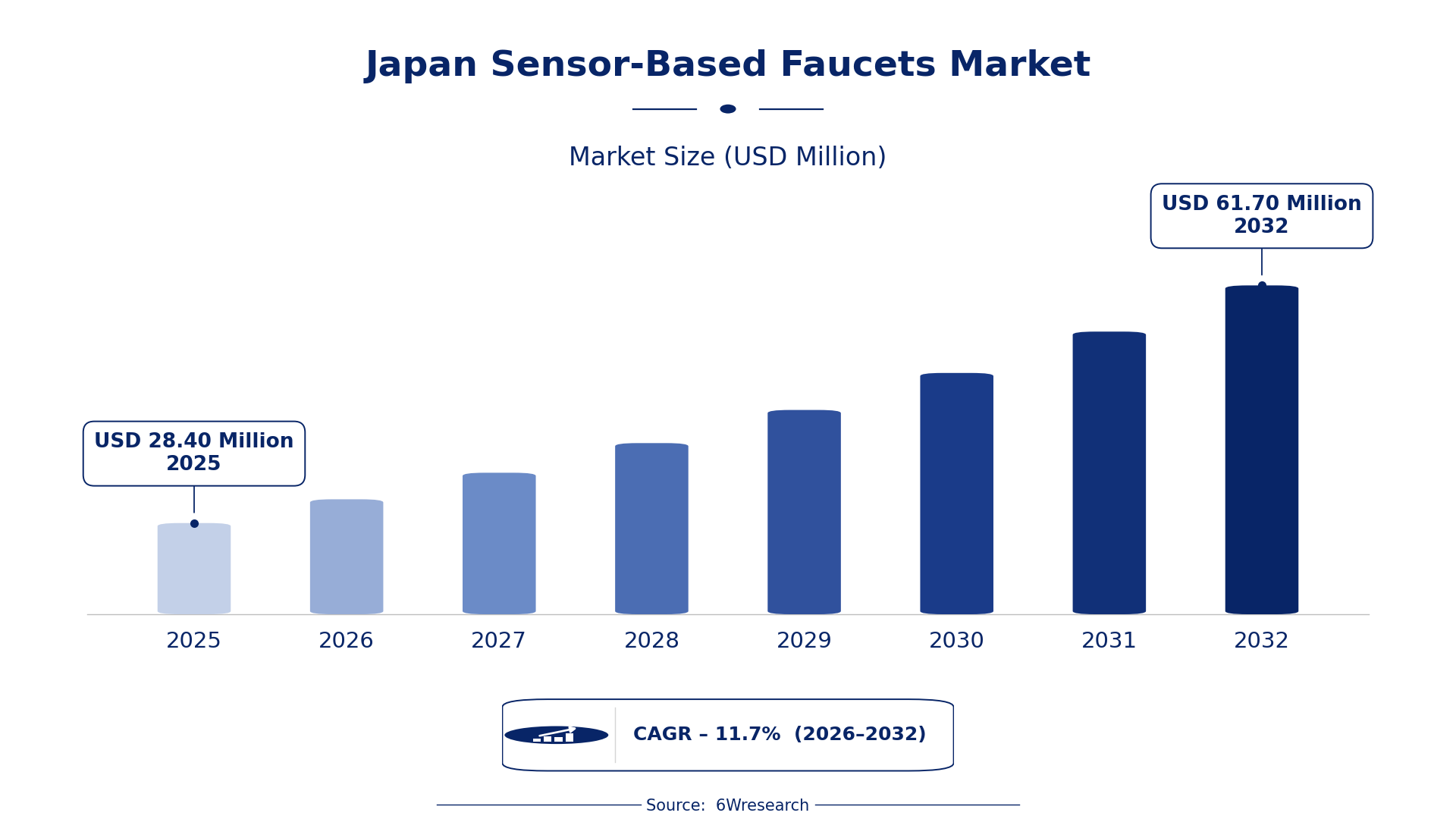
According to 6Wresearch internal database and industry insights, the Japan Sensor-Based Faucets Market was valued at USD 28.40 Million in 2025 and is projected to reach USD 61.70 Million by 2032, growing at a CAGR of approximately 11.7% during 2026–2032.
Japan Sensor-Based Faucets Market Highlights
| Report Metric | Details |
| Report Name | Japan Sensor-Based Faucets Market (2026-2032) |
| Market Size 2025 | USD 28.40 Million |
| Market Size 2032 | USD 61.70 Million |
| Absolute Growth 2025–2032 | USD 33.30 Million |
| CAGR 2026–2032 | 11.7% |
| Peak Annual Growth | 13.9% in 2027 |
| Forecast Period | 2026–2032 |
| Historical Data | 2022–2025 |
| Base Year | 2025 |
| Leading Faucet Type, 2025 | Touchless Faucets (45% share) |
| Leading Sensor Type, 2025 | Infrared Sensors (38% share) |
| Leading Power Source, 2025 | Battery-Operated (39% share) |
| Leading End User, 2025 | Smart Homes (37% share) |
| Fastest-Growing Faucet Type | Commercial Faucets (16.7% CAGR) |
| Fastest-Growing Sensor Type | Ultrasonic Sensors (17.4% CAGR) |
| Fastest-Growing Power Source | AC Powered (16.1% CAGR) |
| Fastest-Growing End User | Hotels & Restaurants (15.3% CAGR) |
| Growing Sector | Hotels & Restaurants |
| Key End Users | Smart Homes, Hotels & Restaurants, Airports & Malls, Healthcare Facilities |
Japan Sensor-Based Faucets Market Year-wise Growth Rate and Key Drivers (2022–2032)
This graph illustrates the annual growth rates of the market from 2022 to 2032, highlighting a steady upward trajectory and projected market expansion over the forecast period.
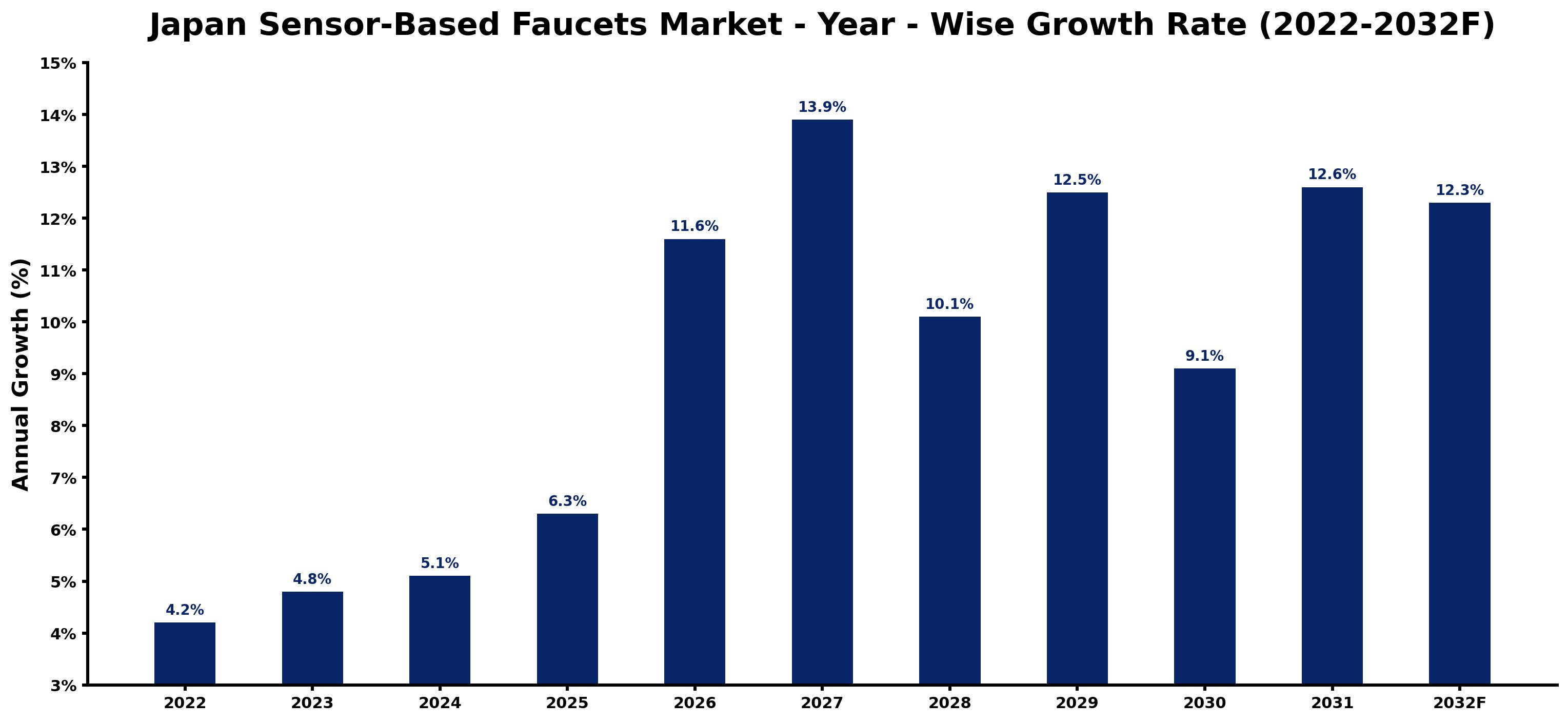
Below, each year's estimated growth is shown next to the factor that most influenced it.
| Year | Estimated Annual Growth (%) | Market Rationale |
| 2022 | 4.2 | The market showed steady growth with rising hygiene standards in public facilities. |
| 2023 | 4.8 | Demand rose as hotels upgraded to touchless technologies following the Tokyo 2020 Olympics. |
| 2024 | 5.1 | The healthcare sector continued investing in sensor-based faucets to improve patient safety. |
| 2025 | 6.3 | Growth accelerated as the average installation rate in new hotels reached 70%. |
| 2026 | 11.6 | The market will experience a surge in demand driven by smart home adoption and water-saving initiatives. |
| 2027 | 13.9 | Peak growth will occur as commercial establishments focus on hygiene, increasing sensor faucet installations. |
| 2028 | 10.1 | Growth is projected to slow slightly as the market adjusts to high installation rates in urban areas. |
| 2029 | 12.5 | Demand will increase again as the healthcare sector expands its use of touchless technologies. |
| 2030 | 9.1 | The market will experience another slowdown as competition intensifies among manufacturers. |
| 2031 | 12.6 | Growth will pick up as the hospitality sector continues to prioritise hygiene in facilities. |
| 2032 | 12.3 | The market is projected to slow again as saturation in urban installations begins to impact new purchases. |
Note: Market size estimations and growth projections presented in this report are based on 6Wresearch's proprietary forecasting methodology, utilizing the latest available industry data, government publications, and primary research inputs.
Japan Sensor-Based Faucets Market Synopsis
Sensor-based faucets are advanced fixtures that utilise sensors for touchless operation, primarily made from durable materials like stainless steel. Their main applications include improving hygiene in public restrooms, conserving water, and increasing convenience. The Japan Sensor-Based Faucets Market is expanding due to rising demand from the hospitality and healthcare sectors, with the average installation rate in new hotels at 70% and the healthcare sector investing significantly in touchless technologies.
Market Dynamics Impact Analysis (2026–2032)
| Factor | Type | Impact | Primary Segment Affected |
| Increasing focus on hygiene standards in commercial establishments drives demand for sensor faucets. | Driver | High | Commercial Faucets |
| Growing adoption of smart home technologies encourages the installation of sensor-based faucets. | Driver | High | Smart Homes |
| Investment in water-saving technologies in healthcare facilities creates new opportunities for suppliers. | Opportunity | High | Healthcare Facilities |
| The Tokyo metropolitan area is expanding its public restroom facilities, increasing demand for sensor faucets. | Opportunity | High | Touchless Faucets |
| High installation costs may deter some buyers from adopting sensor faucets in residential settings. | Restraint | Medium | Smart Homes |
| Market saturation in urban areas may limit growth potential for new installations. | Restraint | Medium | Commercial Faucets |
| Competition among manufacturers is intensifying, leading to price pressures in the market. | Challenge | High | Touchless Faucets |
| Supply chain disruptions could delay the availability of components needed for sensor faucets. | Challenge | High | Touchless Faucets |
Evaluation of Drivers in Japan Sensor-Based Faucets Market (2026–2032)
Key forces behind demand, with the segment each one moves most, are listed below.
| Drivers | Primary Segment Affected | Why It Matters (Evidence) |
| Increased hygiene awareness in public spaces drives demand for sensor faucets. | Commercial Faucets | The average installation rate in new hotels is about 70%, leading to more purchases. |
| Smart home adoption is rising, leading to increased sensor faucet installations. | Smart Homes | In 2023, smart home adoption in Japan reached 20%, boosting demand for touchless solutions. |
| Healthcare facilities are investing in touchless technologies to improve patient safety. | Healthcare Facilities | The average patient turnover in healthcare facilities is about 1.5 million annually, increasing demand. |
| The Tokyo metropolitan area has a high concentration of hotels and restaurants. | Touchless Faucets | This region has over 1,000 public restrooms equipped with sensor faucets, driving installations. |
| Government initiatives promoting water-saving technologies enhance market growth. | Touchless Faucets | The government aims to reduce water consumption by 20% by 2030 through efficient technologies. |
Buyers are adding capacity as the healthcare sector invests in touchless technologies to improve patient safety. The average patient turnover in healthcare facilities is about 1.5 million annually, driving demand for hygienic solutions. Commercial establishments are increasingly focusing on hygiene, leading to a rise in sensor faucet installations. Hotels and restaurants are upgrading to touchless technologies following the Tokyo 2020 Olympics, which spurred a rise in installations.
Evaluation of Restraints in Japan Sensor-Based Faucets Market
These restraints slow adoption and weigh on supplier margins.
| Market Restraint | Primary Segment Affected | Why It Matters (Evidence) |
| High installation costs may deter residential buyers from adopting sensor faucets. | Smart Homes | The average cost of a sensor faucet installation in commercial settings is around 150,000 JPY. |
| Market saturation in urban areas may limit growth potential for new installations. | Commercial Faucets | The Tokyo region has seen a 15% increase in sensor faucet installations since 2020, indicating saturation. |
| Supply chain disruptions could delay the availability of components needed for sensor faucets. | Touchless Faucets | Manufacturers may face challenges sourcing materials, impacting production timelines. |
| Intense competition among manufacturers leads to price pressures in the market. | Touchless Faucets | As more players enter the market, pricing strategies may become aggressive. |
| Consumer reluctance to switch from traditional faucets to sensor-based options may hinder growth. | Smart Homes | Many homeowners remain hesitant to invest in new technologies despite the benefits. |
Japan Sensor-Based Faucets Market Challenges
Many hotels in the Tokyo metropolitan area face high installation costs for sensor faucets, averaging around 150,000 JPY per unit, which strains their budgets and limits upgrades. Producers encounter difficulties in maintaining advanced technology due to a shortage of skilled technicians, resulting in delays that increase downtime for buyers. Strict adherence to JIS standards necessitates extensive testing and certification, extending product launch timelines and hindering suppliers' responsiveness. Commercial establishments experience rising hygiene expectations, yet many buyers hesitate to invest upfront, causing slower adoption rates despite the urgent need for touchless solutions.
Trends in the Japan Sensor-Based Faucets Market
Several trends are reshaping the Japan Sensor-Based Faucets Market; the most important are set out below.
- Transition to Touchless Technology in Public Restrooms: Since the Tokyo 2020 Olympics, there has been a shift towards touchless technologies in public restrooms, with over 1,000 equipped facilities in the Tokyo metropolitan area, improving hygiene standards.
- Growth in Smart Home Adoption: Smart home adoption in Japan reached 20% in 2023, driving demand for sensor-based faucets that improve convenience and hygiene in residential settings, encouraging manufacturers to innovate.
- Increased Emphasis on Hygiene in Healthcare Facilities: The healthcare sector is increasingly prioritising touchless technologies, with substantial investments aimed at improving patient safety, reflecting a growing trend in medical environments.
- Expansion of Sensor Faucet Installations in Hospitality: The average installation rate of sensor faucets in new hotels is about 70%, indicating a trend towards improved hygiene and convenience in the hospitality industry.
Investment Opportunities in the Japan Sensor-Based Faucets Market
The following opportunities in the Japan Sensor-Based Faucets Market pair current demand with a clear way in.
- Collaborating with Local Manufacturers: Now is an ideal time to invest in sensor-based faucets as the market grows, especially in the Tokyo region, where public facilities are expanding. Partnering with local manufacturers can facilitate market entry.
- Investing in Healthcare Facilities: The healthcare sector is increasingly adopting touchless technologies, creating opportunities for suppliers to provide sensor faucets. With an average patient turnover of 1.5 million annually, there is strong demand.
- Developing Smart Home Solutions: With smart home adoption reaching 20% in 2023, suppliers should focus on creating sensor-based faucets for residential use, catering to tech-savvy homeowners looking for convenience.
- Aligning with Government Initiatives: The government's target to reduce water consumption by 20% by 2030 presents an opportunity for suppliers to align their products with these efficiency goals, enhancing market appeal.
Government Initiatives in the Japan Sensor-Based Faucets Market
The Act on Japanese Industrial Standards governs the quality and safety of sensor-based faucets, ensuring that manufacturers comply with rigorous standards. This law helps maintain consumer confidence and supports market growth by promoting high-quality products.
The Economic Security Promotion Act, initiated in 2022, allocates funding to secure supply-chain resilience for critical products, which is essential for producing advanced sensor technologies. This initiative aims to strengthen the supply chain and support local manufacturers in the sensor faucet market.
Future Insight of the Japan Sensor-Based Faucets Market
New public restroom projects will increasingly adopt touchless technologies, driven by hygiene initiatives launched in 2023. By 2032, the average installation rate of sensor faucets in hotels is projected to reach 85%, reflecting a strong shift towards convenience and sanitation. Government efforts to reduce water consumption by 20% by 2030 will prompt suppliers to develop more efficient sensor-based products. The healthcare sector will continue to invest in touchless technologies to enhance patient safety, further driving demand.
Market Segmentation Analysis
Japan Sensor-Based Faucets Market report covers a detailed analysis of the following market segments:
By Faucet Type – Touchless Faucets Lead, Commercial Faucets Expected to Grow Fastest
According to Saurav Kr Singh, Senior Research Analyst at 6Wresearch, the largest faucet type category in 2025 was Touchless Faucets, at 45% of revenue. Touchless faucets dominate the market due to their widespread application in enhancing hygiene and convenience across various settings. Their significance is highlighted by the average installation rate of 70% in new hotels, reflecting strong demand in the hospitality industry. The quickest growth will come from Commercial Faucets, forecast to expand at a CAGR of 16.7% between 2026 and 2032. Commercial faucets are experiencing rapid growth as businesses focus on maintaining high hygiene standards, particularly in busy environments like restaurants and hotels. The 15% increase in sensor faucet installations in public facilities in the Tokyo region since 2020 illustrates this trend. Suppliers should concentrate on developing commercial faucet solutions to align with the rising hygiene expectations in the market.
By Sensor Type – Infrared Sensors Lead, Ultrasonic Sensors Expected to Grow Fastest
In 2025, Infrared Sensors led the sensor type split with a 38% share. Infrared sensors are the leading choice for automatic faucet activation, essential for facilitating touchless operation in diverse environments. Their widespread use in public restrooms across Japan highlights their importance in upholding hygiene standards. Ultrasonic Sensors are projected to grow fastest, at a CAGR of 17.4% during 2026–2032. Ultrasonic sensors are gaining traction in niche applications, driven by the increasing demand for sophisticated touchless technologies. As the market for these advanced solutions expands, their adoption is anticipated to grow significantly. Suppliers may need to expand their offerings to include ultrasonic sensors to meet the evolving market demands.
By Power Source – Battery-Operated Leads, AC Powered Expected to Grow Fastest
Battery-Operated held 39% of the Japan Sensor-Based Faucets Market by power source in 2025. Battery-operated faucets are favoured in locations lacking electrical outlets, providing flexibility for installation. This is particularly relevant in public restrooms where access to power sources can be limited, ensuring wider applicability. Over 2026–2032, AC Powered is expected to post the fastest growth, at a CAGR of 16.1%. AC powered faucets are increasingly preferred in fixed installations, driven by their reliability and consistent performance. As more commercial establishments seek durable solutions, this segment is likely to expand rapidly. Suppliers should consider focusing on AC powered options to cater to the growing demand in commercial settings.
By End User – Smart Homes Lead, Hotels & Restaurants Expected to Grow Fastest
Smart Homes took 37% of end user revenue in 2025, more than any other category. Smart homes are a key segment for sensor-based faucets, fuelled by the growing integration of smart technologies among consumers. With smart home adoption reaching 20% in 2023, this segment is well-positioned for ongoing growth. Hotels & Restaurants are set to record the highest CAGR in this split, 15.3% over 2026–2032. Hotels and restaurants are rapidly adopting sensor faucets to adhere to stringent hygiene standards, demonstrating a robust market demand. The 70% installation rate of sensor faucets in new hotels underscores this increasing trend. This suggests that suppliers should enhance their engagement with the hospitality sector to leverage this expanding opportunity.
Key Attractiveness of the Report
- 10 Years of Market Numbers
- Historical Data Starting from 2022 to 2025
- Base Year 2025
- Forecast Data until 2032
- Key Performance Indicators Impacting the Market
- Major Upcoming Developments and Projects
Key Highlights of the Report:
- Japan Sensor-Based Faucets Market Outlook
- Market Size of Japan Sensor-Based Faucets Market, 2025
- Forecast of Japan Sensor-Based Faucets Market, 2032
- Historical Data and Forecast of Japan Sensor-Based Faucets Revenues & Volume for the Period 2022-2032F
- Japan Sensor-Based Faucets Market Trend Evolution
- Japan Sensor-Based Faucets Market Drivers and Challenges
- Japan Sensor-Based Faucets Price Trends
- Japan Sensor-Based Faucets Porter's Five Forces
- Japan Sensor-Based Faucets Industry Life Cycle
- Historical Data and Forecast of Japan Sensor-Based Faucets Market Revenues & Volume By Faucet Type for the Period 2022-2032F
- Historical Data and Forecast of Japan Sensor-Based Faucets Market Revenues & Volume By Touchless Faucets for the Period 2022-2032F
- Historical Data and Forecast of Japan Sensor-Based Faucets Market Revenues & Volume By Commercial Faucets for the Period 2022-2032F
- Historical Data and Forecast of Japan Sensor-Based Faucets Market Revenues & Volume By Hybrid Faucets for the Period 2022-2032F
- Historical Data and Forecast of Japan Sensor-Based Faucets Market Revenues & Volume By Wall-Mounted Faucets for the Period 2022-2032F
- Historical Data and Forecast of Japan Sensor-Based Faucets Market Revenues & Volume By Sensor Type for the Period 2022-2032F
- Historical Data and Forecast of Japan Sensor-Based Faucets Market Revenues & Volume By Infrared Sensors for the Period 2022-2032F
- Historical Data and Forecast of Japan Sensor-Based Faucets Market Revenues & Volume By Ultrasonic Sensors for the Period 2022-2032F
- Historical Data and Forecast of Japan Sensor-Based Faucets Market Revenues & Volume By IR + Manual Override for the Period 2022-2032F
- Historical Data and Forecast of Japan Sensor-Based Faucets Market Revenues & Volume By Capacitive Sensors for the Period 2022-2032F
- Historical Data and Forecast of Japan Sensor-Based Faucets Market Revenues & Volume By Power Source for the Period 2022-2032F
- Historical Data and Forecast of Japan Sensor-Based Faucets Market Revenues & Volume By Battery-Operated for the Period 2022-2032F
- Historical Data and Forecast of Japan Sensor-Based Faucets Market Revenues & Volume By AC Powered for the Period 2022-2032F
- Historical Data and Forecast of Japan Sensor-Based Faucets Market Revenues & Volume By Dual Powered for the Period 2022-2032F
- Historical Data and Forecast of Japan Sensor-Based Faucets Market Revenues & Volume By Rechargeable for the Period 2022-2032F
- Historical Data and Forecast of Japan Sensor-Based Faucets Market Revenues & Volume By End User for the Period 2022-2032F
- Historical Data and Forecast of Japan Sensor-Based Faucets Market Revenues & Volume By Smart Homes for the Period 2022-2032F
- Historical Data and Forecast of Japan Sensor-Based Faucets Market Revenues & Volume By Hotels & Restaurants for the Period 2022-2032F
- Historical Data and Forecast of Japan Sensor-Based Faucets Market Revenues & Volume By Airports & Malls for the Period 2022-2032F
- Historical Data and Forecast of Japan Sensor-Based Faucets Market Revenues & Volume By Healthcare Facilities for the Period 2022-2032F
- Japan Sensor-Based Faucets Import Export Trade Statistics
- Market Opportunity Assessment By Faucet Type
- Market Opportunity Assessment By Sensor Type
- Market Opportunity Assessment By Power Source
- Market Opportunity Assessment By End User
- Japan Sensor-Based Faucets Top Companies Market Share
- Japan Sensor-Based Faucets Competitive Benchmarking By Technical and Operational Parameters
- Japan Sensor-Based Faucets Company Profiles
- Japan Sensor-Based Faucets Key Strategic Recommendations
Market Covered
Segments analysed in this report are listed below.
By Faucet Type
- Touchless Faucets
- Commercial Faucets
- Hybrid Faucets
- Wall-Mounted Faucets
By Sensor Type
- Infrared Sensors
- Ultrasonic Sensors
- IR + Manual Override
- Capacitive Sensors
By Power Source
- Battery-Operated
- AC Powered
- Dual Powered
- Rechargeable
By End User
- Smart Homes
- Hotels & Restaurants
- Airports & Malls
- Healthcare Facilities































