Japan Sensor Integration Market Size & Growth Rate
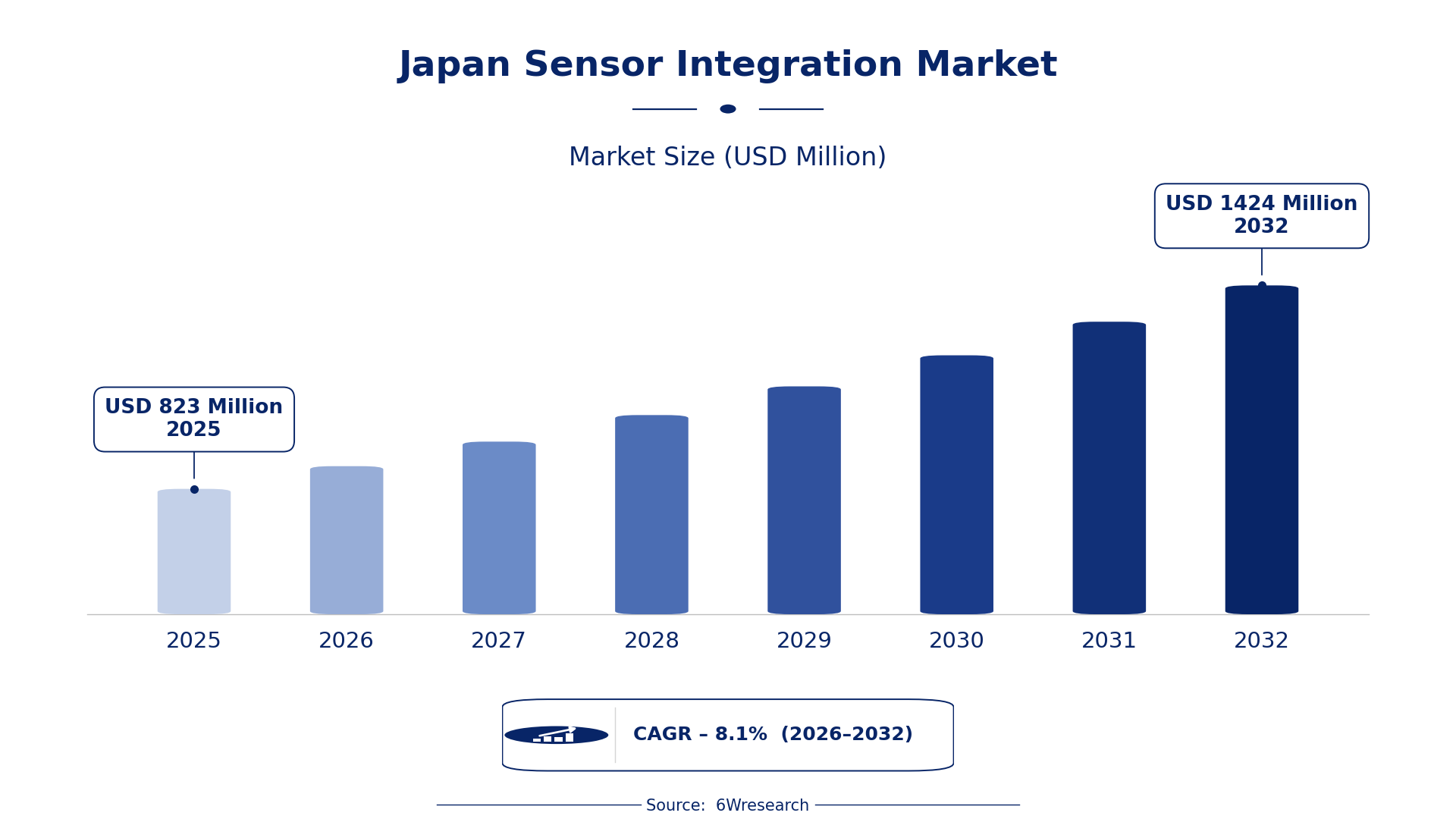
According to 6Wresearch internal database and industry insights, the Japan Sensor Integration Market was valued at USD 823 Million in 2025 and is projected to reach USD 1,424 Million by 2032, growing at a CAGR of approximately 8.1% during 2026–2032.
Japan Sensor Integration Market Highlights
| Report Metric | Details |
| Report Name | Japan Sensor Integration Market (2026-2032) |
| Market Size 2025 | USD 823 Million |
| Market Size 2032 | USD 1,424 Million |
| Absolute Growth 2025–2032 | USD 601 Million |
| CAGR 2026–2032 | 8.1% |
| Peak Annual Growth | 9.1% in 2028 |
| Forecast Period | 2026–2032 |
| Historical Data | 2022–2025 |
| Base Year | 2025 |
| Leading Integration Type, 2025 | MEMS Integration (39% share) |
| Leading Sensor Technology, 2025 | Gyroscope (38% share) |
| Leading Target Device, 2025 | Smartphones (45% share) |
| Leading End User, 2025 | Consumer Electronics Brands (42% share) |
| Fastest-Growing Integration Type | AI Sensor Hubs (12.4% CAGR) |
| Fastest-Growing Sensor Technology | Temp + Pressure Sensors (11.7% CAGR) |
| Fastest-Growing Target Device | Wearables (11.3% CAGR) |
| Fastest-Growing End User | Smart Home System Providers (10.9% CAGR) |
| Growing Sector | Smart Home System Providers |
| Key End Users | Consumer Electronics Brands, Embedded Chip Makers, Industrial Automation Cos., Smart Home System Providers |
Japan Sensor Integration Market Year-wise Growth Rate and Key Drivers (2022–2032)
This graph illustrates the annual growth rates of the market from 2022 to 2032, highlighting a steady upward trajectory and projected market expansion over the forecast period.
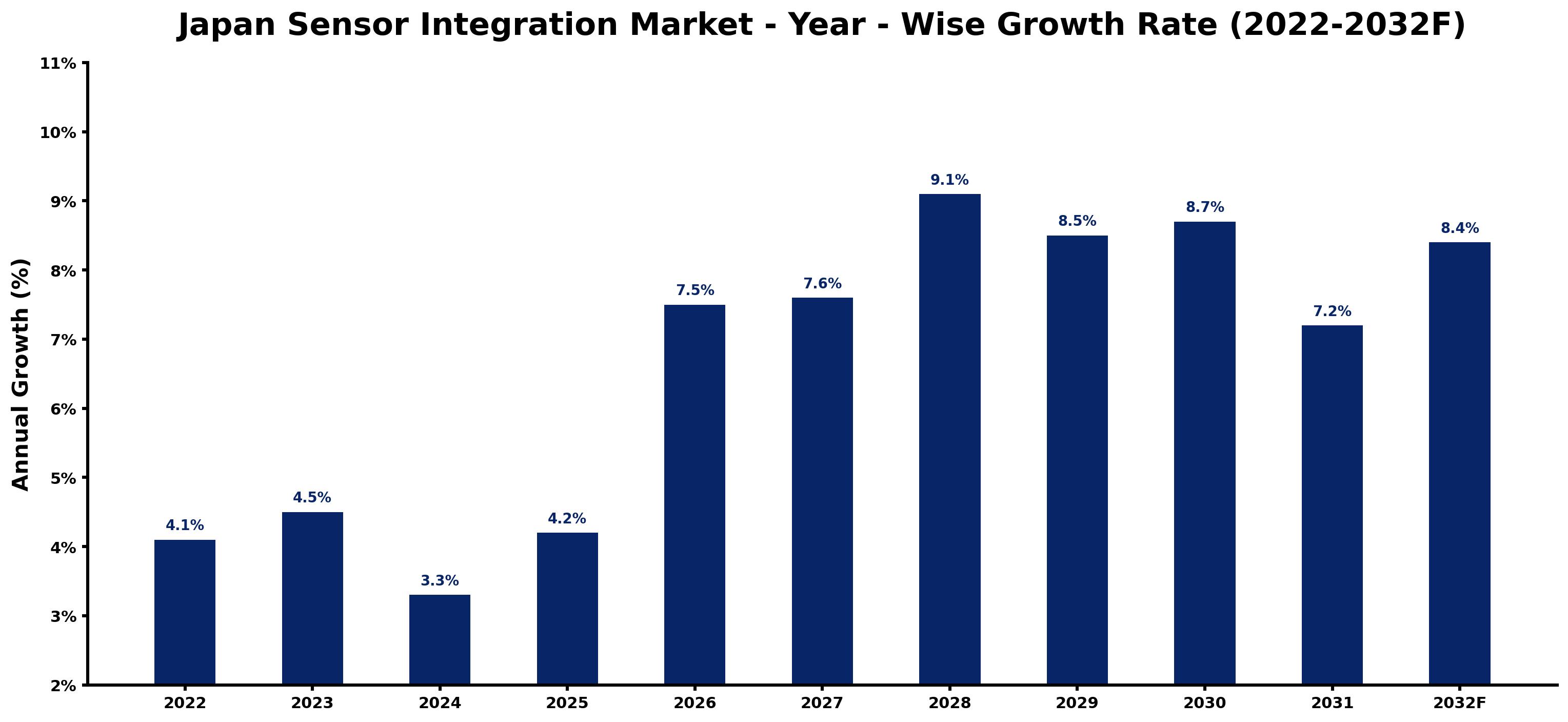
The following figures match every annual growth estimate with the main market development of that year, giving the reasoning behind each rise or slowdown.
| Year | Estimated Annual Growth (%) | Market Rationale |
| 2022 | 4.1 | The market demonstrated steady growth amid rising consumer electronics demand. |
| 2023 | 4.5 | Growth accelerated due to increased smartphone usage and automotive sensor integration. |
| 2024 | 3.3 | A slowdown occurred as the market adjusted to supply chain challenges in manufacturing. |
| 2025 | 4.2 | Growth resumed with renewed investments in automotive and consumer electronics sectors. |
| 2026 | 7.5 | Demand is expected to surge as IoT device adoption expands across various sectors. |
| 2027 | 7.6 | Continued growth will be supported by advancements in sensor technologies and applications. |
| 2028 | 9.1 | The peak growth year will be driven by heightened demand for AI sensor hubs in smart devices. |
| 2029 | 8.5 | Growth is projected to slow slightly as the market begins to stabilise after rapid expansion. |
| 2030 | 8.7 | An uptick in growth will follow as investments in industrial automation increase. |
| 2031 | 7.2 | The market is expected to experience a slowdown as saturation in some segments begins to emerge. |
| 2032 | 8.4 | Growth will accelerate again with new innovations in sensor integration technologies. |
Note: Market size estimations and growth projections presented in this report are based on 6Wresearch's proprietary forecasting methodology, utilizing the latest available industry data, government publications, and primary research inputs.
Japan Sensor Integration Market Synopsis
Sensor integration involves combining multiple sensors into cohesive systems, primarily through MEMS or SoC technologies. This technology is critical in consumer electronics, automotive applications, and industrial automation. The Japan Sensor Integration Market is expanding, driven by demand from consumer electronics brands and the automotive sector, which accounts for over 10% of global production. The IoT device market is expected to reach 1.5 trillion JPY in 2023, further increasing sensor integration needs.
Market Dynamics Impact Analysis (2026–2032)
| Factor | Type | Impact | Primary Segment Affected |
| Rising demand for IoT devices | Driver | High | AI Sensor Hubs |
| Increased automotive production | Driver | High | MEMS Integration |
| Expansion of smart home technologies | Opportunity | Medium | Wireless Sensor Modules |
| Growth in health monitoring wearables | Opportunity | Medium | Wearables |
| Supply chain disruptions in semiconductor manufacturing | Restraint | High | SoC Integration |
| Regulatory compliance costs for sensor standards | Restraint | Medium | Gyroscope |
| High R&D costs in sensor technology development | Challenge | High | Automotive Modules |
| Competition from international sensor manufacturers | Challenge | Medium | Consumer Electronics Brands |
Evaluation of Drivers in Japan Sensor Integration Market (2026–2032)
The table below links each growth driver to the segment it affects and the evidence for it.
| Drivers | Primary Segment Affected | Why It Matters (Evidence) |
| Increased smartphone adoption | Smartphones | The number of smartphone users in Japan is estimated to exceed 80 million, driving sensor demand. |
| Investment in automotive R&D | Automotive Modules | The automotive industry invested over 3 trillion JPY in 2023, driving sensor integration. |
| Growth in IoT applications | IoT Devices | Japan's IoT device market is set to reach 1.5 trillion JPY in 2023, boosting sensor integration. |
| Expansion of health-focused wearables | Wearables | The wearable technology market is on track to grow by 11.3%, increasing demand for integrated sensors. |
| Advancements in industrial automation | Industrial Automation Cos. | Japan's industrial automation market is expected to exceed 2 trillion JPY in 2023, driving sensor use. |
The strongest pull on demand comes from the increasing smartphone adoption, with over 80 million users in Japan, which drives the need for advanced sensor technologies. Investment in automotive R&D exceeded 3 trillion JPY in 2023, fuelling sensor integration in vehicles. The IoT device market is set to reach 1.5 trillion JPY in 2023, which boosts sensor demand significantly. The wearable technology market is expanding, prompting more health-focused devices to integrate sensors. Advances in industrial automation, projected to surpass 2 trillion JPY in 2023, further increase sensor usage across various applications.
Evaluation of Restraints in Japan Sensor Integration Market
The table below lists the restraints and the evidence behind each.
| Market Restraint | Primary Segment Affected | Why It Matters (Evidence) |
| High production costs | MEMS Integration | High production costs burden manufacturers, as Japan's national minimum wage reached JPY 1,055 per hour, increasing operational expenses. |
| Skills shortages | Automotive Modules | Skills shortages hinder growth, with the automotive sector investing over 3 trillion JPY in R&D but struggling to find qualified personnel, delaying project timelines for producers. |
| Intense competition | Consumer Electronics Brands | Intense competition from international markets pressures local suppliers, forcing them to lower prices, which can reduce profit margins and limit innovation. |
| Supply chain disruptions | IoT Devices | Supply chain disruptions arise from reliance on specific regions like Tokyo, where sensor integration companies are concentrated, causing delays in product availability for buyers. |
| Regulatory compliance costs | Industrial Automation Cos. | Compliance with JIS standards increases operational costs for manufacturers, impacting pricing strategies and market competitiveness. |
Japan Sensor Integration Market Challenges
Rising production costs burden manufacturers, with Japan's minimum wage at JPY 1,055 per hour, leading to increased operational expenses. A shortage of skilled workers limits progress, as the automotive sector's JPY 3 trillion R&D investment in 2023 struggles to meet project deadlines for producers. Intense competition from international markets pressures local suppliers to cut prices, which can erode profit margins and hinder innovation. Concentration of sensor integration companies in the Tokyo region creates supply chain risks, causing delays in product availability for buyers in various sectors.
Trends in the Japan Sensor Integration Market
The following changes are redrawing the Japan Sensor Integration Market.
- Shift towards AI Sensor Hubs: The 'Connected Industries' initiative is driving the adoption of AI sensor hubs in smart devices, with demand projected to rise by 12%, reflecting a growing integration of advanced technologies.
- Consumer Electronics Brands prioritising health monitoring: Consumer Electronics Brands are focusing on health monitoring wearables, with the wearable technology market expected to grow by 11.3%, reflecting rising consumer interest in fitness and health tracking.
- Tokyo as a hub for sensor integration: Tokyo continues to be a key location for sensor integration, hosting numerous companies and contributing to over 30% of Japan's sensor production, enhancing local supply chains.
- Increased investment in industrial automation: Japan's industrial automation market is projected to exceed 2 trillion JPY in 2023, creating greater demand for integrated sensor solutions across various industries.
Investment Opportunities in the Japan Sensor Integration Market
The opportunities below stand out in the Japan Sensor Integration Market for new entrants and existing suppliers.
- Tokyo's electronics manufacturing: Tokyo's electronics manufacturing sector is ripe for investment, with a projected growth of 5% in sensor integration, presenting opportunities for local partnerships.
- Supply of advanced sensor technologies: Investing in advanced sensor technologies is timely, as the automotive sector seeks to improve safety features, creating demand for innovative solutions.
- Joint ventures for sensor development: Establishing joint ventures with local firms can facilitate entry into the sensor market, capitalising on Japan's manufacturing capabilities.
- Health-focused wearables market: The growing health-focused wearables market, expected to expand by 11.3%, presents opportunities for suppliers to provide integrated sensor solutions.
Government Initiatives in the Japan Sensor Integration Market
The Industrial Standardization Act, amended in 2019, governs JIS product and test standards, ensuring that sensor integration products meet quality benchmarks. The Semiconductor and Digital Industry Strategy, introduced by METI in June 2021, aims to secure domestic semiconductor manufacturing, which is vital for sensor production.
METI funds initiatives that promote sensor technology development, including the 'Connected Industries' programme, which supports innovation in sensor integration. Additionally, the Economic Security Promotion Act of 2022 strengthens supply-chain resilience for critical products, benefiting sensor manufacturers.
Future Insight of the Japan Sensor Integration Market
The investment pipeline for sensor integration will expand, driven by initiatives like 'Connected Industries', stimulating demand in consumer electronics and automotive applications. By 2032, Japan's IoT device market is projected to reach 1.5 trillion JPY, opening new opportunities for suppliers. Adoption of JIS standards will streamline manufacturing, improving efficiency for producers. As the wearable technology market grows, suppliers must prioritise the integration of advanced sensors to align with health monitoring trends.
Market Segmentation Analysis
Japan Sensor Integration Market report covers a detailed analysis of the following market segments:
By Integration Type – MEMS Integration Leads, AI Sensor Hubs Expected to Grow Fastest
According to Saurav Kr Singh, Senior Research Analyst at 6Wresearch, in 2025, MEMS Integration led the integration type split with a 39% share. MEMS integration holds the largest share due to its extensive application in consumer electronics and automotive sectors, particularly in smartphones and advanced driver-assistance systems. The Tokyo region, known for its electronics manufacturing, plays a crucial role in the widespread adoption of MEMS technologies. AI Sensor Hubs are set to record the highest CAGR in this split, 12.4% over 2026–2032. AI sensor hubs are witnessing rapid growth as they enable enhanced data processing capabilities in smart devices, which aligns with the increasing demand for sophisticated technology integration. The automotive sector's significant investment in research and development for intelligent features is a primary factor driving this growth. Suppliers should prioritise the development of AI sensor hub technologies to meet the surging demand in smart devices.
By Sensor Technology – Gyroscope Leads, Temp + Pressure Sensors Expected to Grow Fastest
Gyroscope held 38% of the Japan Sensor Integration Market by sensor technology in 2025. Gyroscopes dominate the market as they are vital for orientation and motion detection in devices such as smartphones and gaming consoles. Their extensive use in consumer electronics ensures a strong installed base, reinforcing their leading position. Over 2026–2032, Temp + Pressure Sensors are expected to post the fastest growth, at a CAGR of 11.7%. Temp and pressure sensors are expanding quickly due to their essential role in environmental monitoring for IoT applications, which are becoming increasingly common in smart homes and cities. The growing emphasis on sustainability is a key factor propelling this segment's growth. Buyers should consider investing in temp and pressure sensors to enhance their IoT applications and comply with environmental regulations.
By Target Device – Smartphones Lead, Wearables Expected to Grow Fastest
Smartphones accounted for 45% of the market by target device in 2025. Smartphones represent the largest share as they are the primary market for sensor integration technologies, with over 80 million users in Japan. This widespread usage ensures a continuous demand for advanced sensor capabilities. The quickest growth will come from Wearables, forecast to expand at a CAGR of 11.3% between 2026 and 2032. Wearables are the fastest-growing segment, driven by increasing consumer interest in health and fitness monitoring technologies. The expansion of health-focused wearables reflects a shift in consumer preferences towards personal health management. Suppliers should target the wearable market to align with consumer trends towards health and fitness.
By End User – Consumer Electronics Brands Lead, Smart Home System Providers Expected to Grow Fastest
With 42% of end user revenue in 2025, Consumer Electronics Brands was the largest category. Consumer electronics brands lead the market as they are the primary users of integrated sensor technologies, especially in smartphones and wearables. Their substantial market presence drives ongoing innovation and demand for advanced sensor integration solutions. Smart Home System Providers are projected to grow fastest, at a CAGR of 10.9% during 2026–2032. Smart home system providers are rapidly growing as they integrate sensors for home automation solutions, responding to the rising trend of smart living environments. The increasing adoption of IoT devices in households significantly fuels this growth. Suppliers should create customised solutions for smart home system providers to capitalise on the expanding market for home automation.
Key Attractiveness of the Report
- 10 Years of Market Numbers
- Historical Data Starting from 2022 to 2025
- Base Year 2025
- Forecast Data until 2032
- Key Performance Indicators Impacting the Market
- Major Upcoming Developments and Projects
Key Highlights of the Report:
- Japan Sensor Integration Market Outlook
- Market Size of Japan Sensor Integration Market, 2025
- Forecast of Japan Sensor Integration Market, 2032
- Historical Data and Forecast of Japan Sensor Integration Revenues & Volume for the Period 2022-2032F
- Japan Sensor Integration Market Trend Evolution
- Japan Sensor Integration Market Drivers and Challenges
- Japan Sensor Integration Price Trends
- Japan Sensor Integration Porter's Five Forces
- Japan Sensor Integration Industry Life Cycle
- Historical Data and Forecast of Japan Sensor Integration Market Revenues & Volume By Integration Type for the Period 2022-2032F
- Historical Data and Forecast of Japan Sensor Integration Market Revenues & Volume By MEMS Integration for the Period 2022-2032F
- Historical Data and Forecast of Japan Sensor Integration Market Revenues & Volume By SoC Integration for the Period 2022-2032F
- Historical Data and Forecast of Japan Sensor Integration Market Revenues & Volume By AI Sensor Hubs for the Period 2022-2032F
- Historical Data and Forecast of Japan Sensor Integration Market Revenues & Volume By Wireless Sensor Modules for the Period 2022-2032F
- Historical Data and Forecast of Japan Sensor Integration Market Revenues & Volume By Sensor Technology for the Period 2022-2032F
- Historical Data and Forecast of Japan Sensor Integration Market Revenues & Volume By Gyroscope, Accelerometer for the Period 2022-2032F
- Historical Data and Forecast of Japan Sensor Integration Market Revenues & Volume By Temp + Pressure Sensors for the Period 2022-2032F
- Historical Data and Forecast of Japan Sensor Integration Market Revenues & Volume By Vision + Audio for the Period 2022-2032F
- Historical Data and Forecast of Japan Sensor Integration Market Revenues & Volume By RF + Bluetooth for the Period 2022-2032F
- Historical Data and Forecast of Japan Sensor Integration Market Revenues & Volume By Target Device for the Period 2022-2032F
- Historical Data and Forecast of Japan Sensor Integration Market Revenues & Volume By Smartphones, Wearables for the Period 2022-2032F
- Historical Data and Forecast of Japan Sensor Integration Market Revenues & Volume By Automotive Modules for the Period 2022-2032F
- Historical Data and Forecast of Japan Sensor Integration Market Revenues & Volume By Robotics & Smart Devices for the Period 2022-2032F
- Historical Data and Forecast of Japan Sensor Integration Market Revenues & Volume By IoT Devices for the Period 2022-2032F
- Historical Data and Forecast of Japan Sensor Integration Market Revenues & Volume By End User for the Period 2022-2032F
- Historical Data and Forecast of Japan Sensor Integration Market Revenues & Volume By Consumer Electronics Brands for the Period 2022-2032F
- Historical Data and Forecast of Japan Sensor Integration Market Revenues & Volume By Embedded Chip Makers for the Period 2022-2032F
- Historical Data and Forecast of Japan Sensor Integration Market Revenues & Volume By Industrial Automation Cos. for the Period 2022-2032F
- Historical Data and Forecast of Japan Sensor Integration Market Revenues & Volume By Smart Home System Providers for the Period 2022-2032F
- Japan Sensor Integration Import Export Trade Statistics
- Market Opportunity Assessment By Integration Type
- Market Opportunity Assessment By Sensor Technology
- Market Opportunity Assessment By Target Device
- Market Opportunity Assessment By End User
- Japan Sensor Integration Top Companies Market Share
- Japan Sensor Integration Competitive Benchmarking By Technical and Operational Parameters
- Japan Sensor Integration Company Profiles
- Japan Sensor Integration Key Strategic Recommendations
Market Covered
The study includes the following segmentation.
By Integration Type
- MEMS Integration
- SoC Integration
- AI Sensor Hubs
- Wireless Sensor Modules
By Sensor Technology
- Gyroscope
- Accelerometer
- Temp + Pressure Sensors
- Vision + Audio
- RF + Bluetooth
By Target Device
- Smartphones
- Wearables
- Automotive Modules
- Robotics & Smart Devices
- IoT Devices
By End User
- Consumer Electronics Brands
- Embedded Chip Makers
- Industrial Automation Cos.
- Smart Home System Providers































