Japan Server Processor Market Size & Growth Rate
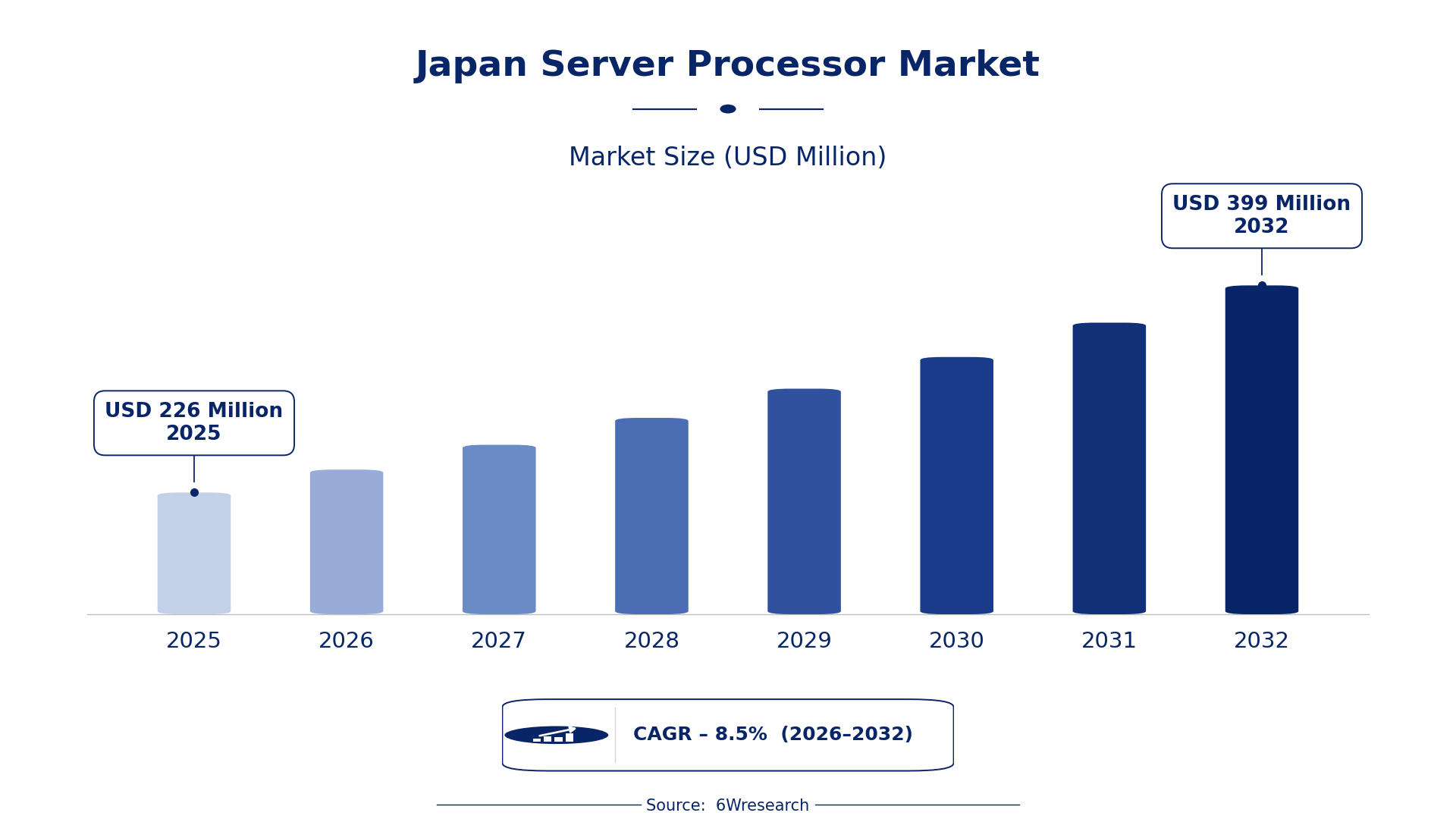
According to 6Wresearch internal database and industry insights, the Japan Server Processor Market was valued at USD 226 Million in 2025 and is projected to reach USD 399 Million by 2032, growing at a CAGR of approximately 8.5% during 2026–2032.
Japan Server Processor Market Highlights
| Report Metric | Details |
| Report Name | Japan Server Processor Market (2026-2032) |
| Market Size 2025 | USD 226 Million |
| Market Size 2032 | USD 399 Million |
| Absolute Growth 2025–2032 | USD 173 Million |
| CAGR 2026–2032 | 8.5% |
| Peak Annual Growth | 10.3% in 2026 |
| Forecast Period | 2026–2032 |
| Historical Data | 2022–2025 |
| Base Year | 2025 |
| Leading Processor Type, 2025 | x86 Server CPUs (46% share) |
| Leading Architecture, 2025 | Multi-Core (44% share) |
| Leading Socket Compatibility, 2025 | LGA Socket (42% share) |
| Leading End User, 2025 | Cloud Providers (43% share) |
| Fastest-Growing Processor Type | ARM-Based Processors (11.4% CAGR) |
| Fastest-Growing Architecture | Energy Efficient (10.5% CAGR) |
| Fastest-Growing Socket Compatibility | PCIe (10.9% CAGR) |
| Fastest-Growing End User | AI/ML Startups (11.0% CAGR) |
| Growing Sector | AI/ML Startups |
| Key End Users | Cloud Providers, Data Center Operators, AI/ML Startups, Research Institutions |
Japan Server Processor Market Year-wise Growth Rate and Key Drivers (2022–2032)
This graph illustrates the annual growth rates of the market from 2022 to 2032, highlighting a steady upward trajectory and projected market expansion over the forecast period.
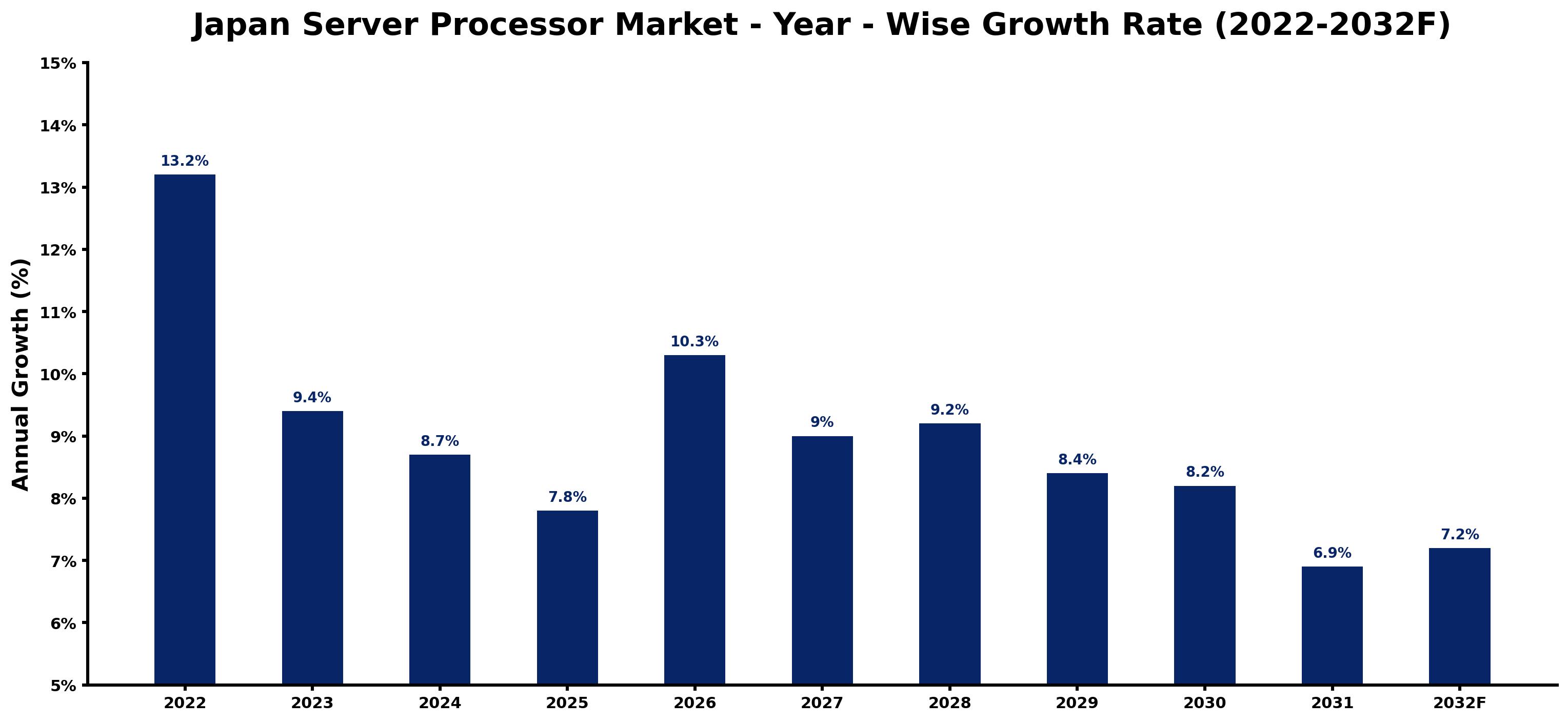
For each year, the table pairs the estimated growth rate with the leading influence on demand, showing how the drivers changed across the period.
| Year | Estimated Annual Growth (%) | Market Rationale |
| 2022 | 13.2 | The market experienced strong demand from cloud providers and data center operators. |
| 2023 | 9.4 | Growth slowed as supply chain issues affected processor availability and delivery timelines. |
| 2024 | 8.7 | The ongoing demand for advanced processing capabilities continued to support market expansion. |
| 2025 | 7.8 | Market growth decelerated due to increased competition and price pressures among suppliers. |
| 2026 | 10.3 | The introduction of new energy-efficient processors is expected to stimulate a surge in demand. |
| 2027 | 9.0 | Demand will remain steady as data center operators upgrade their infrastructure. |
| 2028 | 9.2 | The market will see renewed interest in AI/ML applications, driving processor purchases. |
| 2029 | 8.4 | Growth will slow as market saturation begins to impact new server deployments. |
| 2030 | 8.2 | Demand will remain stable as cloud service providers continue to invest in infrastructure. |
| 2031 | 6.9 | The market will experience slower growth as competition intensifies among manufacturers. |
| 2032 | 7.2 | A resurgence in AI/ML startups is projected to drive demand for advanced processors. |
Note: Market size estimations and growth projections presented in this report are based on 6Wresearch's proprietary forecasting methodology, utilizing the latest available industry data, government publications, and primary research inputs.
Japan Server Processor Market Synopsis
Server processors are specialized CPUs designed for server environments, optimized for performance, reliability, and scalability. They are essential for handling large-scale data processing, supporting enterprise applications, and powering cloud computing. The Japan Server Processor Market is expanding due to the thriving data center sector, with strong demand from domestic users. The installed base of server processors is estimated at 10 million units, and the cloud service market is projected to reach 3 trillion yen by 2025, reflecting substantial investment in advanced processing capabilities.
Market Dynamics Impact Analysis (2026–2032)
| Factor | Type | Impact | Primary Segment Affected |
| Growing demand from cloud providers for enhanced processing capabilities | Driver | High | Cloud Providers |
| Increased interest in AI/ML applications driving processor purchases | Driver | High | AI/ML Startups |
| Expansion of data centers in the Tokyo region creating infrastructure needs | Opportunity | High | Data Center Operators |
| Emerging AI/ML startups seeking advanced processing solutions | Opportunity | High | AI/ML Startups |
| Supply chain disruptions affecting processor availability | Restraint | High | x86 Server CPUs |
| Intense competition leading to price pressures among suppliers | Restraint | Medium | GPU Server Chips |
| Challenges in securing reliable semiconductor supply chains | Challenge | High | ARM-Based Processors |
| Need for continuous innovation to meet evolving technology demands | Challenge | Medium | Multi-Core |
Evaluation of Drivers in Japan Server Processor Market (2026–2032)
Key forces behind demand, with the segment each one moves most, are listed below.
| Drivers | Primary Segment Affected | Why It Matters (Evidence) |
| High demand from cloud providers | Cloud Providers | The cloud service market is projected to reach 3 trillion yen by 2025, prompting increased purchases of server processors. |
| Rising AI/ML applications | AI/ML Startups | The number of AI/ML startups in Japan increased by 25% last year, driving demand for advanced processing capabilities. |
| Expansion of data centers | Data Center Operators | Japan's data center market is projected to reach 1.2 trillion yen by 2025, leading to higher processor demand. |
| Focus on energy-efficient solutions | Energy Efficient | Support for energy-efficient data centers boosts processor purchases as firms seek to reduce operational costs. |
| Increased parallel processing needs | Parallel Processing | The growing demand for applications requiring high computational power drives purchases of specialized server processors. |
What keeps demand rising is the growth in cloud services, projected to reach 3 trillion yen by 2025, which drives cloud providers to invest in server processors. The number of AI/ML startups surged by 25% last year, increasing the need for advanced processing capabilities. Japan's data centre market is expected to reach 1.2 trillion yen by 2025, prompting operators to upgrade their infrastructure. The focus on energy-efficient data centres encourages purchases of energy-efficient processors. Demand for high computational power is also increasing, further driving the market.
Evaluation of Restraints in Japan Server Processor Market
The table below lists the restraints and the evidence behind each.
| Market Restraint | Primary Segment Affected | Why It Matters (Evidence) |
| Supply chain disruptions affecting processor availability | x86 Server CPUs | Supply chain issues have delayed processor deliveries, impacting production timelines for manufacturers. |
| Intense competition leading to price pressures among suppliers | GPU Server Chips | Increased competition has forced suppliers to lower prices, impacting profit margins. |
| Challenges in securing reliable semiconductor supply chains | x86 Server CPUs | Dependence on imported materials creates bottlenecks, delaying production and increasing costs. |
| Skills shortages in advanced semiconductor fabrication | x86 Server CPUs | Limited skilled workforce hampers production capacity, affecting supply to meet rising demand. |
| Regulatory hurdles in semiconductor manufacturing | x86 Server CPUs | Compliance with stringent regulations can slow down production timelines and increase costs. |
Japan Server Processor Market Challenges
In Japan, the reliance on imported semiconductor materials causes supply chain disruptions, delaying server processor production timelines by up to six months for manufacturers. Heightened competition among local data centres results in price reductions, forcing producers to lower their profit margins and potentially compromising product quality. A shortage of skilled workers in semiconductor fabrication limits suppliers' ability to scale operations, resulting in a 15% decline in output. Buyers are facing increased costs as energy-efficient data centres require significant investments, with average power consumption reaching 1.5 MW, impacting operational budgets.
Trends in the Japan Server Processor Market
The shifts below are changing how Japan Server Processor Market products are bought and supplied.
- Shift Towards Energy-Efficient Server Solutions: Japan's data centre operators are increasingly adopting energy-efficient server processors to reduce operational costs, with the average power consumption for a data centre around 1.5 MW. This trend is supported by the Tokyo Metropolitan Government promoting green technologies.
- Growing Adoption of AI/ML Technologies: AI/ML startups are prioritising advanced server processors to improve computational capabilities, reflecting a 25% increase in such startups last year. This shift is driving demand for specialised processing solutions across various sectors.
- Transition to Modular Server Architectures: The rise of modular server architectures is reshaping data centre design, allowing for greater flexibility and scalability. This trend is supported by the increasing need for adaptable infrastructure in the Tokyo region.
- Emergence of Open Architecture Solutions: Open architecture solutions are gaining traction among developers seeking custom server configurations, appealing to niche markets. The growing interest in tailored solutions is clear as more firms explore these options.
Investment Opportunities in the Japan Server Processor Market
The opportunities below stand out in the Japan Server Processor Market for new entrants and existing suppliers.
- Cloud Providers Seeking Advanced Processors: Cloud providers are increasingly looking for advanced server processors to enhance their infrastructure capabilities, with the cloud service market projected to reach 3 trillion yen by 2025. Entering partnerships with local data centres can facilitate access to this growing market.
- Data Center Operators Upgrading Infrastructure: Data centre operators are investing in new server processors to improve efficiency and performance, driven by the projected growth of the data centre market to 1.2 trillion yen by 2025. Suppliers can benefit by offering tailored solutions.
- AI/ML Startups Demanding Specialized Solutions: AI/ML startups are actively seeking specialised server processors to support their computational needs, with a 25% increase in such startups last year. Suppliers can tap into this demand by providing tailored processing solutions.
- Emerging Interest in Energy-Efficient Technologies: The growing focus on energy-efficient technologies presents an opportunity for suppliers to provide processors that meet these standards. With support from local governments, this sector is poised for growth.
Government Initiatives in the Japan Server Processor Market
The Semiconductor and Digital Industry Strategy, established by the Ministry of Economy, Trade and Industry in June 2021, mandates measures to secure domestic semiconductor manufacturing. This strategy aims to enhance the local production of server processors, ensuring that buyers have access to reliable and efficient products. The Economic Security Promotion Act of 2022 further supports supply-chain resilience for critical products, which includes server processors, thereby stabilising the market for producers and users alike.
The Ministry of Economy, Trade and Industry oversees the implementation of various initiatives, including funding for energy-efficient data centres. The Data Center Industry Association promotes best practices, approving projects that enhance operational efficiency and sustainability in server processor usage. These measures aim to support the growth of the server processor market by ensuring that infrastructure meets modern demands.
Future Insight of the Japan Server Processor Market
By 2032, investment in cloud infrastructure will significantly increase, driven by government programmes that will elevate demand for server processors. The introduction of the JIS X 5050 standard will enhance operational efficiency and ensure hardware compatibility across systems. Japan's data centre market is expected to grow to 1.5 trillion yen, which will lead to increased orders for suppliers and improved processing capabilities for buyers. The anticipated expansion of the cloud service market to 3.5 trillion yen will stimulate further advancements in server technology.
Market Segmentation Analysis
Japan Server Processor Market report covers a detailed analysis of the following market segments:
By Processor Type – x86 Server CPUs Leads, ARM-Based Processors Expected to Grow Fastest
According to Saurav Kr Singh, Senior Research Analyst at 6Wresearch, x86 Server CPUs took 46% of processor type revenue in 2025, more than any other category. x86 Server CPUs dominate the market in Japan due to their extensive application in enterprise servers, which depend on their compatibility and performance. Their substantial installed base of approximately 10 million units reflects their strong presence in the server processor landscape. ARM-Based Processors are set to record the highest CAGR in this split, 11.4% over 2026–2032. The demand for x86 Server CPUs is expected to persist as their established performance metrics maintain their relevance, particularly in cloud computing settings. The recent programme initiated in 2023 to bolster cloud infrastructure capabilities is likely to further reinforce their market position. Suppliers should focus on enhancing x86 Server CPUs to meet the sustained demand from enterprise users.
By Architecture – Multi-Core Leads, Energy Efficient Expected to Grow Fastest
The largest architecture category in 2025 was Multi-Core, at 44% of revenue. Multi-Core architecture is preferred in server environments as it allows for efficient handling of multiple tasks simultaneously, essential for data processing and cloud applications. The increasing complexity of workloads in Japan's data centres necessitates the use of such processors. Over 2026–2032, Energy Efficient is expected to post the fastest growth, at a CAGR of 10.5%. Energy Efficient architecture is rapidly gaining traction as businesses seek to reduce operational costs and environmental impact, aligning with government initiatives for energy-efficient data centres. The Ministry of Economy, Trade and Industry's support for these technologies is a key growth driver. Buyers will benefit from investing in energy-efficient solutions to lower operational costs and comply with regulatory standards.
By Socket Compatibility – LGA Socket Leads, PCIe Expected to Grow Fastest
With 42% of socket compatibility revenue in 2025, LGA Socket was the largest category. LGA Socket leads the market as it is the standard for many server motherboards, ensuring compatibility across various server configurations. This standardisation is critical for the efficient operation of the approximately 300 data centers in Japan. PCIe is projected to grow fastest, at a CAGR of 10.9% during 2026–2032. PCIe is rapidly gaining traction due to its importance in connecting high-speed devices, reflecting the increasing need for advanced processing capabilities in server environments. This trend aligns with the growing focus on performance in Japan's data centre market. Suppliers need to ensure their products are compatible with LGA Socket to meet the requirements of server manufacturers.
By End User – Cloud Providers Lead, AI/ML Startups Expected to Grow Fastest
Cloud Providers held 43% of the Japan Server Processor Market by end user in 2025. Cloud Providers lead the segment of server processor consumers, utilising these processors to establish and support their essential infrastructure. The projected growth of Japan's cloud service market to 3 trillion yen by 2025 underscores the importance of this user group. The quickest growth will come from AI/ML Startups, forecast to expand at a CAGR of 11.0% between 2026 and 2032. AI/ML Startups are significantly increasing their demand for advanced processing capabilities, evidenced by a 25% rise in such startups over the past year. This trend indicates a heightened requirement for high-performance computing solutions in the market. Suppliers should prioritise the needs of Cloud Providers to take advantage of the expanding cloud service market.
Key Attractiveness of the Report
- 10 Years of Market Numbers
- Historical Data Starting from 2022 to 2025
- Base Year 2025
- Forecast Data until 2032
- Key Performance Indicators Impacting the Market
- Major Upcoming Developments and Projects
Key Highlights of the Report:
- Japan Server Processor Market Outlook
- Market Size of Japan Server Processor Market, 2025
- Forecast of Japan Server Processor Market, 2032
- Historical Data and Forecast of Japan Server Processor Revenues & Volume for the Period 2022-2032F
- Japan Server Processor Market Trend Evolution
- Japan Server Processor Market Drivers and Challenges
- Japan Server Processor Price Trends
- Japan Server Processor Porter's Five Forces
- Japan Server Processor Industry Life Cycle
- Historical Data and Forecast of Japan Server Processor Market Revenues & Volume By Processor Type for the Period 2022-2032F
- Historical Data and Forecast of Japan Server Processor Market Revenues & Volume By x86 Server CPUs for the Period 2022-2032F
- Historical Data and Forecast of Japan Server Processor Market Revenues & Volume By ARM-Based Processors for the Period 2022-2032F
- Historical Data and Forecast of Japan Server Processor Market Revenues & Volume By GPU Server Chips for the Period 2022-2032F
- Historical Data and Forecast of Japan Server Processor Market Revenues & Volume By RISC-V Processors for the Period 2022-2032F
- Historical Data and Forecast of Japan Server Processor Market Revenues & Volume By Architecture for the Period 2022-2032F
- Historical Data and Forecast of Japan Server Processor Market Revenues & Volume By Multi-Core for the Period 2022-2032F
- Historical Data and Forecast of Japan Server Processor Market Revenues & Volume By Energy Efficient for the Period 2022-2032F
- Historical Data and Forecast of Japan Server Processor Market Revenues & Volume By Parallel Processing for the Period 2022-2032F
- Historical Data and Forecast of Japan Server Processor Market Revenues & Volume By Open Architecture for the Period 2022-2032F
- Historical Data and Forecast of Japan Server Processor Market Revenues & Volume By Socket Compatibility for the Period 2022-2032F
- Historical Data and Forecast of Japan Server Processor Market Revenues & Volume By LGA Socket for the Period 2022-2032F
- Historical Data and Forecast of Japan Server Processor Market Revenues & Volume By Custom Boards for the Period 2022-2032F
- Historical Data and Forecast of Japan Server Processor Market Revenues & Volume By PCIe for the Period 2022-2032F
- Historical Data and Forecast of Japan Server Processor Market Revenues & Volume By Modular for the Period 2022-2032F
- Historical Data and Forecast of Japan Server Processor Market Revenues & Volume By End User for the Period 2022-2032F
- Historical Data and Forecast of Japan Server Processor Market Revenues & Volume By Cloud Providers for the Period 2022-2032F
- Historical Data and Forecast of Japan Server Processor Market Revenues & Volume By Data Center Operators for the Period 2022-2032F
- Historical Data and Forecast of Japan Server Processor Market Revenues & Volume By AI/ML Startups for the Period 2022-2032F
- Historical Data and Forecast of Japan Server Processor Market Revenues & Volume By Research Institutions for the Period 2022-2032F
- Japan Server Processor Import Export Trade Statistics
- Market Opportunity Assessment By Processor Type
- Market Opportunity Assessment By Architecture
- Market Opportunity Assessment By Socket Compatibility
- Market Opportunity Assessment By End User
- Japan Server Processor Top Companies Market Share
- Japan Server Processor Competitive Benchmarking By Technical and Operational Parameters
- Japan Server Processor Company Profiles
- Japan Server Processor Key Strategic Recommendations
Market Covered
The report covers the following segments.
By Processor Type
- x86 Server CPUs
- ARM-Based Processors
- GPU Server Chips
- RISC-V Processors
By Architecture
- Multi-Core
- Energy Efficient
- Parallel Processing
- Open Architecture
By Socket Compatibility
- LGA Socket
- Custom Boards
- PCIe
- Modular
By End User
- Cloud Providers
- Data Center Operators
- AI/ML Startups
- Research Institutions































