Japan Service Robots with AI Market Size & Growth Rate
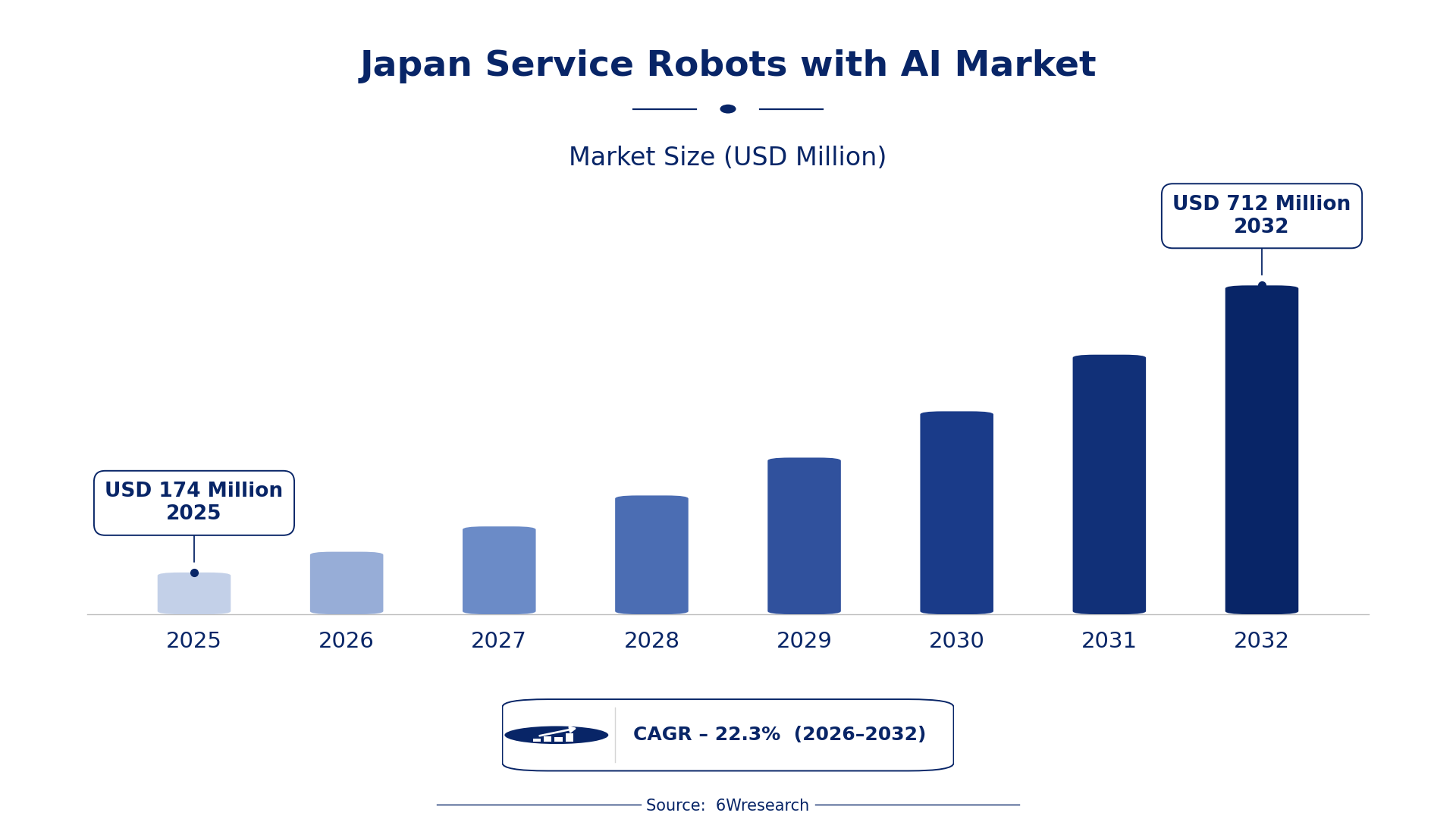
According to 6Wresearch internal database and industry insights, the Japan Service Robots with AI Market was valued at USD 174 Million in 2025 and is projected to reach USD 712 Million by 2032, growing at a CAGR of approximately 22.3% during 2026–2032.
Japan Service Robots with AI Market Highlights
| Report Metric | Details |
| Report Name | Japan Service Robots with AI Market (2026-2032) |
| Market Size 2025 | USD 174 Million |
| Market Size 2032 | USD 712 Million |
| Absolute Growth 2025–2032 | USD 538 Million |
| CAGR 2026–2032 | 22.3% |
| Peak Annual Growth | 27.2% in 2032 |
| Forecast Period | 2026–2032 |
| Historical Data | 2022–2025 |
| Base Year | 2025 |
| Leading AI Capability, 2025 | NLP (Voice Assist) (52% share) |
| Leading Robot Application, 2025 | Customer Support (40% share) |
| Leading Learning Mode, 2025 | Cloud-Based AI (39% share) |
| Leading End User, 2025 | Malls/Restaurants (47% share) |
| Fastest-Growing AI Capability | Emotion Recognition (29.3% CAGR) |
| Fastest-Growing Robot Application | Elder Care & Therapy (23.7% CAGR) |
| Fastest-Growing Learning Mode | Federated Learning (31.3% CAGR) |
| Fastest-Growing End User | Nursing Homes (24.8% CAGR) |
| Growing Sector | Healthcare |
| Key End Users | Healthcare facilities, Retailers, Logistics providers, Restaurants |
Japan Service Robots with AI Market Year-wise Growth Rate and Key Drivers (2022–2032)
This graph illustrates the annual growth rates of the market from 2022 to 2032, highlighting a steady upward trajectory and projected market expansion over the forecast period.
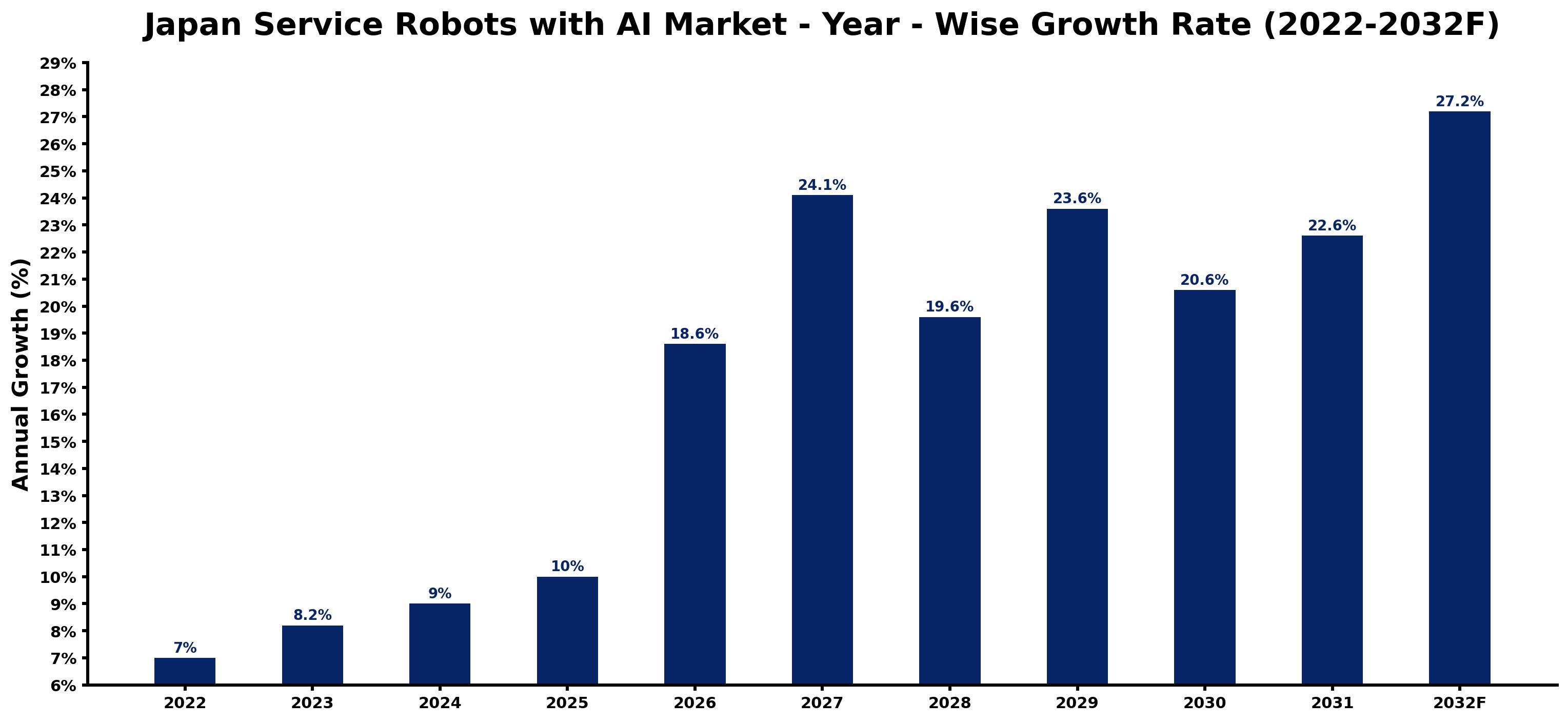
The following figures match every annual growth estimate with the main market development of that year, giving the reasoning behind each rise or slowdown.
| Year | Estimated Annual Growth (%) | Market Rationale |
| 2022 | 7.0 | The market showed steady growth due to increasing interest in automation technologies. |
| 2023 | 8.2 | Demand accelerated as more sectors adopted AI-driven service robots for efficiency. |
| 2024 | 9.0 | Growth continued as businesses sought to improve customer experiences with automation. |
| 2025 | 10.0 | The introduction of new standards boosted confidence in service robot safety and efficacy. |
| 2026 | 18.6 | Demand is expected to surge as healthcare facilities expand their use of elder care robots. |
| 2027 | 24.1 | Increased investments in AI technologies will lead to a rise in robot deployment. |
| 2028 | 19.6 | Growth is projected to slow as the market begins to stabilise after rapid expansion. |
| 2029 | 23.6 | Demand is expected to rebound as new applications in logistics gain traction across sectors. |
| 2030 | 20.6 | Growth will moderate as market saturation begins to affect new purchases. |
| 2031 | 22.6 | Continued expansion in the healthcare sector will drive renewed interest in service robots. |
| 2032 | 27.2 | The market is projected to peak as advancements in AI technology lead to widespread adoption. |
Note: Market size estimations and growth projections presented in this report are based on 6Wresearch's proprietary forecasting methodology, utilizing the latest available industry data, government publications, and primary research inputs.
Japan Service Robots with AI Market Synopsis
Service Robots with AI are sophisticated machines designed to assist in a variety of tasks through artificial intelligence technologies. Their primary applications include customer service, elder care, and logistics, with demand fuelled by a growing elderly population and substantial investments in healthcare robotics. The Japan Service Robots with AI Market is growing as automation becomes more prevalent across sectors, particularly in healthcare, where the need for elder care solutions is increasing. In 2023, more than 1,000 service robots were deployed in nursing homes, illustrating the deeper integration of these technologies. This trend is anticipated to persist as sectors adapt to new technologies and standards.
Market Dynamics Impact Analysis (2026–2032)
| Factor | Type | Impact | Primary Segment Affected |
| Growing elderly population drives demand for elder care robots. | Driver | High | Elder Care & Therapy |
| Increased automation in retail enhances customer engagement with service robots. | Driver | High | Customer Support |
| Healthcare facilities are expanding their use of AI-driven robots for patient support. | Opportunity | High | Nursing Homes |
| The logistics sector is rapidly adopting AI technologies to improve efficiency. | Opportunity | Medium | Smart Warehouses |
| High initial investment costs deter some potential buyers from purchasing robots. | Restraint | High | Elder Care & Therapy |
| Limited awareness of service robots' capabilities restricts market growth. | Restraint | Medium | Customer Support |
| Talent shortages in robotics engineering slow down production capabilities. | Challenge | High | Industrial Service Bots |
| Competition from low-cost alternatives hampers market penetration. | Challenge | Medium | Navigation + Delivery |
Evaluation of Drivers in Japan Service Robots with AI Market (2026–2032)
These are the developments adding the most demand over the forecast period.
| Drivers | Primary Segment Affected | Why It Matters (Evidence) |
| Growing investments in healthcare robotics. | Elder Care & Therapy | Japan's healthcare sector is investing heavily in AI technologies, leading to increased purchases of service robots. |
| Expansion of customer service applications in retail. | Customer Support | In 2022, over 500 AI-based customer support robots were in operation, driving demand. |
| Adoption of AI technologies in logistics. | Smart Warehouses | The logistics sector is rapidly adopting AI technologies, increasing demand for service robots. |
| Government initiatives promoting robotics. | Nursing Homes | The New Robot Strategy introduced in 2015 aims to expand robot use in healthcare, boosting robot deployment. |
| Rising demand for automation in manufacturing. | Industrial Service Bots | The manufacturing sector is the largest end-user of service robots, driving investments in automation. |
Volumes increase due to rising investments in healthcare robotics, with a strong emphasis on elder care. In 2023, over 1,000 service robots were deployed in nursing homes, indicating a heightened demand for automation in patient support. The logistics sector is also broadening its use of AI technologies, with more service robots enhancing operational efficiency. Retail has seen a growth in customer service applications, with over 500 AI-based robots currently in operation, further propelling demand for automation across various sectors.
Evaluation of Restraints in Japan Service Robots with AI Market
The key brakes on demand, and where they bite hardest, are shown below.
| Market Restraint | Primary Segment Affected | Why It Matters (Evidence) |
| High initial costs of service robots limit market access for smaller businesses. | Elder Care & Therapy | The average cost of deploying a service robot can exceed JPY 1 million, deterring smaller healthcare facilities. |
| Limited understanding of service robots' capabilities restricts adoption in non-traditional sectors. | Customer Support | Many businesses are unaware of the potential benefits of service robots, slowing adoption rates. |
| Regulatory compliance can be complex and costly for manufacturers. | Industrial Service Bots | Manufacturers must adhere to strict standards like ISO 13482, increasing operational costs. |
| Technological limitations in existing robots hinder performance in complex environments. | Navigation + Delivery | Current navigation systems struggle with dynamic obstacles, limiting effectiveness in busy settings. |
| Market saturation in certain applications may slow growth rates. | Customer Support | As more businesses adopt similar technologies, differentiation becomes challenging, impacting new purchases. |
Japan Service Robots with AI Market Challenges
Intensifying competition in the service robot market compels producers to reduce prices, potentially cutting profit margins by up to 15% for manufacturers. A shortage of skilled robotics engineers limits suppliers' ability to meet demand, resulting in delays that cost buyers valuable time in deployment. Buyers are facing rising costs due to compliance with standards such as ISO 13482, which may add 10% to their overall investment in service robots. Regulatory changes necessitate additional investments in safety and training, impacting hospitals' budgets and delaying the adoption of new technologies.
Trends in the Japan Service Robots with AI Market
The following changes are redrawing the Japan Service Robots with AI Market.
- Increase in Elder Care Robots: By 2025, the demand for elder care robots is projected to rise by 30%, reflecting Japan's growing elderly population. This trend underscores the need for effective solutions in healthcare.
- Shift towards Cloud-Based AI Solutions: Cloud-Based AI is becoming the preferred learning mode for service robots, with 70% adoption in 2023. This shift allows for remote data processing and updates, improving robot capabilities.
- Expansion of AI in Retail: The Tokyo metropolitan area is experiencing a surge in AI applications in retail, with over 1,000 service robots deployed in 2023. This trend is reshaping customer engagement strategies.
- Growth of Smart Warehouses: The Smart Warehouse initiative is improving logistics efficiency, with an increase in AI-driven robots for inventory management. This shift is set to streamline operations significantly.
Investment Opportunities in the Japan Service Robots with AI Market
Below are the investment opportunities with the strongest case in the Japan Service Robots with AI Market.
- Supply of Elder Care Robots: With demand for elder care robots projected to rise by 30% by 2025, suppliers can target nursing homes and healthcare facilities to meet this growing need.
- Investment in AI Technologies for Logistics: The logistics sector is rapidly adopting AI technologies, creating opportunities for suppliers to provide advanced service robots to improve operational efficiency in smart warehouses.
- Development of Customer Support Robots: With over 500 AI-based customer support robots in operation, there is an opportunity for suppliers to innovate and expand offerings in retail environments.
- Expansion of Cloud-Based AI Solutions: As 70% of service robots adopt cloud-based AI, suppliers can invest in developing advanced solutions that improve robot learning and adaptability in various applications.
Government Initiatives in the Japan Service Robots with AI Market
Japan's regulatory framework for service robots is influenced by several key laws. The Industrial Standardization Act, established in 1949 and amended in 2019, governs product and testing standards. The New Robot Strategy, initiated in 2015, aims to broaden robot use across manufacturing, services, agriculture, and care sectors, promoting innovation and safety in robotics. These measures directly impact service robots by ensuring compliance with safety and operational standards, which buyers must consider when integrating these technologies.
The Ministry of Economy, Trade and Industry supervises the implementation of various initiatives supporting service robots. The AI Promotion Act, introduced in 2025, allocates funding for projects that enhance elder care services and improve AI capabilities. Additionally, the Consumer Affairs Agency enforces regulations to ensure transparency in robot marketing, which influences how buyers perceive and adopt these technologies.
Future Insight of the Japan Service Robots with AI Market
By 2032, healthcare providers will increasingly embrace advanced AI capabilities in robots, improving elder care services. The number of service robots in restaurants is expected to surpass 5,000, streamlining operations and enhancing customer experiences. The 'Robot Revolution Initiative' will propel AI integration in healthcare, benefiting suppliers through heightened demand. As the Tokyo region continues to lead in AI research, collaboration will accelerate technological advancements, ultimately improving service delivery for buyers.
Market Segmentation Analysis
Japan Service Robots with AI Market report covers a detailed analysis of the following market segments:
By AI Capability – NLP (Voice Assist) Leads, Emotion Recognition Expected to Grow Fastest
According to Saurav Kr Singh, Senior Research Analyst at 6Wresearch, in 2025, NLP (Voice Assist) led the ai capability split with a 52% share. Natural Language Processing is essential for effective communication in customer interactions, especially in retail environments where engagement is crucial. Its widespread application in support systems has established it as the dominant technology in Japan's service robots market. Emotion Recognition is set to record the highest CAGR in this split, 29.3% over 2026–2032. Emotion Recognition is gaining momentum as businesses increasingly prioritise enhancing customer experiences, particularly in therapy and support roles. This growing focus on emotional intelligence is expected to drive its rapid adoption across various applications. Suppliers must prioritise advancements in AI capabilities to meet the evolving market demands.
By Robot Application – Customer Support Leads, Elder Care & Therapy Expected to Grow Fastest
Customer Support held 40% of the Japan Service Robots with AI Market by robot application in 2025. Customer Support robots are extensively used in retail and service sectors, playing a vital role in enhancing customer engagement and streamlining operations. The strong demand for interactive solutions has solidified their position as the leading application of service robots in Japan. Elder Care & Therapy is projected to grow fastest, at a CAGR of 23.7% during 2026–2032. Elder Care & Therapy applications are expanding significantly due to the increasing elderly population and rising investments in healthcare robotics. The anticipated 30% growth in demand for elder care robots by 2025 highlights the urgency for innovation in this sector. Healthcare buyers should consider investing in elder care robots to meet the rising needs of an ageing population.
By Learning Mode – Cloud-Based AI Leads, Federated Learning Expected to Grow Fastest
The largest learning mode category in 2025 was Cloud-Based AI, at 39% of revenue. Cloud-Based AI enables efficient remote data processing and updates, making it essential for the operation of service robots. Its established presence in the market has made it the preferred learning mode for various applications in Japan. The quickest growth will come from Federated Learning, forecast to expand at a CAGR of 31.3% between 2026 and 2032. Federated Learning is emerging as a valuable technology that prioritises data privacy, which is increasingly important in the context of AI. As concerns over data security rise, its adoption is expected to accelerate in the near future. Suppliers should explore federated learning solutions to align with trends towards enhanced data privacy.
By End User – Malls/Restaurants Lead, Nursing Homes Expected to Grow Fastest
With 47% of end user revenue in 2025, Malls/Restaurants was the largest category. Malls and Restaurants represent the largest end-user segment due to their high demand for customer engagement and operational efficiency. The concentration of service robots in these environments underscores their critical role in improving customer experiences. Over 2026–2032, Nursing Homes are expected to post the fastest growth, at a CAGR of 24.8%. Nursing Homes are experiencing a notable increase in the use of service robots as they adopt technology for elder care support. This projected growth indicates a significant opportunity for suppliers to meet healthcare needs. Investing in service robots for nursing homes can yield substantial benefits in addressing the care demands of an ageing population.
Key Attractiveness of the Report
- 10 Years of Market Numbers
- Historical Data Starting from 2022 to 2025
- Base Year 2025
- Forecast Data until 2032
- Key Performance Indicators Impacting the Market
- Major Upcoming Developments and Projects
Key Highlights of the Report:
- Japan Service Robots with AI Market Outlook
- Market Size of Japan Service Robots with AI Market, 2025
- Forecast of Japan Service Robots with AI Market, 2032
- Historical Data and Forecast of Japan Service Robots with AI Revenues & Volume for the Period 2022-2032F
- Japan Service Robots with AI Market Trend Evolution
- Japan Service Robots with AI Market Drivers and Challenges
- Japan Service Robots with AI Price Trends
- Japan Service Robots with AI Porter's Five Forces
- Japan Service Robots with AI Industry Life Cycle
- Historical Data and Forecast of Japan Service Robots with AI Market Revenues & Volume By AI Capability for the Period 2022-2032F
- Historical Data and Forecast of Japan Service Robots with AI Market Revenues & Volume By NLP (Voice Assist) for the Period 2022-2032F
- Historical Data and Forecast of Japan Service Robots with AI Market Revenues & Volume By Computer Vision for the Period 2022-2032F
- Historical Data and Forecast of Japan Service Robots with AI Market Revenues & Volume By Predictive Maintenance for the Period 2022-2032F
- Historical Data and Forecast of Japan Service Robots with AI Market Revenues & Volume By Emotion Recognition for the Period 2022-2032F
- Historical Data and Forecast of Japan Service Robots with AI Market Revenues & Volume By Robot Application for the Period 2022-2032F
- Historical Data and Forecast of Japan Service Robots with AI Market Revenues & Volume By Customer Support for the Period 2022-2032F
- Historical Data and Forecast of Japan Service Robots with AI Market Revenues & Volume By Navigation + Delivery for the Period 2022-2032F
- Historical Data and Forecast of Japan Service Robots with AI Market Revenues & Volume By Industrial Service Bots for the Period 2022-2032F
- Historical Data and Forecast of Japan Service Robots with AI Market Revenues & Volume By Elder Care & Therapy for the Period 2022-2032F
- Historical Data and Forecast of Japan Service Robots with AI Market Revenues & Volume By Learning Mode for the Period 2022-2032F
- Historical Data and Forecast of Japan Service Robots with AI Market Revenues & Volume By Cloud-Based AI for the Period 2022-2032F
- Historical Data and Forecast of Japan Service Robots with AI Market Revenues & Volume By Onboard Learning for the Period 2022-2032F
- Historical Data and Forecast of Japan Service Robots with AI Market Revenues & Volume By Edge AI for the Period 2022-2032F
- Historical Data and Forecast of Japan Service Robots with AI Market Revenues & Volume By Federated Learning for the Period 2022-2032F
- Historical Data and Forecast of Japan Service Robots with AI Market Revenues & Volume By End User for the Period 2022-2032F
- Historical Data and Forecast of Japan Service Robots with AI Market Revenues & Volume By Malls/Restaurants for the Period 2022-2032F
- Historical Data and Forecast of Japan Service Robots with AI Market Revenues & Volume By Smart Warehouses for the Period 2022-2032F
- Historical Data and Forecast of Japan Service Robots with AI Market Revenues & Volume By Manufacturing Facilities for the Period 2022-2032F
- Historical Data and Forecast of Japan Service Robots with AI Market Revenues & Volume By Nursing Homes for the Period 2022-2032F
- Japan Service Robots with AI Import Export Trade Statistics
- Market Opportunity Assessment By AI Capability
- Market Opportunity Assessment By Robot Application
- Market Opportunity Assessment By Learning Mode
- Market Opportunity Assessment By End User
- Japan Service Robots with AI Top Companies Market Share
- Japan Service Robots with AI Competitive Benchmarking By Technical and Operational Parameters
- Japan Service Robots with AI Company Profiles
- Japan Service Robots with AI Key Strategic Recommendations
Market Covered
The following segment groups are covered in the report.
By AI Capability
- NLP (Voice Assist)
- Computer Vision
- Predictive Maintenance
- Emotion Recognition
By Robot Application
- Customer Support
- Navigation + Delivery
- Industrial Service Bots
- Elder Care & Therapy
By Learning Mode
- Cloud-Based AI
- Onboard Learning
- Edge AI
- Federated Learning
By End User
- Malls/Restaurants
- Smart Warehouses
- Manufacturing Facilities
- Nursing Homes































