Japan Sewage Treatment Market Size & Growth Rate
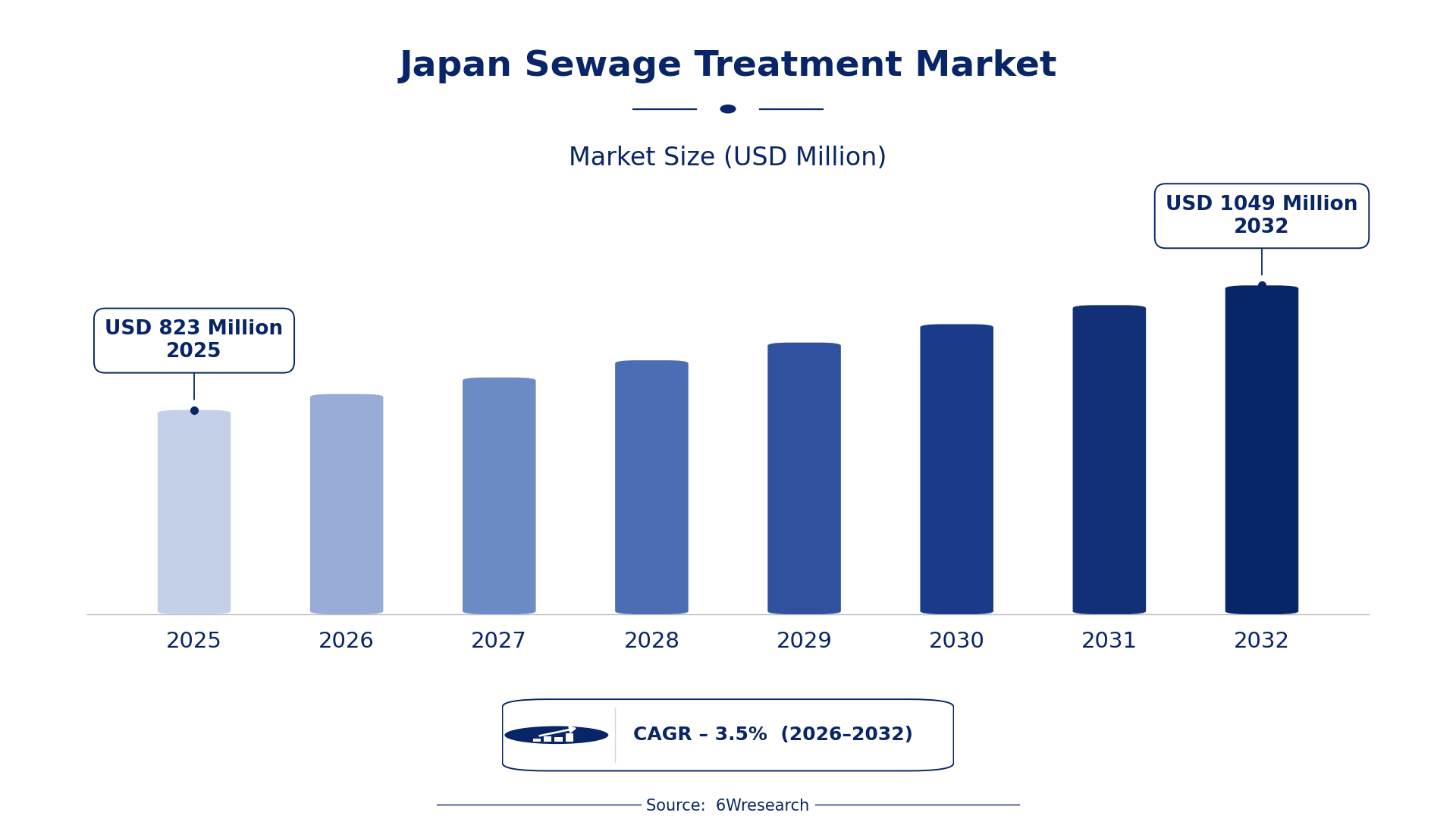
According to 6Wresearch internal database and industry insights, the Japan Sewage Treatment Market was valued at USD 823 Million in 2025 and is projected to reach USD 1,049 Million by 2032, growing at a CAGR of approximately 3.5% during 2026–2032.
Japan Sewage Treatment Market Highlights
| Report Metric | Details |
| Report Name | Japan Sewage Treatment Market (2026-2032) |
| Market Size 2025 | USD 823 Million |
| Market Size 2032 | USD 1,049 Million |
| Absolute Growth 2025–2032 | USD 226 Million |
| CAGR 2026–2032 | 3.5% |
| Peak Annual Growth | 4.7% in 2032 |
| Forecast Period | 2026–2032 |
| Historical Data | 2022–2025 |
| Base Year | 2025 |
| Leading Treatment Type, 2025 | Primary Treatment (46% share) |
| Leading Process Stage, 2025 | Sedimentation (50% share) |
| Leading Plant Type, 2025 | Municipal Sewage Plants (40% share) |
| Leading End User, 2025 | Urban Utilities (42% share) |
| Fastest-Growing Treatment Type | Secondary Treatment (4.9% CAGR) |
| Fastest-Growing Process Stage | Biological Filtration (5.3% CAGR) |
| Fastest-Growing Plant Type | Decentralized Systems (5.2% CAGR) |
| Fastest-Growing End User | Rural Water Boards (4.6% CAGR) |
| Growing Sector | Urban Utilities |
| Key End Users | Urban Utilities, Industrial Waste Managers, Water Reclamation Units |
Japan Sewage Treatment Market Year-wise Growth Rate and Key Drivers (2022–2032)
This graph illustrates the annual growth rates of the market from 2022 to 2032, highlighting a steady upward trajectory and projected market expansion over the forecast period.
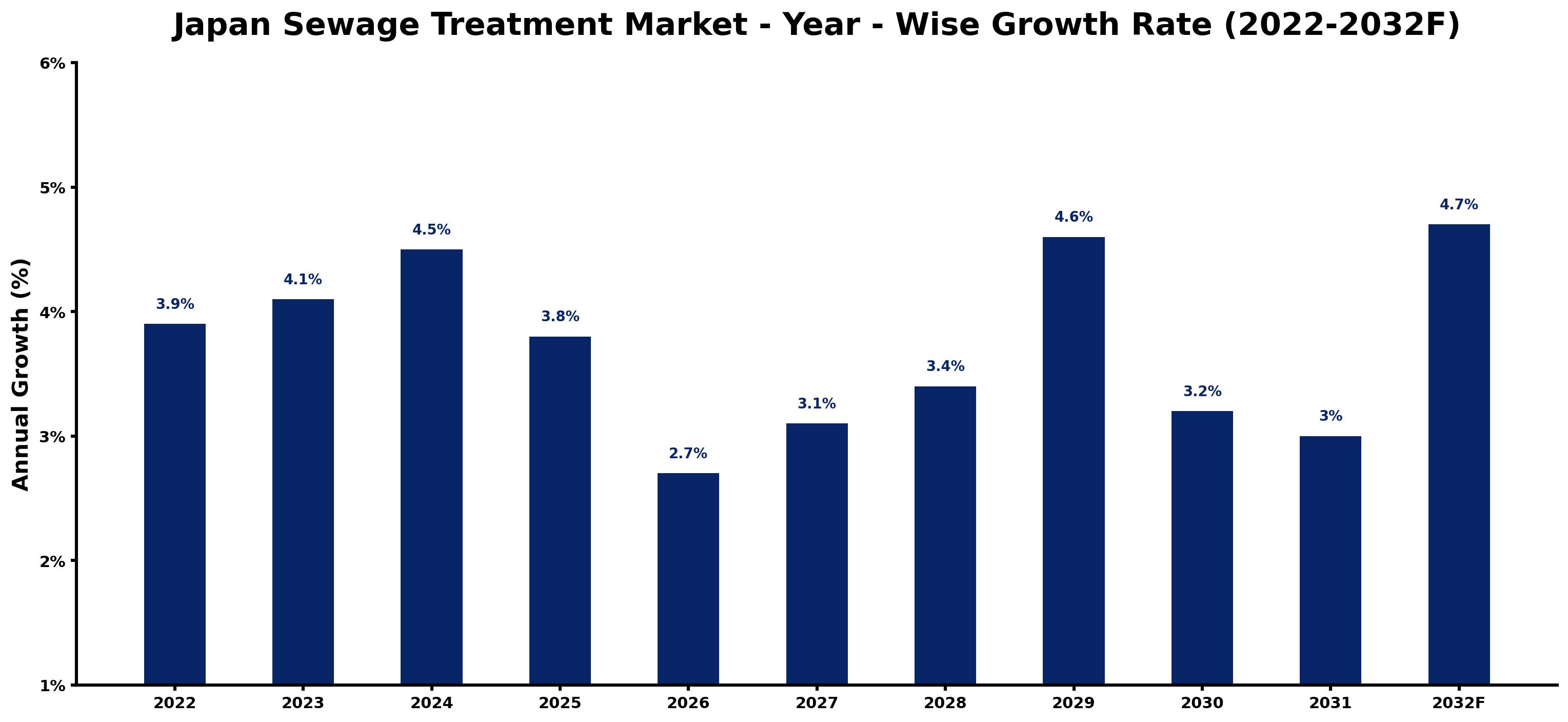
For each year, the table pairs the estimated growth rate with the leading influence on demand, showing how the drivers changed across the period.
| Year | Estimated Annual Growth (%) | Market Rationale |
| 2022 | 3.9 | The market experienced steady growth due to consistent demand from urban utilities. |
| 2023 | 4.1 | Demand from industrial sectors increased, contributing to faster growth than the previous year. |
| 2024 | 4.5 | The adoption of advanced treatment technologies accelerated market expansion further. |
| 2025 | 3.8 | Growth slowed as the market adjusted to previous peaks in demand and investment. |
| 2026 | 2.7 | A slowdown is expected as the market faces capacity constraints in treatment facilities. |
| 2027 | 3.1 | Demand will rise again as urban utilities expand their treatment capabilities. |
| 2028 | 3.4 | Growth is projected to continue as municipalities invest in infrastructure improvements for sewage treatment. |
| 2029 | 4.6 | Increased focus on environmental sustainability will boost demand for advanced treatment solutions. |
| 2030 | 3.2 | Growth will slow again as market saturation begins to affect new investments. |
| 2031 | 3.0 | The market will continue to grow, albeit at a slower pace due to operational challenges. |
| 2032 | 4.7 | Demand will rise again as new government initiatives spur investment in sewage treatment. |
Note: Market size estimations and growth projections presented in this report are based on 6Wresearch's proprietary forecasting methodology, utilizing the latest available industry data, government publications, and primary research inputs.
Japan Sewage Treatment Market Synopsis
Sewage treatment involves the removal of contaminants from wastewater using biological, chemical, and physical methods. This process protects public health and the environment while recycling water for various applications. The Japan Sewage Treatment Market is growing due to high demand from urban utilities and industrial sectors, alongside substantial investments in infrastructure improvements, such as the ¥1 trillion allocated for water infrastructure in 2022. The adoption of advanced technologies, including membrane bioreactors, drives this growth, ensuring compliance with environmental standards and improving operational effectiveness.
Market Dynamics Impact Analysis (2026–2032)
| Factor | Type | Impact | Primary Segment Affected |
| High demand from urban utilities drives investment in treatment infrastructure. | Driver | High | Municipal Sewage Plants |
| Growing focus on environmental sustainability creates opportunities for advanced treatment technologies. | Opportunity | High | Tertiary Treatment |
| Regulatory constraints on wastewater discharge limit operational flexibility for facilities. | Restraint | High | Municipal Sewage Plants |
| Increasing competition among treatment facilities may lead to price pressures. | Challenge | Medium | Municipal Sewage Plants |
| Rising population in urban areas necessitates expanded sewage treatment capacity. | Driver | High | Urban Utilities |
| The push for biogas recovery units presents new market opportunities. | Opportunity | Medium | Biogas Recovery Units |
| Aging infrastructure in existing treatment plants requires significant upgrades. | Restraint | Medium | Municipal Sewage Plants |
| Limited availability of skilled workforce affects operational efficiency. | Challenge | Medium | Municipal Sewage Plants |
Evaluation of Drivers in Japan Sewage Treatment Market (2026–2032)
These are the developments adding the most demand over the forecast period.
| Drivers | Primary Segment Affected | Why It Matters (Evidence) |
| High demand from urban utilities for improved sewage treatment services. | Municipal Sewage Plants | Urban utilities serve approximately 126 million people, necessitating robust treatment solutions. |
| Increased focus on environmental sustainability drives investment in advanced technologies. | Tertiary Treatment | The government aims for 100% sewage coverage in urban areas by 2030, enhancing demand. |
| Growing population in urban areas leads to higher sewage flow rates. | Urban Utilities | The average daily sewage flow in Japan is approximately 10 million cubic meters. |
| Investment in water infrastructure improvements boosts treatment capacity. | Municipal Sewage Plants | In 2022, Japan allocated ¥1 trillion for water infrastructure enhancements. |
| Adoption of advanced treatment technologies enhances operational efficiency. | Tertiary Treatment | ISO 14001 is widely adopted, ensuring compliance with environmental standards. |
What keeps demand rising is the increasing need for efficient sewage treatment driven by urban utilities serving approximately 126 million people. The average daily sewage flow in Japan is around 10 million cubic meters, prompting investment in municipal sewage plants. In 2022, ¥1 trillion was allocated for water infrastructure improvements, boosting treatment capacity. The goal of achieving 100% sewage coverage in urban areas by 2030 further fuels demand. The adoption of advanced treatment technologies, such as membrane bioreactors, supports operational efficiency and environmental compliance.
Evaluation of Restraints in Japan Sewage Treatment Market
The table below lists the restraints and the evidence behind each.
| Market Restraint | Primary Segment Affected | Why It Matters (Evidence) |
| Regulatory constraints on wastewater discharge limit operational flexibility for facilities. | Municipal Sewage Plants | Compliance with the Sewerage Act requires stringent adherence to treatment standards. |
| Aging infrastructure in existing treatment plants requires upgrades. | Municipal Sewage Plants | Over 1,200 municipal sewage treatment plants need modernisation to meet current demands. |
| Limited availability of skilled workforce affects operational efficiency. | Municipal Sewage Plants | The need for skilled technicians is increasing as facilities adopt advanced technologies. |
| High operational costs associated with advanced treatment technologies can deter investment. | Tertiary Treatment | Facilities must balance costs while upgrading to comply with environmental standards. |
| Increasing competition among treatment facilities may lead to price pressures. | Municipal Sewage Plants | As more facilities enter the market, pricing strategies become increasingly aggressive. |
Japan Sewage Treatment Market Challenges
High operational costs challenge private sewage treatment operators, as competition from over 1,200 municipal plants drives down prices, risking revenue reductions of up to 15% for smaller facilities. Supply chain disruptions arise from reliance on imported treatment chemicals, leading to project delays that can extend timelines by three months for contractors. Increasing expenses for advanced treatment technologies, particularly membrane bioreactors, can inflate capital costs by 20%, straining budgets for facilities needing upgrades. Compliance with regulations from the Ministry of the Environment incurs average expenses of ¥500 million per year for facilities adapting to new standards.
Trends in the Japan Sewage Treatment Market
Several trends are reshaping the Japan Sewage Treatment Market; the most important are set out below.
- Growing Investment in Water Infrastructure: Japan allocated ¥1 trillion for water infrastructure improvements in 2022, highlighting a shift towards modernising sewage treatment facilities. This investment is essential for meeting future demand.
- Focus on Environmental Sustainability: The government aims for 100% sewage coverage in urban areas by 2030, driving demand for efficient sewage treatment solutions. This initiative aligns with broader environmental goals.
- Increased Adoption of Biogas Recovery Units: Biogas recovery units are gaining traction for energy generation from waste. This trend supports Japan's commitment to sustainability while addressing waste management challenges.
- Shift towards Advanced Treatment Technologies: The adoption of advanced treatment technologies, such as membrane bioreactors, is increasing in Japan. In 2020, the sewage treatment rate reached 99.7%, reflecting the need for higher standards.
Investment Opportunities in the Japan Sewage Treatment Market
Where to invest in the Japan Sewage Treatment Market: the main openings are set out below.
- Partner with Local Utilities for Infrastructure Upgrades: Urban utilities are seeking partners for infrastructure upgrades, focusing on advanced treatment technologies. The ¥1 trillion allocated in 2022 creates a substantial investment opportunity.
- Supply Advanced Treatment Technologies: The demand for advanced treatment technologies is growing, particularly in urban areas. Facilities are increasingly adopting solutions like membrane bioreactors to improve efficiency.
- Invest in Biogas Recovery Solutions: With biogas recovery units gaining traction, there is a clear opportunity for investment in this area. Urban utilities are keen on integrating these solutions into their operations.
- Provide Training for Skilled Workforce: The need for skilled technicians is rising as facilities modernise. Training programs targeting sewage treatment operations can help bridge the skills gap.
Government Initiatives in the Japan Sewage Treatment Market
The Water Supply Act (1957) and the Sewerage Act (1958) set the framework for sewage treatment standards and practices in Japan. These laws ensure that facilities meet stringent environmental requirements and protect public health. Compliance with these regulations is critical for all sewage treatment plants, influencing operational practices and investment decisions.
The Ministry of the Environment oversees the implementation of sewage treatment regulations and standards. Local utilities benefit from government support in upgrading facilities, with funding allocated for sludge management programs. This support encourages the adoption of advanced technologies and ensures compliance with national standards.
Future Insight of the Japan Sewage Treatment Market
Japan will enhance sewage infrastructure to achieve 100% coverage in urban areas by 2030, driven by government initiatives. The allocation of ¥1 trillion for water improvements will encourage the adoption of advanced treatment technologies, boosting operational efficiency. Innovative sludge management programs in regions like Shiga Prefecture will serve as models for sustainable practices nationwide. New subsidy initiatives for upgrading facilities will prompt suppliers to develop enhanced solutions, improving service delivery and environmental protection.
Market Segmentation Analysis
Japan Sewage Treatment Market report covers a detailed analysis of the following market segments:
By Treatment Type – Primary Treatment Leads, Secondary Treatment Expected to Grow Fastest
According to Saurav Kr Singh, Senior Research Analyst at 6Wresearch, Primary Treatment took 46% of treatment type revenue in 2025, more than any other category. Primary Treatment holds the largest share as it is the essential first step in sewage treatment, necessary for all municipal facilities. This segment's importance is underscored by the fact that Japan has over 1,200 municipal sewage treatment plants. Secondary Treatment is set to record the highest CAGR in this split, 4.9% over 2026–2032. The growth of Secondary Treatment is propelled by the increasing need for biological removal of organic matter, especially in urban areas with high sewage flow. The government's aim for 100% sewage coverage by 2030 will further boost this segment's expansion. Suppliers should focus on enhancing Secondary Treatment technologies to meet the rising demand for efficient wastewater management.
By Process Stage – Sedimentation Leads, Biological Filtration Expected to Grow Fastest
The largest process stage category in 2025 was Sedimentation, at 50% of revenue. Sedimentation is the leading process stage due to its fundamental role in solid separation, crucial for all sewage treatment operations. This method is widely implemented across Japan's extensive network of sewage treatment facilities, ensuring effective wastewater processing. Biological Filtration is projected to grow fastest, at a CAGR of 5.3% during 2026–2032. Biological Filtration is experiencing rapid growth as it effectively removes organic pollutants, aligning with environmental sustainability goals. The increasing adoption of advanced treatment technologies will further accelerate its uptake in the market. Buyers should consider investing in Biological Filtration systems to improve treatment efficiency and meet regulatory standards.
By Plant Type – Municipal Sewage Plants Lead, Decentralized Systems Expected to Grow Fastest
Municipal Sewage Plants held 40% of the Japan Sewage Treatment Market by plant type in 2025. Municipal Sewage Plants dominate the market as they serve as the primary facilities for urban wastewater treatment, catering to a population of around 126 million. Their extensive infrastructure supports the high sewage treatment rate of 99.7% in Japan, making them indispensable. Over 2026–2032, Decentralized Systems are expected to post the fastest growth, at a CAGR of 5.2%. Decentralized Systems are growing quickly as they provide essential wastewater management solutions in areas lacking centralized treatment facilities. The government's promotion of these systems in rural areas will drive their adoption significantly. Suppliers must develop tailored solutions for Decentralized Systems to address the unique challenges of rural wastewater management.
By End User – Urban Utilities Lead, Rural Water Boards Expected to Grow Fastest
Urban Utilities accounted for 42% of the market by end user in 2025. Urban Utilities represent the largest end user group as they are the main consumers of sewage treatment services, managing vast amounts of wastewater in densely populated areas. Their operations are vital for maintaining public health and environmental standards, reflecting their crucial role in the market. The quickest growth will come from Rural Water Boards, forecast to expand at a CAGR of 4.6% between 2026 and 2032. Rural Water Boards are witnessing the fastest growth as they play a crucial role in supporting smaller communities with wastewater management solutions. The increasing focus on rural infrastructure development will enhance their capabilities and demand. Buyers in rural areas should seek partnerships with suppliers to improve their wastewater management systems effectively.
Key Attractiveness of the Report
- 10 Years of Market Numbers
- Historical Data Starting from 2022 to 2025
- Base Year 2025
- Forecast Data until 2032
- Key Performance Indicators Impacting the Market
- Major Upcoming Developments and Projects
Key Highlights of the Report:
- Japan Sewage Treatment Market Outlook
- Market Size of Japan Sewage Treatment Market, 2025
- Forecast of Japan Sewage Treatment Market, 2032
- Historical Data and Forecast of Japan Sewage Treatment Revenues & Volume for the Period 2022-2032F
- Japan Sewage Treatment Market Trend Evolution
- Japan Sewage Treatment Market Drivers and Challenges
- Japan Sewage Treatment Price Trends
- Japan Sewage Treatment Porter's Five Forces
- Japan Sewage Treatment Industry Life Cycle
- Historical Data and Forecast of Japan Sewage Treatment Market Revenues & Volume By Treatment Type for the Period 2022-2032F
- Historical Data and Forecast of Japan Sewage Treatment Market Revenues & Volume By Primary Treatment for the Period 2022-2032F
- Historical Data and Forecast of Japan Sewage Treatment Market Revenues & Volume By Secondary Treatment for the Period 2022-2032F
- Historical Data and Forecast of Japan Sewage Treatment Market Revenues & Volume By Tertiary Treatment for the Period 2022-2032F
- Historical Data and Forecast of Japan Sewage Treatment Market Revenues & Volume By Sludge Management for the Period 2022-2032F
- Historical Data and Forecast of Japan Sewage Treatment Market Revenues & Volume By Process Stage for the Period 2022-2032F
- Historical Data and Forecast of Japan Sewage Treatment Market Revenues & Volume By Sedimentation for the Period 2022-2032F
- Historical Data and Forecast of Japan Sewage Treatment Market Revenues & Volume By Biological Filtration for the Period 2022-2032F
- Historical Data and Forecast of Japan Sewage Treatment Market Revenues & Volume By UV/RO/Advanced for the Period 2022-2032F
- Historical Data and Forecast of Japan Sewage Treatment Market Revenues & Volume By Anaerobic Digestion for the Period 2022-2032F
- Historical Data and Forecast of Japan Sewage Treatment Market Revenues & Volume By Plant Type for the Period 2022-2032F
- Historical Data and Forecast of Japan Sewage Treatment Market Revenues & Volume By Municipal Sewage Plants for the Period 2022-2032F
- Historical Data and Forecast of Japan Sewage Treatment Market Revenues & Volume By Decentralized Systems for the Period 2022-2032F
- Historical Data and Forecast of Japan Sewage Treatment Market Revenues & Volume By Compact Modular Systems for the Period 2022-2032F
- Historical Data and Forecast of Japan Sewage Treatment Market Revenues & Volume By Biogas Recovery Units for the Period 2022-2032F
- Historical Data and Forecast of Japan Sewage Treatment Market Revenues & Volume By End User for the Period 2022-2032F
- Historical Data and Forecast of Japan Sewage Treatment Market Revenues & Volume By Urban Utilities for the Period 2022-2032F
- Historical Data and Forecast of Japan Sewage Treatment Market Revenues & Volume By Rural Water Boards for the Period 2022-2032F
- Historical Data and Forecast of Japan Sewage Treatment Market Revenues & Volume By Industrial Waste Managers for the Period 2022-2032F
- Historical Data and Forecast of Japan Sewage Treatment Market Revenues & Volume By Water Reclamation Units for the Period 2022-2032F
- Japan Sewage Treatment Import Export Trade Statistics
- Market Opportunity Assessment By Treatment Type
- Market Opportunity Assessment By Process Stage
- Market Opportunity Assessment By Plant Type
- Market Opportunity Assessment By End User
- Japan Sewage Treatment Top Companies Market Share
- Japan Sewage Treatment Competitive Benchmarking By Technical and Operational Parameters
- Japan Sewage Treatment Company Profiles
- Japan Sewage Treatment Key Strategic Recommendations
Market Covered
Coverage by segment is as follows.
By Treatment Type
- Primary Treatment
- Secondary Treatment
- Tertiary Treatment
- Sludge Management
By Process Stage
- Sedimentation
- Biological Filtration
- UV/RO/Advanced
- Anaerobic Digestion
By Plant Type
- Municipal Sewage Plants
- Decentralized Systems
- Compact Modular Systems
- Biogas Recovery Units
By End User
- Urban Utilities
- Rural Water Boards
- Industrial Waste Managers
- Water Reclamation Units































