Japan Sheet Metal Automation Market Size & Growth Rate
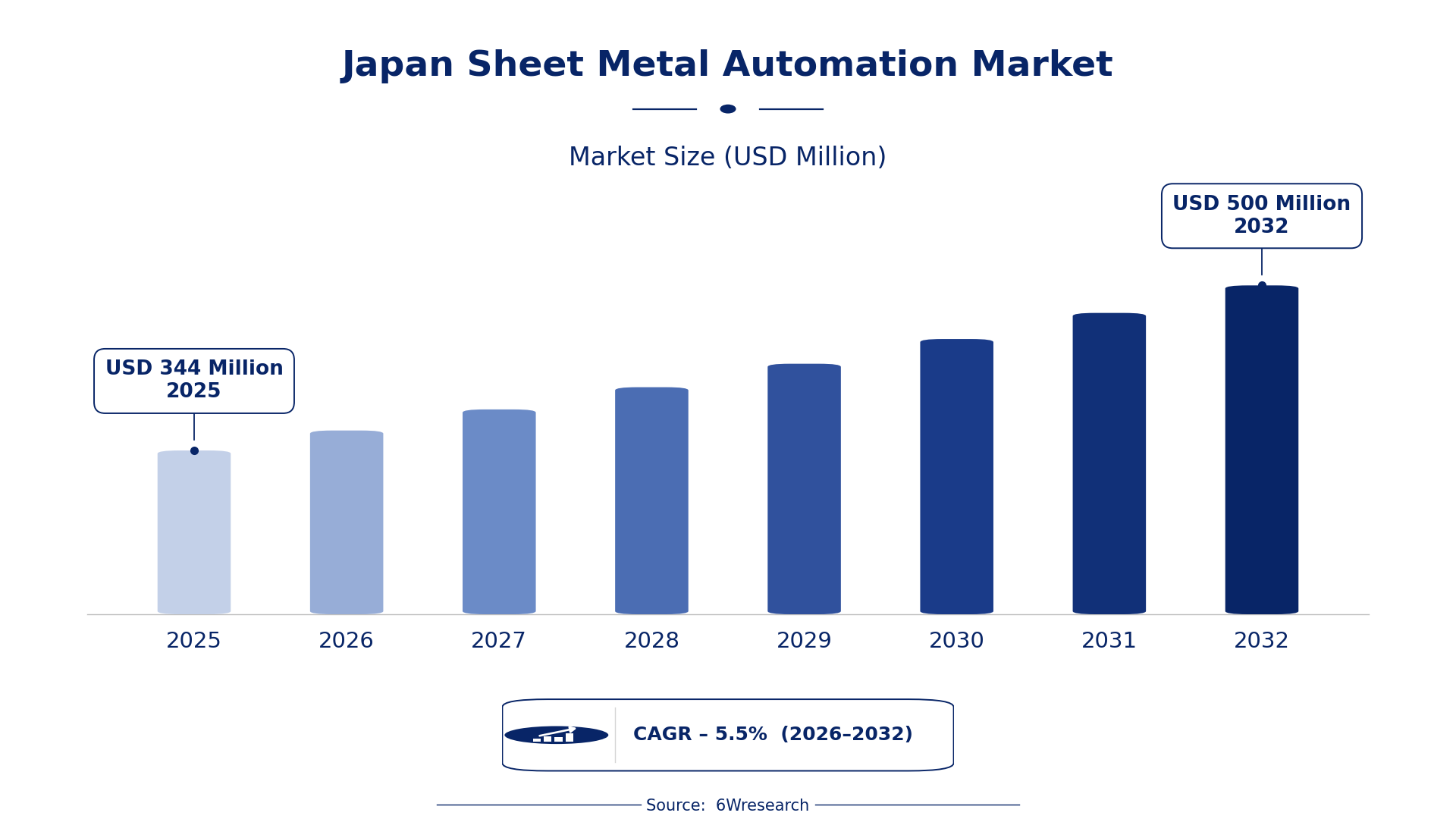
According to 6Wresearch internal database and industry insights, the Japan Sheet Metal Automation Market was valued at USD 344 Million in 2025 and is projected to reach USD 500 Million by 2032, growing at a CAGR of approximately 5.5% during 2026–2032.
Japan Sheet Metal Automation Market Highlights
| Report Metric | Details |
| Report Name | Japan Sheet Metal Automation Market (2026-2032) |
| Market Size 2025 | USD 344 Million |
| Market Size 2032 | USD 500 Million |
| Absolute Growth 2025–2032 | USD 156 Million |
| CAGR 2026–2032 | 5.5% |
| Peak Annual Growth | 6.7% in 2026 |
| Forecast Period | 2026–2032 |
| Historical Data | 2022–2025 |
| Base Year | 2025 |
| Leading Automation Type, 2025 | Robotic Welding Systems (36% share) |
| Leading Equipment Used, 2025 | CNC + Robots (38% share) |
| Leading Process Step, 2025 | Welding & Joining (40% share) |
| Leading End User, 2025 | Auto Component Makers (48% share) |
| Fastest-Growing Automation Type | Laser Cutting Automation (7.7% CAGR) |
| Fastest-Growing Equipment Used | Fiber Lasers (7.0% CAGR) |
| Fastest-Growing Process Step | Profiling & Cutting (8.1% CAGR) |
| Fastest-Growing End User | Fabrication Shops (6.9% CAGR) |
| Growing Sector | automotive |
| Key End Users | auto component makers, fabrication shops, industrial manufacturers |
Japan Sheet Metal Automation Market Year-wise Growth Rate and Key Drivers (2022–2032)
This graph illustrates the annual growth rates of the market from 2022 to 2032, highlighting a steady upward trajectory and projected market expansion over the forecast period.
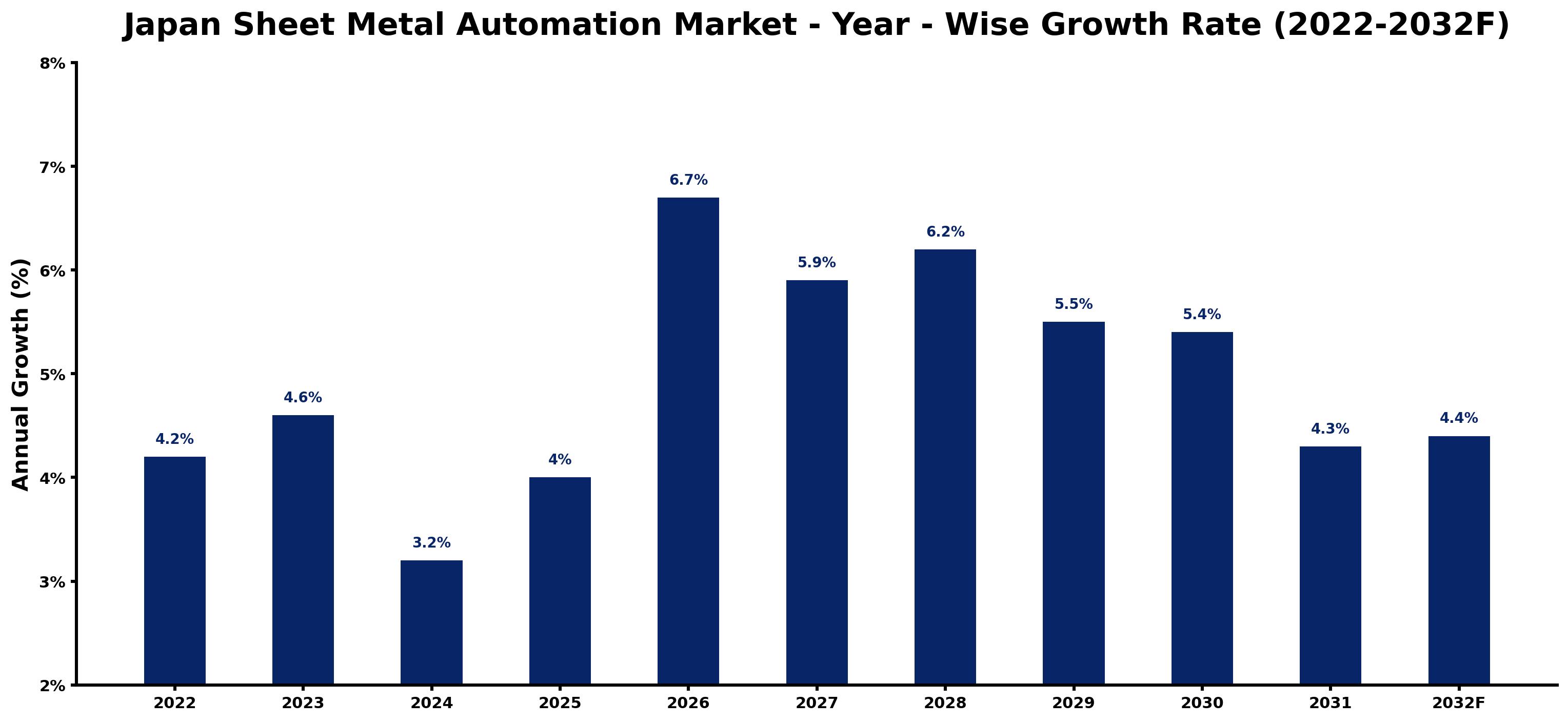
Annual growth estimates for each year appear below with the principal reason behind them, explaining the shifts that set the pace of the market.
| Year | Estimated Annual Growth (%) | Market Rationale |
| 2022 | 4.2 | The market showed steady growth, reflecting ongoing investments in automation technologies. |
| 2023 | 4.6 | Demand increased due to the automotive sector's recovery and rising production needs. |
| 2024 | 3.2 | Growth slowed as manufacturers faced challenges in upgrading older machinery. |
| 2025 | 4.0 | The market rebounded with renewed investments in advanced manufacturing technologies. |
| 2026 | 6.7 | Growth is expected to accelerate as new projects in the automotive sector drive demand. |
| 2027 | 5.9 | A slight slowdown is projected as manufacturers adjust to new operational standards. |
| 2028 | 6.2 | Demand is expected to rise again, supported by technological advancements in automation. |
| 2029 | 5.5 | Growth is projected to decelerate as market saturation begins to affect new investments. |
| 2030 | 5.4 | The market will continue to grow, driven by sustainability initiatives and efficiency needs. |
| 2031 | 4.3 | Growth is expected to slow as the industry faces challenges in workforce availability. |
| 2032 | 4.4 | Demand will increase again as manufacturers embrace Industry 4.0 technologies. |
Note: Market size estimations and growth projections presented in this report are based on 6Wresearch's proprietary forecasting methodology, utilizing the latest available industry data, government publications, and primary research inputs.
Japan Sheet Metal Automation Market Synopsis
The Japan Sheet Metal Automation Market involves technologies that improve metalworking efficiency through robotics and advanced machinery, primarily serving the automotive and industrial sectors. The market is driven by Japan's strong automotive sector, employing over 5 million people, and the adoption of advanced technologies in fabrication shops. The Tokyo region, a hub for manufacturing, supports this growth with substantial investments in automation, evidenced by the production of approximately 8 million vehicles in 2022.
Market Dynamics Impact Analysis (2026–2032)
| Factor | Type | Impact | Primary Segment Affected |
| Growing investments in advanced manufacturing technologies are driving demand for automation solutions. | Driver | High | Robotic Welding Systems |
| The rising focus on sustainability is creating opportunities for efficient manufacturing processes. | Driver | High | Laser Cutting Automation |
| The increasing adoption of Industry 4.0 technologies presents a significant opportunity for automation providers. | Opportunity | High | Automated Bending Units |
| The need for modernization in aging machinery creates a gap for new technology investments. | Opportunity | Medium | CNC + Robots |
| High initial costs of automation systems can deter small manufacturers from investing. | Restraint | High | Punching Systems |
| The shortage of skilled workers in the automation field limits operational capacity. | Restraint | Medium | Welding & Joining |
| The rapid pace of technological change can lead to obsolescence of existing systems. | Challenge | High | Fiber Lasers |
| Intense competition in the automation market pressures profit margins for suppliers. | Challenge | Medium | Servo + CNC Presses |
Evaluation of Drivers in Japan Sheet Metal Automation Market (2026–2032)
Below are the drivers that matter most for revenue growth, with supporting evidence.
| Drivers | Primary Segment Affected | Why It Matters (Evidence) |
| Increased production capacity in the automotive sector is driving demand for robotic welding systems. | Robotic Welding Systems | Japan produced approximately 8 million vehicles in 2022, necessitating automation for efficiency. |
| The push for sustainability is leading to higher adoption of laser cutting automation. | Laser Cutting Automation | Japan targets a 46% reduction in greenhouse gas emissions by 2030, driving efficiency in manufacturing. |
| The integration of Industry 4.0 technologies is enhancing the capabilities of automated bending units. | Automated Bending Units | Over 60% of fabrication shops in Japan use automated bending, reflecting a shift towards smart manufacturing. |
| The aging machinery in fabrication shops necessitates investment in CNC and robotic systems. | CNC + Robots | The average age of machinery in Japanese shops exceeds 15 years, highlighting the need for upgrades. |
| The demand for precision in metal fabrication is increasing the use of punching systems. | Punching Systems | Press brakes are used in over 70% of metal fabrication processes, driving demand for accurate hole-making. |
Buyers are adding capacity as Japan's automotive sector continues to thrive, producing around 8 million vehicles annually. The push for sustainability drives manufacturers to adopt laser cutting automation, aligning with national goals for greenhouse gas emissions reduction. Over 60% of fabrication shops are integrating automated bending units, reflecting a shift towards smart manufacturing. The need to modernise aging machinery, with an average age exceeding 15 years, compels investments in CNC and robotic systems. Precision requirements in metal fabrication are increasing the demand for punching systems, essential for creating functional features in components.
Evaluation of Restraints in Japan Sheet Metal Automation Market
The key brakes on demand, and where they bite hardest, are shown below.
| Market Restraint | Primary Segment Affected | Why It Matters (Evidence) |
| High initial costs of automation systems deter small manufacturers from investing in new technologies. | Punching Systems | Many small manufacturers struggle with the upfront costs, limiting their ability to modernise operations. |
| The shortage of skilled workers in the automation field restricts operational capacity and efficiency. | Welding & Joining | As the industry evolves, finding qualified personnel becomes increasingly challenging for manufacturers. |
| Rapid technological advancements can lead to obsolescence of existing systems, impacting ROI. | Fiber Lasers | Manufacturers face risks if they invest in technology that quickly becomes outdated. |
| Intense competition in the automation market pressures profit margins for suppliers, affecting sustainability. | Servo + CNC Presses | Suppliers must balance competitive pricing with maintaining quality and innovation. |
| Regulatory compliance can impose additional costs on manufacturers, affecting their bottom line. | CNC + Robots | Compliance with standards such as JIS B 0001 requires investment in testing and certification. |
Japan Sheet Metal Automation Market Challenges
High operational costs challenge buyers in the automotive sector, as Japan's national minimum wage increased to JPY 1,055 per hour in October 2024, raising production expenses. A skills gap in advanced automation technologies limits suppliers' capabilities, resulting in delays in meeting rising demand. Compliance with the JIS B 0001 standard burdens suppliers with costly upgrades, which can postpone product launches by several months. The average age of machinery in Japanese fabrication shops exceeds 15 years, requiring substantial investments for modernization that strain both buyers and suppliers.
Trends in the Japan Sheet Metal Automation Market
Below are the shifts with the largest effect on the Japan Sheet Metal Automation Market.
- Shift from Traditional to Smart Manufacturing: Since 2023, Japan has seen a transition towards smart manufacturing technologies, particularly in the Tokyo region. Over 60% of fabrication shops are now adopting automated systems, improving efficiency and productivity.
- Emergence of Fiber Laser Technology: In 2023, fiber laser cutting systems gained traction in fabrication shops, with adoption rates exceeding 40%. This shift allows for faster and more precise cutting of thin materials, meeting rising demand for quality.
- Growing Demand for Automated Welding Solutions: The automotive sector's recovery in 2022 led to a surge in demand for automated welding systems, essential for producing high-quality automotive parts. This trend is reflected in the increasing investments in automation technologies.
- Transition to Sustainable Manufacturing Practices: Japan's commitment to reducing greenhouse gas emissions is driving manufacturers to adopt more efficient technologies. By 2030, the country aims for a 46% reduction, influencing the adoption of sustainable automation solutions.
Investment Opportunities in the Japan Sheet Metal Automation Market
The opportunities below stand out in the Japan Sheet Metal Automation Market for new entrants and existing suppliers.
- Investment in Automation Technologies: With Japan's automotive sector rebounding, now is an opportune moment to invest in advanced automation technologies, especially in the Tokyo region where demand is high. The government allocated ¥10 billion in 2023 to support such initiatives.
- Modernisation of Aging Machinery: The average age of machinery in Japanese fabrication shops exceeds 15 years, indicating a need for new technology investments. Fabrication shops are increasingly pursuing modern solutions to boost productivity.
- Expansion of Smart Manufacturing: The emphasis on Industry 4.0 technologies presents opportunities for suppliers to provide advanced solutions. The Tokyo Metropolitan Government backs initiatives that promote smart manufacturing practices.
- Adoption of Sustainable Practices: With a goal of a 46% reduction in emissions by 2030, there is a rising opportunity to supply energy-efficient automation technologies. This shift is particularly pertinent for automotive manufacturers.
Government Initiatives in the Japan Sheet Metal Automation Market
The Economic Security Promotion Act, enacted in 2022, supports supply-chain resilience for critical products, including automation technologies. This legislation encourages manufacturers to invest in advanced systems that improve efficiency and reduce reliance on imports. Additionally, the Act aims to stimulate innovation in the automation sector, ensuring that Japan remains competitive in global markets.
The Ministry of Economy, Trade and Industry (METI) oversees programs that fund advanced manufacturing technologies. In 2023, METI allocated ¥10 billion to assist small manufacturers in adopting automation solutions. This funding enables buyers to access modern technologies, enhancing their production capabilities and ensuring compliance with industry standards.
Future Insight of the Japan Sheet Metal Automation Market
By 2032, automotive producers will adopt more advanced automation technologies, spurred by government initiatives supporting innovation. The Tokyo region will see increased investment in smart manufacturing facilities, enhancing production capabilities. Japan's commitment to a 46% reduction in greenhouse gas emissions by 2030 will drive the shift towards sustainable manufacturing practices. As a result, suppliers will need to adapt to new standards, while buyers will benefit from improved efficiency and reduced environmental impact.
Market Segmentation Analysis
Japan Sheet Metal Automation Market report covers a detailed analysis of the following market segments:
By Automation Type – Robotic Welding Systems Lead, Laser Cutting Automation Expected to Grow Fastest
According to Saurav Kr Singh, Senior Research Analyst at 6Wresearch, Robotic Welding Systems held 36% of the Japan Sheet Metal Automation Market by automation type in 2025. Robotic welding systems dominate the market owing to their essential role in automated joining processes, particularly in the automotive industry that employs over 5 million people. Their widespread application is influenced by the need for efficiency and precision in manufacturing components, especially in regions like Nagoya. The quickest growth will come from Laser Cutting Automation, forecast to expand at a CAGR of 7.7% between 2026 and 2032. Laser cutting automation is experiencing rapid growth as it offers precise cutting of sheet metal, which is crucial for producing high-quality automotive components. The production of around 8 million vehicles in 2022 has significantly increased the demand for advanced cutting technologies. This trend indicates that suppliers must focus on enhancing their laser cutting offerings to meet the rising needs of the automotive sector.
By Equipment Used – CNC + Robots Lead, Fiber Lasers Expected to Grow Fastest
With 38% of equipment used revenue in 2025, CNC + Robots was the largest category. CNC combined with robots holds the largest market share as this integration offers unparalleled precision in metalworking processes. This technology is essential for adhering to the stringent quality standards established by the JIS B 0001 standard in Japan. Fiber Lasers are set to record the highest CAGR in this split, 7.0% over 2026–2032. Fiber lasers are quickly becoming popular due to their high-speed cutting capabilities, especially for thin materials used in automotive production. The urgency for modernisation in fabrication shops, where machinery is often over 15 years old, is propelling this trend forward. Buyers should invest in fibre laser technology to improve production efficiency and respond to changing market needs.
By Process Step – Welding & Joining Leads, Profiling & Cutting Expected to Grow Fastest
The largest process step category in 2025 was Welding & Joining, at 40% of revenue. Welding and joining processes lead the market as they are fundamental in assembling metal components, particularly in the automotive industry. This necessity is reflected in the high volume of automated welding systems employed across various manufacturing facilities. Profiling & Cutting is projected to grow fastest, at a CAGR of 8.1% during 2026–2032. Profiling and cutting processes are seeing the fastest growth as they are essential for shaping metal sheets used in diverse applications. The increased focus on efficiency in fabrication shops is propelling the adoption of advanced cutting technologies. Suppliers must innovate in profiling and cutting technologies to meet the rising demand from fabrication shops.
By End User – Auto Component Makers Lead, Fabrication Shops Expected to Grow Fastest
Auto Component Makers accounted for 48% of the market by end user in 2025. Auto component makers account for the largest segment as they are the primary users of sheet metal automation technologies, driven by the strong automotive industry in Japan. The concentration of manufacturers in areas like Nagoya further reinforces their market leadership. Over 2026–2032, Fabrication Shops are expected to post the fastest growth, at a CAGR of 6.9%. Fabrication shops are experiencing the highest growth rate as they increasingly adopt automation for custom metal projects, reflecting a broader shift towards efficiency in manufacturing. Government initiatives supporting advanced manufacturing technologies are aiding this transition. Suppliers should focus on providing tailored automation solutions to fabrication shops to capture this expanding market segment.
Key Attractiveness of the Report
- 10 Years of Market Numbers
- Historical Data Starting from 2022 to 2025
- Base Year 2025
- Forecast Data until 2032
- Key Performance Indicators Impacting the Market
- Major Upcoming Developments and Projects
Key Highlights of the Report:
- Japan Sheet Metal Automation Market Outlook
- Market Size of Japan Sheet Metal Automation Market, 2025
- Forecast of Japan Sheet Metal Automation Market, 2032
- Historical Data and Forecast of Japan Sheet Metal Automation Revenues & Volume for the Period 2022-2032F
- Japan Sheet Metal Automation Market Trend Evolution
- Japan Sheet Metal Automation Market Drivers and Challenges
- Japan Sheet Metal Automation Price Trends
- Japan Sheet Metal Automation Porter's Five Forces
- Japan Sheet Metal Automation Industry Life Cycle
- Historical Data and Forecast of Japan Sheet Metal Automation Market Revenues & Volume By Automation Type for the Period 2022-2032F
- Historical Data and Forecast of Japan Sheet Metal Automation Market Revenues & Volume By Robotic Welding Systems for the Period 2022-2032F
- Historical Data and Forecast of Japan Sheet Metal Automation Market Revenues & Volume By Laser Cutting Automation for the Period 2022-2032F
- Historical Data and Forecast of Japan Sheet Metal Automation Market Revenues & Volume By Punching Systems for the Period 2022-2032F
- Historical Data and Forecast of Japan Sheet Metal Automation Market Revenues & Volume By Automated Bending Units for the Period 2022-2032F
- Historical Data and Forecast of Japan Sheet Metal Automation Market Revenues & Volume By Equipment Used for the Period 2022-2032F
- Historical Data and Forecast of Japan Sheet Metal Automation Market Revenues & Volume By CNC + Robots for the Period 2022-2032F
- Historical Data and Forecast of Japan Sheet Metal Automation Market Revenues & Volume By Fiber Lasers for the Period 2022-2032F
- Historical Data and Forecast of Japan Sheet Metal Automation Market Revenues & Volume By Servo + CNC Presses for the Period 2022-2032F
- Historical Data and Forecast of Japan Sheet Metal Automation Market Revenues & Volume By Press Brakes for the Period 2022-2032F
- Historical Data and Forecast of Japan Sheet Metal Automation Market Revenues & Volume By Process Step for the Period 2022-2032F
- Historical Data and Forecast of Japan Sheet Metal Automation Market Revenues & Volume By Welding & Joining for the Period 2022-2032F
- Historical Data and Forecast of Japan Sheet Metal Automation Market Revenues & Volume By Profiling & Cutting for the Period 2022-2032F
- Historical Data and Forecast of Japan Sheet Metal Automation Market Revenues & Volume By Hole Making for the Period 2022-2032F
- Historical Data and Forecast of Japan Sheet Metal Automation Market Revenues & Volume By Folding/Forming for the Period 2022-2032F
- Historical Data and Forecast of Japan Sheet Metal Automation Market Revenues & Volume By End User for the Period 2022-2032F
- Historical Data and Forecast of Japan Sheet Metal Automation Market Revenues & Volume By Auto Component Makers for the Period 2022-2032F
- Historical Data and Forecast of Japan Sheet Metal Automation Market Revenues & Volume By Fabrication Shops for the Period 2022-2032F
- Historical Data and Forecast of Japan Sheet Metal Automation Market Revenues & Volume By Industrial Manufacturers for the Period 2022-2032F
- Historical Data and Forecast of Japan Sheet Metal Automation Market Revenues & Volume By Furniture & Appliances Firms for the Period 2022-2032F
- Japan Sheet Metal Automation Import Export Trade Statistics
- Market Opportunity Assessment By Automation Type
- Market Opportunity Assessment By Equipment Used
- Market Opportunity Assessment By Process Step
- Market Opportunity Assessment By End User
- Japan Sheet Metal Automation Top Companies Market Share
- Japan Sheet Metal Automation Competitive Benchmarking By Technical and Operational Parameters
- Japan Sheet Metal Automation Company Profiles
- Japan Sheet Metal Automation Key Strategic Recommendations
Market Covered
The following segment groups are covered in the report.
By Automation Type
- Robotic Welding Systems
- Laser Cutting Automation
- Punching Systems
- Automated Bending Units
By Equipment Used
- CNC + Robots
- Fiber Lasers
- Servo + CNC Presses
- Press Brakes
By Process Step
- Welding & Joining
- Profiling & Cutting
- Hole Making
- Folding/Forming
By End User
- Auto Component Makers
- Fabrication Shops
- Industrial Manufacturers
- Furniture & Appliances Firms































