Japan Shelf-life Prediction AI Market Size & Growth Rate
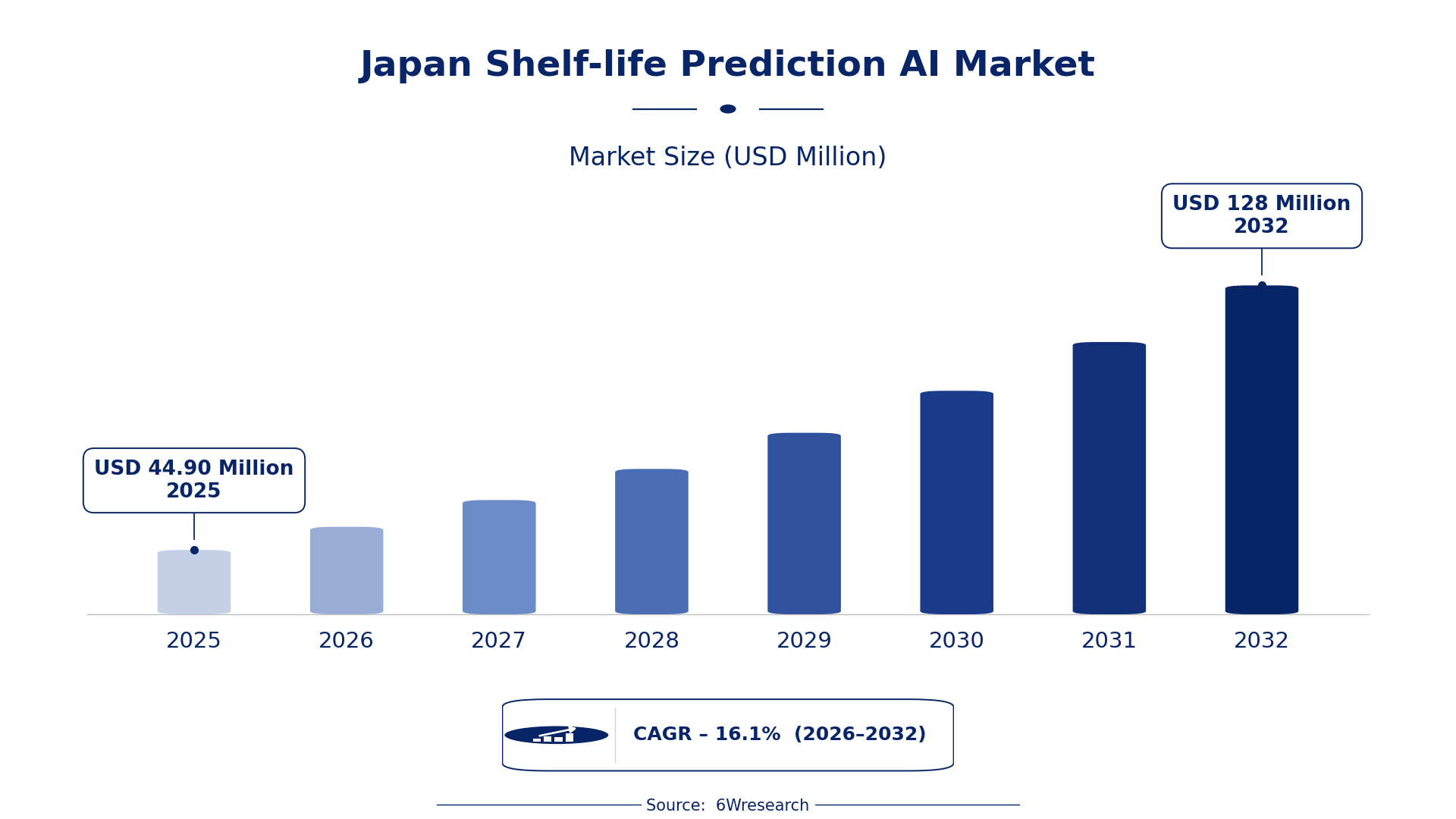
According to 6Wresearch internal database and industry insights, the Japan Shelf-life Prediction AI Market was valued at USD 44.90 Million in 2025 and is projected to reach USD 128 Million by 2032, growing at a CAGR of approximately 16.1% during 2026–2032.
Japan Shelf-life Prediction AI Market Highlights
| Report Metric | Details |
| Report Name | Japan Shelf-life Prediction AI Market (2026-2032) |
| Market Size 2025 | USD 44.90 Million |
| Market Size 2032 | USD 128 Million |
| Absolute Growth 2025–2032 | USD 83.10 Million |
| CAGR 2026–2032 | 16.1% |
| Peak Annual Growth | 21.0% in 2027 |
| Forecast Period | 2026–2032 |
| Historical Data | 2022–2025 |
| Base Year | 2025 |
| Leading AI Model Type, 2025 | Machine Learning Models (41% share) |
| Leading Data Source, 2025 | Historical Shelf Data (46% share) |
| Leading Application Area, 2025 | Food Expiry Estimation (45% share) |
| Leading End User, 2025 | Food Processing Companies (41% share) |
| Fastest-Growing AI Model Type | Predictive Analytics (24.2% CAGR) |
| Fastest-Growing Data Source | Sensor + IoT Inputs (18.1% CAGR) |
| Fastest-Growing Application Area | Logistics & Inventory (19.1% CAGR) |
| Fastest-Growing End User | Pharmaceutical Firms (21.3% CAGR) |
| Growing Sector | food processing |
| Key End Users | food processing companies, pharmaceutical firms, retail chains |
Japan Shelf-life Prediction AI Market Year-wise Growth Rate and Key Drivers (2022–2032)
This graph illustrates the annual growth rates of the market from 2022 to 2032, highlighting a steady upward trajectory and projected market expansion over the forecast period.
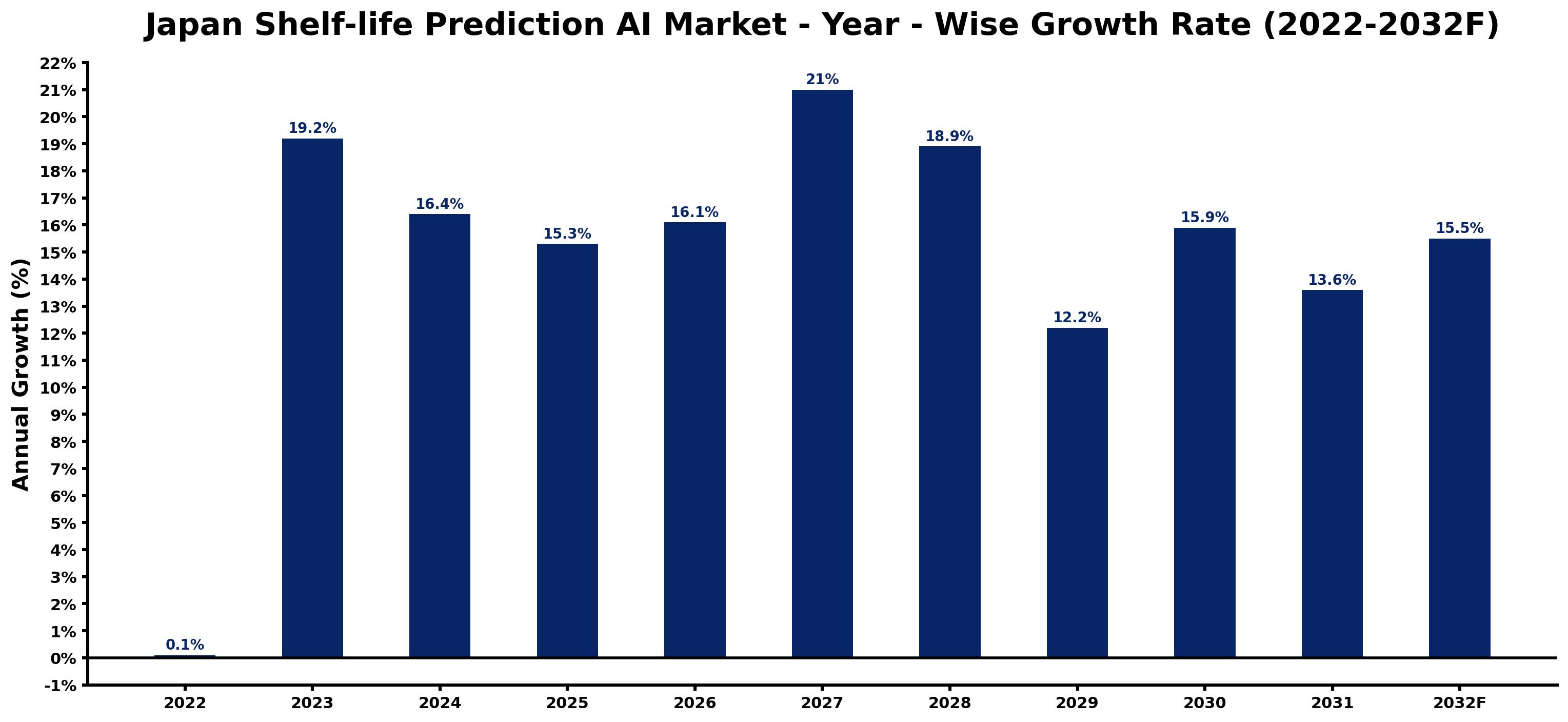
For each year, the table pairs the estimated growth rate with the leading influence on demand, showing how the drivers changed across the period.
| Year | Estimated Annual Growth (%) | Market Rationale |
| 2022 | 0.1 | The market showed minimal growth due to initial adoption phases. |
| 2023 | 19.2 | Demand surged as food safety concerns prompted increased AI integration. |
| 2024 | 16.4 | Growth slowed as companies adjusted to new technologies and standards. |
| 2025 | 15.3 | Demand continued to rise, driven by food processing sector expansion. |
| 2026 | 16.1 | Growth is expected to accelerate as pharmaceutical firms adopt AI for stability testing. |
| 2027 | 21.0 | The peak growth year reflects heightened investment in AI technologies. |
| 2028 | 18.9 | Growth is projected to slow as market saturation begins to set in. |
| 2029 | 12.2 | Demand will continue to grow, albeit at a slower pace than before. |
| 2030 | 15.9 | Growth is expected to pick up again as new technologies enter the market. |
| 2031 | 13.6 | The market will experience a slowdown as competition intensifies. |
| 2032 | 15.5 | Demand is projected to rise again due to ongoing technological advancements. |
Note: Market size estimations and growth projections presented in this report are based on 6Wresearch's proprietary forecasting methodology, utilizing the latest available industry data, government publications, and primary research inputs.
Japan Shelf-life Prediction AI Market Synopsis
Shelf-life Prediction AI employs advanced algorithms to estimate product expiration dates using historical data and real-time inputs. This technology is essential for food safety management and pharmaceutical stability testing. The Japan Shelf-life Prediction AI Market is expanding, driven by the food processing industry, valued at approximately 20 trillion yen, and the pharmaceutical sector, which includes over 1,000 firms. Initiatives like the 2023 program for drug stability testing further stimulate market growth, highlighting the increasing reliance on AI technologies.
Market Dynamics Impact Analysis (2026–2032)
| Factor | Type | Impact | Primary Segment Affected |
| Increasing food safety regulations drive demand for accurate shelf-life predictions. | Driver | High | Food Expiry Estimation |
| Growing pharmaceutical sector necessitates advanced stability testing solutions. | Driver | High | Pharma Stability Testing |
| Rising consumer awareness about food safety creates opportunities for AI solutions. | Opportunity | High | Food Expiry Estimation |
| Investment in AI technologies for logistics optimization is increasing. | Opportunity | Medium | Logistics & Inventory |
| High costs associated with AI implementation can deter smaller firms. | Restraint | High | Food Processing Companies |
| Limited access to quality historical data hampers model accuracy. | Restraint | Medium | Pharma Stability Testing |
| Competition among AI providers may lead to price wars affecting margins. | Challenge | High | Food Expiry Estimation |
| Rapid technological advancements require constant updates to AI models. | Challenge | Medium | Logistics & Inventory |
Evaluation of Drivers in Japan Shelf-life Prediction AI Market (2026–2032)
The factors lifting demand, and the evidence behind each, are summarised below.
| Drivers | Primary Segment Affected | Why It Matters (Evidence) |
| Rising food safety concerns drive demand for accurate shelf-life predictions. | Food Expiry Estimation | The average shelf-life of processed food is estimated at 6 months, prompting food companies to adopt AI. |
| Increased pharmaceutical production necessitates effective stability testing. | Pharma Stability Testing | With over 1,000 firms in Japan, the need for precise testing methods is critical. |
| Growing adoption of IoT technologies enhances data collection for predictions. | Real-Time Supply Data | The use of IoT in food logistics is projected to rise significantly by 2025, improving accuracy. |
| Investment in AI technologies is increasing within the food processing sector. | Food Processing Companies | The Japanese government aims to increase AI utilization in the food industry by 30% by 2025. |
| Integration of AI models into ERP systems is becoming standard practice. | Logistics & Inventory | Retail chains in Japan have seen a 15% increase in AI adoption for inventory management. |
The pharmaceutical sector is increasing its use of AI for stability testing, motivated by the need for precise methodologies. The average shelf-life of processed food in Japan is estimated at 6 months, prompting food processing companies to implement advanced AI solutions. The expected rise in IoT usage in food logistics by 2025 will improve data accuracy, encouraging further investments in AI technologies. These developments drive demand for shelf-life prediction AI across various industries.
Evaluation of Restraints in Japan Shelf-life Prediction AI Market
Below are the constraints most often cited by buyers and suppliers, with the segment each affects.
| Market Restraint | Primary Segment Affected | Why It Matters (Evidence) |
| High implementation costs deter smaller food processing companies from adopting AI. | Food Processing Companies | The food processing industry is valued at approximately 20 trillion yen, yet smaller firms struggle with AI costs. |
| Limited access to reliable historical data affects model training accuracy. | Pharma Stability Testing | Pharmaceutical stability testing is regulated by the PMDA, necessitating high-quality data for compliance. |
| Inconsistent regulatory standards can complicate AI integration into existing systems. | Food Expiry Estimation | ISO 22000 is a standard adopted by food companies, but compliance can vary. |
| Resistance to change among traditional firms slows AI adoption rates. | Logistics & Inventory | Many companies in Japan still rely on conventional inventory management methods. |
| Concerns over data privacy may hinder the adoption of AI solutions. | Real-Time Supply Data | With increasing IoT integration, data security remains a concern for many firms. |
Japan Shelf-life Prediction AI Market Challenges
High competition in Japan's food processing sector compels producers to reduce prices. This pressure arises from over 1,000 firms vying for market share, which diminishes profit margins for producers. Buyers face delays in product availability as producers prioritise cost-cutting over quality maintenance. The average shelf-life of processed food is only six months, leading producers to accelerate production cycles, which increases operational costs. Outdated inventory systems create inefficiencies in the supply chain, resulting in delays that cause higher waste and increased costs for buyers.
Trends in the Japan Shelf-life Prediction AI Market
Below are the shifts with the largest effect on the Japan Shelf-life Prediction AI Market.
- Shift from Traditional Methods to AI-Driven Solutions: Food processing companies in Tokyo are increasingly adopting AI-driven solutions for shelf-life predictions, with a reported 15% rise in AI integration in 2023. This transition enhances food safety and optimises inventory management.
- Growing Integration of IoT in Food Logistics: The use of IoT technologies in food logistics is anticipated to rise by 2025, particularly in Osaka. This shift facilitates real-time data collection, improving the accuracy of shelf-life predictions.
- Increased Focus on Pharmaceutical Stability Testing: Pharmaceutical firms are prioritising AI for stability testing, driven by regulatory requirements from the PMDA. In 2023, over 1,000 firms are expected to enhance their testing capabilities using AI technologies.
- Expansion of AI in Food Safety Management: The Japanese government allocated 500 million yen for AI in food safety in 2023, promoting its adoption across the food processing sector. This funding aims to improve compliance with safety standards.
Investment Opportunities in the Japan Shelf-life Prediction AI Market
Several openings in the Japan Shelf-life Prediction AI Market merit attention from investors.
- Timing is Right for AI Adoption: With the Japanese government aiming for a 30% increase in AI utilisation by 2025, food processing companies should invest in AI technologies to improve safety and efficiency. This presents a notable opportunity for suppliers.
- Supply Chain Optimization through AI: The logistics sector is ripe for investment, especially with a projected 15% increase in AI adoption among retail chains. Suppliers can enter this market by partnering with local firms for AI integration.
- Growing Demand for Accurate Shelf-life Predictions: The food processing industry, valued at approximately 20 trillion yen, is seeking advanced AI solutions. Suppliers can target this sector by offering tailored AI models for shelf-life estimation.
- Enhancing Pharmaceutical Testing Capabilities: Pharmaceutical firms are increasingly investing in AI for stability testing, driven by regulatory pressures. Suppliers should focus on providing AI solutions that meet PMDA standards.
Government Initiatives in the Japan Shelf-life Prediction AI Market
The PMD Act regulates pharmaceuticals and medical devices, ensuring quality and safety in production. The Semiconductor and Digital Industry Strategy, established in June 2021, promotes domestic semiconductor manufacturing, which supports AI development in various sectors, including food safety. These measures aim to improve the overall quality of products in Japan.
The Japan Food Safety Commission oversees food safety regulations, ensuring that food processing companies comply with safety standards. The government also supports AI initiatives through funding, such as the 500 million yen allocated in 2023 for AI in food safety, which helps firms improve their compliance and operational efficiency.
Future Insight of the Japan Shelf-life Prediction AI Market
By 2032, Japan will experience a transformative shift in AI utilisation for food safety management. The government aims for a 30% increase in AI adoption by 2025, encouraging suppliers to invest in advanced technologies. IoT integration in logistics will enhance inventory accuracy and reduce waste. The 2023 programme by the Ministry of Health for drug stability testing will stimulate progress in pharmaceutical applications. These advancements will enable buyers to receive fresher products and streamline inventory management.
Market Segmentation Analysis
Japan Shelf-life Prediction AI Market report covers a detailed analysis of the following market segments:
By AI Model Type – Machine Learning Models Lead, Predictive Analytics Expected to Grow Fastest
According to Saurav Kr Singh, Senior Research Analyst at 6Wresearch, in 2025, Machine Learning Models led the ai model type split with a 41% share. Machine Learning Models hold the largest share in the market as they are essential for estimating product shelf life, especially within the food processing industry valued at approximately 20 trillion yen. Their widespread use in safety management programmes like ISO 22000 highlights their importance in maintaining food quality. The quickest growth will come from Predictive Analytics, forecast to expand at a CAGR of 24.2% between 2026 and 2032. Predictive Analytics is experiencing rapid growth due to the increasing demand for accurate shelf-life estimates, particularly in sectors like pharmaceuticals. The 15% rise in AI adoption for inventory management among retail chains illustrates the urgency for precise analytics in optimising operations. Suppliers should focus on advancing their machine learning capabilities to meet the growing need for accurate predictive analytics in various industries.
By Data Source – Historical Shelf Data Leads, Sensor + IoT Inputs Expected to Grow Fastest
Historical Shelf Data took 46% of data source revenue in 2025, more than any other category. Historical Shelf Data is the leading source as it forms the foundation for training AI models, ensuring accurate predictions of product expiration dates. Its critical role in the food processing sector underlines its importance in maintaining safety standards. Sensor + IoT Inputs are set to record the highest CAGR in this split, 18.1% over 2026–2032. Sensor + IoT Inputs are growing quickly as they provide real-time data essential for making timely shelf-life predictions. The projected rise in IoT usage in food logistics by 2025 indicates a shift towards more dynamic data sources. Buyers should invest in IoT technologies to improve the accuracy and efficiency of their shelf-life predictions.
By Application Area – Food Expiry Estimation Leads, Logistics & Inventory Expected to Grow Fastest
The largest application area category in 2025 was Food Expiry Estimation, at 45% of revenue. Food Expiry Estimation is the primary application area for AI, directly addressing the need for accurate shelf-life predictions in the food industry. This focus is particularly relevant given Japan's high food safety standards and consumer expectations. Over 2026–2032, Logistics & Inventory is expected to post the fastest growth, at a CAGR of 19.1%. Logistics & Inventory is the fastest growing area as companies seek to optimise stock management and reduce waste. The increasing integration of AI in inventory processes reflects a strategic shift towards efficiency in supply chains. Suppliers must develop solutions that cater specifically to logistics and inventory management to capitalise on this growth.
By End User – Food Processing Companies Lead, Pharmaceutical Firms Expected to Grow Fastest
Food Processing Companies accounted for 41% of the market by end user in 2025. Food Processing Companies are the primary users of shelf-life prediction technologies, as they depend on these tools for maintaining product safety and adhering to regulations. Their substantial market presence highlights the critical need for effective predictive solutions in this sector. Pharmaceutical Firms are projected to grow fastest, at a CAGR of 21.3% during 2026–2032. Pharmaceutical Firms are experiencing the fastest growth as they face stringent regulations regarding product safety and stability testing. The recent government initiative to improve drug stability testing will further fuel this demand. Vendors should customise their solutions to address the unique requirements of pharmaceutical firms to effectively capture this growing segment.
Key Attractiveness of the Report
- 10 Years of Market Numbers
- Historical Data Starting from 2022 to 2025
- Base Year 2025
- Forecast Data until 2032
- Key Performance Indicators Impacting the Market
- Major Upcoming Developments and Projects
Key Highlights of the Report:
- Japan Shelf-life Prediction AI Market Outlook
- Market Size of Japan Shelf-life Prediction AI Market, 2025
- Forecast of Japan Shelf-life Prediction AI Market, 2032
- Historical Data and Forecast of Japan Shelf-life Prediction AI Revenues & Volume for the Period 2022-2032F
- Japan Shelf-life Prediction AI Market Trend Evolution
- Japan Shelf-life Prediction AI Market Drivers and Challenges
- Japan Shelf-life Prediction AI Price Trends
- Japan Shelf-life Prediction AI Porter's Five Forces
- Japan Shelf-life Prediction AI Industry Life Cycle
- Historical Data and Forecast of Japan Shelf-life Prediction AI Market Revenues & Volume By AI Model Type for the Period 2022-2032F
- Historical Data and Forecast of Japan Shelf-life Prediction AI Market Revenues & Volume By Machine Learning Models for the Period 2022-2032F
- Historical Data and Forecast of Japan Shelf-life Prediction AI Market Revenues & Volume By Predictive Analytics for the Period 2022-2032F
- Historical Data and Forecast of Japan Shelf-life Prediction AI Market Revenues & Volume By Deep Learning Systems for the Period 2022-2032F
- Historical Data and Forecast of Japan Shelf-life Prediction AI Market Revenues & Volume By Cloud-Based AI for the Period 2022-2032F
- Historical Data and Forecast of Japan Shelf-life Prediction AI Market Revenues & Volume By Data Source for the Period 2022-2032F
- Historical Data and Forecast of Japan Shelf-life Prediction AI Market Revenues & Volume By Historical Shelf Data for the Period 2022-2032F
- Historical Data and Forecast of Japan Shelf-life Prediction AI Market Revenues & Volume By Sensor + IoT Inputs for the Period 2022-2032F
- Historical Data and Forecast of Japan Shelf-life Prediction AI Market Revenues & Volume By Vision + Environment for the Period 2022-2032F
- Historical Data and Forecast of Japan Shelf-life Prediction AI Market Revenues & Volume By Real-Time Supply Data for the Period 2022-2032F
- Historical Data and Forecast of Japan Shelf-life Prediction AI Market Revenues & Volume By Application Area for the Period 2022-2032F
- Historical Data and Forecast of Japan Shelf-life Prediction AI Market Revenues & Volume By Food Expiry Estimation for the Period 2022-2032F
- Historical Data and Forecast of Japan Shelf-life Prediction AI Market Revenues & Volume By Pharma Stability Testing for the Period 2022-2032F
- Historical Data and Forecast of Japan Shelf-life Prediction AI Market Revenues & Volume By Packaging Condition Check for the Period 2022-2032F
- Historical Data and Forecast of Japan Shelf-life Prediction AI Market Revenues & Volume By Logistics & Inventory for the Period 2022-2032F
- Historical Data and Forecast of Japan Shelf-life Prediction AI Market Revenues & Volume By End User for the Period 2022-2032F
- Historical Data and Forecast of Japan Shelf-life Prediction AI Market Revenues & Volume By Food Processing Companies for the Period 2022-2032F
- Historical Data and Forecast of Japan Shelf-life Prediction AI Market Revenues & Volume By Pharmaceutical Firms for the Period 2022-2032F
- Historical Data and Forecast of Japan Shelf-life Prediction AI Market Revenues & Volume By Retail Chains for the Period 2022-2032F
- Historical Data and Forecast of Japan Shelf-life Prediction AI Market Revenues & Volume By E-Commerce Warehouses for the Period 2022-2032F
- Japan Shelf-life Prediction AI Import Export Trade Statistics
- Market Opportunity Assessment By AI Model Type
- Market Opportunity Assessment By Data Source
- Market Opportunity Assessment By Application Area
- Market Opportunity Assessment By End User
- Japan Shelf-life Prediction AI Top Companies Market Share
- Japan Shelf-life Prediction AI Competitive Benchmarking By Technical and Operational Parameters
- Japan Shelf-life Prediction AI Company Profiles
- Japan Shelf-life Prediction AI Key Strategic Recommendations
Market Covered
The report covers the following segments.
By AI Model Type
- Machine Learning Models
- Predictive Analytics
- Deep Learning Systems
- Cloud-Based AI
By Data Source
- Historical Shelf Data
- Sensor + IoT Inputs
- Vision + Environment
- Real-Time Supply Data
By Application Area
- Food Expiry Estimation
- Pharma Stability Testing
- Packaging Condition Check
- Logistics & Inventory
By End User
- Food Processing Companies
- Pharmaceutical Firms
- Retail Chains
- E-Commerce Warehouses































