Japan Ship Electrification Market Size & Growth Rate
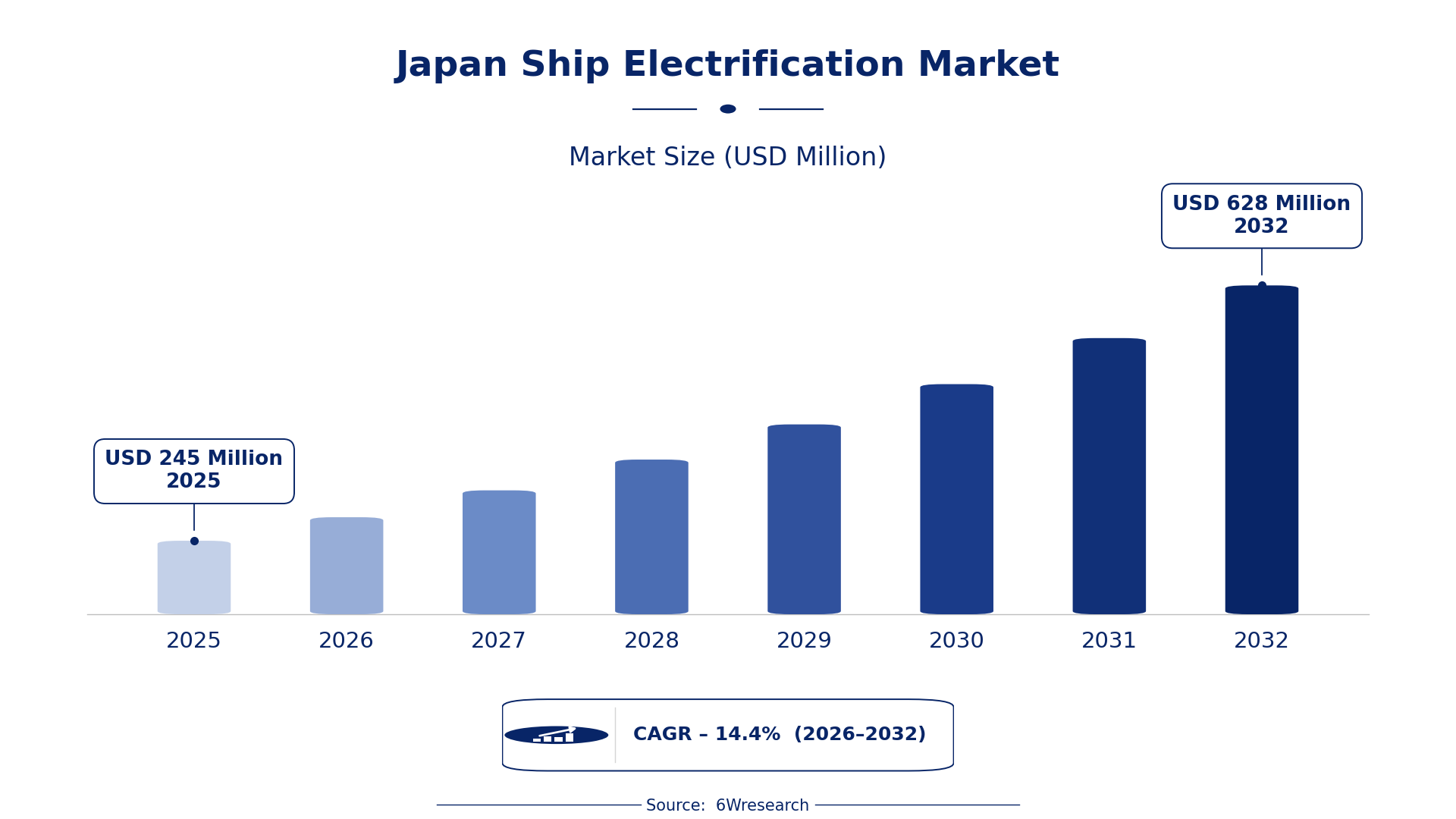
According to 6Wresearch internal database and industry insights, the Japan Ship Electrification Market was valued at USD 245 Million in 2025 and is projected to reach USD 628 Million by 2032, growing at a CAGR of approximately 14.4% during 2026–2032.
Japan Ship Electrification Market Highlights
| Report Metric | Details |
| Report Name | Japan Ship Electrification Market (2026-2032) |
| Market Size 2025 | USD 245 Million |
| Market Size 2032 | USD 628 Million |
| Absolute Growth 2025–2032 | USD 383 Million |
| CAGR 2026–2032 | 14.4% |
| Peak Annual Growth | 16.5% in 2032 |
| Forecast Period | 2026–2032 |
| Historical Data | 2022–2025 |
| Base Year | 2025 |
| Leading Electrification Type, 2025 | Hybrid-Electric Ships (44% share) |
| Leading Power Source, 2025 | Diesel + Battery (44% share) |
| Leading Ship Type, 2025 | Cargo/Container Ships (37% share) |
| Leading End User, 2025 | Marine Transport Companies (50% share) |
| Fastest-Growing Electrification Type | Full Electric Ships (16.1% CAGR) |
| Fastest-Growing Power Source | Lithium-ion Battery (21.4% CAGR) |
| Fastest-Growing Ship Type | Ferries/Short-Route Ships (17.0% CAGR) |
| Fastest-Growing End User | Urban Transport Agencies (18.8% CAGR) |
| Growing Sector | Marine Transport |
| Key End Users | Marine Transport Companies, Urban Transport Agencies, Port Authorities |
Japan Ship Electrification Market Year-wise Growth Rate and Key Drivers (2022–2032)
This graph illustrates the annual growth rates of the market from 2022 to 2032, highlighting a steady upward trajectory and projected market expansion over the forecast period.
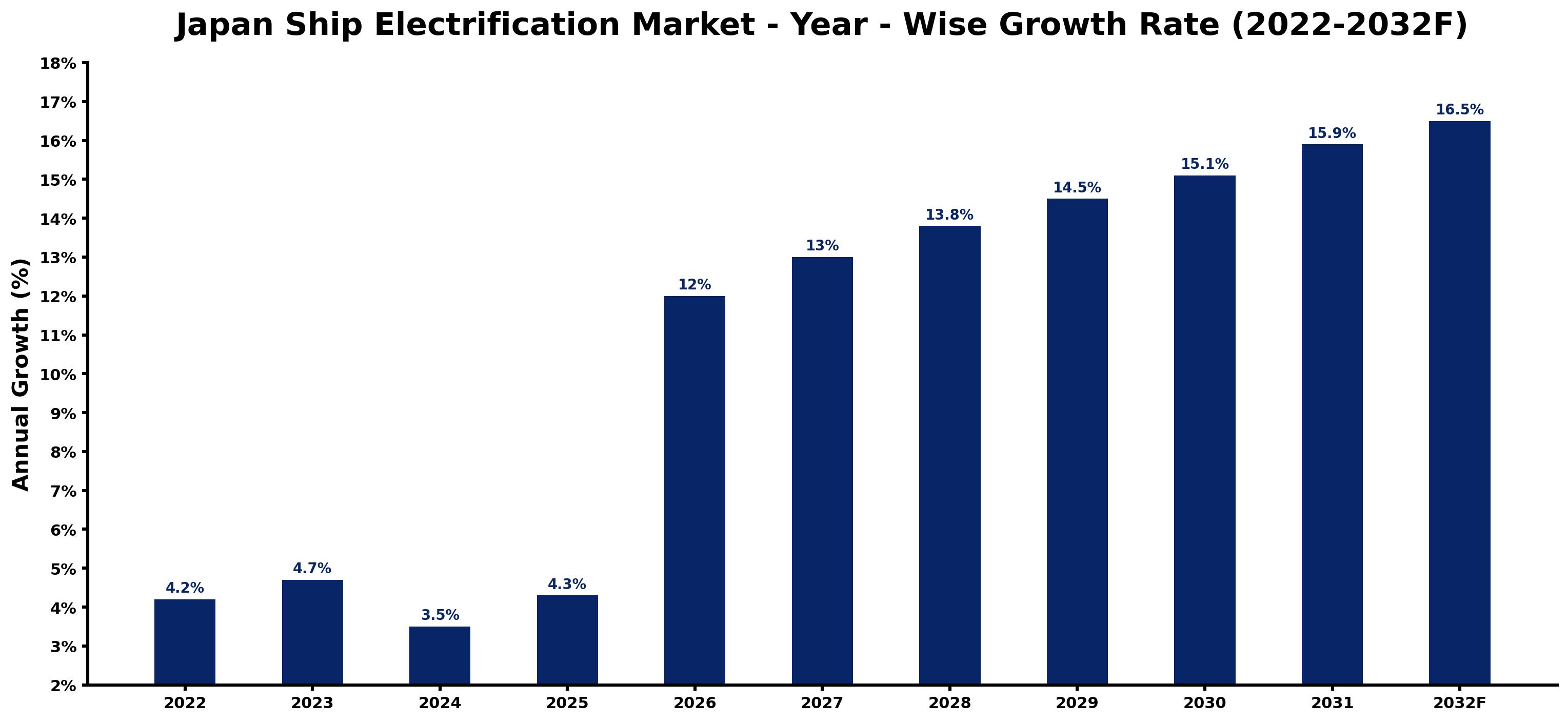
The table below sets out the estimated growth rate for each year and the main factor behind it.
| Year | Estimated Annual Growth (%) | Market Rationale |
| 2022 | 4.2 | The market showed steady growth with increasing interest in electrification technologies. |
| 2023 | 4.7 | Demand rose as marine transport companies sought to improve energy efficiency. |
| 2024 | 3.5 | Growth slowed as some projects faced delays in implementation. |
| 2025 | 4.3 | Interest in hybrid technologies increased, leading to a faster growth rate. |
| 2026 | 12.0 | The market is expected to accelerate with rising investments in electric ships. |
| 2027 | 13.0 | Demand continues to rise as more companies adopt hybrid systems. |
| 2028 | 13.8 | Growth is projected to remain strong with advancements in battery technology. |
| 2029 | 14.5 | The market is expected to expand as urban transport agencies invest in electrification. |
| 2030 | 15.1 | Increased focus on sustainability drives further adoption of electric vessels. |
| 2031 | 15.9 | Demand rises as the government supports electrification initiatives. |
| 2032 | 16.5 | The market peaks as the industry shifts towards full electrification. |
Note: Market size estimations and growth projections presented in this report are based on 6Wresearch's proprietary forecasting methodology, utilizing the latest available industry data, government publications, and primary research inputs.
Japan Ship Electrification Market Synopsis
Ship electrification integrates electric power systems in maritime vessels, primarily through hybrid or fully electric technologies. This approach reduces reliance on fossil fuels and improves energy efficiency, with applications in cargo ships, ferries, and naval vessels. The Japan Ship Electrification Market is expanding due to heightened demand from marine transport companies and port authorities, driven by sustainability initiatives and substantial investments, including over 100 billion yen in electric and hybrid ship technologies as of 2023, which improve operational efficiency and compliance with environmental regulations.
Market Dynamics Impact Analysis (2026–2032)
| Factor | Type | Impact | Primary Segment Affected |
| Increasing investments in hybrid technologies | Driver | High | Hybrid-Electric Ships |
| Growing demand for shore power systems | Driver | High | Shore Power Supply |
| Emerging need for electric solutions in urban transport | Opportunity | High | Ferries/Short-Route Ships |
| Demand for lithium-ion batteries is rising | Opportunity | High | Lithium-ion Battery |
| Aging cargo fleet necessitates modernization | Restraint | Medium | Cargo/Container Ships |
| Limited applications of fuel cell technology | Restraint | Medium | Fuel Cell Ships |
| Supply chain disruptions impact production timelines | Challenge | High | Hybrid-Electric Ships |
| Shortage of skilled workforce in electrification technologies | Challenge | Medium | Marine Transport Companies |
Evaluation of Drivers in Japan Ship Electrification Market (2026–2032)
Key forces behind demand, with the segment each one moves most, are listed below.
| Drivers | Primary Segment Affected | Why It Matters (Evidence) |
| Rising investments in electric and hybrid ship technologies | Hybrid-Electric Ships | Japan has invested over 100 billion yen in developing these technologies, prompting marine transport companies to adopt them. |
| Increased regulatory demands for emissions reduction | Shore Power Supply | Japan's target of reducing greenhouse gas emissions by 46% by 2030 drives demand for shore power systems. |
| Growing focus on sustainability among marine transport companies | Ferries/Short-Route Ships | ISO 14001 standards adoption is increasing, pushing companies to electrify their fleets. |
| Expansion of pilot projects in key regions | Full Electric Ships | The Tokyo Bay area hosts multiple pilot projects, encouraging the adoption of fully electric vessels. |
| Advancements in lithium-ion battery technology | Lithium-ion Battery | Research by the National Maritime Research Institute is improving battery applications in ships. |
Spending rises due to substantial investments in electric and hybrid technologies, with over 100 billion yen allocated as of 2023. Marine transport companies are focusing more on sustainability, leading to greater adoption of ISO 14001 standards. The Tokyo Bay area is becoming a hub for pilot projects, driving demand for fully electric ships. Ongoing research into battery applications is improving energy storage solutions, further boosting market growth.
Evaluation of Restraints in Japan Ship Electrification Market
The table below lists the restraints and the evidence behind each.
| Market Restraint | Primary Segment Affected | Why It Matters (Evidence) |
| Aging cargo fleet requiring modernization | Cargo/Container Ships | The average age of Japan's cargo fleet is around 20 years, creating a need for upgrades. |
| Limited applications of fuel cell technology | Fuel Cell Ships | Fuel cell ships are still emerging, with few current applications in the market. |
| Supply chain disruptions affecting production timelines | Hybrid-Electric Ships | Global supply chain issues have delayed the delivery of critical components. |
| Shortage of skilled workforce in electrification technologies | Marine Transport Companies | The maritime industry employs approximately 200,000 people, but skills in electrification are lacking. |
| High initial investment costs for electrification | Full Electric Ships | The transition to fully electric ships requires substantial upfront capital, deterring some buyers. |
Japan Ship Electrification Market Challenges
Producers face intense competition as Japan's target to cut greenhouse gas emissions by 46% by 2030 pressures them to invest heavily in electrification technologies. This urgency results in delays for buyers who rely on modernised vessels to meet regulatory standards. Rising costs stem from the average age of Japan's cargo fleet, which is around 20 years, necessitating expensive upgrades that strain budgets for marine transport companies. Supply chain disruptions arise from limited availability of advanced battery technologies, hindering timely vessel upgrades and increasing operational challenges for producers.
Trends in the Japan Ship Electrification Market
Several trends are reshaping the Japan Ship Electrification Market; the most important are set out below.
- Shift from Traditional to Hybrid-Electric Ships: In 2023, marine transport companies are increasingly adopting hybrid-electric systems to reduce emissions. Approximately 44% of the market share is held by hybrid-electric ships, reflecting a marked shift in operational strategies.
- Emerging Demand for Shore Power Supply: The Tokyo Port Authority implemented shore power facilities in 2023 to reduce emissions from docked vessels. This initiative aligns with Japan's environmental goals, promoting cleaner energy use in ports.
- Growing Adoption of Lithium-Ion Batteries: Since 2022, the demand for lithium-ion batteries in the maritime sector has surged, with a projected CAGR of 21.4% through 2032. This trend supports the electrification of various ship types, improving energy efficiency.
- Increased Focus on Environmental Management Standards: The adoption of ISO 14001 standards by marine transport companies has accelerated since 2023, with many companies now prioritising environmental management in their operations.
Investment Opportunities in the Japan Ship Electrification Market
Investors looking at the Japan Ship Electrification Market should consider the following areas.
- Urban Transport Agencies Seeking Electrification Solutions: Urban transport agencies are increasingly looking for electrification solutions, with a projected market gap of 628 million USD by 2032. Collaborating with local partners can facilitate entry into this growing segment.
- Tokyo Bay Area as a Hub for Electrification: The Tokyo Bay area is a key region for electrification initiatives, hosting multiple pilot projects. Investing in shore power supply solutions can meet the demand from port authorities.
- Growing Need for Hybrid-Electric Solutions: With Japan's cargo fleet aging, there is a substantial opportunity to supply hybrid-electric solutions. Marine transport companies are actively seeking upgrades to improve efficiency.
- Investment in Lithium-Ion Battery Manufacturing: The demand for lithium-ion batteries is increasing, with a target of 150 GWh domestic manufacturing capacity by 2030. Suppliers can enter this market by forming joint ventures with local manufacturers.
Government Initiatives in the Japan Ship Electrification Market
The Hydrogen Society Promotion Act, enacted in 2024, builds on previous laws by providing price-gap support for low-carbon hydrogen and ammonia supply chains. This measure encourages investment in cleaner energy solutions, directly benefiting ship electrification producers and buyers by making technologies more affordable.
The Ministry of Land, Infrastructure, Transport and Tourism approves funding for shore power systems across major ports. This initiative, part of Japan's broader electrification strategy, aims to reduce emissions from docked vessels, benefiting marine transport companies and port authorities.
Future Insight of the Japan Ship Electrification Market
A policy-driven shift will reshape Japan's maritime sector by 2032, prompting a commercial response that prioritises electrification. Shore power systems will become commonplace, significantly improving energy efficiency for docked vessels. Government subsidies for hybrid technology development will encourage suppliers to deliver advanced solutions. Research into lithium-ion battery applications will yield advancements that improve vessel performance, providing tangible benefits for both producers and buyers as they navigate the transition to sustainable maritime operations.
Market Segmentation Analysis
Japan Ship Electrification Market report covers a detailed analysis of the following market segments:
By Electrification Type – Hybrid-Electric Ships Lead, Full Electric Ships Expected to Grow Fastest
According to Saurav Kr Singh, Senior Research Analyst at 6Wresearch, Hybrid-Electric Ships took 44% of electrification type revenue in 2025, more than any other category. Hybrid-electric ships dominate the market due to their versatility in various ship types, effectively reducing emissions and fuel costs. For instance, these systems are widely adopted in the Tokyo Bay area, where multiple pilot projects are underway. The quickest growth will come from Full Electric Ships, forecast to expand at a CAGR of 16.1% between 2026 and 2032. Full electric ships are experiencing rapid growth as they are increasingly employed for short routes and urban transport, minimising pollution. The Japanese government’s subsidy program for developing electric vessels is further accelerating this transition. Suppliers should focus on advancing hybrid technologies while exploring opportunities in full electric solutions.
By Power Source – Diesel + Battery Leads, Lithium-ion Battery Expected to Grow Fastest
Diesel + Battery held 44% of the Japan Ship Electrification Market by power source in 2025. The diesel plus battery systems hold the largest market share as they are commonly used in hybrid configurations, enhancing efficiency across various vessel types. This is particularly evident in cargo ships, which depend on reliable power sources for their extensive operations. Lithium-ion Battery is projected to grow fastest, at a CAGR of 21.4% during 2026–2032. Lithium-ion batteries are rapidly gaining traction, primarily due to their increasing application in electric ships for energy storage, spurred by advancements in battery technology. The maritime sector's focus on cleaner energy solutions is further propelling this growth. Suppliers should prioritise lithium-ion technology to align with the industry's shift towards sustainable practices.
By Ship Type – Cargo/Container Ships Lead, Ferries/Short-Route Ships Expected to Grow Fastest
The largest ship type category in 2025 was Cargo/Container Ships, at 37% of revenue. Cargo and container ships dominate the market as they have widely adopted electrification technologies to significantly improve operational efficiency. The average age of Japan's cargo fleet, around 20 years, highlights the pressing need for modernisation in this segment. Over 2026–2032, Ferries/Short-Route Ships are expected to post the fastest growth, at a CAGR of 17.0%. Ferries and short-route ships are experiencing the fastest growth due to the high demand for electric solutions in urban areas, where reducing pollution is critical. This trend is supported by initiatives from urban transport agencies to electrify public transport vessels. Suppliers should concentrate on the ferry segment to capitalise on urban electrification efforts.
By End User – Marine Transport Companies Lead, Urban Transport Agencies Expected to Grow Fastest
In 2025, Marine Transport Companies led the end user split with a 50% share. Marine transport companies lead the market as they are the primary users of electrification technologies, aiming to comply with stringent environmental regulations while lowering operational costs. Their active participation in electrification initiatives, especially in the Tokyo Bay area, underscores their pivotal role in this sector. Urban Transport Agencies are set to record the highest CAGR in this split, 18.8% over 2026–2032. Urban transport agencies are seeing the fastest growth as they focus on electrifying public transport vessels, promoting sustainability in metropolitan areas. This trend is bolstered by government incentives aimed at reducing emissions in urban settings. Suppliers must align their offerings with the electrification goals of urban transport agencies to capture new market opportunities.
Key Attractiveness of the Report
- 10 Years of Market Numbers
- Historical Data Starting from 2022 to 2025
- Base Year 2025
- Forecast Data until 2032
- Key Performance Indicators Impacting the Market
- Major Upcoming Developments and Projects
Key Highlights of the Report:
- Japan Ship Electrification Market Outlook
- Market Size of Japan Ship Electrification Market, 2025
- Forecast of Japan Ship Electrification Market, 2032
- Historical Data and Forecast of Japan Ship Electrification Revenues & Volume for the Period 2022-2032F
- Japan Ship Electrification Market Trend Evolution
- Japan Ship Electrification Market Drivers and Challenges
- Japan Ship Electrification Price Trends
- Japan Ship Electrification Porter's Five Forces
- Japan Ship Electrification Industry Life Cycle
- Historical Data and Forecast of Japan Ship Electrification Market Revenues & Volume By Electrification Type for the Period 2022-2032F
- Historical Data and Forecast of Japan Ship Electrification Market Revenues & Volume By Hybrid-Electric Ships for the Period 2022-2032F
- Historical Data and Forecast of Japan Ship Electrification Market Revenues & Volume By Full Electric Ships for the Period 2022-2032F
- Historical Data and Forecast of Japan Ship Electrification Market Revenues & Volume By Shore Power Supply for the Period 2022-2032F
- Historical Data and Forecast of Japan Ship Electrification Market Revenues & Volume By Fuel Cell Ships for the Period 2022-2032F
- Historical Data and Forecast of Japan Ship Electrification Market Revenues & Volume By Power Source for the Period 2022-2032F
- Historical Data and Forecast of Japan Ship Electrification Market Revenues & Volume By Diesel + Battery for the Period 2022-2032F
- Historical Data and Forecast of Japan Ship Electrification Market Revenues & Volume By Lithium-ion Battery for the Period 2022-2032F
- Historical Data and Forecast of Japan Ship Electrification Market Revenues & Volume By Grid Integration for the Period 2022-2032F
- Historical Data and Forecast of Japan Ship Electrification Market Revenues & Volume By Hydrogen for the Period 2022-2032F
- Historical Data and Forecast of Japan Ship Electrification Market Revenues & Volume By Ship Type for the Period 2022-2032F
- Historical Data and Forecast of Japan Ship Electrification Market Revenues & Volume By Cargo/Container Ships for the Period 2022-2032F
- Historical Data and Forecast of Japan Ship Electrification Market Revenues & Volume By Ferries/Short-Route Ships for the Period 2022-2032F
- Historical Data and Forecast of Japan Ship Electrification Market Revenues & Volume By Cruise Ships for the Period 2022-2032F
- Historical Data and Forecast of Japan Ship Electrification Market Revenues & Volume By Research/Surveillance for the Period 2022-2032F
- Historical Data and Forecast of Japan Ship Electrification Market Revenues & Volume By End User for the Period 2022-2032F
- Historical Data and Forecast of Japan Ship Electrification Market Revenues & Volume By Marine Transport Companies for the Period 2022-2032F
- Historical Data and Forecast of Japan Ship Electrification Market Revenues & Volume By Urban Transport Agencies for the Period 2022-2032F
- Historical Data and Forecast of Japan Ship Electrification Market Revenues & Volume By Port Authorities for the Period 2022-2032F
- Historical Data and Forecast of Japan Ship Electrification Market Revenues & Volume By Naval Defense for the Period 2022-2032F
- Japan Ship Electrification Import Export Trade Statistics
- Market Opportunity Assessment By Electrification Type
- Market Opportunity Assessment By Power Source
- Market Opportunity Assessment By Ship Type
- Market Opportunity Assessment By End User
- Japan Ship Electrification Top Companies Market Share
- Japan Ship Electrification Competitive Benchmarking By Technical and Operational Parameters
- Japan Ship Electrification Company Profiles
- Japan Ship Electrification Key Strategic Recommendations
Market Covered
The report covers the following segments.
By Electrification Type
- Hybrid-Electric Ships
- Full Electric Ships
- Shore Power Supply
- Fuel Cell Ships
By Power Source
- Diesel + Battery
- Lithium-ion Battery
- Grid Integration
- Hydrogen
By Ship Type
- Cargo/Container Ships
- Ferries/Short-Route Ships
- Cruise Ships
- Research/Surveillance
By End User
- Marine Transport Companies
- Urban Transport Agencies
- Port Authorities
- Naval Defense































