Japan Ship Equipment Services Market Size & Growth Rate
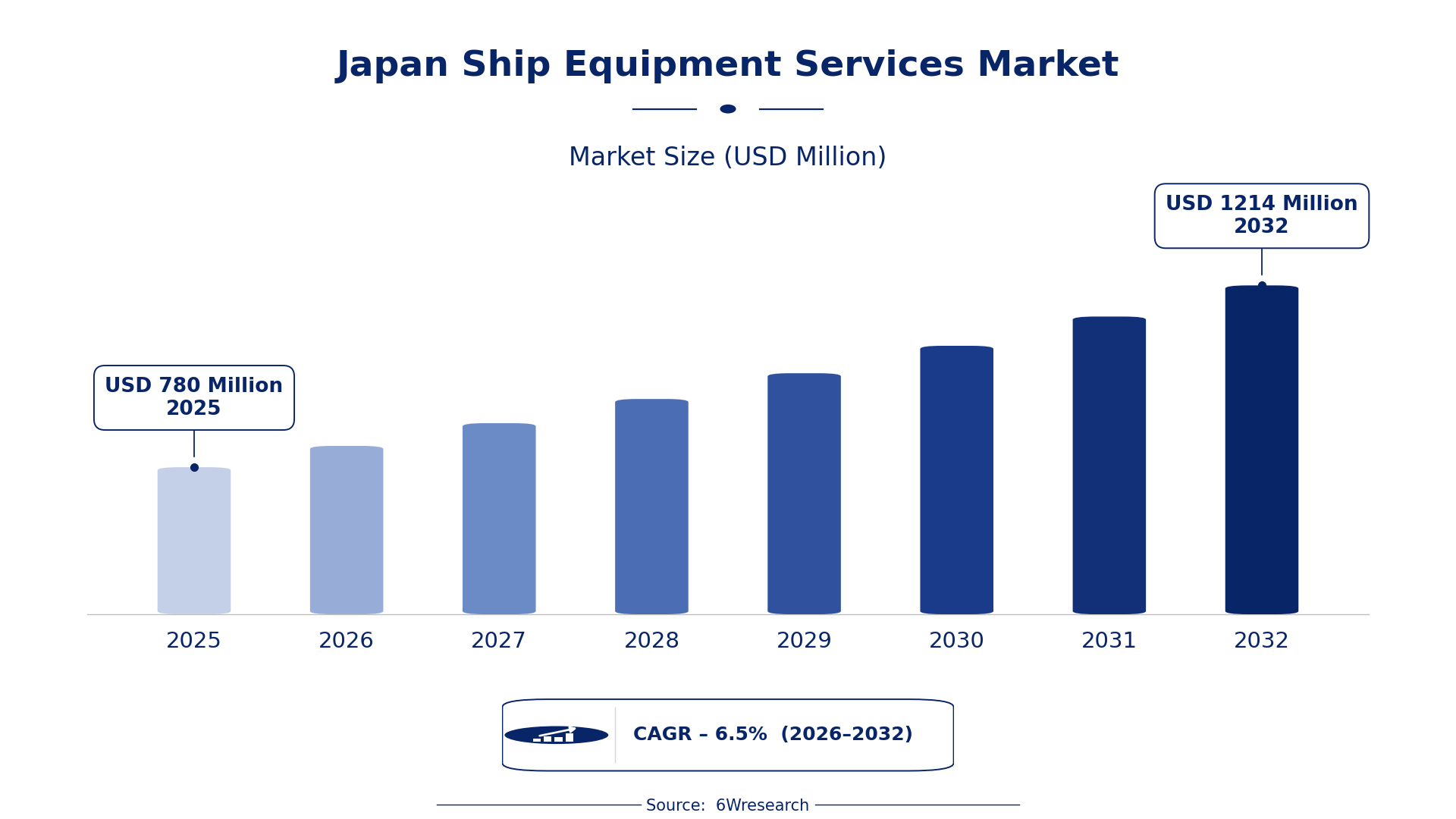
According to 6Wresearch internal database and industry insights, the Japan Ship Equipment Services Market was valued at USD 780 Million in 2025 and is projected to reach USD 1,214 Million by 2032, growing at a CAGR of approximately 6.5% during 2026–2032.
Japan Ship Equipment Services Market Highlights
| Report Metric | Details |
| Report Name | Japan Ship Equipment Services Market (2026-2032) |
| Market Size 2025 | USD 780 Million |
| Market Size 2032 | USD 1,214 Million |
| Absolute Growth 2025–2032 | USD 434 Million |
| CAGR 2026–2032 | 6.5% |
| Peak Annual Growth | 7.4% in 2030 |
| Forecast Period | 2026–2032 |
| Historical Data | 2022–2025 |
| Base Year | 2025 |
| Leading Service Type, 2025 | Propulsion Maintenance (39% share) |
| Leading Equipment Category, 2025 | Engines/Gearboxes (38% share) |
| Leading Vessel Type, 2025 | Tankers (44% share) |
| Leading End User, 2025 | Marine Engineering Firms (53% share) |
| Fastest-Growing Service Type | Electrical Repairs (8.7% CAGR) |
| Fastest-Growing Equipment Category | Navigation Systems (8.5% CAGR) |
| Fastest-Growing Vessel Type | Cruise/Ferries (9.0% CAGR) |
| Fastest-Growing End User | Shipping Companies (8.1% CAGR) |
| Growing Sector | Marine Engineering Services |
| Key End Users | Marine Engineering Firms, Shipping Companies, Ship Operators, Maritime Facilities |
Japan Ship Equipment Services Market Year-wise Growth Rate and Key Drivers (2022–2032)
This graph illustrates the annual growth rates of the market from 2022 to 2032, highlighting a steady upward trajectory and projected market expansion over the forecast period.
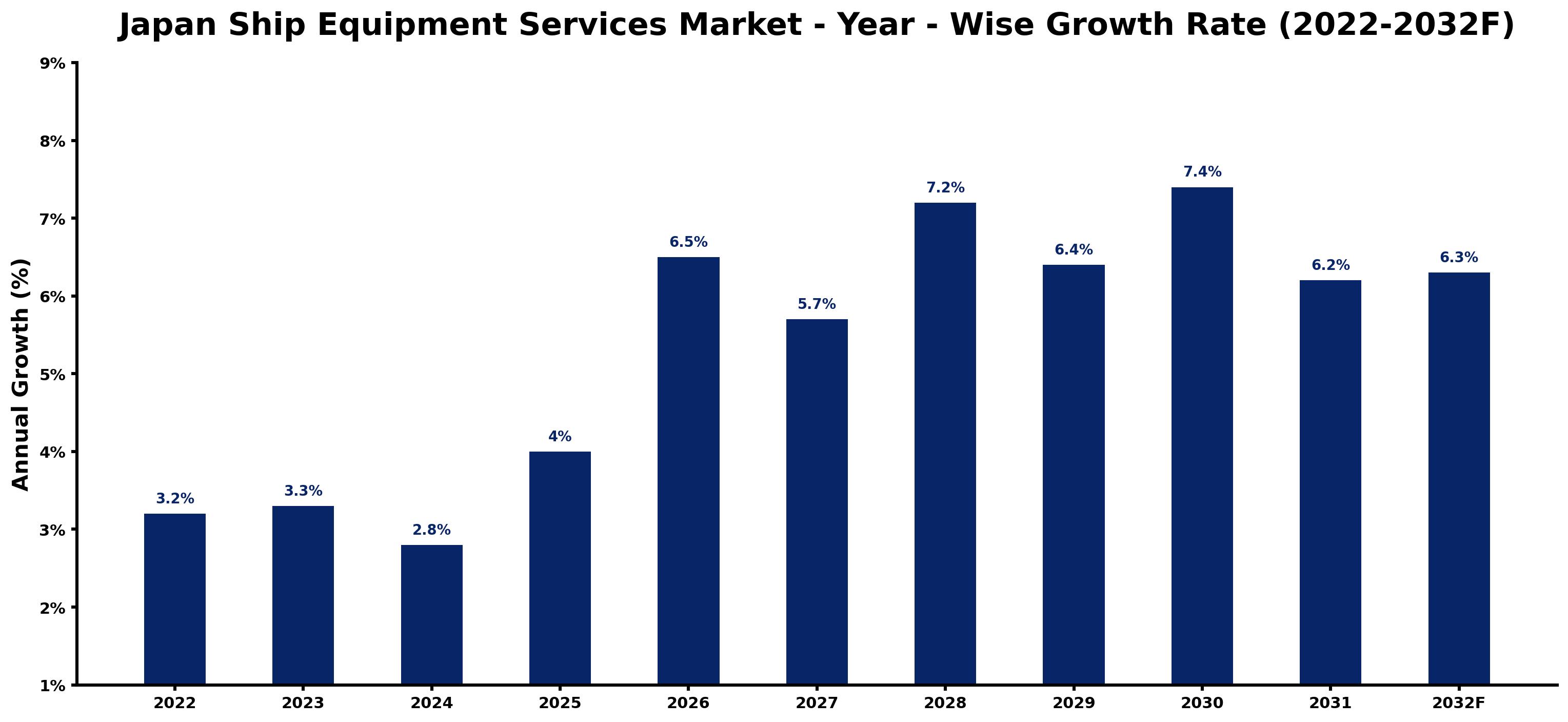
For each year, the table pairs the estimated growth rate with the leading influence on demand, showing how the drivers changed across the period.
| Year | Estimated Annual Growth (%) | Market Rationale |
| 2022 | 3.2 | The market experienced steady growth, supported by ongoing maintenance needs across the fleet. |
| 2023 | 3.3 | Demand increased due to rising operational requirements among shipping companies and marine facilities. |
| 2024 | 2.8 | Growth slowed as maintenance schedules adjusted to align with budget constraints. |
| 2025 | 4.0 | The market rebounded with heightened demand for propulsion maintenance services. |
| 2026 | 6.5 | Growth is expected to accelerate as shipping companies invest more in vessel reliability and safety. |
| 2027 | 5.7 | A slight slowdown is projected as the market adjusts to previous high growth rates. |
| 2028 | 7.2 | Demand is expected to surge again, driven by increasing shipping activity and fleet upgrades. |
| 2029 | 6.4 | Growth will slow as the market stabilises after the previous peak in demand. |
| 2030 | 7.4 | The peak growth rate is projected due to substantial investments in ship servicing. |
| 2031 | 6.2 | A slowdown will follow as the market normalises after reaching high levels of activity. |
| 2032 | 6.3 | Growth remains strong, supported by ongoing investments in maritime safety and efficiency. |
Note: Market size estimations and growth projections presented in this report are based on 6Wresearch's proprietary forecasting methodology, utilizing the latest available industry data, government publications, and primary research inputs.
Japan Ship Equipment Services Market Synopsis
Ship Equipment Services encompass maintenance and repair for various ship systems and components, ensuring operational efficiency and safety. In 2023, Japan's maritime industry included over 1,200 registered vessels, driving demand for these services. Increased shipping activity, investments in maritime safety, and the necessity for routine maintenance fuel the Japan Ship Equipment Services Market's growth, with a projected size of USD 1,214 Million by 2032.
Market Dynamics Impact Analysis (2026–2032)
| Factor | Type | Impact | Primary Segment Affected |
| Rising operational requirements among shipping companies drive demand for maintenance services. | Driver | High | Propulsion Maintenance |
| Increased investments in fleet upgrades enhance the need for equipment servicing. | Driver | High | Electrical Repairs |
| Growing demand for eco-friendly technologies presents opportunities for service providers. | Opportunity | High | HVAC System Servicing |
| The expansion of maritime facilities in the Tokyo Bay area creates new service needs. | Opportunity | Medium | Deck Equipment Overhaul |
| High maintenance costs can deter smaller operators from timely servicing. | Restraint | High | Engines/Gearboxes |
| Limited availability of skilled marine engineers may constrain service delivery. | Restraint | Medium | Electrical Repairs |
| High costs of propulsion maintenance can impact profitability for operators. | Challenge | High | Propulsion Maintenance |
| Technological advancements may outpace current service capabilities, creating gaps. | Challenge | Medium | Navigation Systems |
Evaluation of Drivers in Japan Ship Equipment Services Market (2026–2032)
The following drivers explain most of the expected growth.
| Drivers | Primary Segment Affected | Why It Matters (Evidence) |
| Increased shipping activity | Propulsion Maintenance | In 2023, Japan's shipping industry employed around 200,000 people, driving demand for maintenance services. |
| Investments in vessel reliability | Electrical Repairs | The average maintenance cost for cruise ships is around ¥100 million annually, prompting more repairs. |
| Growing focus on safety standards | HVAC System Servicing | Regular inspections by the Japan Coast Guard increase demand for compliant HVAC services, ensuring safety. |
| Expansion of maritime facilities | Deck Equipment Overhaul | Numerous repair facilities in the Tokyo Bay area support service availability for deck operations, improving operational efficiency. |
| Technological advancements in ship systems | Navigation Systems | Innovation in ship equipment technology leads to increased demand for modern navigation services, improving operational safety. |
Several shifts outside the market lift sales. The average maintenance cost for cruise ships, estimated at ¥100 million annually, prompts more electrical repairs. Increased shipping activity in Japan's maritime industry drives demand for propulsion maintenance services. Regular inspections by the Japan Coast Guard heighten the focus on safety standards, leading to increased HVAC system servicing. Expansion of maritime facilities in the Tokyo Bay area supports the need for deck equipment overhaul, while technological advancements spur demand for navigation systems.
Evaluation of Restraints in Japan Ship Equipment Services Market
Below are the constraints most often cited by buyers and suppliers, with the segment each affects.
| Market Restraint | Primary Segment Affected | Why It Matters (Evidence) |
| High maintenance costs deter timely servicing. | Engines/Gearboxes | The average cost of propulsion maintenance for a tanker is estimated at ¥50 million per year, affecting smaller operators. |
| Limited availability of skilled marine engineers. | Electrical Repairs | The Tokyo Maritime Academy trains over 1,000 marine engineers annually, but demand exceeds supply. |
| Regulatory compliance can increase operational costs. | HVAC System Servicing | Compliance with JIS standards requires investment in quality assurance, raising service costs. |
| Technological advancements may outpace service capabilities. | Navigation Systems | Rapid changes in technology can leave some service providers unable to meet new demands, impacting service delivery. |
| Economic fluctuations can impact spending on maintenance. | Deck Equipment Overhaul | Economic downturns may lead to reduced budgets for vessel upkeep and repairs, affecting service frequency. |
Japan Ship Equipment Services Market Challenges
In Tokyo Bay, marine engineering firms face a shortage of skilled technicians, causing delays in repairs that extend operational downtime for ship operators. Compliance with safety regulations enforced by the Ministry of Land, Infrastructure, Transport and Tourism results in longer repair times, impacting importers who must navigate these stringent requirements. Buyers encounter rising maintenance costs, with average propulsion maintenance for tankers estimated at ¥50 million annually, straining budgets for shipping companies. Repairing electrical systems typically takes 2-3 weeks, disrupting service schedules for producers reliant on timely maintenance.
Trends in the Japan Ship Equipment Services Market
Four trends stand out in the Japan Ship Equipment Services Market.
- Shift towards Eco-friendly Technologies: In 2023, the Japanese government encouraged the adoption of eco-friendly technologies in maritime operations. This shift is reflected in rising investments among shipping companies, focusing on sustainable practices that improve operational efficiency.
- Transition from Traditional to Advanced Navigation Systems: The introduction of advanced navigation systems began in 2022, improving safety and operational efficiency. Consequently, demand for navigation system servicing has increased, with a projected growth rate of 8.5%.
- Emergence of Digital Maintenance Solutions: Since 2023, digital maintenance solutions have gained traction among marine engineering firms. This trend supports efficiency and reduces downtime, with the Tokyo Maritime Academy incorporating digital tools into training.
- Increase in Fleet Modernisation Initiatives: The government allocated ¥2 billion for maritime safety improvements in 2023, prompting shipping companies to modernise fleets. This initiative drives demand for propulsion maintenance services, with a projected growth rate of 6.5%.
Investment Opportunities in the Japan Ship Equipment Services Market
Several openings in the Japan Ship Equipment Services Market merit attention from investors.
- Joint Ventures with Local Firms: Opportunities exist for joint ventures with local marine engineering firms to improve service capabilities, especially as the market grows towards USD 1,214 Million by 2032.
- Supply of Advanced Navigation Systems: The demand for advanced navigation systems is rising, with a projected growth rate of 8.5%. Suppliers can enter this market by partnering with local maritime facilities.
- Investment in Eco-friendly HVAC Solutions: The push for eco-friendly technologies creates opportunities for HVAC system servicing, particularly among shipping companies aiming for compliance with new regulations.
- Approval of Innovative Repair Techniques: As the market grows, there is a gap in innovative repair techniques. Engaging with the Japan Marine Equipment Association can facilitate entry into this sector.
Government Initiatives in the Japan Ship Equipment Services Market
The Industrial Safety and Health Act of 1972 mandates employer responsibilities regarding hazardous substances and machinery, ensuring safety in ship equipment services. The Act on the Rational Use of Energy, established in 1979, requires large energy users to improve energy efficiency, influencing operational practices in the maritime sector.
In 2023, the government allocated ¥2 billion for maritime safety improvements, overseen by the Ministry of Land, Infrastructure, Transport and Tourism. This funding supports compliance with safety regulations and promotes advancements in ship equipment services.
Future Insight of the Japan Ship Equipment Services Market
Investment in maritime safety improvements will create a robust demand for ship equipment services, benefiting suppliers. The government's commitment to modernisation is reflected in its allocation of ¥600 billion for shipbuilding output in 2023. Training initiatives at the Tokyo Maritime Academy will ensure a steady influx of over 1,000 skilled marine engineers annually. Adoption of eco-friendly technologies will drive innovation, prompting suppliers to develop solutions that align with evolving industry standards.
Market Segmentation Analysis
Japan Ship Equipment Services Market report covers a detailed analysis of the following market segments:
By Service Type – Propulsion Maintenance Leads, Electrical Repairs Expected to Grow Fastest
According to Saurav Kr Singh, Senior Research Analyst at 6Wresearch, the largest service type category in 2025 was Propulsion Maintenance, at 39% of revenue. Propulsion maintenance holds the largest share due to its critical role in ensuring vessel operation, with an average maintenance cost for tankers estimated at ¥50 million annually. This substantial investment underscores the necessity of these services for the efficient functioning of shipping operations. Over 2026–2032, Electrical Repairs are expected to post the fastest growth, at a CAGR of 8.7%. Electrical repairs are witnessing rapid growth as they are essential for safety and functionality, with an average repair time of 2-3 weeks indicating urgent service needs. The increasing average age of commercial vessels will further escalate the demand for timely electrical maintenance. Suppliers should prioritise the expansion of electrical repair services to meet the surging demand in the market.
By Equipment Category – Engines/Gearboxes Lead, Navigation Systems Expected to Grow Fastest
Engines/Gearboxes took 38% of equipment category revenue in 2025, more than any other category. Engines and gearboxes lead the market as they are vital for propulsion systems, with the Japanese shipbuilding output valued at ¥600 billion in 2023 showcasing their extensive application. The continuous need for maintenance of these components ensures a steady demand from marine engineering firms. The quickest growth will come from Navigation Systems, forecast to expand at a CAGR of 8.5% between 2026 and 2032. Navigation systems are experiencing the fastest growth due to their critical importance in safe navigation, particularly as maritime routes become more intricate. The implementation of stricter safety regulations will likely further boost the demand for advanced navigation technologies. Buyers should consider investing in navigation systems to enhance compliance and improve overall operational safety.
By Vessel Type – Tankers Lead, Cruise/Ferries Expected to Grow Fastest
With 44% of vessel type revenue in 2025, Tankers was the largest category. Tankers dominate the market as they are crucial for transporting liquids, with Japan's maritime industry featuring over 1,200 registered vessels as of 2023. This reliance on tankers for essential goods creates a consistent need for maintenance services in this sector. Cruise/Ferries are projected to grow fastest, at a CAGR of 9.0% during 2026–2032. Cruise and ferries represent the fastest-growing vessel type, driven by the rising demand for passenger transport in Japan. As tourism activities recover, the need for maintenance services for these vessels will significantly increase, presenting growth opportunities. Suppliers must adapt to the growing maintenance requirements of cruise and ferry operators to capitalise on emerging market opportunities.
By End User – Marine Engineering Firms Lead, Shipping Companies Expected to Grow Fastest
In 2025, Marine Engineering Firms led the end user split with a 53% share. Marine engineering firms command the largest share as they deliver crucial services for vessel maintenance, supported by approximately 200,000 people employed in Japan's shipping industry. Their specialised expertise is vital for ensuring the longevity and safety of maritime operations across the sector. Shipping Companies are set to record the highest CAGR in this split, 8.1% over 2026–2032. Shipping companies are experiencing the fastest growth in demand for maintenance services, driven by the necessity for operational reliability in a competitive market. As these companies expand their fleets, the need for comprehensive maintenance solutions will continue to rise. Suppliers should focus on building strong partnerships with shipping companies to secure long-term service agreements and foster mutual growth.
Key Attractiveness of the Report
- 10 Years of Market Numbers
- Historical Data Starting from 2022 to 2025
- Base Year 2025
- Forecast Data until 2032
- Key Performance Indicators Impacting the Market
- Major Upcoming Developments and Projects
Key Highlights of the Report:
- Japan Ship Equipment Services Market Outlook
- Market Size of Japan Ship Equipment Services Market, 2025
- Forecast of Japan Ship Equipment Services Market, 2032
- Historical Data and Forecast of Japan Ship Equipment Services Revenues & Volume for the Period 2022-2032F
- Japan Ship Equipment Services Market Trend Evolution
- Japan Ship Equipment Services Market Drivers and Challenges
- Japan Ship Equipment Services Price Trends
- Japan Ship Equipment Services Porter's Five Forces
- Japan Ship Equipment Services Industry Life Cycle
- Historical Data and Forecast of Japan Ship Equipment Services Market Revenues & Volume By Service Type for the Period 2022-2032F
- Historical Data and Forecast of Japan Ship Equipment Services Market Revenues & Volume By Propulsion Maintenance for the Period 2022-2032F
- Historical Data and Forecast of Japan Ship Equipment Services Market Revenues & Volume By Electrical Repairs for the Period 2022-2032F
- Historical Data and Forecast of Japan Ship Equipment Services Market Revenues & Volume By Deck Equipment Overhaul for the Period 2022-2032F
- Historical Data and Forecast of Japan Ship Equipment Services Market Revenues & Volume By HVAC System Servicing for the Period 2022-2032F
- Historical Data and Forecast of Japan Ship Equipment Services Market Revenues & Volume By Equipment Category for the Period 2022-2032F
- Historical Data and Forecast of Japan Ship Equipment Services Market Revenues & Volume By Engines/Gearboxes for the Period 2022-2032F
- Historical Data and Forecast of Japan Ship Equipment Services Market Revenues & Volume By Navigation Systems for the Period 2022-2032F
- Historical Data and Forecast of Japan Ship Equipment Services Market Revenues & Volume By Cranes/Hydraulics for the Period 2022-2032F
- Historical Data and Forecast of Japan Ship Equipment Services Market Revenues & Volume By Climate Control for the Period 2022-2032F
- Historical Data and Forecast of Japan Ship Equipment Services Market Revenues & Volume By Vessel Type for the Period 2022-2032F
- Historical Data and Forecast of Japan Ship Equipment Services Market Revenues & Volume By Tankers for the Period 2022-2032F
- Historical Data and Forecast of Japan Ship Equipment Services Market Revenues & Volume By Cruise/Ferries for the Period 2022-2032F
- Historical Data and Forecast of Japan Ship Equipment Services Market Revenues & Volume By Container Vessels for the Period 2022-2032F
- Historical Data and Forecast of Japan Ship Equipment Services Market Revenues & Volume By Passenger Ships for the Period 2022-2032F
- Historical Data and Forecast of Japan Ship Equipment Services Market Revenues & Volume By End User for the Period 2022-2032F
- Historical Data and Forecast of Japan Ship Equipment Services Market Revenues & Volume By Marine Engineering Firms for the Period 2022-2032F
- Historical Data and Forecast of Japan Ship Equipment Services Market Revenues & Volume By Shipping Companies for the Period 2022-2032F
- Historical Data and Forecast of Japan Ship Equipment Services Market Revenues & Volume By Ship Operators for the Period 2022-2032F
- Historical Data and Forecast of Japan Ship Equipment Services Market Revenues & Volume By Maritime Facilities for the Period 2022-2032F
- Japan Ship Equipment Services Import Export Trade Statistics
- Market Opportunity Assessment By Service Type
- Market Opportunity Assessment By Equipment Category
- Market Opportunity Assessment By Vessel Type
- Market Opportunity Assessment By End User
- Japan Ship Equipment Services Top Companies Market Share
- Japan Ship Equipment Services Competitive Benchmarking By Technical and Operational Parameters
- Japan Ship Equipment Services Company Profiles
- Japan Ship Equipment Services Key Strategic Recommendations
Market Covered
Segments analysed in this report are listed below.
By Service Type
- Propulsion Maintenance
- Electrical Repairs
- Deck Equipment Overhaul
- HVAC System Servicing
By Equipment Category
- Engines/Gearboxes
- Navigation Systems
- Cranes/Hydraulics
- Climate Control
By Vessel Type
- Tankers
- Cruise/Ferries
- Container Vessels
- Passenger Ships
By End User
- Marine Engineering Firms
- Shipping Companies
- Ship Operators
- Maritime Facilities































