Japan Shipboard Environmental Systems Market Size & Growth Rate
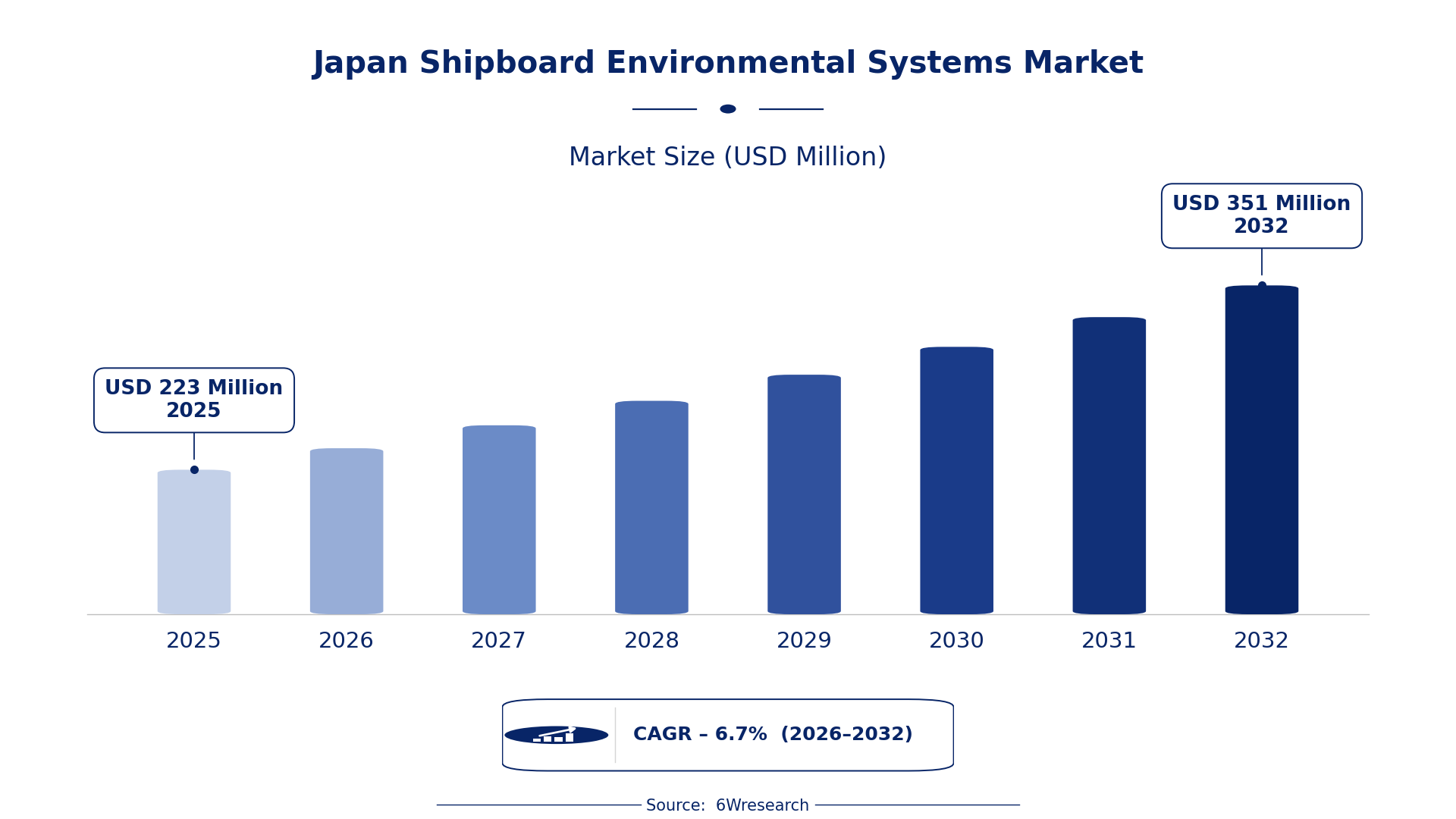
According to 6Wresearch internal database and industry insights, the Japan Shipboard Environmental Systems Market was valued at USD 223 Million in 2025 and is projected to reach USD 351 Million by 2032, growing at a CAGR of approximately 6.7% during 2026–2032.
Japan Shipboard Environmental Systems Market Highlights
| Report Metric | Details |
| Report Name | Japan Shipboard Environmental Systems Market (2026-2032) |
| Market Size 2025 | USD 223 Million |
| Market Size 2032 | USD 351 Million |
| Absolute Growth 2025–2032 | USD 128 Million |
| CAGR 2026–2032 | 6.7% |
| Peak Annual Growth | 7.5% in 2028 |
| Forecast Period | 2026–2032 |
| Historical Data | 2022–2025 |
| Base Year | 2025 |
| Leading System Type, 2025 | Ballast Water Treatment (47% share) |
| Leading Environmental Function, 2025 | Bio-Contaminant Removal (43% share) |
| Leading Compliance Standard, 2025 | IMO D-2 Standard (40% share) |
| Leading End User, 2025 | Cargo Ship Operators (40% share) |
| Fastest-Growing System Type | Air Emission Control (9.2% CAGR) |
| Fastest-Growing Environmental Function | SOx/NOx Reduction (8.7% CAGR) |
| Fastest-Growing Compliance Standard | MARPOL Annex VI (8.5% CAGR) |
| Fastest-Growing End User | Cruise Lines (8.8% CAGR) |
| Growing Sector | Cruise Lines |
| Key End Users | Cargo Ship Operators, Cruise Lines, Green Shipping Companies, Marine Waste Managers |
Japan Shipboard Environmental Systems Market Year-wise Growth Rate and Key Drivers (2022–2032)
This graph illustrates the annual growth rates of the market from 2022 to 2032, highlighting a steady upward trajectory and projected market expansion over the forecast period.
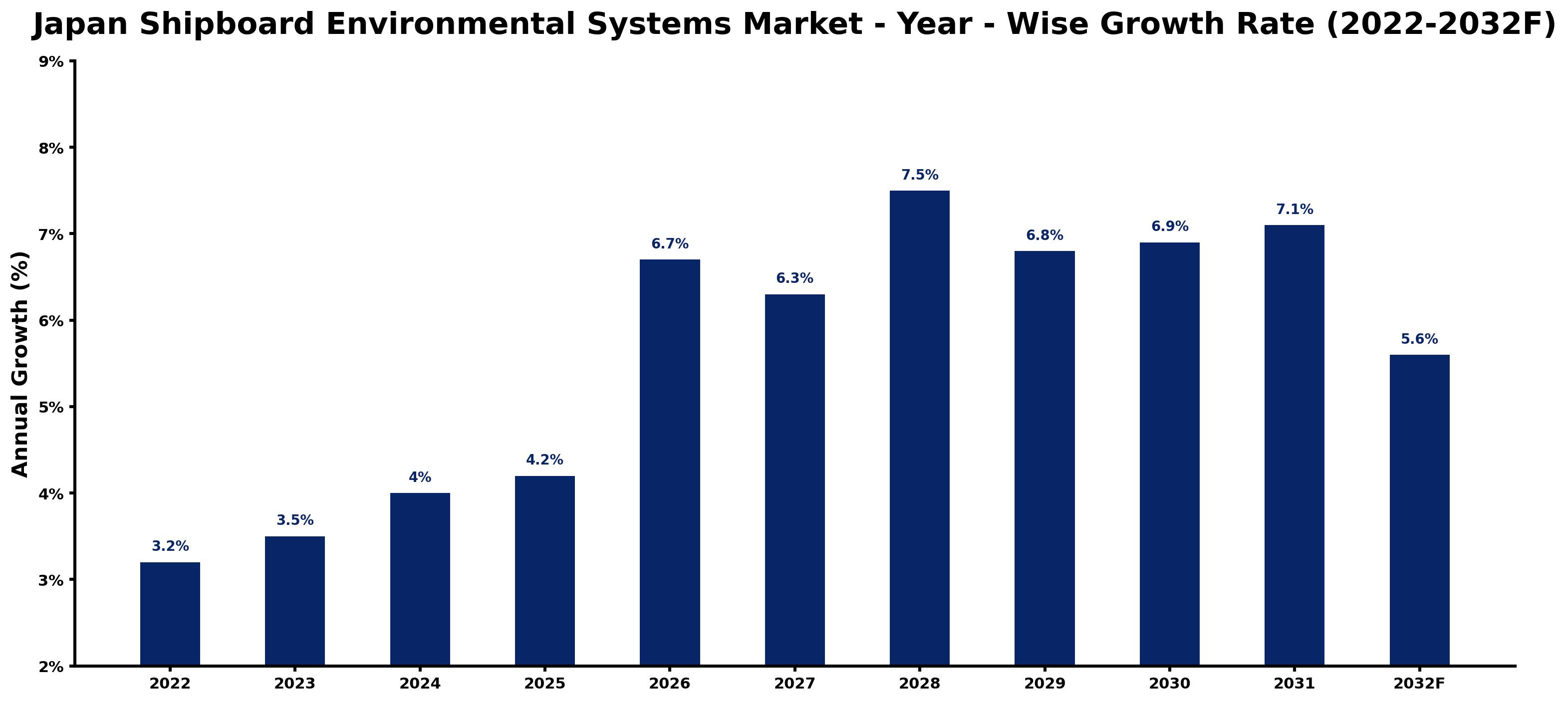
Below, each year's estimated growth is shown next to the factor that most influenced it.
| Year | Estimated Annual Growth (%) | Market Rationale |
| 2022 | 3.2 | The market experienced steady demand from cargo ship operators and compliance with regulations. |
| 2023 | 3.5 | Growth was driven by increased investments in environmental technologies by shipping companies. |
| 2024 | 4.0 | The introduction of stricter emission regulations boosted demand for air emission control systems. |
| 2025 | 4.2 | The market saw further growth due to rising awareness of environmental sustainability in shipping. |
| 2026 | 6.7 | Demand surged as the shipping industry embraced advanced ballast water treatment technologies. |
| 2027 | 6.3 | Growth slowed slightly as some operators faced challenges in upgrading older vessels. |
| 2028 | 7.5 | A peak in growth occurred as the IMO D-2 Standard enforcement intensified compliance efforts. |
| 2029 | 6.8 | The market continued to grow, albeit at a slower rate, with ongoing investments in eco-friendly systems. |
| 2030 | 6.9 | Demand increased as cruise lines adopted new technologies to further reduce emissions. |
| 2031 | 7.1 | The market saw a rise in demand driven by the establishment of green shipping networks. |
| 2032 | 5.6 | Growth slowed as the market stabilised after a period of rapid technological adoption. |
Note: Market size estimations and growth projections presented in this report are based on 6Wresearch's proprietary forecasting methodology, utilizing the latest available industry data, government publications, and primary research inputs.
Japan Shipboard Environmental Systems Market Synopsis
Shipboard Environmental Systems consist of technologies designed to reduce the impact of ships on the environment, including ballast water treatment and air emission control. The Japan Shipboard Environmental Systems Market is expanding due to increasing compliance with international regulations, particularly the IMO D-2 Standard and MARPOL Annex VI. Investments in green shipping technologies, such as the 2 billion yen allocated in 2023, are driving demand from cargo ship operators and cruise lines, leading to continued growth in the sector.
Market Dynamics Impact Analysis (2026–2032)
| Factor | Type | Impact | Primary Segment Affected |
| Increasing regulatory compliance requirements | Driver | High | Air Emission Control |
| Growing investments in eco-friendly technologies | Driver | High | Ballast Water Treatment |
| Expansion of green shipping initiatives in Tokyo Bay | Opportunity | Medium | Waste Heat Recovery |
| Rising demand for sustainable practices among cruise lines | Opportunity | High | Bio-Contaminant Removal |
| High costs associated with system upgrades | Restraint | High | Incineration Systems |
| Challenges in meeting international standards | Restraint | Medium | Air Emission Control |
| Aging fleet requiring extensive retrofitting | Challenge | High | Cargo Ship Operators |
| Limited availability of skilled technicians for installations | Challenge | Medium | Green Shipping Companies |
Evaluation of Drivers in Japan Shipboard Environmental Systems Market (2026–2032)
Below are the drivers that matter most for revenue growth, with supporting evidence.
| Drivers | Primary Segment Affected | Why It Matters (Evidence) |
| Compliance with IMO D-2 Standard | Ballast Water Treatment | This regulation mandates ballast water treatment for all ships, driving demand for compliant systems. |
| MARPOL Annex VI enforcement | Air Emission Control | This regulation requires ships to control air emissions, increasing the need for advanced control systems. |
| Investment in green technologies | Bio-Contaminant Removal | The Japanese government has invested 2 billion yen in green shipping, boosting demand for eco-friendly systems. |
| Aging cargo ship fleet | Incineration Systems | With an average age of 20 years, many ships require new waste management systems to comply with regulations. |
| Cruise lines adopting new technologies | Waste Heat Recovery | Energy optimization technologies are increasingly adopted by cruise lines to improve efficiency and reduce emissions. |
What keeps demand rising is the enforcement of the IMO D-2 Standard, which mandates ballast water treatment for all ships, increasing purchases of compliant systems. In 2023, Japan allocated 2 billion yen towards green shipping technologies, boosting the market for air emission control systems. Energy optimization technologies are increasingly adopted by cruise lines, further driving demand for waste heat recovery systems. The growing focus on sustainable practices among shipping operators influences purchasing decisions.
Evaluation of Restraints in Japan Shipboard Environmental Systems Market
The main factors holding the market back are set out below.
| Market Restraint | Primary Segment Affected | Why It Matters (Evidence) |
| High costs associated with upgrading systems | Incineration Systems | The average ballast water treatment system costs around 100 million yen, limiting investment. |
| Difficulty in meeting international compliance standards | Air Emission Control | Stricter regulations require investments in technology, which some operators may struggle to afford. |
| Limited availability of skilled technicians for installations | Waste Heat Recovery | A shortage of qualified personnel can delay system upgrades and compliance efforts. |
| Aging fleet requiring extensive retrofitting | Cargo Ship Operators | Older vessels often need modifications to meet new environmental standards. |
| Regulatory complexities in the maritime sector | Bio-Contaminant Removal | Navigating various compliance requirements can be challenging for operators. |
Japan Shipboard Environmental Systems Market Challenges
Buyers face rising compliance costs, as the IMO D-2 Standard requires ballast water treatment for all ships, with systems priced around 100 million yen each. Producers encounter competition in the Tokyo Bay area, where a 15% increase in green shipping initiatives since 2022 pressures pricing strategies. Upgrading technology presents challenges, as the average age of cargo ships in Japan is 20 years, necessitating costly retrofits for operators. Supply chain disruptions arise from stricter Port State Controls implemented in 2023, delaying operations for shipping companies and increasing costs.
Trends in the Japan Shipboard Environmental Systems Market
Buyers and suppliers in the Japan Shipboard Environmental Systems Market are adjusting to the following trends.
- Shift towards Eco-Friendly Technologies: In 2023, Japan experienced a 15% increase in green shipping initiatives in the Tokyo Bay area, reflecting a shift towards sustainable practices. This trend encourages shipping operators to invest in advanced environmental systems.
- Transition from Traditional to Advanced Emission Controls: Since 2022, the adoption of advanced air emission control systems has gained momentum, driven by stricter MARPOL Annex VI regulations. This shift is vital for operators aiming to comply with international standards.
- Emergence of Green Shipping Networks: The establishment of the Green Shipping Network in Japan promotes eco-friendly practices among shipping companies. This initiative aims to reduce shipping emissions by 30% by 2030, creating new opportunities for suppliers.
- Increased Focus on Waste Management Solutions: The Japan Maritime Self-Defense Force has implemented advanced waste management systems onboard, highlighting the growing importance of effective waste disposal solutions in maritime operations.
Investment Opportunities in the Japan Shipboard Environmental Systems Market
Below are the investment opportunities with the strongest case in the Japan Shipboard Environmental Systems Market.
- Tokyo Bay Area: In the Tokyo Bay area, demand for advanced ballast water treatment systems is increasing due to stricter regulations. This presents opportunities for suppliers to collaborate with local ship operators to meet compliance needs.
- Green Shipping Companies: With the Japanese government investing 2 billion yen in green technologies, suppliers have the opportunity to provide eco-friendly systems to green shipping companies aiming to improve sustainability.
- Cruise Lines: Cruise lines are increasingly adopting new technologies to lower emissions, creating a demand for innovative waste heat recovery systems. Suppliers can penetrate this market by forming joint ventures with cruise operators.
- Compliance with IMO Standards: As adherence to IMO standards tightens, suppliers have the opportunity to offer consulting services to assist shipping companies in effectively navigating regulatory requirements.
Government Initiatives in the Japan Shipboard Environmental Systems Market
The PRTR Law, enacted in 1999, mandates businesses to report releases and transfers of designated chemical substances, impacting producers of shipboard environmental systems by ensuring compliance with environmental regulations. The law is enforced by the Ministry of the Environment and the Ministry of Economy, Trade and Industry, which oversee reporting and compliance measures.
The Japan Maritime Safety Agency monitors adherence to environmental standards, ensuring that ship operators comply with regulations such as the IMO D-2 Standard and MARPOL Annex VI. This oversight aids buyers in maintaining compliance and avoiding penalties.
Future Insight of the Japan Shipboard Environmental Systems Market
Energy optimisation technologies will reshape demand by 2032, as the average cruise ship now emits 20% less CO2 due to recent advancements. The Japanese government aims to reduce shipping emissions by 30% by 2030, driving investments in eco-friendly systems. The establishment of a Green Shipping Network will enhance collaboration among stakeholders, promoting sustainable practices. Compliance with the JIS Z 1001 standard will standardise environmental management across maritime operations, benefiting both buyers and suppliers.
Market Segmentation Analysis
Japan Shipboard Environmental Systems Market report covers a detailed analysis of the following market segments:
By System Type – Ballast Water Treatment Leads, Air Emission Control Expected to Grow Fastest
According to Saurav Kr Singh, Senior Research Analyst at 6Wresearch, with 47% of system type revenue in 2025, Ballast Water Treatment was the largest category. Ballast water treatment systems are essential for preventing marine pollution, making them vital for ship operators in Japan. The presence of over 1,000 registered cargo ships indicates a strong demand for these systems, particularly in major operational hubs like Tokyo Bay. The quickest growth will come from Air Emission Control, forecast to expand at a CAGR of 9.2% between 2026 and 2032. Air emission control systems are experiencing rapid growth as operators aim to comply with stringent emission regulations. The implementation of stricter Port State Controls in 2023 has heightened the need for these technologies, driving their adoption. Suppliers must prioritise the development of air emission control solutions to meet increasing regulatory demands.
By Environmental Function – Bio-Contaminant Removal Leads, SOx/NOx Reduction Expected to Grow Fastest
The largest environmental function category in 2025 was Bio-Contaminant Removal, at 43% of revenue. Bio-contaminant removal technologies are vital for environmental protection, ensuring compliance with regulations that safeguard marine ecosystems. Their significance is amplified by Japan's active shipping industry, which heavily relies on these systems for operational compliance. SOx/NOx Reduction is set to record the highest CAGR in this split, 8.7% over 2026–2032. SOx/NOx reduction technologies are experiencing swift growth due to mandatory compliance with air quality regulations. The increasing focus on cleaner emissions is propelling investments and advancements in this area, leading to rapid uptake. Buyers need to prioritise investments in SOx/NOx reduction technologies to meet regulatory requirements and improve operational efficiency.
By Compliance Standard – IMO D-2 Standard Leads, MARPOL Annex VI Expected to Grow Fastest
IMO D-2 Standard accounted for 40% of the market by compliance standard in 2025. The IMO D-2 Standard is a regulatory requirement for ballast water treatment, making it a dominant compliance standard among ship operators in Japan. Its global recognition and enforcement ensure that operators prioritise compliance with this standard. MARPOL Annex VI is projected to grow fastest, at a CAGR of 8.5% during 2026–2032. MARPOL Annex VI is gaining traction as a fast-growing compliance standard due to its direct impact on air quality regulations. As Japan intensifies its focus on environmental compliance, this standard is becoming increasingly relevant. Suppliers must ensure their products meet MARPOL Annex VI standards to capture the growing market segment focused on air quality compliance.
By End User – Cargo Ship Operators Lead, Cruise Lines Expected to Grow Fastest
Cargo Ship Operators held 40% of the Japan Shipboard Environmental Systems Market by end user in 2025. Cargo ship operators are the primary users of shipboard environmental systems, driven by the need to comply with international regulations and maintain operational efficiency. Their significant presence in Japan's shipping sector highlights their importance in this market. Over 2026–2032, Cruise Lines are expected to post the fastest growth, at a CAGR of 8.8%. Cruise lines are increasingly investing in advanced environmental systems to enhance their sustainability initiatives and meet consumer expectations for greener operations. This trend is expected to continue as the industry shifts towards more eco-friendly practices. Suppliers should tailor their products to meet the specific needs of cruise lines, which are focusing on advanced environmental technologies.
Key Attractiveness of the Report
- 10 Years of Market Numbers
- Historical Data Starting from 2022 to 2025
- Base Year 2025
- Forecast Data until 2032
- Key Performance Indicators Impacting the Market
- Major Upcoming Developments and Projects
Key Highlights of the Report:
- Japan Shipboard Environmental Systems Market Outlook
- Market Size of Japan Shipboard Environmental Systems Market, 2025
- Forecast of Japan Shipboard Environmental Systems Market, 2032
- Historical Data and Forecast of Japan Shipboard Environmental Systems Revenues & Volume for the Period 2022-2032F
- Japan Shipboard Environmental Systems Market Trend Evolution
- Japan Shipboard Environmental Systems Market Drivers and Challenges
- Japan Shipboard Environmental Systems Price Trends
- Japan Shipboard Environmental Systems Porter's Five Forces
- Japan Shipboard Environmental Systems Industry Life Cycle
- Historical Data and Forecast of Japan Shipboard Environmental Systems Market Revenues & Volume By System Type for the Period 2022-2032F
- Historical Data and Forecast of Japan Shipboard Environmental Systems Market Revenues & Volume By Ballast Water Treatment for the Period 2022-2032F
- Historical Data and Forecast of Japan Shipboard Environmental Systems Market Revenues & Volume By Air Emission Control for the Period 2022-2032F
- Historical Data and Forecast of Japan Shipboard Environmental Systems Market Revenues & Volume By Waste Heat Recovery for the Period 2022-2032F
- Historical Data and Forecast of Japan Shipboard Environmental Systems Market Revenues & Volume By Incineration Systems for the Period 2022-2032F
- Historical Data and Forecast of Japan Shipboard Environmental Systems Market Revenues & Volume By Environmental Function for the Period 2022-2032F
- Historical Data and Forecast of Japan Shipboard Environmental Systems Market Revenues & Volume By Bio-Contaminant Removal for the Period 2022-2032F
- Historical Data and Forecast of Japan Shipboard Environmental Systems Market Revenues & Volume By SOx/NOx Reduction for the Period 2022-2032F
- Historical Data and Forecast of Japan Shipboard Environmental Systems Market Revenues & Volume By Energy Optimization for the Period 2022-2032F
- Historical Data and Forecast of Japan Shipboard Environmental Systems Market Revenues & Volume By Solid Waste Disposal for the Period 2022-2032F
- Historical Data and Forecast of Japan Shipboard Environmental Systems Market Revenues & Volume By Compliance Standard for the Period 2022-2032F
- Historical Data and Forecast of Japan Shipboard Environmental Systems Market Revenues & Volume By IMO D-2 Standard for the Period 2022-2032F
- Historical Data and Forecast of Japan Shipboard Environmental Systems Market Revenues & Volume By MARPOL Annex VI for the Period 2022-2032F
- Historical Data and Forecast of Japan Shipboard Environmental Systems Market Revenues & Volume By Efficiency Regulation for the Period 2022-2032F
- Historical Data and Forecast of Japan Shipboard Environmental Systems Market Revenues & Volume By Port State Controls for the Period 2022-2032F
- Historical Data and Forecast of Japan Shipboard Environmental Systems Market Revenues & Volume By End User for the Period 2022-2032F
- Historical Data and Forecast of Japan Shipboard Environmental Systems Market Revenues & Volume By Cargo Ship Operators for the Period 2022-2032F
- Historical Data and Forecast of Japan Shipboard Environmental Systems Market Revenues & Volume By Cruise Lines for the Period 2022-2032F
- Historical Data and Forecast of Japan Shipboard Environmental Systems Market Revenues & Volume By Green Shipping Companies for the Period 2022-2032F
- Historical Data and Forecast of Japan Shipboard Environmental Systems Market Revenues & Volume By Marine Waste Managers for the Period 2022-2032F
- Japan Shipboard Environmental Systems Import Export Trade Statistics
- Market Opportunity Assessment By System Type
- Market Opportunity Assessment By Environmental Function
- Market Opportunity Assessment By Compliance Standard
- Market Opportunity Assessment By End User
- Japan Shipboard Environmental Systems Top Companies Market Share
- Japan Shipboard Environmental Systems Competitive Benchmarking By Technical and Operational Parameters
- Japan Shipboard Environmental Systems Company Profiles
- Japan Shipboard Environmental Systems Key Strategic Recommendations
Market Covered
This report examines the market across the segments below.
By System Type
- Ballast Water Treatment
- Air Emission Control
- Waste Heat Recovery
- Incineration Systems
By Environmental Function
- Bio-Contaminant Removal
- SOx/NOx Reduction
- Energy Optimization
- Solid Waste Disposal
By Compliance Standard
- IMO D-2 Standard
- MARPOL Annex VI
- Efficiency Regulation
- Port State Controls
By End User
- Cargo Ship Operators
- Cruise Lines
- Green Shipping Companies
- Marine Waste Managers































