Japan Shipboard Water Treatment Market Size & Growth Rate
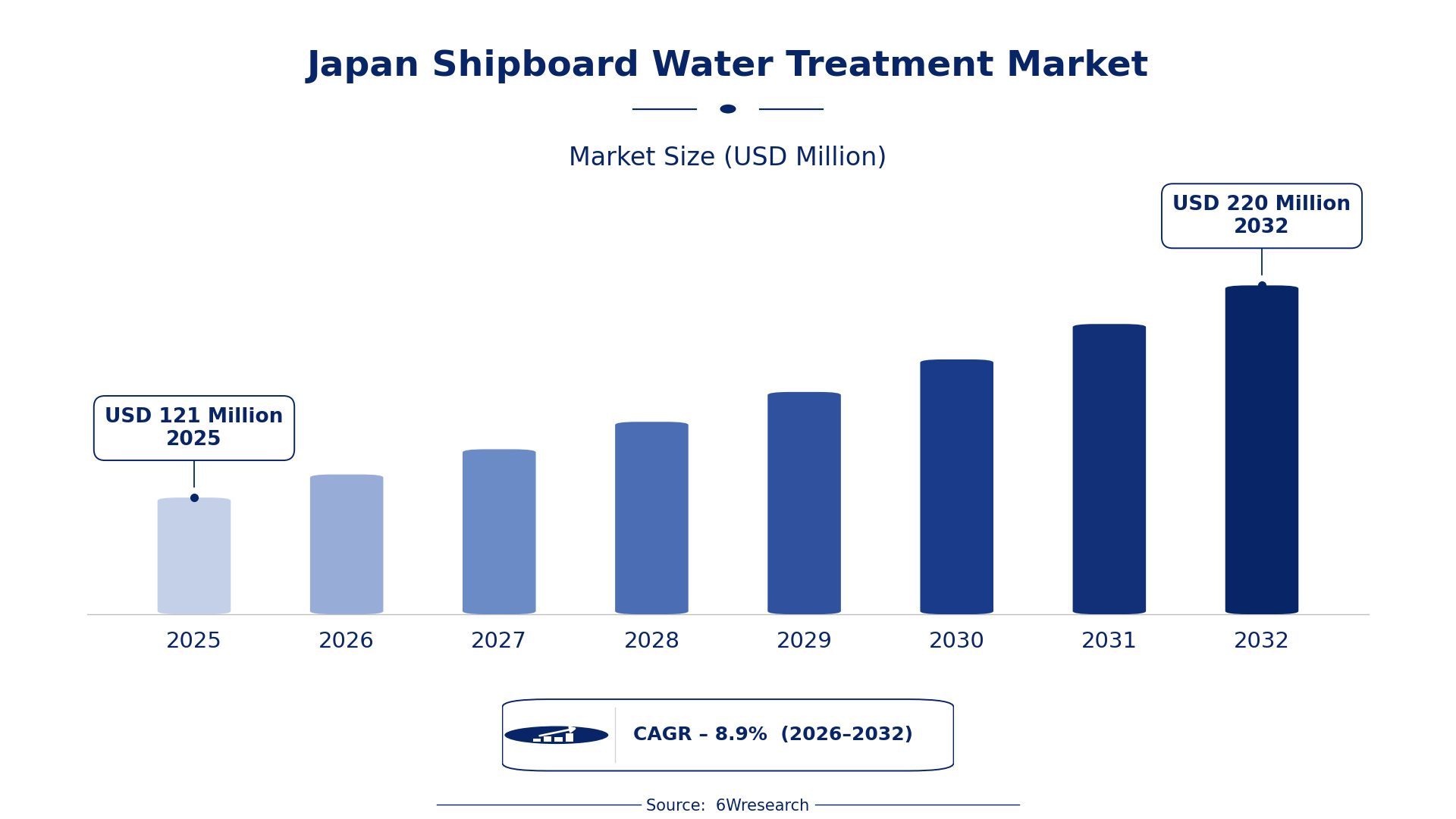
According to 6Wresearch internal database and industry insights, the Japan Shipboard Water Treatment Market was valued at USD 121 Million in 2025 and is projected to reach USD 220 Million by 2032, growing at a CAGR of approximately 8.9% during 2026–2032.
Japan Shipboard Water Treatment Market Highlights
| Report Metric | Details |
| Report Name | Japan Shipboard Water Treatment Market (2026-2032) |
| Market Size 2025 | USD 121 Million |
| Market Size 2032 | USD 220 Million |
| Absolute Growth 2025–2032 | USD 99 Million |
| CAGR 2026–2032 | 8.9% |
| Peak Annual Growth | 10.0% in 2032 |
| Forecast Period | 2026–2032 |
| Historical Data | 2022–2025 |
| Base Year | 2025 |
| Leading Treatment Type, 2025 | Desalination Units (51% share) |
| Leading System Component, 2025 | Reverse Osmosis (43% share) |
| Leading Water Source, 2025 | Seawater (45% share) |
| Leading End User, 2025 | Offshore Vessels (47% share) |
| Fastest-Growing Treatment Type | Wastewater Treatment (12.4% CAGR) |
| Fastest-Growing System Component | Membrane Bioreactor (12.8% CAGR) |
| Fastest-Growing Water Source | Gray/Black Water (12.6% CAGR) |
| Fastest-Growing End User | Commercial Ships (11.5% CAGR) |
| Growing Sector | Maritime Water Management |
| Key End Users | Shipping companies, Offshore vessel operators, Marine service providers, Environmental compliance agencies |
Japan Shipboard Water Treatment Market Year-wise Growth Rate and Key Drivers (2022–2032)
This graph illustrates the annual growth rates of the market from 2022 to 2032, highlighting a steady upward trajectory and projected market expansion over the forecast period.
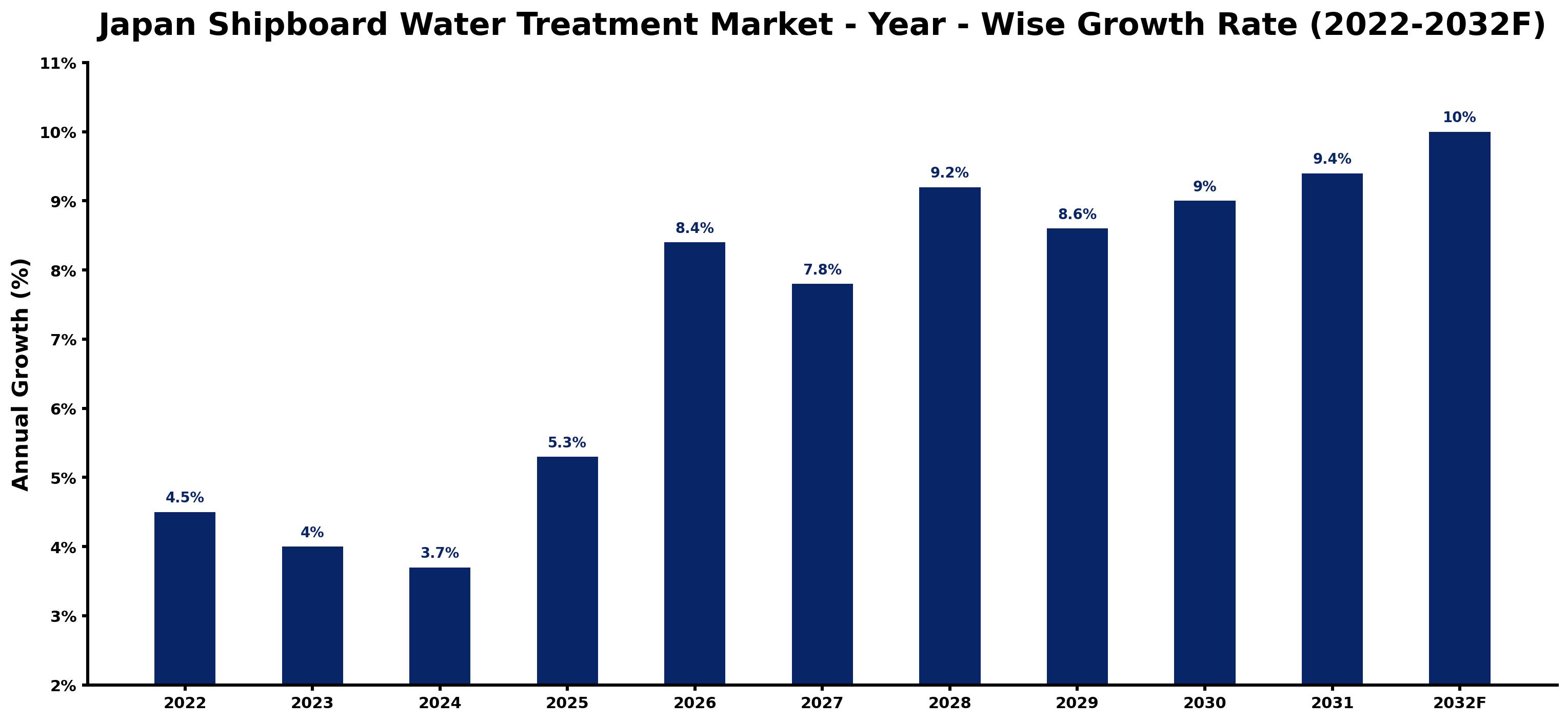
The table below sets out the estimated growth rate for each year and the main factor behind it.
| Year | Estimated Annual Growth (%) | Market Rationale |
| 2022 | 4.5 | The maritime industry demonstrated steady operational activity, supporting water treatment needs. |
| 2023 | 4.0 | Demand for shipboard water treatment systems grew, driven by ongoing maritime operations. |
| 2024 | 3.7 | The market continued to expand, albeit at a slower pace due to market saturation. |
| 2025 | 5.3 | Increased investments in water treatment technologies boosted growth rates. |
| 2026 | 8.4 | The introduction of new standards for water quality is expected to increase demand for advanced systems. |
| 2027 | 7.8 | Growth is projected to slow slightly as the market adjusts to new regulatory frameworks. |
| 2028 | 9.2 | Rising environmental awareness will lead to a resurgence in demand for treatment solutions. |
| 2029 | 8.6 | The market is expected to experience a temporary slowdown as companies reassess their investments. |
| 2030 | 9.0 | Demand will surge again as new projects in maritime infrastructure begin to materialise. |
| 2031 | 9.4 | Increased focus on sustainability and compliance will drive further growth in the sector. |
| 2032 | 10.0 | The peak growth rate reflects heightened investments in advanced water treatment technologies. |
Note: Market size estimations and growth projections presented in this report are based on 6Wresearch's proprietary forecasting methodology, utilizing the latest available industry data, government publications, and primary research inputs.
Japan Shipboard Water Treatment Market Synopsis
Shipboard water treatment technologies purify and manage water onboard vessels, including desalination, wastewater treatment, and filtration. The Japan Shipboard Water Treatment Market is driven by over 1,000 commercial ships requiring advanced systems. Growth stems from compliance with environmental regulations, investments in new technologies, and the operational demands of both domestic and international shipping activities.
Market Dynamics Impact Analysis (2026–2032)
| Factor | Type | Impact | Primary Segment Affected |
| Increasing environmental regulations drive demand for advanced water treatment systems. | Driver | High | Desalination Units |
| The need for reliable freshwater sources on vessels fuels investment in desalination technologies. | Driver | High | Filtration Systems |
| The rising number of offshore vessels creates opportunities for water treatment providers. | Opportunity | High | Offshore Vessels |
| Growing demand for sustainable shipping practices encourages investment in treatment technologies. | Opportunity | High | Commercial Ships |
| High costs associated with implementing advanced treatment systems may limit adoption. | Restraint | Medium | Wastewater Treatment |
| Compliance with stringent regulations can increase operational costs for ship operators. | Restraint | Medium | Desalination Units |
| Limited capacity for local production of advanced treatment systems can delay project timelines. | Challenge | Medium | Filtration Systems |
| Regulatory compliance requirements can complicate the approval process for new technologies. | Challenge | Medium | Wastewater Treatment |
Evaluation of Drivers in Japan Shipboard Water Treatment Market (2026–2032)
Demand rests on the following drivers, each shown with the segment it touches most.
| Drivers | Primary Segment Affected | Why It Matters (Evidence) |
| The maritime industry's need for compliance with ISO 14001 standards increases demand for water treatment systems. | Wastewater Treatment | Approximately 200,000 people are employed in Japan's maritime industry, necessitating effective waste management solutions. |
| The reliance on desalination units for freshwater supply drives investments in advanced technologies. | Desalination Units | Vessels operating in remote areas without fresh water access require dependable solutions. |
| The operational demands of passenger ships necessitate high-quality water treatment systems. | Filtration Systems | The average passenger ship requires 1,500 liters of potable water per day per passenger. |
| Growing environmental concerns prompt shipping companies to adopt new treatment technologies. | Oil-Water Separators | The Tokyo Maritime Forum in 2023 focused on sustainable water management in shipping. |
| The increasing number of offshore vessels boosts demand for efficient water treatment solutions. | Offshore Vessels | Japan has over 1,000 commercial ships requiring advanced water treatment systems. |
Spending rises because the maritime industry employs approximately 200,000 people, necessitating effective waste management solutions. The reliance on desalination units for freshwater supply drives investments in advanced technologies, as vessels in remote areas require dependable solutions. Operational demands of passenger ships necessitate high-quality water treatment systems, with each requiring 1,500 litres of potable water daily. Environmental concerns prompt shipping companies to adopt new treatment technologies, as highlighted by the Tokyo Maritime Forum's focus on sustainable water management. The increasing number of offshore vessels boosts demand for efficient water treatment solutions, with over 1,000 commercial ships in Japan needing these systems.
Evaluation of Restraints in Japan Shipboard Water Treatment Market
Several factors work against faster growth; the main ones are summarised below.
| Market Restraint | Primary Segment Affected | Why It Matters (Evidence) |
| High costs associated with implementing advanced treatment systems may limit adoption. | Wastewater Treatment | Many shipping companies face budget constraints, impacting their ability to invest in new technologies. |
| Compliance with stringent regulations can increase operational costs for ship operators. | Desalination Units | Operators must invest in systems that meet high environmental standards, raising overall expenses. |
| Limited capacity for local production of advanced treatment systems can delay project timelines. | Filtration Systems | Dependence on imports for advanced technologies can create supply chain vulnerabilities. |
| Regulatory compliance requirements can complicate the approval process for new technologies. | Oil-Water Separators | Lengthy approval processes can deter investment in new solutions by shipping companies. |
| Market saturation in certain segments may hinder growth opportunities for new entrants. | Desalination Units | Established players dominate the market, making it challenging for new firms to compete. |
Japan Shipboard Water Treatment Market Challenges
High costs for advanced water treatment systems strain budgets, with some producers reporting expenses exceeding 20% of their operational costs. Supply chain delays occur due to reliance on imported components, causing ship operators to wait up to three months for critical parts. A shortage of skilled workers in the maritime sector hampers the installation and maintenance of these systems, leading to project delays for ship operators. Increased competition from foreign companies offering lower-cost alternatives pressures local producers to cut prices, resulting in reduced profit margins for domestic manufacturers.
Trends in the Japan Shipboard Water Treatment Market
Four trends stand out in the Japan Shipboard Water Treatment Market.
- Shift towards Sustainable Water Management Practices: The Tokyo Bay area is increasingly adopting sustainable water management practices, as highlighted by the Tokyo Maritime Forum in 2023, which focused on new solutions. This shift is prompting shipping companies to invest in advanced water treatment technologies.
- Transition from Conventional to Advanced Filtration Systems: The adoption of membrane bioreactor systems is gaining traction among marine service companies, driven by the need for efficient wastewater treatment. This trend reflects a growing emphasis on environmental compliance and operational efficiency.
- New Standards for Water Quality: In 2023, a new initiative was launched to improve water treatment standards on passenger ships, reflecting the industry's commitment to enhancing water quality. This initiative underscores the increasing regulatory focus on environmental management.
- Growing Demand for Desalination Units: Desalination units are becoming critical for vessels operating in remote areas without fresh water access. This trend is evident as more ships are equipped with these systems to ensure operational sustainability.
Investment Opportunities in the Japan Shipboard Water Treatment Market
The following areas offer the clearest openings for investors and suppliers in the Japan Shipboard Water Treatment Market.
- Investment in Advanced Water Treatment Technologies: The demand for advanced water treatment technologies is rising, particularly in the offshore vessels sector. With over 1,000 commercial ships in Japan, suppliers can benefit by partnering with local firms to improve service delivery.
- Expansion of Wastewater Treatment Solutions: The need for effective wastewater management is growing, especially among commercial ships. Investing in new solutions now can position suppliers advantageously in a market projected to expand significantly.
- Supply of Desalination Units: The maritime industry's reliance on desalination units presents a lucrative opportunity. Suppliers can enter the market by forming joint ventures with local manufacturers to meet increasing demand.
- Enhancement of Compliance Services: As regulations tighten, there is a growing need for compliance services related to water treatment. Targeting marine service companies can provide a pathway for suppliers to establish a foothold in this sector.
Government Initiatives in the Japan Shipboard Water Treatment Market
The Waste Management and Public Cleansing Act of 1970 regulates the treatment and disposal of waste, ensuring that shipboard water treatment systems comply with environmental standards. The Water Supply Act of 1957 sets quality standards for drinking water, while the Sewerage Act of 1958 governs wastewater treatment, impacting the design and operation of onboard systems.
In 2023, the Japanese government allocated USD 5 million to support research on water treatment technologies through the Ministry of Land, Infrastructure, Transport and Tourism. This funding aims to improve the capabilities of shipboard water treatment systems and ensure compliance with environmental regulations.
Future Insight of the Japan Shipboard Water Treatment Market
New desalination units will be implemented by 2032, enhancing water availability for vessels operating in remote areas. The adoption of advanced filtration technologies will improve water quality and compliance with environmental regulations. Ongoing government support for research will lead to more efficient water treatment solutions, benefiting both buyers and suppliers. Initiatives focusing on sustainable water management will encourage collaboration among industry stakeholders, fostering a more resilient maritime sector.
Market Segmentation Analysis
Japan Shipboard Water Treatment Market report covers a detailed analysis of the following market segments:
By Treatment Type – Desalination Units Lead, Wastewater Treatment Expected to Grow Fastest
According to Saurav Kr Singh, Senior Research Analyst at 6Wresearch, the largest treatment type category in 2025 was Desalination Units, at 51% of revenue. Desalination units are vital for vessels in remote areas lacking fresh water, ensuring operational efficiency. The Tokyo Bay area exemplifies this need, being a significant maritime hub reliant on these technologies. Over 2026–2032, Wastewater Treatment is expected to post the fastest growth, at a CAGR of 12.4%. The wastewater treatment segment is expanding rapidly due to stringent regulations aimed at environmental compliance in shipping. The 2023 initiative to improve treatment standards on passenger ships is a key factor driving this growth. Suppliers must prioritise the development of advanced wastewater treatment solutions to meet increasing regulatory requirements.
By System Component – Reverse Osmosis Leads, Membrane Bioreactor Expected to Grow Fastest
Reverse Osmosis accounted for 43% of the market by system component in 2025. Reverse osmosis is the most widely employed technology for desalination and water purification, making it the leading system component in shipboard water treatment. Its extensive use across various maritime applications underscores its critical role in maintaining water quality. Membrane Bioreactor is projected to grow fastest, at a CAGR of 12.8% during 2026–2032. Membrane bioreactor systems are gaining popularity for their effectiveness in specific wastewater treatment applications, driven by the need for efficient waste management onboard. Their increasing adoption reflects a shift towards advanced treatment solutions in the maritime industry. Buyers should invest in membrane bioreactor systems to improve their wastewater management capabilities.
By Water Source – Seawater Leads, Gray/Black Water Expected to Grow Fastest
With 45% of water source revenue in 2025, Seawater was the largest category. Seawater serves as the primary source for desalination, crucial for vessels in regions without fresh water availability. Offshore vessels particularly depend on this resource to ensure a continuous supply of potable water. Gray/Black Water is set to record the highest CAGR in this split, 12.6% over 2026–2032. The management of gray and black water is gaining importance as regulations on onboard waste treatment become stricter. This trend is evident as more vessels adopt systems to effectively treat these waste streams. Suppliers should focus on creating efficient solutions for gray and black water management to align with regulatory trends.
By End User – Offshore Vessels Lead, Commercial Ships Expected to Grow Fastest
In 2025, Offshore Vessels led the end user split with a 47% share. Offshore vessels represent the largest segment for water treatment technologies, requiring sophisticated systems to maintain water quality during long voyages. Their operational demands significantly influence the market for effective water management solutions. The quickest growth will come from Commercial Ships, forecast to expand at a CAGR of 11.5% between 2026 and 2032. Commercial ships are witnessing a notable increase in demand for onboard water management systems, driven by the need to optimise operations and comply with environmental regulations. This reflects a broader commitment to sustainability within the maritime sector. Suppliers should develop customised solutions for commercial ships to improve their water management capabilities.
Key Attractiveness of the Report
- 10 Years of Market Numbers
- Historical Data Starting from 2022 to 2025
- Base Year 2025
- Forecast Data until 2032
- Key Performance Indicators Impacting the Market
- Major Upcoming Developments and Projects
Key Highlights of the Report:
- Japan Shipboard Water Treatment Market Outlook
- Market Size of Japan Shipboard Water Treatment Market, 2025
- Forecast of Japan Shipboard Water Treatment Market, 2032
- Historical Data and Forecast of Japan Shipboard Water Treatment Revenues & Volume for the Period 2022-2032F
- Japan Shipboard Water Treatment Market Trend Evolution
- Japan Shipboard Water Treatment Market Drivers and Challenges
- Japan Shipboard Water Treatment Price Trends
- Japan Shipboard Water Treatment Porter's Five Forces
- Japan Shipboard Water Treatment Industry Life Cycle
- Historical Data and Forecast of Japan Shipboard Water Treatment Market Revenues & Volume By Treatment Type for the Period 2022-2032F
- Historical Data and Forecast of Japan Shipboard Water Treatment Market Revenues & Volume By Desalination Units for the Period 2022-2032F
- Historical Data and Forecast of Japan Shipboard Water Treatment Market Revenues & Volume By Wastewater Treatment for the Period 2022-2032F
- Historical Data and Forecast of Japan Shipboard Water Treatment Market Revenues & Volume By Filtration Systems for the Period 2022-2032F
- Historical Data and Forecast of Japan Shipboard Water Treatment Market Revenues & Volume By Oil-Water Separators for the Period 2022-2032F
- Historical Data and Forecast of Japan Shipboard Water Treatment Market Revenues & Volume By System Component for the Period 2022-2032F
- Historical Data and Forecast of Japan Shipboard Water Treatment Market Revenues & Volume By Reverse Osmosis for the Period 2022-2032F
- Historical Data and Forecast of Japan Shipboard Water Treatment Market Revenues & Volume By Membrane Bioreactor for the Period 2022-2032F
- Historical Data and Forecast of Japan Shipboard Water Treatment Market Revenues & Volume By UV/Cartridge for the Period 2022-2032F
- Historical Data and Forecast of Japan Shipboard Water Treatment Market Revenues & Volume By Bilge Water Management for the Period 2022-2032F
- Historical Data and Forecast of Japan Shipboard Water Treatment Market Revenues & Volume By Water Source for the Period 2022-2032F
- Historical Data and Forecast of Japan Shipboard Water Treatment Market Revenues & Volume By Seawater for the Period 2022-2032F
- Historical Data and Forecast of Japan Shipboard Water Treatment Market Revenues & Volume By Gray/Black Water for the Period 2022-2032F
- Historical Data and Forecast of Japan Shipboard Water Treatment Market Revenues & Volume By Potable Supply for the Period 2022-2032F
- Historical Data and Forecast of Japan Shipboard Water Treatment Market Revenues & Volume By Engine Room Effluents for the Period 2022-2032F
- Historical Data and Forecast of Japan Shipboard Water Treatment Market Revenues & Volume By End User for the Period 2022-2032F
- Historical Data and Forecast of Japan Shipboard Water Treatment Market Revenues & Volume By Offshore Vessels for the Period 2022-2032F
- Historical Data and Forecast of Japan Shipboard Water Treatment Market Revenues & Volume By Commercial Ships for the Period 2022-2032F
- Historical Data and Forecast of Japan Shipboard Water Treatment Market Revenues & Volume By Passenger Ships for the Period 2022-2032F
- Historical Data and Forecast of Japan Shipboard Water Treatment Market Revenues & Volume By Marine Service Companies for the Period 2022-2032F
- Japan Shipboard Water Treatment Import Export Trade Statistics
- Market Opportunity Assessment By Treatment Type
- Market Opportunity Assessment By System Component
- Market Opportunity Assessment By Water Source
- Market Opportunity Assessment By End User
- Japan Shipboard Water Treatment Top Companies Market Share
- Japan Shipboard Water Treatment Competitive Benchmarking By Technical and Operational Parameters
- Japan Shipboard Water Treatment Company Profiles
- Japan Shipboard Water Treatment Key Strategic Recommendations
Market Covered
The report covers the following segments.
By Treatment Type
- Desalination Units
- Wastewater Treatment
- Filtration Systems
- Oil-Water Separators
By System Component
- Reverse Osmosis
- Membrane Bioreactor
- UV/Cartridge
- Bilge Water Management
By Water Source
- Seawater
- Gray/Black Water
- Potable Supply
- Engine Room Effluents
By End User
- Offshore Vessels
- Commercial Ships
- Passenger Ships
- Marine Service Companies































