Japan Shipbuilding Equipment Market Size & Growth Rate
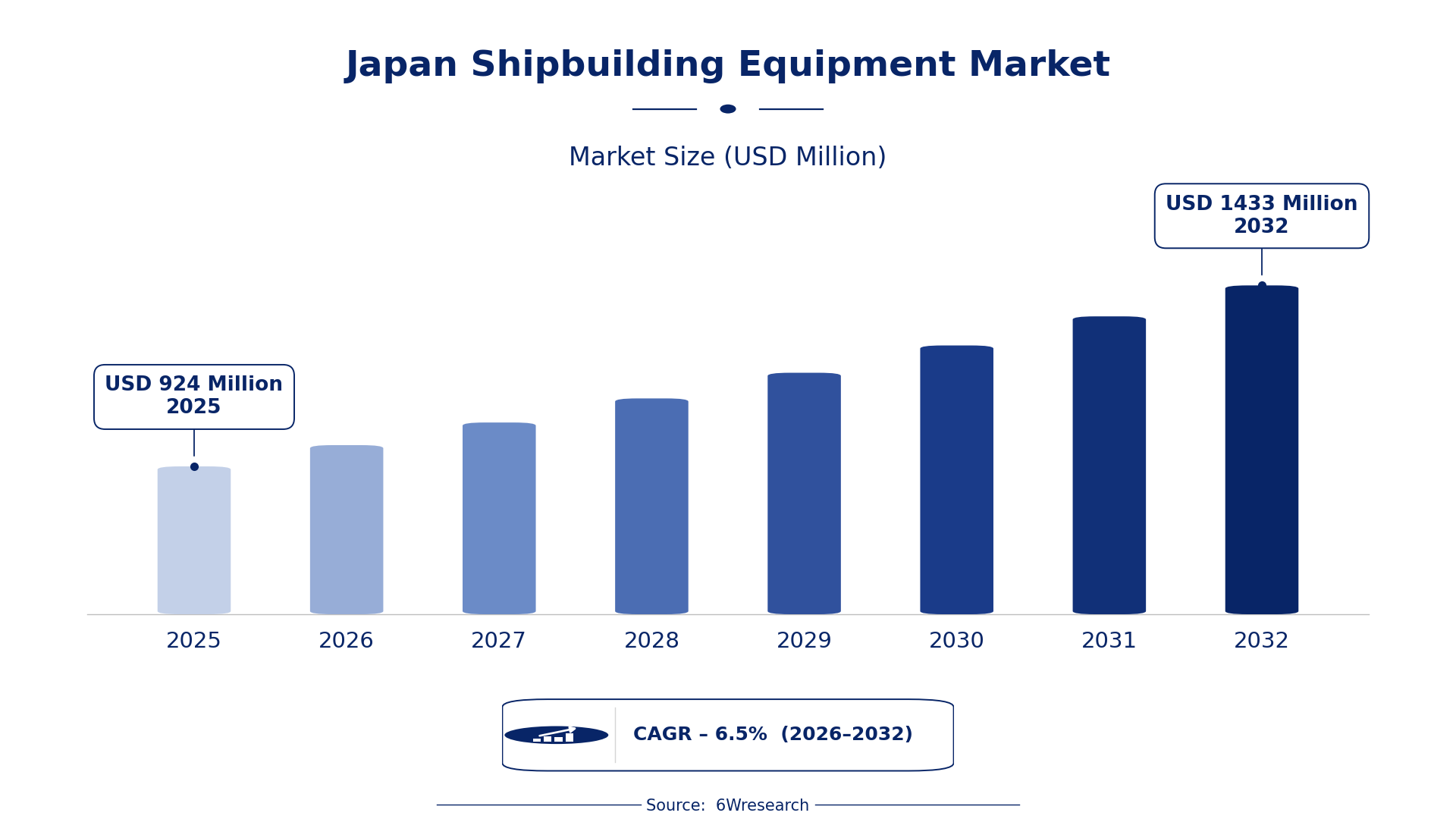
According to 6Wresearch internal database and industry insights, the Japan Shipbuilding Equipment Market was valued at USD 924 Million in 2025 and is projected to reach USD 1,433 Million by 2032, growing at a CAGR of approximately 6.5% during 2026–2032.
Japan Shipbuilding Equipment Market Highlights
| Report Metric | Details |
| Report Name | Japan Shipbuilding Equipment Market (2026-2032) |
| Market Size 2025 | USD 924 Million |
| Market Size 2032 | USD 1,433 Million |
| Absolute Growth 2025–2032 | USD 509 Million |
| CAGR 2026–2032 | 6.5% |
| Peak Annual Growth | 7.4% in 2028 |
| Forecast Period | 2026–2032 |
| Historical Data | 2022–2025 |
| Base Year | 2025 |
| Leading Equipment Type, 2025 | Welding Equipment (37% share) |
| Leading Construction Stage, 2025 | Hull Assembly (41% share) |
| Leading Automation Level, 2025 | Manual/CNC (50% share) |
| Leading End User, 2025 | Shipyards (49% share) |
| Fastest-Growing Equipment Type | Propulsion Systems (9.0% CAGR) |
| Fastest-Growing Construction Stage | Engine Room (9.3% CAGR) |
| Fastest-Growing Automation Level | Integrated (8.9% CAGR) |
| Fastest-Growing End User | Shipbuilders (8.3% CAGR) |
| Growing Sector | Shipbuilding |
| Key End Users | Shipyards, Shipbuilders, Commercial Marine Builders, Offshore Vessel Makers |
Japan Shipbuilding Equipment Market Year-wise Growth Rate and Key Drivers (2022–2032)
This graph illustrates the annual growth rates of the market from 2022 to 2032, highlighting a steady upward trajectory and projected market expansion over the forecast period.
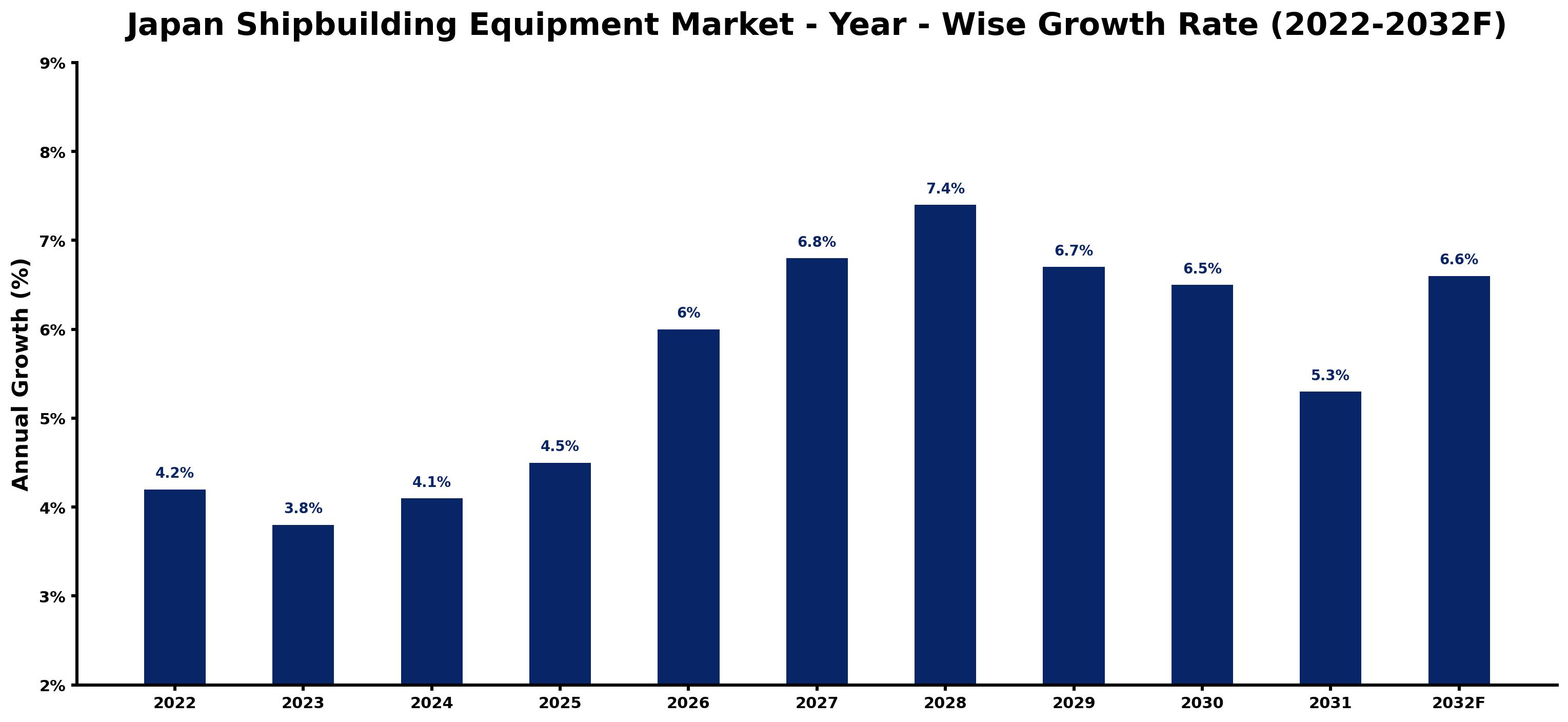
Below, each year's estimated growth is shown next to the factor that most influenced it.
| Year | Estimated Annual Growth (%) | Market Rationale |
| 2022 | 4.2 | Demand remained steady as shipyards focused on fulfilling existing contracts. |
| 2023 | 3.8 | Growth slowed as global supply chain disruptions affected equipment availability. |
| 2024 | 4.1 | Increased orders for LNG-powered vessels boosted demand for propulsion systems. |
| 2025 | 4.5 | Shipbuilders expanded operations, leading to a rise in equipment orders. |
| 2026 | 6.0 | The introduction of new green technologies is expected to spur equipment investments. |
| 2027 | 6.8 | Growing domestic demand for modernization is projected to support higher order volumes. |
| 2028 | 7.4 | Peak demand will occur as shipyards ramp up production for international clients. |
| 2029 | 6.7 | A slight slowdown in growth is expected as market adjustments take place. |
| 2030 | 6.5 | Demand will remain strong, supported by ongoing investments in shipbuilding. |
| 2031 | 5.3 | A further slowdown is projected as the market stabilises. |
| 2032 | 6.6 | Growth is expected to pick up again as new projects are initiated. |
Note: Market size estimations and growth projections presented in this report are based on 6Wresearch's proprietary forecasting methodology, utilizing the latest available industry data, government publications, and primary research inputs.
Japan Shipbuilding Equipment Market Synopsis
Shipbuilding equipment includes essential tools and machinery for constructing ships, such as welding equipment, propulsion systems, and navigation systems. The Japan Shipbuilding Equipment Market is expanding due to domestic shipyards focusing on modernization and the rising demand for LNG-powered vessels. Government initiatives promoting green technologies are driving new investments, further stimulating growth in the sector. In 2023, Japan launched a new initiative to promote these technologies, contributing to a more sustainable industry.
Market Dynamics Impact Analysis (2026–2032)
| Factor | Type | Impact | Primary Segment Affected |
| Increased demand for LNG-powered vessels | Driver | High | Propulsion Systems |
| Government initiatives promoting green technologies | Driver | High | Welding Equipment |
| Modernization of aging vessels | Opportunity | Medium | Navigation Systems |
| Expansion of shipyards in Nagasaki and Yokohama | Opportunity | High | Hull Assembly |
| Rising costs of raw materials | Restraint | High | Steel Cutting Machines |
| Competition from lower-cost international manufacturers | Restraint | Medium | Fabrication Yard |
| High investment costs for advanced technologies | Challenge | High | Robotic |
| Skilled labor shortages in the shipbuilding sector | Challenge | Medium | Shipyards |
Evaluation of Drivers in Japan Shipbuilding Equipment Market (2026–2032)
The following drivers explain most of the expected growth.
| Drivers | Primary Segment Affected | Why It Matters (Evidence) |
| Growing domestic demand for LNG-powered vessels | Propulsion Systems | This trend is prompting shipbuilders to invest in advanced propulsion technologies, resulting in increased orders for these systems. |
| Government support for green shipbuilding technologies | Welding Equipment | New initiatives encourage investments in eco-friendly welding solutions, boosting demand for advanced equipment. |
| Modernization of aging fleets | Navigation Systems | Shipbuilders are upgrading navigation systems to comply with safety regulations, increasing orders for these technologies. |
| Expansion of shipyards in key regions | Hull Assembly | New facilities in Nagasaki and Yokohama are increasing production capacity, driving demand for assembly equipment. |
| Technological advancements in shipbuilding processes | Steel Cutting Machines | Innovations are improving efficiency, prompting shipyards to upgrade their cutting equipment to improve productivity. |
Behind the steady rise in orders sits a growing domestic demand for LNG-powered vessels, prompting shipbuilders to invest in advanced propulsion technologies. New facilities in regions like Nagasaki and Yokohama are boosting production capacity, leading to higher demand for hull assembly equipment. Technological advancements in shipbuilding processes are improving efficiency, prompting shipyards to invest in upgraded steel cutting machines.
Evaluation of Restraints in Japan Shipbuilding Equipment Market
Several factors work against faster growth; the main ones are summarised below.
| Market Restraint | Primary Segment Affected | Why It Matters (Evidence) |
| Rising costs of raw materials | Steel Cutting Machines | Increased prices for steel and other materials are impacting production costs for shipbuilders, raising overall project expenses. |
| Competition from lower-cost international manufacturers | Fabrication Yard | Local manufacturers face pressure from cheaper imports, affecting their market share and pricing strategies. |
| High investment costs for advanced technologies | Robotic | The initial capital required for robotic systems can deter smaller shipyards from upgrading, limiting their competitiveness. |
| Skilled labor shortages in the shipbuilding sector | Shipyards | A lack of qualified workers is hindering production capabilities and project timelines, causing delays in deliveries. |
| Regulatory compliance costs for environmental standards | Welding Equipment | Meeting stringent regulations increases operational costs for shipbuilders, impacting their profit margins. |
Japan Shipbuilding Equipment Market Challenges
Japan produced over 100 ships in 2022, yet buyers encounter project delays due to a shortage of skilled workers, which can extend delivery timelines for shipyards by several months. Rising labour costs, with the minimum wage reaching JPY 1,055 per hour in October 2024, are increasing operational expenses for producers, leading to higher prices for buyers. Compliance with ISO 9001 standards requires additional training and resources, complicating operations for suppliers and potentially delaying project timelines. Supply chain disruptions, particularly for welding equipment, can result in project overruns, costing shipbuilders significant time and money, ultimately affecting delivery schedules for clients.
Trends in the Japan Shipbuilding Equipment Market
The following changes are redrawing the Japan Shipbuilding Equipment Market.
- Shift in Focus to Green Shipbuilding Technologies: The shipbuilding sector is increasingly adopting eco-friendly practices, driven by a government initiative launched in 2023 promoting green shipbuilding technologies. This shift aims for a 46% reduction in greenhouse gas emissions by 2030.
- Transition to Advanced Propulsion Systems: The demand for LNG-powered vessels has surged since 2023, with shipbuilders focusing on advanced propulsion systems to meet environmental standards. This trend is reflected in the growing orders for new propulsion equipment.
- Emergence of Automation in Shipbuilding: The adoption of integrated automation systems has gained momentum since 2024, improving efficiency in ship construction. Shipyards are investing in automated solutions to streamline operations, focusing on reducing costs.
- Increased Investment in Shipyard Expansion: Nagasaki and Yokohama are witnessing significant investments in shipyard expansion, with over 30 major shipyards reported in 2022. This trend supports increased production capabilities and equipment demand.
Investment Opportunities in the Japan Shipbuilding Equipment Market
The opportunities below stand out in the Japan Shipbuilding Equipment Market for new entrants and existing suppliers.
- Nagasaki's Shipyard Expansion: Nagasaki is currently expanding its shipyards, presenting opportunities for suppliers of advanced shipbuilding equipment. The region's historical shipbuilding heritage supports a growing market for modernisation, with over 30 shipyards reported in 2022.
- Supply of Advanced Welding Equipment: There is a rising need for advanced welding equipment as shipbuilders modernise their facilities. Suppliers can target shipyards focusing on eco-friendly technologies to enter this market, especially with government support.
- Partnerships for Automation Solutions: Now is the time for partnerships in automation solutions, as shipbuilders seek to improve efficiency. Collaborating with local firms can facilitate entry into this growing segment, particularly in regions with expanding shipyards.
- Investment in Navigation Systems: The ongoing modernisation of ageing vessels creates a demand for updated navigation systems. Suppliers should focus on shipbuilders looking to improve safety and compliance, especially with new regulatory standards.
Government Initiatives in the Japan Shipbuilding Equipment Market
The Building Energy Efficiency Act, amended in 2022, mandates that all new shipbuilding facilities meet energy efficiency standards starting April 2025. This requirement compels shipbuilders to invest in energy-efficient technologies, directly impacting their operational costs and compliance efforts.
The GX Basic Policy aims for approximately JPY 150 trillion in public-private decarbonisation investment over the next decade, overseen by the Ministry of Land, Infrastructure, Transport and Tourism. This investment will support the development of green technologies in shipbuilding, benefiting both producers and buyers.
Future Insight of the Japan Shipbuilding Equipment Market
The Maritime Industry Development Program will support the establishment of advanced shipbuilding facilities by 2032, focusing on eco-friendly technologies. A transition to LNG-powered vessels will reshape production processes, aligning with Japan's commitment to cut greenhouse gas emissions by 46% from fiscal 2013 levels by fiscal 2030. Modernisation efforts will be driven by the average age of ships, currently around 20 years, creating demand for innovative equipment. Initiatives promoting green shipbuilding technologies will inspire suppliers to develop more efficient and environmentally friendly vessels, benefiting buyers.
Market Segmentation Analysis
Japan Shipbuilding Equipment Market report covers a detailed analysis of the following market segments:
By Equipment Type – Welding Equipment Leads, Propulsion Systems Expected to Grow Fastest
According to Saurav Kr Singh, Senior Research Analyst at 6Wresearch, in 2025, Welding Equipment led the equipment type split with a 37% share. Welding equipment holds the largest share due to its crucial role in joining metal parts during ship construction, which is essential for ensuring structural integrity. The extensive use of techniques like MIG and TIG in over 30 major shipyards across regions such as Nagasaki and Yokohama underscores its importance. The quickest growth will come from Propulsion Systems, forecast to expand at a CAGR of 9.0% between 2026 and 2032. Propulsion systems are experiencing rapid growth as shipbuilders increasingly prioritise LNG-powered vessels to comply with environmental standards. The production of more than 100 ships in 2022 highlights the rising demand for advanced propulsion technologies in the market. Suppliers should prioritise the development of advanced propulsion systems to meet the growing environmental compliance requirements of shipbuilders.
By Construction Stage – Hull Assembly Leads, Engine Room Expected to Grow Fastest
Hull Assembly took 41% of construction stage revenue in 2025, more than any other category. Hull assembly is the leading construction stage, as it is fundamental to the overall structure and design of vessels. This process is critical in Japan's shipyards, known for their historical significance and modern capabilities in shipbuilding. Engine Room is set to record the highest CAGR in this split, 9.3% over 2026–2032. The engine room segment is witnessing quick growth due to its integral role in accommodating essential machinery and systems, reflecting the industry's shift towards more complex vessel designs. This focus aligns with Japan's initiative to promote green shipbuilding technologies. Buyers should invest in advanced engine room technologies to enhance vessel performance and ensure compliance with evolving regulations.
By Automation Level – Manual/CNC Leads, Integrated Expected to Grow Fastest
Manual/CNC accounted for 50% of the market by automation level in 2025. The manual/CNC segment leads the market since these methods are vital for precision tasks in shipbuilding, ensuring high-quality construction. This level of automation is prevalent in Japan's shipyards, where skilled labour collaborates with advanced machinery. Over 2026–2032, Integrated is expected to post the fastest growth, at a CAGR of 8.9%. Integrated automation is the fastest-growing segment, as it significantly improves efficiency in ship construction, enabling quicker project completion. The increasing complexity of ship designs necessitates a transition towards more integrated solutions to streamline operations effectively. Suppliers should concentrate on integrated automation technologies to address the rising efficiency demands of shipbuilders.
By End User – Shipyards Lead, Shipbuilders Expected to Grow Fastest
The largest end user category in 2025 was Shipyards, at 49% of revenue. Shipyards hold the largest market share as the primary users of shipbuilding equipment, directly influencing the demand for various tools and machinery. With approximately 50,000 workers employed in the industry, shipyards play a central role in Japan's shipbuilding sector. Shipbuilders are projected to grow fastest, at a CAGR of 8.3% during 2026–2032. Shipbuilders represent the fastest-growing end user segment, reflecting a core industry emphasis on utilising advanced shipbuilding tools. The drive towards modernisation and adherence to environmental standards is propelling this growth. Suppliers should customise their offerings to meet the specific requirements of shipbuilders, ensuring alignment with current industry trends.
Key Attractiveness of the Report
- 10 Years of Market Numbers
- Historical Data Starting from 2022 to 2025
- Base Year 2025
- Forecast Data until 2032
- Key Performance Indicators Impacting the Market
- Major Upcoming Developments and Projects
Key Highlights of the Report:
- Japan Shipbuilding Equipment Market Outlook
- Market Size of Japan Shipbuilding Equipment Market, 2025
- Forecast of Japan Shipbuilding Equipment Market, 2032
- Historical Data and Forecast of Japan Shipbuilding Equipment Revenues & Volume for the Period 2022-2032F
- Japan Shipbuilding Equipment Market Trend Evolution
- Japan Shipbuilding Equipment Market Drivers and Challenges
- Japan Shipbuilding Equipment Price Trends
- Japan Shipbuilding Equipment Porter's Five Forces
- Japan Shipbuilding Equipment Industry Life Cycle
- Historical Data and Forecast of Japan Shipbuilding Equipment Market Revenues & Volume By Equipment Type for the Period 2022-2032F
- Historical Data and Forecast of Japan Shipbuilding Equipment Market Revenues & Volume By Welding Equipment for the Period 2022-2032F
- Historical Data and Forecast of Japan Shipbuilding Equipment Market Revenues & Volume By Propulsion Systems for the Period 2022-2032F
- Historical Data and Forecast of Japan Shipbuilding Equipment Market Revenues & Volume By Navigation Systems for the Period 2022-2032F
- Historical Data and Forecast of Japan Shipbuilding Equipment Market Revenues & Volume By Steel Cutting Machines for the Period 2022-2032F
- Historical Data and Forecast of Japan Shipbuilding Equipment Market Revenues & Volume By Construction Stage for the Period 2022-2032F
- Historical Data and Forecast of Japan Shipbuilding Equipment Market Revenues & Volume By Hull Assembly for the Period 2022-2032F
- Historical Data and Forecast of Japan Shipbuilding Equipment Market Revenues & Volume By Engine Room for the Period 2022-2032F
- Historical Data and Forecast of Japan Shipbuilding Equipment Market Revenues & Volume By Bridge Installation for the Period 2022-2032F
- Historical Data and Forecast of Japan Shipbuilding Equipment Market Revenues & Volume By Fabrication Yard for the Period 2022-2032F
- Historical Data and Forecast of Japan Shipbuilding Equipment Market Revenues & Volume By Automation Level for the Period 2022-2032F
- Historical Data and Forecast of Japan Shipbuilding Equipment Market Revenues & Volume By Manual/CNC for the Period 2022-2032F
- Historical Data and Forecast of Japan Shipbuilding Equipment Market Revenues & Volume By Integrated for the Period 2022-2032F
- Historical Data and Forecast of Japan Shipbuilding Equipment Market Revenues & Volume By Modular for the Period 2022-2032F
- Historical Data and Forecast of Japan Shipbuilding Equipment Market Revenues & Volume By Robotic for the Period 2022-2032F
- Historical Data and Forecast of Japan Shipbuilding Equipment Market Revenues & Volume By End User for the Period 2022-2032F
- Historical Data and Forecast of Japan Shipbuilding Equipment Market Revenues & Volume By Shipyards for the Period 2022-2032F
- Historical Data and Forecast of Japan Shipbuilding Equipment Market Revenues & Volume By Shipbuilders for the Period 2022-2032F
- Historical Data and Forecast of Japan Shipbuilding Equipment Market Revenues & Volume By Commercial Marine Builders for the Period 2022-2032F
- Historical Data and Forecast of Japan Shipbuilding Equipment Market Revenues & Volume By Offshore Vessel Makers for the Period 2022-2032F
- Japan Shipbuilding Equipment Import Export Trade Statistics
- Market Opportunity Assessment By Equipment Type
- Market Opportunity Assessment By Construction Stage
- Market Opportunity Assessment By Automation Level
- Market Opportunity Assessment By End User
- Japan Shipbuilding Equipment Top Companies Market Share
- Japan Shipbuilding Equipment Competitive Benchmarking By Technical and Operational Parameters
- Japan Shipbuilding Equipment Company Profiles
- Japan Shipbuilding Equipment Key Strategic Recommendations
Market Covered
Segments analysed in this report are listed below.
By Equipment Type
- Welding Equipment
- Propulsion Systems
- Navigation Systems
- Steel Cutting Machines
By Construction Stage
- Hull Assembly
- Engine Room
- Bridge Installation
- Fabrication Yard
By Automation Level
- Manual/CNC
- Integrated
- Modular
- Robotic
By End User
- Shipyards
- Shipbuilders
- Commercial Marine Builders
- Offshore Vessel Makers































