Japan SIEM with AI Market Size & Growth Rate
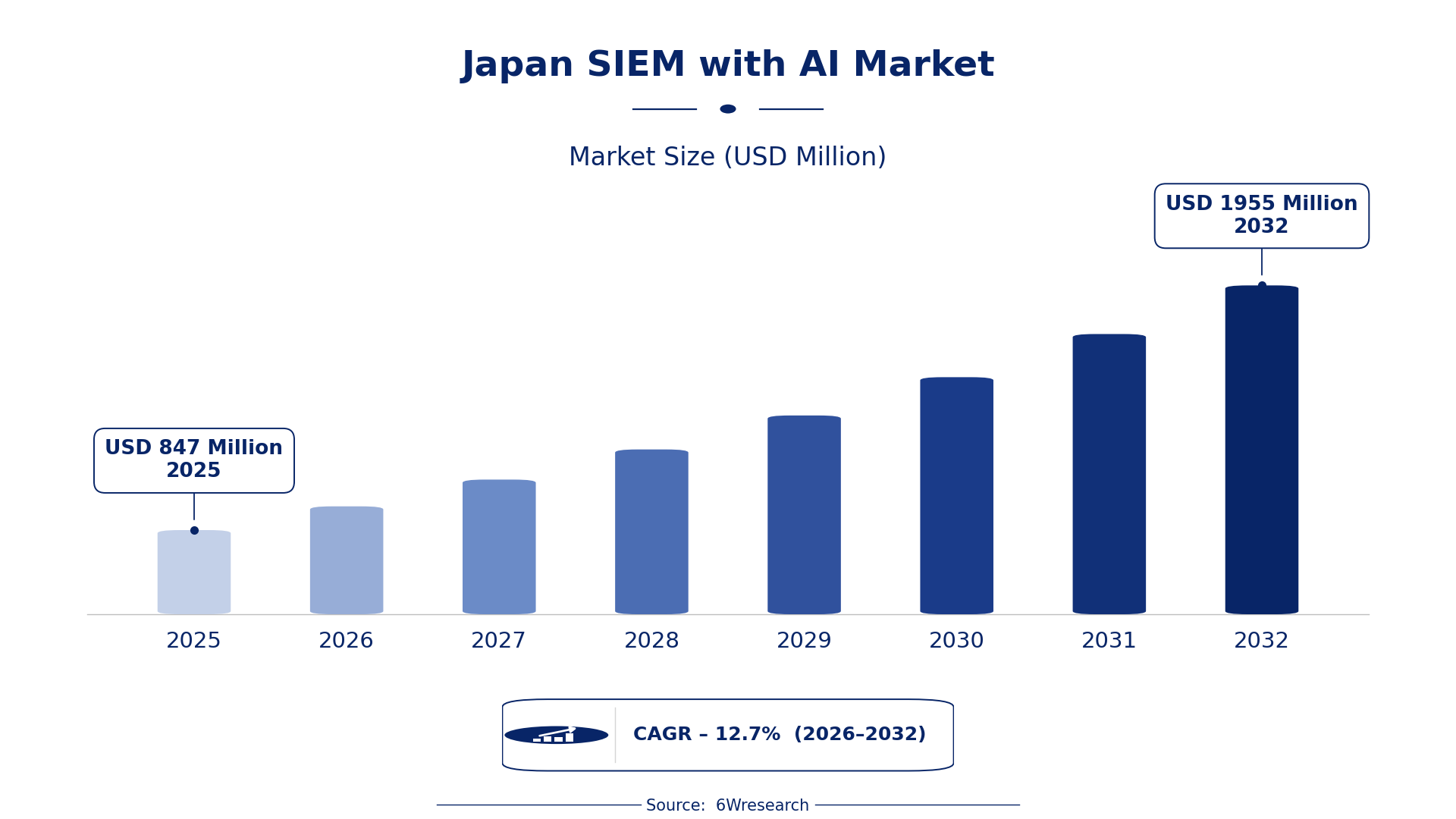
According to 6Wresearch internal database and industry insights, the Japan SIEM with AI Market was valued at USD 847 Million in 2025 and is projected to reach USD 1,955 Million by 2032, growing at a CAGR of approximately 12.7% during 2026–2032.
Japan SIEM with AI Market Highlights
| Report Metric | Details |
| Report Name | Japan SIEM with AI Market (2026-2032) |
| Market Size 2025 | USD 847 Million |
| Market Size 2032 | USD 1,955 Million |
| Absolute Growth 2025–2032 | USD 1,108 Million |
| CAGR 2026–2032 | 12.7% |
| Peak Annual Growth | 14.1% in 2030 |
| Forecast Period | 2026–2032 |
| Historical Data | 2022–2025 |
| Base Year | 2025 |
| Leading SIEM Type, 2025 | Cloud-Based SIEM (47% share) |
| Leading AI Capability, 2025 | Threat Detection AI (53% share) |
| Leading Deployment Mode, 2025 | SaaS (37% share) |
| Leading End User, 2025 | Enterprises (36% share) |
| Fastest-Growing SIEM Type | On-Premise SIEM (18.6% CAGR) |
| Fastest-Growing AI Capability | Log Correlation (17.5% CAGR) |
| Fastest-Growing Deployment Mode | Hardware/Software (18.7% CAGR) |
| Fastest-Growing End User | Banks & Insurance Firms (16.8% CAGR) |
| Growing Sector | Cybersecurity |
| Key End Users | Enterprises, Banks & Insurance Firms, Government Agencies, SMEs |
Japan SIEM with AI Market Year-wise Growth Rate and Key Drivers (2022–2032)
This graph illustrates the annual growth rates of the market from 2022 to 2032, highlighting a steady upward trajectory and projected market expansion over the forecast period.
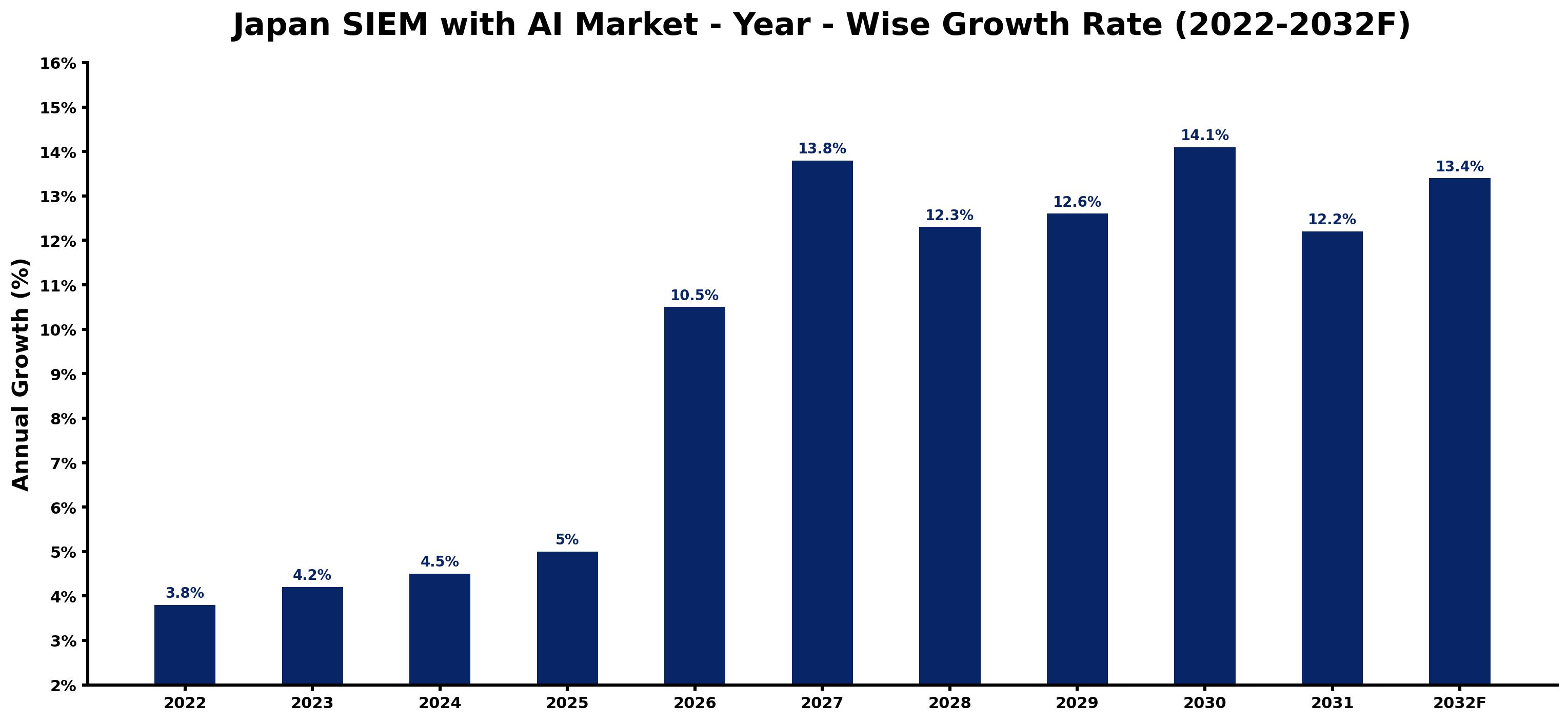
The table below sets out the estimated growth rate for each year and the main factor behind it.
| Year | Estimated Annual Growth (%) | Market Rationale |
| 2022 | 3.8 | The market showed steady growth with increasing cybersecurity awareness among enterprises. |
| 2023 | 4.2 | Demand rose as more organizations adopted cloud-based solutions for flexibility. |
| 2024 | 4.5 | Growth continued due to heightened cyber threats and compliance requirements. |
| 2025 | 5.0 | Investment in cybersecurity measures peaked as enterprises sought effective solutions. |
| 2026 | 10.5 | The market is expected to expand rapidly with the introduction of new technologies. |
| 2027 | 13.8 | Demand is projected to accelerate as organizations upgrade their security infrastructures. |
| 2028 | 12.3 | Growth is anticipated to slow slightly as the market stabilises after rapid expansion. |
| 2029 | 12.6 | Demand is expected to pick up again as new regulations drive further investment. |
| 2030 | 14.1 | The peak growth year reflects advancements in AI capabilities. |
| 2031 | 12.2 | Growth is projected to normalise as the market adjusts to peak demand levels. |
| 2032 | 13.4 | Demand is expected to remain strong as enterprises continue to innovate in cybersecurity. |
Note: Market size estimations and growth projections presented in this report are based on 6Wresearch's proprietary forecasting methodology, utilizing the latest available industry data, government publications, and primary research inputs.
Japan SIEM with AI Market Synopsis
SIEM with AI integrates advanced algorithms for real-time security event management, improving threat detection and response. The Japan SIEM with AI Market is expanding due to rising investments from enterprises, government agencies, and financial institutions. Over 70% of enterprises are adopting cloud-based SIEM solutions, driven by the need for effective cybersecurity measures and compliance with regulations mandated by the Financial Services Agency.
Market Dynamics Impact Analysis (2026–2032)
| Factor | Type | Impact | Primary Segment Affected |
| Growing cybersecurity investments in the Tokyo metropolitan area. | Driver | High | Cloud-Based SIEM |
| Increased adoption of AI capabilities for threat detection. | Driver | High | Threat Detection AI |
| Rising demand for compliance with cybersecurity regulations. | Opportunity | High | Banks & Insurance Firms |
| Investment in cybersecurity training programs across universities. | Opportunity | Medium | Enterprises |
| Limited budgets among SMEs for cybersecurity solutions. | Restraint | High | SMEs |
| Complex integration of new technologies into existing infrastructures. | Restraint | Medium | On-Premise SIEM |
| Shortage of qualified cybersecurity professionals in the market. | Challenge | High | Enterprises |
| Rapid technological advancements outpacing current security measures. | Challenge | Medium | MSSP-Managed SIEM |
Evaluation of Drivers in Japan SIEM with AI Market (2026–2032)
The following drivers explain most of the expected growth.
| Drivers | Primary Segment Affected | Why It Matters (Evidence) |
| Increased cybersecurity investments in the Tokyo metropolitan area. | Cloud-Based SIEM | The Tokyo region accounts for 40% of Japan's cybersecurity investments, driving demand for scalable solutions. |
| Adoption of cloud-based SIEM solutions by over 70% of enterprises. | Cloud-Based SIEM | This trend reflects the need for flexibility and cost-effectiveness in security management. |
| Financial Services Agency mandates cybersecurity measures. | Banks & Insurance Firms | Compliance requirements push financial institutions to invest in advanced SIEM solutions. |
| Cyber incidents reported increased by 30% in 2022. | Enterprises | The rise in cyber threats compels organizations to improve their security measures. |
| Government initiatives promote cybersecurity training. | SMEs | With a budget of 50 billion JPY for enhancements, SMEs are encouraged to improve their cybersecurity capabilities. |
Several shifts outside the market lift sales. The Tokyo metropolitan area accounts for 40% of Japan's cybersecurity investments, driving demand for scalable solutions. More than 70% of enterprises are adopting cloud-based options, reflecting the need for flexibility and cost-effectiveness in security management. The number of reported cyber incidents increased by 30% in 2022, compelling organizations to improve their security measures.
Evaluation of Restraints in Japan SIEM with AI Market
The table below lists the restraints and the evidence behind each.
| Market Restraint | Primary Segment Affected | Why It Matters (Evidence) |
| Limited budgets among SMEs for cybersecurity solutions. | SMEs | The average cybersecurity budget for SMEs is around 5 million JPY annually, restricting their investment capacity. |
| Complex integration of new technologies into existing infrastructures. | On-Premise SIEM | Organizations face challenges in adapting new solutions to legacy systems, hindering adoption. |
| Shortage of qualified cybersecurity professionals in the market. | Enterprises | The number of cybersecurity professionals is expected to reach 300,000 by 2025, but demand still exceeds supply. |
| Rapid technological advancements outpacing current security measures. | MSSP-Managed SIEM | Firms struggle to keep pace with evolving threats, leading to potential vulnerabilities. |
| Regulatory compliance requirements increasing operational burdens. | Banks & Insurance Firms | Financial institutions must invest heavily to meet stringent cybersecurity regulations. |
Japan SIEM with AI Market Challenges
A supply chain disruption in the availability of advanced security technologies hampers producers' ability to deliver timely SIEM with AI solutions. This issue stems from reliance on specific technology providers, leading to delays that can extend product launch timelines for suppliers by up to six months. High implementation costs for these solutions burden buyers, particularly small and medium enterprises that typically allocate around 5 million JPY annually for cybersecurity. The 30% increase in reported cyber incidents in 2022 forces buyers to urgently invest in solutions, straining their budgets and resources further.
Trends in the Japan SIEM with AI Market
The trends below show where the Japan SIEM with AI Market is heading.
- Shift from On-Premise to Cloud-Based Solutions: Over 70% of enterprises in Japan are adopting cloud-based SIEM solutions, reflecting a shift towards flexibility and scalability. This trend is evidenced by the need for effective security measures in a rapidly evolving threat environment.
- Emergence of AI-Driven Threat Detection: Threat Detection AI is becoming essential for security measures, with a 53% market share in Japan. This shift highlights the increasing reliance on AI capabilities to identify and mitigate potential threats effectively.
- Increased Investment in Cybersecurity Training: The Japanese government launched a Cybersecurity Talent Development Program in 2023, aiming to develop the workforce. With over 100 universities implementing training programs, this initiative addresses the growing demand for skilled professionals.
- Rising Compliance Demands from Regulatory Bodies: The Financial Services Agency's mandates are driving financial institutions to strengthen their cybersecurity frameworks. This regulatory push is prompting substantial investments in advanced SIEM solutions.
Investment Opportunities in the Japan SIEM with AI Market
Several openings in the Japan SIEM with AI Market merit attention from investors.
- Enterprises seeking effective security solutions: With 60% of the total SIEM market, enterprises represent a substantial opportunity for suppliers. Investment in advanced threat detection technologies is essential to meet their growing demands.
- Banks & Insurance Firms focusing on compliance: Regulatory pressures create a need for advanced SIEM solutions. Suppliers can enter this market through partnerships with financial institutions to provide tailored solutions.
- SMEs looking to improve cybersecurity: The average budget for cybersecurity in SMEs is around 5 million JPY, indicating a gap in effective solutions. Suppliers can target this segment by offering cost-effective and scalable options.
- Government agencies investing in cybersecurity initiatives: The Japanese government allocated 50 billion JPY for cybersecurity enhancements. Suppliers can engage with government agencies to provide innovative solutions that align with national security goals.
Government Initiatives in the Japan SIEM with AI Market
The AI Promotion Act, enacted in 2025, establishes a national framework for the research, development, and deployment of AI technologies, enhancing the existing Cybersecurity Basic Act from 2014. This newer legislation encourages investments in AI-driven security solutions, ensuring that producers comply with updated standards while improving their capabilities in threat detection and response. As a result, buyers can expect more effective SIEM with AI products that align with the latest technological advancements and regulatory requirements.
The Digital Agency, established in September 2021, plays a critical role in approving cybersecurity initiatives and funding projects that enhance national resilience. In 2023, the government allocated 50 billion JPY for cybersecurity enhancements, supporting the development of advanced SIEM with AI solutions. This funding aims to strengthen the capabilities of enterprises and government agencies, ensuring they can effectively respond to the growing threat landscape while adhering to compliance standards.
Future Insight of the Japan SIEM with AI Market
The establishment of the Cybersecurity Talent Development Program will cultivate a skilled workforce, enabling suppliers to meet the rising need for SIEM with AI solutions. By 2025, the number of cybersecurity professionals is expected to reach 300,000, strengthening the industry's response capabilities. The Tokyo metropolitan area's 40% share of cybersecurity investments will accelerate the adoption of advanced technologies. Compliance with the National Institute of Standards and Technology framework will gain traction, offering buyers more robust security protocols.
Market Segmentation Analysis
Japan SIEM with AI Market report covers a detailed analysis of the following market segments:
By SIEM Type – Cloud-Based SIEM Leads, On-Premise SIEM Expected to Grow Fastest
According to Saurav Kr Singh, Senior Research Analyst at 6Wresearch, with 47% of siem type revenue in 2025, Cloud-Based SIEM was the largest category. Cloud-Based SIEM holds the largest share due to its widespread adoption among enterprises that require scalable and flexible cybersecurity solutions. This is particularly evident in the Tokyo metropolitan area, which represents 40% of Japan's cybersecurity investments. On-Premise SIEM is projected to grow fastest, at a CAGR of 18.6% during 2026–2032. On-Premise SIEM is experiencing rapid growth as organisations with strict data control requirements increasingly prioritise their security measures. The Financial Services Agency of Japan's mandates for cybersecurity in financial institutions further fuel this demand. Suppliers should enhance their on-premise solutions to cater to the growing demand from organisations focused on data control.
By AI Capability – Threat Detection AI Leads, Log Correlation Expected to Grow Fastest
Threat Detection AI accounted for 53% of the market by ai capability in 2025. Threat Detection AI dominates the market because it is essential for proactively identifying security threats, enabling organisations to respond swiftly to potential breaches. The 30% rise in reported cyber incidents in Japan in 2022 underscores the critical need for this capability. Log Correlation is set to record the highest CAGR in this split, 17.5% over 2026–2032. Log Correlation is the fastest-growing segment, driven by organisations' need to gain better insights into security events and patterns. The establishment of cybersecurity training programs in over 100 universities across Japan supports this trend by developing skilled professionals. Buyers must invest in advanced log correlation technologies to improve their incident response capabilities.
By Deployment Mode – SaaS Lead, Hardware/Software Expected to Grow Fastest
The largest deployment mode category in 2025 was SaaS, at 37% of revenue. SaaS is the dominant deployment mode, preferred for its ease of use and lower initial costs, making it accessible for various organisations. This trend is underscored by the fact that over 70% of enterprises in Japan are adopting cloud-based SIEM solutions. The quickest growth will come from Hardware/Software, forecast to expand at a CAGR of 18.7% between 2026 and 2032. Hardware/Software is the fastest-growing deployment mode, attracting traditional setups that require tailored solutions. The ongoing support from the Japan Security Operations Center for incident response reinforces this preference among certain organisations. Suppliers should consider offering flexible hardware/software solutions to cater to the needs of traditional users.
By End User – Enterprises Lead, Banks & Insurance Firms Expected to Grow Fastest
Enterprises took 36% of end user revenue in 2025, more than any other category. Enterprises account for the largest user group, necessitating robust security solutions to safeguard sensitive data and adhere to regulations. This demand is reinforced by the Cybersecurity Strategy of Japan, which aims to enhance national resilience by 2025. Over 2026–2032, Banks & Insurance Firms are expected to post the fastest growth, at a CAGR of 16.8%. Banks & Insurance Firms represent the fastest-growing end user segment, propelled by stringent regulatory compliance needs that demand advanced cybersecurity measures. The average cybersecurity budget for Japanese enterprises indicates a rising awareness of security importance across sectors. Suppliers should tailor their offerings to address the specific compliance and security needs of banks and insurance firms.
Key Attractiveness of the Report
- 10 Years of Market Numbers
- Historical Data Starting from 2022 to 2025
- Base Year 2025
- Forecast Data until 2032
- Key Performance Indicators Impacting the Market
- Major Upcoming Developments and Projects
Key Highlights of the Report:
- Japan SIEM with AI Market Outlook
- Market Size of Japan SIEM with AI Market, 2025
- Forecast of Japan SIEM with AI Market, 2032
- Historical Data and Forecast of Japan SIEM with AI Revenues & Volume for the Period 2022-2032F
- Japan SIEM with AI Market Trend Evolution
- Japan SIEM with AI Market Drivers and Challenges
- Japan SIEM with AI Price Trends
- Japan SIEM with AI Porter's Five Forces
- Japan SIEM with AI Industry Life Cycle
- Historical Data and Forecast of Japan SIEM with AI Market Revenues & Volume By SIEM Type for the Period 2022-2032F
- Historical Data and Forecast of Japan SIEM with AI Market Revenues & Volume By Cloud-Based SIEM for the Period 2022-2032F
- Historical Data and Forecast of Japan SIEM with AI Market Revenues & Volume By On-Premise SIEM for the Period 2022-2032F
- Historical Data and Forecast of Japan SIEM with AI Market Revenues & Volume By Hybrid SIEM for the Period 2022-2032F
- Historical Data and Forecast of Japan SIEM with AI Market Revenues & Volume By MSSP-Managed SIEM for the Period 2022-2032F
- Historical Data and Forecast of Japan SIEM with AI Market Revenues & Volume By AI Capability for the Period 2022-2032F
- Historical Data and Forecast of Japan SIEM with AI Market Revenues & Volume By Threat Detection AI for the Period 2022-2032F
- Historical Data and Forecast of Japan SIEM with AI Market Revenues & Volume By Log Correlation for the Period 2022-2032F
- Historical Data and Forecast of Japan SIEM with AI Market Revenues & Volume By Predictive Alerts for the Period 2022-2032F
- Historical Data and Forecast of Japan SIEM with AI Market Revenues & Volume By Real-Time Anomaly AI for the Period 2022-2032F
- Historical Data and Forecast of Japan SIEM with AI Market Revenues & Volume By Deployment Mode for the Period 2022-2032F
- Historical Data and Forecast of Japan SIEM with AI Market Revenues & Volume By SaaS for the Period 2022-2032F
- Historical Data and Forecast of Japan SIEM with AI Market Revenues & Volume By Hardware/Software for the Period 2022-2032F
- Historical Data and Forecast of Japan SIEM with AI Market Revenues & Volume By Mixed Infrastructure for the Period 2022-2032F
- Historical Data and Forecast of Japan SIEM with AI Market Revenues & Volume By Outsourced for the Period 2022-2032F
- Historical Data and Forecast of Japan SIEM with AI Market Revenues & Volume By End User for the Period 2022-2032F
- Historical Data and Forecast of Japan SIEM with AI Market Revenues & Volume By Enterprises for the Period 2022-2032F
- Historical Data and Forecast of Japan SIEM with AI Market Revenues & Volume By Banks & Insurance Firms for the Period 2022-2032F
- Historical Data and Forecast of Japan SIEM with AI Market Revenues & Volume By Government Agencies for the Period 2022-2032F
- Historical Data and Forecast of Japan SIEM with AI Market Revenues & Volume By SMEs for the Period 2022-2032F
- Japan SIEM with AI Import Export Trade Statistics
- Market Opportunity Assessment By SIEM Type
- Market Opportunity Assessment By AI Capability
- Market Opportunity Assessment By Deployment Mode
- Market Opportunity Assessment By End User
- Japan SIEM with AI Top Companies Market Share
- Japan SIEM with AI Competitive Benchmarking By Technical and Operational Parameters
- Japan SIEM with AI Company Profiles
- Japan SIEM with AI Key Strategic Recommendations
Market Covered
The report covers the following segments.
By SIEM Type
- Cloud-Based SIEM
- On-Premise SIEM
- Hybrid SIEM
- MSSP-Managed SIEM
By AI Capability
- Threat Detection AI
- Log Correlation
- Predictive Alerts
- Real-Time Anomaly AI
By Deployment Mode
- SaaS
- Hardware/Software
- Mixed Infrastructure
- Outsourced
By End User
- Enterprises
- Banks & Insurance Firms
- Government Agencies
- SMEs































