Japan Signal Conversion IC Market Size & Growth Rate
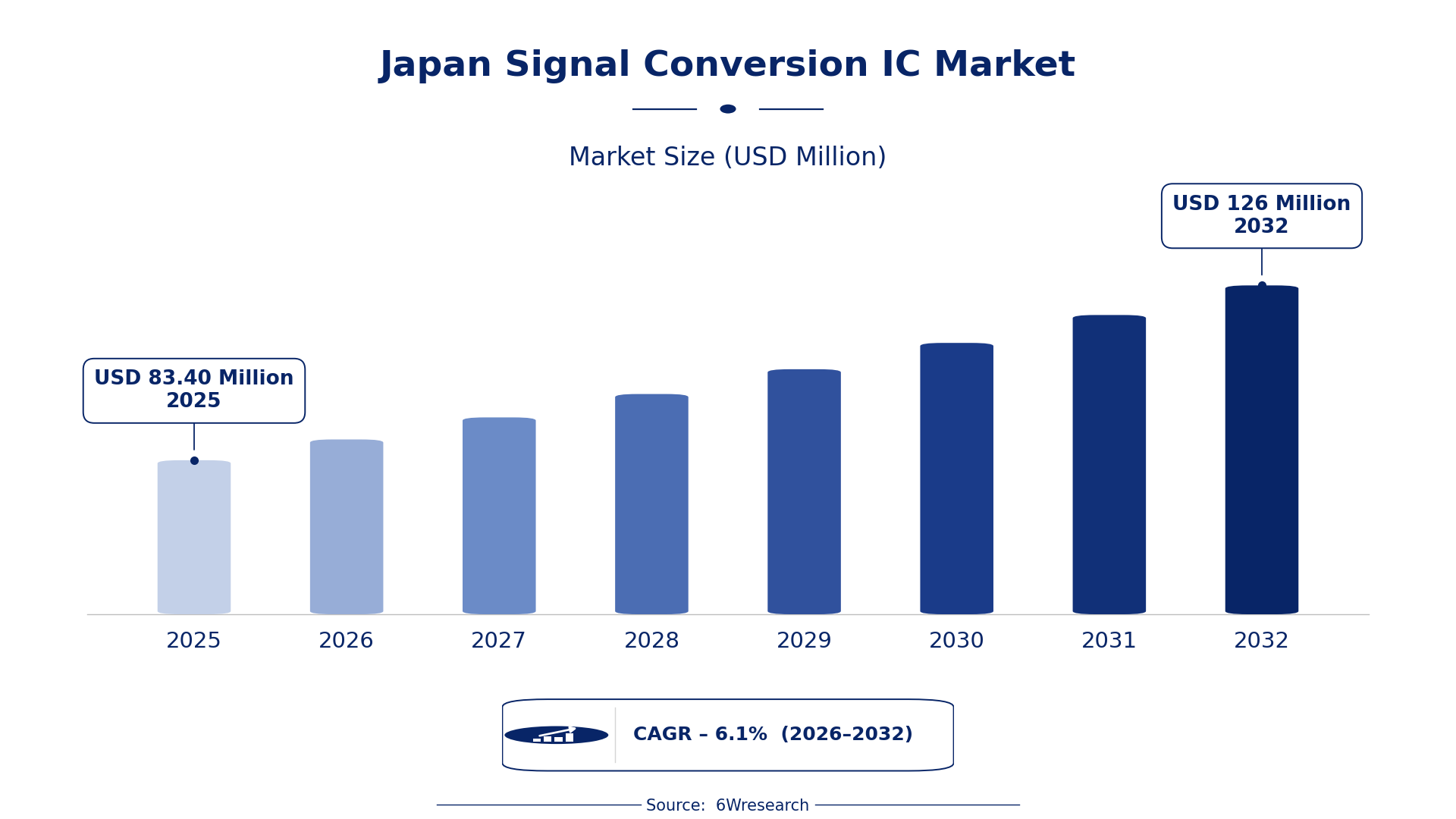
According to 6Wresearch internal database and industry insights, the Japan Signal Conversion IC Market was valued at USD 83.40 Million in 2025 and is projected to reach USD 126 Million by 2032, growing at a CAGR of approximately 6.1% during 2026–2032.
Japan Signal Conversion IC Market Highlights
| Report Metric | Details |
| Report Name | Japan Signal Conversion IC Market (2026-2032) |
| Market Size 2025 | USD 83.40 Million |
| Market Size 2032 | USD 126 Million |
| Absolute Growth 2025–2032 | USD 42.60 Million |
| CAGR 2026–2032 | 6.1% |
| Peak Annual Growth | 7.2% in 2032 |
| Forecast Period | 2026–2032 |
| Historical Data | 2022–2025 |
| Base Year | 2025 |
| Leading Conversion Type, 2025 | ADC (Analog to Digital) (39% share) |
| Leading Signal Type, 2025 | Sensor Input (48% share) |
| Leading IC Function, 2025 | Data Digitization (49% share) |
| Leading End User, 2025 | IoT Device Makers (34% share) |
| Fastest-Growing Conversion Type | DAC (Digital to Analog) (8.6% CAGR) |
| Fastest-Growing Signal Type | Audio/Visual Signals (9.2% CAGR) |
| Fastest-Growing IC Function | Output Control (8.4% CAGR) |
| Fastest-Growing End User | Multimedia OEMs (8.2% CAGR) |
| Growing Sector | Multimedia OEMs |
| Key End Users | IoT Device Makers, Multimedia OEMs, Wearable Devices, Telecom OEMs |
Japan Signal Conversion IC Market Year-wise Growth Rate and Key Drivers (2022–2032)
This graph illustrates the annual growth rates of the market from 2022 to 2032, highlighting a steady upward trajectory and projected market expansion over the forecast period.
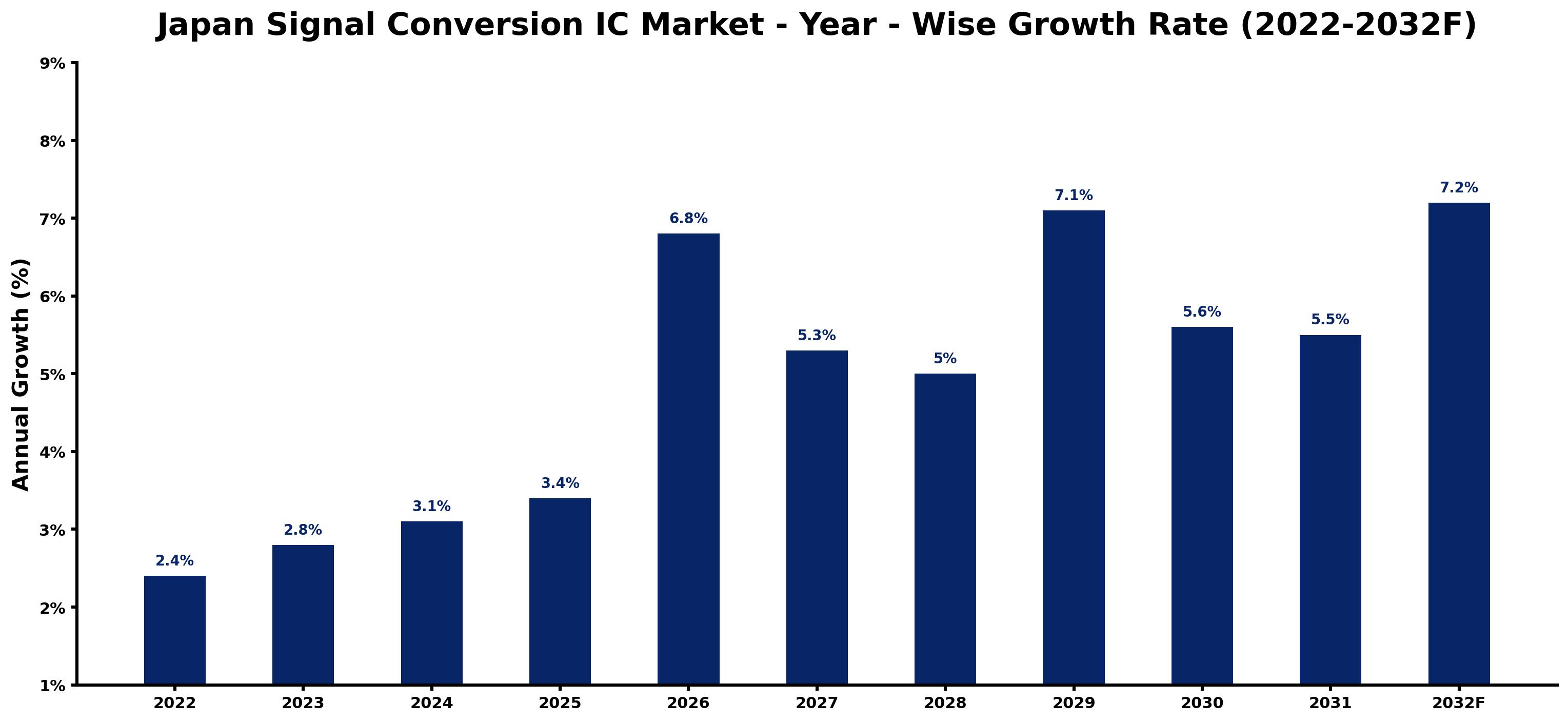
For each year, the table pairs the estimated growth rate with the leading influence on demand, showing how the drivers changed across the period.
| Year | Estimated Annual Growth (%) | Market Rationale |
| 2022 | 2.4 | The market experienced stable growth driven by steady demand in consumer electronics. |
| 2023 | 2.8 | Growth accelerated due to increased adoption of IoT devices and multimedia applications. |
| 2024 | 3.1 | Demand continued to rise as more devices integrated signal conversion technology. |
| 2025 | 3.4 | The market peaked as the installed base of multimedia devices expanded. |
| 2026 | 6.8 | Growth surged as 5G technology adoption increased demand for signal conversion ICs. |
| 2027 | 5.3 | The growth rate slowed as the market began to mature and competition intensified. |
| 2028 | 5.0 | Continued growth was observed, although at a reduced rate compared to previous years. |
| 2029 | 7.1 | Demand rebounded with a renewed focus on advanced audio and visual technologies. |
| 2030 | 5.6 | The growth rate slowed again as market saturation began to impact new sales. |
| 2031 | 5.5 | A slight slowdown was noted as the market stabilised amid growing competition. |
| 2032 | 7.2 | The market is projected to peak as new technologies drive fresh demand. |
Note: Market size estimations and growth projections presented in this report are based on 6Wresearch's proprietary forecasting methodology, utilizing the latest available industry data, government publications, and primary research inputs.
Japan Signal Conversion IC Market Synopsis
Signal Conversion ICs are semiconductor devices that convert signals between analog and digital formats, essential for applications in IoT devices, audio processing, and telecommunications. The Japan Signal Conversion IC Market is expanding due to the increasing number of IoT devices, projected to reach 1 billion by 2025, alongside substantial investments in semiconductor innovation, including a 200 billion yen allocation for R&D in 2023. These factors are driving demand from various sectors, particularly consumer electronics and automotive industries.
Market Dynamics Impact Analysis (2026–2032)
| Factor | Type | Impact | Primary Segment Affected |
| Growing IoT device penetration drives demand for signal conversion ICs. | Driver | High | IoT Device Makers |
| Increasing multimedia applications require advanced signal processing capabilities. | Driver | High | Multimedia OEMs |
| The rise of smart home technology presents new opportunities for signal conversion ICs. | Opportunity | High | IoT Device Makers |
| Expansion in the automotive sector creates demand for advanced signal conversion solutions. | Opportunity | Medium | Telecom OEMs |
| High competition among manufacturers may limit profit margins. | Restraint | High | ADC (Analog to Digital) |
| Supply chain disruptions can affect the availability of raw materials for production. | Restraint | Medium | ADC (Analog to Digital) |
| Rising production costs impact pricing strategies for manufacturers. | Challenge | High | ADC (Analog to Digital) |
| Compliance with stringent safety and quality standards increases operational costs. | Challenge | Medium | ADC (Analog to Digital) |
Evaluation of Drivers in Japan Signal Conversion IC Market (2026–2032)
The table below links each growth driver to the segment it affects and the evidence for it.
| Drivers | Primary Segment Affected | Why It Matters (Evidence) |
| Increased IoT device production drives demand for signal conversion ICs. | IoT Device Makers | Over 50% of signal conversion ICs are used in IoT applications, leading to higher purchases. |
| Growing multimedia device installations require advanced signal processing. | Multimedia OEMs | The installed base of multimedia devices in Japan exceeds 100 million units, boosting demand. |
| Adoption of 5G technology increases the need for RF to baseband converters. | Telecom OEMs | The demand for RF to baseband converters is rising due to 5G technology adoption. |
| Consumer electronics market growth supports signal conversion IC demand. | Wearable Devices | The wearable device market is expected to reach 30 million units by 2025, increasing purchases. |
| Technological advancements in audio processing enhance signal conversion needs. | Audio/Visual Signals | The average household in Japan owns 5-7 smart devices, driving demand for signal conversion. |
Much of the new demand traces back to the increasing production of IoT devices, with projections indicating that the number of such devices in Japan will reach 1 billion by 2025. This surge propels purchases of signal conversion ICs, as over 50% of these components are utilized in IoT applications. The installed base of multimedia devices exceeds 100 million units, further driving demand for advanced signal processing capabilities. The adoption of 5G technology is increasing the need for RF to baseband converters, as telecom manufacturers seek to improve communication infrastructure. The growing wearable device market will boost the demand for signal conversion ICs in health monitoring applications.
Evaluation of Restraints in Japan Signal Conversion IC Market
The main factors holding the market back are set out below.
| Market Restraint | Primary Segment Affected | Why It Matters (Evidence) |
| Supply chain disruptions due to reliance on specific regions for raw materials. | ADC (Analog to Digital) | This can delay production timelines by up to six months for manufacturers. |
| Inflated costs as semiconductor prices surged by 15% in 2023. | DAC (Digital to Analog) | This impacts budgets for consumer electronics and IoT devices. |
| Skills shortages in semiconductor engineering are prevalent. | Mixed Signal ICs | A reported gap of 20,000 qualified professionals hinders innovation. |
| Slow technology adoption for advanced manufacturing processes. | Sensor Input | This can result in a 25% decrease in efficiency for plants unable to modernise. |
| Market saturation affecting new sales of signal conversion ICs. | Audio/Visual Signals | This leads to a slowdown in growth as competition increases. |
Japan Signal Conversion IC Market Challenges
Supply chain disruptions arise from reliance on specific regions for raw materials, causing production delays of up to six months for manufacturers. Buyers are facing rising costs as semiconductor prices increased by 15% in 2023, straining budgets for consumer electronics. A shortage of skilled professionals is apparent, with a gap of 20,000 engineers limiting innovation and development for producers. Slow technology adoption in advanced manufacturing processes can result in a 25% decrease in efficiency for plants that do not modernise swiftly.
Trends in the Japan Signal Conversion IC Market
Buyers and suppliers in the Japan Signal Conversion IC Market are adjusting to the following trends.
- Shift from Analog to Digital Signal Processing: In 2023, IoT Device Makers are increasingly adopting digital signal processing technologies, with over 50% of signal conversion ICs used in IoT applications. This shift improves the efficiency of data acquisition systems.
- Transition to Advanced Audio Processing: By 2025, Multimedia OEMs are focusing on advanced audio processing technologies, driven by the installed base of multimedia devices exceeding 100 million units. This trend supports the demand for signal conversion ICs.
- Emergence of 5G Technology: In 2023, Telecom OEMs are adopting 5G technology, increasing the need for RF to baseband converters. This shift is set to drive substantial growth in signal conversion IC demand.
- Growing Importance of Wearable Devices: By 2025, the wearable device market is anticipated to expand significantly, creating new opportunities for signal conversion ICs. This trend reflects the rising demand for health monitoring technologies.
Investment Opportunities in the Japan Signal Conversion IC Market
Investors looking at the Japan Signal Conversion IC Market should consider the following areas.
- Investment in IoT Device Manufacturing: With the number of IoT devices projected to reach 1 billion by 2025, there is a strong opportunity to supply signal conversion ICs. Collaborating with IoT Device Makers can facilitate market entry.
- Expansion into Multimedia Applications: The installed base of multimedia devices exceeding 100 million units presents an opportunity to supply advanced signal processing ICs. Establishing partnerships with Multimedia OEMs can strengthen market presence.
- Focus on 5G Infrastructure Development: The growing adoption of 5G technology creates a demand for RF to baseband converters. Engaging with Telecom OEMs can provide entry points into this expanding market.
- Development of Health Monitoring Solutions: The wearable device market is expected to grow significantly, reaching 30 million units by 2025. Investing in signal conversion ICs for health monitoring applications can capture this emerging demand.
Government Initiatives in the Japan Signal Conversion IC Market
The Semiconductor and Digital Industry Strategy (METI, June 2021) introduced measures to secure domestic semiconductor manufacturing, complementing previous laws. This strategy aims to strengthen local production capabilities and reduce dependency on imports, benefiting Signal Conversion IC producers and their buyers.
In 2023, the government allocated 200 billion yen for semiconductor R&D initiatives, overseen by the Ministry of Economy, Trade and Industry. This funding supports innovation and development in semiconductor technologies, directly impacting Signal Conversion IC manufacturers.
Future Insight of the Japan Signal Conversion IC Market
By 2032, advancements in semiconductor manufacturing will transform demand patterns. The government has allocated 200 billion yen for semiconductor R&D initiatives, enabling suppliers to develop more efficient signal conversion ICs. With the wearable device market expected to grow to 30 million units by 2025, buyers will benefit from improved product offerings tailored to their needs. The widespread adoption of JIS C 6803 standards will enhance product reliability, ensuring manufacturers consistently meet market expectations.
Market Segmentation Analysis
Japan Signal Conversion IC Market report covers a detailed analysis of the following market segments:
By Conversion Type – ADC (Analog to Digital) Leads, DAC (Digital to Analog) Expected to Grow Fastest
According to Saurav Kr Singh, Senior Research Analyst at 6Wresearch, ADC (Analog to Digital) held 39% of the Japan Signal Conversion IC Market by conversion type in 2025. The ADC segment leads due to its extensive use in data acquisition systems, particularly in sectors like automotive and telecommunications. This widespread application underscores the critical role of ADCs in facilitating accurate data processing across various industries. DAC (Digital to Analog) is projected to grow fastest, at a CAGR of 8.6% during 2026–2032. The DAC segment is witnessing rapid growth as demand surges for high-quality audio and video signal conversion in multimedia applications. With over 100 million multimedia devices in Japan, the need for effective DAC solutions is expected to rise significantly. Suppliers should enhance their DAC offerings to leverage the expanding multimedia market.
By Signal Type – Sensor Input Leads, Audio/Visual Signals Expected to Grow Fastest
Sensor Input accounted for 48% of the market by signal type in 2025. Sensor Input holds the largest share as it is vital for connecting sensors in IoT devices, which are projected to reach 1 billion units by 2025. This critical role in data acquisition highlights the importance of reliable signal conversion in the IoT ecosystem. Audio/Visual Signals are set to record the highest CAGR in this split, 9.2% over 2026–2032. Audio/Visual Signals are the fastest-growing segment due to the increasing demand for high-quality multimedia applications, including televisions and sound systems. As consumer preferences shift towards enhanced audio-visual experiences, this segment is set for substantial growth. Buyers should prioritise suppliers that specialise in Audio/Visual Signal solutions to meet the increasing demand for multimedia quality.
By IC Function – Data Digitization Leads, Output Control Expected to Grow Fastest
With 49% of ic function revenue in 2025, Data Digitization was the largest category. Data Digitization is the leading function as it is essential for converting real-world signals into digital formats, crucial for applications in sectors like IoT and telecommunications. This function's importance is underscored by its role in enabling accurate data processing. Over 2026–2032, Output Control is expected to post the fastest growth, at a CAGR of 8.4%. Output Control is growing rapidly as it becomes increasingly necessary for managing device outputs, reflecting the trend towards automation in technology. This growth is likely to accelerate as more devices require sophisticated control mechanisms for optimal performance. Suppliers should develop advanced Output Control ICs to address the rising automation trends in consumer electronics.
By End User – IoT Device Makers Lead, Multimedia OEMs Expected to Grow Fastest
IoT Device Makers took 34% of end user revenue in 2025, more than any other category. IoT Device Makers dominate the market as they are the primary users of signal conversion technology, driven by the projected growth of IoT devices in Japan. Their substantial investment in signal conversion solutions emphasises the critical nature of this segment in the overall market. The quickest growth will come from Multimedia OEMs, forecast to expand at a CAGR of 8.2% between 2026 and 2032. Multimedia OEMs are experiencing the fastest growth due to the escalating demand for audio and video processing in consumer electronics. This trend is further supported by the increasing installed base of multimedia devices in households, indicating a robust market opportunity. Suppliers should align their strategies with the needs of Multimedia OEMs to capture the growing demand in this sector.
Key Attractiveness of the Report
- 10 Years of Market Numbers
- Historical Data Starting from 2022 to 2025
- Base Year 2025
- Forecast Data until 2032
- Key Performance Indicators Impacting the Market
- Major Upcoming Developments and Projects
Key Highlights of the Report:
- Japan Signal Conversion IC Market Outlook
- Market Size of Japan Signal Conversion IC Market, 2025
- Forecast of Japan Signal Conversion IC Market, 2032
- Historical Data and Forecast of Japan Signal Conversion IC Revenues & Volume for the Period 2022-2032F
- Japan Signal Conversion IC Market Trend Evolution
- Japan Signal Conversion IC Market Drivers and Challenges
- Japan Signal Conversion IC Price Trends
- Japan Signal Conversion IC Porter's Five Forces
- Japan Signal Conversion IC Industry Life Cycle
- Historical Data and Forecast of Japan Signal Conversion IC Market Revenues & Volume By Conversion Type for the Period 2022-2032F
- Historical Data and Forecast of Japan Signal Conversion IC Market Revenues & Volume By ADC (Analog to Digital) for the Period 2022-2032F
- Historical Data and Forecast of Japan Signal Conversion IC Market Revenues & Volume By DAC (Digital to Analog) for the Period 2022-2032F
- Historical Data and Forecast of Japan Signal Conversion IC Market Revenues & Volume By Mixed Signal ICs for the Period 2022-2032F
- Historical Data and Forecast of Japan Signal Conversion IC Market Revenues & Volume By Frequency Converters for the Period 2022-2032F
- Historical Data and Forecast of Japan Signal Conversion IC Market Revenues & Volume By Signal Type for the Period 2022-2032F
- Historical Data and Forecast of Japan Signal Conversion IC Market Revenues & Volume By Sensor Input for the Period 2022-2032F
- Historical Data and Forecast of Japan Signal Conversion IC Market Revenues & Volume By Audio/Visual Signals for the Period 2022-2032F
- Historical Data and Forecast of Japan Signal Conversion IC Market Revenues & Volume By Analog & Digital for the Period 2022-2032F
- Historical Data and Forecast of Japan Signal Conversion IC Market Revenues & Volume By RF to Baseband for the Period 2022-2032F
- Historical Data and Forecast of Japan Signal Conversion IC Market Revenues & Volume By IC Function for the Period 2022-2032F
- Historical Data and Forecast of Japan Signal Conversion IC Market Revenues & Volume By Data Digitization for the Period 2022-2032F
- Historical Data and Forecast of Japan Signal Conversion IC Market Revenues & Volume By Output Control for the Period 2022-2032F
- Historical Data and Forecast of Japan Signal Conversion IC Market Revenues & Volume By Dual Conversion for the Period 2022-2032F
- Historical Data and Forecast of Japan Signal Conversion IC Market Revenues & Volume By Wireless Devices for the Period 2022-2032F
- Historical Data and Forecast of Japan Signal Conversion IC Market Revenues & Volume By End User for the Period 2022-2032F
- Historical Data and Forecast of Japan Signal Conversion IC Market Revenues & Volume By IoT Device Makers for the Period 2022-2032F
- Historical Data and Forecast of Japan Signal Conversion IC Market Revenues & Volume By Multimedia OEMs for the Period 2022-2032F
- Historical Data and Forecast of Japan Signal Conversion IC Market Revenues & Volume By Wearable Devices for the Period 2022-2032F
- Historical Data and Forecast of Japan Signal Conversion IC Market Revenues & Volume By Telecom OEMs for the Period 2022-2032F
- Japan Signal Conversion IC Import Export Trade Statistics
- Market Opportunity Assessment By Conversion Type
- Market Opportunity Assessment By Signal Type
- Market Opportunity Assessment By IC Function
- Market Opportunity Assessment By End User
- Japan Signal Conversion IC Top Companies Market Share
- Japan Signal Conversion IC Competitive Benchmarking By Technical and Operational Parameters
- Japan Signal Conversion IC Company Profiles
- Japan Signal Conversion IC Key Strategic Recommendations
Market Covered
The report covers the following segments.
By Conversion Type
- ADC (Analog to Digital)
- DAC (Digital to Analog)
- Mixed Signal ICs
- Frequency Converters
By Signal Type
- Sensor Input
- Audio/Visual Signals
- Analog & Digital
- RF to Baseband
By IC Function
- Data Digitization
- Output Control
- Dual Conversion
- Wireless Devices
By End User
- IoT Device Makers
- Multimedia OEMs
- Wearable Devices
- Telecom OEMs































