Japan Signal Processing IC Market Size & Growth Rate
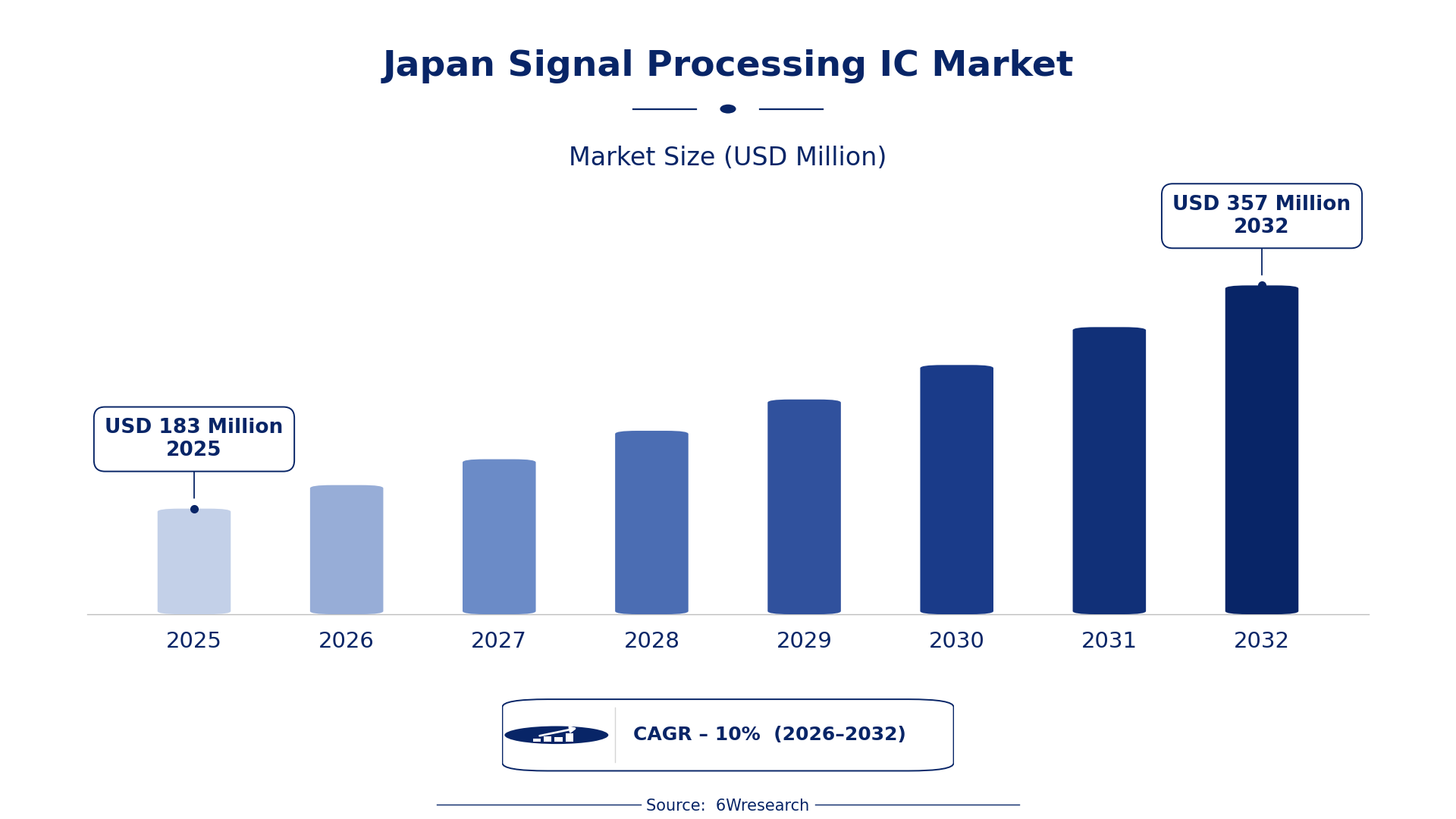
According to 6Wresearch internal database and industry insights, the Japan Signal Processing IC Market was valued at USD 183 Million in 2025 and is projected to reach USD 357 Million by 2032, growing at a CAGR of approximately 10% during 2026–2032.
Japan Signal Processing IC Market Highlights
| Report Metric | Details |
| Report Name | Japan Signal Processing IC Market (2026-2032) |
| Market Size 2025 | USD 183 Million |
| Market Size 2032 | USD 357 Million |
| Absolute Growth 2025–2032 | USD 174 Million |
| CAGR 2026–2032 | 10% |
| Peak Annual Growth | 11.2% in 2031 |
| Forecast Period | 2026–2032 |
| Historical Data | 2022–2025 |
| Base Year | 2025 |
| Leading IC Type, 2025 | DSP (Digital Signal Processor) (40% share) |
| Leading Processing Function, 2025 | Audio/Voice (43% share) |
| Leading Application Area, 2025 | Automotive Infotainment (37% share) |
| Leading End User, 2025 | Smartphone OEMs (49% share) |
| Fastest-Growing IC Type | FPGAs (14.8% CAGR) |
| Fastest-Growing Processing Function | Embedded Processing (14.3% CAGR) |
| Fastest-Growing End User | Automotive Electronics (13.2% CAGR) |
| Growing Sector | automotive electronics |
| Key End Users | automotive manufacturers, smartphone OEMs, telecommunications companies |
Japan Signal Processing IC Market Year-wise Growth Rate and Key Drivers (2022–2032)
This graph illustrates the annual growth rates of the market from 2022 to 2032, highlighting a steady upward trajectory and projected market expansion over the forecast period.
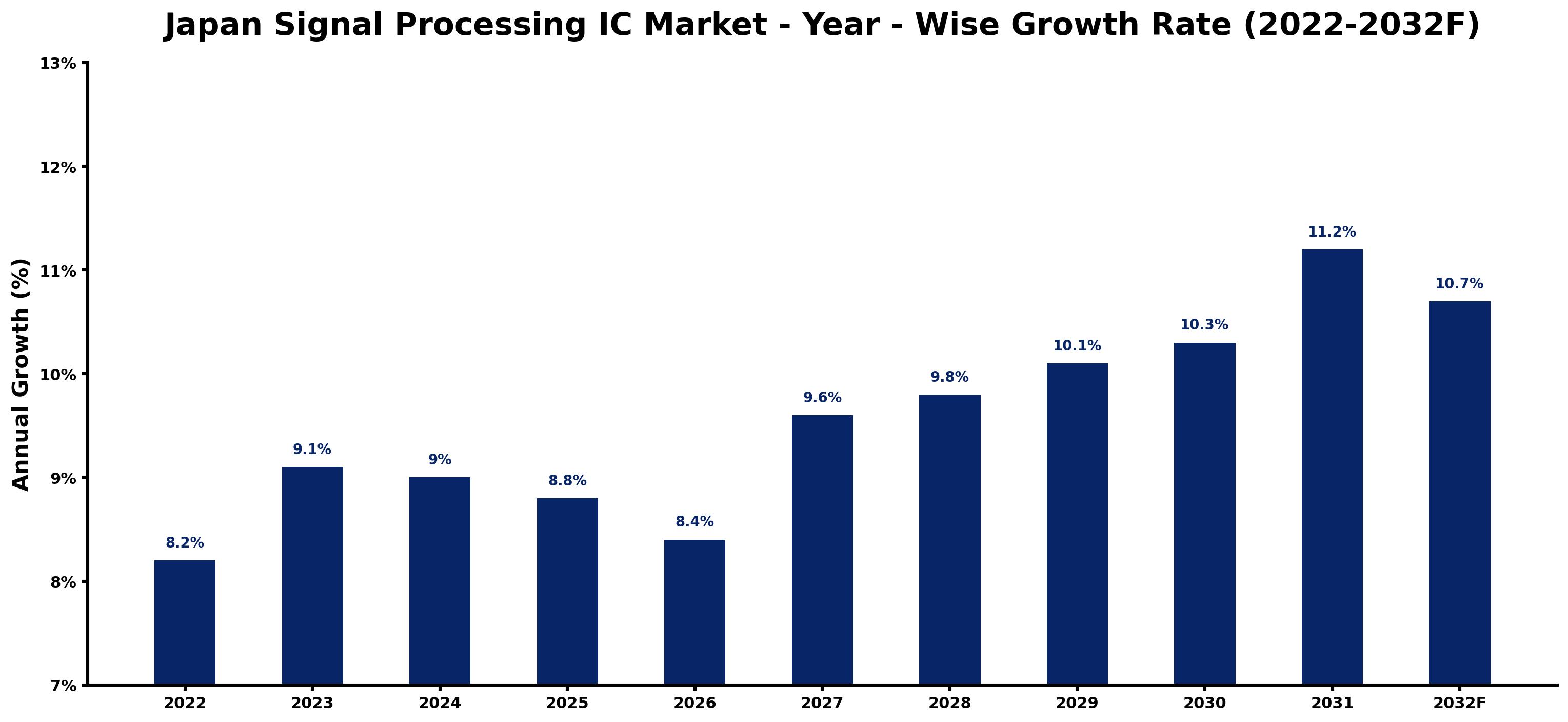
Below, each year's estimated growth is shown next to the factor that most influenced it.
| Year | Estimated Annual Growth (%) | Market Rationale |
| 2022 | 8.2 | The market experienced steady growth due to strong domestic demand for consumer electronics. |
| 2023 | 9.1 | Growth accelerated as the automotive sector increased its adoption of signal processing technologies. |
| 2024 | 9.0 | The growth rate slowed slightly as market saturation began in certain consumer segments. |
| 2025 | 8.8 | A continued slowdown occurred as competition intensified among semiconductor manufacturers. |
| 2026 | 8.4 | Growth is expected to decelerate further as companies adjust to market conditions and demand patterns. |
| 2027 | 9.6 | The market is projected to rebound with renewed interest in advanced automotive applications and consumer electronics. |
| 2028 | 9.8 | Growth is expected to remain strong as new technologies in automotive infotainment gain traction. |
| 2029 | 10.1 | The market is projected to expand as smartphone OEMs increase their demand for advanced signal processing ICs. |
| 2030 | 10.3 | Growth will continue as investments in automotive electronics surge in anticipation of new models. |
| 2031 | 11.2 | The peak growth rate is expected to be achieved as the automotive sector heavily invests in electronics. |
| 2032 | 10.7 | A slight slowdown in growth is anticipated as market maturity sets in for certain applications. |
Note: Market size estimations and growth projections presented in this report are based on 6Wresearch's proprietary forecasting methodology, utilizing the latest available industry data, government publications, and primary research inputs.
Japan Signal Processing IC Market Synopsis
Signal Processing ICs are semiconductor devices that convert analog signals into digital formats for processing. They play a crucial role in various applications, including audio processing, telecommunications, and automotive systems. The Japan Signal Processing IC Market is growing due to rising investments in automotive infotainment systems, projected to reach 1 trillion JPY by 2025. The increasing adoption of DSPs in automotive applications, currently around 30%, further drives market expansion as manufacturers aim to improve audio and communication capabilities.
Market Dynamics Impact Analysis (2026–2032)
| Factor | Type | Impact | Primary Segment Affected |
| Increased demand for automotive infotainment systems | Driver | High | Automotive Infotainment |
| Growing consumer electronics market | Driver | High | Smartphone OEMs |
| Expansion of automotive electronics applications | Opportunity | High | Automotive Electronics |
| Investment in semiconductor innovation programs | Opportunity | High | DSP (Digital Signal Processor) |
| High competition among semiconductor manufacturers | Restraint | High | DSP (Digital Signal Processor) |
| Market saturation in consumer electronics | Restraint | High | Smartphone OEMs |
| Critical shortage of skilled workers | Challenge | High | Automotive Electronics |
| Supply chain disruptions | Challenge | High | Automotive Infotainment |
Evaluation of Drivers in Japan Signal Processing IC Market (2026–2032)
The following drivers explain most of the expected growth.
| Drivers | Primary Segment Affected | Why It Matters (Evidence) |
| Rising adoption of DSPs in automotive applications | DSP (Digital Signal Processor) | The adoption rate of DSPs in automotive applications is around 30%, prompting automotive manufacturers to invest more in these technologies. |
| Growth in consumer electronics demand | Smartphone OEMs | Japan's population of approximately 125 million drives consumer electronics demand, leading smartphone manufacturers to improve their signal processing capabilities. |
| Investment in automotive electronics | Automotive Electronics | The automotive sector is projected to invest 1 trillion JPY in electronics by 2025, increasing demand for signal processing ICs. |
| Advancements in noise cancellation technology | Noise Cancellation | Noise cancellation technology is widely implemented in premium headphones, boosting demand for related signal processing ICs. |
| Emergence of flexible solutions | FPGAs | The growing need for adaptable signal processing solutions is driving demand for FPGAs in various applications. |
Most of the extra volume comes from the rising adoption of DSPs in automotive applications, with an adoption rate around 30%. The consumer electronics market thrives, supported by Japan's population of approximately 125 million, which fuels smartphone demand. The automotive sector plans to invest 1 trillion JPY in electronics by 2025, leading to increased purchases of signal processing ICs. Advancements in noise cancellation technology are widely implemented in premium headphones, further increasing demand for these components.
Evaluation of Restraints in Japan Signal Processing IC Market
The table below lists the restraints and the evidence behind each.
| Market Restraint | Primary Segment Affected | Why It Matters (Evidence) |
| High competition among semiconductor manufacturers | DSP (Digital Signal Processor) | Intense competition in the DSP market has led to pricing pressures, affecting profitability for manufacturers. |
| Market saturation in consumer electronics | Smartphone OEMs | As the average lifespan of a smartphone in Japan is around 2.5 years, market saturation limits new purchases. |
| Regulatory compliance costs | Automotive Electronics | Compliance with standards such as ISO/IEC 27001 increases operational costs for manufacturers. |
| Limited domestic production capacity | Automotive Infotainment | Japan's semiconductor market faces challenges in scaling production to meet rising demand. |
| Technological obsolescence | FPGAs | Rapid advancements in technology can render existing FPGA solutions obsolete, impacting sales. |
Japan Signal Processing IC Market Challenges
A key obstacle for signal processing ICs is the shortage of skilled workers, stemming from Japan's ageing population and limited influx of new talent. This gap can delay product launches for producers by up to six months, affecting their competitiveness. Supply chain issues arise from reliance on specific regions for semiconductor materials, resulting in lead times that can extend by 30% for buyers needing timely access to components. Rapid technological changes require constant innovation from manufacturers, raising R&D costs and potentially increasing prices for buyers by 15%. Unpredictable consumer demand in electronics complicates inventory management, risking a 20% revenue loss for producers due to overstocking or understocking.
Trends in the Japan Signal Processing IC Market
Below are the shifts with the largest effect on the Japan Signal Processing IC Market.
- Shift from Traditional to Advanced Automotive Infotainment: Tokyo is experiencing a shift towards advanced automotive infotainment systems, with investments expected to improve user experience. The automotive infotainment market is projected to grow significantly by 2025, indicating strong demand for signal processing ICs.
- Transition from Analog to Digital Signal Processing: The adoption of digital signal processing standards is increasing among automotive manufacturers, enhancing product performance. This transition aligns with the automotive sector's planned investment of 1 trillion JPY in electronics by 2025.
- Smartphone OEMs Prioritising Enhanced Audio Quality: Smartphone OEMs are increasingly focusing on improving audio quality through advanced signal processing technologies. Noise cancellation technology is now widely used in premium headphones, driving demand for these ICs.
- Emergence of Flexible Solutions in Signal Processing: FPGAs are emerging as flexible solutions for various signal processing tasks, appealing to diverse applications. The CAGR for FPGAs is forecasted at 14.8% from 2026 to 2032.
Investment Opportunities in the Japan Signal Processing IC Market
The following opportunities in the Japan Signal Processing IC Market pair current demand with a clear way in.
- Investment in DSPs for Automotive Applications: The automotive sector's anticipated investment of 1 trillion JPY in electronics by 2025 creates an opportunity for DSP suppliers to meet demand from automotive manufacturers.
- Supply of Advanced Noise Cancellation Solutions: With noise cancellation technology prevalent in premium headphones, suppliers can invest in advanced solutions to capture this growing market segment.
- Development of Customised FPGAs: The increasing need for flexible solutions in signal processing presents an opportunity to develop customised FPGAs for niche applications, particularly in telecommunications.
- Expansion into Emerging Automotive Markets: As automotive electronics continue to grow, suppliers should target emerging markets where demand for advanced infotainment systems is increasing.
Government Initiatives in the Japan Signal Processing IC Market
The Semiconductor and Digital Industry Strategy, established by METI in June 2021, aims to secure domestic semiconductor manufacturing capabilities. This strategy includes measures to support research and development, ensuring that producers can meet the growing demand for signal processing ICs. The Industrial Safety and Health Act (1972) mandates strict employer responsibilities regarding hazardous substances, impacting production processes in semiconductor manufacturing.
METI supports semiconductor innovation programs that facilitate funding for research and development in signal processing technologies. The Japan Electronics and Information Technology Industries Association (JEITA) promotes semiconductor development, providing guidance for manufacturers. These initiatives help buyers access advanced technologies while ensuring compliance with industry standards.
Future Insight of the Japan Signal Processing IC Market
A shift towards semiconductor innovation will reshape the market by 2032, prompting suppliers to adopt advanced fabrication techniques. The automotive sector's projected investment of 1 trillion JPY in electronics will drive demand for sophisticated signal processing applications. Standards like ISO/IEC 27001 will enhance security measures, boosting buyer confidence in product reliability. As the automotive infotainment market expands, suppliers must adjust their offerings to align with evolving consumer preferences, ensuring relevance in a competitive landscape.
Market Segmentation Analysis
Japan Signal Processing IC Market report covers a detailed analysis of the following market segments:
By IC Type – DSP (Digital Signal Processor) Leads, FPGAs Expected to Grow Fastest
According to Saurav Kr Singh, Senior Research Analyst at 6Wresearch, in 2025, DSP (Digital Signal Processor) led the ic type split with a 40% share. The DSP segment holds the largest share due to its essential role in audio and video processing within consumer electronics, which are widely used across Japan. This is particularly evident in the automotive sector, where DSPs are integral to audio systems and infotainment features. Over 2026–2032, FPGAs are expected to post the fastest growth, at a CAGR of 14.8%. FPGAs are experiencing the fastest growth as they provide flexible solutions for various signal processing tasks, catering to the increasing demand for customisation in technology. Their adaptability is particularly appealing to sectors such as telecommunications, which require rapid innovation and deployment. Suppliers should focus on enhancing FPGA offerings to capitalise on this growing demand.
By Processing Function – Audio/Voice Leads, Embedded Processing Expected to Grow Fastest
Audio/Voice held 43% of the Japan Signal Processing IC Market by processing function in 2025. The Audio/Voice segment leads the market as it is crucial for enhancing audio quality in devices, which is a key consideration for consumers in Japan. This is particularly evident in the high demand for premium headphones, where noise cancellation technology is prevalent. The quickest growth will come from Embedded Processing, forecast to expand at a CAGR of 14.3% between 2026 and 2032. Embedded Processing is the fastest-growing function due to its integral role in real-time processing for devices, which is becoming increasingly necessary as technology advances. This trend reflects the industry's shift towards more sophisticated and responsive electronics, particularly in smart devices. Buyers should prioritise solutions that enhance embedded processing capabilities to remain competitive.
By Application Area – Automotive Infotainment Leads and Records the Fastest Growth
The largest application area category in 2025 was Automotive Infotainment, at 37% of revenue. Automotive Infotainment dominates the market as it meets the growing demand for advanced user interfaces in automotive electronics, driven by consumer expectations for connectivity and entertainment. This sector is projected to see substantial growth as automotive technology evolves, particularly with the rise of electric vehicles. The same category is also set to grow fastest, at a CAGR of 12.6% during 2026–2032. The Automotive Infotainment segment is also the fastest-growing area, indicating a robust trend towards integrating sophisticated infotainment systems in vehicles. This dual role reinforces the segment's importance in the market as consumers seek enhanced in-car experiences. Suppliers must innovate in infotainment technologies to capture the expanding automotive sector.
By End User – Smartphone OEMs Lead, Automotive Electronics Expected to Grow Fastest
With 49% of end user revenue in 2025, Smartphone OEMs was the largest category. Smartphone OEMs represent the largest share of the market as they are major consumers of signal processing technology, which is essential for enhancing device performance and user experience. The high demand for smartphones in Japan drives this segment significantly, with a large installed base of devices. Automotive Electronics is projected to grow fastest, at a CAGR of 13.2% during 2026–2032. Automotive Electronics is the fastest-growing end user segment, reflecting a significant shift towards incorporating advanced signal processing applications in vehicles. This growth is fuelled by substantial investments in automotive electronics, projected to reach 1 trillion JPY by 2025, highlighting the sector's potential. Suppliers should align their strategies to address the increasing needs of automotive electronics.
Key Attractiveness of the Report
- 10 Years of Market Numbers
- Historical Data Starting from 2022 to 2025
- Base Year 2025
- Forecast Data until 2032
- Key Performance Indicators Impacting the Market
- Major Upcoming Developments and Projects
Key Highlights of the Report:
- Japan Signal Processing IC Market Outlook
- Market Size of Japan Signal Processing IC Market, 2025
- Forecast of Japan Signal Processing IC Market, 2032
- Historical Data and Forecast of Japan Signal Processing IC Revenues & Volume for the Period 2022-2032F
- Japan Signal Processing IC Market Trend Evolution
- Japan Signal Processing IC Market Drivers and Challenges
- Japan Signal Processing IC Price Trends
- Japan Signal Processing IC Porter's Five Forces
- Japan Signal Processing IC Industry Life Cycle
- Historical Data and Forecast of Japan Signal Processing IC Market Revenues & Volume By IC Type for the Period 2022-2032F
- Historical Data and Forecast of Japan Signal Processing IC Market Revenues & Volume By DSP (Digital Signal Processor) for the Period 2022-2032F
- Historical Data and Forecast of Japan Signal Processing IC Market Revenues & Volume By ASICs for the Period 2022-2032F
- Historical Data and Forecast of Japan Signal Processing IC Market Revenues & Volume By FPGAs for the Period 2022-2032F
- Historical Data and Forecast of Japan Signal Processing IC Market Revenues & Volume By MCU + DSP Hybrid for the Period 2022-2032F
- Historical Data and Forecast of Japan Signal Processing IC Market Revenues & Volume By Processing Function for the Period 2022-2032F
- Historical Data and Forecast of Japan Signal Processing IC Market Revenues & Volume By Audio/Voice for the Period 2022-2032F
- Historical Data and Forecast of Japan Signal Processing IC Market Revenues & Volume By Dedicated Functions for the Period 2022-2032F
- Historical Data and Forecast of Japan Signal Processing IC Market Revenues & Volume By Configurable Logic for the Period 2022-2032F
- Historical Data and Forecast of Japan Signal Processing IC Market Revenues & Volume By Embedded Processing for the Period 2022-2032F
- Historical Data and Forecast of Japan Signal Processing IC Market Revenues & Volume By Application Area for the Period 2022-2032F
- Historical Data and Forecast of Japan Signal Processing IC Market Revenues & Volume By Noise Cancellation for the Period 2022-2032F
- Historical Data and Forecast of Japan Signal Processing IC Market Revenues & Volume By Baseband Processing for the Period 2022-2032F
- Historical Data and Forecast of Japan Signal Processing IC Market Revenues & Volume By High-Speed Data for the Period 2022-2032F
- Historical Data and Forecast of Japan Signal Processing IC Market Revenues & Volume By Automotive Infotainment for the Period 2022-2032F
- Historical Data and Forecast of Japan Signal Processing IC Market Revenues & Volume By End User for the Period 2022-2032F
- Historical Data and Forecast of Japan Signal Processing IC Market Revenues & Volume By Smartphone OEMs for the Period 2022-2032F
- Historical Data and Forecast of Japan Signal Processing IC Market Revenues & Volume By Network Equipment Cos. for the Period 2022-2032F
- Historical Data and Forecast of Japan Signal Processing IC Market Revenues & Volume By Aerospace Firms for the Period 2022-2032F
- Historical Data and Forecast of Japan Signal Processing IC Market Revenues & Volume By Automotive Electronics for the Period 2022-2032F
- Japan Signal Processing IC Import Export Trade Statistics
- Market Opportunity Assessment By IC Type
- Market Opportunity Assessment By Processing Function
- Market Opportunity Assessment By Application Area
- Market Opportunity Assessment By End User
- Japan Signal Processing IC Top Companies Market Share
- Japan Signal Processing IC Competitive Benchmarking By Technical and Operational Parameters
- Japan Signal Processing IC Company Profiles
- Japan Signal Processing IC Key Strategic Recommendations
Market Covered
This report examines the market across the segments below.
By IC Type
- DSP (Digital Signal Processor)
- ASICs
- FPGAs
- MCU + DSP Hybrid
By Processing Function
- Audio/Voice
- Dedicated Functions
- Configurable Logic
- Embedded Processing
By Application Area
- Noise Cancellation
- Baseband Processing
- High-Speed Data
- Automotive Infotainment
By End User
- Smartphone OEMs
- Network Equipment Cos.
- Aerospace Firms
- Automotive Electronics































