Japan Silage Handling Equipment Market Size & Growth Rate
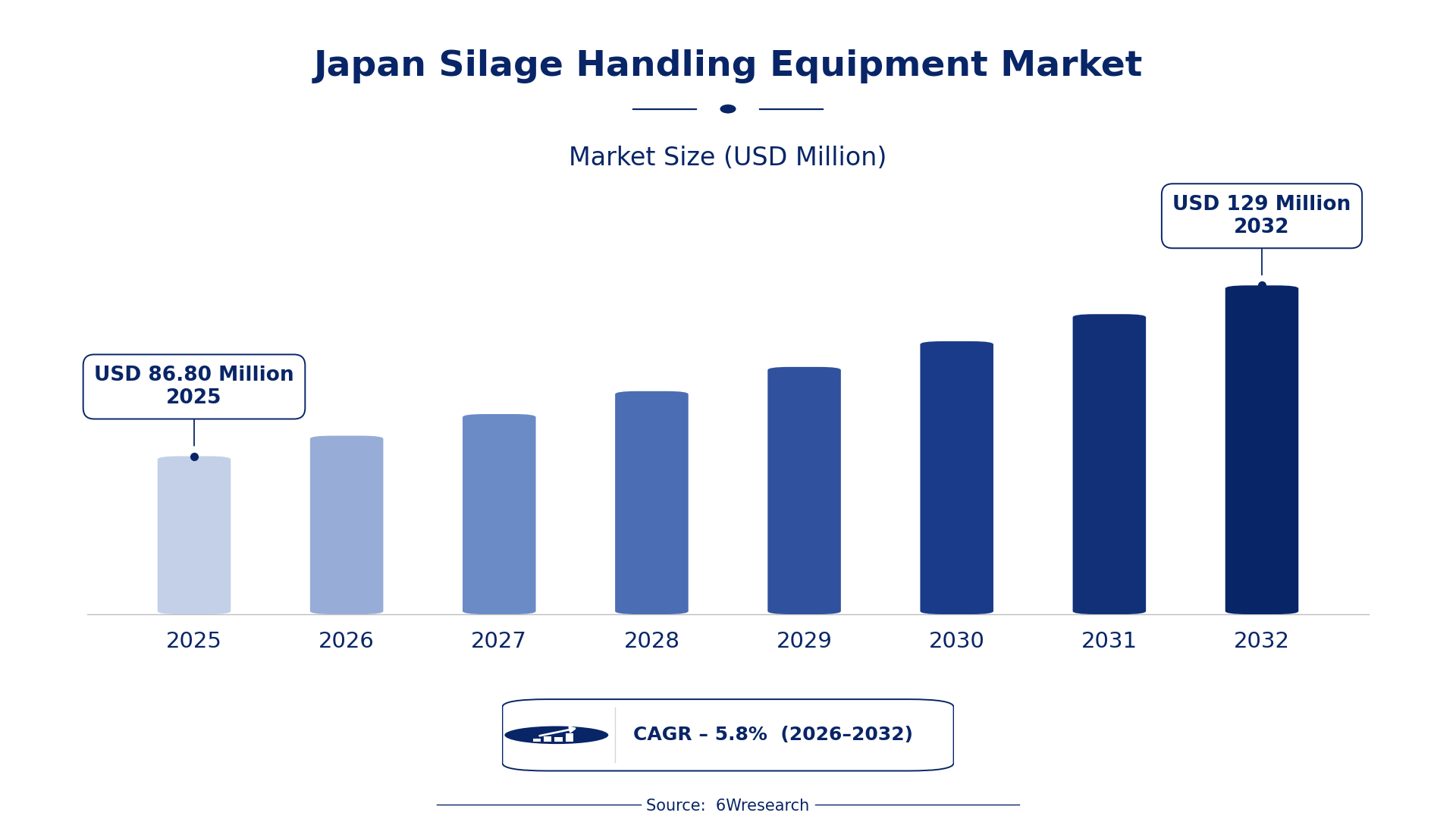
According to 6Wresearch internal database and industry insights, the Japan Silage Handling Equipment Market was valued at USD 86.80 Million in 2025 and is projected to reach USD 129 Million by 2032, growing at a CAGR of approximately 5.8% during 2026–2032.
Japan Silage Handling Equipment Market Highlights
| Report Metric | Details |
| Report Name | Japan Silage Handling Equipment Market (2026-2032) |
| Market Size 2025 | USD 86.80 Million |
| Market Size 2032 | USD 129 Million |
| Absolute Growth 2025–2032 | USD 42.20 Million |
| CAGR 2026–2032 | 5.8% |
| Peak Annual Growth | 6.9% in 2029 |
| Forecast Period | 2026–2032 |
| Historical Data | 2022–2025 |
| Base Year | 2025 |
| Leading Equipment Type, 2025 | Front Loaders (48% share) |
| Leading Operation Type, 2025 | Tractor-Attached (37% share) |
| Leading Loading Capacity, 2025 | Medium/Heavy Duty (48% share) |
| Leading End User, 2025 | Agri Co-operatives (46% share) |
| Fastest-Growing Equipment Type | Bale Grabs (8.0% CAGR) |
| Fastest-Growing Operation Type | Motorized Belt (8.1% CAGR) |
| Fastest-Growing Loading Capacity | High Volume (7.2% CAGR) |
| Fastest-Growing End User | Livestock Farm Owners (7.4% CAGR) |
| Growing Sector | livestock farming |
| Key End Users | Agri Co-operatives, Livestock Farm Owners, Smallholder Farmers, Silage Storage Units |
Japan Silage Handling Equipment Market Year-wise Growth Rate and Key Drivers (2022–2032)
This graph illustrates the annual growth rates of the market from 2022 to 2032, highlighting a steady upward trajectory and projected market expansion over the forecast period.
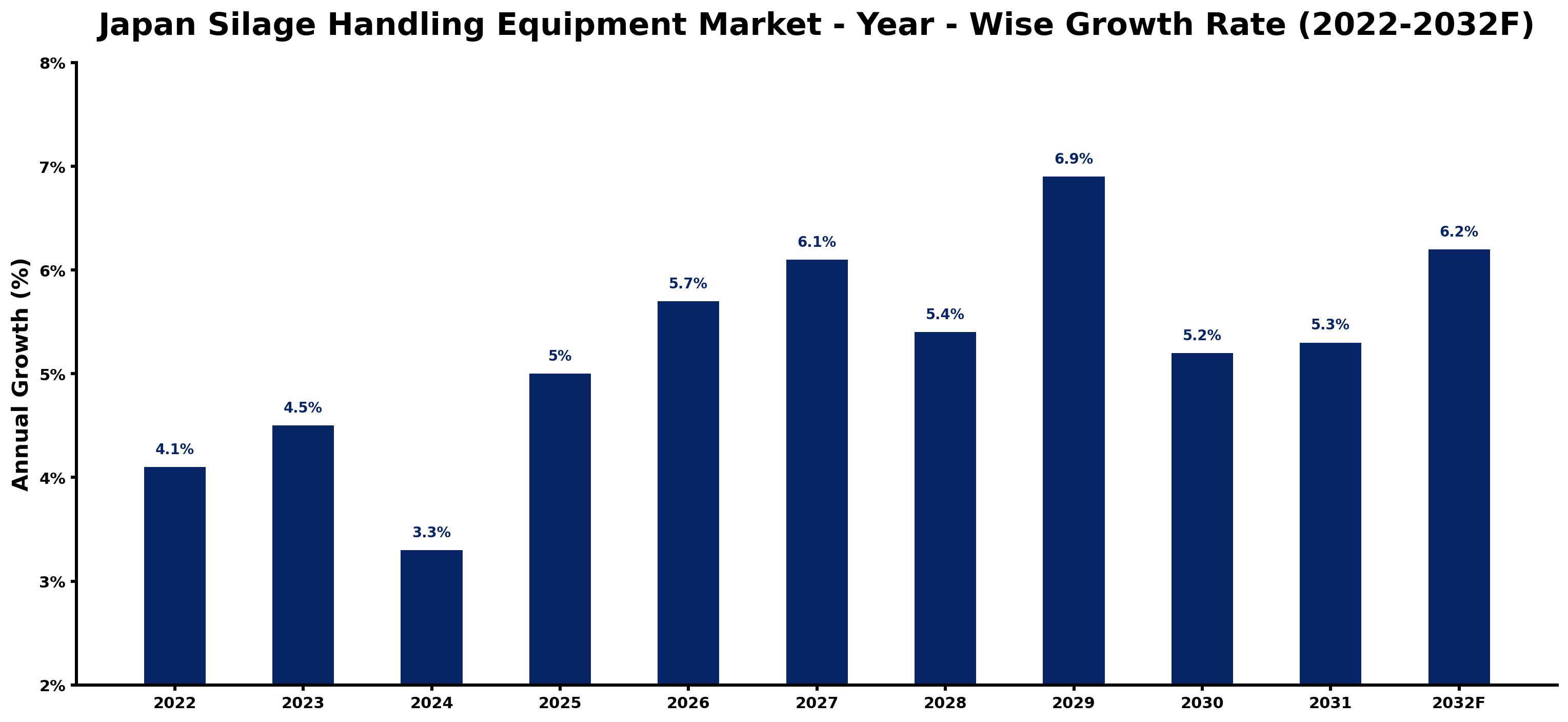
The following figures match every annual growth estimate with the main market development of that year, giving the reasoning behind each rise or slowdown.
| Year | Estimated Annual Growth (%) | Market Rationale |
| 2022 | 4.1 | The market showed steady growth due to high demand from livestock farmers. |
| 2023 | 4.5 | Increased adoption of efficient silage handling methods contributed to faster growth. |
| 2024 | 3.3 | Growth slowed as market saturation began to affect new equipment purchases. |
| 2025 | 5.0 | A surge in agricultural subsidies boosted demand for modern silage handling equipment. |
| 2026 | 5.7 | The introduction of advanced technology in equipment is expected to drive growth. |
| 2027 | 6.1 | Rising livestock numbers are anticipated to sustain demand for silage handling. |
| 2028 | 5.4 | Growth is projected to slow as equipment replacement cycles stabilise. |
| 2029 | 6.9 | Investments in agricultural efficiency will accelerate market expansion. |
| 2030 | 5.2 | Market growth is projected to slow as competition intensifies among suppliers. |
| 2031 | 5.3 | Awareness of silage quality management will support steady growth. |
| 2032 | 6.2 | The demand for effective handling solutions is expected to rise. |
Note: Market size estimations and growth projections presented in this report are based on 6Wresearch's proprietary forecasting methodology, utilizing the latest available industry data, government publications, and primary research inputs.
Japan Silage Handling Equipment Market Synopsis
Silage handling equipment plays a crucial role in the storage and management of silage, which serves as fermented fodder for livestock. Constructed from durable materials, this equipment guarantees optimal feed quality through efficient loading and transportation. The Japan Silage Handling Equipment Market is growing alongside a robust agricultural sector, particularly in livestock farming, where around 1.2 million dairy cows necessitate effective silage management. In the Tohoku region, agricultural initiatives are propelling modernization efforts, further driving demand for this equipment.
Market Dynamics Impact Analysis (2026–2032)
| Factor | Type | Impact | Primary Segment Affected |
| Increasing livestock numbers in the Tohoku region drive demand for silage handling equipment, as approximately 1.2 million dairy cows require efficient management. | Driver | High | Silage Forks |
| Technological advancements in equipment design enhance operational efficiency, attracting livestock farm owners to invest in modern solutions. | Driver | High | Bale Grabs |
| The agricultural modernization program launched in 2023 creates opportunities for suppliers to introduce advanced silage handling solutions to farmers. | Opportunity | High | Front Loaders |
| Growing awareness of silage quality management presents a chance for producers to develop innovative handling equipment tailored to livestock farm needs. | Opportunity | Medium | Hydraulic Clamp |
| High production costs, influenced by Japan's minimum wage, limit farmers' ability to upgrade silage handling equipment, affecting overall efficiency. | Restraint | High | Tractor-Attached |
| Supply chain disruptions hinder access to essential silage handling equipment, delaying feed preparation and impacting livestock health. | Restraint | Medium | Conveyor Systems |
| Intense competition among local agricultural cooperatives restricts price flexibility, leading to higher costs for farmers seeking modern solutions. | Challenge | High | Manual/Hydraulic |
| Outdated technology in silage handling creates inefficiencies, delaying feed preparation for livestock and affecting overall productivity. | Challenge | Medium | Motorized Belt |
Evaluation of Drivers in Japan Silage Handling Equipment Market (2026–2032)
The factors lifting demand, and the evidence behind each, are summarised below.
| Drivers | Primary Segment Affected | Why It Matters (Evidence) |
| Increased dairy cow population in Japan | Silage Forks | Approximately 1.2 million dairy cows require efficient silage handling, boosting demand for silage forks. |
| Agricultural subsidies for modernization | Front Loaders | In 2023, ¥2 billion was allocated for agricultural modernization, driving demand for front loaders. |
| Technological advancements in equipment | Bale Grabs | Innovations in bale grab design improve efficiency, attracting more livestock farm owners. |
| Growing awareness of silage quality management | Hydraulic Clamp | Standards under JIS Z 2341 encourage better practices, increasing demand for hydraulic clamps. |
| Expansion of agricultural cooperatives | Tractor-Attached | Agri cooperatives in Japan provide equipment, driving tractor-attached sales. |
Purchasing activity is increasing as the Tohoku region experiences a rise in livestock numbers, with about 1.2 million dairy cows needing effective management. In 2023, ¥2 billion was designated for agricultural modernization, stimulating demand for various types of equipment. Improvements in equipment design boost efficiency, making handling solutions more attractive to livestock farm owners. Growing awareness of silage quality management promotes the use of hydraulic clamps, while the expansion of agricultural cooperatives improves access to necessary handling equipment.
Evaluation of Restraints in Japan Silage Handling Equipment Market
Several factors work against faster growth; the main ones are summarised below.
| Market Restraint | Primary Segment Affected | Why It Matters (Evidence) |
| High initial investment costs for modern equipment | Manual/Hydraulic | Many smallholder farmers find it challenging to afford modern silage handling equipment, limiting their operational efficiency. |
| Limited awareness of modern silage management practices | Conveyor Systems | Some farmers remain unaware of the benefits of upgrading to newer conveyor systems, hindering market growth. |
| Delays in supply chains affecting equipment availability | Bale Grabs | Extended wait times for essential bale grabs can impact farm operations and feed quality. |
| Regulatory compliance costs for equipment manufacturers | Tractor-Attached | Manufacturers face costs associated with meeting JIS standards, which can affect pricing strategies. |
| Market saturation in certain regions | Silage Forks | In areas with high equipment penetration, growth potential for silage forks is limited. |
Japan Silage Handling Equipment Market Challenges
Outdated technology in silage handling creates inefficiencies, delaying feed preparation for approximately 1.2 million dairy cows. High production costs, driven by a minimum wage of JPY 1,055 per hour, strain farmers' budgets, forcing them to postpone necessary equipment upgrades. Supply chain disruptions limit access to essential silage handling equipment, increasing lead times for producers and impacting livestock feed quality. Intense competition among local agricultural cooperatives restricts price flexibility, resulting in higher costs for farmers seeking modern solutions, which can reach up to 15% more than anticipated.
Trends in the Japan Silage Handling Equipment Market
Several trends are reshaping the Japan Silage Handling Equipment Market; the most important are set out below.
- Shift towards Advanced Silage Management: The Tohoku region is undergoing a shift towards advanced silage management techniques, with over 60% of livestock farms adopting silage forks to boost efficiency.
- Increase in Agricultural Subsidies: In 2023, Japan allocated ¥2 billion to support agricultural modernization, leading to a marked increase in demand for modern silage handling equipment.
- Transition from Manual to Motorized Equipment: Farmers are progressively replacing manual equipment with motorized alternatives, as evidenced by the rising adoption of hydraulic clamps for efficient silage handling.
- Focus on Sustainable Agriculture Practices: The Ministry of Agriculture, Forestry and Fisheries advocates for sustainable practices, encouraging farmers to invest in quality silage handling equipment to uphold feed standards.
Investment Opportunities in the Japan Silage Handling Equipment Market
Investors looking at the Japan Silage Handling Equipment Market should consider the following areas.
- Joint Ventures with Local Cooperatives: Forming partnerships with agricultural cooperatives can ease market entry, especially in the Tohoku region, where demand for silage handling equipment is substantial.
- Investment in High Volume Equipment: With an average farm size increasing to about 100 hectares, there is an opportunity to provide high volume silage handling equipment to large-scale operations.
- Supply of Efficient Silage Forks: The rising demand for effective silage management opens avenues to supply efficient silage forks, particularly to livestock farm owners in Japan.
- Approval for Modernization Initiatives: Collaborating with local agricultural authorities to secure approval for modernization initiatives can improve market access and support equipment sales.
Government Initiatives in the Japan Silage Handling Equipment Market
The Act on the Rational Use of Energy, amended in 1979, mandates large energy users to improve efficiency, impacting producers of silage handling equipment by requiring investments in energy-efficient designs. This legislation complements the Industrial Standardization Act, which regulates product standards, ensuring that equipment meets quality benchmarks. In 2023, the government allocated ¥2 billion to support agricultural modernization projects, benefiting livestock farm owners and improving equipment quality.
The Ministry of Agriculture, Forestry and Fisheries supervises the execution of agricultural modernization initiatives, approving funding for projects aimed at enhancing silage handling equipment. In 2023, the agency allocated ¥2 billion to assist farmers in upgrading their equipment, benefiting livestock farm owners.
Future Insight of the Japan Silage Handling Equipment Market
Technological advancements in automation will reshape silage handling by 2032, enabling farmers to enhance operational efficiency and reduce labour costs. New agricultural subsidies will incentivise the adoption of modern equipment, significantly boosting productivity across the sector. Stricter standards for silage quality will promote better feed management practices, ensuring livestock health. Government investments in agricultural modernization initiatives, amounting to ¥2 billion in 2023, will drive innovation, benefiting both buyers and suppliers as they adapt to changing market needs.
Market Segmentation Analysis
Japan Silage Handling Equipment Market report covers a detailed analysis of the following market segments:
By Equipment Type – Front Loaders Lead, Bale Grabs Expected to Grow Fastest
According to Saurav Kr Singh, Senior Research Analyst at 6Wresearch, Front Loaders took 48% of equipment type revenue in 2025, more than any other category. Front loaders hold the largest share due to their essential role in loading silage into storage units, making them indispensable for efficient operations. Their extensive use in the Tohoku region, a significant area for livestock farming, reinforces their market dominance. Bale Grabs are set to record the highest CAGR in this split, 8.0% over 2026–2032. Bale grabs are witnessing rapid growth as they are specifically designed for handling silage bales efficiently, addressing the increasing demand for streamlined operations. As farmers aim to optimise their silage management processes, the adoption of this equipment is expected to surge. Suppliers should prioritise the availability of bale grabs to align with the rising demand from farmers.
By Operation Type – Tractor-Attached Leads, Motorized Belt Expected to Grow Fastest
Tractor-Attached held 37% of the Japan Silage Handling Equipment Market by operation type in 2025. Tractor-attached equipment is prevalent as it greatly enhances the efficiency of silage handling, making it a staple in numerous agricultural operations. The reliance on tractors in large-scale farming significantly contributes to its leading market position. The quickest growth will come from Motorized Belt, forecast to expand at a CAGR of 8.1% between 2026 and 2032. Motorized belts are gaining popularity due to their ability to automate the loading process, appealing to modern livestock operations focused on efficiency. As technology adoption increases among farmers, this segment is poised for rapid expansion. Buyers may find value in investing in motorized belt systems to boost operational efficiency.
By Loading Capacity – Medium/Heavy Duty Leads, High Volume Expected to Grow Fastest
In 2025, Medium/Heavy Duty led the loading capacity split with a 48% share. Medium/heavy duty equipment is the preferred choice for large-scale operations, as it effectively meets the demands of extensive silage handling requirements. Given that the average size of livestock farms in Japan is about 100 hectares, robust solutions are essential. Over 2026–2032, High Volume is expected to post the fastest growth, at a CAGR of 7.2%. High volume equipment is increasingly favoured for larger livestock operations needing efficient handling, driven by the rising consumption of silage per dairy cow. This trend signifies a shift towards maximising productivity within the sector. Suppliers should ensure high volume options are available to meet the needs of expanding livestock operations.
By End User – Agri Co-operatives Lead, Livestock Farm Owners Expected to Grow Fastest
With 46% of end user revenue in 2025, Agri Co-operatives was the largest category. Agri co-operatives are the primary users of silage handling equipment in Japan, as they cater to the collective needs of numerous farmers. Their established networks and purchasing power provide them with a considerable share of the market. Livestock Farm Owners are projected to grow fastest, at a CAGR of 7.4% during 2026–2032. Livestock farm owners are rapidly adopting silage handling equipment to enhance feed management for their herds, driven by the need for improved operational efficiency. This growth underscores the ongoing focus on optimising livestock productivity within the sector. Suppliers should tailor their offerings to address the specific requirements of livestock farm owners to capture this expanding market segment.
Key Attractiveness of the Report
- 10 Years of Market Numbers
- Historical Data Starting from 2022 to 2025
- Base Year 2025
- Forecast Data until 2032
- Key Performance Indicators Impacting the Market
- Major Upcoming Developments and Projects
Key Highlights of the Report:
- Japan Silage Handling Equipment Market Outlook
- Market Size of Japan Silage Handling Equipment Market, 2025
- Forecast of Japan Silage Handling Equipment Market, 2032
- Historical Data and Forecast of Japan Silage Handling Equipment Revenues & Volume for the Period 2022-2032F
- Japan Silage Handling Equipment Market Trend Evolution
- Japan Silage Handling Equipment Market Drivers and Challenges
- Japan Silage Handling Equipment Price Trends
- Japan Silage Handling Equipment Porter's Five Forces
- Japan Silage Handling Equipment Industry Life Cycle
- Historical Data and Forecast of Japan Silage Handling Equipment Market Revenues & Volume By Equipment Type for the Period 2022-2032F
- Historical Data and Forecast of Japan Silage Handling Equipment Market Revenues & Volume By Front Loaders for the Period 2022-2032F
- Historical Data and Forecast of Japan Silage Handling Equipment Market Revenues & Volume By Silage Forks for the Period 2022-2032F
- Historical Data and Forecast of Japan Silage Handling Equipment Market Revenues & Volume By Conveyor Systems for the Period 2022-2032F
- Historical Data and Forecast of Japan Silage Handling Equipment Market Revenues & Volume By Bale Grabs for the Period 2022-2032F
- Historical Data and Forecast of Japan Silage Handling Equipment Market Revenues & Volume By Operation Type for the Period 2022-2032F
- Historical Data and Forecast of Japan Silage Handling Equipment Market Revenues & Volume By Tractor-Attached for the Period 2022-2032F
- Historical Data and Forecast of Japan Silage Handling Equipment Market Revenues & Volume By Manual/Hydraulic for the Period 2022-2032F
- Historical Data and Forecast of Japan Silage Handling Equipment Market Revenues & Volume By Motorized Belt for the Period 2022-2032F
- Historical Data and Forecast of Japan Silage Handling Equipment Market Revenues & Volume By Hydraulic Clamp for the Period 2022-2032F
- Historical Data and Forecast of Japan Silage Handling Equipment Market Revenues & Volume By Loading Capacity for the Period 2022-2032F
- Historical Data and Forecast of Japan Silage Handling Equipment Market Revenues & Volume By Medium/Heavy Duty for the Period 2022-2032F
- Historical Data and Forecast of Japan Silage Handling Equipment Market Revenues & Volume By Low/Medium for the Period 2022-2032F
- Historical Data and Forecast of Japan Silage Handling Equipment Market Revenues & Volume By High Volume for the Period 2022-2032F
- Historical Data and Forecast of Japan Silage Handling Equipment Market Revenues & Volume By Round/Square Bale for the Period 2022-2032F
- Historical Data and Forecast of Japan Silage Handling Equipment Market Revenues & Volume By End User for the Period 2022-2032F
- Historical Data and Forecast of Japan Silage Handling Equipment Market Revenues & Volume By Agri Co-operatives for the Period 2022-2032F
- Historical Data and Forecast of Japan Silage Handling Equipment Market Revenues & Volume By Smallholder Farmers for the Period 2022-2032F
- Historical Data and Forecast of Japan Silage Handling Equipment Market Revenues & Volume By Silage Storage Units for the Period 2022-2032F
- Historical Data and Forecast of Japan Silage Handling Equipment Market Revenues & Volume By Livestock Farm Owners for the Period 2022-2032F
- Japan Silage Handling Equipment Import Export Trade Statistics
- Market Opportunity Assessment By Equipment Type
- Market Opportunity Assessment By Operation Type
- Market Opportunity Assessment By Loading Capacity
- Market Opportunity Assessment By End User
- Japan Silage Handling Equipment Top Companies Market Share
- Japan Silage Handling Equipment Competitive Benchmarking By Technical and Operational Parameters
- Japan Silage Handling Equipment Company Profiles
- Japan Silage Handling Equipment Key Strategic Recommendations
Market Covered
Segments analysed in this report are listed below.
By Equipment Type
- Front Loaders
- Silage Forks
- Conveyor Systems
- Bale Grabs
By Operation Type
- Tractor-Attached
- Manual/Hydraulic
- Motorized Belt
- Hydraulic Clamp
By Loading Capacity
- Medium/Heavy Duty
- Low/Medium
- High Volume
- Round/Square Bale
By End User
- Agri Co-operatives
- Smallholder Farmers
- Silage Storage Units
- Livestock Farm Owners































