Japan Silica Market Size & Growth Rate
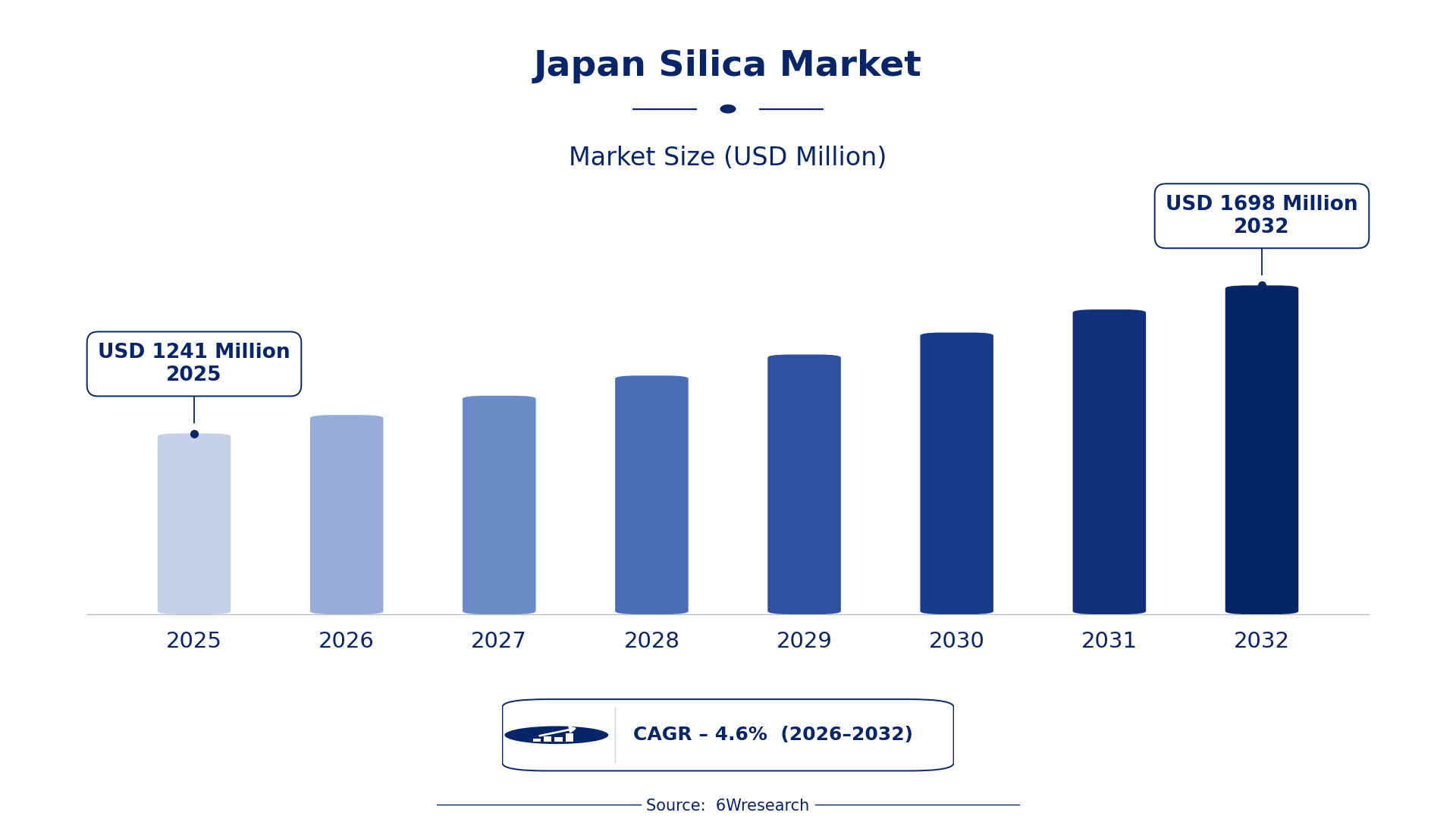
According to 6Wresearch internal database and industry insights, the Japan Silica Market was valued at USD 1,241 Million in 2025 and is projected to reach USD 1,698 Million by 2032, growing at a CAGR of approximately 4.6% during 2026–2032.
Japan Silica Market Highlights
| Report Metric | Details |
| Report Name | Japan Silica Market (2026-2032) |
| Market Size 2025 | USD 1,241 Million |
| Market Size 2032 | USD 1,698 Million |
| Absolute Growth 2025–2032 | USD 457 Million |
| CAGR 2026–2032 | 4.6% |
| Peak Annual Growth | 6.3% in 2032 |
| Forecast Period | 2026–2032 |
| Historical Data | 2022–2025 |
| Base Year | 2025 |
| Leading Application, 2025 | Rubber (37% share) |
| Fastest-Growing Application | Construction (6.5% CAGR) |
| Growing Sector | Construction |
| Key End Users | Construction manufacturers, rubber producers, agrochemical companies |
Japan Silica Market Year-wise Growth Rate and Key Drivers (2022–2032)
This graph illustrates the annual growth rates of the market from 2022 to 2032, highlighting a steady upward trajectory and projected market expansion over the forecast period.
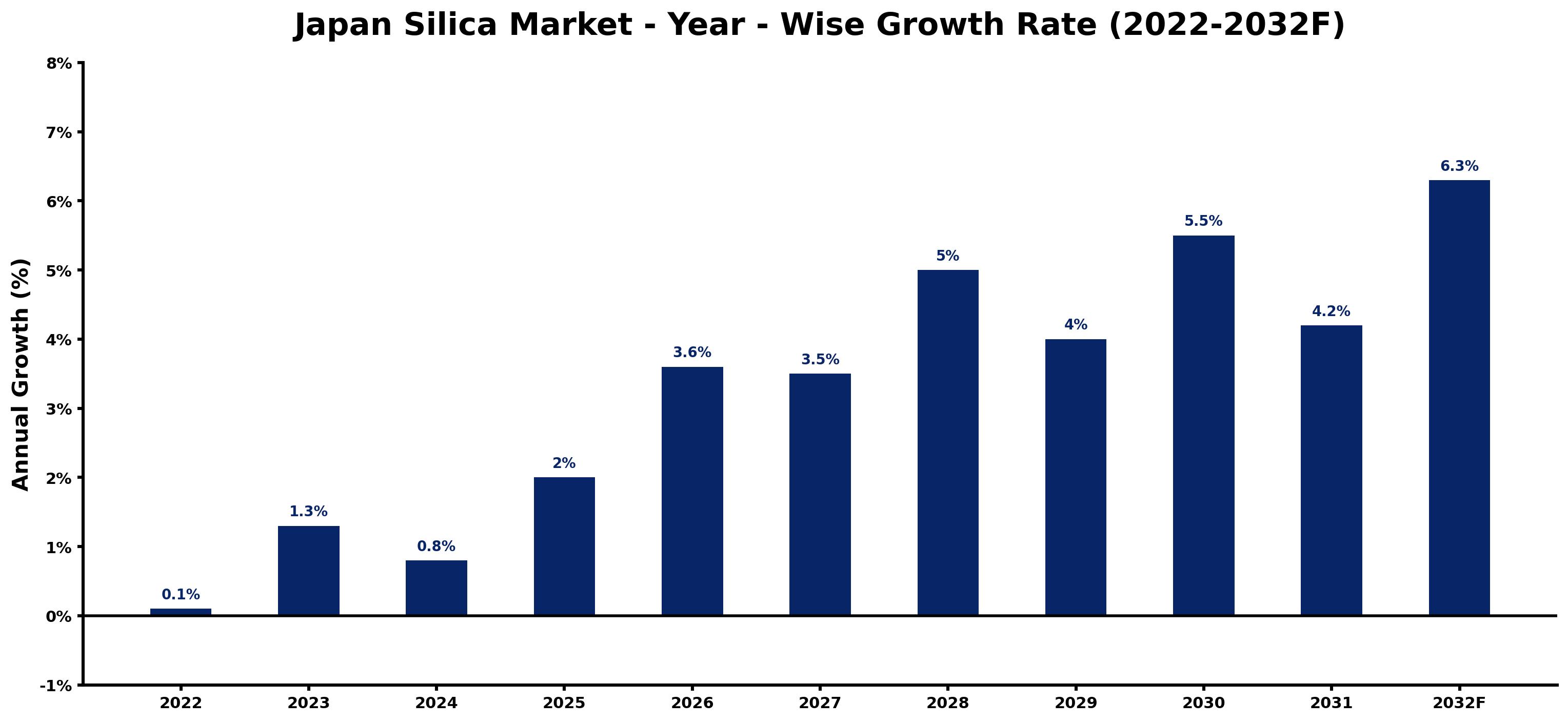
The yearly estimates that follow link every growth rate to its principal driver, so readers can see why the pace changed in each period.
| Year | Estimated Annual Growth (%) | Market Rationale |
| 2022 | 0.1 | The market showed minimal growth due to ongoing recovery from previous economic impacts. |
| 2023 | 1.3 | Demand increased as the construction sector began to rebound. |
| 2024 | 0.8 | Growth slowed as supply chain issues affected production timelines. |
| 2025 | 2.0 | A surge in construction projects drove faster growth in silica consumption. |
| 2026 | 3.6 | The rubber industry expanded, boosting silica demand across sectors. |
| 2027 | 3.5 | Growth slowed slightly as market conditions stabilised after previous peaks. |
| 2028 | 5.0 | Increased infrastructure spending is projected to lead to a resurgence in silica usage. |
| 2029 | 4.0 | Demand growth is expected to slow as construction projects reach completion phases. |
| 2030 | 5.5 | The introduction of new silica applications is projected to drive renewed interest. |
| 2031 | 4.2 | Growth is anticipated to moderate as the market adjusts to previous rapid expansions. |
| 2032 | 6.3 | Peak growth is projected as new technologies improve silica recycling. |
Note: Market size estimations and growth projections presented in this report are based on 6Wresearch's proprietary forecasting methodology, utilizing the latest available industry data, government publications, and primary research inputs.
Japan Silica Market Synopsis
Silica is a chemical compound primarily composed of silicon dioxide, produced from quartz sand and used as a filler in various industries. The Japan Silica Market is experiencing growth driven by strong demand from the construction and rubber sectors, particularly in the Tokyo region, where the construction sector is projected to use around 1 million tons of silica annually. The rubber industry, valued at approximately 2 trillion yen, also contributes significantly to market growth. As urbanisation continues, the need for high-quality silica in various applications is expected to rise, further boosting market potential.
Market Dynamics Impact Analysis (2026–2032)
| Factor | Type | Impact | Primary Segment Affected |
| Rising construction activities in urban areas | Driver | High | Construction |
| Increased demand for high-performance tires | Driver | High | Rubber |
| Growing focus on sustainable materials | Opportunity | Medium | Construction |
| Investment in silica recycling technologies | Opportunity | Medium | Rubber |
| Supply chain disruptions affecting raw material availability | Restraint | High | Rubber |
| Regulatory compliance costs for silica production | Restraint | Medium | Construction |
| Fluctuating raw material prices impacting production costs | Challenge | High | Rubber |
| Technological advancements requiring constant adaptation | Challenge | Medium | Construction |
Evaluation of Drivers in Japan Silica Market (2026–2032)
The main growth drivers and the segments they affect most are set out below.
| Drivers | Primary Segment Affected | Why It Matters (Evidence) |
| Increased urbanisation driving construction demand | Construction | The construction sector in Japan is projected to use around 1 million tons of silica annually, leading to higher purchases by manufacturers. |
| Rising automotive production boosting tire manufacturing | Rubber | Silica is used in over 50% of tire manufacturing processes in Japan, increasing demand from tire manufacturers. |
| Focus on quality standards improving production processes | Rubber | Adherence to ISO 9001 standards improves quality management in silica production, motivating manufacturers to invest in higher-quality silica. |
| Government initiatives promoting sustainable practices | Construction | The Green Growth Strategy identifies growth sectors, encouraging investments in eco-friendly construction materials, with a target of 30% sustainable material usage by 2030. |
| Technological advancements in silica applications | Construction | Emerging applications in construction materials are prompting manufacturers to increase silica usage, with a projected 20% rise in demand. |
Volumes increase due to heightened urbanisation and construction demand, with the construction sector expected to utilise around 1 million tons of silica annually. The automotive sector also contributes, as silica is essential to over 50% of tire manufacturing processes in Japan. Adherence to ISO 9001 standards improves production quality, encouraging manufacturers to invest in superior silica grades. These elements create a favourable environment for silica producers and suppliers.
Evaluation of Restraints in Japan Silica Market
Below are the constraints most often cited by buyers and suppliers, with the segment each affects.
| Market Restraint | Primary Segment Affected | Why It Matters (Evidence) |
| Supply chain disruptions affecting raw material availability | Rubber | Recent global supply chain issues have led to delays in obtaining essential raw materials for silica production, causing a 20% increase in lead times. |
| Regulatory compliance costs for silica production | Construction | Producers face increased costs due to compliance with stringent regulations, impacting overall profitability by approximately 15%. |
| Fluctuating raw material prices impacting production costs | Rubber | Volatility in raw material prices has made budgeting for silica production more challenging for manufacturers, with costs fluctuating by up to 10%. |
| Limited awareness of silica applications in new markets | Construction | Manufacturers may struggle to penetrate new markets due to a lack of understanding of silica's benefits, limiting potential sales by 25%. |
| Environmental regulations affecting production processes | Rubber | Stricter environmental regulations require additional investments in cleaner production technologies, increasing operational costs by around 12%. |
Japan Silica Market Challenges
In 2023, manufacturers in the rubber industry face rising costs due to limited domestic silica production, increasing input prices by up to 15%. Supply chain disruptions from natural disasters can delay silica deliveries, affecting construction projects and extending timelines by three months. Regulatory changes from the Ministry of Economy, Trade and Industry complicate compliance for producers, potentially resulting in fines of up to 5 million yen. Shortages of skilled workers in silica processing hinder production efficiency, causing operational delays that may reduce output by 20%.
Trends in the Japan Silica Market
The following changes are redrawing the Japan Silica Market.
- Shift towards Sustainable Silica Applications: The focus on sustainable materials is transforming silica applications in construction, with an emphasis on eco-friendly products. The Green Growth Strategy promotes this shift, targeting a 30% increase in sustainable material usage by 2030.
- Emergence of Advanced Silica Recycling Technologies: In 2023, a government program was initiated to improve silica recycling technologies, aiming to increase recycling rates by 30% by 2025. This initiative aids manufacturers in minimising waste and enhancing sustainability.
- Transition to High-Performance Silica Grades: There is a rising preference for high-performance silica grades in tire manufacturing, driven by consumer demand for improved fuel efficiency. The rubber industry is adapting, with over 60% of new tires incorporating advanced silica formulations.
- Increase in Collaborative Research for Silica Innovations: Research partnerships between universities and industry are on the rise, focusing on new silica applications. In 2022, funding for such research increased by 20%, reflecting strong interest in developing novel uses.
Investment Opportunities in the Japan Silica Market
Where to invest in the Japan Silica Market: the main openings are set out below.
- Construction sector seeking high-quality silica: With the construction sector projected to consume around 1 million tons of silica annually, suppliers have the opportunity to meet this demand by providing high-quality products.
- Investment in silica recycling technologies: The government initiated a program in 2023 to enhance silica recycling technologies, targeting a 30% increase in recycling rates by 2025, creating investment opportunities for technology providers.
- Growing agrochemical market requiring silica: The agrochemical market in Japan, valued at around 1 trillion yen, offers opportunities for silica suppliers as it is increasingly used as a carrier for pesticides and fertilizers.
- Partnerships for sustainable silica production: Collaboration with local manufacturers in the Tokyo region can facilitate entry into the silica market, especially with the rising demand for sustainable production practices.
Government Initiatives in the Japan Silica Market
The Chemical Substances Control Law, enacted in 1973, mandates the evaluation and oversight of chemical substances in manufacturing and import. This law ensures that silica producers comply with safety and environmental standards, improving product quality and safety for consumers. Additionally, the PRTR Law requires businesses to report releases of designated chemical substances, promoting transparency and accountability in silica production. These regulations help maintain high standards in the industry, benefiting both producers and consumers.
The Ministry of Economy, Trade and Industry oversees the implementation of various initiatives, including funding for sustainable production practices. The Long-Term Care Insurance Act, in force since 2000, also supports the development of materials for the aging population, indirectly benefiting silica producers by promoting innovations in construction and healthcare applications. These measures encourage advancements in silica production and usage, aligning with market needs.
Future Insight of the Japan Silica Market
Manufacturers in the construction sector will adopt new silica recycling technologies by 2032, significantly reducing raw material costs. The introduction of ISO 9001 standards will improve product consistency, benefiting both suppliers and buyers. Upgrades in processing facilities will optimise production, enabling suppliers to meet the growing demands of the construction sector. The rubber industry will increasingly incorporate silica in eco-friendly formulations, aligning with stricter environmental regulations.
Market Segmentation Analysis
Japan Silica Market report covers a detailed analysis of the following market segments:
By Application – Rubber Leads, Construction Expected to Grow Fastest
According to Summon Dutta, Assistant Manager at 6Wresearch, Rubber accounted for 37% of the market by application in 2025. The rubber segment holds the largest share as it is essential in tire manufacturing, where silica is a key component in over 50% of processes. The rubber industry's valuation at approximately 2 trillion yen highlights the critical role silica plays in enhancing the performance and longevity of rubber products. Construction is projected to grow fastest, at a CAGR of 6.5% during 2026–2032. The construction segment is experiencing rapid growth, with projected annual consumption of around 1 million tons of silica for construction materials. This surge is propelled by ongoing urban development and infrastructure initiatives that require high-quality concrete and asphalt. This means suppliers should focus on adapting their offerings to cater to the increasing needs of the construction industry.
Key Attractiveness of the Report
- 10 Years of Market Numbers
- Historical Data Starting from 2022 to 2025
- Base Year 2025
- Forecast Data until 2032
- Key Performance Indicators Impacting the Market
- Major Upcoming Developments and Projects
Key Highlights of the Report:
- Japan Silica Market Outlook
- Market Size of Japan Silica Market, 2025
- Forecast of Japan Silica Market, 2032
- Historical Data and Forecast of Japan Silica Revenues & Volume for the Period 2022-2032
- Japan Silica Market Trend Evolution
- Japan Silica Market Drivers and Challenges
- Japan Silica Price Trends
- Japan Silica Porter's Five Forces
- Japan Silica Industry Life Cycle
- Historical Data and Forecast of Japan Silica Market Revenues & Volume By Application for the Period 2022-2032
- Historical Data and Forecast of Japan Silica Market Revenues & Volume By Rubber for the Period 2022-2032
- Historical Data and Forecast of Japan Silica Market Revenues & Volume By Construction for the Period 2022-2032
- Historical Data and Forecast of Japan Silica Market Revenues & Volume By Agrochemicals for the Period 2022-2032
- Historical Data and Forecast of Japan Silica Market Revenues & Volume By Oral Care for the Period 2022-2032
- Historical Data and Forecast of Japan Silica Market Revenues & Volume By Food & Feed for the Period 2022-2032
- Historical Data and Forecast of Japan Silica Market Revenues & Volume By Others for the Period 2022-2032
- Japan Silica Import Export Trade Statistics
- Market Opportunity Assessment By Application
- Japan Silica Top Companies Market Share
- Japan Silica Competitive Benchmarking By Technical and Operational Parameters
- Japan Silica Company Profiles
- Japan Silica Key Strategic Recommendations
Market Covered
This report examines the market across the segments below.
By Application
- Rubber
- Construction
- Agrochemicals
- Oral Care
- Food & Feed
- Others






































