Japan Silicon Anode Market Size & Growth Rate
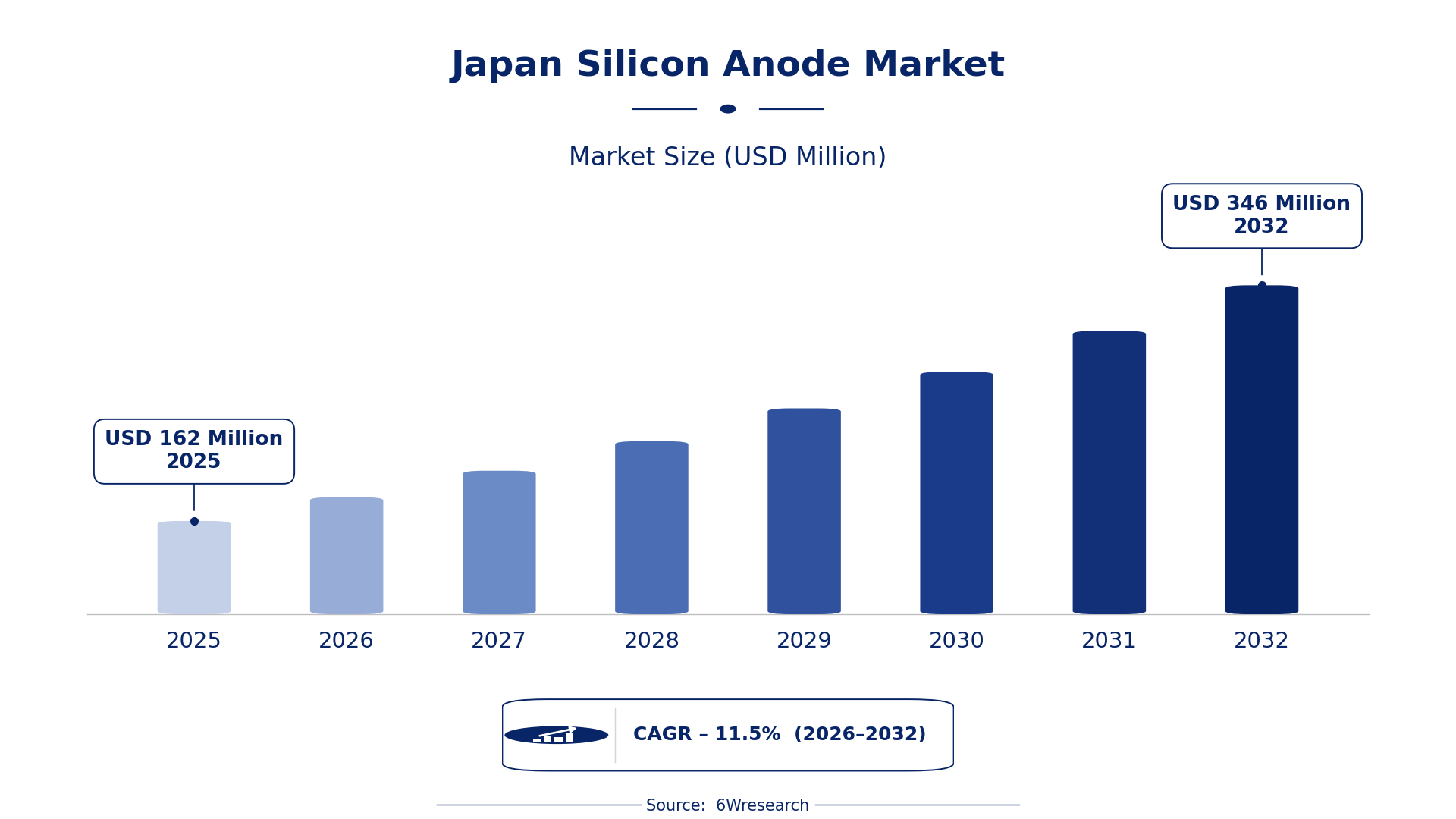
According to 6Wresearch internal database and industry insights, the Japan Silicon Anode Market was valued at USD 162 Million in 2025 and is projected to reach USD 346 Million by 2032, growing at a CAGR of approximately 11.5% during 2026–2032.
Japan Silicon Anode Market Highlights
| Report Metric | Details |
| Report Name | Japan Silicon Anode Market (2026-2032) |
| Market Size 2025 | USD 162 Million |
| Market Size 2032 | USD 346 Million |
| Absolute Growth 2025–2032 | USD 184 Million |
| CAGR 2026–2032 | 11.5% |
| Peak Annual Growth | 13.9% in 2026 |
| Forecast Period | 2026–2032 |
| Historical Data | 2022–2025 |
| Base Year | 2025 |
| Leading Anode Type, 2025 | Silicon-Graphite Anode (52% share) |
| Leading Cell Chemistry, 2025 | Li-ion Batteries (40% share) |
| Leading Application, 2025 | Consumer Electronics (37% share) |
| Leading End User, 2025 | Battery Manufacturers (48% share) |
| Fastest-Growing Anode Type | Silicon Oxide Anode (16.0% CAGR) |
| Fastest-Growing Cell Chemistry | High-Capacity Cells (14.2% CAGR) |
| Fastest-Growing Application | Electric Vehicles (15.5% CAGR) |
| Fastest-Growing End User | EV Battery Suppliers (14.9% CAGR) |
| Growing Sector | Electric Vehicles |
| Key End Users | Battery Manufacturers, EV Battery Suppliers, Energy Storage Companies |
Japan Silicon Anode Market Year-wise Growth Rate and Key Drivers (2022–2032)
This graph illustrates the annual growth rates of the market from 2022 to 2032, highlighting a steady upward trajectory and projected market expansion over the forecast period.
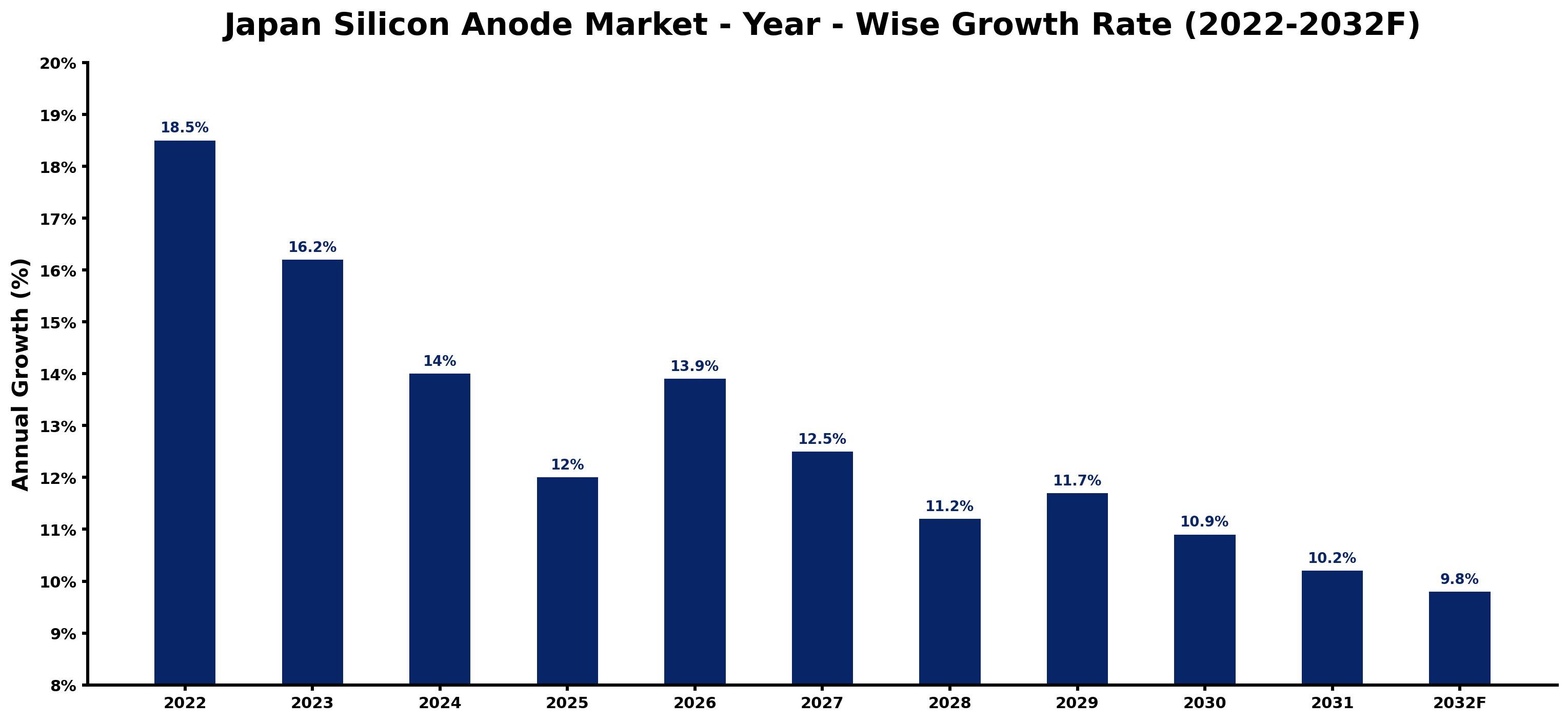
The yearly estimates that follow link every growth rate to its principal driver, so readers can see why the pace changed in each period.
| Year | Estimated Annual Growth (%) | Market Rationale |
| 2022 | 18.5 | The market experienced strong demand from the electric vehicle sector, boosting growth. |
| 2023 | 16.2 | Growth slowed due to market saturation in consumer electronics, yet demand remained high overall. |
| 2024 | 14.0 | The electric vehicle market continued to expand, sustaining the demand for advanced battery technologies. |
| 2025 | 12.0 | Market growth slowed as supply chain challenges affected battery manufacturers' output. |
| 2026 | 13.9 | Demand surged as new electric vehicle models were introduced, driving higher silicon anode adoption. |
| 2027 | 12.5 | Growth slowed as competition increased among battery manufacturers for advanced technologies. |
| 2028 | 11.2 | The market continued to grow, supported by rising investments in renewable energy storage solutions. |
| 2029 | 11.7 | Demand increased as electric vehicle adoption rates improved, leading to higher silicon anode usage. |
| 2030 | 10.9 | Growth slowed as the market matured, with established players dominating the silicon anode segment. |
| 2031 | 10.2 | Market expansion continued, driven by ongoing developments in battery technology and energy storage. |
| 2032 | 9.8 | Growth slowed as the market stabilised, with established technologies maintaining their positions. |
Note: Market size estimations and growth projections presented in this report are based on 6Wresearch's proprietary forecasting methodology, utilizing the latest available industry data, government publications, and primary research inputs.
Japan Silicon Anode Market Synopsis
Silicon anodes are advanced materials used in lithium-ion batteries, enhancing energy density and performance. They are produced by combining silicon with other materials, making them essential for applications in electric vehicles, consumer electronics, and renewable energy storage systems. The Japan Silicon Anode Market is expanding due to strong demand from the electric vehicle sector, alongside government initiatives promoting advanced battery technologies, which attract investments from battery manufacturers and energy storage companies. The electric vehicle market is projected to grow significantly by 2025, further driving demand for silicon anodes.
Market Dynamics Impact Analysis (2026–2032)
| Factor | Type | Impact | Primary Segment Affected |
| Increasing demand for electric vehicles drives silicon anode adoption. | Driver | High | Silicon-Graphite Anode |
| Growing renewable energy storage solutions create a need for advanced battery technologies. | Driver | High | Composite Silicon Anode |
| Emerging technologies in battery manufacturing present opportunities for innovation. | Opportunity | Medium | Nano-Silicon Anode |
| Investment in electric vehicle infrastructure is rising, enhancing market potential. | Opportunity | High | Electric Vehicles |
| Supply chain disruptions can impact the availability of raw materials for production. | Restraint | High | Silicon-Graphite Anode |
| Competition among battery manufacturers may lead to price pressures. | Restraint | Medium | Battery Manufacturers |
| Technological advancements require continuous investment from producers. | Challenge | High | EV Battery Suppliers |
| Regulatory compliance can increase operational costs for manufacturers. | Challenge | Medium | Energy Storage Cos. |
Evaluation of Drivers in Japan Silicon Anode Market (2026–2032)
Demand rests on the following drivers, each shown with the segment it touches most.
| Drivers | Primary Segment Affected | Why It Matters (Evidence) |
| Rising electric vehicle production levels. | Electric Vehicles | In 2025, the electric vehicle market in Japan is projected to grow significantly, driving demand for silicon anodes. |
| Increased investment in renewable energy projects. | Renewable Storage | The renewable energy market in Japan is expected to reach $50 billion by 2025, boosting demand for advanced battery technologies. |
| Technological advancements in battery performance. | High-Capacity Cells | The average energy density of silicon anodes can reach 1500 Wh/L, improving battery performance in various applications. |
| Government initiatives promoting advanced battery technologies. | Consumer Electronics | The Ministry of Economy, Trade and Industry supports advanced battery technologies, encouraging growth in consumer electronics. |
| Growing consumer electronics market driven by population size. | Battery Manufacturers | Japan's population of approximately 125 million drives demand for consumer electronics, increasing battery production. |
Much of the new demand traces back to the electric vehicle market, which is set to expand by 2025, leading to higher adoption of silicon anodes. The average energy density of silicon anodes can reach 1500 Wh/L, improving battery performance across various applications. Investments in renewable energy projects are also on the rise, reflecting a strong commitment to advanced battery technologies. Japan's population of approximately 125 million fuels demand for consumer electronics, resulting in increased production and usage of silicon anodes. As electric vehicle adoption continues to grow, battery manufacturers are likely to increase their investments in technology to meet evolving market needs.
Evaluation of Restraints in Japan Silicon Anode Market
Below are the constraints most often cited by buyers and suppliers, with the segment each affects.
| Market Restraint | Primary Segment Affected | Why It Matters (Evidence) |
| Supply chain disruptions affecting raw material availability. | Silicon-Graphite Anode | Increased global demand for silicon can lead to shortages, impacting production timelines for manufacturers. |
| Price competition among battery manufacturers. | Battery Manufacturers | Intense competition may drive prices down, affecting profitability for producers of silicon anodes. |
| Technological advancements requiring high investment costs. | EV Battery Suppliers | Continuous innovation demands capital, which can strain budgets for smaller manufacturers. |
| Regulatory compliance increasing operational costs. | Energy Storage Cos. | Compliance with standards like JIS C 8714 may require additional investments in testing and certification. |
| Limited applications for emerging technologies. | Nano-Silicon Anode | Current applications for nano-silicon anodes are niche, restricting broader market penetration. |
Japan Silicon Anode Market Challenges
In 2022, Japan produced 40 million lithium-ion batteries, yet buyers struggle with limited access to advanced silicon anodes, delaying electric vehicle production timelines. Suppliers encounter complex manufacturing processes that hinder scaling, leading to lead times extending by three months. Regulatory standards like JIS C 8714 impose strict compliance, slowing new material introductions and limiting suppliers' innovation capabilities. Rising raw material costs for silicon anodes can increase prices for buyers, squeezing profit margins and reducing competitiveness in the market.
Trends in the Japan Silicon Anode Market
The following changes are redrawing the Japan Silicon Anode Market.
- Shift from Conventional to Advanced Battery Technologies: The trend towards advanced battery technologies began in 2022, reflecting the need for higher energy density. The electric vehicle sector is increasingly adopting silicon anodes, with a projected increase in range by 20%.
- Transition from Standard to High-Capacity Cells: In 2023, battery manufacturers began focusing on high-capacity cells to meet growing consumer demands. This shift is reflected in the projected CAGR of 14.2% for high-capacity cells through 2032.
- Consumer Electronics Prioritising Battery Longevity: Starting in 2022, consumer electronics have prioritised long-life batteries to improve user experience. The average lifespan of lithium-ion batteries is around 10 years, prompting manufacturers to invest in silicon anodes.
- Electric Vehicles Driving Market Evolution: The electric vehicle market has been a key driver since 2022, with substantial investments in infrastructure. By 2030, the government aims for 20% of new vehicles to be electric, fuelling demand for silicon anodes.
Investment Opportunities in the Japan Silicon Anode Market
Several openings in the Japan Silicon Anode Market merit attention from investors.
- Entering through Joint Ventures: Now is the time for investment in joint ventures with local battery manufacturers to strengthen market presence. The Tokyo region, a hub for battery manufacturing, offers opportunities for collaboration.
- Investing in Electric Vehicle Infrastructure: With the electric vehicle market projected to grow, investing in charging infrastructure is essential. EV battery suppliers in Japan are seeking partnerships to expand their capabilities.
- Focusing on Renewable Energy Storage Solutions: The increasing demand for renewable energy storage creates opportunities for suppliers of silicon anodes. Energy storage companies are investing heavily in advanced battery technologies to meet market needs.
- Certification for Advanced Battery Technologies: Now is the time to pursue certification for silicon anodes to meet industry standards. The Japan Industrial Standards Committee oversees battery standards, ensuring compliance for manufacturers.
Government Initiatives in the Japan Silicon Anode Market
The Semiconductor and Digital Industry Strategy, established by METI in June 2021, aims to secure domestic semiconductor manufacturing, which is essential for silicon anode production. The Battery Industry Strategy, launched in August 2022, targets 150 GWh of domestic battery manufacturing capacity by 2030, promoting innovation and investment in advanced battery technologies.
In 2023, $200 million has been allocated for battery research, administered by the Ministry of Economy, Trade and Industry. This funding supports initiatives aimed at improving battery performance and production capabilities, benefiting silicon anode producers and buyers.
Future Insight of the Japan Silicon Anode Market
By 2032, energy storage systems will expand through new projects and government initiatives, increasing total installed capacity significantly. The electric vehicle market will see a substantial rise in demand, with projections indicating a 20% increase in range due to silicon anodes. The government has launched a programme to incentivise battery recycling, promoting sustainability in the sector. As the renewable energy market approaches $50 billion by 2025, suppliers will need to align with new standards and buyer expectations for advanced energy solutions.
Market Segmentation Analysis
Japan Silicon Anode Market report covers a detailed analysis of the following market segments:
By Anode Type – Silicon-Graphite Anode Leads, Silicon Oxide Anode Expected to Grow Fastest
According to Saurav Kr Singh, Senior Research Analyst at 6Wresearch, with 52% of anode type revenue in 2025, Silicon-Graphite Anode was the largest category. The Silicon-Graphite Anode holds the largest share due to its widespread use in battery manufacturing, particularly in electric vehicles. Its established role in improving battery capacity ensures consistent demand from manufacturers across various applications. Over 2026–2032, Silicon Oxide Anode is expected to post the fastest growth, at a CAGR of 16.0%. The Silicon Oxide Anode is gaining rapid traction as it is increasingly recognised for its suitability in niche applications, particularly in high-performance electronics. This growing acceptance is driving demand in specialised markets that require advanced battery solutions. Suppliers should focus on developing tailored solutions for niche applications to capitalise on this growth.
By Cell Chemistry – Li-ion Batteries Lead, High-Capacity Cells Expected to Grow Fastest
The largest cell chemistry category in 2025 was Li-ion Batteries, at 40% of revenue. Li-ion Batteries dominate the market as they are the primary application for silicon anodes across a range of devices, including consumer electronics and electric vehicles. Their reliability and established presence make them the preferred choice among manufacturers, ensuring sustained demand. The quickest growth will come from High-Capacity Cells, forecast to expand at a CAGR of 14.2% between 2026 and 2032. High-Capacity Cells are experiencing rapid growth due to the increasing need for high-performance battery solutions, particularly in the electric vehicle sector. Their superior energy density is crucial for meeting the evolving market requirements. Buyers should prioritise sourcing high-capacity cells to remain competitive in performance-driven applications.
By Application – Consumer Electronics Leads, Electric Vehicles Expected to Grow Fastest
Consumer Electronics held 37% of the Japan Silicon Anode Market by application in 2025. Consumer Electronics represents the largest share in this segment, serving as a major market for lithium-ion batteries with significant demand from devices like smartphones and laptops. The continuous expansion of this sector guarantees a steady need for silicon anodes. Electric Vehicles are projected to grow fastest, at a CAGR of 15.5% during 2026–2032. Electric Vehicles are the fastest-growing application, driven by the rising adoption of electric vehicles and government incentives promoting greener technologies. This push for electric mobility significantly increases the demand for advanced battery solutions. Suppliers must align their strategies with the electric vehicle sector to capture emerging opportunities.
By End User – Battery Manufacturers Lead, EV Battery Suppliers Expected to Grow Fastest
In 2025, Battery Manufacturers led the end user split with a 48% share. Battery Manufacturers are the primary end-users of silicon anode technology, producing batteries that integrate these advanced materials. Their dependence on silicon anodes for enhanced performance solidifies their leading position in the market. EV Battery Suppliers are set to record the highest CAGR in this split, 14.9% over 2026–2032. EV Battery Suppliers are experiencing the fastest growth due to the surging demand from electric vehicle manufacturers for high-performance batteries. This trend is expected to continue as the electric vehicle market expands rapidly. Suppliers should strengthen partnerships with EV battery suppliers to leverage the growing electric vehicle market.
Key Attractiveness of the Report
- 10 Years of Market Numbers
- Historical Data Starting from 2022 to 2025
- Base Year 2025
- Forecast Data until 2032
- Key Performance Indicators Impacting the Market
- Major Upcoming Developments and Projects
Key Highlights of the Report:
- Japan Silicon Anode Market Outlook
- Market Size of Japan Silicon Anode Market, 2025
- Forecast of Japan Silicon Anode Market, 2032
- Historical Data and Forecast of Japan Silicon Anode Revenues & Volume for the Period 2022-2032F
- Japan Silicon Anode Market Trend Evolution
- Japan Silicon Anode Market Drivers and Challenges
- Japan Silicon Anode Price Trends
- Japan Silicon Anode Porter's Five Forces
- Japan Silicon Anode Industry Life Cycle
- Historical Data and Forecast of Japan Silicon Anode Market Revenues & Volume By Anode Type for the Period 2022-2032F
- Historical Data and Forecast of Japan Silicon Anode Market Revenues & Volume By Silicon-Graphite Anode for the Period 2022-2032F
- Historical Data and Forecast of Japan Silicon Anode Market Revenues & Volume By Silicon Oxide Anode for the Period 2022-2032F
- Historical Data and Forecast of Japan Silicon Anode Market Revenues & Volume By Nano-Silicon Anode for the Period 2022-2032F
- Historical Data and Forecast of Japan Silicon Anode Market Revenues & Volume By Composite Silicon Anode for the Period 2022-2032F
- Historical Data and Forecast of Japan Silicon Anode Market Revenues & Volume By Cell Chemistry for the Period 2022-2032F
- Historical Data and Forecast of Japan Silicon Anode Market Revenues & Volume By Li-ion Batteries for the Period 2022-2032F
- Historical Data and Forecast of Japan Silicon Anode Market Revenues & Volume By High-Capacity Cells for the Period 2022-2032F
- Historical Data and Forecast of Japan Silicon Anode Market Revenues & Volume By Fast Charging for the Period 2022-2032F
- Historical Data and Forecast of Japan Silicon Anode Market Revenues & Volume By Long-Life Batteries for the Period 2022-2032F
- Historical Data and Forecast of Japan Silicon Anode Market Revenues & Volume By Application for the Period 2022-2032F
- Historical Data and Forecast of Japan Silicon Anode Market Revenues & Volume By Consumer Electronics for the Period 2022-2032F
- Historical Data and Forecast of Japan Silicon Anode Market Revenues & Volume By Electric Vehicles for the Period 2022-2032F
- Historical Data and Forecast of Japan Silicon Anode Market Revenues & Volume By Power Tools for the Period 2022-2032F
- Historical Data and Forecast of Japan Silicon Anode Market Revenues & Volume By Renewable Storage for the Period 2022-2032F
- Historical Data and Forecast of Japan Silicon Anode Market Revenues & Volume By End User for the Period 2022-2032F
- Historical Data and Forecast of Japan Silicon Anode Market Revenues & Volume By Battery Manufacturers for the Period 2022-2032F
- Historical Data and Forecast of Japan Silicon Anode Market Revenues & Volume By EV Battery Suppliers for the Period 2022-2032F
- Historical Data and Forecast of Japan Silicon Anode Market Revenues & Volume By Energy Storage Cos. for the Period 2022-2032F
- Historical Data and Forecast of Japan Silicon Anode Market Revenues & Volume By Solar Battery OEMs for the Period 2022-2032F
- Japan Silicon Anode Import Export Trade Statistics
- Market Opportunity Assessment By Anode Type
- Market Opportunity Assessment By Cell Chemistry
- Market Opportunity Assessment By Application
- Market Opportunity Assessment By End User
- Japan Silicon Anode Top Companies Market Share
- Japan Silicon Anode Competitive Benchmarking By Technical and Operational Parameters
- Japan Silicon Anode Company Profiles
- Japan Silicon Anode Key Strategic Recommendations
Market Covered
The study includes the following segmentation.
By Anode Type
- Silicon-Graphite Anode
- Silicon Oxide Anode
- Nano-Silicon Anode
- Composite Silicon Anode
By Cell Chemistry
- Li-ion Batteries
- High-Capacity Cells
- Fast Charging
- Long-Life Batteries
By Application
- Consumer Electronics
- Electric Vehicles
- Power Tools
- Renewable Storage
By End User
- Battery Manufacturers
- EV Battery Suppliers
- Energy Storage Cos.
- Solar Battery OEMs































