Japan Simulation and Reconstruction Software Market Size & Growth Rate
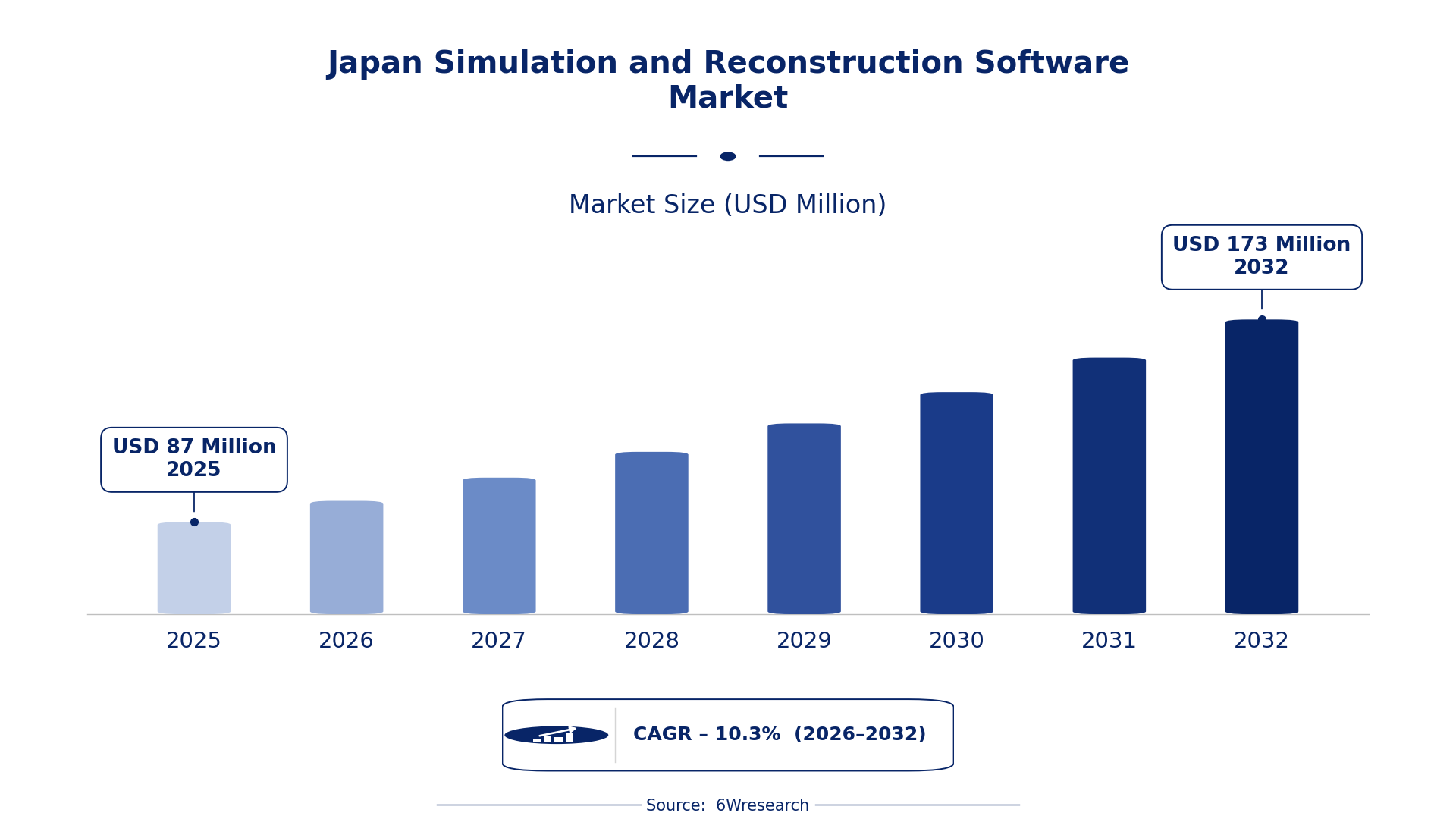
According to 6Wresearch internal database and industry insights, the Japan Simulation and Reconstruction Software Market was valued at USD 87 Million in 2025 and is projected to reach USD 173 Million by 2032, growing at a CAGR of approximately 10.3% during 2026–2032.
Japan Simulation and Reconstruction Software Market Highlights
| Report Metric | Details |
| Report Name | Japan Simulation and Reconstruction Software Market (2026-2032) |
| Market Size 2025 | USD 87 Million |
| Market Size 2032 | USD 173 Million |
| Absolute Growth 2025–2032 | USD 86 Million |
| CAGR 2026–2032 | 10.3% |
| Peak Annual Growth | 12.5% in 2032 |
| Forecast Period | 2026–2032 |
| Historical Data | 2022–2025 |
| Base Year | 2025 |
| Leading Software Type, 2025 | Engineering Simulation (45% share) |
| Leading Simulation Focus, 2025 | Medical Scenarios (41% share) |
| Leading Deployment Platform, 2025 | Cloud (46% share) |
| Leading End User, 2025 | Aerospace & Automotive (38% share) |
| Fastest-Growing Software Type | Smart City Simulators (15.0% CAGR) |
| Fastest-Growing Deployment Platform | Desktop/Cloud (15.2% CAGR) |
| Fastest-Growing End User | City Planners (13.6% CAGR) |
| Growing Sector | Medical Training |
| Key End Users | Aerospace, Healthcare, Urban Planners, Educational Institutions |
Japan Simulation and Reconstruction Software Market Year-wise Growth Rate and Key Drivers (2022–2032)
This graph illustrates the annual growth rates of the market from 2022 to 2032, highlighting a steady upward trajectory and projected market expansion over the forecast period.
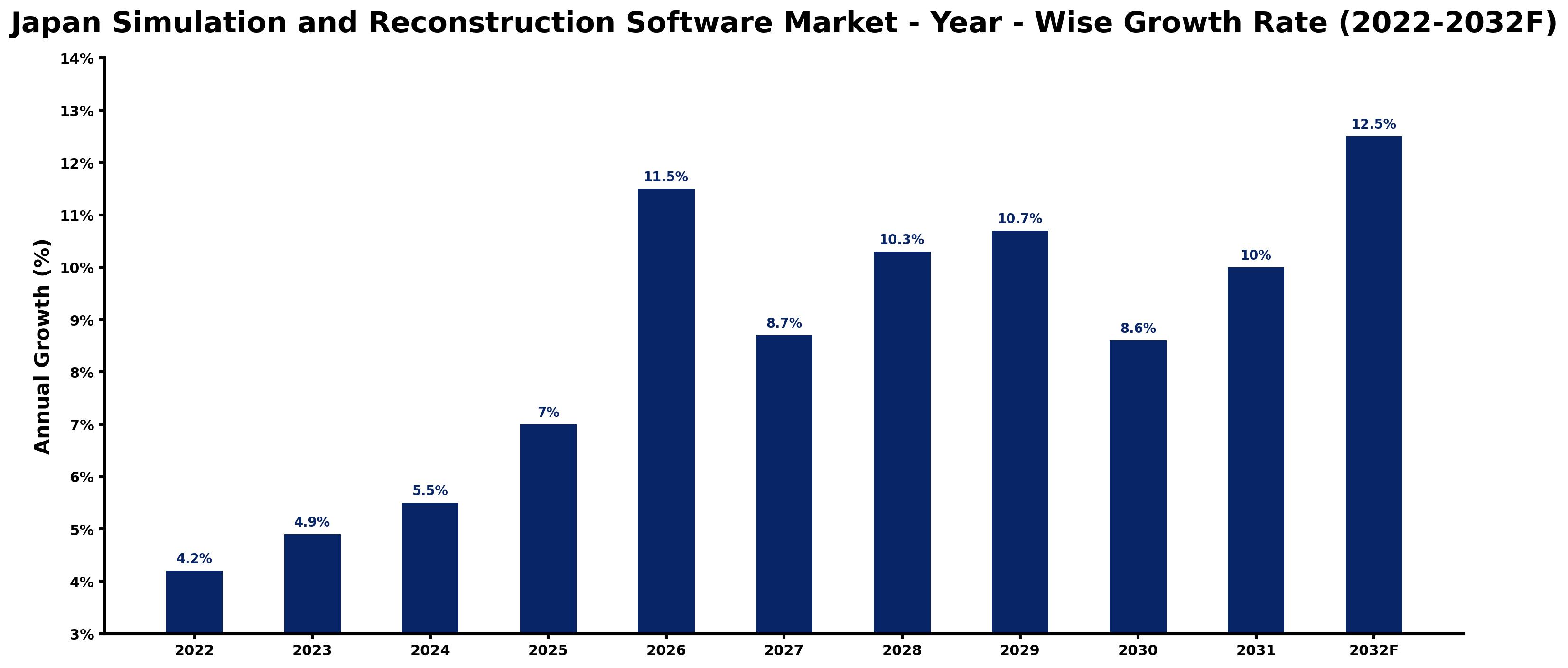
Each row of the following table gives one year's estimated growth and the event or demand shift that explains it.
| Year | Estimated Annual Growth (%) | Market Rationale |
| 2022 | 4.2 | The market experienced steady growth as demand for simulation tools increased across various sectors. |
| 2023 | 4.9 | Growth accelerated due to heightened investments in medical training and urban planning technologies. |
| 2024 | 5.5 | The rise in engineering simulation applications contributed to continued market expansion. |
| 2025 | 7.0 | Strong investments in aerospace engineering tools drove growth in this year. |
| 2026 | 11.5 | Demand is expected to surge as the aerospace sector ramps up investments in simulation technologies. |
| 2027 | 8.7 | Growth is projected to slow as the market adjusts to previous high investment levels in engineering. |
| 2028 | 10.3 | The market is expected to rebound with renewed interest in urban infrastructure simulation projects. |
| 2029 | 10.7 | Continued investment in medical scenarios will support a further increase in demand. |
| 2030 | 8.6 | Growth is projected to slow as the market stabilises after rapid expansion in previous years. |
| 2031 | 10.0 | A resurgence in aerospace investments is expected to lead to a faster growth rate this year. |
| 2032 | 12.5 | The market is projected to peak as demand for simulation software reaches new heights. |
Note: Market size estimations and growth projections presented in this report are based on 6Wresearch's proprietary forecasting methodology, utilizing the latest available industry data, government publications, and primary research inputs.
Japan Simulation and Reconstruction Software Market Synopsis
Simulation and Reconstruction Software encompasses tools for creating virtual models across various fields, particularly in engineering, medical training, and urban planning. The Japan Simulation and Reconstruction Software Market is growing due to substantial investments in aerospace engineering tools and medical training programmes. With over 200 medical schools employing simulation software and a Smart City initiative launched in 2023, demand is fuelled by both domestic users and the need for advanced training and planning solutions.
Market Dynamics Impact Analysis (2026–2032)
| Factor | Type | Impact | Primary Segment Affected |
| Increased investment in aerospace engineering tools | Driver | High | Engineering Simulation |
| Growing adoption of medical training software | Driver | High | Virtual Surgery Software |
| Rising demand for urban planning solutions | Opportunity | High | Smart City Simulators |
| Expanding market for AR/VR applications in healthcare | Opportunity | Medium | Medical Scenarios |
| High costs associated with advanced simulation software | Restraint | High | Engineering Simulation |
| Limited awareness of simulation benefits among smaller firms | Restraint | Medium | Smart City Simulators |
| Competition from international software providers | Challenge | High | Virtual Surgery Software |
| Rapid technological changes requiring constant updates | Challenge | Medium | Engineering Simulation |
Evaluation of Drivers in Japan Simulation and Reconstruction Software Market (2026–2032)
The main growth drivers and the segments they affect most are set out below.
| Drivers | Primary Segment Affected | Why It Matters (Evidence) |
| Increased investment in aerospace engineering tools | Engineering Simulation | The aerospace sector is projected to invest heavily in engineering simulation tools by 2025, improving design capabilities. |
| Growing adoption of medical training software | Virtual Surgery Software | Over 50% of hospitals in urban areas are adopting virtual surgery software for improved medical training. |
| Rising demand for urban planning solutions | Smart City Simulators | Urban infrastructure simulation projects in the Tokyo metropolitan area are driving demand for smart city solutions, with significant investments expected. |
| Expanding market for AR/VR applications in healthcare | Medical Scenarios | Support for AR/VR integration in medical training programs is increasing demand for simulation tools, with funding from educational institutions. |
| Cloud deployment preference among developers | Cloud | Cloud deployment is preferred by 70% of AR/VR developers in Japan, facilitating access and collaboration. |
The strongest pull on demand comes from increased investment in aerospace engineering tools, with projections indicating funding by 2025. The adoption of virtual surgery software is rising, as over 50% of hospitals in urban areas implement these systems for training. Urban infrastructure simulation projects in the Tokyo metropolitan area are driving demand for smart city solutions, with significant investments expected. Seventy percent of AR/VR developers prefer cloud deployment, improving accessibility and collaboration.
Evaluation of Restraints in Japan Simulation and Reconstruction Software Market
The main factors holding the market back are set out below.
| Market Restraint | Primary Segment Affected | Why It Matters (Evidence) |
| High costs associated with advanced simulation software | Engineering Simulation | The high costs of advanced simulation software deter smaller firms from investing in necessary tools, limiting market participation. |
| Limited awareness of simulation benefits among smaller firms | Smart City Simulators | Many smaller companies lack awareness of the advantages of simulation technology, hindering market growth and adoption rates. |
| Regulatory hurdles in software certification | Virtual Surgery Software | Compliance with ISO 13485 standards poses challenges for software developers in the medical field, delaying product launches. |
| Dependence on skilled personnel for implementation | Engineering Simulation | The need for skilled personnel to operate complex simulation tools limits accessibility for some firms, affecting their competitiveness. |
| Slow adoption rates in traditional sectors | Medical Scenarios | Traditional sectors are slower to adopt new technologies, impacting overall market growth and the integration of simulation tools. |
Japan Simulation and Reconstruction Software Market Challenges
A shortage of domestic suppliers for simulation tools presents supply challenges, particularly impacting over 200 medical schools that depend on these resources for training, potentially delaying student readiness by several months. Rising development costs, driven by Japan's minimum wage increase to JPY 1,055 per hour, compel hospitals to reallocate budgets, affecting their ability to invest in other crucial services. Stringent regulations like ISO 13485 complicate the software development process, extending product launch timelines and delaying access to critical tools for healthcare providers. Intense competition in the aerospace sector pressures prices for simulation tools, squeezing profit margins for producers and limiting their capacity to innovate.
Trends in the Japan Simulation and Reconstruction Software Market
These developments are changing demand patterns in the Japan Simulation and Reconstruction Software Market.
- Shift from Traditional to Cloud-Based Solutions: The trend towards cloud-based simulation software is gaining traction, particularly among AR/VR developers, with 70% preferring this deployment method. This shift allows for greater flexibility and collaboration in projects.
- Transition to Smart City Initiatives: Japan's Smart City initiative, launched in 2023, is reshaping urban planning practices. This programme aims to improve infrastructure management and resource allocation, driving demand for simulation tools.
- Emergence of AR/VR in Medical Training: AR/VR applications are increasingly being integrated into medical training, supported by educational initiatives. This trend is expected to improve the quality of training for future healthcare professionals.
- Growing Focus on Engineering Simulations: The aerospace sector's focus on engineering simulations is clear, with investments projected by 2025. This emphasis on simulation tools is important for improving design and testing processes.
Investment Opportunities in the Japan Simulation and Reconstruction Software Market
Where to invest in the Japan Simulation and Reconstruction Software Market: the main openings are set out below.
- Supply of Advanced Simulation Software: There is a growing need for advanced simulation software in the aerospace sector, projected to invest heavily by 2025. Suppliers can enter through partnerships with local developers.
- Provision of Medical Training Solutions: With over 200 medical schools utilizing simulation software, there is an opportunity to supply tailored training solutions. Collaborating with educational institutions can facilitate market entry.
- Investment in Smart City Technologies: The Smart City initiative launched in 2023 creates a demand for urban planning simulation tools. Companies can engage with local governments to provide effective solutions.
- Development of Cloud-Based Platforms: The preference for cloud deployment among AR/VR developers indicates a need for scalable solutions. Entering the market through joint ventures can improve competitive positioning.
Government Initiatives in the Japan Simulation and Reconstruction Software Market
The Building Energy Efficiency Act, amended in 2022, mandates that all new buildings meet energy standards from April 2025. This requirement encourages software developers to create simulation tools that assist in compliance with these standards, improving their market offerings.
The Digital Agency, established in September 2021, spearheads the government's digital transformation efforts. It supports projects that integrate simulation software into public infrastructure planning, enhancing efficiency and effectiveness in urban development.
Future Insight of the Japan Simulation and Reconstruction Software Market
Medical schools will increasingly adopt virtual surgery tools, improving training efficiency and student preparedness. By 2032, urban infrastructure projects will employ advanced simulation technologies, driven by the Smart City initiative, enhancing planning outcomes. The aerospace sector's investment in engineering simulation tools will accelerate design processes, resulting in quicker project completions. Collaborations between research institutions and simulation developers will introduce new methodologies, ensuring that training programmes remain aligned with industry needs and technological advancements.
Market Segmentation Analysis
Japan Simulation and Reconstruction Software Market report covers a detailed analysis of the following market segments:
By Software Type – Engineering Simulation Leads, Smart City Simulators Expected to Grow Fastest
According to Saurav Kr Singh, Senior Research Analyst at 6Wresearch, with 45% of software type revenue in 2025, Engineering Simulation was the largest category. Engineering Simulation commands the largest share because it is crucial for testing designs in sectors like aerospace and automotive. The aerospace sector's projected heavy investment in engineering simulation tools by 2025 exemplifies the strong demand for this software. Over 2026–2032, Smart City Simulators are expected to post the fastest growth, at a CAGR of 15.0%. The Smart City Simulators segment is growing rapidly, spurred by Japan's 2023 Smart City initiative aimed at improving urban planning. This initiative is expected to drive increased adoption of simulation tools for urban infrastructure projects. Suppliers should prioritise developing solutions tailored for urban planning to leverage this expanding market.
By Simulation Focus – Medical Scenarios Lead and Record the Fastest Growth
Medical Scenarios accounted for 41% of the market by simulation focus in 2025. Medical Scenarios leads the market as it is extensively used in medical training across Japan's medical schools. With over 200 institutions employing simulation software, the demand for this focus area remains consistently high. Its lead should widen, with a projected CAGR of 13.7% during 2026–2032, the highest in this split. Medical Scenarios is also the fastest-growing segment, fuelled by the rising adoption of virtual surgery software in more than 50% of urban hospitals. This trend indicates a strong commitment to advancing medical training technologies. Buyers will gain enhanced training capabilities as the demand for medical simulations continues to increase.
By Deployment Platform – Cloud Leads, Desktop/Cloud Expected to Grow Fastest
The largest deployment platform category in 2025 was Cloud, at 46% of revenue. Cloud deployment is the market leader due to its scalability and accessibility, making it the preferred choice for many users. Approximately 70% of AR/VR developers in Japan favour cloud solutions, illustrating this trend's strength. The quickest growth will come from Desktop/Cloud, forecast to expand at a CAGR of 15.2% between 2026 and 2032. Desktop/Cloud platforms are witnessing rapid growth as they offer flexibility in access and collaboration for users. This trend is likely to persist as organisations seek versatile deployment options to boost productivity. Suppliers must ensure compatibility with both cloud and desktop platforms to address diverse user requirements.
By End User – Aerospace & Automotive Leads, City Planners Expected to Grow Fastest
Aerospace & Automotive took 38% of end user revenue in 2025, more than any other category. Aerospace & Automotive is the leading end user group, essential for design and testing in these critical industries. The substantial investment in engineering simulations by the aerospace sector highlights the importance of this segment. City Planners are set to record the highest CAGR in this split, 13.6% over 2026–2032. City Planners are the fastest-growing end user group, driven by the demand for effective urban development and management tools. Ongoing urban infrastructure simulation projects in metropolitan areas like Tokyo underscore the need for advanced solutions. Suppliers should focus on creating solutions specifically for city planners to capture this emerging market.
Key Attractiveness of the Report
- 10 Years of Market Numbers
- Historical Data Starting from 2022 to 2025
- Base Year 2025
- Forecast Data until 2032
- Key Performance Indicators Impacting the Market
- Major Upcoming Developments and Projects
Key Highlights of the Report:
- Japan Simulation and Reconstruction Software Market Outlook
- Market Size of Japan Simulation and Reconstruction Software Market, 2025
- Forecast of Japan Simulation and Reconstruction Software Market, 2032
- Historical Data and Forecast of Japan Simulation and Reconstruction Software Revenues & Volume for the Period 2022-2032F
- Japan Simulation and Reconstruction Software Market Trend Evolution
- Japan Simulation and Reconstruction Software Market Drivers and Challenges
- Japan Simulation and Reconstruction Software Price Trends
- Japan Simulation and Reconstruction Software Porter's Five Forces
- Japan Simulation and Reconstruction Software Industry Life Cycle
- Historical Data and Forecast of Japan Simulation and Reconstruction Software Market Revenues & Volume By Software Type for the Period 2022-2032F
- Historical Data and Forecast of Japan Simulation and Reconstruction Software Market Revenues & Volume By 3D Reconstruction for the Period 2022-2032F
- Historical Data and Forecast of Japan Simulation and Reconstruction Software Market Revenues & Volume By Engineering Simulation for the Period 2022-2032F
- Historical Data and Forecast of Japan Simulation and Reconstruction Software Market Revenues & Volume By Virtual Surgery Software for the Period 2022-2032F
- Historical Data and Forecast of Japan Simulation and Reconstruction Software Market Revenues & Volume By Smart City Simulators for the Period 2022-2032F
- Historical Data and Forecast of Japan Simulation and Reconstruction Software Market Revenues & Volume By Simulation Focus for the Period 2022-2032F
- Historical Data and Forecast of Japan Simulation and Reconstruction Software Market Revenues & Volume By Image/Scene Building for the Period 2022-2032F
- Historical Data and Forecast of Japan Simulation and Reconstruction Software Market Revenues & Volume By Structural/Fluid Dynamics for the Period 2022-2032F
- Historical Data and Forecast of Japan Simulation and Reconstruction Software Market Revenues & Volume By Medical Scenarios for the Period 2022-2032F
- Historical Data and Forecast of Japan Simulation and Reconstruction Software Market Revenues & Volume By Urban Infrastructure for the Period 2022-2032F
- Historical Data and Forecast of Japan Simulation and Reconstruction Software Market Revenues & Volume By Deployment Platform for the Period 2022-2032F
- Historical Data and Forecast of Japan Simulation and Reconstruction Software Market Revenues & Volume By Desktop/Cloud for the Period 2022-2032F
- Historical Data and Forecast of Japan Simulation and Reconstruction Software Market Revenues & Volume By On-Premise for the Period 2022-2032F
- Historical Data and Forecast of Japan Simulation and Reconstruction Software Market Revenues & Volume By Hospital Network for the Period 2022-2032F
- Historical Data and Forecast of Japan Simulation and Reconstruction Software Market Revenues & Volume By Cloud for the Period 2022-2032F
- Historical Data and Forecast of Japan Simulation and Reconstruction Software Market Revenues & Volume By End User for the Period 2022-2032F
- Historical Data and Forecast of Japan Simulation and Reconstruction Software Market Revenues & Volume By AR/VR Developers for the Period 2022-2032F
- Historical Data and Forecast of Japan Simulation and Reconstruction Software Market Revenues & Volume By Aerospace & Automotive for the Period 2022-2032F
- Historical Data and Forecast of Japan Simulation and Reconstruction Software Market Revenues & Volume By Medical Schools for the Period 2022-2032F
- Historical Data and Forecast of Japan Simulation and Reconstruction Software Market Revenues & Volume By City Planners for the Period 2022-2032F
- Japan Simulation and Reconstruction Software Import Export Trade Statistics
- Market Opportunity Assessment By Software Type
- Market Opportunity Assessment By Simulation Focus
- Market Opportunity Assessment By Deployment Platform
- Market Opportunity Assessment By End User
- Japan Simulation and Reconstruction Software Top Companies Market Share
- Japan Simulation and Reconstruction Software Competitive Benchmarking By Technical and Operational Parameters
- Japan Simulation and Reconstruction Software Company Profiles
- Japan Simulation and Reconstruction Software Key Strategic Recommendations
Market Covered
This report examines the market across the segments below.
By Software Type
- 3D Reconstruction
- Engineering Simulation
- Virtual Surgery Software
- Smart City Simulators
By Simulation Focus
- Image/Scene Building
- Structural/Fluid Dynamics
- Medical Scenarios
- Urban Infrastructure
By Deployment Platform
- Desktop/Cloud
- On-Premise
- Hospital Network
- Cloud
By End User
- AR/VR Developers
- Aerospace & Automotive
- Medical Schools
- City Planners































