Japan Simulation-Based Learning Market Size & Growth Rate
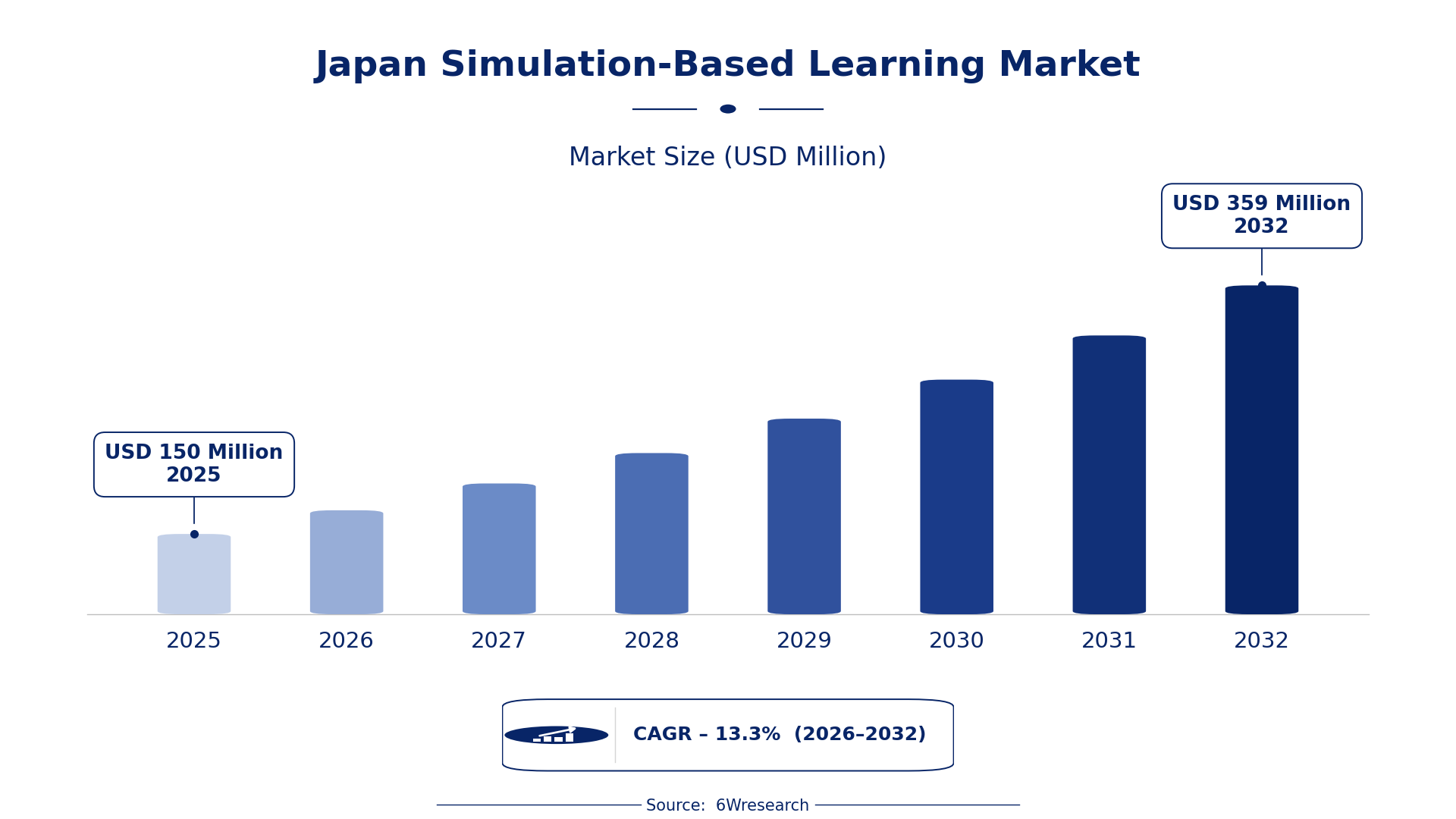
According to 6Wresearch internal database and industry insights, the Japan Simulation-Based Learning Market was valued at USD 150 Million in 2025 and is projected to reach USD 359 Million by 2032, growing at a CAGR of approximately 13.3% during 2026–2032.
Japan Simulation-Based Learning Market Highlights
| Report Metric | Details |
| Report Name | Japan Simulation-Based Learning Market (2026-2032) |
| Market Size 2025 | USD 150 Million |
| Market Size 2032 | USD 359 Million |
| Absolute Growth 2025–2032 | USD 209 Million |
| CAGR 2026–2032 | 13.3% |
| Peak Annual Growth | 14.7% in 2032 |
| Forecast Period | 2026–2032 |
| Historical Data | 2022–2025 |
| Base Year | 2025 |
| Leading Learning Type, 2025 | Medical Simulation (47% share) |
| Leading Training Field, 2025 | Aviation Training (38% share) |
| Leading Technology Used, 2025 | VR Cockpit Systems (40% share) |
| Leading End User, 2025 | Educational Institutes (37% share) |
| Fastest-Growing Learning Type | Virtual Lab Simulation (18.5% CAGR) |
| Fastest-Growing Training Field | Surgical/Diagnostic Skills (17.7% CAGR) |
| Fastest-Growing Technology Used | Haptics + AI (19.5% CAGR) |
| Fastest-Growing End User | Medical Colleges (17.0% CAGR) |
| Growing Sector | educational technology |
| Key End Users | educational institutions, medical colleges, pilot training centers, corporate trainers |
Japan Simulation-Based Learning Market Year-wise Growth Rate and Key Drivers (2022–2032)
This graph illustrates the annual growth rates of the market from 2022 to 2032, highlighting a steady upward trajectory and projected market expansion over the forecast period.
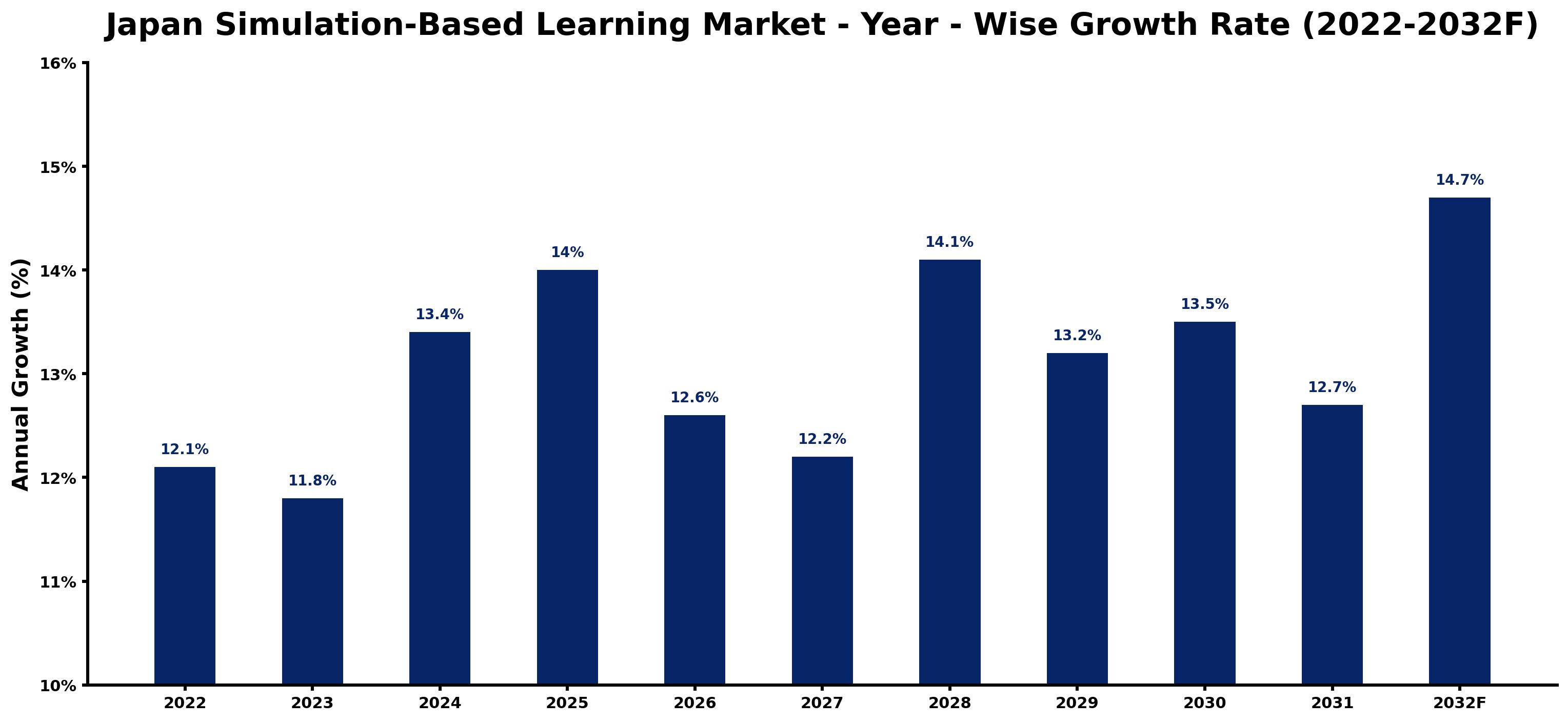
The table below sets out the estimated growth rate for each year and the main factor behind it.
| Year | Estimated Annual Growth (%) | Market Rationale |
| 2022 | 12.1 | The market experienced steady growth, driven by rising interest in STEM education. |
| 2023 | 11.8 | Growth slowed slightly due to market saturation in some educational sectors. |
| 2024 | 13.4 | Increased investment in educational technology spurred faster growth this year. |
| 2025 | 14.0 | The peak growth rate was achieved as educational reforms gained momentum. |
| 2026 | 12.6 | Growth is projected to slow as the market adjusts to previous rapid expansions. |
| 2027 | 12.2 | Continued emphasis on STEM education will maintain a positive growth trend. |
| 2028 | 14.1 | Growth is expected to accelerate again, driven by advancements in simulation technologies. |
| 2029 | 13.2 | A slight slowdown is anticipated as competition intensifies in the market. |
| 2030 | 13.5 | Growth will pick up again, supported by new educational initiatives. |
| 2031 | 12.7 | The market will continue to grow, albeit at a slower pace due to maturity. |
| 2032 | 14.7 | A surge in demand for advanced training solutions will drive peak growth. |
Note: Market size estimations and growth projections presented in this report are based on 6Wresearch's proprietary forecasting methodology, utilizing the latest available industry data, government publications, and primary research inputs.
Japan Simulation-Based Learning Market Synopsis
Simulation-Based Learning creates immersive environments using advanced software and hardware, including virtual reality and 3D modeling. The Japan Simulation-Based Learning Market is expanding due to educational reforms and a growing emphasis on STEM education, with the government allocating ¥5 billion for educational technology advancements in 2023, which drives demand from training centres and educational institutions.
Market Dynamics Impact Analysis (2026–2032)
| Factor | Type | Impact | Primary Segment Affected |
| Rising interest in STEM education | Driver | High | Educational Institutes |
| Integration of simulation in medical training | Driver | High | Medical Simulation |
| Growing demand for aviation training | Opportunity | High | Aviation Training |
| Expansion of virtual labs in universities | Opportunity | Medium | Virtual Lab Simulation |
| Limited awareness of simulation benefits | Restraint | Medium | Business Simulation |
| High initial investment costs for technology | Restraint | High | Medical Simulation |
| Competition from alternative training methods | Challenge | High | Flight Simulation |
| Technological advancements outpacing adoption rates | Challenge | Medium | VR Cockpit Systems |
Evaluation of Drivers in Japan Simulation-Based Learning Market (2026–2032)
The table below links each growth driver to the segment it affects and the evidence for it.
| Drivers | Primary Segment Affected | Why It Matters (Evidence) |
| Increased focus on STEM education | Educational Institutes | This focus has led to a higher adoption rate of simulation technologies in classrooms, with over 500 universities implementing virtual labs. |
| Integration of simulation in medical training | Medical Simulation | With 80% of medical colleges using simulation training, demand for realistic training tools has surged. |
| Growth in aviation training programmes | Aviation Training | Standards set by the National Institute of Aviation Training have driven more pilot training centres to adopt simulation technologies. |
| Expansion of virtual labs in educational settings | Virtual Lab Simulation | Over 500 universities are increasingly using virtual labs to improve practical science education. |
| Corporate training programmes adopting simulations | Business Simulation | Companies are utilising simulations to improve employee skills, reflecting a shift in training methodologies. |
Purchasing is picking up as educational institutions increasingly integrate simulation technologies into their curricula. The integration of simulation training into medical education is growing, with many medical colleges incorporating these tools. Universities are implementing virtual labs, creating substantial demand for immersive learning solutions. This trend reflects a broader shift towards modernising practices across Japan.
Evaluation of Restraints in Japan Simulation-Based Learning Market
The table below lists the restraints and the evidence behind each.
| Market Restraint | Primary Segment Affected | Why It Matters (Evidence) |
| Limited awareness of simulation benefits among educators | Business Simulation | Many educational institutions remain unaware of the advantages of simulation-based learning, hindering adoption rates. |
| High initial investment costs for simulation technologies | Medical Simulation | The upfront costs deter some training centres from investing in advanced simulation tools. |
| Competition from traditional training methods | Flight Simulation | Established training methods continue to dominate, limiting the market share of simulation technologies. |
| Slow adoption of new technologies in educational settings | Virtual Lab Simulation | Despite advancements, many institutions are hesitant to transition from traditional methods to simulations. |
| Regulatory hurdles for new educational technologies | Aviation Training | Compliance with existing educational standards can delay the implementation of new simulation tools. |
Japan Simulation-Based Learning Market Challenges
Regulatory hurdles persist, as adherence to ISO 9001 standards can delay implementation for educational institutions by up to six months. High costs of advanced software and hardware restrict access for many training centres, forcing them to operate with limited budgets and potentially compromising educational quality. Technological limitations, especially in rural areas, hinder the deployment of virtual labs, impacting over 500 universities that could otherwise enhance their offerings. Buyers face challenges in sourcing effective solutions, as the limited number of suppliers can inflate prices and reduce available options.
Trends in the Japan Simulation-Based Learning Market
Several trends are reshaping the Japan Simulation-Based Learning Market; the most important are set out below.
- Initiatives Promoting Virtual Labs in Education: The Tokyo Metropolitan Government has launched initiatives to promote VR in education, with over 500 universities adopting virtual labs for practical learning experiences.
- Growing Adoption of Medical Simulations: Medical colleges are increasingly integrating simulation training, with 80% now using it to improve surgical and diagnostic skills, reflecting a trend in healthcare education.
- Advancements in Aviation Training Technologies: The National Institute of Aviation Training is enhancing pilot training standards, leading to a surge in demand for flight simulation technologies across training centres.
- Emphasis on STEM Education: Japan's focus on STEM education has led to increased investments in educational technologies, with the government allocating ¥5 billion for advancements in 2023.
Investment Opportunities in the Japan Simulation-Based Learning Market
The following opportunities in the Japan Simulation-Based Learning Market pair current demand with a clear way in.
- Government Investment in Educational Technology: With the government allocating ¥5 billion for educational technology, there is an opportunity to invest in simulation tools for schools and universities.
- Demand for Advanced Training Solutions in Medical Colleges: Medical colleges are actively seeking simulation tools, presenting a prime opportunity for suppliers to meet this demand for improved training.
- Corporate Training Needs for Simulation Solutions: With many companies still relying on traditional training methods, there is a growing need for simulation-based corporate training solutions to improve employee skills.
- Aviation Training Centres Adopting New Technologies: Aviation training centres are increasingly adopting simulation technologies to comply with new standards, creating opportunities for suppliers to provide advanced solutions.
Government Initiatives in the Japan Simulation-Based Learning Market
The Next-Generation Medical Infrastructure Act (2017) sets standards for medical training facilities, requiring them to adopt advanced simulation technologies. This law complements the Medical Care Act (1948), which established foundational standards for healthcare training and practice, ensuring that simulation-based learning is integrated into medical education.
The Ministry of Education, Culture, Sports, Science and Technology oversees educational technology initiatives, funding projects that integrate simulation-based learning in schools. This agency supports educational institutions in adopting new training methods, ensuring compliance with national standards and improving the quality of education.
Future Insight of the Japan Simulation-Based Learning Market
A robust investment pipeline will drive demand for simulation-based learning solutions across various sectors. By 2032, advancements in virtual reality will revolutionise educational experiences, enabling more immersive learning environments. Collaborations between educational institutions and government bodies will elevate the quality of educational programmes, particularly in medical and aviation fields. The integration of simulation technologies in corporate environments will broaden, allowing companies to develop essential skills for employees in a safe, controlled setting.
Market Segmentation Analysis
Japan Simulation-Based Learning Market report covers a detailed analysis of the following market segments:
By Learning Type – Medical Simulation Leads, Virtual Lab Simulation Expected to Grow Fastest
According to Saurav Kr Singh, Senior Research Analyst at 6Wresearch, Medical Simulation held 47% of the Japan Simulation-Based Learning Market by learning type in 2025. Medical simulation holds the largest share due to its critical role in training healthcare professionals, ensuring they acquire necessary surgical and diagnostic skills. With 80% of medical colleges integrating this training, it remains a fundamental aspect of medical education in Japan. Virtual Lab Simulation is set to record the highest CAGR in this split, 18.5% over 2026–2032. Virtual lab simulation is experiencing rapid growth as educational institutions increasingly adopt it for practical science experiments, which enhances student engagement. The presence of virtual labs in over 500 universities underscores a significant shift towards this immersive technology. Suppliers should focus on improving virtual lab technologies to meet the rising demand in educational settings.
By Training Field – Aviation Training Leads, Surgical/Diagnostic Skills Expected to Grow Fastest
With 38% of training field revenue in 2025, Aviation Training was the largest category. Aviation training commands the largest share as it is essential for preparing pilots and aircrew, ensuring safety and operational efficiency. The National Institute of Aviation Training's strict standards underline the importance of this training in the aviation sector. Over 2026–2032, Surgical/Diagnostic Skills are expected to post the fastest growth, at a CAGR of 17.7%. Surgical and diagnostic skills training is witnessing swift growth as medical colleges strive to enhance skill assessment and training quality. This trend is reflected in the increasing integration of simulation into medical education practices. Buyers in the medical sector should invest in high-quality simulation tools to elevate training outcomes and adhere to educational standards.
By Technology Used – VR Cockpit Systems Lead, Haptics + AI Expected to Grow Fastest
VR Cockpit Systems accounted for 40% of the market by technology used in 2025. VR cockpit systems dominate the market as they provide realistic training experiences crucial for pilot training, making them indispensable in aviation education. Their widespread application in aviation training ensures a consistent and immersive learning environment for trainees. Haptics + AI is projected to grow fastest, at a CAGR of 19.5% during 2026–2032. Haptics combined with AI is set for rapid growth as it enhances the realism of simulations, although current adoption rates are limited. As technology advances, its integration into training programmes is expected to increase, driving further demand. Suppliers must prioritise the development of haptic technologies to stay competitive as the need for more immersive training experiences grows.
By End User – Educational Institutes Lead, Medical Colleges Expected to Grow Fastest
Educational Institutes took 37% of end user revenue in 2025, more than any other category. Educational institutes represent the largest user group for simulation-based learning, as they are the primary providers of education and training across various fields. Their commitment to integrating advanced technologies into curricula ensures a steady demand for simulation solutions. The quickest growth will come from Medical Colleges, forecast to expand at a CAGR of 17.0% between 2026 and 2032. Medical colleges are experiencing the fastest growth as they increasingly adopt simulation for medical training and skill assessment. This trend reflects the urgent need for effective training solutions in the healthcare sector. Suppliers must tailor their offerings to meet the specific needs of medical colleges to capitalise on this growing market segment.
Key Attractiveness of the Report
- 10 Years of Market Numbers
- Historical Data Starting from 2022 to 2025
- Base Year 2025
- Forecast Data until 2032
- Key Performance Indicators Impacting the Market
- Major Upcoming Developments and Projects
Key Highlights of the Report:
- Japan Simulation-Based Learning Market Outlook
- Market Size of Japan Simulation-Based Learning Market, 2025
- Forecast of Japan Simulation-Based Learning Market, 2032
- Historical Data and Forecast of Japan Simulation-Based Learning Revenues & Volume for the Period 2022-2032F
- Japan Simulation-Based Learning Market Trend Evolution
- Japan Simulation-Based Learning Market Drivers and Challenges
- Japan Simulation-Based Learning Price Trends
- Japan Simulation-Based Learning Porter's Five Forces
- Japan Simulation-Based Learning Industry Life Cycle
- Historical Data and Forecast of Japan Simulation-Based Learning Market Revenues & Volume By Learning Type for the Period 2022-2032F
- Historical Data and Forecast of Japan Simulation-Based Learning Market Revenues & Volume By Virtual Lab Simulation for the Period 2022-2032F
- Historical Data and Forecast of Japan Simulation-Based Learning Market Revenues & Volume By Flight Simulation for the Period 2022-2032F
- Historical Data and Forecast of Japan Simulation-Based Learning Market Revenues & Volume By Medical Simulation for the Period 2022-2032F
- Historical Data and Forecast of Japan Simulation-Based Learning Market Revenues & Volume By Business Simulation for the Period 2022-2032F
- Historical Data and Forecast of Japan Simulation-Based Learning Market Revenues & Volume By Training Field for the Period 2022-2032F
- Historical Data and Forecast of Japan Simulation-Based Learning Market Revenues & Volume By Science/Engineering for the Period 2022-2032F
- Historical Data and Forecast of Japan Simulation-Based Learning Market Revenues & Volume By Aviation Training for the Period 2022-2032F
- Historical Data and Forecast of Japan Simulation-Based Learning Market Revenues & Volume By Surgical/Diagnostic Skills for the Period 2022-2032F
- Historical Data and Forecast of Japan Simulation-Based Learning Market Revenues & Volume By Strategic Planning for the Period 2022-2032F
- Historical Data and Forecast of Japan Simulation-Based Learning Market Revenues & Volume By Technology Used for the Period 2022-2032F
- Historical Data and Forecast of Japan Simulation-Based Learning Market Revenues & Volume By Browser/3D Models for the Period 2022-2032F
- Historical Data and Forecast of Japan Simulation-Based Learning Market Revenues & Volume By VR Cockpit Systems for the Period 2022-2032F
- Historical Data and Forecast of Japan Simulation-Based Learning Market Revenues & Volume By Haptics + AI for the Period 2022-2032F
- Historical Data and Forecast of Japan Simulation-Based Learning Market Revenues & Volume By Scenario Engines for the Period 2022-2032F
- Historical Data and Forecast of Japan Simulation-Based Learning Market Revenues & Volume By End User for the Period 2022-2032F
- Historical Data and Forecast of Japan Simulation-Based Learning Market Revenues & Volume By Educational Institutes for the Period 2022-2032F
- Historical Data and Forecast of Japan Simulation-Based Learning Market Revenues & Volume By Pilot Training Centers for the Period 2022-2032F
- Historical Data and Forecast of Japan Simulation-Based Learning Market Revenues & Volume By Medical Colleges for the Period 2022-2032F
- Historical Data and Forecast of Japan Simulation-Based Learning Market Revenues & Volume By Corporate Trainers for the Period 2022-2032F
- Japan Simulation-Based Learning Import Export Trade Statistics
- Market Opportunity Assessment By Learning Type
- Market Opportunity Assessment By Training Field
- Market Opportunity Assessment By Technology Used
- Market Opportunity Assessment By End User
- Japan Simulation-Based Learning Top Companies Market Share
- Japan Simulation-Based Learning Competitive Benchmarking By Technical and Operational Parameters
- Japan Simulation-Based Learning Company Profiles
- Japan Simulation-Based Learning Key Strategic Recommendations
Market Covered
Segments analysed in this report are listed below.
By Learning Type
- Virtual Lab Simulation
- Flight Simulation
- Medical Simulation
- Business Simulation
By Training Field
- Science/Engineering
- Aviation Training
- Surgical/Diagnostic Skills
- Strategic Planning
By Technology Used
- Browser/3D Models
- VR Cockpit Systems
- Haptics + AI
- Scenario Engines
By End User
- Educational Institutes
- Pilot Training Centers
- Medical Colleges
- Corporate Trainers































