Japan Simulation Platforms Market Size & Growth Rate
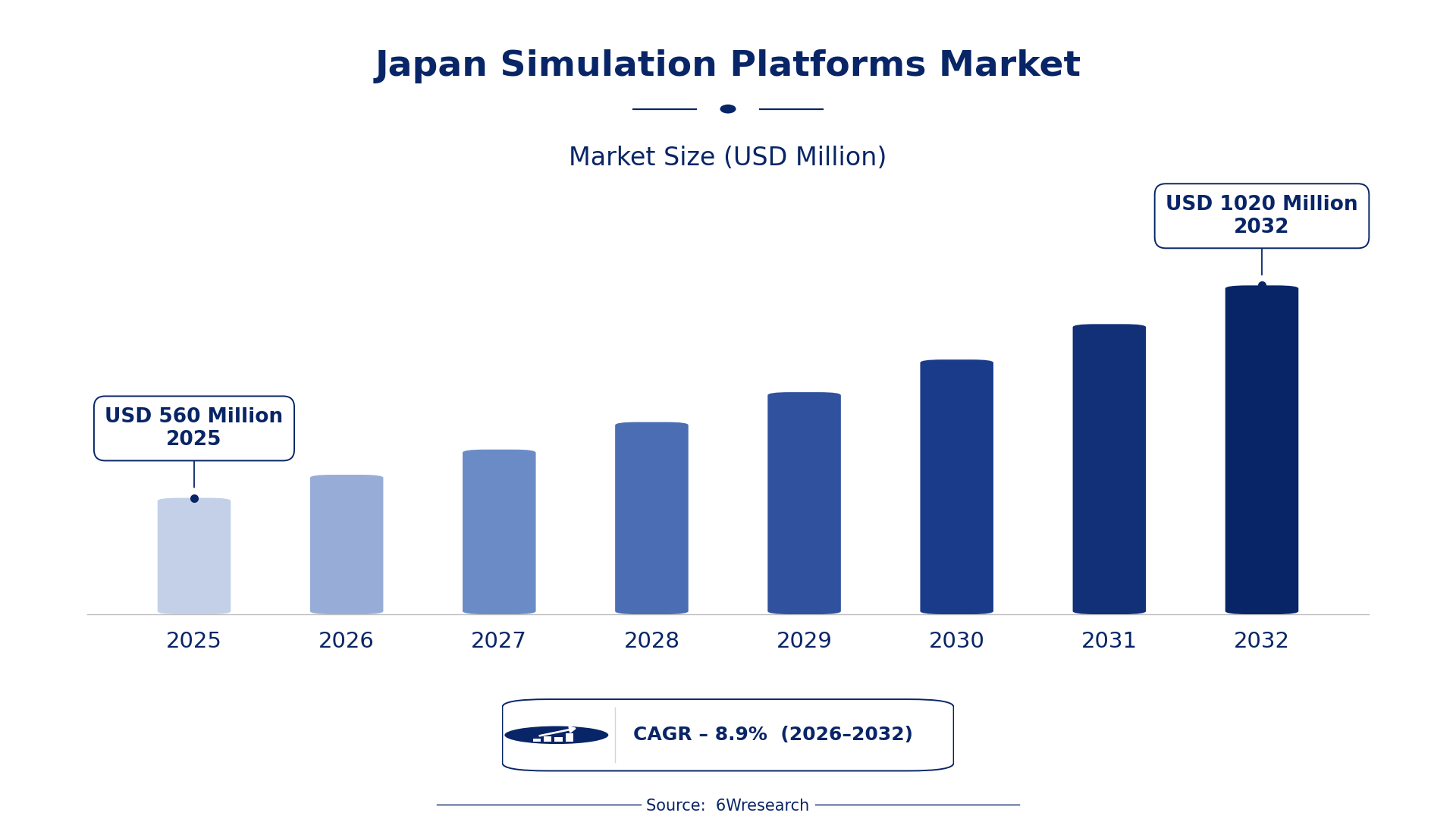
According to 6Wresearch internal database and industry insights, the Japan Simulation Platforms Market was valued at USD 560 Million in 2025 and is projected to reach USD 1,020 Million by 2032, growing at a CAGR of approximately 8.9% during 2026–2032.
Japan Simulation Platforms Market Highlights
| Report Metric | Details |
| Report Name | Japan Simulation Platforms Market (2026-2032) |
| Market Size 2025 | USD 560 Million |
| Market Size 2032 | USD 1,020 Million |
| Absolute Growth 2025–2032 | USD 460 Million |
| CAGR 2026–2032 | 8.9% |
| Peak Annual Growth | 9.4% in 2028 |
| Forecast Period | 2026–2032 |
| Historical Data | 2022–2025 |
| Base Year | 2025 |
| Leading Platform Type, 2025 | Physics Simulation (45% share) |
| Leading Use Case, 2025 | Engineering Design (36% share) |
| Leading Integration Support, 2025 | CAD/CAE (42% share) |
| Leading End User, 2025 | Industrial Design Firms (44% share) |
| Fastest-Growing Platform Type | Traffic Simulation (12.6% CAGR) |
| Fastest-Growing Use Case | Mobility Infrastructure (11.8% CAGR) |
| Fastest-Growing Integration Support | GIS/IoT (12.1% CAGR) |
| Fastest-Growing End User | Government Transport Depts (11.6% CAGR) |
| Growing Sector | Robotics Development |
| Key End Users | Industrial Design Firms, Robotics Companies, Government Transport Departments, Defense Contractors |
Japan Simulation Platforms Market Year-wise Growth Rate and Key Drivers (2022–2032)
This graph illustrates the annual growth rates of the market from 2022 to 2032, highlighting a steady upward trajectory and projected market expansion over the forecast period.
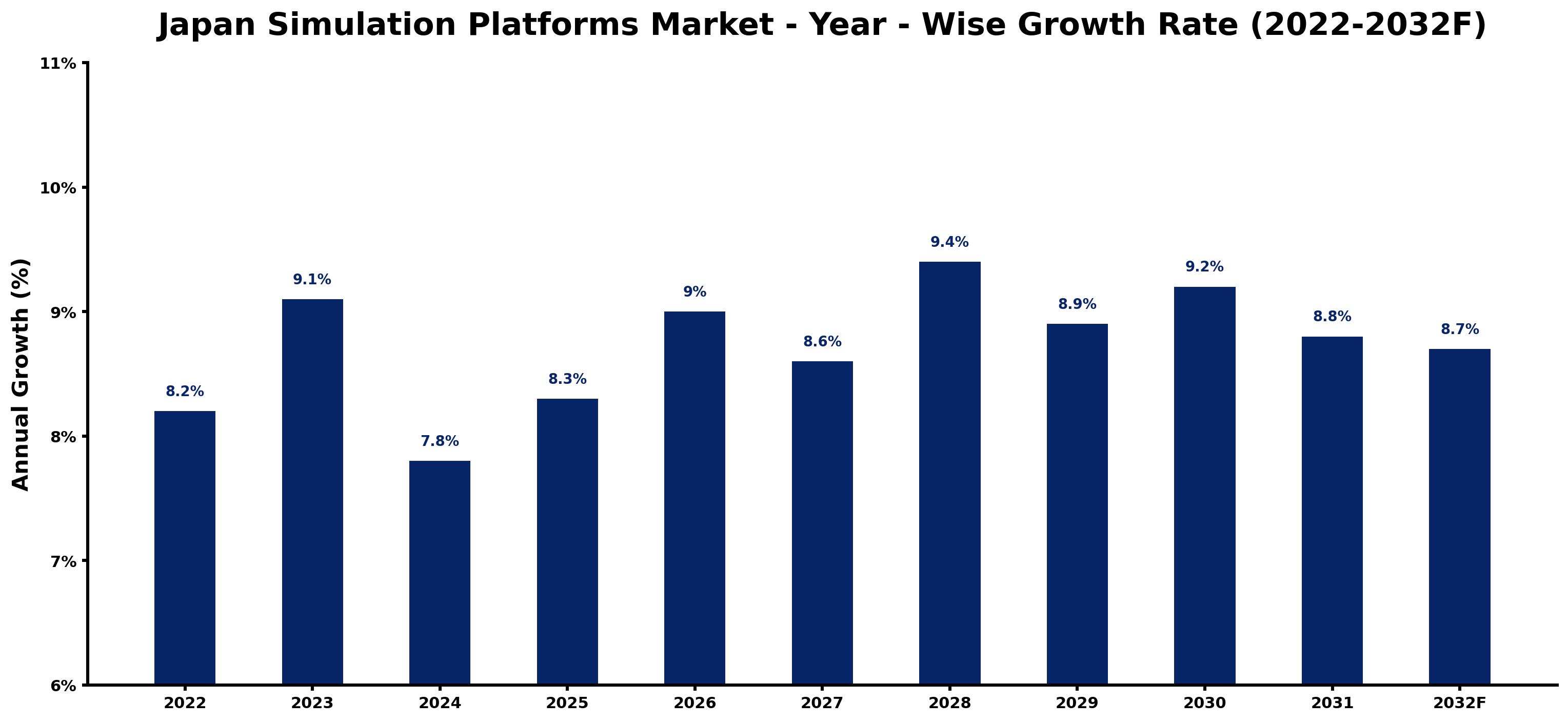
For each year, the table pairs the estimated growth rate with the leading influence on demand, showing how the drivers changed across the period.
| Year | Estimated Annual Growth (%) | Market Rationale |
| 2022 | 8.2 | The market experienced steady growth due to increasing interest in simulation technologies. |
| 2023 | 9.1 | Demand rose as industries adopted advanced simulation for design and training. |
| 2024 | 7.8 | Growth slowed as some sectors reassessed their technology investments. |
| 2025 | 8.3 | A resurgence in demand followed as industries ramped up their simulation capabilities. |
| 2026 | 9.0 | Urban planning initiatives are expected to stimulate market growth. |
| 2027 | 8.6 | Growth is projected to slow slightly as market maturity sets in. |
| 2028 | 9.4 | Demand is set to surge with new projects in robotics and urban planning. |
| 2029 | 8.9 | A slight slowdown is anticipated as some sectors consolidate their technologies. |
| 2030 | 9.2 | Growth is expected to rise again as new standards in simulation are adopted. |
| 2031 | 8.8 | The market is anticipated to slow as it stabilises after rapid expansion. |
| 2032 | 8.7 | Growth will continue at a steady pace as industries further integrate simulation. |
Note: Market size estimations and growth projections presented in this report are based on 6Wresearch's proprietary forecasting methodology, utilizing the latest available industry data, government publications, and primary research inputs.
Japan Simulation Platforms Market Synopsis
Simulation platforms are advanced software tools that create digital representations of physical systems, essential for engineering design, traffic management, robotics development, and military training. The Japan Simulation Platforms Market is expanding due to rising demand from domestic industries and exports, particularly in robotics and urban planning. The government is investing heavily in AI and simulation technologies, with initiatives like 'Society 5.0' driving innovation and adoption across various sectors.
Market Dynamics Impact Analysis (2026–2032)
| Factor | Type | Impact | Primary Segment Affected |
| Growing adoption of simulation in engineering design | Driver | High | Engineering Design |
| Increased focus on urban planning and traffic management | Driver | High | Traffic Simulation |
| Rising demand for advanced robotics solutions | Opportunity | High | Robotics Simulation |
| Expansion of smart mobility initiatives in urban areas | Opportunity | High | Traffic Simulation |
| High initial investment costs for simulation technologies | Restraint | Medium | Engineering Design |
| Limited awareness of simulation benefits among smaller firms | Restraint | Medium | Robotics Simulation |
| Challenges in integrating simulation with existing systems | Challenge | High | CAD/CAE |
| Shortage of skilled professionals in simulation technologies | Challenge | High | Robotics Simulation |
Evaluation of Drivers in Japan Simulation Platforms Market (2026–2032)
Demand rests on the following drivers, each shown with the segment it touches most.
| Drivers | Primary Segment Affected | Why It Matters (Evidence) |
| Increased investment in robotics | Robotics Simulation | Japan's robotics sector is projected to reach 2.5 million units by 2025, driving demand for simulation tools. |
| Growing urbanisation and traffic congestion | Traffic Simulation | Tokyo's smart mobility initiatives are increasing the need for traffic simulation solutions. |
| Rising complexity in engineering designs | Engineering Design | The integration of ISO 26262 standards in automotive simulations boosts demand for advanced design tools. |
| Government initiatives promoting AI and simulation | Military Simulation | The 'Society 5.0' initiative is increasing investments in simulation technologies for defence applications. |
| Expansion of industrial design firms | Industrial Design Firms | Over 1,000 industrial design firms in Japan are utilising simulation platforms for product development. |
Spending is rising due to the increasing complexity of engineering designs, with ISO 26262 standards driving demand for simulation tools in automotive applications. The robotics sector is expected to reach 2.5 million units by 2025, resulting in greater demand for robotics simulation. Support for AI and simulation technologies is boosting investments in military simulation, further expanding the market. The presence of over 1,000 industrial design firms utilising these platforms highlights the growing necessity for simulation tools.
Evaluation of Restraints in Japan Simulation Platforms Market
Below are the constraints most often cited by buyers and suppliers, with the segment each affects.
| Market Restraint | Primary Segment Affected | Why It Matters (Evidence) |
| High initial investment costs for simulation technologies | Engineering Design | The cost of advanced simulation tools can deter smaller firms from adopting them. |
| Limited awareness of simulation benefits among smaller firms | Robotics Simulation | Many smaller robotics companies lack knowledge about the advantages of simulation, hindering adoption. |
| Integration challenges with existing systems | CAD/CAE | Existing systems may not easily incorporate new simulation technologies, causing delays. |
| Shortage of skilled professionals in simulation technologies | Robotics Simulation | The lack of trained personnel limits the effective use of simulation tools in development. |
| Regulatory compliance requirements | Military Simulation | Strict regulations complicate the implementation of simulation technologies in defence. |
Japan Simulation Platforms Market Challenges
Buyers in the robotics sector encounter high costs stemming from limited access to advanced simulation platforms, which can delay product development timelines by up to six months. Intense competition from international firms pressures suppliers to lower margins by approximately 15%, affecting their profitability. Slow technology adoption results from the gradual integration of AI in simulation processes, leading to a productivity loss of around 20% for firms that do not innovate. Skills shortages in simulation expertise cause project delays, costing companies up to ¥5 million per project in additional training expenses.
Trends in the Japan Simulation Platforms Market
Buyers and suppliers in the Japan Simulation Platforms Market are adjusting to the following trends.
- Shift from Traditional to Advanced Simulation Techniques: Since 2021, industries have been transitioning to advanced simulation techniques to enhance accuracy. The Tokyo Metropolitan Government's smart mobility initiatives exemplify this trend, with a projected investment of ¥10 billion in advanced technologies.
- Transition from Physical to Virtual Testing: In 2023, the trend towards virtual testing gained traction, particularly in robotics. The Aichi Prefecture's emphasis on robotics development is propelling this shift, with substantial investments in simulation capabilities.
- Emergence of AI-Driven Simulation Platforms: Starting in 2025, AI-driven simulation platforms are becoming increasingly common. The Japanese government's AI Promotion Act aims to create a framework for AI integration, improving simulation capabilities across sectors.
- Prioritisation of Traffic Simulation in Urban Planning: Since 2022, traffic simulation has been prioritised in urban planning initiatives. The Ministry of Land, Infrastructure, Transport and Tourism is spearheading this effort, promoting effective traffic management solutions.
Investment Opportunities in the Japan Simulation Platforms Market
Below are the investment opportunities with the strongest case in the Japan Simulation Platforms Market.
- Gap in Advanced Robotics Simulation: With Japan's robotics sector projected to reach 2.5 million units by 2025, there is an opportunity to provide advanced robotics simulation tools. Robotics companies are seeking partners to refine their development processes.
- Expansion of Smart Mobility Solutions: Tokyo's smart mobility initiatives offer an opportunity to supply traffic simulation technologies. Companies can enter this market through collaborations with local government agencies.
- Investment in Military Simulation Technologies: The Japanese government's focus on military training creates an opportunity for suppliers of military simulation platforms. Partnering with defence contractors can facilitate market entry.
- Growing Demand for CAD/CAE Integration: With CAD/CAE holding a 42% share in integration support, there is a demand for improved simulation tools. Industrial design firms are pursuing partnerships to enhance their design validation processes.
Government Initiatives in the Japan Simulation Platforms Market
The Electrical Appliance and Material Safety Act of 1961 ensures simulation platforms meet safety standards, affecting both producers and users. This law mandates compliance with safety regulations, shaping the operational framework for simulation technologies.
The Digital Agency funds projects that encourage the adoption of simulation technologies across various sectors, improving operational efficiencies and integration. This agency plays a key role in advancing digital transformation initiatives.
Future Insight of the Japan Simulation Platforms Market
The introduction of smart mobility projects in Tokyo will drive demand for advanced simulation platforms by 2032. Government investments in AI and simulation technologies under the 'Society 5.0' initiative will improve capabilities across various sectors. With the government allocating ¥10 billion for advanced technology research, suppliers will need to adjust their offerings to meet specific requirements. The emphasis on traffic management simulations will further stimulate innovation and integration of these technologies in urban planning.
Market Segmentation Analysis
Japan Simulation Platforms Market report covers a detailed analysis of the following market segments:
By Platform Type – Physics Simulation Leads, Traffic Simulation Expected to Grow Fastest
According to Saurav Kr Singh, Senior Research Analyst at 6Wresearch, Physics Simulation took 45% of platform type revenue in 2025, more than any other category. Physics Simulation holds the largest share due to its critical application in engineering and scientific fields, particularly in sectors like automotive and aerospace. The adoption of ISO 26262 standards in automotive simulations underscores its importance in ensuring safety and compliance. The quickest growth will come from Traffic Simulation, forecast to expand at a CAGR of 12.6% between 2026 and 2032. Traffic Simulation is witnessing rapid growth driven by increasing urbanisation and the need for effective traffic management solutions. Initiatives from the Ministry of Land, Infrastructure, Transport and Tourism, alongside smart mobility projects in Tokyo, are propelling this segment forward. Suppliers should prioritise the development of traffic simulation tools to align with the rising urban planning demands.
By Use Case – Engineering Design Leads, Mobility Infrastructure Expected to Grow Fastest
Engineering Design held 36% of the Japan Simulation Platforms Market by use case in 2025. Engineering Design leads the market as it is integral to the design process across various engineering fields, ensuring that products meet required specifications and performance standards. The presence of over 1,000 industrial design firms in Japan underscores the high demand for these platforms. Mobility Infrastructure is projected to grow fastest, at a CAGR of 11.8% during 2026–2032. Mobility Infrastructure is the fastest-growing segment, fuelled by the need for effective infrastructure planning in response to urbanisation. Government investments in smart mobility projects are propelling this growth, indicating a shift towards more advanced planning solutions. Buyers in mobility infrastructure should seek advanced simulation solutions to optimise their planning processes.
By Integration Support – CAD/CAE Leads, GIS/IoT Expected to Grow Fastest
With 42% of integration support revenue in 2025, CAD/CAE was the largest category. CAD/CAE integration leads the market as it is essential for design validation, enabling engineers to test and refine their designs efficiently. Its widespread use across various industries confirms the necessity of simulation platforms in the design process. Over 2026–2032, GIS/IoT is expected to post the fastest growth, at a CAGR of 12.1%. GIS/IoT integration is growing swiftly, particularly due to the increasing need for data-driven insights in urban planning. The emergence of smart city projects highlights the demand for improved data connectivity within simulation platforms. Suppliers must focus on enhancing GIS/IoT integration capabilities to meet the rising demand for data connectivity in simulations.
By End User – Industrial Design Firms Lead, Government Transport Depts Expected to Grow Fastest
In 2025, Industrial Design Firms led the end user split with a 44% share. Industrial Design Firms dominate the market as they heavily rely on simulation platforms for product development, ensuring quality and efficiency in their processes. Their substantial presence in the industry drives ongoing demand for advanced simulation tools. Government Transport Depts are set to record the highest CAGR in this split, 11.6% over 2026–2032. Government Transport Departments are the fastest-growing end user, employing simulation for traffic and infrastructure planning to enhance urban mobility. Their heightened focus on smart transportation solutions is a significant factor contributing to this growth. Suppliers should customise their offerings to address the specific requirements of government transport departments for effective planning.
Key Attractiveness of the Report
- 10 Years of Market Numbers
- Historical Data Starting from 2022 to 2025
- Base Year 2025
- Forecast Data until 2032
- Key Performance Indicators Impacting the Market
- Major Upcoming Developments and Projects
Key Highlights of the Report:
- Japan Simulation Platforms Market Outlook
- Market Size of Japan Simulation Platforms Market, 2025
- Forecast of Japan Simulation Platforms Market, 2032
- Historical Data and Forecast of Japan Simulation Platforms Revenues & Volume for the Period 2022-2032F
- Japan Simulation Platforms Market Trend Evolution
- Japan Simulation Platforms Market Drivers and Challenges
- Japan Simulation Platforms Price Trends
- Japan Simulation Platforms Porter's Five Forces
- Japan Simulation Platforms Industry Life Cycle
- Historical Data and Forecast of Japan Simulation Platforms Market Revenues & Volume By Platform Type for the Period 2022-2032F
- Historical Data and Forecast of Japan Simulation Platforms Market Revenues & Volume By Physics Simulation for the Period 2022-2032F
- Historical Data and Forecast of Japan Simulation Platforms Market Revenues & Volume By Traffic Simulation for the Period 2022-2032F
- Historical Data and Forecast of Japan Simulation Platforms Market Revenues & Volume By Robotics Simulation for the Period 2022-2032F
- Historical Data and Forecast of Japan Simulation Platforms Market Revenues & Volume By Military Simulation for the Period 2022-2032F
- Historical Data and Forecast of Japan Simulation Platforms Market Revenues & Volume By Use Case for the Period 2022-2032F
- Historical Data and Forecast of Japan Simulation Platforms Market Revenues & Volume By Engineering Design for the Period 2022-2032F
- Historical Data and Forecast of Japan Simulation Platforms Market Revenues & Volume By Mobility Infrastructure for the Period 2022-2032F
- Historical Data and Forecast of Japan Simulation Platforms Market Revenues & Volume By Motion & Control for the Period 2022-2032F
- Historical Data and Forecast of Japan Simulation Platforms Market Revenues & Volume By Combat Training for the Period 2022-2032F
- Historical Data and Forecast of Japan Simulation Platforms Market Revenues & Volume By Integration Support for the Period 2022-2032F
- Historical Data and Forecast of Japan Simulation Platforms Market Revenues & Volume By CAD/CAE for the Period 2022-2032F
- Historical Data and Forecast of Japan Simulation Platforms Market Revenues & Volume By GIS/IoT for the Period 2022-2032F
- Historical Data and Forecast of Japan Simulation Platforms Market Revenues & Volume By ROS Support for the Period 2022-2032F
- Historical Data and Forecast of Japan Simulation Platforms Market Revenues & Volume By VR/AR Interfaces for the Period 2022-2032F
- Historical Data and Forecast of Japan Simulation Platforms Market Revenues & Volume By End User for the Period 2022-2032F
- Historical Data and Forecast of Japan Simulation Platforms Market Revenues & Volume By Industrial Design Firms for the Period 2022-2032F
- Historical Data and Forecast of Japan Simulation Platforms Market Revenues & Volume By Government Transport Depts for the Period 2022-2032F
- Historical Data and Forecast of Japan Simulation Platforms Market Revenues & Volume By Robotics Companies for the Period 2022-2032F
- Historical Data and Forecast of Japan Simulation Platforms Market Revenues & Volume By Defense Contractors for the Period 2022-2032F
- Japan Simulation Platforms Import Export Trade Statistics
- Market Opportunity Assessment By Platform Type
- Market Opportunity Assessment By Use Case
- Market Opportunity Assessment By Integration Support
- Market Opportunity Assessment By End User
- Japan Simulation Platforms Top Companies Market Share
- Japan Simulation Platforms Competitive Benchmarking By Technical and Operational Parameters
- Japan Simulation Platforms Company Profiles
- Japan Simulation Platforms Key Strategic Recommendations
Market Covered
Coverage by segment is as follows.
By Platform Type
- Physics Simulation
- Traffic Simulation
- Robotics Simulation
- Military Simulation
By Use Case
- Engineering Design
- Mobility Infrastructure
- Motion & Control
- Combat Training
By Integration Support
- CAD/CAE
- GIS/IoT
- ROS Support
- VR/AR Interfaces
By End User
- Industrial Design Firms
- Government Transport Depts
- Robotics Companies
- Defense Contractors































