Japan Skin Hydration Market Size & Growth Rate
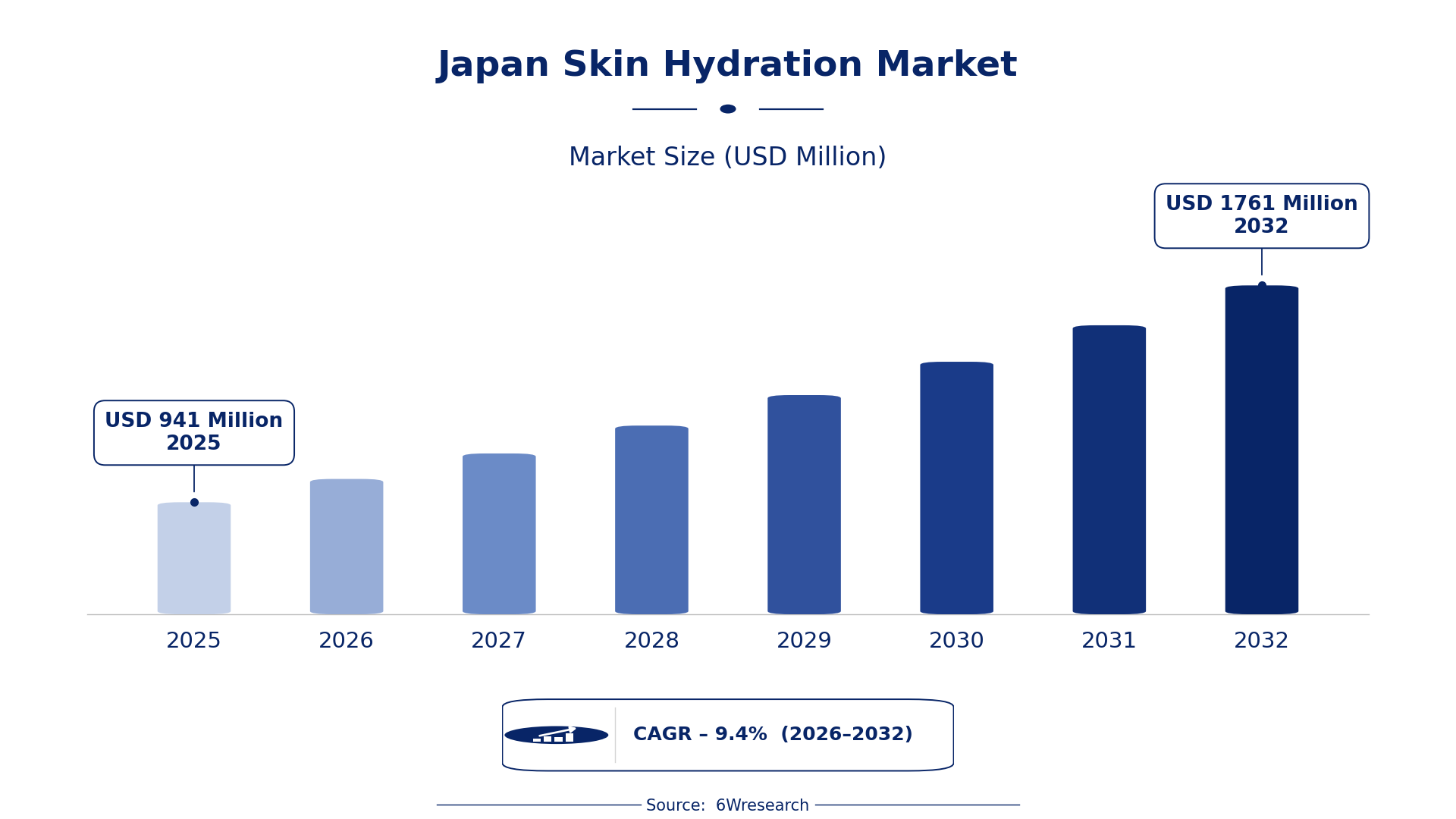
According to 6Wresearch internal database and industry insights, the Japan Skin Hydration Market was valued at USD 941 Million in 2025 and is projected to reach USD 1,761 Million by 2032, growing at a CAGR of approximately 9.4% during 2026–2032.
Japan Skin Hydration Market Highlights
| Report Metric | Details |
| Report Name | Japan Skin Hydration Market (2026-2032) |
| Market Size 2025 | USD 941 Million |
| Market Size 2032 | USD 1,761 Million |
| Absolute Growth 2025–2032 | USD 820 Million |
| CAGR 2026–2032 | 9.4% |
| Peak Annual Growth | 10.4% in 2027 |
| Forecast Period | 2026–2032 |
| Historical Data | 2022–2025 |
| Base Year | 2025 |
| Leading Product Type, 2025 | Moisturizers (40% share) |
| Leading Hydration Mechanism, 2025 | Occlusive/Emollient (54% share) |
| Leading Application Form, 2025 | Cream/Lotion (42% share) |
| Leading End User, 2025 | Skincare Brands (35% share) |
| Fastest-Growing Product Type | Face Mists (13.1% CAGR) |
| Fastest-Growing Hydration Mechanism | Humectant + Water (12.6% CAGR) |
| Fastest-Growing Application Form | Spray (12.7% CAGR) |
| Fastest-Growing End User | Beauty Retail Chains (12.1% CAGR) |
| Growing Sector | skincare |
| Key End Users | skincare brands, beauty retail chains, dermatology clinics |
Japan Skin Hydration Market Year-wise Growth Rate and Key Drivers (2022–2032)
This graph illustrates the annual growth rates of the market from 2022 to 2032, highlighting a steady upward trajectory and projected market expansion over the forecast period.
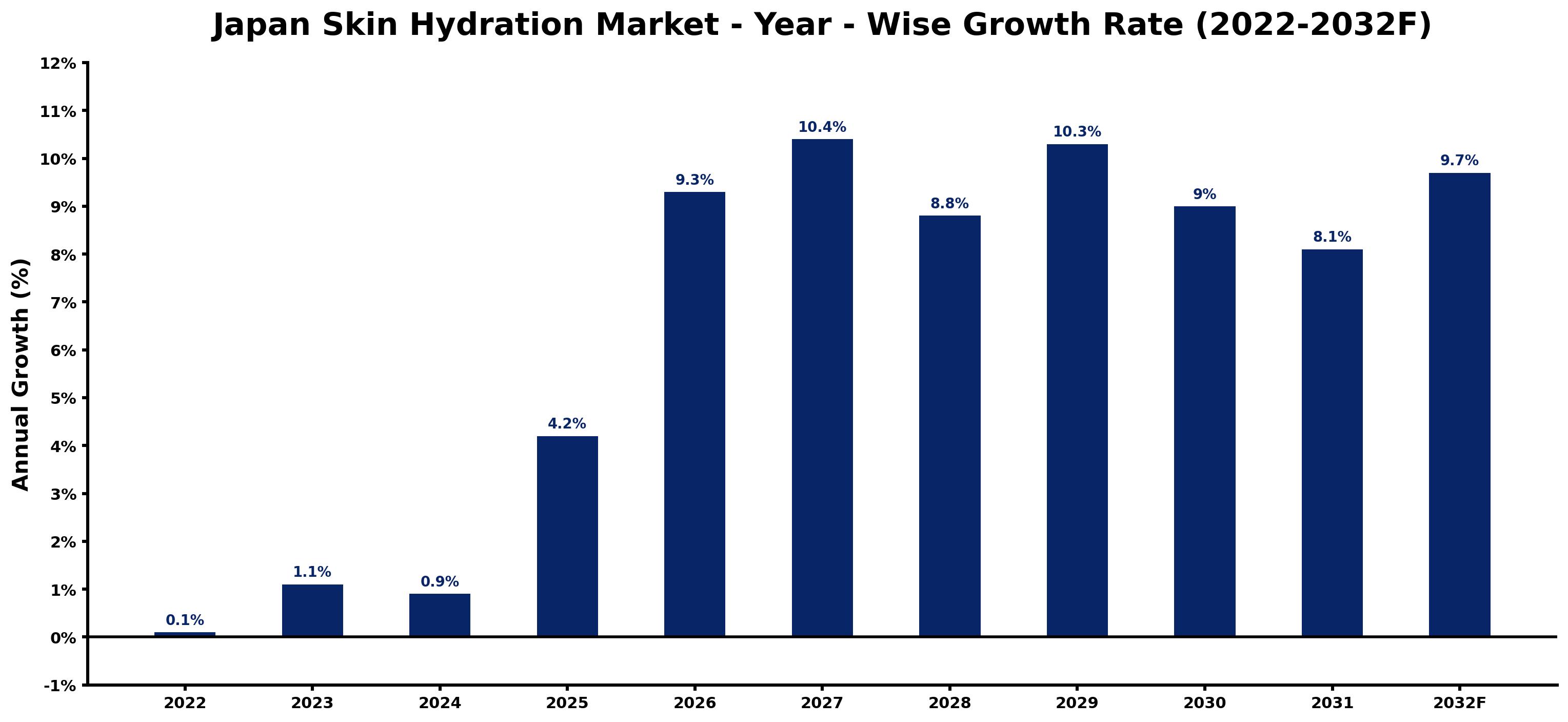
For each year, the table pairs the estimated growth rate with the leading influence on demand, showing how the drivers changed across the period.
| Year | Estimated Annual Growth (%) | Market Rationale |
| 2022 | 0.1 | The market showed minimal growth due to cautious consumer spending. |
| 2023 | 1.1 | Growth accelerated as consumers returned to their skincare routines after restrictions eased. |
| 2024 | 0.9 | A slight slowdown occurred as market conditions stabilised following the previous year's surge. |
| 2025 | 4.2 | Growth surged as new product launches and marketing campaigns gained traction. |
| 2026 | 9.3 | Demand is expected to rise sharply due to increased awareness of skincare benefits. |
| 2027 | 10.4 | The market is projected to peak with heightened consumer interest in hydration products. |
| 2028 | 8.8 | A slowdown will follow as market saturation begins to set in. |
| 2029 | 10.3 | Growth is expected to rebound as new formulations attract buyers. |
| 2030 | 9.0 | The market will experience another slowdown as competition intensifies. |
| 2031 | 8.1 | Growth will continue but at a reduced pace due to market maturity. |
| 2032 | 9.7 | Demand is expected to rise again as new trends emerge. |
Note: Market size estimations and growth projections presented in this report are based on 6Wresearch's proprietary forecasting methodology, utilizing the latest available industry data, government publications, and primary research inputs.
Japan Skin Hydration Market Synopsis
Skin hydration products in Japan include moisturizers, face mists, hydrating masks, and hyaluronic acid serums, designed to improve skin moisture and appearance. The Japan Skin Hydration Market is expanding due to rising consumer awareness, a strong skincare culture, and increasing sales through beauty retail chains. Valued at approximately 1.3 trillion yen in 2022, moisturizers account for 40% of total sales and reflect ongoing growth in the sector.
Market Dynamics Impact Analysis (2026–2032)
| Factor | Type | Impact | Primary Segment Affected |
| Rising consumer awareness of skincare benefits | Driver | High | Moisturizers |
| Increased product innovation in hydration formulations | Driver | High | Hyaluronic Acid Serums |
| Growing demand for convenient hydration solutions | Opportunity | High | Face Mists |
| Expansion of e-commerce platforms for skincare products | Opportunity | Medium | Hydrating Masks |
| Intense competition among skincare brands | Restraint | High | Moisturizers |
| Market saturation in key urban areas | Restraint | Medium | Hyaluronic Acid Serums |
| Price sensitivity among consumers | Challenge | High | Face Mists |
| Regulatory compliance costs for new products | Challenge | Medium | Hydrating Masks |
Evaluation of Drivers in Japan Skin Hydration Market (2026–2032)
Key forces behind demand, with the segment each one moves most, are listed below.
| Drivers | Primary Segment Affected | Why It Matters (Evidence) |
| Increased consumer interest in skincare routines | Moisturizers | Approximately 80% of dermatology clinics recommend hydration products to their patients, driving higher sales. |
| Growing popularity of hyaluronic acid in formulations | Hyaluronic Acid Serums | Hyaluronic acid is a key ingredient in 70% of moisturizers sold, boosting demand for targeted hydration. |
| Rise in skincare product usage among consumers | Face Mists | The average Japanese consumer uses 6 skincare products daily, leading to higher demand for quick hydration solutions. |
| Expansion of beauty retail chains across Japan | Hydrating Masks | Beauty retail chains are major distributors, increasing access to hydration products for consumers. |
| Effective marketing strategies targeting younger demographics | Moisturizers | Skincare brands are focusing on women aged 20-40, who are key consumers in the hydration market. |
Much of the new demand traces back to heightened consumer interest in skincare routines, with approximately 80% of dermatology clinics recommending hydration products. The average Japanese consumer uses 6 skincare products daily, leading to increased purchases of face mists and moisturizers. The popularity of hyaluronic acid as a key ingredient drives demand for serums, as it is found in 70% of moisturizers sold. The expansion of beauty retail chains improves access to hydrating masks, while targeted marketing strategies further boost sales among younger consumers.
Evaluation of Restraints in Japan Skin Hydration Market
These restraints slow adoption and weigh on supplier margins.
| Market Restraint | Primary Segment Affected | Why It Matters (Evidence) |
| High competition affecting profit margins | Moisturizers | Intense competition among brands results in price reductions, impacting profitability. |
| Market saturation in urban areas | Hyaluronic Acid Serums | With many options available, consumers may struggle to choose, limiting growth potential. |
| Regulatory compliance costs for new products | Face Mists | Meeting stringent regulations increases costs for manufacturers, affecting pricing strategies. |
| Consumer price sensitivity impacting premium products | Hydrating Masks | Price sensitivity leads consumers to opt for lower-cost alternatives, affecting premium product sales. |
| Limited awareness of product benefits among older demographics | Hyaluronic Acid Serums | Older consumers may not fully understand the benefits, reducing potential market size. |
Japan Skin Hydration Market Challenges
High demand for skin hydration products leads to fierce competition among buyers, pushing average moisturiser prices to about 3,000 yen, which limits options for consumers. Production delays arise from the need for advanced technology in formulation, resulting in potential shortages that retailers may face, affecting their sales. Regulatory complexities, including compliance with ISO 16128, extend product development timelines, causing longer waits for suppliers to introduce new offerings. Continuous advancements in skincare technology require substantial investment, which can burden smaller producers and hinder their ability to compete effectively.
Trends in the Japan Skin Hydration Market
Several trends are reshaping the Japan Skin Hydration Market; the most important are set out below.
- Shift towards Natural Ingredients in Skincare: Tokyo is experiencing a shift towards natural ingredients in skincare products, with ISO 16128 promoting organic formulations. In 2023, 30% of new products launched featured natural ingredients, appealing to health-conscious consumers.
- Increase in Multi-functional Skincare Products: The trend towards multi-functional products is growing, with face mists combining hydration and sun protection. In 2023, 25% of face mist sales included SPF, catering to consumer demand for convenience.
- Growth of Online Skincare Retailing: The Tokyo Beauty Week 2023 showcased innovations in online skincare retailing, with e-commerce sales increasing by 40% in the past year. This shift allows consumers easier access to hydration products.
- Emergence of Subscription Services for Skincare: Subscription services for skincare products are gaining traction, with a reported 20% increase in users in 2023. These services offer personalised hydration solutions, appealing to busy consumers.
Investment Opportunities in the Japan Skin Hydration Market
The following opportunities in the Japan Skin Hydration Market pair current demand with a clear way in.
- Gap in Eco-friendly Hydration Products: With 30% of consumers seeking eco-friendly options, there is an opportunity to create sustainable hydration products. Beauty retail chains are searching for suppliers that align with this trend.
- Demand for Targeted Hydration Solutions: The average Japanese consumer uses 6 skincare products daily, indicating a need for targeted hydration solutions. Skincare brands can focus on developing specialised serums to address this demand.
- Expansion of E-commerce Platforms for Skincare: E-commerce sales of skincare products rose by 40% in the past year, presenting an opportunity for brands to strengthen their online presence. Collaborating with local e-commerce platforms can facilitate market entry.
- Growth in Dermatology Recommendations for Hydration: With 80% of dermatology clinics recommending hydration products, there is a notable opportunity for brands to partner with clinics for product endorsements and distribution.
Government Initiatives in the Japan Skin Hydration Market
The regulatory framework for skincare products in Japan is shaped by the Standards for Cosmetics established in 2000, which outlines prohibited and restricted ingredients. Additionally, the Water Supply Act ensures the quality of water used in cosmetic formulations, impacting product safety and compliance. These measures affect producers by requiring adherence to safety standards and ingredient regulations, ensuring consumer trust and product efficacy.
In 2023, the Ministry of Health, Labour and Welfare funded initiatives to promote best practices in formulation, focusing on consumer safety and product efficacy. This support aids manufacturers in navigating compliance and improves the overall quality of hydration products.
Future Insight of the Japan Skin Hydration Market
By 2032, dermatology clinics will increasingly advocate for personalised hydration solutions, prompting suppliers to diversify their product lines. Technological advancements will facilitate the development of multifunctional hydration products, improving user experience. The standardisation of ingredient sourcing will streamline compliance for suppliers, enabling them to meet the growing demand for organic skincare. The Japanese skincare market is projected to experience a 5% increase in product sales in 2023, indicating growth opportunities for both buyers and suppliers.
Market Segmentation Analysis
Japan Skin Hydration Market report covers a detailed analysis of the following market segments:
By Product Type – Moisturizers Lead, Face Mists Expected to Grow Fastest
According to Saurav Kr Singh, Senior Research Analyst at 6Wresearch, with 40% of product type revenue in 2025, Moisturizers was the largest category. Moisturizers hold the largest share in Japan's skincare market due to their integral role in daily routines, with 40% of the total skincare market attributed to them. Their consistent use, particularly among women aged 20-40, reinforces their dominant position. The quickest growth will come from Face Mists, forecast to expand at a CAGR of 13.1% between 2026 and 2032. Face mists are rapidly gaining traction as a convenient hydration solution for consumers seeking quick refreshment throughout the day. The Tokyo Beauty Week 2023 highlighted innovations in this segment, showcasing its growing appeal. Suppliers should prioritise expanding face mist ranges to meet the rising demand for convenient hydration products.
By Hydration Mechanism – Occlusive/Emollient Leads, Humectant + Water Expected to Grow Fastest
In 2025, Occlusive/Emollient led the hydration mechanism split with a 54% share. Occlusive and emollient mechanisms are integral to moisturisers, with dermatology clinics recommending them for 80% of patients seeking hydration. This widespread endorsement highlights their crucial role in maintaining skin moisture levels across various demographics. Over 2026–2032, Humectant + Water is expected to post the fastest growth, at a CAGR of 12.6%. Humectant and water combinations are increasingly vital for consumers wanting to maintain hydration throughout their daily routines. The average Japanese consumer utilises six skincare products daily, which propels the demand for these effective hydration mechanisms. Buyers should prioritise products that incorporate humectant and water formulations to meet the rising demand for effective hydration solutions.
By Application Form – Cream/Lotion Leads, Spray Expected to Grow Fastest
Cream/Lotion accounted for 42% of the market by application form in 2025. Creams and lotions are the primary forms for skin hydration, commonly featured in daily skincare routines throughout Japan. Their established presence in the market ensures they retain a substantial share among consumers who value effective hydration. Spray is projected to grow fastest, at a CAGR of 12.7% during 2026–2032. Spray applications are gaining popularity as a convenient choice for on-the-go hydration, appealing to busy consumers. This trend aligns with the growing preference for portable and easy-to-use skincare solutions. Suppliers should invest in developing spray formulations to cater to the increasing demand for convenient hydration options.
By End User – Skincare Brands Lead, Beauty Retail Chains Expected to Grow Fastest
The largest end user category in 2025 was Skincare Brands, at 35% of revenue. Skincare brands are the main manufacturers of hydration products, driving innovation and product development within the market. Their strong connections with consumers ensure a significant market presence and influence in shaping trends. Beauty Retail Chains are set to record the highest CAGR in this split, 12.1% over 2026–2032. Beauty retail chains are rapidly expanding their skincare offerings, capitalising on the rising consumer interest in hydration solutions. This trend is evidenced by the 5% increase in skincare product sales reported in 2023. Suppliers need to enhance partnerships with beauty retail chains to effectively reach the growing consumer base interested in hydration products.
Key Attractiveness of the Report
- 10 Years of Market Numbers
- Historical Data Starting from 2022 to 2025
- Base Year 2025
- Forecast Data until 2032
- Key Performance Indicators Impacting the Market
- Major Upcoming Developments and Projects
Key Highlights of the Report:
- Japan Skin Hydration Market Outlook
- Market Size of Japan Skin Hydration Market, 2025
- Forecast of Japan Skin Hydration Market, 2032
- Historical Data and Forecast of Japan Skin Hydration Revenues & Volume for the Period 2022-2032F
- Japan Skin Hydration Market Trend Evolution
- Japan Skin Hydration Market Drivers and Challenges
- Japan Skin Hydration Price Trends
- Japan Skin Hydration Porter's Five Forces
- Japan Skin Hydration Industry Life Cycle
- Historical Data and Forecast of Japan Skin Hydration Market Revenues & Volume By Product Type for the Period 2022-2032F
- Historical Data and Forecast of Japan Skin Hydration Market Revenues & Volume By Moisturizers for the Period 2022-2032F
- Historical Data and Forecast of Japan Skin Hydration Market Revenues & Volume By Face Mists for the Period 2022-2032F
- Historical Data and Forecast of Japan Skin Hydration Market Revenues & Volume By Hydrating Masks for the Period 2022-2032F
- Historical Data and Forecast of Japan Skin Hydration Market Revenues & Volume By Hyaluronic Acid Serums for the Period 2022-2032F
- Historical Data and Forecast of Japan Skin Hydration Market Revenues & Volume By Hydration Mechanism for the Period 2022-2032F
- Historical Data and Forecast of Japan Skin Hydration Market Revenues & Volume By Occlusive/Emollient for the Period 2022-2032F
- Historical Data and Forecast of Japan Skin Hydration Market Revenues & Volume By Humectant + Water for the Period 2022-2032F
- Historical Data and Forecast of Japan Skin Hydration Market Revenues & Volume By Sheet/Gel for the Period 2022-2032F
- Historical Data and Forecast of Japan Skin Hydration Market Revenues & Volume By Water Binding Agent for the Period 2022-2032F
- Historical Data and Forecast of Japan Skin Hydration Market Revenues & Volume By Application Form for the Period 2022-2032F
- Historical Data and Forecast of Japan Skin Hydration Market Revenues & Volume By Cream/Lotion for the Period 2022-2032F
- Historical Data and Forecast of Japan Skin Hydration Market Revenues & Volume By Spray for the Period 2022-2032F
- Historical Data and Forecast of Japan Skin Hydration Market Revenues & Volume By Overnight Treatment for the Period 2022-2032F
- Historical Data and Forecast of Japan Skin Hydration Market Revenues & Volume By Dropper for the Period 2022-2032F
- Historical Data and Forecast of Japan Skin Hydration Market Revenues & Volume By End User for the Period 2022-2032F
- Historical Data and Forecast of Japan Skin Hydration Market Revenues & Volume By Skincare Brands for the Period 2022-2032F
- Historical Data and Forecast of Japan Skin Hydration Market Revenues & Volume By Beauty Retail Chains for the Period 2022-2032F
- Historical Data and Forecast of Japan Skin Hydration Market Revenues & Volume By Personal Care Brands for the Period 2022-2032F
- Historical Data and Forecast of Japan Skin Hydration Market Revenues & Volume By Dermatology Product Makers for the Period 2022-2032F
- Japan Skin Hydration Import Export Trade Statistics
- Market Opportunity Assessment By Product Type
- Market Opportunity Assessment By Hydration Mechanism
- Market Opportunity Assessment By Application Form
- Market Opportunity Assessment By End User
- Japan Skin Hydration Top Companies Market Share
- Japan Skin Hydration Competitive Benchmarking By Technical and Operational Parameters
- Japan Skin Hydration Company Profiles
- Japan Skin Hydration Key Strategic Recommendations
Market Covered
The study includes the following segmentation.
By Product Type
- Moisturizers
- Face Mists
- Hydrating Masks
- Hyaluronic Acid Serums
By Hydration Mechanism
- Occlusive/Emollient
- Humectant + Water
- Sheet/Gel
- Water Binding Agent
By Application Form
- Cream/Lotion
- Spray
- Overnight Treatment
- Dropper
By End User
- Skincare Brands
- Beauty Retail Chains
- Personal Care Brands
- Dermatology Product Makers































