Japan Skincare Airless Packaging Market Size & Growth Rate
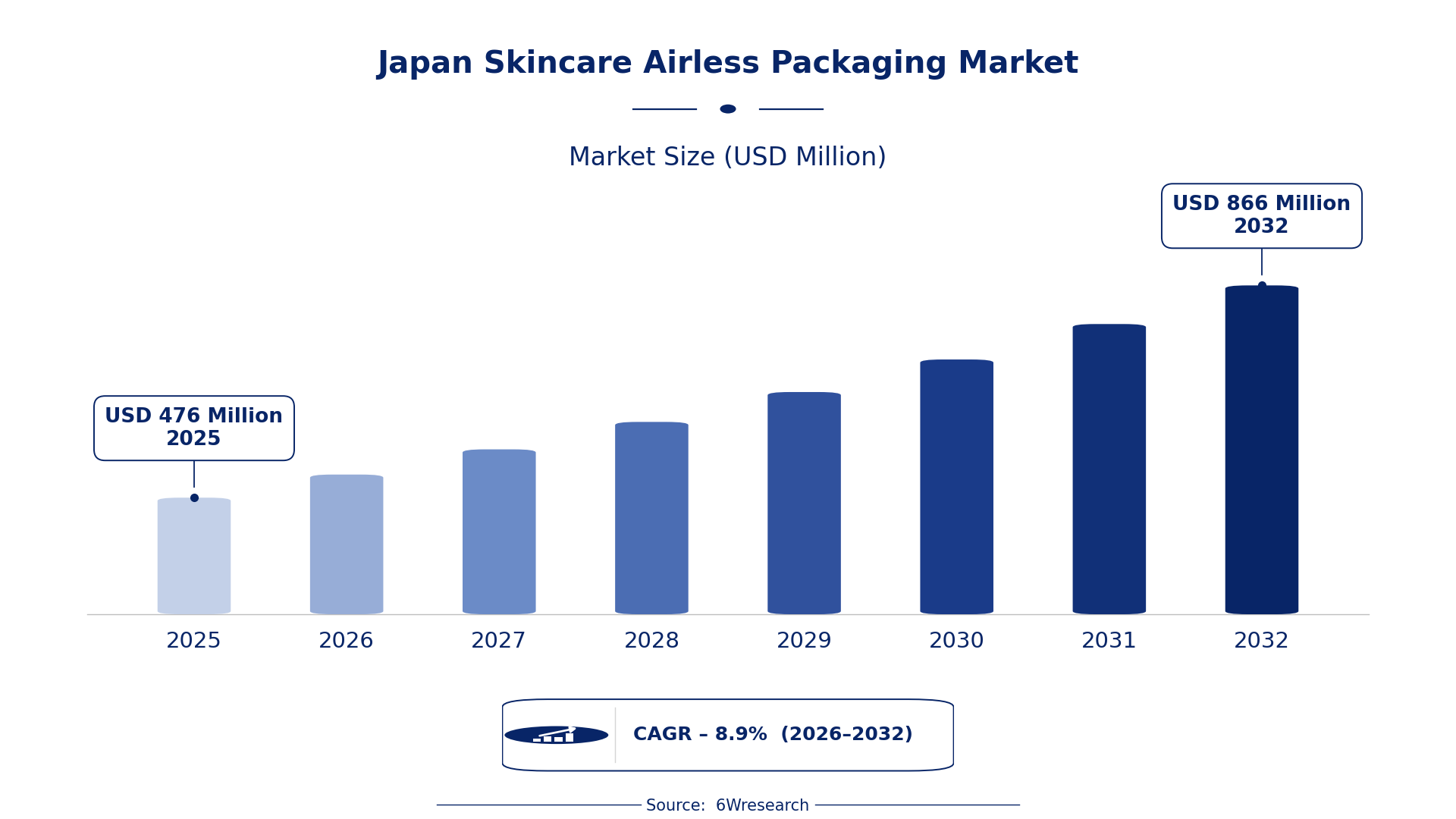
According to 6Wresearch internal database and industry insights, the Japan Skincare Airless Packaging Market was valued at USD 476 Million in 2025 and is projected to reach USD 866 Million by 2032, growing at a CAGR of approximately 8.9% during 2026–2032.
Japan Skincare Airless Packaging Market Highlights
| Report Metric | Details |
| Report Name | Japan Skincare Airless Packaging Market (2026-2032) |
| Market Size 2025 | USD 476 Million |
| Market Size 2032 | USD 866 Million |
| Absolute Growth 2025–2032 | USD 390 Million |
| CAGR 2026–2032 | 8.9% |
| Peak Annual Growth | 9.7% in 2026 |
| Forecast Period | 2026–2032 |
| Historical Data | 2022–2025 |
| Base Year | 2025 |
| Leading Packaging Type, 2025 | Airless Pump Bottles (37% share) |
| Leading Material Used, 2025 | PET/PP/Glass (47% share) |
| Leading Application Form, 2025 | Creams/Serums (45% share) |
| Leading End User, 2025 | Skincare Brands (41% share) |
| Fastest-Growing Packaging Type | Airless Jars (12.1% CAGR) |
| Fastest-Growing Material Used | Acrylic/Plastic (12.7% CAGR) |
| Fastest-Growing Application Form | Moisturizers/Masks (12.3% CAGR) |
| Fastest-Growing End User | Cosmetics Manufacturers (11.7% CAGR) |
| Growing Sector | premium skincare |
| Key End Users | skincare brands, cosmetics manufacturers, personal care companies |
Japan Skincare Airless Packaging Market Year-wise Growth Rate and Key Drivers (2022–2032)
This graph illustrates the annual growth rates of the market from 2022 to 2032, highlighting a steady upward trajectory and projected market expansion over the forecast period.
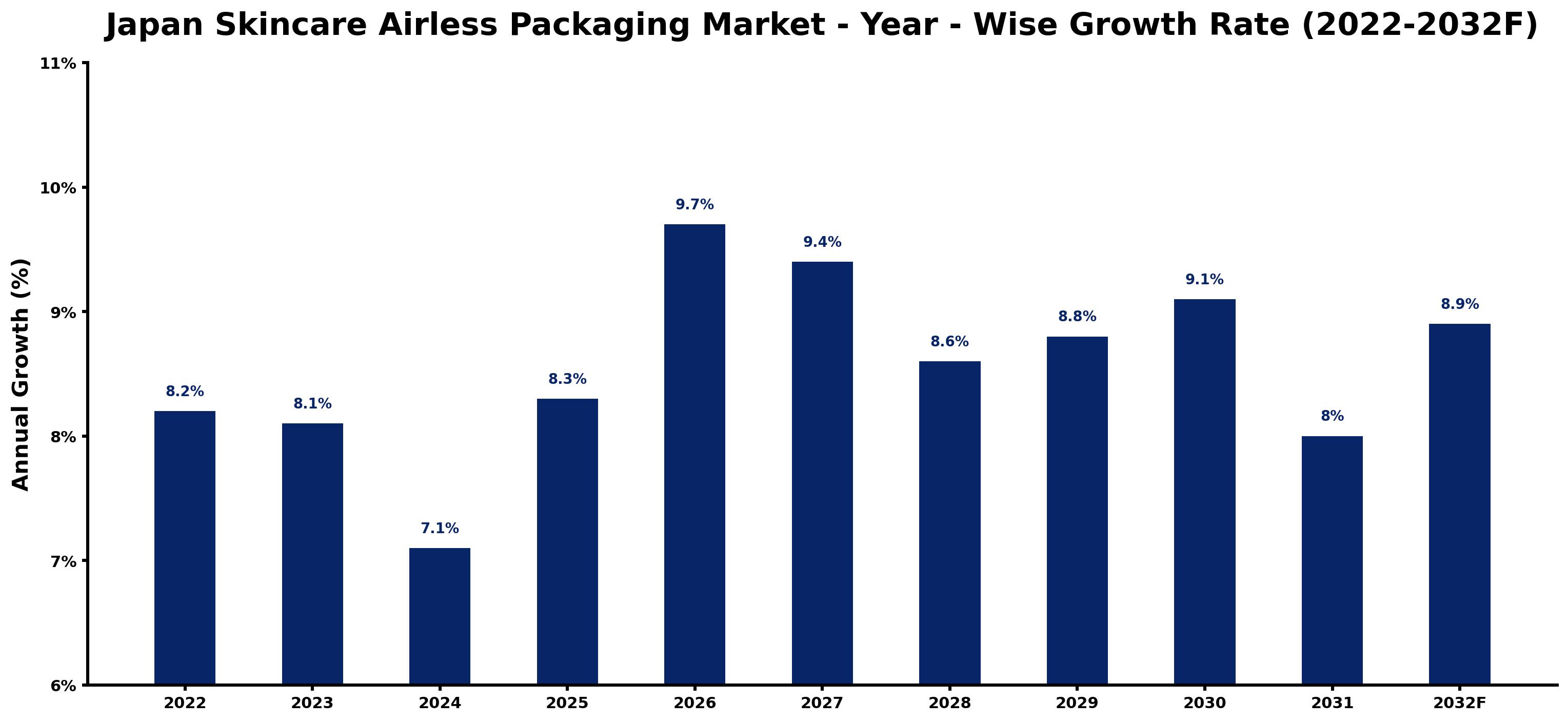
The yearly estimates that follow link every growth rate to its principal driver, so readers can see why the pace changed in each period.
| Year | Estimated Annual Growth (%) | Market Rationale |
| 2022 | 8.2 | The market experienced steady growth due to increasing consumer interest in skincare. |
| 2023 | 8.1 | Demand growth slowed slightly as consumers became more discerning about product quality. |
| 2024 | 7.1 | Market growth continued to slow as competition intensified among skincare brands. |
| 2025 | 8.3 | Growth accelerated as premium skincare products gained popularity among consumers. |
| 2026 | 9.7 | The market is expected to peak with heightened demand for airless packaging solutions. |
| 2027 | 9.4 | Growth will moderate slightly as manufacturers adjust to supply chain challenges. |
| 2028 | 8.6 | Demand is projected to continue slowing as consumers focus on sustainability in packaging. |
| 2029 | 8.8 | Growth is anticipated to rebound as new skincare brands enter the market with unique offerings. |
| 2030 | 9.1 | The market will see a rise in demand for eco-friendly packaging solutions. |
| 2031 | 8.0 | Growth is expected to slow again as market saturation begins to impact new product launches. |
| 2032 | 8.9 | The market is projected to grow steadily as consumer preferences shift towards quality. |
Note: Market size estimations and growth projections presented in this report are based on 6Wresearch's proprietary forecasting methodology, utilizing the latest available industry data, government publications, and primary research inputs.
Japan Skincare Airless Packaging Market Synopsis
Skincare airless packaging protects cosmetic products from air exposure, preventing oxidation and contamination. This type of packaging is made from materials like PET, acrylic, or glass and is particularly popular among premium skincare brands. The Japan Skincare Airless Packaging Market is growing due to a 15% increase in premium skincare products, with over 60% of consumers preferring airless packaging. Tokyo serves as a hub for skincare innovation, driving demand as brands seek to improve product quality and sustainability.
Market Dynamics Impact Analysis (2026–2032)
| Factor | Type | Impact | Primary Segment Affected |
| Growing demand for premium skincare products | Driver | High | Airless Pump Bottles |
| Increased consumer preference for sustainable packaging solutions | Driver | High | Acrylic/Plastic |
| Rising interest in eco-friendly packaging among consumers | Opportunity | High | Airless Jars |
| Expansion of skincare brands in urban areas like Tokyo | Opportunity | High | Skincare Brands |
| Competitive pricing pressures from alternative packaging solutions | Restraint | Medium | Airless Tubes |
| Limited availability of high-quality materials for packaging | Restraint | Medium | Dual-Chamber Airless |
| Supply chain disruptions affecting material availability | Challenge | High | Airless Pump Bottles |
| Technological advancements in packaging design | Challenge | Medium | Acrylic/Plastic |
Evaluation of Drivers in Japan Skincare Airless Packaging Market (2026–2032)
The table below links each growth driver to the segment it affects and the evidence for it.
| Drivers | Primary Segment Affected | Why It Matters (Evidence) |
| Increase in disposable income among consumers | Creams/Serums | This trend leads to higher spending on premium skincare products, with the average consumer spending ¥10,000 annually. |
| Growing awareness of product efficacy and quality | Moisturizers/Masks | Consumers are increasingly purchasing airless packaging to ensure product integrity, especially in premium lines. |
| Rising demand for sustainable packaging solutions | Airless Pump Bottles | This shift is supported by over 60% of consumers preferring eco-friendly options, boosting brand loyalty. |
| Innovation in packaging technology | Airless Jars | Technological advancements are facilitating the development of user-friendly designs, increasing consumer adoption rates. |
| Expansion of skincare brands in urban areas | Skincare Brands | Tokyo's metropolitan area, with over 1,000 registered brands, fosters a competitive environment for new entrants. |
Behind the steady rise in orders sits an increase in disposable income, with consumers spending an average of ¥10,000 annually on skincare. This trend is reflected in the growing demand for creams and serums, where product efficacy drives purchases. Over 60% of consumers prefer sustainable packaging, leading to a notable rise in airless pump bottles. The concentration of skincare brands in urban areas fuels competition, pushing innovation in packaging technology. The expansion of premium skincare lines further supports the demand for airless packaging solutions.
Evaluation of Restraints in Japan Skincare Airless Packaging Market
Below are the constraints most often cited by buyers and suppliers, with the segment each affects.
| Market Restraint | Primary Segment Affected | Why It Matters (Evidence) |
| Skills gap in production | Airless Pump Bottles | This gap can delay production timelines by three months for suppliers, affecting market responsiveness. |
| Supply chain disruptions | Acrylic/Plastic | Reliance on acrylic materials leads to increased costs for producers when raw material availability fluctuates. |
| Outdated machinery | Airless Jars | Using outdated machinery can raise operational costs by 15% for clinics, impacting overall profitability. |
| Compliance testing delays | Dual-Chamber Airless | Compliance with JIS standards requires extensive testing, extending product launch timelines by six weeks for brands. |
| Limited recycling options | PET/PP/Glass | Limited recycling options for these materials can hinder sustainability efforts and increase waste. |
Japan Skincare Airless Packaging Market Challenges
Over 60% of Japanese consumers prefer airless packaging, yet manufacturers face a skills gap that can delay production timelines by three months for suppliers. The reliance on acrylic materials, which account for 30% of the airless packaging market, leads to supply chain disruptions, increasing costs for producers when raw material availability fluctuates. Many manufacturers use outdated machinery, resulting in inefficiencies that can raise operational costs by 15% for clinics. Compliance with JIS standards requires extensive testing, extending product launch timelines by six weeks for brands.
Trends in the Japan Skincare Airless Packaging Market
These developments are changing demand patterns in the Japan Skincare Airless Packaging Market.
- Shift towards Eco-Friendly Packaging Solutions: Tokyo is experiencing a shift towards eco-friendly packaging, as consumer demand for sustainability grows. Over 60% of consumers prefer airless packaging that reduces waste, prompting brands to innovate and adopt more sustainable practices.
- Increase in Premium Skincare Product Offerings: Skincare brands are focusing on premium products, with a 15% growth in this segment. This trend encourages the use of airless packaging to improve product appeal and quality, aligning with consumer preferences.
- Rising Popularity of Airless Pump Bottles: Airless pump bottles are becoming the preferred choice for skincare packaging, projected to dominate the market by 2025. This trend is due to their ability to preserve product integrity and extend shelf life.
- Expansion of Skincare Brands in Urban Areas: The Tokyo metropolitan area is experiencing an influx of skincare brands, with over 1,000 registered. This growth drives demand for innovative packaging solutions that meet the evolving needs of consumers.
Investment Opportunities in the Japan Skincare Airless Packaging Market
The openings below show where demand in the Japan Skincare Airless Packaging Market is visible and how suppliers can enter.
- Growing Demand for Sustainable Packaging: With over 60% of consumers preferring eco-friendly options, brands can invest in sustainable airless packaging solutions in urban areas like Tokyo, where consumer awareness is high.
- Expansion into Emerging Skincare Markets: Now is an ideal time to partner with local skincare brands in Japan, as the market for airless packaging is projected to grow significantly due to rising disposable incomes and consumer interest in quality products.
- Investment in Innovative Packaging Technologies: The demand for airless packaging solutions is increasing, suggesting opportunities for suppliers to innovate and meet market needs through advanced designs and materials.
- Focus on Premium Skincare Lines: With the premium skincare segment growing by 15%, suppliers can target cosmetics manufacturers looking to improve product quality through advanced airless packaging that meets consumer expectations.
Government Initiatives in the Japan Skincare Airless Packaging Market
In 2023, the Ministry of Health launched a program promoting sustainable packaging, which builds on the existing Food Sanitation Act. This initiative encourages manufacturers to adopt eco-friendly practices, aligning with consumer preferences for sustainable products. The program aims to reduce plastic waste and improve recycling rates, benefiting both the environment and public health.
The Ministry of Health, Labour and Welfare oversees the implementation of the Standards for Cosmetics, which mandates compliance with quality assessments for packaging. This regulation ensures that products meet safety and efficacy standards, benefiting both producers and consumers. The ministry conducts regular inspections to ensure compliance, supporting a high standard of quality in the market.
Future Insight of the Japan Skincare Airless Packaging Market
Consumers will increasingly prioritise sustainable packaging solutions by 2032, driven by government initiatives promoting eco-friendly practices. Airless pump bottles are expected to dominate the market segment by 2025, which will require suppliers to innovate their offerings. The average Japanese consumer's annual skincare expenditure is projected to shift towards premium products, encouraging suppliers to enhance their product lines. Technological advancements in packaging will streamline production processes, benefiting both buyers and suppliers.
Market Segmentation Analysis
Japan Skincare Airless Packaging Market report covers a detailed analysis of the following market segments:
By Packaging Type – Airless Pump Bottles Lead, Airless Jars Expected to Grow Fastest
According to Saurav Kr Singh, Senior Research Analyst at 6Wresearch, Airless Pump Bottles took 37% of packaging type revenue in 2025, more than any other category. Airless pump bottles hold the largest share due to their widespread use in dispensing creams and serums, which are popular among consumers. This packaging type is particularly favoured in Tokyo, a hub for skincare brands and innovations. Over 2026–2032, Airless Jars are expected to post the fastest growth, at a CAGR of 12.1%. Airless jars are experiencing rapid growth as they are commonly used for thicker formulations like creams, which are increasingly sought after by consumers. The trend towards premium skincare products is driving this demand. Suppliers should focus on developing airless jars to capture the growing segment of thicker skincare formulations.
By Material Used – PET/PP/Glass Leads, Acrylic/Plastic Expected to Grow Fastest
In 2025, PET/PP/Glass led the material used split with a 47% share. PET, PP, and glass are preferred in airless packaging due to their excellent barrier properties that help maintain product quality. Their widespread use is evident in the extensive adoption by skincare brands across Japan, ensuring effective protection against oxidation. Acrylic/Plastic is set to record the highest CAGR in this split, 12.7% over 2026–2032. Acrylic and plastic materials are rapidly gaining popularity because of their lightweight characteristics and design flexibility, which attract brands looking for modern aesthetics. This trend is further accelerated by the rising consumer demand for eco-friendly packaging solutions. Suppliers should focus on developing acrylic and plastic materials to cater to the growing consumer preference for lightweight and visually appealing packaging.
By Application Form – Creams/Serums Lead, Moisturizers/Masks Expected to Grow Fastest
With 45% of application form revenue in 2025, Creams/Serums was the largest category. Creams and serums dominate the application forms for airless packaging, as they are major components of the skincare routine for many consumers. Their popularity is reflected in the substantial spending of the average Japanese consumer on skincare products. Moisturizers/Masks are projected to grow fastest, at a CAGR of 12.3% during 2026–2032. Moisturizers and masks are seeing the fastest growth as consumers increasingly seek effective hydration solutions and self-care products. The rise in demand for premium skincare is further propelling this segment. Brands should expand their offerings in moisturizers and masks to align with consumer preferences for effective skincare solutions.
By End User – Skincare Brands Lead, Cosmetics Manufacturers Expected to Grow Fastest
Skincare Brands accounted for 41% of the market by end user in 2025. Skincare brands are the primary users of airless packaging, as they require high-quality solutions that maintain product integrity and extend shelf life. The robust skincare market in Japan, with its numerous registered brands, underscores the reliance on this packaging type for premium products. The quickest growth will come from Cosmetics Manufacturers, forecast to expand at a CAGR of 11.7% between 2026 and 2032. Cosmetics manufacturers are increasingly adopting airless packaging for a variety of products, driven by the need for quality assurance and consumer satisfaction. The industry's movement towards sustainable practices is also contributing to this growth, indicating a significant shift in market dynamics. Manufacturers should prioritise the needs of cosmetics manufacturers to capitalise on the increasing demand for airless packaging across diverse cosmetic applications.
Key Attractiveness of the Report
- 10 Years of Market Numbers
- Historical Data Starting from 2022 to 2025
- Base Year 2025
- Forecast Data until 2032
- Key Performance Indicators Impacting the Market
- Major Upcoming Developments and Projects
Key Highlights of the Report:
- Japan Skincare Airless Packaging Market Outlook
- Market Size of Japan Skincare Airless Packaging Market, 2025
- Forecast of Japan Skincare Airless Packaging Market, 2032
- Historical Data and Forecast of Japan Skincare Airless Packaging Revenues & Volume for the Period 2022-2032F
- Japan Skincare Airless Packaging Market Trend Evolution
- Japan Skincare Airless Packaging Market Drivers and Challenges
- Japan Skincare Airless Packaging Price Trends
- Japan Skincare Airless Packaging Porter's Five Forces
- Japan Skincare Airless Packaging Industry Life Cycle
- Historical Data and Forecast of Japan Skincare Airless Packaging Market Revenues & Volume By Packaging Type for the Period 2022-2032F
- Historical Data and Forecast of Japan Skincare Airless Packaging Market Revenues & Volume By Airless Pump Bottles for the Period 2022-2032F
- Historical Data and Forecast of Japan Skincare Airless Packaging Market Revenues & Volume By Airless Jars for the Period 2022-2032F
- Historical Data and Forecast of Japan Skincare Airless Packaging Market Revenues & Volume By Airless Tubes for the Period 2022-2032F
- Historical Data and Forecast of Japan Skincare Airless Packaging Market Revenues & Volume By Dual-Chamber Airless for the Period 2022-2032F
- Historical Data and Forecast of Japan Skincare Airless Packaging Market Revenues & Volume By Material Used for the Period 2022-2032F
- Historical Data and Forecast of Japan Skincare Airless Packaging Market Revenues & Volume By PET/PP/Glass for the Period 2022-2032F
- Historical Data and Forecast of Japan Skincare Airless Packaging Market Revenues & Volume By Acrylic/Plastic for the Period 2022-2032F
- Historical Data and Forecast of Japan Skincare Airless Packaging Market Revenues & Volume By HDPE for the Period 2022-2032F
- Historical Data and Forecast of Japan Skincare Airless Packaging Market Revenues & Volume By Co-Formulated Products for the Period 2022-2032F
- Historical Data and Forecast of Japan Skincare Airless Packaging Market Revenues & Volume By Application Form for the Period 2022-2032F
- Historical Data and Forecast of Japan Skincare Airless Packaging Market Revenues & Volume By Creams/Serums for the Period 2022-2032F
- Historical Data and Forecast of Japan Skincare Airless Packaging Market Revenues & Volume By Moisturizers/Masks for the Period 2022-2032F
- Historical Data and Forecast of Japan Skincare Airless Packaging Market Revenues & Volume By Lotions/Sunscreens for the Period 2022-2032F
- Historical Data and Forecast of Japan Skincare Airless Packaging Market Revenues & Volume By Anti-aging & Actives for the Period 2022-2032F
- Historical Data and Forecast of Japan Skincare Airless Packaging Market Revenues & Volume By End User for the Period 2022-2032F
- Historical Data and Forecast of Japan Skincare Airless Packaging Market Revenues & Volume By Skincare Brands for the Period 2022-2032F
- Historical Data and Forecast of Japan Skincare Airless Packaging Market Revenues & Volume By Cosmetics Manufacturers for the Period 2022-2032F
- Historical Data and Forecast of Japan Skincare Airless Packaging Market Revenues & Volume By Personal Care Companies for the Period 2022-2032F
- Historical Data and Forecast of Japan Skincare Airless Packaging Market Revenues & Volume By Premium Skincare Lines for the Period 2022-2032F
- Japan Skincare Airless Packaging Import Export Trade Statistics
- Market Opportunity Assessment By Packaging Type
- Market Opportunity Assessment By Material Used
- Market Opportunity Assessment By Application Form
- Market Opportunity Assessment By End User
- Japan Skincare Airless Packaging Top Companies Market Share
- Japan Skincare Airless Packaging Competitive Benchmarking By Technical and Operational Parameters
- Japan Skincare Airless Packaging Company Profiles
- Japan Skincare Airless Packaging Key Strategic Recommendations
Market Covered
The study includes the following segmentation.
By Packaging Type
- Airless Pump Bottles
- Airless Jars
- Airless Tubes
- Dual-Chamber Airless
By Material Used
- PET/PP/Glass
- Acrylic/Plastic
- HDPE
- Co-Formulated Products
By Application Form
- Creams/Serums
- Moisturizers/Masks
- Lotions/Sunscreens
- Anti-aging & Actives
By End User
- Skincare Brands
- Cosmetics Manufacturers
- Personal Care Companies
- Premium Skincare Lines































