Japan Skincare Masks Market Size & Growth Rate
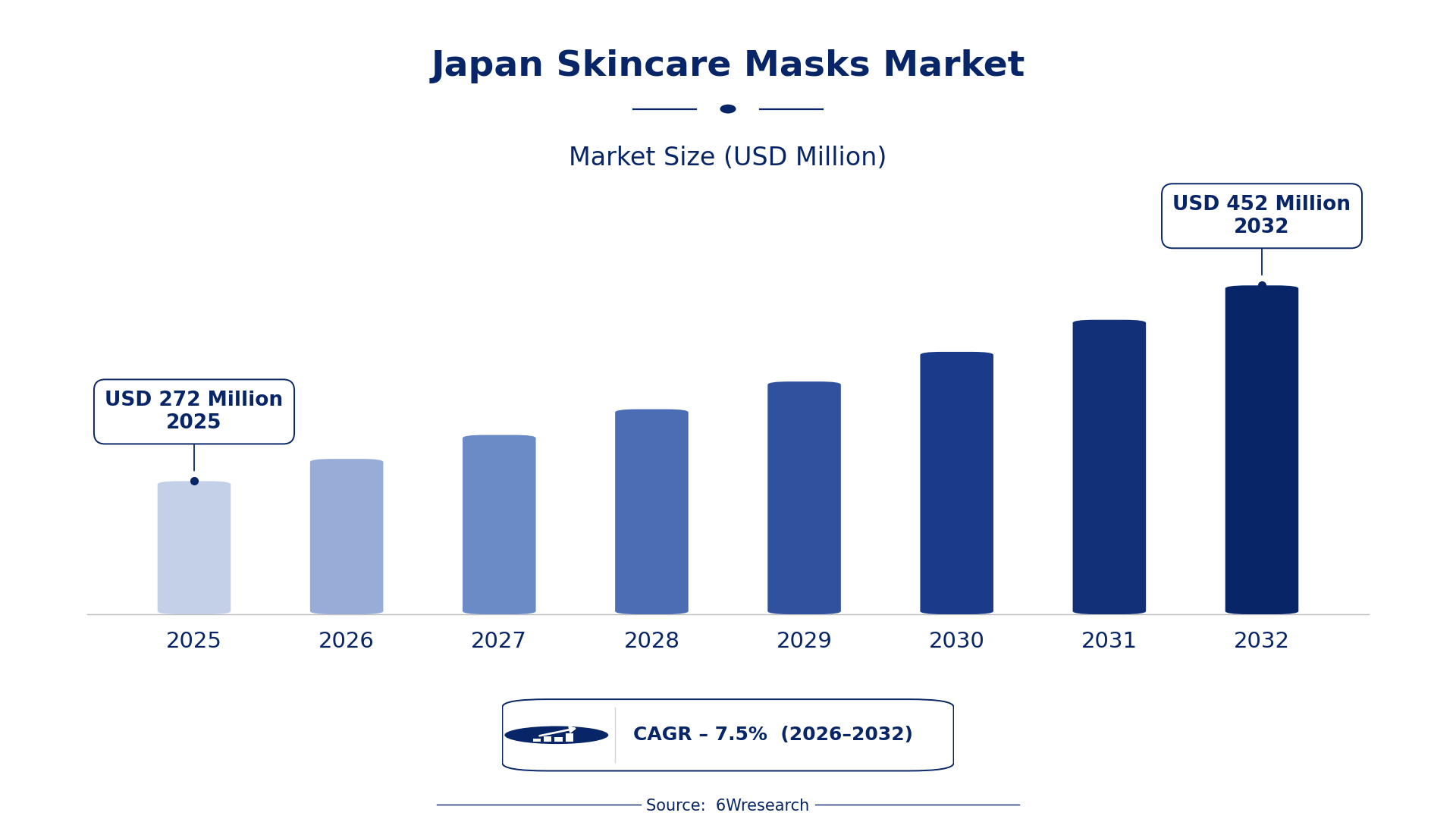
According to 6Wresearch internal database and industry insights, the Japan Skincare Masks Market was valued at USD 272 Million in 2025 and is projected to reach USD 452 Million by 2032, growing at a CAGR of approximately 7.5% during 2026–2032.
Japan Skincare Masks Market Highlights
| Report Metric | Details |
| Report Name | Japan Skincare Masks Market (2026-2032) |
| Market Size 2025 | USD 272 Million |
| Market Size 2032 | USD 452 Million |
| Absolute Growth 2025–2032 | USD 180 Million |
| CAGR 2026–2032 | 7.5% |
| Peak Annual Growth | 8.7% in 2028 |
| Forecast Period | 2026–2032 |
| Historical Data | 2022–2025 |
| Base Year | 2025 |
| Leading Mask Type, 2025 | Sheet Masks (41% share) |
| Leading Application Form, 2025 | Pre-Cut Cotton/Cellulose (40% share) |
| Leading Skin Concern Addressed, 2025 | Hydration/Brightening (46% share) |
| Leading End User, 2025 | K-Beauty Brands (54% share) |
| Fastest-Growing Mask Type | Clay Masks (10.1% CAGR) |
| Fastest-Growing Application Form | Jar/Pouch (10.3% CAGR) |
| Fastest-Growing Skin Concern Addressed | Detox/Oil Control (9.9% CAGR) |
| Fastest-Growing End User | Natural Beauty Companies (9.3% CAGR) |
| Growing Sector | Skincare |
| Key End Users | Beauty consumers, skincare brands, e-commerce platforms, luxury retailers |
Japan Skincare Masks Market Year-wise Growth Rate and Key Drivers (2022–2032)
This graph illustrates the annual growth rates of the market from 2022 to 2032, highlighting a steady upward trajectory and projected market expansion over the forecast period.
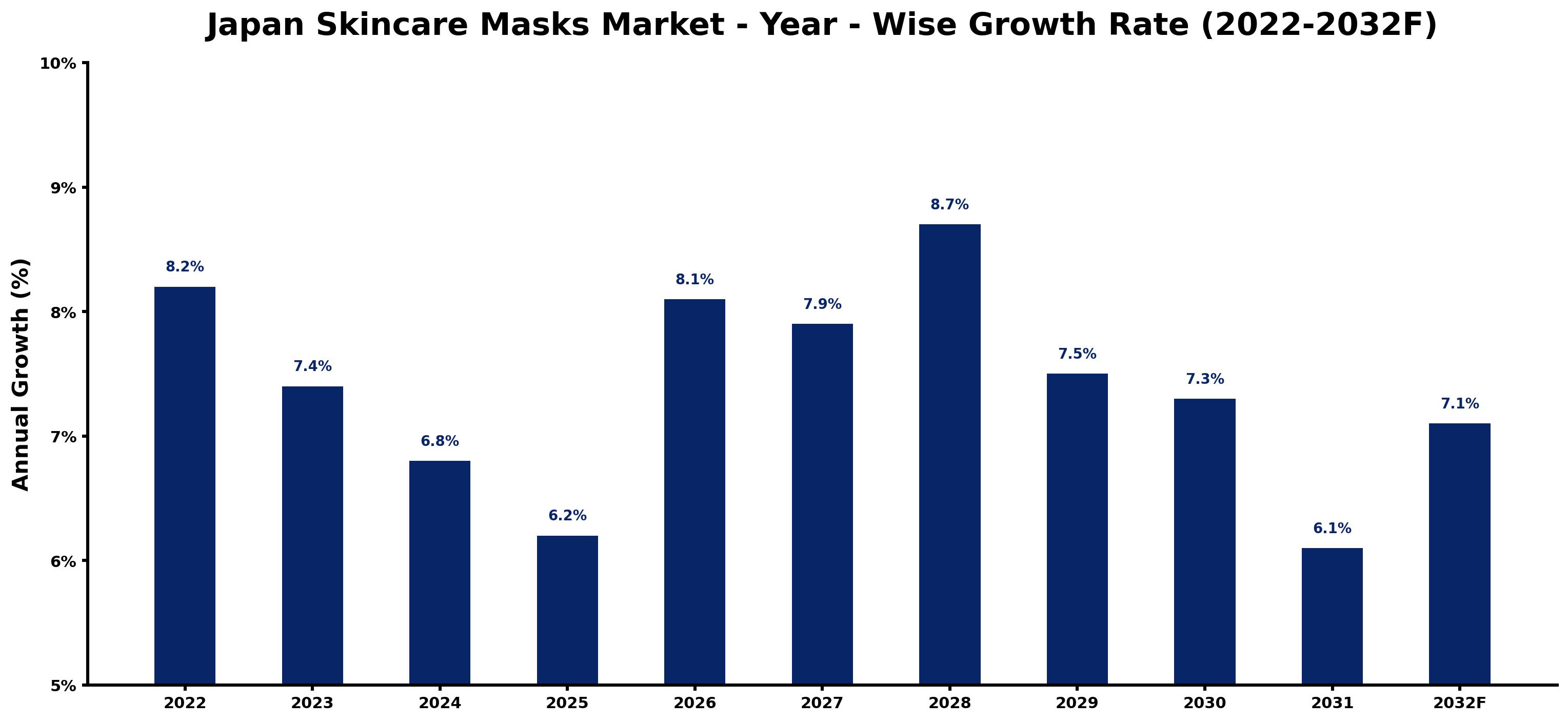
Below, each year's estimated growth is shown next to the factor that most influenced it.
| Year | Estimated Annual Growth (%) | Market Rationale |
| 2022 | 8.2 | The market experienced strong consumer interest in skincare routines and products. |
| 2023 | 7.4 | Growth slowed as consumers became more selective in their skincare purchases. |
| 2024 | 6.8 | A continued focus on hydration led to steady demand for skincare masks. |
| 2025 | 6.2 | Market growth slowed further due to saturation in certain product categories. |
| 2026 | 8.1 | Demand is expected to increase as consumers seek new skincare solutions. |
| 2027 | 7.9 | Growth is projected to slow again as competition intensifies among brands. |
| 2028 | 8.7 | The market is expected to peak with heightened interest in skincare during seasonal promotions. |
| 2029 | 7.5 | Growth is projected to slow as consumer preferences shift towards sustainable products. |
| 2030 | 7.3 | Demand is expected to stabilise as consumers become more price-conscious in their purchases. |
| 2031 | 6.1 | Growth is projected to slow due to increased competition and market maturity. |
| 2032 | 7.1 | Demand is expected to rise again as new trends emerge in skincare. |
Note: Market size estimations and growth projections presented in this report are based on 6Wresearch's proprietary forecasting methodology, utilizing the latest available industry data, government publications, and primary research inputs.
Japan Skincare Masks Market Synopsis
Skincare masks are cosmetic products designed to improve skin health and appearance, typically made from materials like fabric, clay, or gel infused with active ingredients. The Japan Skincare Masks Market is growing as consumer interest in skincare routines rises, with over 30% of women aged 20-40 regularly using these products. Factors such as the influence of K-Beauty trends and the increasing popularity of online sales are driving demand, with the market valued at approximately 200 billion JPY.
Market Dynamics Impact Analysis (2026–2032)
| Factor | Type | Impact | Primary Segment Affected |
| Rising consumer interest in hydration and skin health drives demand for skincare masks. | Driver | High | Sheet Masks |
| The popularity of K-Beauty trends encourages local brands to innovate and expand their offerings. | Driver | High | Clay Masks |
| The increasing focus on natural ingredients presents opportunities for organic skincare brands. | Opportunity | High | Natural Beauty Companies |
| The growth of e-commerce platforms provides a new channel for skincare mask sales. | Opportunity | Medium | Personal Care Brands |
| Saturation in the market may limit growth potential for established brands. | Restraint | High | Luxury Skincare Labels |
| Consumer price sensitivity may hinder sales of premium skincare masks. | Restraint | Medium | K-Beauty Brands |
| Intense competition among brands can lead to price wars, affecting profitability. | Challenge | High | Clay Masks |
| Shifts in consumer preferences towards sustainability may require brands to adapt. | Challenge | Medium | Sheet Masks |
Evaluation of Drivers in Japan Skincare Masks Market (2026–2032)
The table below links each growth driver to the segment it affects and the evidence for it.
| Drivers | Primary Segment Affected | Why It Matters (Evidence) |
| Increased consumer awareness of skincare benefits drives demand for hydration-focused products. | Sheet Masks | Over 70% of Japanese consumers using masks seek hydration, boosting sales. |
| The influence of K-Beauty trends encourages local brands to innovate. | Clay Masks | Japan has a high adoption rate of K-Beauty trends, leading to a 20% increase in luxury skincare sales. |
| Growing online sales channels expand market reach for skincare masks. | Personal Care Brands | Online sales of skincare masks increased by 25% in 2023, attracting more buyers. |
| Rising interest in natural ingredients drives demand for organic skincare products. | Natural Beauty Companies | Sustainable practices are appealing to eco-conscious consumers, increasing market interest. |
| Seasonal promotions and events boost consumer spending on skincare masks. | Luxury Skincare Labels | Tokyo Beauty Week showcases new trends, driving purchases during the event. |
Behind the steady rise in orders sits the increasing consumer awareness of skincare benefits, with over 70% of users seeking hydration through various masks. The influence of K-Beauty trends has led to a 20% increase in luxury skincare sales, prompting local brands to innovate. The expansion of online sales channels has attracted more buyers, with a 25% increase in 2023. Seasonal promotions, such as those during Tokyo Beauty Week, have stimulated spending on skincare masks, further driving demand.
Evaluation of Restraints in Japan Skincare Masks Market
The key brakes on demand, and where they bite hardest, are shown below.
| Market Restraint | Primary Segment Affected | Why It Matters (Evidence) |
| Market saturation limits growth potential for established brands, resulting in fierce competition. | Luxury Skincare Labels | With many brands offering similar products, differentiation becomes challenging. |
| Consumer price sensitivity may hinder sales of premium skincare masks, affecting revenue. | K-Beauty Brands | As consumers seek value, high-priced items may see reduced demand. |
| Intense competition among brands can lead to price wars, impacting profitability. | Clay Masks | Brands may lower prices to attract customers, which squeezes margins. |
| Shifts in consumer preferences towards sustainability may require brands to adapt quickly. | Sheet Masks | Failure to meet eco-friendly demands could result in loss of market share. |
| Regulatory compliance can increase operational costs for producers, affecting pricing strategies. | Natural Beauty Companies | Producers must invest in meeting safety and ingredient standards. |
Japan Skincare Masks Market Challenges
Over 60% of Japan's skincare mask market consists of sheet masks, yet suppliers face a shortage of skilled labour, which delays production and raises costs for manufacturers. Compliance with the JIS S 0010 standard demands substantial investment in safety testing, extending the time-to-market for new products. Buyers experience price hikes, with the average sheet mask costing around 300 JPY, as demand escalates. Urban consumers in Tokyo and Osaka deal with supply chain disruptions from fierce competition, resulting in stock shortages and unmet skincare needs.
Trends in the Japan Skincare Masks Market
The shifts below are changing how Japan Skincare Masks Market products are bought and supplied.
- Shift Towards Sustainable Ingredients: The 'Green Beauty' initiative encourages brands to adopt sustainable practices in product formulation, with over 30% of consumers prioritising eco-friendly products in 2023.
- Surge in Online Sales Channels: Online sales of skincare masks surged by 25% in 2023, reflecting a shift in consumer purchasing behaviour towards e-commerce platforms.
- Growing Popularity of DIY Skincare: Consumers are increasingly turning to DIY skincare solutions, with pre-cut cotton masks gaining traction, appealing to those seeking personalised skincare experiences.
- Emergence of Multifunctional Masks: Skincare masks are evolving to address multiple skin concerns simultaneously, with products combining hydration and detoxification becoming more common.
Investment Opportunities in the Japan Skincare Masks Market
Where to invest in the Japan Skincare Masks Market: the main openings are set out below.
- Collaborate with Local Brands: Investing in partnerships with local skincare brands is timely, as the market is valued at approximately 200 billion JPY, presenting growth potential.
- Expand in Urban Markets: Focusing on urban areas like Tokyo and Osaka can yield high returns, given the concentration of skincare consumers and a growing trend towards luxury products.
- Prioritise E-commerce Platforms: With online sales increasing by 25% in 2023, brands should focus on e-commerce strategies to capture the growing digital consumer base.
- Create Sustainable Product Lines: The rising interest in natural ingredients offers opportunities for brands to develop eco-friendly skincare masks, appealing to the 30% of consumers prioritising sustainability.
Government Initiatives in the Japan Skincare Masks Market
Recent updates to the Standards for Cosmetics (2000) under the PMD Act have strengthened regulations on prohibited and restricted ingredients in skincare masks. This measure improves consumer safety and ensures that products meet high-quality standards, thereby increasing trust among buyers. The Ministry of Health, Labour and Welfare oversees compliance, requiring manufacturers to adhere strictly to these guidelines, which can lead to increased production costs but ultimately benefits consumers by ensuring safer products.
Buyers benefit from the Long-Term Care Insurance Act (1997), which supports the elderly in accessing skincare products that promote skin health. This act enables older consumers to invest in skincare masks, particularly those aimed at hydration, which is crucial for maintaining skin elasticity. The Ministry of Health, Labour and Welfare manages the funding for these services, ensuring that a significant portion of the elderly population can afford skincare solutions that enhance their quality of life.
Future Insight of the Japan Skincare Masks Market
Technological innovations in formulation will reshape demand for skincare masks by 2032, enabling suppliers to create more effective products. The 'Green Beauty' initiative will drive sustainable practices, appealing to eco-conscious buyers. E-commerce will continue to transform purchasing behaviours, as online sales of skincare masks surged by 25% in 2023. Events like Tokyo Beauty Week will showcase new trends, providing buyers with access to the latest innovations and helping suppliers stay competitive.
Market Segmentation Analysis
Japan Skincare Masks Market report covers a detailed analysis of the following market segments:
By Mask Type – Sheet Masks Lead, Clay Masks Expected to Grow Fastest
According to Saurav Kr Singh, Senior Research Analyst at 6Wresearch, Sheet Masks took 41% of mask type revenue in 2025, more than any other category. Sheet masks dominate the market due to their widespread use for hydration and convenience, appealing to a broad demographic. For instance, over 30% of Japanese women aged 20-40 regularly use these masks, showcasing their popularity. The quickest growth will come from Clay Masks, forecast to expand at a CAGR of 10.1% between 2026 and 2032. Clay masks are experiencing rapid growth as they cater to consumers seeking detoxification and oil control, particularly in urban areas like Osaka and Yokohama. The increasing awareness of skincare benefits among younger demographics is also propelling this segment. Suppliers should focus on expanding their clay mask offerings to capture the growing interest in detoxifying products.
By Application Form – Pre-Cut Cotton/Cellulose Leads, Jar/Pouch Expected to Grow Fastest
The largest application form category in 2025 was Pre-Cut Cotton/Cellulose, at 40% of revenue. Pre-cut cotton/cellulose masks hold the largest share as they are widely used in DIY applications, making them accessible for various consumers. Their ease of use and effectiveness in delivering skincare benefits have solidified their position in the market. Over 2026–2032, Jar/Pouch is expected to post the fastest growth, at a CAGR of 10.3%. Jar/pouch packaging is gaining traction due to its versatility for various products, appealing to consumers looking for convenience and variety. The rise in e-commerce has also boosted sales of these formats, making them more accessible. Suppliers should consider diversifying their packaging options to meet the rising demand for jar and pouch formats.
By Skin Concern Addressed – Hydration/Brightening Leads, Detox/Oil Control Expected to Grow Fastest
With 46% of skin concern addressed revenue in 2025, Hydration/Brightening was the largest category. Hydration and brightening are essential for many consumers, making these products highly sought after. With 70% of users prioritising hydration, this segment's focus on skin health solidifies its leading market position. Detox/Oil Control is set to record the highest CAGR in this split, 9.9% over 2026–2032. Detox and oil control masks are gaining traction as they cater to the needs of oily skin types, particularly in urban settings. The rising popularity of skincare routines among younger demographics is propelling this segment's growth. Suppliers must consider expanding their offerings to include more detoxifying products to meet changing consumer preferences.
By End User – K-Beauty Brands Lead, Natural Beauty Companies Expected to Grow Fastest
In 2025, K-Beauty Brands led the end user split with a 54% share. K-Beauty brands hold the largest share of the market due to their significant influence on consumer preferences and trends in Japan. Their ability to innovate and connect with local tastes has cultivated a dedicated customer base, particularly among younger demographics. Natural Beauty Companies are projected to grow fastest, at a CAGR of 9.3% during 2026–2032. Natural beauty companies are witnessing rapid growth as consumer interest shifts towards organic and sustainable skincare options. The impact of the 'Green Beauty' initiative is encouraging more brands to enter this segment, thereby accelerating its expansion. This trend indicates that suppliers should consider partnerships with natural beauty companies to meet the increasing demand for organic products.
Key Attractiveness of the Report
- 10 Years of Market Numbers
- Historical Data Starting from 2022 to 2025
- Base Year 2025
- Forecast Data until 2032
- Key Performance Indicators Impacting the Market
- Major Upcoming Developments and Projects
Key Highlights of the Report:
- Japan Skincare Masks Market Outlook
- Market Size of Japan Skincare Masks Market, 2025
- Forecast of Japan Skincare Masks Market, 2032
- Historical Data and Forecast of Japan Skincare Masks Revenues & Volume for the Period 2022-2032F
- Japan Skincare Masks Market Trend Evolution
- Japan Skincare Masks Market Drivers and Challenges
- Japan Skincare Masks Price Trends
- Japan Skincare Masks Porter's Five Forces
- Japan Skincare Masks Industry Life Cycle
- Historical Data and Forecast of Japan Skincare Masks Market Revenues & Volume By Mask Type for the Period 2022-2032F
- Historical Data and Forecast of Japan Skincare Masks Market Revenues & Volume By Sheet Masks for the Period 2022-2032F
- Historical Data and Forecast of Japan Skincare Masks Market Revenues & Volume By Clay Masks for the Period 2022-2032F
- Historical Data and Forecast of Japan Skincare Masks Market Revenues & Volume By Peel-Off Masks for the Period 2022-2032F
- Historical Data and Forecast of Japan Skincare Masks Market Revenues & Volume By Overnight Masks for the Period 2022-2032F
- Historical Data and Forecast of Japan Skincare Masks Market Revenues & Volume By Application Form for the Period 2022-2032F
- Historical Data and Forecast of Japan Skincare Masks Market Revenues & Volume By Pre-Cut Cotton/Cellulose for the Period 2022-2032F
- Historical Data and Forecast of Japan Skincare Masks Market Revenues & Volume By Jar/Pouch for the Period 2022-2032F
- Historical Data and Forecast of Japan Skincare Masks Market Revenues & Volume By Gel/Paste for the Period 2022-2032F
- Historical Data and Forecast of Japan Skincare Masks Market Revenues & Volume By Cream/Gel for the Period 2022-2032F
- Historical Data and Forecast of Japan Skincare Masks Market Revenues & Volume By Skin Concern Addressed for the Period 2022-2032F
- Historical Data and Forecast of Japan Skincare Masks Market Revenues & Volume By Hydration/Brightening for the Period 2022-2032F
- Historical Data and Forecast of Japan Skincare Masks Market Revenues & Volume By Detox/Oil Control for the Period 2022-2032F
- Historical Data and Forecast of Japan Skincare Masks Market Revenues & Volume By Exfoliation/Glow for the Period 2022-2032F
- Historical Data and Forecast of Japan Skincare Masks Market Revenues & Volume By Intensive Treatment for the Period 2022-2032F
- Historical Data and Forecast of Japan Skincare Masks Market Revenues & Volume By End User for the Period 2022-2032F
- Historical Data and Forecast of Japan Skincare Masks Market Revenues & Volume By K-Beauty Brands for the Period 2022-2032F
- Historical Data and Forecast of Japan Skincare Masks Market Revenues & Volume By Natural Beauty Companies for the Period 2022-2032F
- Historical Data and Forecast of Japan Skincare Masks Market Revenues & Volume By Personal Care Brands for the Period 2022-2032F
- Historical Data and Forecast of Japan Skincare Masks Market Revenues & Volume By Luxury Skincare Labels for the Period 2022-2032F
- Japan Skincare Masks Import Export Trade Statistics
- Market Opportunity Assessment By Mask Type
- Market Opportunity Assessment By Application Form
- Market Opportunity Assessment By Skin Concern Addressed
- Market Opportunity Assessment By End User
- Japan Skincare Masks Top Companies Market Share
- Japan Skincare Masks Competitive Benchmarking By Technical and Operational Parameters
- Japan Skincare Masks Company Profiles
- Japan Skincare Masks Key Strategic Recommendations
Market Covered
The study includes the following segmentation.
By Mask Type
- Sheet Masks
- Clay Masks
- Peel-Off Masks
- Overnight Masks
By Application Form
- Pre-Cut Cotton/Cellulose
- Jar/Pouch
- Gel/Paste
- Cream/Gel
By Skin Concern Addressed
- Hydration/Brightening
- Detox/Oil Control
- Exfoliation/Glow
- Intensive Treatment
By End User
- K-Beauty Brands
- Natural Beauty Companies
- Personal Care Brands
- Luxury Skincare Labels































