Japan Skincare Serums Market Size & Growth Rate
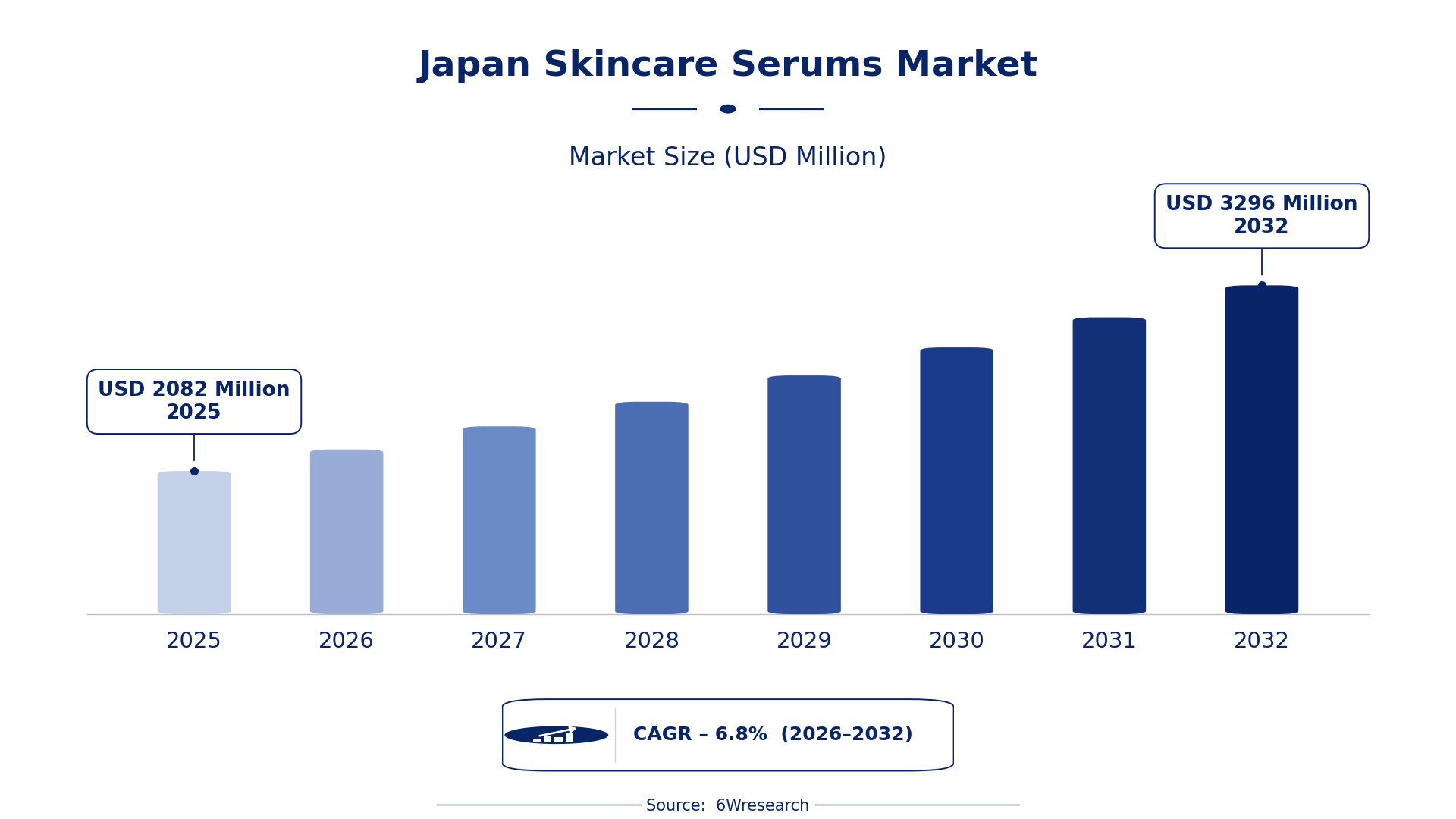
According to 6Wresearch internal database and industry insights, the Japan Skincare Serums Market was valued at USD 2,082 Million in 2025 and is projected to reach USD 3,296 Million by 2032, growing at a CAGR of approximately 6.8% during 2026–2032.
Japan Skincare Serums Market Highlights
| Report Metric | Details |
| Report Name | Japan Skincare Serums Market (2026-2032) |
| Market Size 2025 | USD 2,082 Million |
| Market Size 2032 | USD 3,296 Million |
| Absolute Growth 2025–2032 | USD 1,214 Million |
| CAGR 2026–2032 | 6.8% |
| Peak Annual Growth | 7.7% in 2028 |
| Forecast Period | 2026–2032 |
| Historical Data | 2022–2025 |
| Base Year | 2025 |
| Leading Type, 2025 | Oil Serum (42% share) |
| Leading Application, 2025 | Anti-aging Serums (36% share) |
| Leading Distribution Channel, 2025 | Hospital Pharmacies (43% share) |
| Fastest-Growing Type | Gel Serum (9.5% CAGR) |
| Fastest-Growing Application | Antioxidant Serums (9.4% CAGR) |
| Fastest-Growing Distribution Channel | Retail Pharmacies (9.0% CAGR) |
| Growing Sector | skincare |
| Key End Users | beauty enthusiasts, healthcare providers, retail consumers |
Japan Skincare Serums Market Year-wise Growth Rate and Key Drivers (2022–2032)
This graph illustrates the annual growth rates of the market from 2022 to 2032, highlighting a steady upward trajectory and projected market expansion over the forecast period.

Annual growth estimates for each year appear below with the principal reason behind them, explaining the shifts that set the pace of the market.
| Year | Estimated Annual Growth (%) | Market Rationale |
| 2022 | 9.2 | The market experienced strong demand due to heightened consumer interest in skincare routines. |
| 2023 | 8.1 | Growth slowed as consumers became more selective in their skincare purchases. |
| 2024 | 7.3 | The market continued to grow, but at a slower rate as competition increased. |
| 2025 | 7.0 | Demand remained steady, driven by ongoing interest in anti-aging products. |
| 2026 | 6.1 | Growth is expected to slow further as market saturation begins to affect new product launches. |
| 2027 | 6.4 | Demand is projected to pick up again as consumers seek new skincare solutions. |
| 2028 | 7.7 | The market is expected to see a surge in growth due to the introduction of new product lines. |
| 2029 | 6.9 | Growth will slow as consumers become more price-sensitive in their purchases. |
| 2030 | 6.5 | The market is projected to continue growing, driven by a focus on natural ingredients. |
| 2031 | 7.1 | Demand is expected to increase as consumers return to prioritising skincare in their routines. |
| 2032 | 6.8 | Growth will slow slightly as the market stabilises after several years of rapid expansion. |
Note: Market size estimations and growth projections presented in this report are based on 6Wresearch's proprietary forecasting methodology, utilizing the latest available industry data, government publications, and primary research inputs.
Japan Skincare Serums Market Synopsis
Skincare serums are concentrated formulations designed to deliver active ingredients directly to the skin, primarily used for anti-aging, hydration, and specific skin concerns. The Japan Skincare Serums Market is growing, driven by a culture that prioritises skincare, with Tokyo leading in product demand. The average consumer spends about 15,000 JPY annually on skincare, while the government promotes natural ingredients through campaigns and funding initiatives, further stimulating market expansion. The sector is valued at approximately 2 trillion JPY, reflecting strong domestic demand and investment in new products.
Market Dynamics Impact Analysis (2026–2032)
| Factor | Type | Impact | Primary Segment Affected |
| Aging population increasing demand for anti-aging serums | Driver | High | Anti-aging Serums |
| Growing interest in vegan products among consumers | Driver | High | Gel Serum |
| Rising disposable income allowing for premium skincare purchases | Opportunity | High | Hydrating Serums |
| Expansion of e-commerce platforms facilitating product accessibility | Opportunity | High | E-commerce |
| High competition leading to price wars affecting profit margins | Restraint | Medium | Oil Serum |
| Market saturation making it difficult for new entrants to gain traction | Restraint | Medium | Gel Serum |
| Consumer preference shifting towards natural ingredients | Challenge | High | Skin Whitening Serums |
| Rapid technological advancements requiring constant innovation | Challenge | Medium | Antioxidant Serums |
Evaluation of Drivers in Japan Skincare Serums Market (2026–2032)
These are the developments adding the most demand over the forecast period.
| Drivers | Primary Segment Affected | Why It Matters (Evidence) |
| Increasing geriatric population | Anti-aging Serums | 29.3% of Japan's population was aged 65 or older in September 2024, driving demand for products targeting age-related skin concerns. |
| Rising popularity of vegan skincare | Gel Serum | In 2023, the Japanese skincare market saw a rise in popularity for vegan products, attracting health-conscious consumers. |
| Growing disposable income | Hydrating Serums | The average Japanese consumer spends about 15,000 JPY annually on skincare, allowing for increased purchases of premium serums. |
| Expansion of e-commerce channels | E-commerce | The shift towards online shopping has made skincare products more accessible, boosting sales across various demographics by 15%. |
| Consumer focus on natural ingredients | Skin Whitening Serums | In 2023, the Japanese government launched a campaign promoting natural skincare ingredients, influencing consumer preferences. |
Buyers are adding capacity as the aging population increases demand for anti-aging serums. The average consumer's annual skincare expenditure of 15,000 JPY allows for more premium purchases. In 2023, the market saw a rise in vegan products, attracting health-conscious consumers. The expansion of e-commerce platforms has improved accessibility, driving sales across demographics by 15%. The campaign promoting natural ingredients is influencing consumer preferences towards skincare products.
Evaluation of Restraints in Japan Skincare Serums Market
The table below lists the restraints and the evidence behind each.
| Market Restraint | Primary Segment Affected | Why It Matters (Evidence) |
| High competition leading to price wars | Oil Serum | Numerous brands in the market have resulted in aggressive pricing strategies, affecting profit margins by up to 15%. |
| Market saturation hindering new product launches | Gel Serum | With many established products available, new entrants find it challenging to gain market share, leading to a 10% decline in new product introductions. |
| Consumer preference shifting towards natural ingredients | Skin Whitening Serums | As consumers become more aware of ingredient safety, demand for synthetic products is declining, with a reported 20% drop in sales. |
| Rapid technological advancements requiring constant innovation | Antioxidant Serums | Suppliers must continuously adapt to new technologies, increasing research and development costs by approximately 12%. |
| Regulatory compliance costs for product safety | Hydrating Serums | Producers face expenses to comply with safety regulations set by the Ministry of Health, Labour and Welfare, adding up to 10% in operational costs. |
Japan Skincare Serums Market Challenges
Buyers face inflated retail prices due to outdated production technology, which can increase costs by 20%. Suppliers struggle with rising ingredient expenses, particularly for natural components, leading to a 15% hike in production costs that ultimately affects buyers. Delays in product launches arise from skills shortages in formulation expertise, averaging six months, which hampers suppliers' competitiveness and frustrates buyers seeking timely access to new products. Compliance with safety regulations, such as ISO 22716, adds up to 10% in operational costs for producers, limiting their capacity to invest in product innovation.
Trends in the Japan Skincare Serums Market
Buyers and suppliers in the Japan Skincare Serums Market are adjusting to the following trends.
- Shift towards Vegan Skincare Products: Tokyo is experiencing a notable shift towards vegan skincare products, with a reported rise in demand for such items in 2023. This change reflects a growing awareness among consumers about ethical and health considerations, with the market for vegan skincare projected to expand by 15%.
- Transition from Traditional to E-commerce Sales: Since 2023, there has been a marked transition from traditional retail to e-commerce for skincare purchases. The convenience of online shopping has led to a 15% increase in e-commerce sales, making it a vital channel for reaching consumers.
- Emergence of Natural Ingredients in Skincare: The Japanese skincare market is increasingly prioritising natural ingredients, driven by a government campaign launched in 2023. This trend is expected to reshape product formulations and consumer preferences, as buyers seek safer and more sustainable options, with a 20% increase in demand.
- Focus on Anti-aging Solutions: The focus on anti-aging solutions has intensified, particularly in urban areas like Tokyo. The demand for anti-aging serums rose by 10% in 2023, reflecting consumers' desire to maintain youthful skin.
Investment Opportunities in the Japan Skincare Serums Market
Below are the investment opportunities with the strongest case in the Japan Skincare Serums Market.
- Timing for Investment in Vegan Products: With the rise in demand for vegan skincare products, now is an opportune time to invest in this segment. The market for vegan skincare is projected to grow by 15%, appealing to health-conscious consumers.
- Gap in Natural Ingredient Offerings: The market shows a gap in natural ingredient offerings, with a 20% increase in consumer interest. Suppliers can enter this space by partnering with local brands focused on natural formulations.
- Expansion of E-commerce Platforms: The growth of e-commerce presents an opportunity to supply skincare products directly to consumers. Collaborating with local e-commerce platforms can improve market reach and accessibility, with a projected 15% increase in sales.
- Investment in Anti-aging Product Development: With an increasing aging population, there is a pressing need for innovative anti-aging products. Investing in research and development can cater to this growing demographic, particularly in urban centres like Tokyo.
Government Initiatives in the Japan Skincare Serums Market
Standards for Cosmetics established under the PMD Act in 2000 require skincare producers to adhere to strict ingredient guidelines, ensuring product safety and quality. These regulations affect how producers formulate their products, impacting consumer trust and marketability.
The Ministry of Health, Labour and Welfare oversees the approval of new skincare products, ensuring compliance with safety standards. This agency also funds initiatives aimed at promoting local brands, increasing their competitiveness in the market.
Future Insight of the Japan Skincare Serums Market
The investment pipeline for natural skincare ingredients will expand by 2032, driving demand for suppliers to innovate and diversify their offerings. The Tokyo Beauty Week will highlight emerging trends, influencing buyer preferences and shaping product development. Government initiatives will support local brand development, enhancing competition and quality in the market. The growing interest in vegan products will necessitate changes in formulation strategies, aligning with consumer expectations for sustainable options.
Market Segmentation Analysis
Japan Skincare Serums Market report covers a detailed analysis of the following market segments:
By Type – Oil Serum Leads, Gel Serum Expected to Grow Fastest
According to Summon Dutta, Assistant Manager at 6Wresearch, Oil Serum accounted for 42% of the market by type in 2025. Oil serums dominate the market due to their effectiveness in providing deep hydration and nourishment, appealing particularly to consumers with dry skin. This is especially relevant as 29.3% of Japan's population is aged 65 or older, who often prioritise skin health. The quickest growth will come from Gel Serum, forecast to expand at a CAGR of 9.5% between 2026 and 2032. Gel serums are rapidly gaining traction as they meet the demands of younger consumers looking for lightweight options suitable for oily skin types. The surge in popularity of vegan products in 2023 has further fuelled this growth, attracting environmentally conscious buyers. Suppliers should prioritise the development of gel serums to align with the increasing preferences of younger consumers.
By Application – Anti-aging Serums Lead, Antioxidant Serums Expected to Grow Fastest
Anti-aging Serums took 36% of application revenue in 2025, more than any other category. Anti-aging serums dominate the market due to their focus on wrinkle reduction and skin rejuvenation, appealing to Japan's substantial aging demographic. This is evident as the population aged 65 and older reached 29.3% in September 2024, highlighting the demand for effective skincare solutions. Antioxidant Serums are projected to grow fastest, at a CAGR of 9.4% during 2026–2032. Antioxidant serums are growing rapidly as consumers become more aware of the importance of protecting their skin from environmental stressors. The government's 2023 initiative promoting natural skincare ingredients further fuels this demand, positioning antioxidant serums as a key growth area. Suppliers should prioritise the development of antioxidant serums to meet the rising consumer interest in skin protection.
By Distribution Channel – Hospital Pharmacies Lead, Retail Pharmacies Expected to Grow Fastest
The largest distribution channel category in 2025 was Hospital Pharmacies, at 43% of revenue. Hospital pharmacies lead the distribution channel by providing a trusted environment for consumers to access a curated selection of skincare products. This channel is particularly important for older consumers who often rely on healthcare professionals for skincare recommendations. Retail Pharmacies are set to record the highest CAGR in this split, 9.0% over 2026–2032. Retail pharmacies are experiencing the fastest growth due to their convenience and accessibility, making it easier for consumers to purchase skincare products. Their widespread presence encourages impulse buying, which is vital in the competitive skincare landscape. Suppliers should focus on strengthening their distribution strategies with retail pharmacies to capture the growing consumer base.
Key Attractiveness of the Report
- 10 Years of Market Numbers
- Historical Data Starting from 2022 to 2025
- Base Year 2025
- Forecast Data until 2032
- Key Performance Indicators Impacting the Market
- Major Upcoming Developments and Projects
Key Highlights of the Report:
- Japan Skincare Serums Market Outlook
- Market Size of Japan Skincare Serums Market, 2025
- Forecast of Japan Skincare Serums Market, 2032
- Historical Data and Forecast of Japan Skincare Serums Revenues & Volume for the Period 2022-2032
- Japan Skincare Serums Market Trend Evolution
- Japan Skincare Serums Market Drivers and Challenges
- Japan Skincare Serums Price Trends
- Japan Skincare Serums Porter's Five Forces
- Japan Skincare Serums Industry Life Cycle
- Historical Data and Forecast of Japan Skincare Serums Market Revenues & Volume By Type for the Period 2022-2032
- Historical Data and Forecast of Japan Skincare Serums Market Revenues & Volume By Oil Serum for the Period 2022-2032
- Historical Data and Forecast of Japan Skincare Serums Market Revenues & Volume By Gel Serum for the Period 2022-2032
- Historical Data and Forecast of Japan Skincare Serums Market Revenues & Volume By Emulsion Serum for the Period 2022-2032
- Historical Data and Forecast of Japan Skincare Serums Market Revenues & Volume By Others for the Period 2022-2032
- Historical Data and Forecast of Japan Skincare Serums Market Revenues & Volume By Application for the Period 2022-2032
- Historical Data and Forecast of Japan Skincare Serums Market Revenues & Volume By Anti-aging Serums for the Period 2022-2032
- Historical Data and Forecast of Japan Skincare Serums Market Revenues & Volume By Antioxidant Serums for the Period 2022-2032
- Historical Data and Forecast of Japan Skincare Serums Market Revenues & Volume By Skin Whitening Serums for the Period 2022-2032
- Historical Data and Forecast of Japan Skincare Serums Market Revenues & Volume By Hydrating Serums for the Period 2022-2032
- Historical Data and Forecast of Japan Skincare Serums Market Revenues & Volume By Acne Fighting Serums for the Period 2022-2032
- Historical Data and Forecast of Japan Skincare Serums Market Revenues & Volume By Others for the Period 2022-2032
- Historical Data and Forecast of Japan Skincare Serums Market Revenues & Volume By Distribution Channel for the Period 2022-2032
- Historical Data and Forecast of Japan Skincare Serums Market Revenues & Volume By Hospital Pharmacies for the Period 2022-2032
- Historical Data and Forecast of Japan Skincare Serums Market Revenues & Volume By Retail Pharmacies for the Period 2022-2032
- Historical Data and Forecast of Japan Skincare Serums Market Revenues & Volume By E-commerce for the Period 2022-2032
- Japan Skincare Serums Import Export Trade Statistics
- Market Opportunity Assessment By Type
- Market Opportunity Assessment By Application
- Market Opportunity Assessment By Distribution Channel
- Japan Skincare Serums Top Companies Market Share
- Japan Skincare Serums Competitive Benchmarking By Technical and Operational Parameters
- Japan Skincare Serums Company Profiles
- Japan Skincare Serums Key Strategic Recommendations
Market Covered
The following segment groups are covered in the report.
By Type
- Oil Serum
- Gel Serum
- Emulsion Serum
- Others
By Application
- Anti-aging Serums
- Antioxidant Serums
- Skin Whitening Serums
- Hydrating Serums
- Acne Fighting Serums
- Others
By Distribution Channel
- Hospital Pharmacies
- Retail Pharmacies
- E-commerce






































