Japan Skincare Soap Market Size & Growth Rate
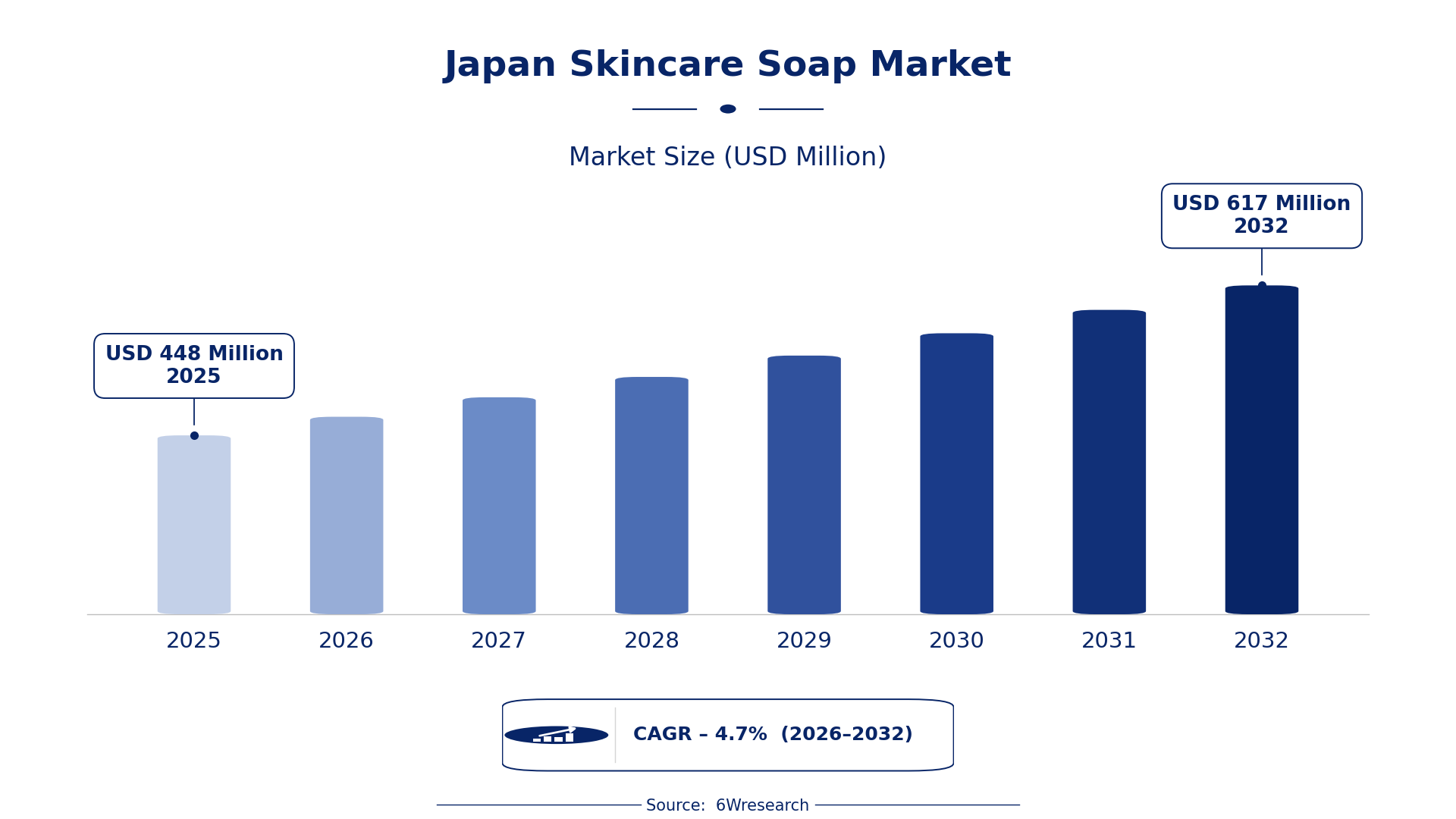
According to 6Wresearch internal database and industry insights, the Japan Skincare Soap Market was valued at USD 448 Million in 2025 and is projected to reach USD 617 Million by 2032, growing at a CAGR of approximately 4.7% during 2026–2032.
Japan Skincare Soap Market Highlights
| Report Metric | Details |
| Report Name | Japan Skincare Soap Market (2026-2032) |
| Market Size 2025 | USD 448 Million |
| Market Size 2032 | USD 617 Million |
| Absolute Growth 2025–2032 | USD 169 Million |
| CAGR 2026–2032 | 4.7% |
| Peak Annual Growth | 5.3% in 2030 |
| Forecast Period | 2026–2032 |
| Historical Data | 2022–2025 |
| Base Year | 2025 |
| Leading Soap Type, 2025 | Moisturizing Soap (42% share) |
| Leading Base Material, 2025 | Glycerin/Shea Butter (42% share) |
| Leading Purpose, 2025 | Skin Brightening (44% share) |
| Leading End User, 2025 | Bath & Body Retailers (46% share) |
| Fastest-Growing Soap Type | Herbal Skincare Soap (6.4% CAGR) |
| Fastest-Growing Base Material | Neem/Aloe/Turmeric (6.8% CAGR) |
| Fastest-Growing Purpose | Acne Treatment (6.2% CAGR) |
| Fastest-Growing End User | Ayurvedic Brands (6.0% CAGR) |
| Growing Sector | personal care |
| Key End Users | Bath & Body Retailers, Pharmacies, Ayurvedic Brands, Cosmetic Retailers |
Japan Skincare Soap Market Year-wise Growth Rate and Key Drivers (2022–2032)
This graph illustrates the annual growth rates of the market from 2022 to 2032, highlighting a steady upward trajectory and projected market expansion over the forecast period.
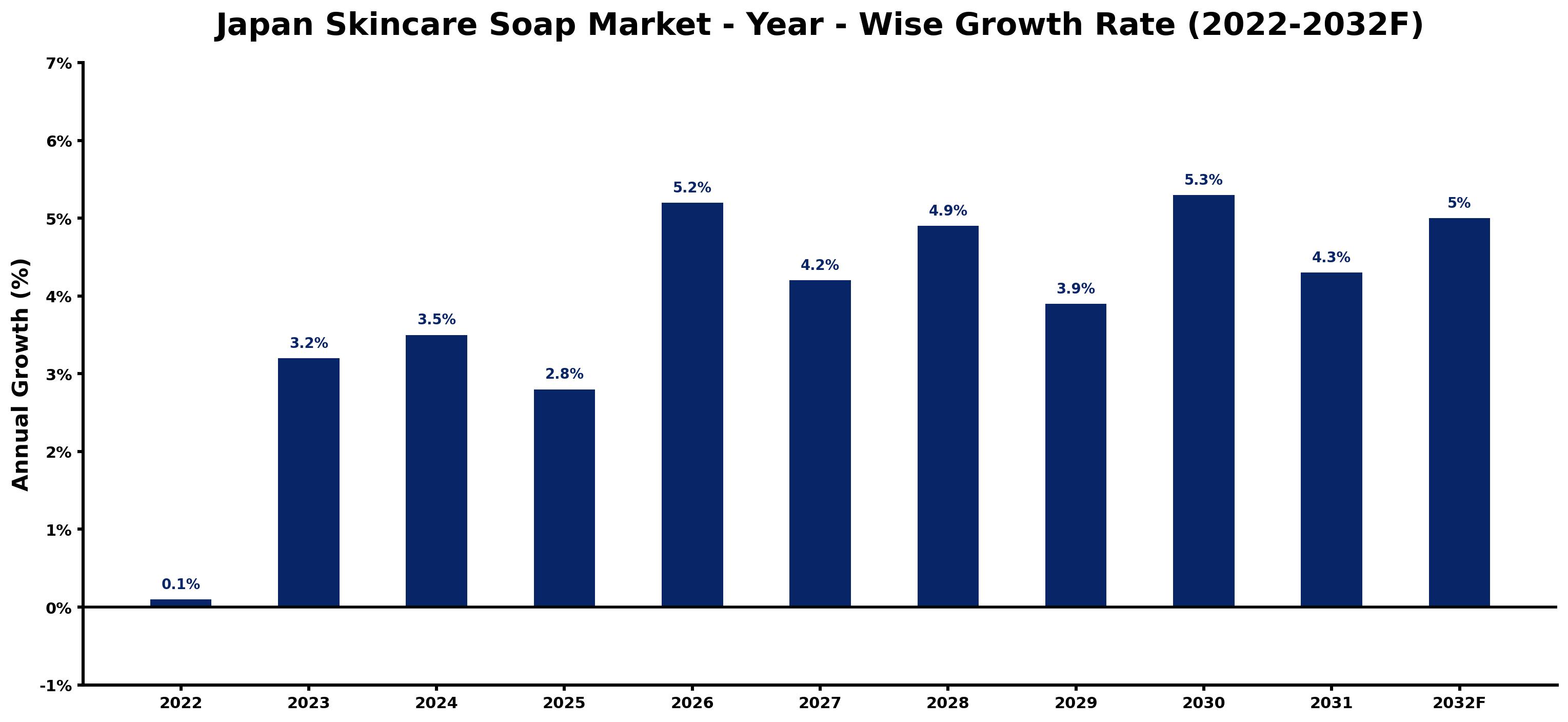
The table below sets out the estimated growth rate for each year and the main factor behind it.
| Year | Estimated Annual Growth (%) | Market Rationale |
| 2022 | 0.1 | The market showed minimal growth as consumers began to explore skincare options. |
| 2023 | 3.2 | Increased interest in natural ingredients led to a notable rise in purchases. |
| 2024 | 3.5 | Demand continued to grow as consumers sought effective skincare solutions. |
| 2025 | 2.8 | Growth slowed as market saturation began to affect purchasing patterns. |
| 2026 | 5.2 | A surge in demand for herbal products is anticipated to stimulate market activity. |
| 2027 | 4.2 | The market is projected to experience a slight slowdown as consumer preferences stabilise. |
| 2028 | 4.9 | Interest in natural skincare solutions is expected to spur renewed growth in purchases. |
| 2029 | 3.9 | Growth is anticipated to slow again as competition intensifies among established brands. |
| 2030 | 5.3 | A peak in demand for skincare soap will be driven by heightened consumer awareness. |
| 2031 | 4.3 | Growth is projected to slow as market dynamics begin to normalise after peak activity. |
| 2032 | 5.0 | The market is expected to continue growing as new trends emerge. |
Note: Market size estimations and growth projections presented in this report are based on 6Wresearch's proprietary forecasting methodology, utilizing the latest available industry data, government publications, and primary research inputs.
Japan Skincare Soap Market Synopsis
Skincare soap is a personal care product designed to cleanse and nourish the skin, typically made through a saponification process involving fats, oils, and lye. The market is expanding due to rising consumer interest in natural and herbal ingredients, highlighted by a campaign launched in 2023 promoting these products. Consumers spend an average of 5,000 yen annually on skincare, with urban demand for herbal skincare soap increasing by 15%, indicating a shift towards natural solutions. This growth is supported by rising disposable incomes and a focus on skin health, creating opportunities for suppliers to innovate and meet evolving consumer preferences.
Market Dynamics Impact Analysis (2026–2032)
| Factor | Type | Impact | Primary Segment Affected |
| Growing consumer preference for natural ingredients drives demand for herbal skincare soap. | Driver | High | Herbal Skincare Soap |
| The rise in disposable income allows consumers to spend more on skincare products. | Driver | High | Moisturizing Soap |
| The increasing popularity of Ayurvedic brands presents a significant market opportunity. | Opportunity | High | Ayurvedic Brands |
| The expansion of pharmacies as key distribution channels enables wider access to skincare products. | Opportunity | Medium | Pharmacies |
| Market saturation limits growth potential for established brands in the skincare sector. | Restraint | High | Medicated Soap |
| Consumer loyalty to established brands can hinder new entrants in the market. | Restraint | Medium | Whitening Soap |
| High production costs for natural ingredients can limit profit margins for producers. | Challenge | High | Glycerin/Shea Butter |
| Intense competition among brands can lead to price wars, affecting profitability. | Challenge | Medium | Acne Treatment |
Evaluation of Drivers in Japan Skincare Soap Market (2026–2032)
The table below links each growth driver to the segment it affects and the evidence for it.
| Drivers | Primary Segment Affected | Why It Matters (Evidence) |
| Increased consumer interest in herbal ingredients boosts demand for herbal skincare soap. | Herbal Skincare Soap | The demand for herbal skincare soap has increased by 15% in urban areas. |
| Rising disposable incomes enable consumers to invest more in skincare products. | Moisturizing Soap | The average consumer spends about 5,000 yen annually on skincare products. |
| Growing popularity of Ayurvedic brands attracts younger consumers to natural products. | Ayurvedic Brands | The popularity of Ayurvedic brands is increasing among younger consumers. |
| The expansion of pharmacies increases the availability of skincare soap options. | Pharmacies | Pharmacies account for 30% of skincare soap sales in Japan. |
| Awareness of skin health drives demand for effective skincare solutions. | Medicated Soap | Japan's national medical care expenditure was about JPY 46.7 trillion in fiscal 2022. |
Much of the new demand traces back to the increasing consumer interest in natural ingredients, with the demand for herbal skincare soap rising by 15% in urban areas. Consumers are willing to invest in quality, as reflected in their average annual spending of approximately 5,000 yen on skincare products. The popularity of Ayurvedic brands is growing among younger consumers, driving further interest in natural solutions. Pharmacies account for 30% of skincare soap sales, increasing accessibility for buyers. Japan's national medical care expenditure reached about JPY 46.7 trillion in fiscal 2022, indicating a strong focus on health and wellness.
Evaluation of Restraints in Japan Skincare Soap Market
These are the pressures that could keep growth below its potential.
| Market Restraint | Primary Segment Affected | Why It Matters (Evidence) |
| High production costs for natural ingredients limit profit margins for producers. | Glycerin/Shea Butter | Producers face challenges in sourcing high-quality natural ingredients, increasing costs. |
| Consumer loyalty to established brands can hinder new entrants in the market. | Whitening Soap | Established brands dominate the market, making it difficult for newcomers to gain traction. |
| Market saturation limits growth potential for established brands in the skincare sector. | Medicated Soap | The number of products available has increased, leading to intense competition. |
| Regulatory compliance for new products can delay market entry. | Herbal Skincare Soap | Producers must navigate complex regulations, which can slow down product launches. |
| Intense competition among brands can lead to price wars, affecting profitability. | Acne Treatment | As brands compete for market share, prices may drop, squeezing margins. |
Japan Skincare Soap Market Challenges
In 2022, Japan's national medical care expenditure reached JPY 46.7 trillion, reflecting the regulatory costs producers face to meet the JIS standard for cosmetics. Supply chain disruptions hinder importers from accessing essential natural ingredients, which can delay product launches by up to six months. Buyers experience increased prices as demand for herbal skincare soap has surged by 15% in urban areas, pushing average annual spending on skincare products to 5,000 yen. Competition intensifies as trends from K-beauty and J-beauty compel local producers to innovate rapidly, risking market share for those unable to adapt.
Trends in the Japan Skincare Soap Market
Several trends are reshaping the Japan Skincare Soap Market; the most important are set out below.
- Shift towards Natural Ingredients: Pharmacies are increasingly stocking natural skincare products, responding to consumer demand for herbal options. In 2023, the Japanese government launched a campaign promoting natural skincare products, reflecting a growing trend. This shift encourages suppliers to focus on sourcing natural ingredients.
- Emergence of Ayurvedic Brands: Ayurvedic brands are gaining traction among younger consumers, driven by a desire for natural solutions. The popularity of these products is clear, with a reported increase in sales of herbal skincare soap in urban areas. This trend presents opportunities for suppliers to cater to this demographic.
- Rise in Consumer Spending: In 2023, the average consumer spent about 5,000 yen annually on skincare products, reflecting an increase in disposable income. This trend indicates a willingness to invest in quality skincare, prompting suppliers to improve product offerings.
- Focus on Skin Health Awareness: The emphasis on skin health is growing, with consumers seeking effective skincare solutions. In 2022, Japan's national medical care expenditure was about JPY 46.7 trillion, highlighting the importance of health and wellness. This focus drives demand for innovative skincare products.
Investment Opportunities in the Japan Skincare Soap Market
The following opportunities in the Japan Skincare Soap Market pair current demand with a clear way in.
- Supply of Herbal Skincare Soap: The rising demand for herbal skincare soap presents an opportunity for suppliers to invest in natural ingredients. Urban areas are increasingly seeking natural options, indicating a gap for new entrants to fill.
- Investment in Ayurvedic Brands: The growing popularity of Ayurvedic brands among younger consumers creates an opportunity for investment. Suppliers can enter this market by forming partnerships with local distributors to reach target demographics.
- Expansion of Pharmacies: Pharmacies account for 30% of skincare soap sales, indicating a key distribution channel. Suppliers should consider partnerships with pharmacies to improve product availability and reach more consumers.
- Development of Medicated Soaps: The increasing focus on skin health drives demand for medicated soaps, particularly for acne treatment. Suppliers can invest in this segment to cater to the needs of consumers seeking effective solutions.
Government Initiatives in the Japan Skincare Soap Market
The Standards for Cosmetics, established in 2000 under the PMD Act, require skincare soap producers to adhere to strict ingredient regulations, ensuring safety and quality. This law mandates that all cosmetics sold in Japan, including skincare soaps, comply with the prohibited and restricted ingredient lists, impacting production processes. Additionally, the Long-Term Care Insurance Act, in force since 2000, supports the growing elderly population's demand for skincare products, as 29.3% of Japan's population was aged 65 or older in September 2024, influencing market dynamics.
The Ministry of Health, Labour and Welfare oversees the implementation of these standards and funds initiatives aimed at promoting natural ingredients in cosmetics. In 2023, the ministry launched a campaign to encourage the use of herbal components in skincare products, which has led to increased funding for research and development in this area. This support is crucial for producers aiming to innovate and meet the rising consumer demand for natural skincare solutions, contributing to the overall market growth.
Future Insight of the Japan Skincare Soap Market
The Tokyo Cosmetic Fair in 2023 showcased advancements in product formulations, indicating a shift towards more effective skincare solutions by 2032. The Japanese government's campaign promoting natural skincare products will stimulate further investment in sustainable sourcing practices. As the average age of skincare soap users remains between 30-45 years, suppliers must cater to this demographic's growing preference for herbal ingredients. By 2032, annual investment in skincare product development is expected to exceed 10 billion yen, fostering a more competitive market.
Market Segmentation Analysis
Japan Skincare Soap Market report covers a detailed analysis of the following market segments:
By Soap Type – Moisturizing Soap Leads, Herbal Skincare Soap Expected to Grow Fastest
According to Saurav Kr Singh, Senior Research Analyst at 6Wresearch, Moisturizing Soap accounted for 42% of the market by soap type in 2025. Moisturizing soap holds the largest share due to its widespread use among consumers seeking hydration, particularly in urban areas where skincare awareness is high. This type of soap is often recommended by dermatologists and is a staple in many households across Japan. The quickest growth will come from Herbal Skincare Soap, forecast to expand at a CAGR of 6.4% between 2026 and 2032. The rapid growth of herbal skincare soap is attributed to the increasing consumer preference for natural ingredients, as highlighted by a 15% rise in demand in urban regions. This trend is supported by the Japanese government's campaign promoting natural skincare products, which is likely to further boost its popularity. Suppliers should focus on expanding their herbal product lines to meet rising consumer demand.
By Base Material – Glycerin/Shea Butter Leads, Neem/Aloe/Turmeric Expected to Grow Fastest
Glycerin/Shea Butter held 42% of the Japan Skincare Soap Market by base material in 2025. Glycerin and shea butter are preferred for their well-known moisturizing properties, appealing to a broad base of consumers seeking skin nourishment. This segment benefits from a strong installed base, as these ingredients are often highlighted in popular skincare campaigns and product formulations. Neem/Aloe/Turmeric is projected to grow fastest, at a CAGR of 6.8% during 2026–2032. The rapid growth of neem, aloe, and turmeric in skincare products is driven by increasing consumer interest in natural benefits, with a reported 15% rise in demand for herbal soaps in urban areas. This trend is further supported by government initiatives promoting natural ingredients. Suppliers should focus on expanding their herbal product lines to meet the rising consumer demand for natural skincare solutions.
By Purpose – Skin Brightening Leads, Acne Treatment Expected to Grow Fastest
In 2025, Skin Brightening led the purpose split with a 44% share. Skin brightening soaps hold the largest share due to their high demand among consumers seeking to improve skin appearance. The popularity of ingredients like kojic acid, known for its whitening effects, drives sales in urban areas where skincare trends are prominent. Acne Treatment is set to record the highest CAGR in this split, 6.2% over 2026–2032. The acne treatment segment is experiencing rapid growth as awareness of skin health rises among younger consumers. The increasing prevalence of acne-related skin issues, particularly in urban settings, fuels this demand, leading to a projected growth rate that outpaces other segments. Suppliers should focus on enhancing product offerings in skin brightening and acne treatment to capture the growing consumer interest.
By End User – Bath & Body Retailers Lead, Ayurvedic Brands Expected to Grow Fastest
The largest end user category in 2025 was Bath & Body Retailers, at 46% of revenue. Bath and body retailers dominate the market as they serve as the primary distribution channel for skincare soap products. Their extensive reach and established customer base allow them to effectively cater to the needs of consumers across various demographics. Over 2026–2032, Ayurvedic Brands are expected to post the fastest growth, at a CAGR of 6.0%. Ayurvedic brands are rapidly gaining traction as consumers increasingly seek natural and herbal skincare solutions. This trend is particularly evident among younger demographics, who are more inclined to explore products with organic ingredients, driving the growth of this segment. For suppliers, aligning product development with the preferences of bath and body retailers and the rising demand for Ayurvedic brands will be crucial for market success.
Key Attractiveness of the Report
- 10 Years of Market Numbers
- Historical Data Starting from 2022 to 2025
- Base Year 2025
- Forecast Data until 2032
- Key Performance Indicators Impacting the Market
- Major Upcoming Developments and Projects
Key Highlights of the Report:
- Japan Skincare Soap Market Outlook
- Market Size of Japan Skincare Soap Market, 2025
- Forecast of Japan Skincare Soap Market, 2032
- Historical Data and Forecast of Japan Skincare Soap Revenues & Volume for the Period 2022-2032F
- Japan Skincare Soap Market Trend Evolution
- Japan Skincare Soap Market Drivers and Challenges
- Japan Skincare Soap Price Trends
- Japan Skincare Soap Porter's Five Forces
- Japan Skincare Soap Industry Life Cycle
- Historical Data and Forecast of Japan Skincare Soap Market Revenues & Volume By Soap Type for the Period 2022-2032F
- Historical Data and Forecast of Japan Skincare Soap Market Revenues & Volume By Herbal Skincare Soap for the Period 2022-2032F
- Historical Data and Forecast of Japan Skincare Soap Market Revenues & Volume By Moisturizing Soap for the Period 2022-2032F
- Historical Data and Forecast of Japan Skincare Soap Market Revenues & Volume By Medicated Soap for the Period 2022-2032F
- Historical Data and Forecast of Japan Skincare Soap Market Revenues & Volume By Whitening Soap for the Period 2022-2032F
- Historical Data and Forecast of Japan Skincare Soap Market Revenues & Volume By Base Material for the Period 2022-2032F
- Historical Data and Forecast of Japan Skincare Soap Market Revenues & Volume By Neem/Aloe/Turmeric for the Period 2022-2032F
- Historical Data and Forecast of Japan Skincare Soap Market Revenues & Volume By Glycerin/Shea Butter for the Period 2022-2032F
- Historical Data and Forecast of Japan Skincare Soap Market Revenues & Volume By Sulfur/Salicylic Acid for the Period 2022-2032F
- Historical Data and Forecast of Japan Skincare Soap Market Revenues & Volume By Kojic Acid/Glutathione for the Period 2022-2032F
- Historical Data and Forecast of Japan Skincare Soap Market Revenues & Volume By Purpose for the Period 2022-2032F
- Historical Data and Forecast of Japan Skincare Soap Market Revenues & Volume By Acne Treatment for the Period 2022-2032F
- Historical Data and Forecast of Japan Skincare Soap Market Revenues & Volume By Dry Skin Relief for the Period 2022-2032F
- Historical Data and Forecast of Japan Skincare Soap Market Revenues & Volume By Fungal/Bacterial Skin for the Period 2022-2032F
- Historical Data and Forecast of Japan Skincare Soap Market Revenues & Volume By Skin Brightening for the Period 2022-2032F
- Historical Data and Forecast of Japan Skincare Soap Market Revenues & Volume By End User for the Period 2022-2032F
- Historical Data and Forecast of Japan Skincare Soap Market Revenues & Volume By Ayurvedic Brands for the Period 2022-2032F
- Historical Data and Forecast of Japan Skincare Soap Market Revenues & Volume By Bath & Body Retailers for the Period 2022-2032F
- Historical Data and Forecast of Japan Skincare Soap Market Revenues & Volume By Pharmacies for the Period 2022-2032F
- Historical Data and Forecast of Japan Skincare Soap Market Revenues & Volume By Cosmetic Retailers for the Period 2022-2032F
- Japan Skincare Soap Import Export Trade Statistics
- Market Opportunity Assessment By Soap Type
- Market Opportunity Assessment By Base Material
- Market Opportunity Assessment By Purpose
- Market Opportunity Assessment By End User
- Japan Skincare Soap Top Companies Market Share
- Japan Skincare Soap Competitive Benchmarking By Technical and Operational Parameters
- Japan Skincare Soap Company Profiles
- Japan Skincare Soap Key Strategic Recommendations
Market Covered
Coverage by segment is as follows.
By Soap Type
- Herbal Skincare Soap
- Moisturizing Soap
- Medicated Soap
- Whitening Soap
By Base Material
- Neem/Aloe/Turmeric
- Glycerin/Shea Butter
- Sulfur/Salicylic Acid
- Kojic Acid/Glutathione
By Purpose
- Acne Treatment
- Dry Skin Relief
- Fungal/Bacterial Skin
- Skin Brightening
By End User
- Ayurvedic Brands
- Bath & Body Retailers
- Pharmacies
- Cosmetic Retailers































