Japan SLES, SLS and LABSA Market Size & Growth Rate
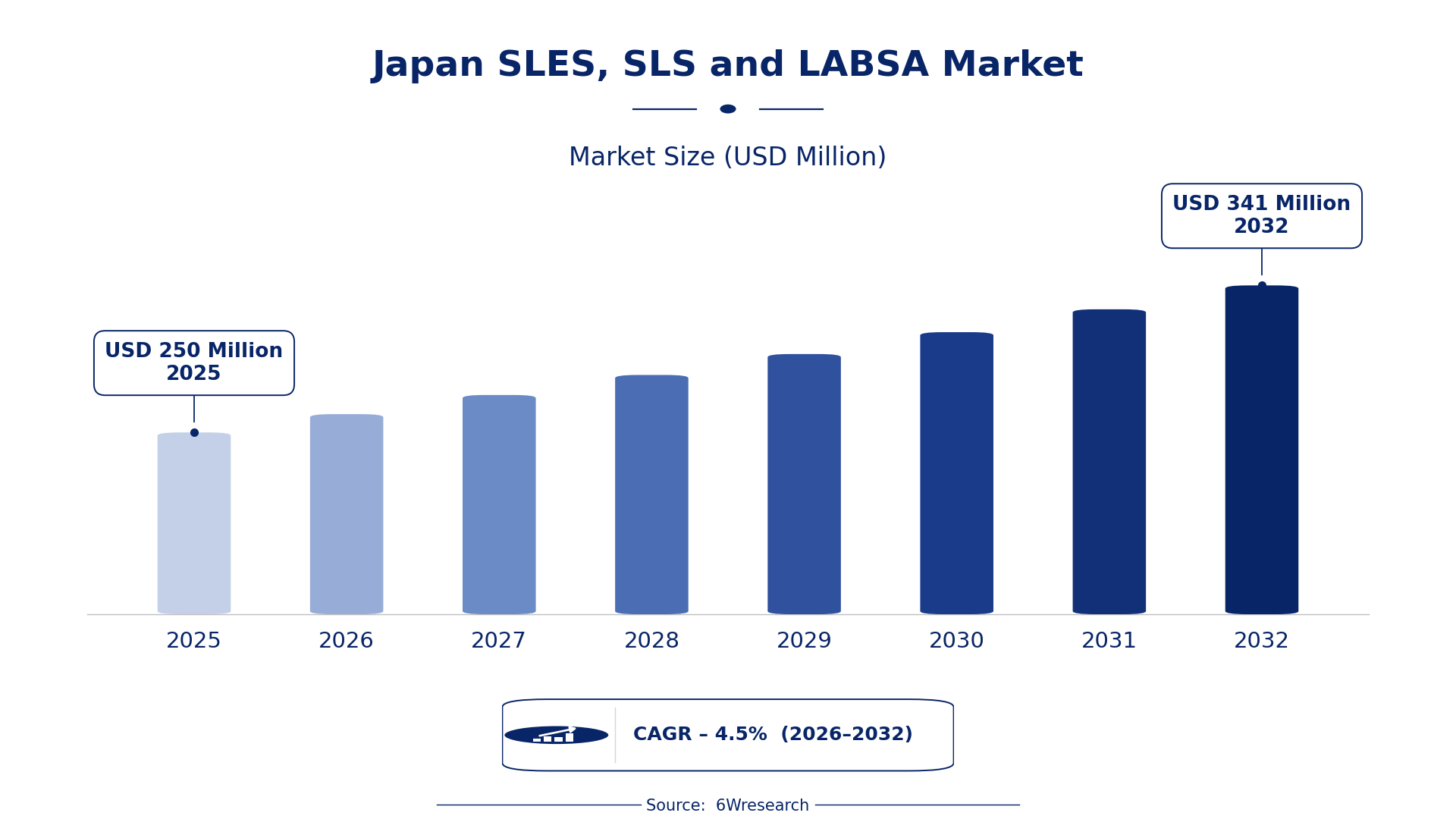
According to 6Wresearch internal database and industry insights, the Japan SLES, SLS and LABSA Market was valued at USD 250 Million in 2025 and is projected to reach USD 341 Million by 2032, growing at a CAGR of approximately 4.5% during 2026–2032.
Japan SLES, SLS and LABSA Market Highlights
| Report Metric | Details |
| Report Name | Japan SLES, SLS and LABSA Market (2026-2032) |
| Market Size 2025 | USD 250 Million |
| Market Size 2032 | USD 341 Million |
| Absolute Growth 2025–2032 | USD 91 Million |
| CAGR 2026–2032 | 4.5% |
| Peak Annual Growth | 5.7% in 2026 |
| Forecast Period | 2026–2032 |
| Historical Data | 2022–2025 |
| Base Year | 2025 |
| Leading Type, 2025 | SLES (43% share) |
| Fastest-Growing Type | SLS (6.1% CAGR) |
| Growing Sector | personal care products |
| Key End Users | cleaning product manufacturers, personal care product manufacturers, industrial cleaning companies |
Japan SLES, SLS and LABSA Market Year-wise Growth Rate and Key Drivers (2022–2032)
This graph illustrates the annual growth rates of the market from 2022 to 2032, highlighting a steady upward trajectory and projected market expansion over the forecast period.
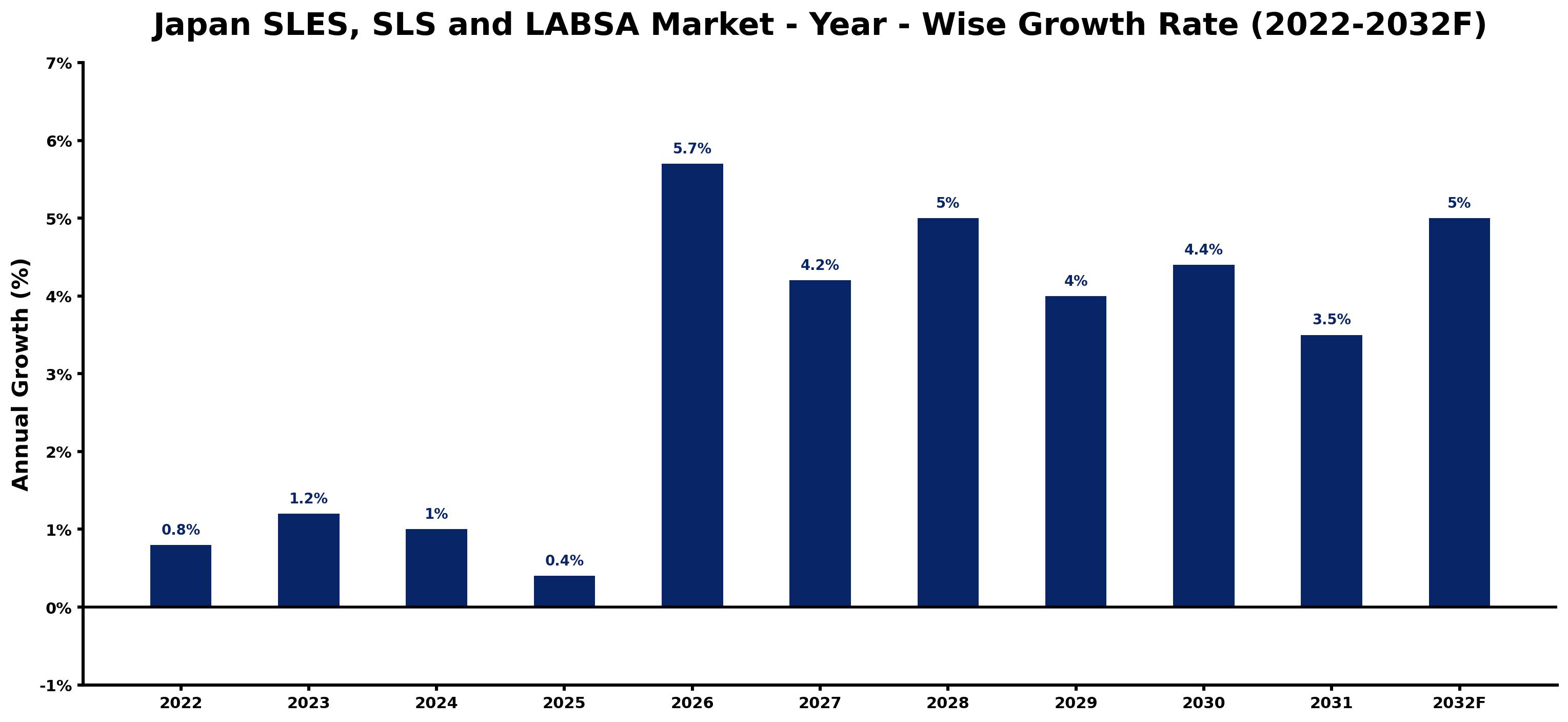
Annual growth estimates for each year appear below with the principal reason behind them, explaining the shifts that set the pace of the market.
| Year | Estimated Annual Growth (%) | Market Rationale |
| 2022 | 0.8 | The market experienced steady growth due to stable demand from personal care manufacturers. |
| 2023 | 1.2 | Growth accelerated as consumer interest in personal care products increased. |
| 2024 | 1.0 | The growth rate slowed as market saturation began to affect new product launches. |
| 2025 | 0.4 | A further slowdown occurred as economic conditions tightened consumer spending on non-essentials. |
| 2026 | 5.7 | Demand is expected to surge as the personal care sector embraces new formulations and eco-friendly practices. |
| 2027 | 4.2 | Growth will decelerate as competition intensifies among local manufacturers in the surfactant space. |
| 2028 | 5.0 | An uptick in demand is projected as sustainability trends gain traction in consumer preferences. |
| 2029 | 4.0 | Growth will slow again as established brands dominate the market with their product lines. |
| 2030 | 4.4 | The market will see renewed interest as new entrants introduce novel surfactant formulations. |
| 2031 | 3.5 | A slowdown in growth is anticipated as regulatory pressures increase on product formulations. |
| 2032 | 5.0 | Demand will rise again as consumers shift towards eco-friendly and sustainable products. |
Note: Market size estimations and growth projections presented in this report are based on 6Wresearch's proprietary forecasting methodology, utilizing the latest available industry data, government publications, and primary research inputs.
Japan SLES, SLS and LABSA Market Synopsis
SLES, SLS, and LABSA are surfactants used in cleaning and personal care items, synthesized from fatty alcohols. These products play a crucial role in formulations for shampoos and industrial cleaners. The Japan SLES, SLS and LABSA Market is growing due to rising domestic demand from the personal care sector, with over 70% of personal care products containing SLES. The increasing focus on eco-friendly products and government initiatives further drive growth in this market.
Market Dynamics Impact Analysis (2026–2032)
| Factor | Type | Impact | Primary Segment Affected |
| Rising consumer interest in personal care products | Driver | High | SLES |
| Growing demand for eco-friendly cleaning agents | Driver | High | SLS |
| Increasing production of personal care items | Opportunity | High | SLES |
| Expansion of industrial cleaning sector | Opportunity | High | LABSA |
| Regulatory compliance costs for manufacturers | Restraint | High | SLS |
| Market saturation limiting new entrants | Restraint | Medium | LABSA |
| High raw material prices affecting production | Challenge | High | SLES |
| Capacity constraints in production facilities | Challenge | Medium | SLS |
Evaluation of Drivers in Japan SLES, SLS and LABSA Market (2026–2032)
Below are the drivers that matter most for revenue growth, with supporting evidence.
| Drivers | Primary Segment Affected | Why It Matters (Evidence) |
| Increased production of personal care products | SLES | Over 70% of personal care products in Japan use SLES, driving higher demand for this surfactant. |
| Growing eco-conscious consumer base | SLS | SLS is a key ingredient in over 50% of liquid soaps, aligning with consumer preferences for eco-friendly options. |
| Rising industrial cleaning sector | LABSA | The industrial cleaning sector is anticipated to grow steadily, increasing demand for LABSA as a key ingredient. |
| Technological advancements in surfactant formulations | SLES | New developments in formulations are leading to higher consumption of SLES in personal care products. |
| Support from local manufacturing initiatives | SLS | The Tokyo region, accounting for 30% of personal care product manufacturing, boosts SLS demand. |
Most of the extra volume comes from the increasing production of personal care products, with SLES used in over 70% of these items. The industrial cleaning sector is also a key driver, as it is expected to grow steadily, increasing LABSA consumption. New developments in formulations have resulted in greater demand for SLES. An eco-conscious consumer base is increasingly seeking products with sustainable ingredients, which drives demand for SLS in liquid soaps. The Tokyo region's production of personal care products further supports rising consumption of SLS.
Evaluation of Restraints in Japan SLES, SLS and LABSA Market
The following restraints limit how fast demand can grow.
| Market Restraint | Primary Segment Affected | Why It Matters (Evidence) |
| High compliance costs for eco-friendly standards | SLS | Manufacturers face increased costs to comply with eco-friendly standards, impacting pricing strategies. |
| Market saturation limiting growth potential | LABSA | The presence of established brands in the market restricts opportunities for new entrants. |
| Fluctuating raw material prices affecting profitability | SLES | Rising prices of fatty alcohols used in SLES production can squeeze profit margins for manufacturers. |
| Strict regulations on surfactant formulations | SLS | Regulatory scrutiny from the Ministry of Health, Labour and Welfare complicates product development. |
| Capacity limitations in production facilities | LABSA | Existing production facilities may not meet the growing demand, resulting in supply constraints. |
Japan SLES, SLS and LABSA Market Challenges
Producers of personal care products in Japan face intense competition, which drives down prices and reduces margins. This situation arises from a saturated market with many players, costing producers about 15% in potential revenue. Supply chain disruptions affect the availability of SLES and SLS, as local regulations complicate sourcing, leading to delays in product launches for manufacturers. Skills shortages in the surfactant production sector hinder innovation, causing a 10% slowdown in the development of new formulations that limits producers' ability to meet evolving consumer demands.
Trends in the Japan SLES, SLS and LABSA Market
Four trends stand out in the Japan SLES, SLS and LABSA Market.
- Shift towards Eco-Friendly Surfactants: In 2023, initiatives promoting eco-friendly surfactants are influencing manufacturers to adapt. This shift is anticipated to increase the market for sustainable surfactants by approximately 20%.
- Transition from Conventional to Sustainable Ingredients: The adoption of ISO 22716 standards for good manufacturing practices encourages the use of sustainable ingredients in surfactant production. This trend is likely to improve product quality and safety, with a projected 15% increase in compliant products.
- Emergence of Innovative Formulations: Innovative formulations in personal care products are on the rise, with SLES being a primary ingredient. This trend is expected to boost SLES consumption by around 25% over the next five years.
- Growing Demand for Industrial Cleaning Solutions: The industrial cleaning sector is expanding, driven by the need for effective cleaning agents. This growth is projected to increase LABSA consumption annually by 10%.
Investment Opportunities in the Japan SLES, SLS and LABSA Market
Investors looking at the Japan SLES, SLS and LABSA Market should consider the following areas.
- Personal Care Manufacturers Seeking Sustainable Ingredients: Personal care manufacturers are increasingly looking for eco-friendly surfactants, creating opportunities for suppliers of SLES. The market for sustainable ingredients is set to grow by 15%.
- Investment in Eco-Friendly Surfactant Production: Investing in eco-friendly surfactant production facilities can yield strong returns, especially in urban areas like Tokyo, where demand is high. The Tokyo Metropolitan Government supports green chemistry initiatives, with funding of around JPY 5 billion.
- Expansion of Industrial Cleaning Facilities: The industrial cleaning sector requires effective cleaning agents, presenting opportunities for LABSA suppliers. With an estimated annual consumption of 100,000 tons, there is strong market potential.
- Timing for New Product Launches: Now is an opportune moment for launching new surfactant formulations, as consumer preferences shift towards sustainability. The personal care market, valued at 3 trillion JPY, is ripe for innovation.
Government Initiatives in the Japan SLES, SLS and LABSA Market
The Act against Unjustifiable Premiums and Misleading Representations, enforced by the Consumer Affairs Agency, ensures that buyers receive accurate information about surfactants. This law mandates truthful advertising and labeling, protecting consumers from misleading claims. The act also includes penalties for non-compliance, enhancing consumer trust in the market.
The Industrial Standardization Act, governed by the Ministry of Economy, Trade and Industry, establishes standards for surfactant quality. This act ensures that products like SLES and SLS meet safety and efficacy requirements, benefiting both producers and buyers. The ministry conducts regular inspections, ensuring compliance and maintaining high industry standards.
Future Insight of the Japan SLES, SLS and LABSA Market
Buyers of personal care products will see a shift towards eco-friendly surfactants by 2032, driven by changing consumer preferences. The Clean Japan Initiative will encourage the adoption of sustainable practices in production. By 2030, annual consumption of LABSA is expected to reach approximately 100,000 tons, reflecting a growing demand for responsible ingredients. Enhanced compliance with ISO 22716 standards will elevate manufacturing quality, benefiting both buyers and suppliers.
Market Segmentation Analysis
Japan SLES, SLS and LABSA Market report covers a detailed analysis of the following market segments:
By Type – SLES Leads, SLS Expected to Grow Fastest
According to Summon Dutta, Assistant Manager at 6Wresearch, SLES held 43% of the Japan SLES, SLS and LABSA Market by type in 2025. SLES holds the largest market share as it serves as the primary surfactant in over 70% of personal care products in Japan, highlighting its critical role for both consumers and manufacturers. Its extensive use in products that comply with Japanese Industrial Standards solidifies its dominant position in the market. SLS is projected to grow fastest, at a CAGR of 6.1% during 2026–2032. SLS is experiencing the fastest growth due to its essential role in over 50% of liquid soaps produced in Japan, reflecting a growing consumer demand for effective foaming agents. The projected steady growth of the industrial cleaning sector will further enhance SLS's market trajectory. This indicates that suppliers should focus on enhancing their SLS offerings to capitalise on the rising demand in personal care and industrial cleaning sectors.
Key Attractiveness of the Report
- 10 Years of Market Numbers
- Historical Data Starting from 2022 to 2025
- Base Year 2025
- Forecast Data until 2032
- Key Performance Indicators Impacting the Market
- Major Upcoming Developments and Projects
Key Highlights of the Report:
- Japan SLES, SLS and LABSA Market Outlook
- Market Size of Japan SLES, SLS and LABSA Market, 2025
- Forecast of Japan SLES, SLS and LABSA Market, 2032
- Historical Data and Forecast of Japan SLES, SLS and LABSA Revenues & Volume for the Period 2022-2032
- Japan SLES, SLS and LABSA Market Trend Evolution
- Japan SLES, SLS and LABSA Market Drivers and Challenges
- Japan SLES, SLS and LABSA Price Trends
- Japan SLES, SLS and LABSA Porter's Five Forces
- Japan SLES, SLS and LABSA Industry Life Cycle
- Historical Data and Forecast of Japan SLES, SLS and LABSA Market Revenues & Volume By Type for the Period 2022-2032
- Historical Data and Forecast of Japan SLES, SLS and LABSA Market Revenues & Volume By SLES for the Period 2022-2032
- Historical Data and Forecast of Japan SLES, SLS and LABSA Market Revenues & Volume By SLS for the Period 2022-2032
- Historical Data and Forecast of Japan SLES, SLS and LABSA Market Revenues & Volume By LABSA for the Period 2022-2032
- Japan SLES, SLS and LABSA Import Export Trade Statistics
- Market Opportunity Assessment By Type
- Japan SLES, SLS and LABSA Top Companies Market Share
- Japan SLES, SLS and LABSA Competitive Benchmarking By Technical and Operational Parameters
- Japan SLES, SLS and LABSA Company Profiles
- Japan SLES, SLS and LABSA Key Strategic Recommendations
Market Covered
Coverage by segment is as follows.
By Type
- SLES
- SLS
- LABSA






































