Japan Sliding Door Market Size & Growth Rate
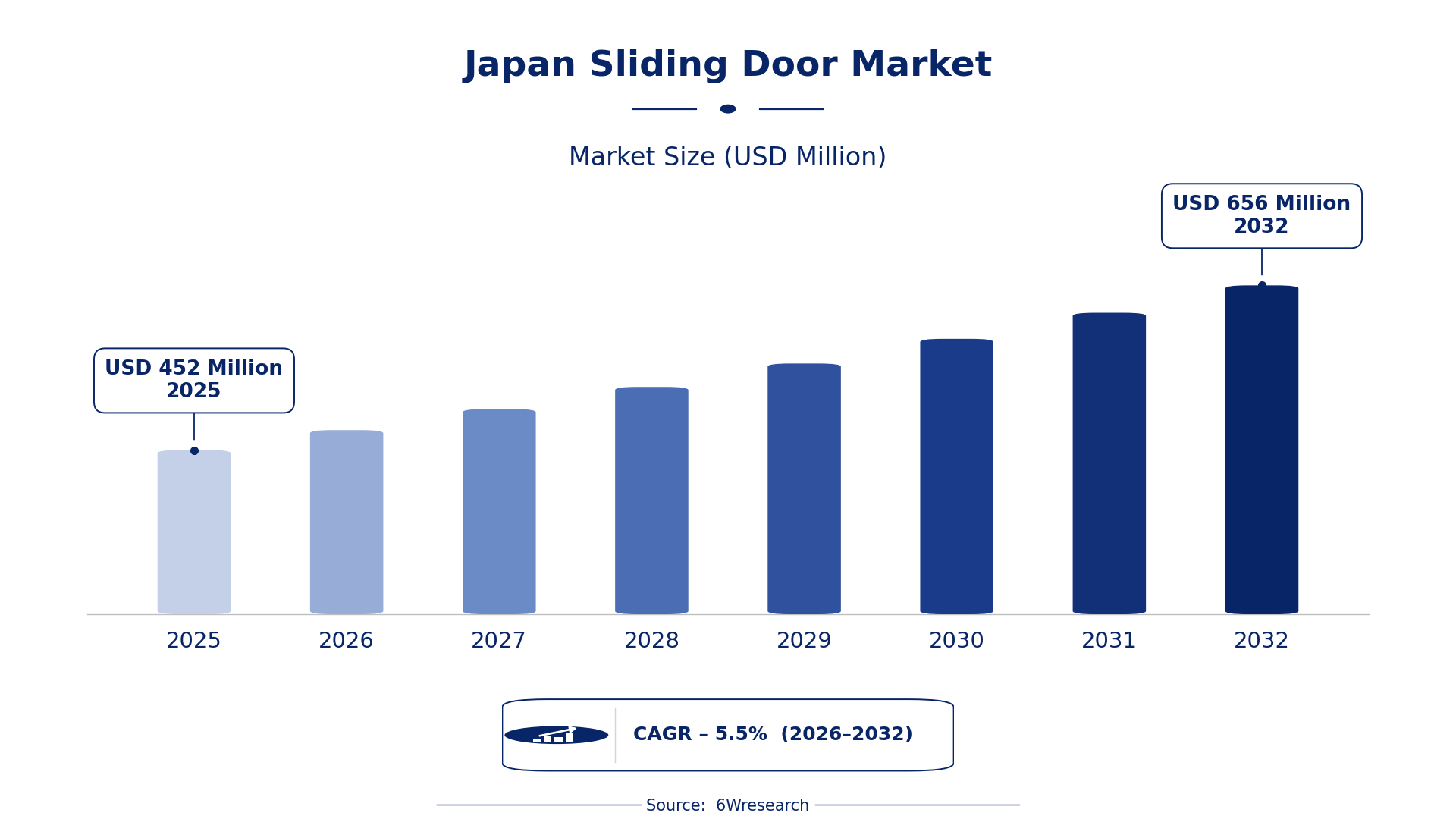
According to 6Wresearch internal database and industry insights, the Japan Sliding Door Market was valued at USD 452 Million in 2025 and is projected to reach USD 656 Million by 2032, growing at a CAGR of approximately 5.5% during 2026–2032.
Japan Sliding Door Market Highlights
| Report Metric | Details |
| Report Name | Japan Sliding Door Market (2026-2032) |
| Market Size 2025 | USD 452 Million |
| Market Size 2032 | USD 656 Million |
| Absolute Growth 2025–2032 | USD 204 Million |
| CAGR 2026–2032 | 5.5% |
| Peak Annual Growth | 6.5% in 2028 |
| Forecast Period | 2026–2032 |
| Historical Data | 2022–2025 |
| Base Year | 2025 |
| Leading Door Type, 2025 | Automatic Sliding Doors (43% share) |
| Leading Frame Material, 2025 | Aluminum/UPVC (47% share) |
| Leading Application Area, 2025 | Commercial Entryways (42% share) |
| Leading End User, 2025 | Residential Builders (35% share) |
| Fastest-Growing Door Type | Glass Sliding Doors (7.7% CAGR) |
| Fastest-Growing Frame Material | Sensor-Based (7.9% CAGR) |
| Fastest-Growing Application Area | Balconies/Patios (6.7% CAGR) |
| Fastest-Growing End User | Luxury Home Builders (7.0% CAGR) |
| Growing Sector | Balconies/Patios |
| Key End Users | Commercial Entryways, Balconies/Patios, Interior Rooms, Warehouses/Factories |
Japan Sliding Door Market Year-wise Growth Rate and Key Drivers (2022–2032)
This graph illustrates the annual growth rates of the market from 2022 to 2032, highlighting a steady upward trajectory and projected market expansion over the forecast period.
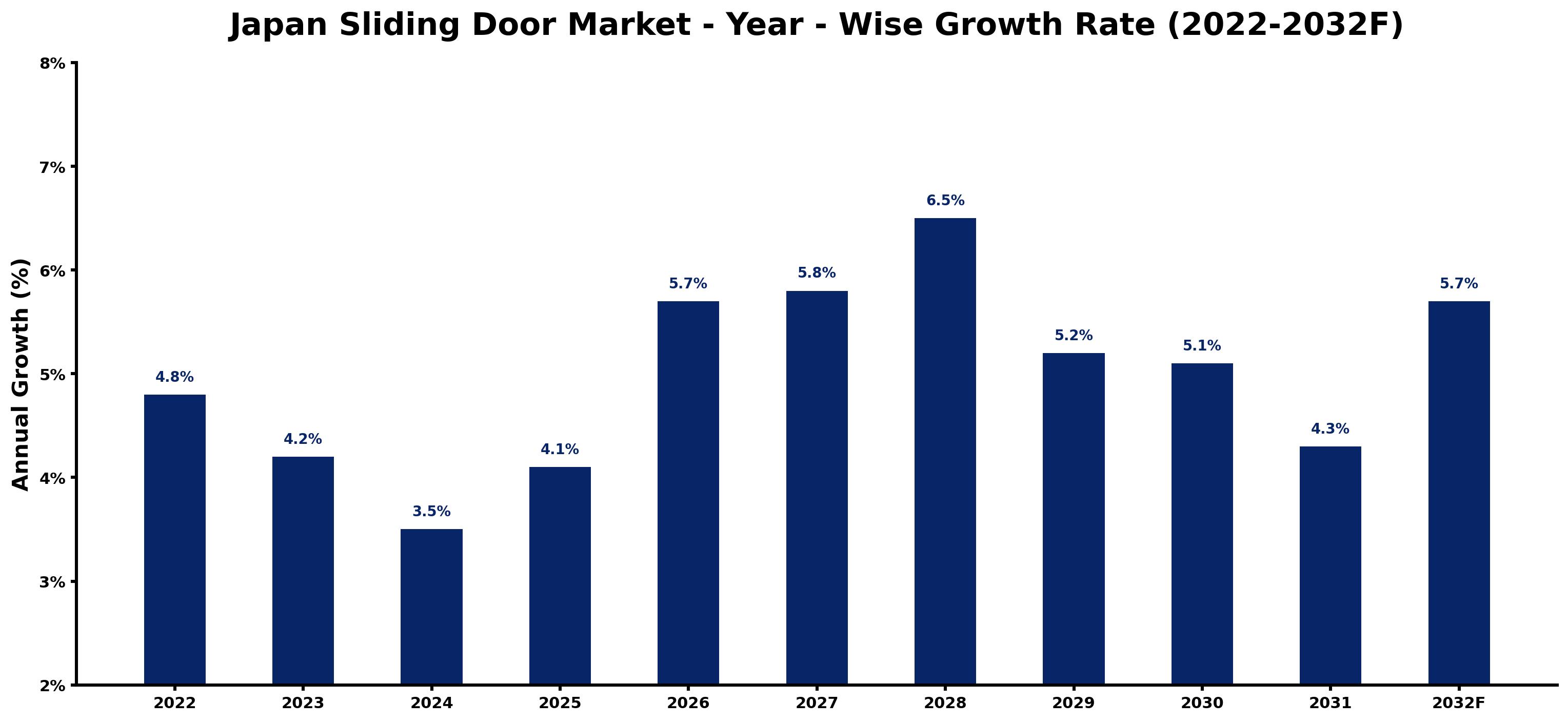
Below, each year's estimated growth is shown next to the factor that most influenced it.
| Year | Estimated Annual Growth (%) | Market Rationale |
| 2022 | 4.8 | The market experienced solid growth due to increasing construction activities and renovations. |
| 2023 | 4.2 | Growth slowed as demand stabilised following a strong recovery in the previous year. |
| 2024 | 3.5 | The market continued to grow, albeit at a slower pace, influenced by rising material costs. |
| 2025 | 4.1 | Demand increased as residential builders sought modernisation in home designs and functionality. |
| 2026 | 5.7 | Investment in infrastructure projects is expected to drive higher demand for sliding doors across various sectors. |
| 2027 | 5.8 | The market is projected to maintain momentum as technological advancements in door automation gain traction. |
| 2028 | 6.5 | A peak in growth is expected as consumer preferences shift towards energy-efficient designs. |
| 2029 | 5.2 | Growth is projected to slow as market saturation begins to affect new installations in urban areas. |
| 2030 | 5.1 | The market will continue to grow, albeit at a slower rate due to economic uncertainties. |
| 2031 | 4.3 | Demand is expected to stabilise as buyers adjust to new pricing dynamics in the construction sector. |
| 2032 | 5.7 | Growth will accelerate again as innovative designs and materials capture buyer interest. |
Note: Market size estimations and growth projections presented in this report are based on 6Wresearch's proprietary forecasting methodology, utilizing the latest available industry data, government publications, and primary research inputs.
Japan Sliding Door Market Synopsis
Sliding doors serve as versatile entry solutions, widely used in residential and commercial applications, including automatic and glass sliding doors. The Japan Sliding Door Market is expanding due to rising urbanisation, increased investment in residential construction, and a shift towards energy-efficient designs. This growth stems from advancements in door technology and heightened consumer demand for modern aesthetics, leading to a positive outlook for the market.
Market Dynamics Impact Analysis (2026–2032)
| Factor | Type | Impact | Primary Segment Affected |
| Rising urbanisation and construction activities drive demand for modern entry solutions. | Driver | High | Automatic Sliding Doors |
| Increased focus on energy efficiency creates opportunities for innovative door designs. | Opportunity | High | Glass Sliding Doors |
| Rising material costs can limit profit margins for sliding door manufacturers. | Restraint | High | Aluminum/UPVC |
| Market saturation in urban areas may slow down growth in new installations. | Restraint | Medium | Commercial Entryways |
| Technological advancements in automation enhance product appeal to buyers. | Driver | Medium | Automatic Sliding Doors |
| Growing demand for sliding doors in luxury residential projects presents new opportunities. | Opportunity | Medium | Luxury Home Builders |
| Competition from alternative entry solutions may impact sliding door sales. | Challenge | High | Barn Sliding Doors |
| Supply chain disruptions can delay project timelines and increase costs. | Challenge | Medium | Industrial Sliding Doors |
Evaluation of Drivers in Japan Sliding Door Market (2026–2032)
Below are the drivers that matter most for revenue growth, with supporting evidence.
| Drivers | Primary Segment Affected | Why It Matters (Evidence) |
| Increased residential construction projects create demand for modern sliding doors. | Automatic Sliding Doors | In 2022, residential construction in Japan reached USD 200 billion, boosting sliding door sales. |
| Technological advancements in automation enhance the functionality of sliding doors. | Glass Sliding Doors | The rise of smart home technology has led to a 15% increase in automated door installations. |
| Consumer preferences are shifting towards energy-efficient and stylish designs. | Aluminum/UPVC | Energy-efficient products accounted for 30% of new installations in 2022. |
| Growth in commercial spaces drives demand for sliding doors in entryways. | Commercial Entryways | The commercial real estate sector saw a 5% increase in new projects in 2022. |
| Renovation activities in urban areas create a need for modern sliding door solutions. | Luxury Home Builders | Renovation spending in Japan reached USD 50 billion in 2022, increasing sliding door demand. |
Much of the new demand traces back to increased residential construction projects, which reached USD 200 billion in 2022, driving the need for modern sliding doors. Technological advancements in automation have led to a rise in automated door installations, appealing to tech-savvy consumers. Energy-efficient products accounted for 30% of new installations in 2022, reflecting changing consumer preferences. Growth in commercial spaces, with an increase in new projects, further boosts demand for sliding doors in entryways. Renovation activities among residential builders have also contributed to demand, as spending reached USD 50 billion in 2022.
Evaluation of Restraints in Japan Sliding Door Market
These are the pressures that could keep growth below its potential.
| Market Restraint | Primary Segment Affected | Why It Matters (Evidence) |
| Compliance costs are rising due to stringent regulations, increasing production expenses by up to 15%. | Automatic Sliding Doors | These costs can lead to higher prices for buyers. |
| Skills shortages in the workforce hinder production efficiency, delaying project timelines by an average of 20%. | Glass Sliding Doors | This affects importers' ability to meet market demand. |
| Fluctuating material costs impact buyers, with prices for raw materials increasing by 10% annually. | Aluminum/UPVC | Buyers must frequently adjust budgets. |
| Logistical challenges can add up to 25% in transportation costs for importers. | Commercial Entryways | This impacts profit margins and pricing strategies. |
| Market saturation is limiting new installations in urban areas, slowing growth. | Luxury Home Builders | This affects the overall demand for sliding doors. |
Japan Sliding Door Market Challenges
Increased regulatory requirements burden producers with compliance costs, raising production expenses by 15% and driving up prices for buyers. Skills shortages hinder production efficiency, causing delays of approximately 20%, which disrupts importers' ability to meet market demand. Buyers experience rising material costs, with raw material prices increasing by 10% annually, necessitating frequent budget adjustments. Logistical challenges inflate transportation costs by 25% for importers, eroding profit margins and complicating pricing strategies.
Trends in the Japan Sliding Door Market
Several trends are reshaping the Japan Sliding Door Market; the most important are set out below.
- Growth in Energy-Efficient Designs: In 2022, energy-efficient sliding doors accounted for 30% of new installations, reflecting a shift towards sustainability. This trend is driven by consumer preferences for eco-friendly options, influencing suppliers to innovate.
- Rise of Smart Home Technology: The integration of smart technology in sliding doors is becoming prevalent, with automated systems gaining traction. This shift is visible in residential projects, where smart features are increasingly sought after.
- Expansion of Commercial Applications: Commercial entryways are seeing a surge in demand, with a 5% increase in new projects in 2022. This trend highlights the growing need for modern sliding door solutions in business environments.
- Increased Renovation Activities: Renovation spending in Japan reached USD 50 billion in 2022, driving demand for modern sliding doors. This trend is particularly strong among residential builders looking to upgrade properties.
Investment Opportunities in the Japan Sliding Door Market
The following areas offer the clearest openings for investors and suppliers in the Japan Sliding Door Market.
- Growing Demand for Energy-Efficient Products: With energy-efficient sliding doors accounting for 30% of new installations, suppliers can focus on eco-friendly designs. Residential builders are increasingly seeking these solutions to meet consumer preferences.
- Investment in Smart Technology: The rise of smart home technology presents an opportunity for suppliers to innovate. Collaborating with residential builders can help integrate automated features in new projects.
- Commercial Sector Expansion: The commercial real estate sector's 5% growth in new projects offers suppliers a chance to meet rising demand. Targeting commercial entryways can strengthen market presence.
- Renovation Market Growth: With renovation spending reaching USD 50 billion in 2022, suppliers can tap into this lucrative market. Partnering with residential builders can facilitate entry into this segment.
Government Initiatives in the Japan Sliding Door Market
The Economic Security Promotion Act (2022) supports supply-chain resilience for critical products, including sliding doors. This measure encourages manufacturers to invest in local production capabilities, ensuring a stable supply for buyers.
The PRTR Law (1999) requires businesses to report releases of designated chemical substances, ensuring compliance in sliding door manufacturing. The Ministry of the Environment oversees this regulation, impacting producers by necessitating adherence to environmental standards.
Future Insight of the Japan Sliding Door Market
By 2032, the investment pipeline in smart manufacturing technologies will create a more efficient production environment, stimulating demand for sliding doors. The push for eco-friendly materials will lead suppliers to adopt sustainable practices, benefiting buyers with improved product offerings. New industry standards will enhance product quality and safety, providing buyers with greater confidence in their purchases. With a projected 40% increase in residential projects, suppliers will need to innovate to cater to the expanding market.
Market Segmentation Analysis
Japan Sliding Door Market report covers a detailed analysis of the following market segments:
By Door Type – Automatic Sliding Doors Lead, Glass Sliding Doors Expected to Grow Fastest
According to Saurav Kr Singh, Senior Research Analyst at 6Wresearch, the largest door type category in 2025 was Automatic Sliding Doors, at 43% of revenue. Automatic sliding doors are extensively used in busy places like shopping malls and airports, where quick access is essential. Their ability to integrate with modern architecture solidifies their position as the leading choice across various settings. The quickest growth will come from Glass Sliding Doors, forecast to expand at a CAGR of 7.7% between 2026 and 2032. The rapid growth of glass sliding doors is attributed to a rising consumer preference for aesthetics and natural light in residential and commercial spaces. The increase in home renovation activities has significantly amplified the demand for these attractive options. Suppliers should focus on the aesthetic aspects of glass sliding doors to meet the growing consumer expectations.
By Frame Material – Aluminum/UPVC Leads, Sensor-Based Expected to Grow Fastest
Aluminum/UPVC took 47% of frame material revenue in 2025, more than any other category. Aluminum/UPVC frames are favoured for their durability, low maintenance, and versatility, making them ideal for diverse applications from commercial buildings to homes. Their cost-effectiveness and energy efficiency further enhance their attractiveness to builders. Over 2026–2032, Sensor-Based is expected to post the fastest growth, at a CAGR of 7.9%. The rapid rise of sensor-based frames is associated with the increasing emphasis on smart home technologies, which enhance user convenience and security. The trend towards integrating advanced technology in residential properties is driving this segment's growth. Suppliers must invest in sensor-based frame advancements to capitalise on the rising demand for smart home features.
By Application Area – Commercial Entryways Lead, Balconies/Patios Expected to Grow Fastest
Commercial Entryways accounted for 42% of the market by application area in 2025. Commercial entryways are vital for facilitating access in businesses, retail spaces, and public facilities, where they handle substantial foot traffic. The need for efficient and accessible entry solutions in urban environments reinforces their leading position. Balconies/Patios are set to record the highest CAGR in this split, 6.7% over 2026–2032. The balcony and patio segment is swiftly growing due to the rising trend of outdoor living spaces and the desire for seamless transitions between indoor and outdoor environments in homes. This shift is evident in the increasing number of home improvement projects. Suppliers should expand their product offerings to cater to the increasing interest in enhancing outdoor living spaces.
By End User – Residential Builders Lead, Luxury Home Builders Expected to Grow Fastest
With 35% of end user revenue in 2025, Residential Builders was the largest category. Residential builders dominate the market, as they account for most new housing developments, where sliding doors are increasingly integrated for both aesthetic and practical reasons. The current housing boom in Japan reinforces this segment's leadership. Luxury Home Builders are projected to grow fastest, at a CAGR of 7.0% during 2026–2032. Luxury home builders are experiencing the quickest growth as wealthy consumers seek bespoke features and high-end designs in their homes, driving the demand for premium sliding door solutions. The rise in disposable income among urban consumers supports this trend. Suppliers should customise their offerings to cater to the specific requirements of luxury home builders to capture this expanding market.
Key Attractiveness of the Report
- 10 Years of Market Numbers
- Historical Data Starting from 2022 to 2025
- Base Year 2025
- Forecast Data until 2032
- Key Performance Indicators Impacting the Market
- Major Upcoming Developments and Projects
Key Highlights of the Report:
- Japan Sliding Door Market Outlook
- Market Size of Japan Sliding Door Market, 2025
- Forecast of Japan Sliding Door Market, 2032
- Historical Data and Forecast of Japan Sliding Door Revenues & Volume for the Period 2022-2032F
- Japan Sliding Door Market Trend Evolution
- Japan Sliding Door Market Drivers and Challenges
- Japan Sliding Door Price Trends
- Japan Sliding Door Porter's Five Forces
- Japan Sliding Door Industry Life Cycle
- Historical Data and Forecast of Japan Sliding Door Market Revenues & Volume By Door Type for the Period 2022-2032F
- Historical Data and Forecast of Japan Sliding Door Market Revenues & Volume By Glass Sliding Doors for the Period 2022-2032F
- Historical Data and Forecast of Japan Sliding Door Market Revenues & Volume By Automatic Sliding Doors for the Period 2022-2032F
- Historical Data and Forecast of Japan Sliding Door Market Revenues & Volume By Barn Sliding Doors for the Period 2022-2032F
- Historical Data and Forecast of Japan Sliding Door Market Revenues & Volume By Industrial Sliding Doors for the Period 2022-2032F
- Historical Data and Forecast of Japan Sliding Door Market Revenues & Volume By Frame Material for the Period 2022-2032F
- Historical Data and Forecast of Japan Sliding Door Market Revenues & Volume By Aluminum/UPVC for the Period 2022-2032F
- Historical Data and Forecast of Japan Sliding Door Market Revenues & Volume By Sensor-Based for the Period 2022-2032F
- Historical Data and Forecast of Japan Sliding Door Market Revenues & Volume By Wood/Steel Frame for the Period 2022-2032F
- Historical Data and Forecast of Japan Sliding Door Market Revenues & Volume By Metal Panels for the Period 2022-2032F
- Historical Data and Forecast of Japan Sliding Door Market Revenues & Volume By Application Area for the Period 2022-2032F
- Historical Data and Forecast of Japan Sliding Door Market Revenues & Volume By Balconies/Patios for the Period 2022-2032F
- Historical Data and Forecast of Japan Sliding Door Market Revenues & Volume By Commercial Entryways for the Period 2022-2032F
- Historical Data and Forecast of Japan Sliding Door Market Revenues & Volume By Interior Rooms for the Period 2022-2032F
- Historical Data and Forecast of Japan Sliding Door Market Revenues & Volume By Warehouses/Factories for the Period 2022-2032F
- Historical Data and Forecast of Japan Sliding Door Market Revenues & Volume By End User for the Period 2022-2032F
- Historical Data and Forecast of Japan Sliding Door Market Revenues & Volume By Residential Builders for the Period 2022-2032F
- Historical Data and Forecast of Japan Sliding Door Market Revenues & Volume By Malls & Offices for the Period 2022-2032F
- Historical Data and Forecast of Japan Sliding Door Market Revenues & Volume By Luxury Home Builders for the Period 2022-2032F
- Historical Data and Forecast of Japan Sliding Door Market Revenues & Volume By Industrial Construction for the Period 2022-2032F
- Japan Sliding Door Import Export Trade Statistics
- Market Opportunity Assessment By Door Type
- Market Opportunity Assessment By Frame Material
- Market Opportunity Assessment By Application Area
- Market Opportunity Assessment By End User
- Japan Sliding Door Top Companies Market Share
- Japan Sliding Door Competitive Benchmarking By Technical and Operational Parameters
- Japan Sliding Door Company Profiles
- Japan Sliding Door Key Strategic Recommendations
Market Covered
The following segment groups are covered in the report.
By Door Type
- Glass Sliding Doors
- Automatic Sliding Doors
- Barn Sliding Doors
- Industrial Sliding Doors
By Frame Material
- Aluminum/UPVC
- Sensor-Based
- Wood/Steel Frame
- Metal Panels
By Application Area
- Balconies/Patios
- Commercial Entryways
- Interior Rooms
- Warehouses/Factories
By End User
- Residential Builders
- Malls & Offices
- Luxury Home Builders
- Industrial Construction































