Japan Small Cell Deployment Market Size & Growth Rate
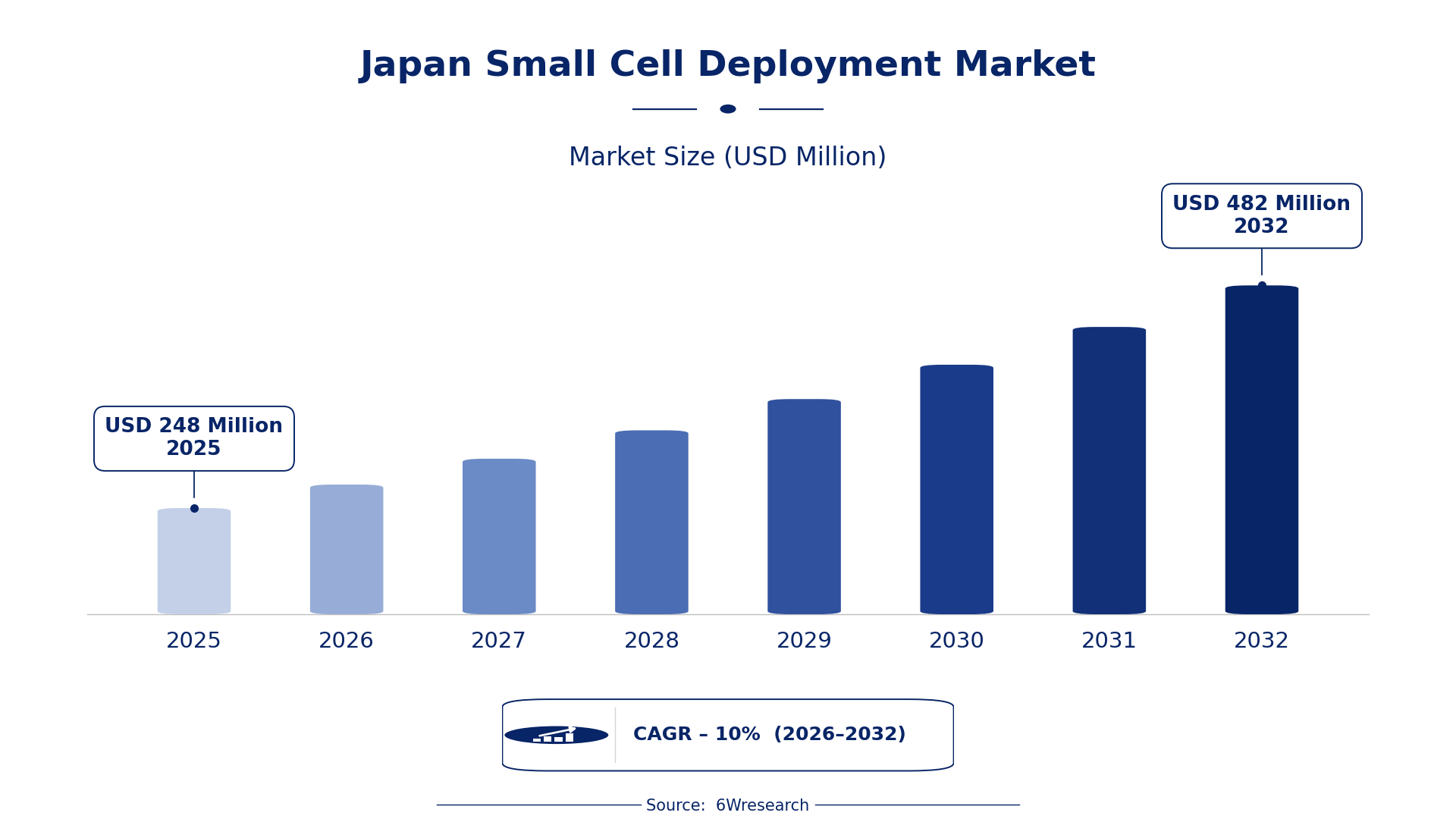
According to 6Wresearch internal database and industry insights, the Japan Small Cell Deployment Market was valued at USD 248 Million in 2025 and is projected to reach USD 482 Million by 2032, growing at a CAGR of approximately 10% during 2026–2032.
Japan Small Cell Deployment Market Highlights
| Report Metric | Details |
| Report Name | Japan Small Cell Deployment Market (2026-2032) |
| Market Size 2025 | USD 248 Million |
| Market Size 2032 | USD 482 Million |
| Absolute Growth 2025–2032 | USD 234 Million |
| CAGR 2026–2032 | 10% |
| Peak Annual Growth | 11.0% in 2028 |
| Forecast Period | 2026–2032 |
| Historical Data | 2022–2025 |
| Base Year | 2025 |
| Leading Cell Type, 2025 | Femtocell (46% share) |
| Leading Deployment Environment, 2025 | Indoor (Home/Office) (41% share) |
| Leading Technology Supported, 2025 | 4G/5G (41% share) |
| Leading End User, 2025 | Telecom Operators (38% share) |
| Fastest-Growing Cell Type | Picocell (13.6% CAGR) |
| Fastest-Growing Deployment Environment | Enterprises (13.8% CAGR) |
| Fastest-Growing Technology Supported | LTE (14.4% CAGR) |
| Fastest-Growing End User | Commercial Real Estate (13.2% CAGR) |
| Growing Sector | Telecommunications |
| Key End Users | Telecom Operators, Commercial Real Estate, Smart City Authorities |
Japan Small Cell Deployment Market Year-wise Growth Rate and Key Drivers (2022–2032)
This graph illustrates the annual growth rates of the market from 2022 to 2032, highlighting a steady upward trajectory and projected market expansion over the forecast period.
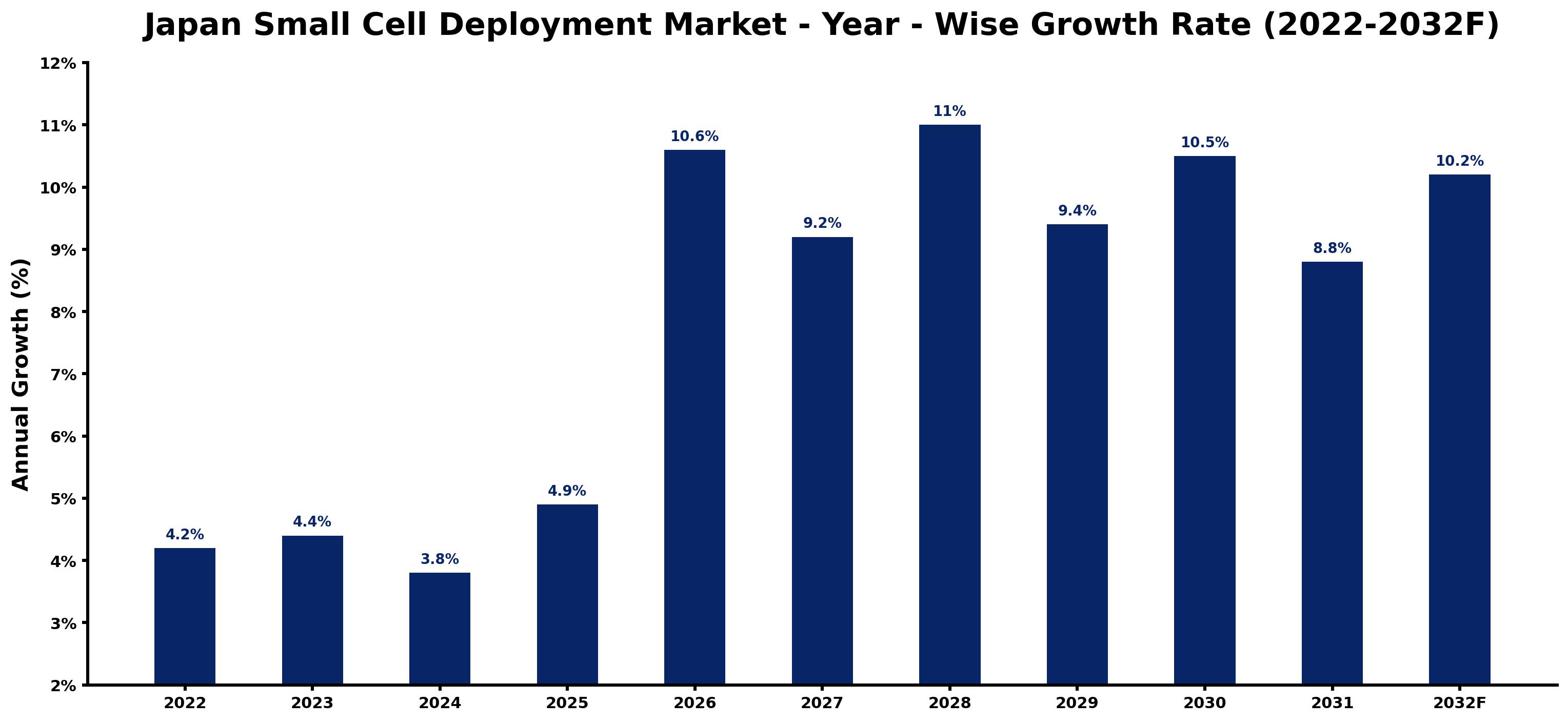
Each row of the following table gives one year's estimated growth and the event or demand shift that explains it.
| Year | Estimated Annual Growth (%) | Market Rationale |
| 2022 | 4.2 | The market exhibited steady growth due to increasing mobile connectivity needs. |
| 2023 | 4.4 | Demand for small cells rose as urban areas expanded and data usage increased. |
| 2024 | 3.8 | Growth slowed as the market adjusted to saturation in certain regions. |
| 2025 | 4.9 | A surge in small cell installations coincided with the 5G rollout plan's progress. |
| 2026 | 10.6 | Demand is expected to accelerate as telecom operators invest heavily in infrastructure upgrades. |
| 2027 | 9.2 | Growth is projected to slow as market maturity begins to set in after rapid expansion. |
| 2028 | 11.0 | The market is expected to peak as 5G adoption reaches critical mass in urban areas. |
| 2029 | 9.4 | Growth is anticipated to moderate as the market stabilises after peak adoption. |
| 2030 | 10.5 | Demand will remain strong as new applications for 5G emerge and expand. |
| 2031 | 8.8 | Growth is expected to slow as the market adjusts to increased competition and saturation. |
| 2032 | 10.2 | Demand is projected to rise again as new technologies drive further adoption. |
Note: Market size estimations and growth projections presented in this report are based on 6Wresearch's proprietary forecasting methodology, utilizing the latest available industry data, government publications, and primary research inputs.
Japan Small Cell Deployment Market Synopsis
Small Cell Deployment involves the installation of low-powered cellular nodes that improve network coverage and capacity, particularly in urban areas. The Japan Small Cell Deployment Market is propelled by the telecom industry, with a strong emphasis on 5G technology. With a population of approximately 125 million, there is a substantial demand for mobile connectivity, especially in densely populated regions like Tokyo. The government's 5G rollout plan targets 90% urban coverage by 2025, while local authorities are investing in smart city initiatives that include small cell deployment, further driving market growth.
Market Dynamics Impact Analysis (2026–2032)
| Factor | Type | Impact | Primary Segment Affected |
| Increasing urbanisation and mobile data traffic drive demand for small cells. | Driver | High | Indoor (Home/Office) |
| The 5G rollout plan accelerates the need for small cell installations. | Driver | High | 4G/5G |
| Growing demand for reliable connectivity in urban areas presents opportunities. | Opportunity | High | Dense Urban Area |
| Investment in smart city projects creates demand for small cell technology. | Opportunity | High | Urban Streets |
| Regulatory challenges can slow down deployment timelines for small cells. | Restraint | Medium | Telecom Operators |
| High initial installation costs may deter some potential buyers. | Restraint | Medium | Commercial Real Estate |
| Supply chain disruptions can delay small cell deployments. | Challenge | High | Mobile Infrastructure Firms |
| Intense competition among telecom operators may impact pricing strategies. | Challenge | Medium | Telecom Operators |
Evaluation of Drivers in Japan Small Cell Deployment Market (2026–2032)
The factors lifting demand, and the evidence behind each, are summarised below.
| Drivers | Primary Segment Affected | Why It Matters (Evidence) |
| Urbanisation increases mobile data traffic, necessitating more small cells. | Dense Urban Area | Urban areas account for over 80% of mobile data traffic in Japan. |
| The 5G rollout plan drives demand for connectivity solutions. | 4G/5G | The government aims for 90% coverage in urban areas by 2025. |
| Rising smartphone penetration boosts demand for mobile services. | Telecom Operators | The average smartphone penetration rate in Japan is around 80%. |
| Investments in smart cities create a need for small cell technology. | Urban Streets | Local governments are investing in smart city initiatives that include small cell deployment. |
| Advancements in small cell technology improve performance. | LTE | 5G mmWave technology is being tested in urban areas for high-speed applications. |
A wider customer base explains much of the growth, as urbanisation increases mobile data traffic, necessitating more small cells in urban environments. The 5G rollout plan aims for 90% coverage in urban areas by 2025, driving demand for connectivity solutions. With smartphone penetration at around 80%, demand for mobile services is rising. Technological advancements, including testing of 5G mmWave in urban areas, further improve performance and drive adoption.
Evaluation of Restraints in Japan Small Cell Deployment Market
Below are the constraints most often cited by buyers and suppliers, with the segment each affects.
| Market Restraint | Primary Segment Affected | Why It Matters (Evidence) |
| Regulatory challenges can delay small cell installations. | Telecom Operators | The Ministry of Internal Affairs and Communications oversees telecommunications regulations, which can slow deployment timelines. |
| High initial installation costs may deter some buyers. | Commercial Real Estate | The cost of deploying small cells can be prohibitive for some commercial real estate developers. |
| Supply chain disruptions can impact availability of components. | Mobile Infrastructure Firms | Global supply chain issues have affected the availability of necessary small cell components. |
| Limited awareness of small cell benefits among potential users. | Enterprises | Some enterprises may not fully understand the advantages of small cell technology. |
| Competition among telecom operators can lead to price wars. | Telecom Operators | Intense competition may drive down prices, affecting profitability for service providers. |
Japan Small Cell Deployment Market Challenges
Buyers encounter delays in small cell deployment due to outdated technology, which can extend installation timelines by up to six months in urban areas. Competition among local governments for funding creates inconsistent support for projects, leading to uncertainty and potential cancellations for suppliers. A shortage of skilled technicians hampers installation efforts, resulting in labour costs that can rise by 20% for contractors. Increasing material costs for infrastructure inflate project budgets by 15%, affecting financial viability for urban planners and clinics.
Trends in the Japan Small Cell Deployment Market
Four trends stand out in the Japan Small Cell Deployment Market.
- Shift towards 5G Technology: The push for 5G technology began in 2020, influencing small cell deployment. In 2023, the government initiated a program to subsidise small cell installations in rural areas, facilitating broader coverage.
- Increase in Smart City Initiatives: Local authorities are investing heavily in smart city projects, with urban areas accounting for over 80% of mobile data traffic. This trend will drive small cell deployment, improving connectivity.
- Growing Demand for Indoor Connectivity: As remote work becomes more common, the need for reliable indoor connectivity has surged. In 2025, Indoor (Home/Office) is projected to hold a 41% share in the deployment environment.
- Emphasis on Multi-band Technology: The trend towards multi-band small cells has gained traction since 2021, allowing for greater flexibility. By 2025, demand for multi-band technology is projected to rise as telecom operators optimise their networks.
Investment Opportunities in the Japan Small Cell Deployment Market
The following areas offer the clearest openings for investors and suppliers in the Japan Small Cell Deployment Market.
- Investment in Urban Infrastructure: Urban areas like Tokyo are investing heavily in infrastructure, with a projected 50,000 5G base stations by 2025. This creates opportunities for suppliers of small cell technology to meet demand.
- Expansion in Rural Connectivity: With the government subsidising small cell installations in rural areas, there is a gap to fill. Telecom operators can partner with local governments to improve connectivity in underserved regions.
- Focus on Smart City Projects: Local authorities are prioritising smart city initiatives, creating demand for small cells. Suppliers can enter this market by collaborating with municipal authorities to provide necessary technology.
- Development of IoT Applications: The rise of IoT applications in smart cities presents an opportunity for small cell deployment. Companies can invest in technologies that support these applications to meet market needs.
Government Initiatives in the Japan Small Cell Deployment Market
The Industrial Standardization Act, amended in 2019, governs product and test standards for telecommunications equipment in Japan. This law ensures that small cell technology meets specific requirements, facilitating safer and more efficient deployments. Additionally, the GX Basic Policy adopted in 2023 aims for substantial public-private investment in decarbonisation, indirectly supporting the telecommunications sector by improving infrastructure capabilities.
The subsidy program for small cell installations in rural areas, launched in 2023, aims to improve connectivity in underserved regions while promoting the adoption of new technologies. The Ministry of Internal Affairs and Communications oversees this program, which aims to improve mobile network performance across Japan.
Future Insight of the Japan Small Cell Deployment Market
By 2032, a shift in policy will prioritise small cell technology, encouraging increased subsidies and streamlined regulations that will support broader adoption among buyers. The integration of advanced technologies will improve network efficiency, facilitating better connectivity for smart cities. Urban areas will see a rise in small cell installations, with projections estimating over 50,000 5G base stations by 2025. Local governments will allocate resources to smart city initiatives, ensuring small cells become integral to future urban infrastructure.
Market Segmentation Analysis
Japan Small Cell Deployment Market report covers a detailed analysis of the following market segments:
By Cell Type – Femtocell Leads, Picocell Expected to Grow Fastest
According to Saurav Kr Singh, Senior Research Analyst at 6Wresearch, Femtocell took 46% of cell type revenue in 2025, more than any other category. Femtocells dominate the market as they are specifically designed to improve indoor coverage in residential areas, which is crucial for users seeking reliable connectivity. The high smartphone penetration rate of around 80% in Japan reinforces the demand for effective home network solutions. Picocell is projected to grow fastest, at a CAGR of 13.6% during 2026–2032. Picocells are growing rapidly, particularly in commercial spaces, as businesses increasingly require enhanced connectivity for IoT applications and customer engagement. This growth is further supported by local government investments in smart city projects that necessitate robust network infrastructure. Suppliers should focus on tailored solutions for commercial environments to meet the rising demand for connectivity.
By Deployment Environment – Indoor (Home/Office) Leads, Enterprises Expected to Grow Fastest
Indoor (Home/Office) held 41% of the Japan Small Cell Deployment Market by deployment environment in 2025. Indoor deployments in homes and offices hold the largest share because they are vital for ensuring connectivity in areas with high mobile usage. The average mobile data consumption of around 10GB per user per month highlights the pressing need for reliable indoor solutions. Enterprises are set to record the highest CAGR in this split, 13.8% over 2026–2032. Enterprises are the fastest-growing segment, driven by the need for dependable connectivity to support business operations and enhance productivity. The ongoing digital transformation across industries is prompting enterprises to adopt advanced network solutions. Buyers in the enterprise sector should prioritise small cell technology to ensure uninterrupted connectivity for their operations.
By Technology Supported – 4G/5G Leads, LTE Expected to Grow Fastest
In 2025, 4G/5G led the technology supported split with a 41% share. The 4G/5G technology segment leads as it supports the latest mobile technologies, providing better performance and coverage for users. The government's ambitious 5G rollout plan aims for 90% coverage in urban areas by 2025, further driving demand for this technology. The quickest growth will come from LTE, forecast to expand at a CAGR of 14.4% between 2026 and 2032. LTE technology is growing rapidly as it enables high-speed mobile communication, essential for users demanding fast data services. The increasing average mobile data usage per user reinforces the need for LTE solutions to meet consumer expectations. Suppliers should prioritise the development of LTE solutions to meet the rising demand for high-speed mobile communication.
By End User – Telecom Operators Lead, Commercial Real Estate Expected to Grow Fastest
The largest end user category in 2025 was Telecom Operators, at 38% of revenue. Telecom operators are the leading users of small cells, deploying them to enhance network capabilities and meet the increasing demand for mobile services. With projections suggesting over 50,000 5G base stations by 2025, operators are investing heavily in small cell technology. Over 2026–2032, Commercial Real Estate is expected to post the fastest growth, at a CAGR of 13.2%. Commercial real estate is the fastest-growing segment, benefiting from improved connectivity as businesses aim to boost operational efficiency. The rise of smart city initiatives is prompting real estate developers to integrate advanced connectivity solutions into their projects. Suppliers should explore collaborations with commercial real estate developers to take advantage of the growing need for enhanced connectivity.
Key Attractiveness of the Report
- 10 Years of Market Numbers
- Historical Data Starting from 2022 to 2025
- Base Year 2025
- Forecast Data until 2032
- Key Performance Indicators Impacting the Market
- Major Upcoming Developments and Projects
Key Highlights of the Report:
- Japan Small Cell Deployment Market Outlook
- Market Size of Japan Small Cell Deployment Market, 2025
- Forecast of Japan Small Cell Deployment Market, 2032
- Historical Data and Forecast of Japan Small Cell Deployment Revenues & Volume for the Period 2022-2032F
- Japan Small Cell Deployment Market Trend Evolution
- Japan Small Cell Deployment Market Drivers and Challenges
- Japan Small Cell Deployment Price Trends
- Japan Small Cell Deployment Porter's Five Forces
- Japan Small Cell Deployment Industry Life Cycle
- Historical Data and Forecast of Japan Small Cell Deployment Market Revenues & Volume By Cell Type for the Period 2022-2032F
- Historical Data and Forecast of Japan Small Cell Deployment Market Revenues & Volume By Femtocell for the Period 2022-2032F
- Historical Data and Forecast of Japan Small Cell Deployment Market Revenues & Volume By Picocell for the Period 2022-2032F
- Historical Data and Forecast of Japan Small Cell Deployment Market Revenues & Volume By Microcell for the Period 2022-2032F
- Historical Data and Forecast of Japan Small Cell Deployment Market Revenues & Volume By Metrocells for the Period 2022-2032F
- Historical Data and Forecast of Japan Small Cell Deployment Market Revenues & Volume By Deployment Environment for the Period 2022-2032F
- Historical Data and Forecast of Japan Small Cell Deployment Market Revenues & Volume By Indoor (Home/Office) for the Period 2022-2032F
- Historical Data and Forecast of Japan Small Cell Deployment Market Revenues & Volume By Enterprises for the Period 2022-2032F
- Historical Data and Forecast of Japan Small Cell Deployment Market Revenues & Volume By Urban Streets for the Period 2022-2032F
- Historical Data and Forecast of Japan Small Cell Deployment Market Revenues & Volume By Dense Urban Area for the Period 2022-2032F
- Historical Data and Forecast of Japan Small Cell Deployment Market Revenues & Volume By Technology Supported for the Period 2022-2032F
- Historical Data and Forecast of Japan Small Cell Deployment Market Revenues & Volume By 4G/5G for the Period 2022-2032F
- Historical Data and Forecast of Japan Small Cell Deployment Market Revenues & Volume By LTE for the Period 2022-2032F
- Historical Data and Forecast of Japan Small Cell Deployment Market Revenues & Volume By 5G mmWave for the Period 2022-2032F
- Historical Data and Forecast of Japan Small Cell Deployment Market Revenues & Volume By Multi-band for the Period 2022-2032F
- Historical Data and Forecast of Japan Small Cell Deployment Market Revenues & Volume By End User for the Period 2022-2032F
- Historical Data and Forecast of Japan Small Cell Deployment Market Revenues & Volume By Telecom Operators for the Period 2022-2032F
- Historical Data and Forecast of Japan Small Cell Deployment Market Revenues & Volume By Commercial Real Estate for the Period 2022-2032F
- Historical Data and Forecast of Japan Small Cell Deployment Market Revenues & Volume By Smart City Authorities for the Period 2022-2032F
- Historical Data and Forecast of Japan Small Cell Deployment Market Revenues & Volume By Mobile Infrastructure Firms for the Period 2022-2032F
- Japan Small Cell Deployment Import Export Trade Statistics
- Market Opportunity Assessment By Cell Type
- Market Opportunity Assessment By Deployment Environment
- Market Opportunity Assessment By Technology Supported
- Market Opportunity Assessment By End User
- Japan Small Cell Deployment Top Companies Market Share
- Japan Small Cell Deployment Competitive Benchmarking By Technical and Operational Parameters
- Japan Small Cell Deployment Company Profiles
- Japan Small Cell Deployment Key Strategic Recommendations
Market Covered
This report examines the market across the segments below.
By Cell Type
- Femtocell
- Picocell
- Microcell
- Metrocells
By Deployment Environment
- Indoor (Home/Office)
- Enterprises
- Urban Streets
- Dense Urban Area
By Technology Supported
- 4G/5G
- LTE
- 5G mmWave
- Multi-band
By End User
- Telecom Operators
- Commercial Real Estate
- Smart City Authorities
- Mobile Infrastructure Firms































