Japan Small Cell RAN Market Size & Growth Rate
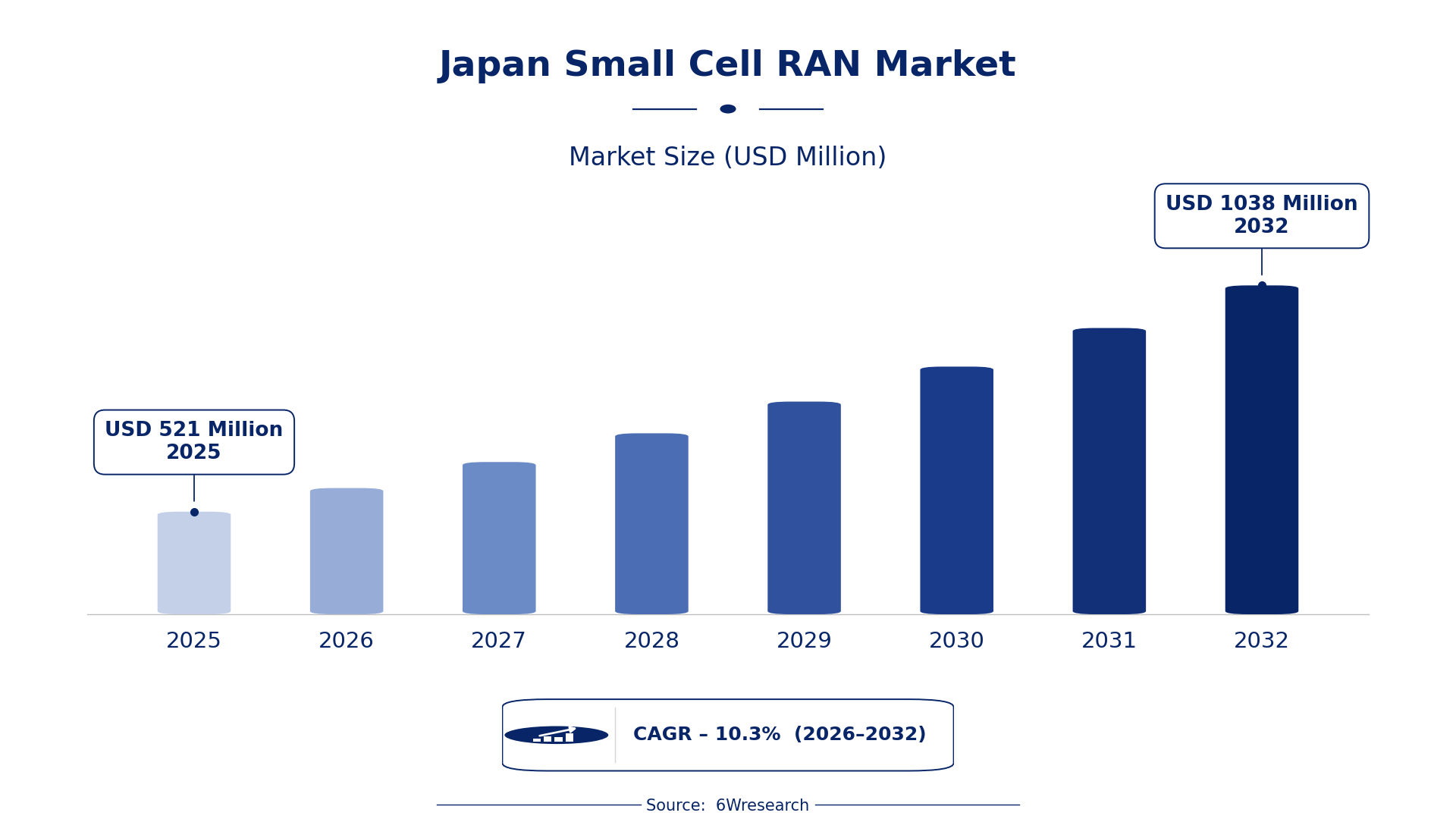
According to 6Wresearch internal database and industry insights, the Japan Small Cell RAN Market was valued at USD 521 Million in 2025 and is projected to reach USD 1,038 Million by 2032, growing at a CAGR of approximately 10.3% during 2026–2032.
Japan Small Cell RAN Market Highlights
| Report Metric | Details |
| Report Name | Japan Small Cell RAN Market (2026-2032) |
| Market Size 2025 | USD 521 Million |
| Market Size 2032 | USD 1,038 Million |
| Absolute Growth 2025–2032 | USD 517 Million |
| CAGR 2026–2032 | 10.3% |
| Peak Annual Growth | 12.4% in 2028 |
| Forecast Period | 2026–2032 |
| Historical Data | 2022–2025 |
| Base Year | 2025 |
| Leading RAN Type, 2025 | Distributed RAN (46% share) |
| Leading Network Generation, 2025 | 5G (49% share) |
| Leading Installation Type, 2025 | Tower/Pole Mounted (40% share) |
| Leading End User, 2025 | Network Infrastructure Vendors (47% share) |
| Fastest-Growing RAN Type | Centralized RAN (14.0% CAGR) |
| Fastest-Growing Network Generation | 4G/5G (15.0% CAGR) |
| Fastest-Growing Installation Type | Data Centers (15.2% CAGR) |
| Fastest-Growing End User | Telecom Service Providers (13.8% CAGR) |
| Growing Sector | telecommunications |
| Key End Users | telecom service providers, network infrastructure vendors, rural/private networks |
Japan Small Cell RAN Market Year-wise Growth Rate and Key Drivers (2022–2032)
This graph illustrates the annual growth rates of the market from 2022 to 2032, highlighting a steady upward trajectory and projected market expansion over the forecast period.
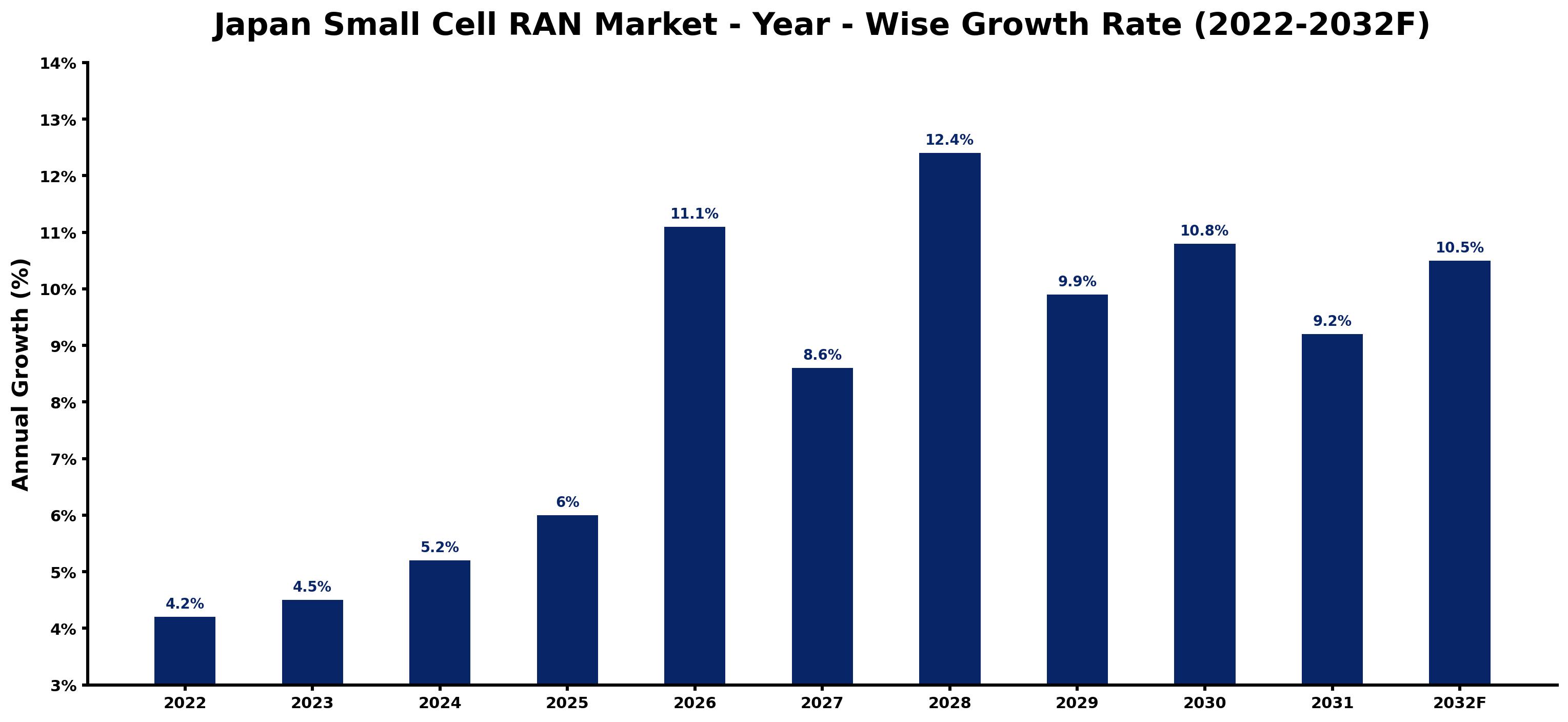
Year by year, the estimates below pair each growth rate with the development that shaped it.
| Year | Estimated Annual Growth (%) | Market Rationale |
| 2022 | 4.2 | The market showed steady growth due to ongoing 5G deployment efforts. |
| 2023 | 4.5 | Demand continued to rise as telecom service providers expanded their small cell networks. |
| 2024 | 5.2 | The introduction of new technologies increased interest in small cell solutions. |
| 2025 | 6.0 | 5G subscriber numbers surged, boosting the market's growth potential. |
| 2026 | 11.1 | Growth is anticipated as urban development plans prioritise small cell installations. |
| 2027 | 8.6 | Growth is projected to slow slightly as the market adjusts to increased competition. |
| 2028 | 12.4 | Demand is expected to accelerate again with new investments in urban telecom infrastructure. |
| 2029 | 9.9 | The market will see a slowdown as growth stabilises after rapid expansion. |
| 2030 | 10.8 | Growth is likely to resume as new applications for 5G technology emerge. |
| 2031 | 9.2 | The market will continue to grow but at a slower pace due to market saturation. |
| 2032 | 10.5 | Demand is projected to rise again as rural connectivity initiatives gain momentum. |
Note: Market size estimations and growth projections presented in this report are based on 6Wresearch's proprietary forecasting methodology, utilizing the latest available industry data, government publications, and primary research inputs.
Japan Small Cell RAN Market Synopsis
Small Cell RAN technology improves cellular coverage and capacity by deploying low-power nodes connected to a central network. The Japan Small Cell RAN Market is growing, driven by 60 million 5G subscribers in 2023 and government initiatives that promote 5G deployment. Local investments in telecom infrastructure and rising demand from service providers and infrastructure vendors are further propelling this market. The total telecom market in Japan is valued at approximately $40 billion, highlighting the opportunities for small cell technology adoption.
Market Dynamics Impact Analysis (2026–2032)
| Factor | Type | Impact | Primary Segment Affected |
| Growing 5G subscriber base | Driver | High | 5G |
| Investment in urban telecom infrastructure | Driver | High | Tower/Pole Mounted |
| Rural connectivity initiatives | Opportunity | High | Rural/Private Networks |
| Expansion of Open RAN initiatives | Opportunity | Medium | Open RAN (O-RAN) |
| High installation costs for small cells | Restraint | High | Tower/Pole Mounted |
| Limited awareness among rural users | Restraint | Medium | Rural/Private Networks |
| Competition from alternative technologies | Challenge | High | Distributed RAN |
| Regulatory hurdles in frequency allocation | Challenge | Medium | Open RAN (O-RAN) |
Evaluation of Drivers in Japan Small Cell RAN Market (2026–2032)
Key forces behind demand, with the segment each one moves most, are listed below.
| Drivers | Primary Segment Affected | Why It Matters (Evidence) |
| Increase in 5G subscribers | 5G | Japan's 5G subscribers reached 60 million in 2023, driving demand for small cell technology. |
| Urban development plans prioritising small cells | Tower/Pole Mounted | The installation of 5G small cells is prioritised in urban development plans, increasing purchases. |
| Government initiatives promoting rural connectivity | Rural/Private Networks | Japan's rural network initiatives aim to connect 1,000 remote areas by 2025, boosting demand. |
| Support for Open RAN initiatives | Open RAN (O-RAN) | Open RAN initiatives are backed by the 5G Promotion Council, encouraging technology adoption. |
| Investment in telecom infrastructure | Network Infrastructure Vendors | Local governments are investing in telecom infrastructure to improve connectivity, leading to more purchases. |
What keeps demand rising is the increasing number of 5G subscribers, which reached 60 million in 2023, prompting telecom service providers to expand their small cell networks. Urban development plans prioritise the installation of small cells, with investments directed towards improving connectivity in densely populated areas like Tokyo. Local investments in telecom infrastructure improvements create a favourable environment for small cell solutions, as the total telecom market in Japan is valued at approximately $40 billion.
Evaluation of Restraints in Japan Small Cell RAN Market
These restraints slow adoption and weigh on supplier margins.
| Market Restraint | Primary Segment Affected | Why It Matters (Evidence) |
| High costs associated with small cell installations | Tower/Pole Mounted | The total telecom market in Japan is valued at approximately $40 billion, making installation costs a concern for buyers. |
| Limited awareness among rural users about small cell benefits | Rural/Private Networks | Many rural users remain unaware of the advantages of small cell technology, hindering market growth. |
| Competition from alternative technologies like macro cells | Distributed RAN | The presence of macro cells as a cost-effective solution limits the appeal of small cells in some areas. |
| Regulatory hurdles in frequency allocation for small cells | Open RAN (O-RAN) | Regulatory challenges complicate small cell deployment, impacting market expansion. |
| Slow adoption of Open RAN standards | Open RAN (O-RAN) | The transition to Open RAN is gradual, limiting immediate demand for compatible small cell solutions. |
Japan Small Cell RAN Market Challenges
In Japan, the scarcity of suitable installation sites for small cells delays deployment for buyers and telecom providers. Local regulations complicate the installation process, often resulting in compliance costs exceeding $100,000 per project for producers. Competition among telecom service providers drives up investment requirements, stretching budgets and extending project timelines by several months. The lack of standardisation in small cell technology creates uncertainty for buyers, causing potential project rollouts to be postponed by up to six months as they navigate varying requirements.
Trends in the Japan Small Cell RAN Market
Four trends stand out in the Japan Small Cell RAN Market.
- Shift from Macro to Small Cell Deployments: In 2023, telecom service providers began shifting focus from macro cells to small cell installations to improve urban coverage. The total number of small cells installed in Japan is estimated at 100,000, reflecting this trend.
- Increased Investment in Rural Connectivity: Japan's rural network initiatives aim to connect 1,000 remote areas by 2025, driving demand for small cell technology. This investment is important for improving connectivity in underserved regions.
- Prioritisation of Urban Development Plans: The installation of 5G small cells is prioritised in urban development plans, particularly in Tokyo. This focus on urban infrastructure is projected to lead to a marked increase in small cell deployments.
- Emergence of Open RAN Standards: Support for Open RAN initiatives has led to increased adoption of interoperable solutions. This shift is expected to promote innovation and flexibility in network deployments across Japan.
Investment Opportunities in the Japan Small Cell RAN Market
The openings below show where demand in the Japan Small Cell RAN Market is visible and how suppliers can enter.
- Telecom Service Providers: Telecom service providers are seeking to improve coverage in urban areas, with investments expected to rise as 5G adoption grows. The government has allocated $500 million for telecom infrastructure improvements in 2023.
- Rural/Private Networks: With the push for rural connectivity, there is a strong need for small cell technology to improve coverage. Local governments are actively seeking solutions to improve connectivity in remote areas.
- Network Infrastructure Vendors: Network infrastructure vendors are positioned to benefit from the growing demand for small cell technology. The Small Cell Forum Japan chapter is promoting technology adoption, creating opportunities for suppliers.
- Open RAN Initiatives: Open RAN initiatives present an opportunity for investment in interoperable solutions. The Japan Small Cell Association is encouraging collaboration in the industry, fostering new partnerships.
Government Initiatives in the Japan Small Cell RAN Market
The Japan Small Cell RAN Market is influenced by several key policies, including the AI Promotion Act of 2025, which establishes a framework for technological advancement. The Digital Agency, established in September 2021, drives government digital transformation and sets common system standards that affect small cell deployment. These measures encourage telecom service providers to invest in infrastructure improvements, ensuring compliance with evolving standards and enhancing connectivity across urban and rural areas.
In 2023, the government allocated $500 million for telecom infrastructure improvements, administered by the Ministry of Internal Affairs and Communications. This funding supports initiatives aimed at expanding small cell installations, particularly in densely populated regions like Tokyo. The government also promotes the 5G deployment strategy, which aims to connect 1,000 remote areas by 2025, further driving demand for small cell technology.
Future Insight of the Japan Small Cell RAN Market
By 2032, advancements in small cell technology will significantly improve network capacity, especially in urban areas. The Ministry of Internal Affairs and Communications plans to connect 1,000 remote areas by 2025, which will increase demand for small cells. Open RAN initiatives will promote interoperability, allowing buyers to select from a wider array of suppliers. As Japan prepares to support 1 million IoT devices by 2025, suppliers will need to adapt their offerings to meet the growing connectivity demands.
Market Segmentation Analysis
Japan Small Cell RAN Market report covers a detailed analysis of the following market segments:
By RAN Type – Distributed RAN Leads, Centralized RAN Expected to Grow Fastest
According to Saurav Kr Singh, Senior Research Analyst at 6Wresearch, Distributed RAN accounted for 46% of the market by ran type in 2025. Distributed RAN holds the largest share due to its effectiveness in managing network operations and extending coverage, particularly in urban centres like Tokyo, where high population density necessitates robust connectivity. The deployment of approximately 100,000 small cells across Japan further reinforces the importance of this segment in enhancing network performance. Over 2026–2032, Centralized RAN is expected to post the fastest growth, at a CAGR of 14.0%. Centralized RAN is witnessing rapid growth as it is increasingly adopted for larger network deployments essential for 5G support, particularly in metropolitan areas where demand for high-capacity networks is surging. This trend is likely to continue as urban development initiatives prioritise connectivity improvements. Suppliers should develop tailored solutions for both Distributed and Centralized RAN to seize market opportunities.
By Network Generation – 5G Leads, 4G/5G Expected to Grow Fastest
In 2025, 5G led the network generation split with a 49% share. 5G leads the market as it is vital for next-generation mobile connectivity, with Japan reaching 60 million subscribers in 2023, highlighting the extensive demand for enhanced network capabilities. This widespread adoption necessitates small cell technology to support the growing user base and improve overall network performance. 4G/5G is set to record the highest CAGR in this split, 15.0% over 2026–2032. The 4G/5G segment is growing swiftly as it underpins both current and future mobile services, particularly as users transition towards 5G technology. The integration of these technologies in urban environments accelerates this segment's growth, ensuring that service providers can meet evolving consumer demands. Buyers should focus on investing in 5G infrastructure to remain competitive in the telecommunications sector.
By Installation Type – Tower/Pole Mounted Leads, Data Centers Expected to Grow Fastest
Tower/Pole Mounted took 40% of installation type revenue in 2025, more than any other category. Tower/Pole Mounted installations are the predominant method for small cell deployment, enabling effective coverage in densely populated regions where high demand for connectivity exists. This approach aligns with urban development strategies aimed at improving connectivity and accommodating the growing number of 5G users. Data Centers are projected to grow fastest, at a CAGR of 15.2% during 2026–2032. Data Centers are experiencing the fastest growth as they play a crucial role in backend operations for managing small cell networks, particularly as telecom infrastructure becomes more data-intensive. The rising demand for efficient data management in telecom infrastructure is driving this trend. Suppliers must ensure compatibility of their products with both Tower/Pole Mounted and Data Center installations to cater to diverse customer requirements.
By End User – Network Infrastructure Vendors Lead, Telecom Service Providers Expected to Grow Fastest
The largest end user category in 2025 was Network Infrastructure Vendors, at 47% of revenue. Network Infrastructure Vendors dominate the market as primary users of small cell technology, supplying essential components for network deployment and ensuring the infrastructure meets the demands of modern telecommunications. Their critical position within the telecommunications ecosystem solidifies their market share, particularly as 5G adoption accelerates. The quickest growth will come from Telecom Service Providers, forecast to expand at a CAGR of 13.8% between 2026 and 2032. Telecom Service Providers are the fastest-growing segment, being the main users implementing small cell networks to improve service delivery in line with the increasing demand for high-speed connectivity. The ongoing rollout of 5G technology acts as a catalyst for this rapid growth, ensuring that these providers remain competitive. Suppliers should enhance collaborations with Telecom Service Providers to capitalise on the increasing demand for small cell networks.
Key Attractiveness of the Report
- 10 Years of Market Numbers
- Historical Data Starting from 2022 to 2025
- Base Year 2025
- Forecast Data until 2032
- Key Performance Indicators Impacting the Market
- Major Upcoming Developments and Projects
Key Highlights of the Report:
- Japan Small Cell RAN Market Outlook
- Market Size of Japan Small Cell RAN Market, 2025
- Forecast of Japan Small Cell RAN Market, 2032
- Historical Data and Forecast of Japan Small Cell RAN Revenues & Volume for the Period 2022-2032F
- Japan Small Cell RAN Market Trend Evolution
- Japan Small Cell RAN Market Drivers and Challenges
- Japan Small Cell RAN Price Trends
- Japan Small Cell RAN Porter's Five Forces
- Japan Small Cell RAN Industry Life Cycle
- Historical Data and Forecast of Japan Small Cell RAN Market Revenues & Volume By RAN Type for the Period 2022-2032F
- Historical Data and Forecast of Japan Small Cell RAN Market Revenues & Volume By Distributed RAN for the Period 2022-2032F
- Historical Data and Forecast of Japan Small Cell RAN Market Revenues & Volume By Centralized RAN for the Period 2022-2032F
- Historical Data and Forecast of Japan Small Cell RAN Market Revenues & Volume By Open RAN (O-RAN) for the Period 2022-2032F
- Historical Data and Forecast of Japan Small Cell RAN Market Revenues & Volume By Virtualized RAN (vRAN) for the Period 2022-2032F
- Historical Data and Forecast of Japan Small Cell RAN Market Revenues & Volume By Network Generation for the Period 2022-2032F
- Historical Data and Forecast of Japan Small Cell RAN Market Revenues & Volume By 5G for the Period 2022-2032F
- Historical Data and Forecast of Japan Small Cell RAN Market Revenues & Volume By 4G/5G for the Period 2022-2032F
- Historical Data and Forecast of Japan Small Cell RAN Market Revenues & Volume By Open-Interface for the Period 2022-2032F
- Historical Data and Forecast of Japan Small Cell RAN Market Revenues & Volume By Software Defined for the Period 2022-2032F
- Historical Data and Forecast of Japan Small Cell RAN Market Revenues & Volume By Installation Type for the Period 2022-2032F
- Historical Data and Forecast of Japan Small Cell RAN Market Revenues & Volume By Tower/Pole Mounted for the Period 2022-2032F
- Historical Data and Forecast of Japan Small Cell RAN Market Revenues & Volume By Data Centers for the Period 2022-2032F
- Historical Data and Forecast of Japan Small Cell RAN Market Revenues & Volume By Plug & Play for the Period 2022-2032F
- Historical Data and Forecast of Japan Small Cell RAN Market Revenues & Volume By Cloud for the Period 2022-2032F
- Historical Data and Forecast of Japan Small Cell RAN Market Revenues & Volume By End User for the Period 2022-2032F
- Historical Data and Forecast of Japan Small Cell RAN Market Revenues & Volume By Network Infrastructure Vendors for the Period 2022-2032F
- Historical Data and Forecast of Japan Small Cell RAN Market Revenues & Volume By Telecom Service Providers for the Period 2022-2032F
- Historical Data and Forecast of Japan Small Cell RAN Market Revenues & Volume By Rural/Private Networks for the Period 2022-2032F
- Historical Data and Forecast of Japan Small Cell RAN Market Revenues & Volume By Telco Cloud Providers for the Period 2022-2032F
- Japan Small Cell RAN Import Export Trade Statistics
- Market Opportunity Assessment By RAN Type
- Market Opportunity Assessment By Network Generation
- Market Opportunity Assessment By Installation Type
- Market Opportunity Assessment By End User
- Japan Small Cell RAN Top Companies Market Share
- Japan Small Cell RAN Competitive Benchmarking By Technical and Operational Parameters
- Japan Small Cell RAN Company Profiles
- Japan Small Cell RAN Key Strategic Recommendations
Market Covered
The following segment groups are covered in the report.
By RAN Type
- Distributed RAN
- Centralized RAN
- Open RAN (O-RAN)
- Virtualized RAN (vRAN)
By Network Generation
- 5G
- 4G/5G
- Open-Interface
- Software Defined
By Installation Type
- Tower/Pole Mounted
- Data Centers
- Plug & Play
- Cloud
By End User
- Network Infrastructure Vendors
- Telecom Service Providers
- Rural/Private Networks
- Telco Cloud Providers































