Japan Smart Actuator Market Size & Growth Rate
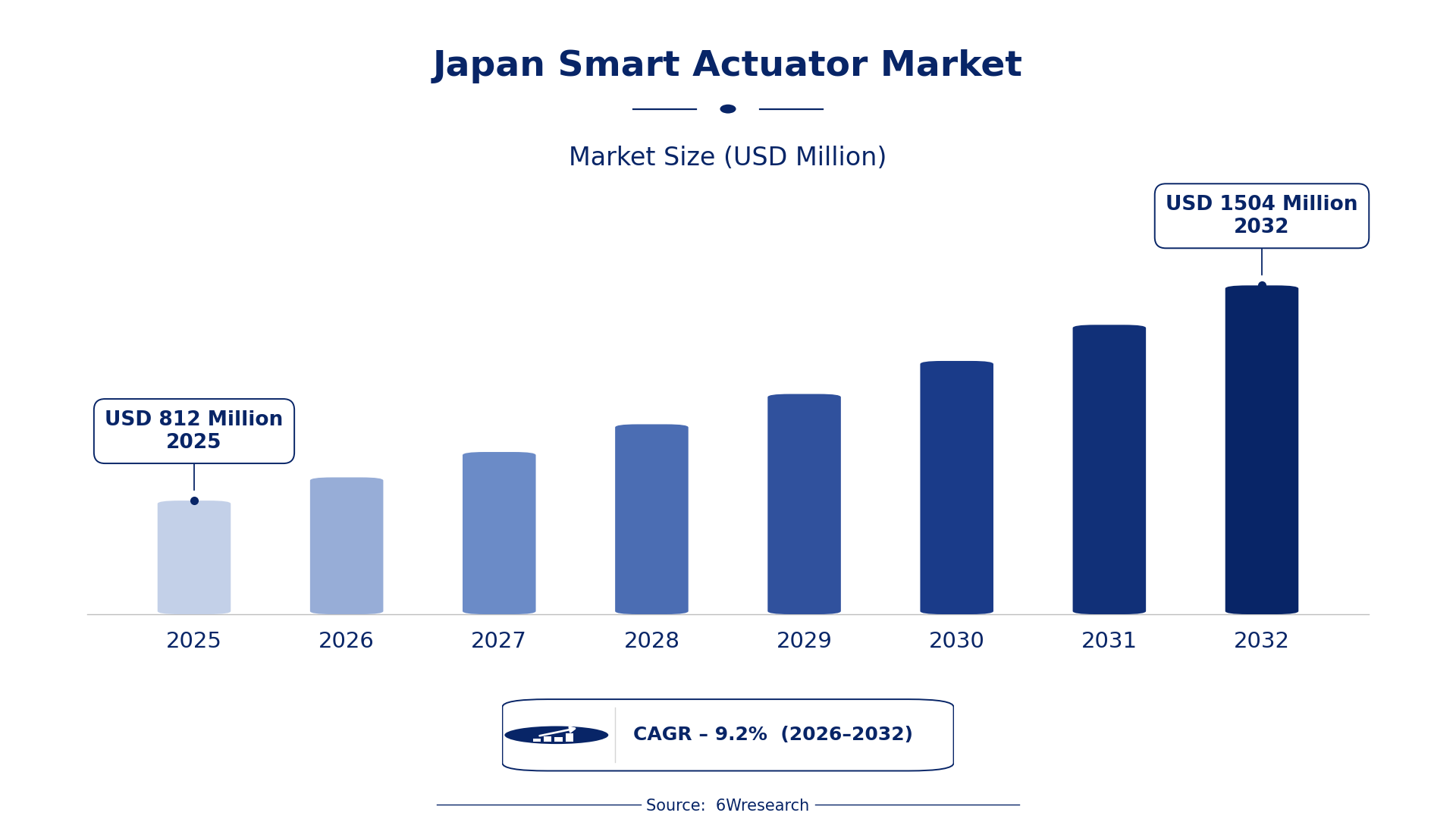
According to 6Wresearch internal database and industry insights, the Japan Smart Actuator Market was valued at USD 812 Million in 2025 and is projected to reach USD 1,504 Million by 2032, growing at a CAGR of approximately 9.2% during 2026–2032.
Japan Smart Actuator Market Highlights
| Report Metric | Details |
| Report Name | Japan Smart Actuator Market (2026-2032) |
| Market Size 2025 | USD 812 Million |
| Market Size 2032 | USD 1,504 Million |
| Absolute Growth 2025–2032 | USD 692 Million |
| CAGR 2026–2032 | 9.2% |
| Peak Annual Growth | 10.2% in 2028 |
| Forecast Period | 2026–2032 |
| Historical Data | 2022–2025 |
| Base Year | 2025 |
| Leading Actuator Type, 2025 | Electric Smart Actuators (45% share) |
| Leading Motion Type, 2025 | Linear/Rotary (39% share) |
| Leading Control Mechanism, 2025 | Embedded Electronics (37% share) |
| Leading End User, 2025 | Industrial Automation (35% share) |
| Fastest-Growing Actuator Type | Pneumatic Smart Actuators (13.4% CAGR) |
| Fastest-Growing Motion Type | Linear (12.8% CAGR) |
| Fastest-Growing Control Mechanism | Pressure Sensors + Logic (12.1% CAGR) |
| Fastest-Growing End User | Robotics Manufacturers (12.2% CAGR) |
| Growing Sector | Robotics Manufacturers |
| Key End Users | Industrial Automation, Robotics Manufacturers, Heavy Machinery OEMs, Smart Building Integrators |
Japan Smart Actuator Market Year-wise Growth Rate and Key Drivers (2022–2032)
This graph illustrates the annual growth rates of the market from 2022 to 2032, highlighting a steady upward trajectory and projected market expansion over the forecast period.
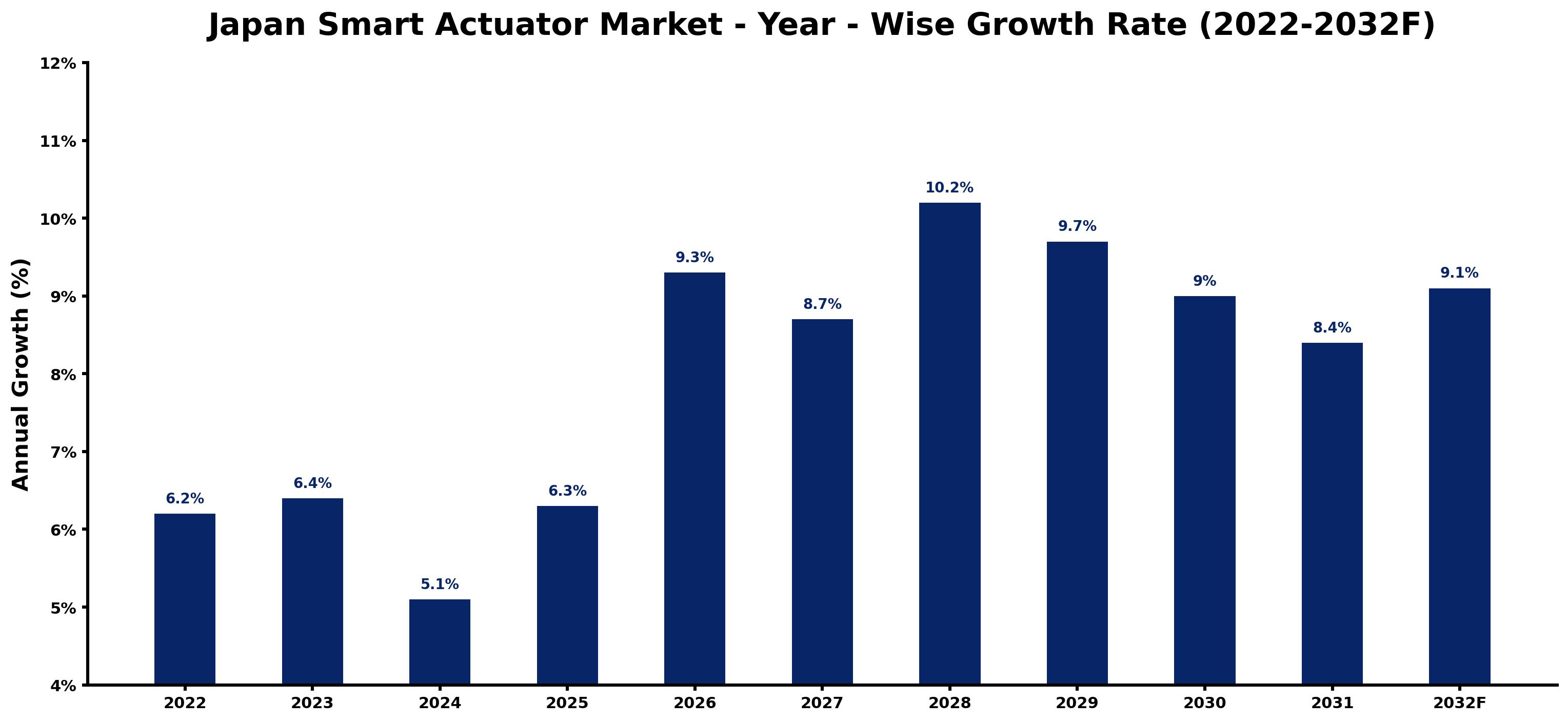
Annual growth estimates for each year appear below with the principal reason behind them, explaining the shifts that set the pace of the market.
| Year | Estimated Annual Growth (%) | Market Rationale |
| 2022 | 6.2 | The market was characterised by steady growth driven by automation demand. |
| 2023 | 6.4 | Growth accelerated due to increased investments in smart manufacturing technologies. |
| 2024 | 5.1 | A slowdown occurred as companies adjusted to new automation standards. |
| 2025 | 6.3 | Demand rose again as industrial automation projects expanded across sectors. |
| 2026 | 9.3 | Growth is expected to surge as more manufacturers adopt IoT-enabled solutions. |
| 2027 | 8.7 | A slight slowdown is projected as the market stabilises after rapid expansion. |
| 2028 | 10.2 | The market is expected to peak with heightened investments in advanced actuator technologies. |
| 2029 | 9.7 | Growth is projected to slow as the market begins to normalise after peak activity. |
| 2030 | 9.0 | Continued growth is expected to be supported by ongoing automation initiatives. |
| 2031 | 8.4 | A further slowdown is projected as the market adjusts to new technological advancements. |
| 2032 | 9.1 | Demand is expected to increase again as robotics manufacturers expand their operations. |
Note: Market size estimations and growth projections presented in this report are based on 6Wresearch's proprietary forecasting methodology, utilizing the latest available industry data, government publications, and primary research inputs.
Japan Smart Actuator Market Synopsis
Smart actuators convert electrical, pneumatic, or hydraulic energy into mechanical motion, crucial for automation in manufacturing, robotics, and smart buildings. The Japan Smart Actuator Market is expanding rapidly, driven by a robust industrial automation sector. Demand for IoT-enabled actuators is rising annually, especially in smart buildings, while the Tokyo metropolitan area acts as a centre for robotics manufacturers, further energising market activity.
Market Dynamics Impact Analysis (2026–2032)
| Factor | Type | Impact | Primary Segment Affected |
| Rising demand for automation in manufacturing processes | Driver | High | Pneumatic Smart Actuators |
| Increasing integration of IoT technologies in smart buildings | Driver | High | IoT-Enabled Actuators |
| Growing investments in smart manufacturing technologies | Opportunity | High | Industrial Automation |
| Expansion of robotics manufacturers in the Tokyo metropolitan area | Opportunity | Medium | Robotics Manufacturers |
| Challenges in supply chain resilience for actuator components | Restraint | High | Electric Smart Actuators |
| Compliance with stringent actuator specifications under JIS B 8401 | Restraint | Medium | Hydraulic Smart Actuators |
| High development costs for advanced actuator technologies | Challenge | High | IoT-Enabled Actuators |
| Limited skilled workforce in automation technology | Challenge | Medium | Industrial Automation |
Evaluation of Drivers in Japan Smart Actuator Market (2026–2032)
Below are the drivers that matter most for revenue growth, with supporting evidence.
| Drivers | Primary Segment Affected | Why It Matters (Evidence) |
| Increased automation in manufacturing | Pneumatic Smart Actuators | This trend is linked to the need for efficiency, with smart actuators used in over 50% of new industrial automation projects. |
| Integration of IoT technologies | IoT-Enabled Actuators | The rise in smart building solutions is driving a 15% annual increase in demand for IoT-enabled actuators. |
| Support for automation initiatives | Industrial Automation | Government initiatives promote automation, contributing to an average annual investment of around 1 trillion JPY. |
| Expansion of robotics sector in Japan | Robotics Manufacturers | With over 1,000 companies in the robotics sector, demand for smart actuators is surging. |
| Focus on precision in manufacturing processes | Electric Smart Actuators | The adoption of advanced materials and technologies is improving actuator performance, aligning with the JIS B 8401 standard. |
Much of the new demand stems from increased automation in manufacturing, with smart actuators utilised in over 50% of new industrial automation projects. The robotics sector, comprising over 1,000 companies, fuels demand for smart actuators, particularly in the Tokyo metropolitan area. Furthermore, the integration of IoT technologies in smart buildings is driving a 15% annual rise in demand for IoT-enabled actuators. The emphasis on precision in manufacturing processes is also improving the performance of electric smart actuators, in line with the JIS B 8401 standard.
Evaluation of Restraints in Japan Smart Actuator Market
Below are the constraints most often cited by buyers and suppliers, with the segment each affects.
| Market Restraint | Primary Segment Affected | Why It Matters (Evidence) |
| Component shortages lead to longer lead times for buyers. | Electric Smart Actuators | This can delay projects by up to six months. |
| Compliance with JIS B 8401 standard increases operational costs. | Pneumatic Smart Actuators | Manufacturers must invest time and resources, raising costs by 10%. |
| Intense competition among robotics companies drives price wars. | Hydraulic Smart Actuators | Producers are forced to lower margins, impacting technology investments. |
| Rising raw material costs inflate production expenses. | IoT-Enabled Actuators | Global supply chain issues can increase costs by 15%. |
| Market volatility affects long-term planning for suppliers. | Linear/Rotary | Uncertainty can disrupt investment in new technologies. |
Japan Smart Actuator Market Challenges
High demand for smart actuators in Japan arises from the active industrial automation market, leading buyers to face lead times of up to six months due to component shortages. Regulatory requirements under the JIS B 8401 standard pose challenges for manufacturers, increasing compliance costs by 10% for suppliers. Competition among over 1,000 robotics companies intensifies, resulting in price wars that squeeze producers' margins and restrict their investment in new technologies. Rising raw material costs, influenced by global supply chain disruptions, inflate production expenses by 15%, ultimately raising prices for buyers.
Trends in the Japan Smart Actuator Market
Several trends are reshaping the Japan Smart Actuator Market; the most important are set out below.
- Increase in IoT-Enabled Actuators: Demand for IoT-enabled actuators is growing, with an annual increase of 15%. This trend is evident in smart buildings, where automation technologies are increasingly integrated, improving operational efficiency.
- Shift Towards Robotics Integration: Robotics manufacturers are progressively incorporating smart actuators into their systems, enhancing automation capabilities. This shift is particularly noticeable in the Tokyo metropolitan area, which hosts numerous robotics companies, driving innovation.
- Focus on Precision Engineering: Precision engineering is becoming a priority in actuator design, aligning with the JIS B 8401 standard. This focus drives enhancements in actuator performance across various sectors, ensuring reliability.
- Growth in Industrial Automation: Industrial automation is on the rise, with a market value of 20 trillion JPY. This growth stimulates increased demand for smart actuators in manufacturing processes, as companies seek efficiency.
Investment Opportunities in the Japan Smart Actuator Market
Where to invest in the Japan Smart Actuator Market: the main openings are set out below.
- Partnerships with Robotics Manufacturers: Establishing partnerships with robotics manufacturers in the Tokyo area can create new market opportunities. This collaboration can improve product offerings and expand market reach, facilitating growth.
- Investing in Smart Building Solutions: There is a rising demand for IoT-enabled actuators in smart buildings, particularly in urban areas. Suppliers can concentrate on developing advanced solutions to meet this demand, ensuring market relevance.
- Expansion in Aichi and Osaka: The supply chain for actuator components in Aichi and Osaka offers investment opportunities. Companies can set up local operations to improve production capabilities and reduce costs.
- Development of Advanced Actuator Technologies: Investing in the advancement of actuator technologies is crucial. The ongoing demand for precision and efficiency in manufacturing drives this opportunity, ensuring competitiveness.
Government Initiatives in the Japan Smart Actuator Market
The Economic Security Promotion Act (2022) supports supply-chain resilience for critical products, affecting buyers by ensuring a stable supply of actuator components. This initiative encourages investment in smart actuator technologies, driving market growth. The New Robot Strategy (2015) promotes automation across various sectors, enhancing efficiency and encouraging the adoption of smart actuators in manufacturing and services.
In 2023, the government initiated a programme to promote smart manufacturing technologies, with funding of approximately 10 billion JPY. The Ministry of Economy, Trade and Industry oversees this initiative, assisting companies in adopting advanced automation solutions, which directly benefits smart actuator buyers.
Future Insight of the Japan Smart Actuator Market
By 2032, buyers will gain from the adoption of IoT-enabled actuators, as demand in smart buildings grows by 15% annually. The government’s smart manufacturing programme will push suppliers to innovate and implement advanced automation solutions. Compliance with the ISO 9001 standard will ensure higher quality products, boosting buyer confidence. The Tokyo metropolitan area will continue to attract investments, solidifying its position as a robotics hub and strengthening the local supply chain.
Market Segmentation Analysis
Japan Smart Actuator Market report covers a detailed analysis of the following market segments:
By Actuator Type – Electric Smart Actuators Lead, Pneumatic Smart Actuators Expected to Grow Fastest
According to Saurav Kr Singh, Senior Research Analyst at 6Wresearch, Electric Smart Actuators took 45% of actuator type revenue in 2025, more than any other category. Electric smart actuators dominate the market due to their extensive application in automation, particularly within the industrial sector. Their significance is underscored by their integration in over 50% of new industrial automation projects, showcasing their vital role in enhancing operational efficiency. The quickest growth will come from Pneumatic Smart Actuators, forecast to expand at a CAGR of 13.4% between 2026 and 2032. Pneumatic smart actuators are experiencing rapid growth, primarily due to their increasing use in manufacturing processes that require responsive and efficient systems. This trend is likely to drive their market share higher as industries seek more adaptable solutions. Suppliers should consider expanding their product offerings to include more pneumatic smart actuators to align with the rising demand.
By Motion Type – Linear/Rotary Leads, Linear Expected to Grow Fastest
With 39% of motion type revenue in 2025, Linear/Rotary was the largest category. Linear/rotary motion types capture the largest market share as they are crucial for diverse motion applications in automation and robotics. Their flexibility and reliability make them a preferred choice among industrial users, ensuring consistent demand. Linear is projected to grow fastest, at a CAGR of 12.8% during 2026–2032. Linear motion types are rapidly gaining traction due to their precision in positioning tasks, which is essential in industries that prioritise accuracy. This focus on precision is expected to propel the growth of this segment further. Suppliers should invest in developing advanced linear motion solutions to meet the increasing demand in the market.
By Control Mechanism – Embedded Electronics Leads, Pressure Sensors + Logic Expected to Grow Fastest
The largest control mechanism category in 2025 was Embedded Electronics, at 37% of revenue. Embedded electronics are the leading control mechanism as they are vital for the precise operation of smart actuators across various applications. Their integration is necessary for compliance with specifications set by standards such as JIS B 8401. Over 2026–2032, Pressure Sensors + Logic is expected to post the fastest growth, at a CAGR of 12.1%. Pressure sensors combined with logic are gaining popularity as they improve monitoring capabilities in actuator systems, which is essential for optimising performance. Their increasing importance in applications that require real-time feedback is propelling this growth. This suggests that suppliers need to innovate in sensor technologies to maintain competitiveness in the market.
By End User – Industrial Automation Leads, Robotics Manufacturers Expected to Grow Fastest
In 2025, Industrial Automation led the end user split with a 35% share. Industrial automation represents the largest end user of smart actuators, supported by substantial investments in automation technologies averaging around 1 trillion JPY annually. This sector's demand is pivotal for the ongoing growth of smart actuators in Japan. Robotics Manufacturers are set to record the highest CAGR in this split, 12.2% over 2026–2032. Robotics manufacturers are the fastest-growing end users, increasingly relying on smart actuators to integrate advanced functionalities into their robotic systems. The robust expansion of the robotics sector in Japan is anticipated to further accelerate this trend. Suppliers should tailor their products to meet the specific needs of robotics manufacturers to leverage this growth opportunity.
Key Attractiveness of the Report
- 10 Years of Market Numbers
- Historical Data Starting from 2022 to 2025
- Base Year 2025
- Forecast Data until 2032
- Key Performance Indicators Impacting the Market
- Major Upcoming Developments and Projects
Key Highlights of the Report:
- Japan Smart Actuator Market Outlook
- Market Size of Japan Smart Actuator Market, 2025
- Forecast of Japan Smart Actuator Market, 2032
- Historical Data and Forecast of Japan Smart Actuator Revenues & Volume for the Period 2022-2032F
- Japan Smart Actuator Market Trend Evolution
- Japan Smart Actuator Market Drivers and Challenges
- Japan Smart Actuator Price Trends
- Japan Smart Actuator Porter's Five Forces
- Japan Smart Actuator Industry Life Cycle
- Historical Data and Forecast of Japan Smart Actuator Market Revenues & Volume By Actuator Type for the Period 2022-2032F
- Historical Data and Forecast of Japan Smart Actuator Market Revenues & Volume By Electric Smart Actuators for the Period 2022-2032F
- Historical Data and Forecast of Japan Smart Actuator Market Revenues & Volume By Pneumatic Smart Actuators for the Period 2022-2032F
- Historical Data and Forecast of Japan Smart Actuator Market Revenues & Volume By Hydraulic Smart Actuators for the Period 2022-2032F
- Historical Data and Forecast of Japan Smart Actuator Market Revenues & Volume By IoT-Enabled Actuators for the Period 2022-2032F
- Historical Data and Forecast of Japan Smart Actuator Market Revenues & Volume By Motion Type for the Period 2022-2032F
- Historical Data and Forecast of Japan Smart Actuator Market Revenues & Volume By Linear/Rotary for the Period 2022-2032F
- Historical Data and Forecast of Japan Smart Actuator Market Revenues & Volume By Linear for the Period 2022-2032F
- Historical Data and Forecast of Japan Smart Actuator Market Revenues & Volume By High Force Motion for the Period 2022-2032F
- Historical Data and Forecast of Japan Smart Actuator Market Revenues & Volume By Configurable for the Period 2022-2032F
- Historical Data and Forecast of Japan Smart Actuator Market Revenues & Volume By Control Mechanism for the Period 2022-2032F
- Historical Data and Forecast of Japan Smart Actuator Market Revenues & Volume By Embedded Electronics for the Period 2022-2032F
- Historical Data and Forecast of Japan Smart Actuator Market Revenues & Volume By Pressure Sensors + Logic for the Period 2022-2032F
- Historical Data and Forecast of Japan Smart Actuator Market Revenues & Volume By Flow & Pressure Control for the Period 2022-2032F
- Historical Data and Forecast of Japan Smart Actuator Market Revenues & Volume By Remote Monitoring for the Period 2022-2032F
- Historical Data and Forecast of Japan Smart Actuator Market Revenues & Volume By End User for the Period 2022-2032F
- Historical Data and Forecast of Japan Smart Actuator Market Revenues & Volume By Industrial Automation for the Period 2022-2032F
- Historical Data and Forecast of Japan Smart Actuator Market Revenues & Volume By Robotics Manufacturers for the Period 2022-2032F
- Historical Data and Forecast of Japan Smart Actuator Market Revenues & Volume By Heavy Machinery OEMs for the Period 2022-2032F
- Historical Data and Forecast of Japan Smart Actuator Market Revenues & Volume By Smart Building Integrators for the Period 2022-2032F
- Japan Smart Actuator Import Export Trade Statistics
- Market Opportunity Assessment By Actuator Type
- Market Opportunity Assessment By Motion Type
- Market Opportunity Assessment By Control Mechanism
- Market Opportunity Assessment By End User
- Japan Smart Actuator Top Companies Market Share
- Japan Smart Actuator Competitive Benchmarking By Technical and Operational Parameters
- Japan Smart Actuator Company Profiles
- Japan Smart Actuator Key Strategic Recommendations
Market Covered
This report examines the market across the segments below.
By Actuator Type
- Electric Smart Actuators
- Pneumatic Smart Actuators
- Hydraulic Smart Actuators
- IoT-Enabled Actuators
By Motion Type
- Linear/Rotary
- Linear
- High Force Motion
- Configurable
By Control Mechanism
- Embedded Electronics
- Pressure Sensors + Logic
- Flow & Pressure Control
- Remote Monitoring
By End User
- Industrial Automation
- Robotics Manufacturers
- Heavy Machinery OEMs
- Smart Building Integrators































