Japan Smart Agri Platforms Market Size & Growth Rate
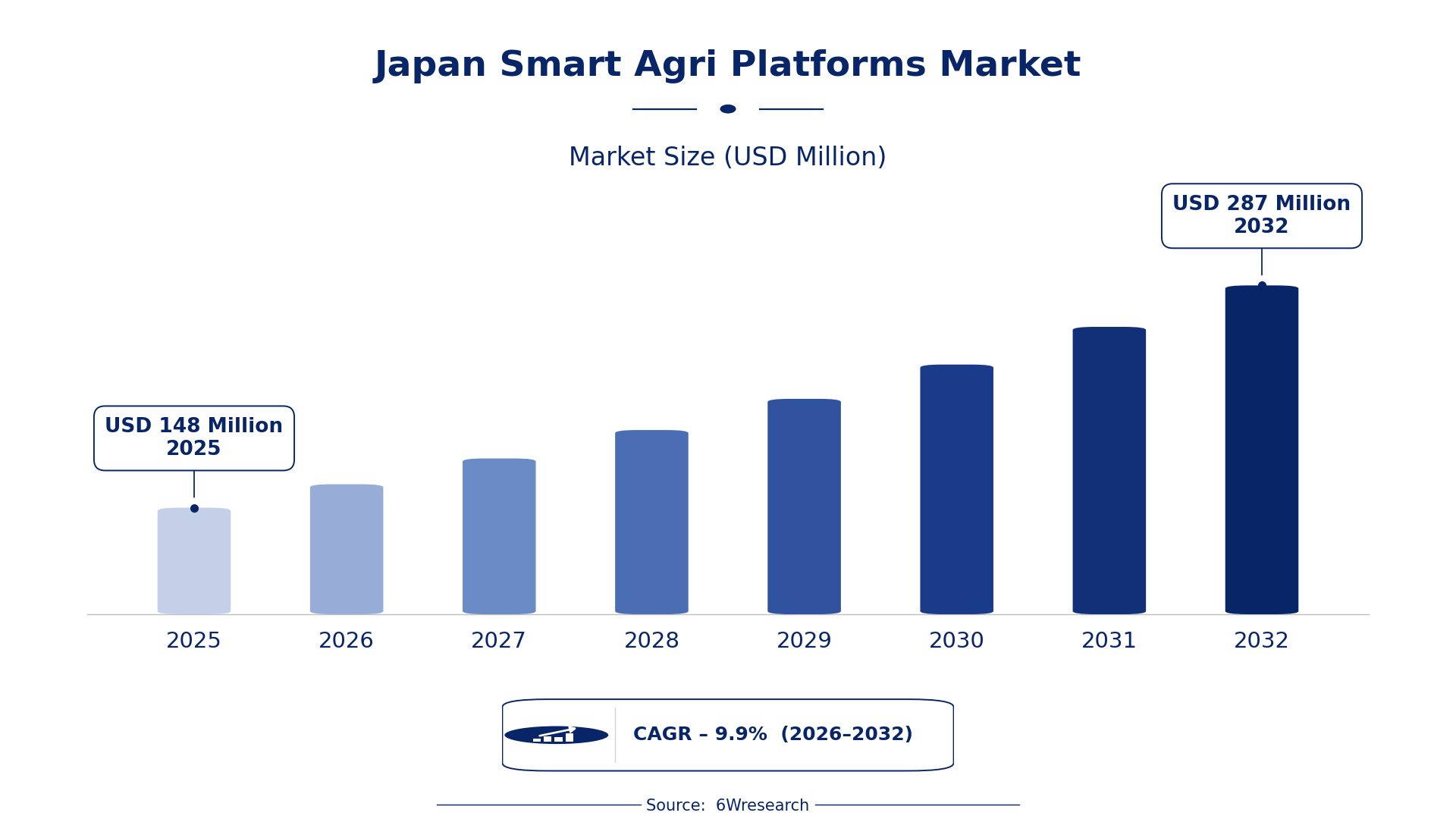
According to 6Wresearch internal database and industry insights, the Japan Smart Agri Platforms Market was valued at USD 148 Million in 2025 and is projected to reach USD 287 Million by 2032, growing at a CAGR of approximately 9.9% during 2026–2032.
Japan Smart Agri Platforms Market Highlights
| Report Metric | Details |
| Report Name | Japan Smart Agri Platforms Market (2026-2032) |
| Market Size 2025 | USD 148 Million |
| Market Size 2032 | USD 287 Million |
| Absolute Growth 2025–2032 | USD 139 Million |
| CAGR 2026–2032 | 9.9% |
| Peak Annual Growth | 10.3% in 2026 |
| Forecast Period | 2026–2032 |
| Historical Data | 2022–2025 |
| Base Year | 2025 |
| Leading Platform Type, 2025 | Farm Management Systems (40% share) |
| Leading Core Feature, 2025 | Crop Planning (45% share) |
| Leading Integration Level, 2025 | IoT (39% share) |
| Leading End User, 2025 | AgTech Companies (39% share) |
| Fastest-Growing Platform Type | Precision Input Tools (14.1% CAGR) |
| Fastest-Growing Core Feature | AI-Based Forecasting (13.1% CAGR) |
| Fastest-Growing End User | Small Farmers (12.4% CAGR) |
| Growing Sector | Small Farmers |
| Key End Users | AgTech Companies, Small Farmers, Agri Cooperatives, Agrochemical Firms |
Japan Smart Agri Platforms Market Year-wise Growth Rate and Key Drivers (2022–2032)
This graph illustrates the annual growth rates of the market from 2022 to 2032, highlighting a steady upward trajectory and projected market expansion over the forecast period.
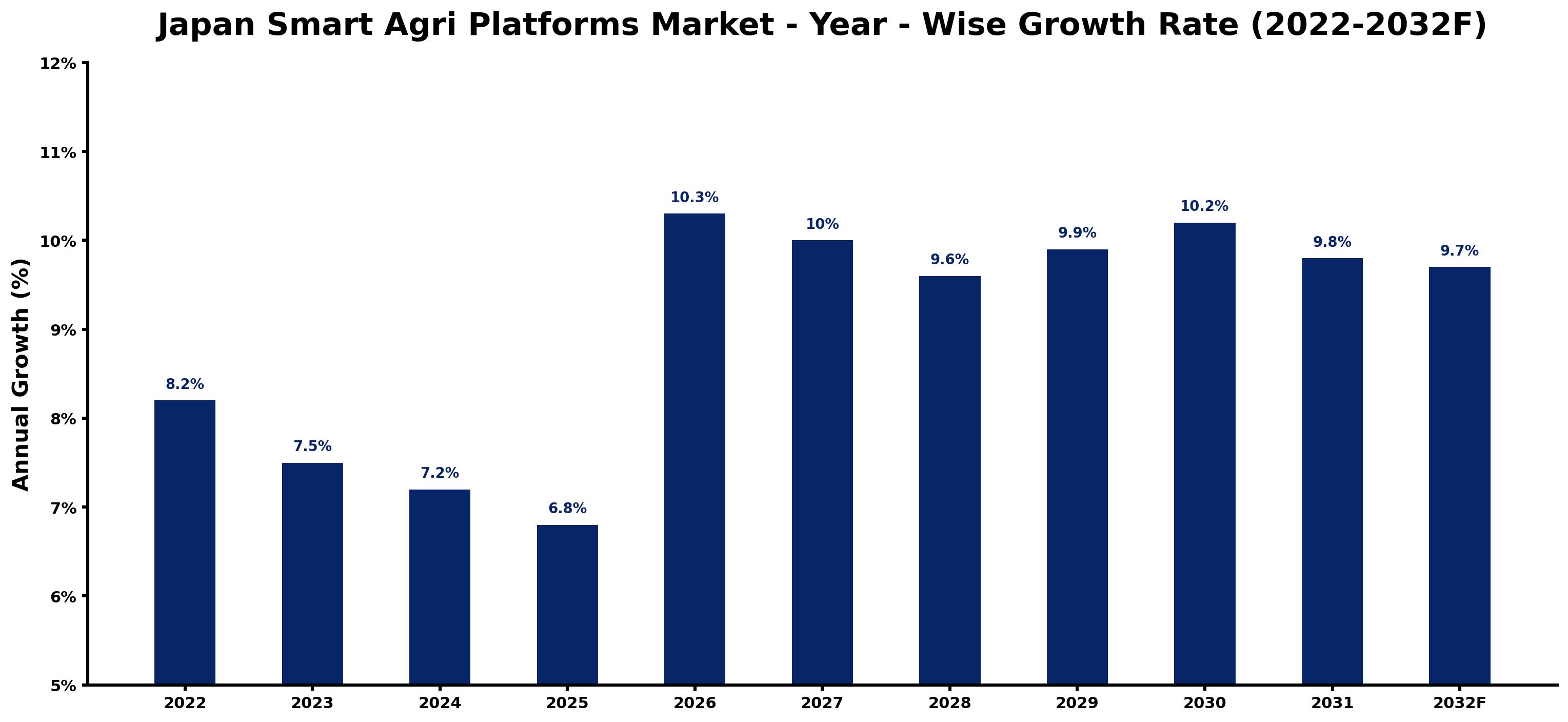
Below, each year's estimated growth is shown next to the factor that most influenced it.
| Year | Estimated Annual Growth (%) | Market Rationale |
| 2022 | 8.2 | The market showed strong activity with 30% of farmers using smart agriculture technology. |
| 2023 | 7.5 | Growth slowed as the agricultural sector faced challenges in technology adoption. |
| 2024 | 7.2 | The market continued to grow, but at a slower rate due to market saturation. |
| 2025 | 6.8 | Growth decelerated as farmers adjusted to new technologies and practices. |
| 2026 | 10.3 | The market is set to accelerate with increased investment in smart agriculture. |
| 2027 | 10.0 | Growth will remain strong as technology adoption becomes more widespread. |
| 2028 | 9.6 | The market will continue to grow, driven by ongoing demand for efficiency. |
| 2029 | 9.9 | Growth is expected to rise as more farmers embrace smart agri solutions. |
| 2030 | 10.2 | The market will see further expansion as technology integration improves. |
| 2031 | 9.8 | Growth will moderate as the market matures and competition intensifies. |
| 2032 | 9.7 | The market will still grow, driven by ongoing technology advancements. |
Note: Market size estimations and growth projections presented in this report are based on 6Wresearch's proprietary forecasting methodology, utilizing the latest available industry data, government publications, and primary research inputs.
Japan Smart Agri Platforms Market Synopsis
Smart Agri Platforms are technology-driven solutions that integrate data analytics, IoT, and AI to improve agricultural productivity. The Japan Smart Agri Platforms Market is growing due to increasing adoption among small farmers and AgTech companies, with 30% of farmers reporting usage in 2022. Rising investments in precision agriculture and government initiatives aimed at promoting technology use in farming, such as the Smart Agriculture Promotion Strategy launched in 2021, target a 50% increase in technology adoption by 2025.
Market Dynamics Impact Analysis (2026–2032)
| Factor | Type | Impact | Primary Segment Affected |
| Increased investment in technology adoption | Driver | High | Farm Management Systems |
| Growing demand for efficiency in agriculture | Driver | High | Crop Advisory Platforms |
| Expansion of AgTech startups in Japan | Opportunity | Medium | AgTech Companies |
| Need for enhanced productivity among small farmers | Opportunity | Medium | Small Farmers |
| Aging farmer population limits technology uptake | Restraint | High | AgTech Companies |
| Limited awareness of smart agriculture benefits | Restraint | Medium | Small Farmers |
| High initial investment costs for technology | Challenge | High | Farm Management Systems |
| Slow adaptation to new farming technologies | Challenge | Medium | Crop Advisory Platforms |
Evaluation of Drivers in Japan Smart Agri Platforms Market (2026–2032)
Demand rests on the following drivers, each shown with the segment it touches most.
| Drivers | Primary Segment Affected | Why It Matters (Evidence) |
| Investment in precision agriculture technologies | Farm Management Systems | In 2023, the government allocated $10 million for research, encouraging farmers to adopt advanced tools. |
| Rising need for data-driven decision making | Crop Advisory Platforms | With 30% of farmers using smart technology, demand for crop advisory insights is increasing. |
| Growing number of AgTech startups | AgTech Companies | Over 100 startups are expanding the market, driving innovation and growth in smart agriculture. |
| Focus on sustainable farming practices | Precision Input Tools | The government aims for a 50% increase in technology adoption by 2025, supporting sustainable practices. |
| Demand for improved yield predictions | AI-Based Forecasting | Farmers are increasingly seeking AI tools to improve productivity and profitability. |
The need for data-driven decision making is evident, as 30% of farmers reported using smart technology. A growing number of AgTech startups, exceeding 100, are driving innovation in the market. Demand for improved yield predictions is pushing farmers to seek AI tools for better productivity and profitability.
Evaluation of Restraints in Japan Smart Agri Platforms Market
The following restraints limit how fast demand can grow.
| Market Restraint | Primary Segment Affected | Why It Matters (Evidence) |
| High initial investment costs for smart agriculture technologies | Farm Management Systems | The average age of farmers is around 67 years, making them hesitant to invest in new technologies. |
| Limited awareness of smart agriculture benefits among farmers | Small Farmers | Many small farmers lack knowledge about the advantages of adopting smart technologies. |
| Aging farmer population affects technology adoption | AgTech Companies | With an average age of 67, older farmers may resist adopting new technologies. |
| Slow adaptation to new farming technologies | Crop Advisory Platforms | Farmers often take time to adjust to new tools and practices, delaying implementation. |
| Market saturation in certain regions | Precision Input Tools | Growth in key regions like Tokyo and Hokkaido is slowing due to existing technology. |
Japan Smart Agri Platforms Market Challenges
A lack of familiarity with advanced technology among farmers, whose average age is 67, limits the adoption of smart agriculture solutions, resulting in delayed productivity gains for buyers. Only 30% of farmers currently utilise smart technology, which raises operational costs and reduces efficiency for producers. Stringent regulations, such as ISO 22000, create compliance burdens that slow down innovation, impacting AgTech companies' ability to launch new products. Fragmented technology adoption leads to supply chain inefficiencies, increasing logistics costs for suppliers and clinics, which can delay timely product delivery.
Trends in the Japan Smart Agri Platforms Market
The trends below show where the Japan Smart Agri Platforms Market is heading.
- Shift from Traditional Methods to Smart Technologies: Since 2021, Japan has seen a shift towards smart agriculture technologies, with 30% of farmers adopting these solutions. This trend indicates a growing acceptance of technology in farming, improving productivity and efficiency.
- Emergence of AI in Agriculture: The integration of AI-based forecasting tools has gained traction among farmers, with a projected growth of 13.1% in this segment. This shift is visible in regions like Hokkaido, where farmers are using AI for better yield predictions.
- Rise of AgTech Startups: The number of AgTech startups in Japan has surpassed 100, reflecting a growing interest in smart agriculture solutions. This surge is expected to drive innovation and competition in the market, benefiting farmers.
- Increased Focus on Sustainability: The government emphasises sustainable farming practices, aiming to increase technology adoption by 50% by 2025. This initiative aligns with global sustainability trends and encourages farmers to adopt smart solutions.
Investment Opportunities in the Japan Smart Agri Platforms Market
The opportunities below stand out in the Japan Smart Agri Platforms Market for new entrants and existing suppliers.
- Tokyo's Agricultural Cooperatives: Tokyo's agricultural cooperatives require advanced farm management systems to boost productivity. With a projected gap of $40 million in technology investment, suppliers can partner with local cooperatives to meet this demand.
- Supply Chain Optimization Tools: There is a growing need for supply chain platforms to improve logistics efficiency. With 30% of farmers reporting technology use, suppliers can provide tailored solutions to meet this demand.
- Precision Input Tools for Small Farmers: Small farmers are seeking precision input tools to optimize resource usage. With a projected market gap of $20 million, suppliers can enter by collaborating with local agricultural organizations.
- AI-Based Forecasting Solutions: The demand for AI-based forecasting solutions is increasing among farmers. With a projected growth of 13.1%, suppliers can invest in developing tailored tools for the agricultural sector.
Government Initiatives in the Japan Smart Agri Platforms Market
The PRTR Law, established in 1999, requires businesses to report the release of designated chemical substances. This regulation affects producers, as they must comply with reporting standards to ensure environmental safety in agricultural practices.
The Agricultural and Rural Affairs Agency oversees smart agri initiatives in Japan, approving funding for research and development projects. In 2023, the agency allocated $10 million to support innovation in smart agriculture technologies.
Future Insight of the Japan Smart Agri Platforms Market
A policy-driven shift will stimulate a marked increase in technology adoption, prompting suppliers to develop more advanced solutions. The government’s commitment to research funding will facilitate the creation of effective platforms that improve agricultural productivity. The integration of data analytics and IoT will optimise farm management processes, enabling buyers to achieve better yields. Closer collaboration between AgTech startups and farmers will produce customised solutions that effectively tackle specific challenges in the agricultural sector.
Market Segmentation Analysis
Japan Smart Agri Platforms Market report covers a detailed analysis of the following market segments:
By Platform Type – Farm Management Systems Lead, Precision Input Tools Expected to Grow Fastest
According to Saurav Kr Singh, Senior Research Analyst at 6Wresearch, in 2025, Farm Management Systems led the platform type split with a 40% share. Farm Management Systems hold the largest share as they are essential for managing farm operations, with many farmers in regions like Hokkaido utilising them to streamline their activities. This reliance demonstrates their critical role in enhancing productivity within Japan's agricultural sector. Precision Input Tools are projected to grow fastest, at a CAGR of 14.1% during 2026–2032. Precision Input Tools are experiencing rapid growth due to their effectiveness in optimising input usage, which is crucial for farmers aiming to increase their crop yields. The government's target to boost smart agriculture technology adoption by 50% by 2025 further propels this segment's expansion. Suppliers should focus on developing advanced precision tools to meet the rising demand from farmers.
By Core Feature – Crop Planning Leads, AI-Based Forecasting Expected to Grow Fastest
Crop Planning held 45% of the Japan Smart Agri Platforms Market by core feature in 2025. Crop Planning is the leading feature as it is vital for optimising planting schedules, enabling farmers to make informed decisions based on seasonal patterns. This necessity is particularly evident in Japan, where precise timing is crucial for successful agricultural outcomes. Over 2026–2032, AI-Based Forecasting is expected to post the fastest growth, at a CAGR of 13.1%. AI-Based Forecasting is witnessing rapid growth as it improves yield predictions, allowing farmers to better anticipate crop outcomes and adjust their strategies accordingly. The increasing reliance on data analytics in agriculture significantly contributes to this trend. Buyers will benefit from investing in advanced technologies to improve their forecasting capabilities.
By Integration Level – IoT Leads and Records the Fastest Growth
IoT took 39% of integration level revenue in 2025, more than any other category. IoT is the leading integration level as it enables real-time data connectivity, which is essential for modern agricultural practices. The widespread adoption of IoT devices among farmers in Japan highlights its critical role in enhancing operational efficiency. The same category is also set to grow fastest, at a CAGR of 13.9% during 2026–2032. IoT is also the fastest-growing integration level, as its ability to provide real-time data access is increasingly recognised for improving decision-making processes. The ongoing adoption of smart technologies among farmers will further drive demand for IoT solutions. Suppliers must prioritise IoT solutions to remain competitive in this expanding market.
By End User – AgTech Companies Lead, Small Farmers Expected to Grow Fastest
AgTech Companies accounted for 39% of the market by end user in 2025. AgTech Companies represent the largest user group of smart agri platforms, as they actively seek to incorporate advanced technologies into their operations. Their significant involvement in developing and implementing smart solutions drives the market forward. Small Farmers are set to record the highest CAGR in this split, 12.4% over 2026–2032. Small Farmers are the fastest-growing segment, as they gain productivity benefits from adopting smart agriculture technologies. The increasing number of small farmers utilising these technologies indicates a shift towards more efficient farming practices. Suppliers should tailor their offerings to address the specific needs of small farmers to capture this growing market.
Key Attractiveness of the Report
- 10 Years of Market Numbers
- Historical Data Starting from 2022 to 2025
- Base Year 2025
- Forecast Data until 2032
- Key Performance Indicators Impacting the Market
- Major Upcoming Developments and Projects
Key Highlights of the Report:
- Japan Smart Agri Platforms Market Outlook
- Market Size of Japan Smart Agri Platforms Market, 2025
- Forecast of Japan Smart Agri Platforms Market, 2032
- Historical Data and Forecast of Japan Smart Agri Platforms Revenues & Volume for the Period 2022-2032F
- Japan Smart Agri Platforms Market Trend Evolution
- Japan Smart Agri Platforms Market Drivers and Challenges
- Japan Smart Agri Platforms Price Trends
- Japan Smart Agri Platforms Porter's Five Forces
- Japan Smart Agri Platforms Industry Life Cycle
- Historical Data and Forecast of Japan Smart Agri Platforms Market Revenues & Volume By Platform Type for the Period 2022-2032F
- Historical Data and Forecast of Japan Smart Agri Platforms Market Revenues & Volume By Farm Management Systems for the Period 2022-2032F
- Historical Data and Forecast of Japan Smart Agri Platforms Market Revenues & Volume By Crop Advisory Platforms for the Period 2022-2032F
- Historical Data and Forecast of Japan Smart Agri Platforms Market Revenues & Volume By Supply Chain Platforms for the Period 2022-2032F
- Historical Data and Forecast of Japan Smart Agri Platforms Market Revenues & Volume By Precision Input Tools for the Period 2022-2032F
- Historical Data and Forecast of Japan Smart Agri Platforms Market Revenues & Volume By Core Feature for the Period 2022-2032F
- Historical Data and Forecast of Japan Smart Agri Platforms Market Revenues & Volume By Crop Planning, Inputs for the Period 2022-2032F
- Historical Data and Forecast of Japan Smart Agri Platforms Market Revenues & Volume By AI-Based Forecasting for the Period 2022-2032F
- Historical Data and Forecast of Japan Smart Agri Platforms Market Revenues & Volume By Traceability for the Period 2022-2032F
- Historical Data and Forecast of Japan Smart Agri Platforms Market Revenues & Volume By Variable Rate Applications for the Period 2022-2032F
- Historical Data and Forecast of Japan Smart Agri Platforms Market Revenues & Volume By Integration Level for the Period 2022-2032F
- Historical Data and Forecast of Japan Smart Agri Platforms Market Revenues & Volume By Sensors, Drones, IoT for the Period 2022-2032F
- Historical Data and Forecast of Japan Smart Agri Platforms Market Revenues & Volume By Mobile/Web for the Period 2022-2032F
- Historical Data and Forecast of Japan Smart Agri Platforms Market Revenues & Volume By API/Cloud for the Period 2022-2032F
- Historical Data and Forecast of Japan Smart Agri Platforms Market Revenues & Volume By GIS + Satellite for the Period 2022-2032F
- Historical Data and Forecast of Japan Smart Agri Platforms Market Revenues & Volume By End User for the Period 2022-2032F
- Historical Data and Forecast of Japan Smart Agri Platforms Market Revenues & Volume By AgTech Companies for the Period 2022-2032F
- Historical Data and Forecast of Japan Smart Agri Platforms Market Revenues & Volume By Small Farmers for the Period 2022-2032F
- Historical Data and Forecast of Japan Smart Agri Platforms Market Revenues & Volume By Agri Cooperatives for the Period 2022-2032F
- Historical Data and Forecast of Japan Smart Agri Platforms Market Revenues & Volume By Agrochemical Firms for the Period 2022-2032F
- Japan Smart Agri Platforms Import Export Trade Statistics
- Market Opportunity Assessment By Platform Type
- Market Opportunity Assessment By Core Feature
- Market Opportunity Assessment By Integration Level
- Market Opportunity Assessment By End User
- Japan Smart Agri Platforms Top Companies Market Share
- Japan Smart Agri Platforms Competitive Benchmarking By Technical and Operational Parameters
- Japan Smart Agri Platforms Company Profiles
- Japan Smart Agri Platforms Key Strategic Recommendations
Market Covered
Coverage by segment is as follows.
By Platform Type
- Farm Management Systems
- Crop Advisory Platforms
- Supply Chain Platforms
- Precision Input Tools
By Core Feature
- Crop Planning
- Inputs
- AI-Based Forecasting
- Traceability
- Variable Rate Applications
By Integration Level
- Sensors
- Drones
- IoT
- Mobile/Web
- API/Cloud
- GIS + Satellite
By End User
- AgTech Companies
- Small Farmers
- Agri Cooperatives
- Agrochemical Firms































