Japan Smart Agriculture Monitoring Market Size & Growth Rate
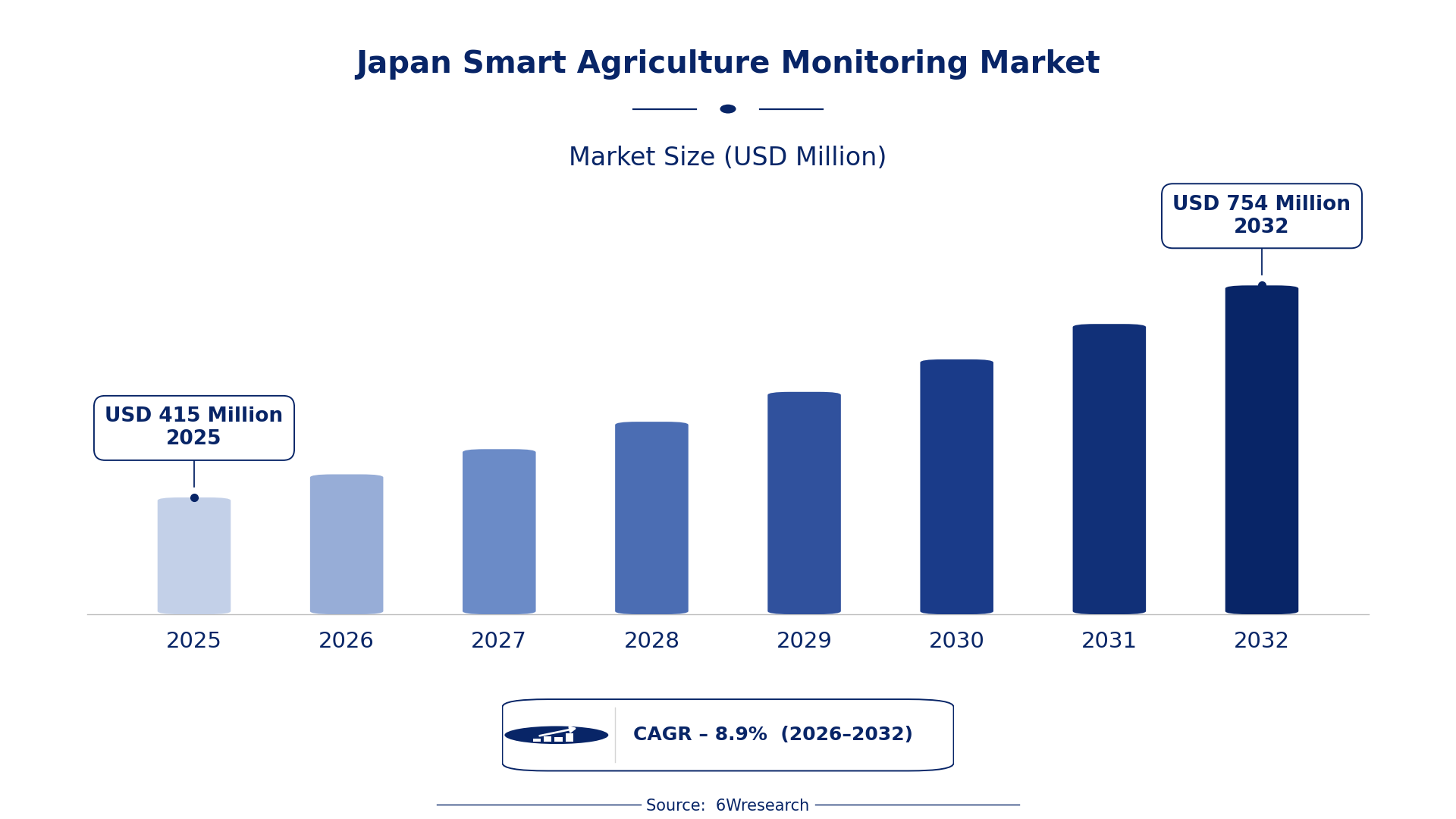
According to 6Wresearch internal database and industry insights, the Japan Smart Agriculture Monitoring Market was valued at USD 415 Million in 2025 and is projected to reach USD 754 Million by 2032, growing at a CAGR of approximately 8.9% during 2026–2032.
Japan Smart Agriculture Monitoring Market Highlights
| Report Metric | Details |
| Report Name | Japan Smart Agriculture Monitoring Market (2026-2032) |
| Market Size 2025 | USD 415 Million |
| Market Size 2032 | USD 754 Million |
| Absolute Growth 2025–2032 | USD 339 Million |
| CAGR 2026–2032 | 8.9% |
| Peak Annual Growth | 10.7% in 2032 |
| Forecast Period | 2026–2032 |
| Historical Data | 2022–2025 |
| Base Year | 2025 |
| Leading Monitoring Type, 2025 | Soil Health Monitoring (41% share) |
| Leading Sensing Technology, 2025 | Moisture/PH Sensors (39% share) |
| Leading Coverage Area, 2025 | Per-Plot (44% share) |
| Leading End User, 2025 | Smart Farm Operators (41% share) |
| Fastest-Growing Monitoring Type | Crop Growth Monitoring (12.6% CAGR) |
| Fastest-Growing Sensing Technology | Vision + Drones (14.0% CAGR) |
| Fastest-Growing Coverage Area | Large Fields (10.8% CAGR) |
| Fastest-Growing End User | AgTech Companies (12.1% CAGR) |
| Growing Sector | Smart Agriculture |
| Key End Users | Smart Farm Operators, AgTech Companies, Precision Agri Suppliers, Dairy & Livestock Farms |
Japan Smart Agriculture Monitoring Market Year-wise Growth Rate and Key Drivers (2022–2032)
This graph illustrates the annual growth rates of the market from 2022 to 2032, highlighting a steady upward trajectory and projected market expansion over the forecast period.
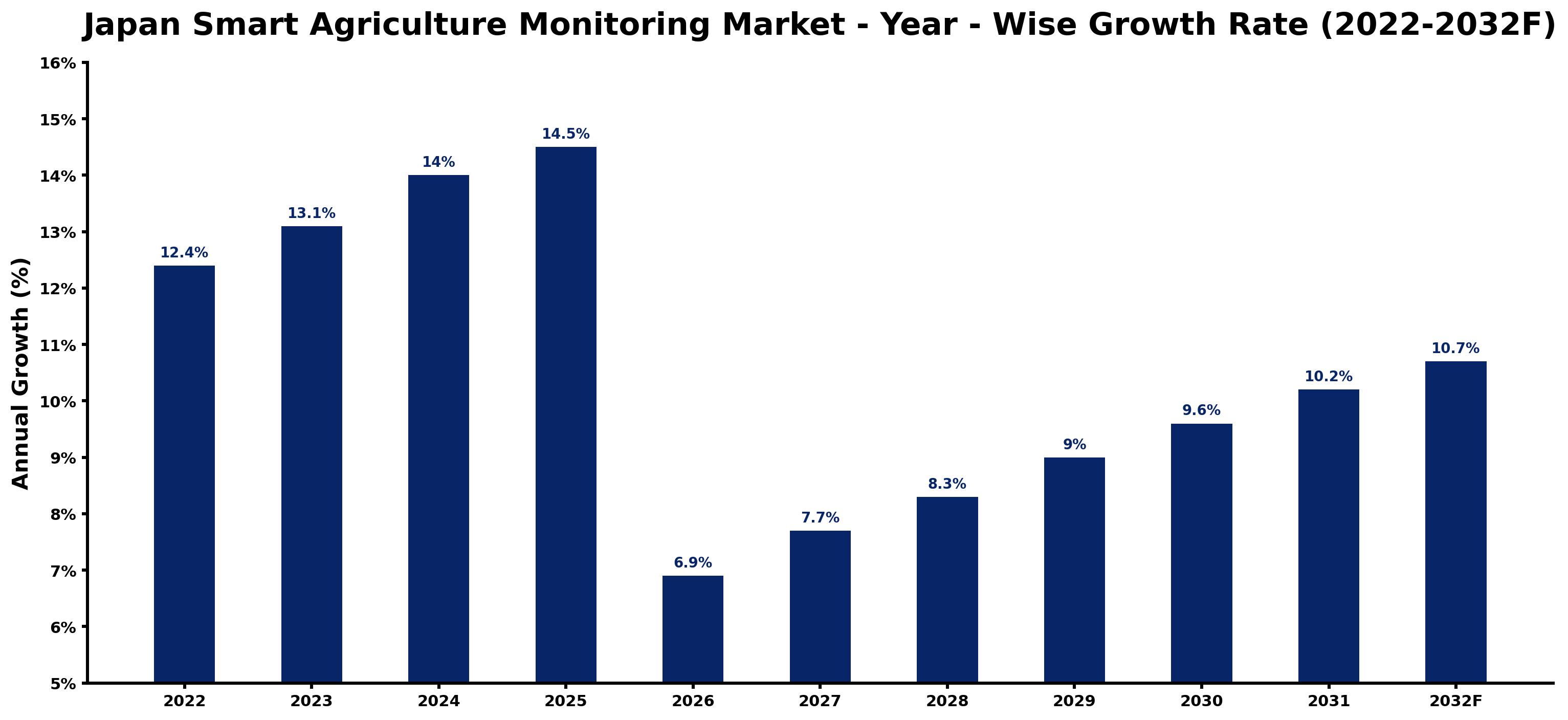
The table below sets out the estimated growth rate for each year and the main factor behind it.
| Year | Estimated Annual Growth (%) | Market Rationale |
| 2022 | 12.4 | The market experienced solid growth due to increased technology adoption in agriculture. |
| 2023 | 13.1 | Demand rose as farmers sought to improve efficiency and productivity through smart solutions. |
| 2024 | 14.0 | Growth accelerated as precision agriculture practices gained traction among various user groups. |
| 2025 | 14.5 | The market peaked, driven by heightened investments in advanced monitoring technologies. |
| 2026 | 6.9 | Growth is expected to slow as the market begins to stabilise following a period of rapid expansion. |
| 2027 | 7.7 | Demand will pick up again as farmers increasingly recognise the benefits of smart agriculture. |
| 2028 | 8.3 | The market is projected to continue growing as technology integration becomes more commonplace. |
| 2029 | 9.0 | Growth will persist as the adoption of IoT solutions expands across agricultural sectors. |
| 2030 | 9.6 | Demand is expected to remain strong with ongoing investments in modern agricultural practices. |
| 2031 | 10.2 | Growth will continue as the focus on sustainability and efficiency in farming intensifies. |
| 2032 | 10.7 | The market is projected to peak again as smart agriculture becomes a standard practice. |
Note: Market size estimations and growth projections presented in this report are based on 6Wresearch's proprietary forecasting methodology, utilizing the latest available industry data, government publications, and primary research inputs.
Japan Smart Agriculture Monitoring Market Synopsis
Smart Agriculture Monitoring employs advanced technologies to optimise farming practices, including monitoring soil health, crop growth, weather conditions, and livestock management. The Japan Smart Agriculture Monitoring Market is expanding due to rising demand from smart farm operators and AgTech companies, driven by a government initiative aiming for a 50% increase in smart farm adoption by 2025. The integration of IoT devices and data analytics improves decision-making, leading to better yields and resource management in agriculture. This growth is supported by a strong focus on sustainability and innovation in farming practices.
Market Dynamics Impact Analysis (2026–2032)
| Factor | Type | Impact | Primary Segment Affected |
| Increasing adoption of IoT technologies in agriculture | Driver | High | Soil Health Monitoring |
| Government initiatives promoting smart agriculture | Driver | High | Crop Growth Monitoring |
| Growing interest in sustainable farming practices | Opportunity | Medium | Weather Monitoring |
| Expansion of AgTech startups in Japan | Opportunity | Medium | Livestock Monitoring |
| High initial investment costs for smart technologies | Restraint | High | Moisture/PH Sensors |
| Limited awareness among traditional farmers | Restraint | Medium | Vision + Drones |
| Aging farmer population affecting technology adoption | Challenge | High | IoT + Micro Stations |
| Regulatory compliance requirements for new technologies | Challenge | Medium | Wearable Sensors |
Evaluation of Drivers in Japan Smart Agriculture Monitoring Market (2026–2032)
These are the developments adding the most demand over the forecast period.
| Drivers | Primary Segment Affected | Why It Matters (Evidence) |
| Rising adoption of IoT technologies | Soil Health Monitoring | The adoption rate of IoT in agriculture is around 30%, encouraging farmers to invest in soil health technologies. |
| Government support for smart agriculture | Crop Growth Monitoring | The government launched a Smart Agriculture Promotion Strategy in 2023 to support technology integration in farming. |
| Focus on sustainable farming practices | Weather Monitoring | Japan's agricultural sector increasingly prioritises sustainability, driving demand for weather monitoring solutions. |
| Growth of AgTech startups | Livestock Monitoring | With over 1,000 AgTech startups, innovation in livestock monitoring technologies is accelerating. |
| Investment in precision agriculture | Moisture/PH Sensors | The Agricultural Land Act supports precision farming, boosting demand for moisture and pH monitoring technologies. |
Buyers are adding capacity as the adoption of IoT technologies in agriculture rises, with approximately 30% of farmers integrating these systems into their practices. As sustainability becomes a priority, demand for weather monitoring solutions grows, with farmers seeking to optimise resource use. The presence of numerous AgTech startups accelerates innovation in livestock monitoring, improving productivity. The focus on precision agriculture drives the need for moisture and pH sensors among farmers.
Evaluation of Restraints in Japan Smart Agriculture Monitoring Market
The key brakes on demand, and where they bite hardest, are shown below.
| Market Restraint | Primary Segment Affected | Why It Matters (Evidence) |
| High initial investment costs | Moisture/PH Sensors | Farmers face upfront costs when adopting smart agriculture technologies, limiting widespread adoption. |
| Limited awareness among traditional farmers | Vision + Drones | Many traditional farmers lack knowledge about the benefits of drone technology, hindering its uptake. |
| Aging farmer population | IoT + Micro Stations | With an average age of 67, many farmers are reluctant to adopt new technologies, impacting market growth. |
| Regulatory compliance requirements | Wearable Sensors | Complex regulations can delay the introduction of wearable sensors, affecting their availability in the market. |
| Concerns over data privacy and security | Livestock Monitoring | Farmers hesitate to adopt technologies requiring data sharing, limiting the growth of livestock monitoring solutions. |
Japan Smart Agriculture Monitoring Market Challenges
Farmers experience high costs from outdated technology, which limits yield optimisation and raises operational expenses. Many still rely on traditional methods, resulting in an average yield loss of 20% compared to modern practices. Suppliers encounter disruptions in delivering advanced equipment due to a fragmented supply chain, causing delays that can extend lead times by up to six months. Regulatory compliance with JIS standards complicates the introduction of new technologies for suppliers, increasing costs by 15% and impacting their ability to meet market demands. Skills shortages hinder progress, with over 67% of farmers lacking training in modern agricultural technologies.
Trends in the Japan Smart Agriculture Monitoring Market
These developments are changing demand patterns in the Japan Smart Agriculture Monitoring Market.
- Shift from Traditional to Smart Farming: The transition to smart farming is occurring in Tokyo, where farmers are increasingly adopting IoT solutions for crop monitoring. In 2023, over 10,000 drones were registered for agricultural use, showcasing this shift.
- Increase in Precision Agriculture Adoption: Since 2023, precision agriculture practices have gained momentum, particularly in Hokkaido, where farmers are utilising advanced monitoring technologies to optimise yields. The government aims for a 50% increase in smart farm adoption by 2025.
- Growing Use of Drones for Crop Monitoring: Drones have become essential tools for crop monitoring, especially in Kumamoto, where farmers are using aerial technology to assess crop health. Over 10,000 drones were registered for agricultural purposes in 2023.
- Emergence of AgTech Startups: The rise of AgTech startups is transforming the agricultural sector in Japan, particularly in urban areas. With more than 1,000 startups focusing on new solutions, the sector is experiencing rapid growth.
Investment Opportunities in the Japan Smart Agriculture Monitoring Market
The following opportunities in the Japan Smart Agriculture Monitoring Market pair current demand with a clear way in.
- Partnerships with AgTech Startups: Engaging with AgTech startups in Tokyo can provide established firms with new solutions and access to technologies, boosting their market presence.
- Investment in Soil Health Technologies: With the government's 5 billion yen funding for smart agriculture projects, there is a significant opportunity to supply soil health monitoring technologies to farmers across Japan.
- Expansion of Precision Agriculture Tools: The push for precision agriculture creates demand for advanced monitoring tools, particularly in Hokkaido, where farmers are keen to improve yields.
- Development of Data Analytics Solutions: As farmers seek to optimise resource management, supplying data analytics solutions for smart agriculture can meet the growing demand.
Government Initiatives in the Japan Smart Agriculture Monitoring Market
The Food Sanitation Act amendment, fully applied in June 2021, mandates HACCP-based hygiene management for food businesses, impacting agricultural producers by ensuring food safety standards are met. This regulation encourages the adoption of smart agriculture technologies to improve compliance and traceability, creating a safer food supply chain.
The Ministry of Agriculture, Forestry and Fisheries oversees agricultural technology initiatives and has allocated 5 billion yen for smart agriculture projects in 2023. This funding supports the development and implementation of solutions that benefit farmers and improve productivity.
Future Insight of the Japan Smart Agriculture Monitoring Market
Investment in smart agriculture technologies will surge, generating significant demand for advanced solutions. By 2032, the integration of IoT devices will become standard, enhancing data analytics for farmers. The government aims to increase smart farm adoption by 50% by 2025, which will stimulate growth in regions like Tokyo and Hokkaido. The Smart Agriculture Consortium will facilitate technology adoption, supporting a shift towards modern farming practices.
Market Segmentation Analysis
Japan Smart Agriculture Monitoring Market report covers a detailed analysis of the following market segments:
By Monitoring Type – Soil Health Monitoring Leads, Crop Growth Monitoring Expected to Grow Fastest
According to Saurav Kr Singh, Senior Research Analyst at 6Wresearch, with 41% of monitoring type revenue in 2025, Soil Health Monitoring was the largest category. Soil health monitoring leads the market because it is essential for assessing soil conditions, which directly impacts farming success. The government's Smart Agriculture Promotion Strategy highlights its importance in achieving sustainable agricultural practices. Crop Growth Monitoring is set to record the highest CAGR in this split, 12.6% over 2026–2032. Crop growth monitoring is rapidly expanding as it is crucial for tracking crop development and optimising yields. The rise of over 1,000 AgTech startups focusing on crop monitoring technologies signals strong market interest. Suppliers should prioritise the development of crop growth monitoring solutions to address the increasing demand from farmers.
By Sensing Technology – Moisture/PH Sensors Lead, Vision + Drones Expected to Grow Fastest
Moisture/PH Sensors took 39% of sensing technology revenue in 2025, more than any other category. Moisture and pH sensors are the dominant technology due to their critical role in soil quality assessment, which is vital for effective crop production. Their integration into various precision agriculture initiatives reinforces their leading position in the market. Over 2026–2032, Vision + Drones are expected to post the fastest growth, at a CAGR of 14.0%. Vision and drone technology is experiencing rapid growth as it provides effective aerial crop analysis, enabling efficient monitoring over large areas. The registration of over 10,000 drones for crop monitoring in 2023 illustrates this upward trend. Buyers should invest in advanced vision and drone technologies to enhance monitoring efficiency and improve crop yields.
By Coverage Area – Per-Plot Leads, Large Fields Expected to Grow Fastest
The largest coverage area category in 2025 was Per-Plot, at 44% of revenue. Per-plot monitoring is the largest segment as it allows for tailored monitoring of individual plots, significantly enhancing precision farming efforts. This method is particularly advantageous in diverse agricultural regions like Hokkaido. The quickest growth will come from Large Fields, forecast to expand at a CAGR of 10.8% between 2026 and 2032. Large fields are the fastest-growing segment, catering to expansive agricultural operations, which aligns with the trend towards larger-scale farming. The government's goal to boost smart farm adoption by 50% by 2025 supports this growth trajectory. Suppliers must adapt their offerings to meet the specific needs of large field operations to capitalise on this growth opportunity.
By End User – Smart Farm Operators Lead, AgTech Companies Expected to Grow Fastest
Smart Farm Operators held 41% of the Japan Smart Agriculture Monitoring Market by end user in 2025. Smart farm operators constitute the largest user group of monitoring technologies, as they directly implement these solutions to enhance farming practices. Their significant role in the agricultural sector drives the demand for advanced monitoring systems. AgTech Companies are projected to grow fastest, at a CAGR of 12.1% during 2026–2032. AgTech companies represent the fastest-growing user segment, leading the development and implementation of innovative monitoring solutions. The increasing number of AgTech startups indicates a robust market for these technologies. Suppliers should collaborate with AgTech companies to leverage their innovative capabilities and expand market presence.
Key Attractiveness of the Report
- 10 Years of Market Numbers
- Historical Data Starting from 2022 to 2025
- Base Year 2025
- Forecast Data until 2032
- Key Performance Indicators Impacting the Market
- Major Upcoming Developments and Projects
Key Highlights of the Report:
- Japan Smart Agriculture Monitoring Market Outlook
- Market Size of Japan Smart Agriculture Monitoring Market, 2025
- Forecast of Japan Smart Agriculture Monitoring Market, 2032
- Historical Data and Forecast of Japan Smart Agriculture Monitoring Revenues & Volume for the Period 2022-2032F
- Japan Smart Agriculture Monitoring Market Trend Evolution
- Japan Smart Agriculture Monitoring Market Drivers and Challenges
- Japan Smart Agriculture Monitoring Price Trends
- Japan Smart Agriculture Monitoring Porter's Five Forces
- Japan Smart Agriculture Monitoring Industry Life Cycle
- Historical Data and Forecast of Japan Smart Agriculture Monitoring Market Revenues & Volume By Monitoring Type for the Period 2022-2032F
- Historical Data and Forecast of Japan Smart Agriculture Monitoring Market Revenues & Volume By Soil Health Monitoring for the Period 2022-2032F
- Historical Data and Forecast of Japan Smart Agriculture Monitoring Market Revenues & Volume By Crop Growth Monitoring for the Period 2022-2032F
- Historical Data and Forecast of Japan Smart Agriculture Monitoring Market Revenues & Volume By Weather Monitoring for the Period 2022-2032F
- Historical Data and Forecast of Japan Smart Agriculture Monitoring Market Revenues & Volume By Livestock Monitoring for the Period 2022-2032F
- Historical Data and Forecast of Japan Smart Agriculture Monitoring Market Revenues & Volume By Sensing Technology for the Period 2022-2032F
- Historical Data and Forecast of Japan Smart Agriculture Monitoring Market Revenues & Volume By Moisture/PH Sensors for the Period 2022-2032F
- Historical Data and Forecast of Japan Smart Agriculture Monitoring Market Revenues & Volume By Vision + Drones for the Period 2022-2032F
- Historical Data and Forecast of Japan Smart Agriculture Monitoring Market Revenues & Volume By IoT + Micro Stations for the Period 2022-2032F
- Historical Data and Forecast of Japan Smart Agriculture Monitoring Market Revenues & Volume By Wearable Sensors for the Period 2022-2032F
- Historical Data and Forecast of Japan Smart Agriculture Monitoring Market Revenues & Volume By Coverage Area for the Period 2022-2032F
- Historical Data and Forecast of Japan Smart Agriculture Monitoring Market Revenues & Volume By Per-Plot for the Period 2022-2032F
- Historical Data and Forecast of Japan Smart Agriculture Monitoring Market Revenues & Volume By Large Fields for the Period 2022-2032F
- Historical Data and Forecast of Japan Smart Agriculture Monitoring Market Revenues & Volume By Real-Time for the Period 2022-2032F
- Historical Data and Forecast of Japan Smart Agriculture Monitoring Market Revenues & Volume By Per Animal for the Period 2022-2032F
- Historical Data and Forecast of Japan Smart Agriculture Monitoring Market Revenues & Volume By End User for the Period 2022-2032F
- Historical Data and Forecast of Japan Smart Agriculture Monitoring Market Revenues & Volume By Smart Farm Operators for the Period 2022-2032F
- Historical Data and Forecast of Japan Smart Agriculture Monitoring Market Revenues & Volume By AgTech Companies for the Period 2022-2032F
- Historical Data and Forecast of Japan Smart Agriculture Monitoring Market Revenues & Volume By Precision Agri Suppliers for the Period 2022-2032F
- Historical Data and Forecast of Japan Smart Agriculture Monitoring Market Revenues & Volume By Dairy & Livestock Farms for the Period 2022-2032F
- Japan Smart Agriculture Monitoring Import Export Trade Statistics
- Market Opportunity Assessment By Monitoring Type
- Market Opportunity Assessment By Sensing Technology
- Market Opportunity Assessment By Coverage Area
- Market Opportunity Assessment By End User
- Japan Smart Agriculture Monitoring Top Companies Market Share
- Japan Smart Agriculture Monitoring Competitive Benchmarking By Technical and Operational Parameters
- Japan Smart Agriculture Monitoring Company Profiles
- Japan Smart Agriculture Monitoring Key Strategic Recommendations
Market Covered
The following segment groups are covered in the report.
By Monitoring Type
- Soil Health Monitoring
- Crop Growth Monitoring
- Weather Monitoring
- Livestock Monitoring
By Sensing Technology
- Moisture/PH Sensors
- Vision + Drones
- IoT + Micro Stations
- Wearable Sensors
By Coverage Area
- Per-Plot
- Large Fields
- Real-Time
- Per Animal
By End User
- Smart Farm Operators
- AgTech Companies
- Precision Agri Suppliers
- Dairy & Livestock Farms































