Japan Smart Airport Solutions Market Size & Growth Rate
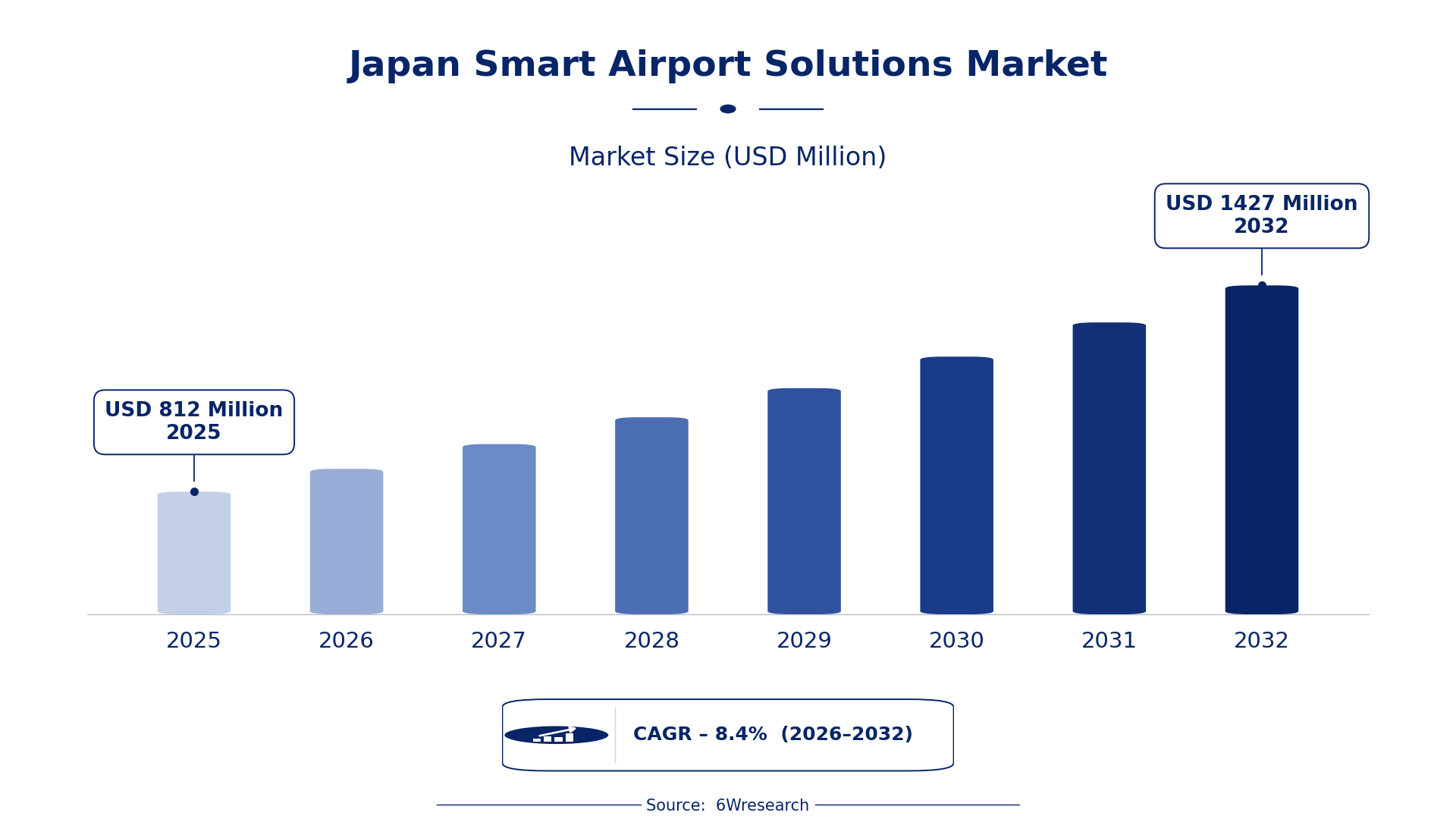
According to 6Wresearch internal database and industry insights, the Japan Smart Airport Solutions Market was valued at USD 812 Million in 2025 and is projected to reach USD 1,427 Million by 2032, growing at a CAGR of approximately 8.4% during 2026–2032.
Japan Smart Airport Solutions Market Highlights
| Report Metric | Details |
| Report Name | Japan Smart Airport Solutions Market (2026-2032) |
| Market Size 2025 | USD 812 Million |
| Market Size 2032 | USD 1,427 Million |
| Absolute Growth 2025–2032 | USD 615 Million |
| CAGR 2026–2032 | 8.4% |
| Peak Annual Growth | 9.6% in 2028 |
| Forecast Period | 2026–2032 |
| Historical Data | 2022–2025 |
| Base Year | 2025 |
| Leading Solution Type, 2025 | Passenger Flow Management (54% share) |
| Leading Functionality, 2025 | Queue Monitoring (46% share) |
| Leading Technology Used, 2025 | AI + Video Analytics (49% share) |
| Leading End User, 2025 | Airport Authorities (41% share) |
| Fastest-Growing Solution Type | Baggage Handling System (11.9% CAGR) |
| Fastest-Growing Functionality | Automation (10.8% CAGR) |
| Fastest-Growing Technology Used | RFID + Robotics (11.6% CAGR) |
| Fastest-Growing End User | Baggage System Vendors (10.4% CAGR) |
| Growing Sector | airport operations |
| Key End Users | airport authorities, baggage system vendors, government airport units, airline operators |
Japan Smart Airport Solutions Market Year-wise Growth Rate and Key Drivers (2022–2032)
This graph illustrates the annual growth rates of the market from 2022 to 2032, highlighting a steady upward trajectory and projected market expansion over the forecast period.
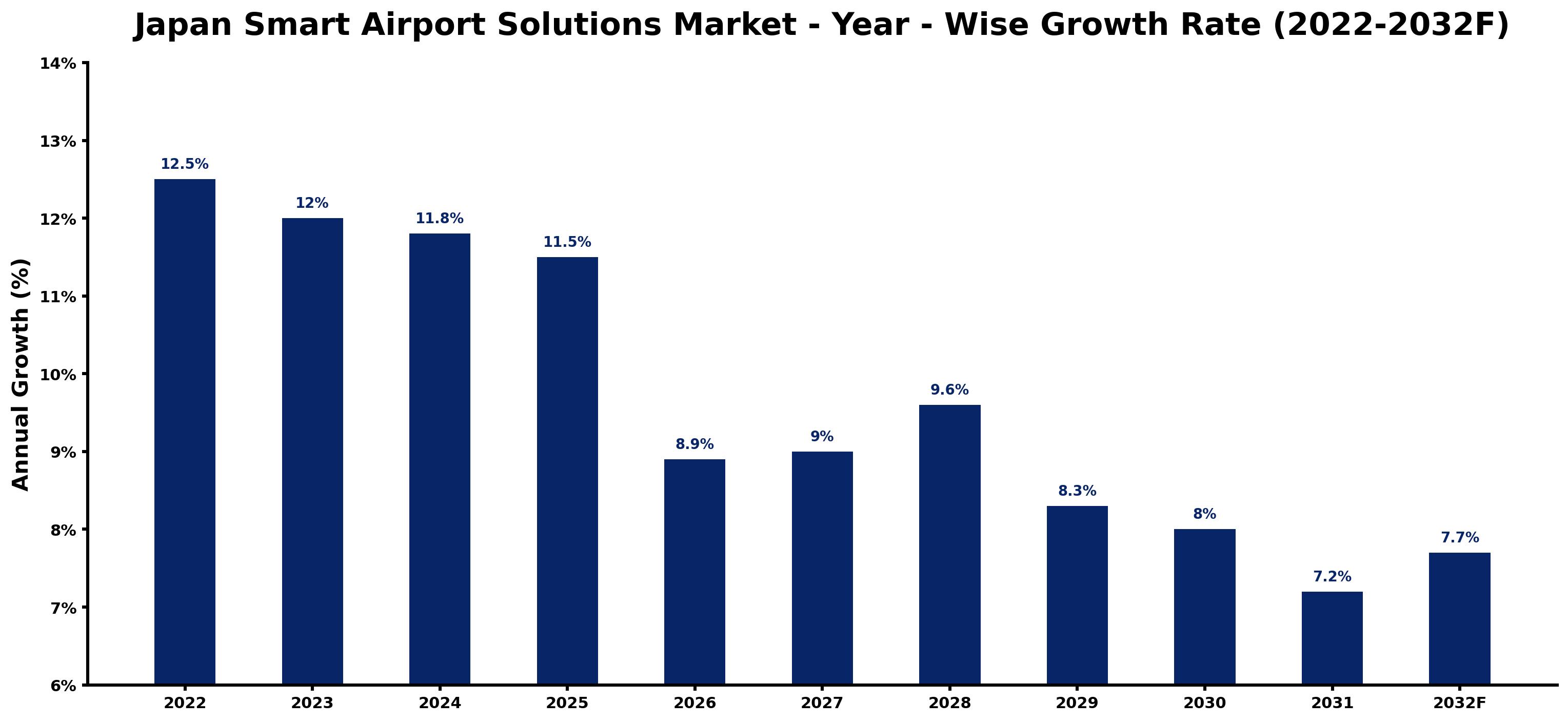
For each year, the table pairs the estimated growth rate with the leading influence on demand, showing how the drivers changed across the period.
| Year | Estimated Annual Growth (%) | Market Rationale |
| 2022 | 12.5 | The market experienced strong demand due to increased investments in airport technology. |
| 2023 | 12.0 | Growth continued but at a slower pace as airports adjusted to new operational standards. |
| 2024 | 11.8 | Demand remained steady, driven by ongoing modernization efforts in airport infrastructure. |
| 2025 | 11.5 | Growth slowed further as airports focused on implementing existing technologies. |
| 2026 | 8.9 | The market growth rate is projected to decrease as international travel recovery faces challenges. |
| 2027 | 9.0 | Demand is expected to rise slightly as airports begin to adopt new automation technologies. |
| 2028 | 9.6 | A peak in growth is anticipated due to heightened investments in AI and robotics. |
| 2029 | 8.3 | Growth is expected to slow as the market begins to stabilise after rapid technological adoption. |
| 2030 | 8.0 | The market will continue to grow, but at a more moderate pace as saturation approaches. |
| 2031 | 7.2 | Growth is projected to slow further as airports focus on optimizing existing solutions. |
| 2032 | 7.7 | Demand is anticipated to rise again as new technologies are integrated into operations. |
Note: Market size estimations and growth projections presented in this report are based on 6Wresearch's proprietary forecasting methodology, utilizing the latest available industry data, government publications, and primary research inputs.
Japan Smart Airport Solutions Market Synopsis
Smart Airport Solutions encompass advanced technologies such as AI, robotics, and data analytics to improve airport operations and passenger experiences. The Japan Smart Airport Solutions Market is expanding due to rising domestic demand, increased international travel, and substantial government investments, including ¥1 trillion allocated for airport infrastructure modernization by 2025. The adoption of contactless travel solutions has surged by 30%, reflecting changing consumer preferences and driving further market growth.
Market Dynamics Impact Analysis (2026–2032)
| Factor | Type | Impact | Primary Segment Affected |
| Increased investment in airport infrastructure modernization | Driver | High | Passenger Flow Management |
| Growing demand for contactless travel solutions | Driver | High | Security Screening AI |
| Rising international passenger traffic targets set by the government | Opportunity | High | Smart Boarding Systems |
| Technological advancements in AI and automation | Opportunity | Medium | Baggage Handling System |
| High initial costs of implementing smart solutions | Restraint | High | Automation |
| Limited skilled workforce for advanced technology deployment | Restraint | Medium | AI + Video Analytics |
| Compliance with international security standards | Challenge | High | Security Screening AI |
| Capacity constraints at major airports | Challenge | Medium | Passenger Flow Management |
Evaluation of Drivers in Japan Smart Airport Solutions Market (2026–2032)
The table below links each growth driver to the segment it affects and the evidence for it.
| Drivers | Primary Segment Affected | Why It Matters (Evidence) |
| Increased passenger traffic at major airports | Passenger Flow Management | Tokyo's Haneda Airport serves over 87 million passengers annually, driving demand for solutions that optimize passenger flow. |
| Government investment in airport infrastructure | Baggage Handling System | The Japanese government has allocated ¥1 trillion for modernization, enhancing baggage handling efficiency across airports. |
| Adoption of AI technologies for security | Security Screening AI | The 2023 AI program aims to improve airport security, increasing demand for AI-driven screening solutions. |
| Rising need for contactless travel solutions | Smart Boarding Systems | Contactless travel solutions have seen a 30% increase in adoption among major airports, improving passenger convenience. |
| Technological advancements in automation | Automation | Machine learning applications in airport operations are projected to grow significantly, enhancing operational efficiency. |
Volumes grow on the back of increased passenger traffic at major airports, particularly in Tokyo, which serves over 87 million passengers annually. This surge drives demand for solutions that optimise movement and reduce wait times. Adoption of contactless travel solutions has risen by 30%, reflecting changing passenger preferences and boosting the need for smart boarding systems. Growth in machine learning applications is expected to enhance automation in airport operations, further increasing demand.
Evaluation of Restraints in Japan Smart Airport Solutions Market
These are the pressures that could keep growth below its potential.
| Market Restraint | Primary Segment Affected | Why It Matters (Evidence) |
| High initial costs of implementing smart solutions | Automation | The substantial investment required for smart solutions can deter airport authorities from upgrading their systems. |
| Limited skilled workforce for advanced technology deployment | AI + Video Analytics | A shortage of qualified personnel hampers the effective implementation of advanced technologies in airports. |
| Compliance with international security standards | Security Screening AI | Meeting stringent security regulations increases operational costs and complicates technology adoption, impacting airport efficiency. |
| Capacity constraints at major airports | Passenger Flow Management | Limited capacity at busy airports restricts the effectiveness of new passenger flow management solutions. |
| Resistance to change from traditional operational practices | Smart Boarding Systems | Airport authorities may hesitate to adopt new technologies due to established routines and processes. |
Japan Smart Airport Solutions Market Challenges
In 2023, Japan's airports face intense competition for passenger traffic, particularly in the Tokyo Metropolitan Area, which accounts for 40% of the nation's air travel. This competition compels airports to reduce fees, straining budgets and delaying crucial upgrades. Many facilities rely on outdated technology, leading to inefficiencies that negatively impact the passenger experience. Supply chain disruptions for essential components, such as RFID systems, can inflate costs and postpone modernization projects, complicating efforts for airport authorities to improve their operations.
Trends in the Japan Smart Airport Solutions Market
Four trends stand out in the Japan Smart Airport Solutions Market.
- Shift towards Automation in Baggage Handling: Automation in baggage handling has become increasingly prevalent, with major airports adopting RFID technology. This shift has led to a 25% reduction in processing times, improving operational efficiency.
- Growing Adoption of Contactless Travel Solutions: Contactless travel solutions have gained momentum, with major airports reporting a 30% increase in adoption, reflecting a shift towards improved passenger convenience and safety.
- Increased Use of AI in Security Screening: The 2023 AI program has spurred airports to integrate AI technologies in security screening, aiming to improve threat detection and overall airport security measures.
- Expansion of Passenger Flow Management Systems: Kansai International Airport has implemented advanced passenger flow management systems, optimising the movement of travelers. This trend supports the growing demand for efficient airport operations.
Investment Opportunities in the Japan Smart Airport Solutions Market
Where to invest in the Japan Smart Airport Solutions Market: the main openings are set out below.
- Timing for Investment in Smart Solutions: With the Japanese government investing ¥1 trillion in airport modernization, now is an ideal time to supply advanced smart solutions to airports, improving operational efficiency.
- Entry into the Market through Partnerships: Forming joint ventures with local airport authorities can facilitate entry into the market, especially for technology providers looking to implement smart solutions.
- Focus on Baggage Handling Systems: The Baggage Handling System segment is set to grow, with an anticipated increase in demand for advanced solutions to airports.
- Expansion of AI Technologies in Airports: As AI technologies gain traction, there is a significant opportunity to supply AI-driven solutions to improve airport security and operations, particularly in major urban areas.
Government Initiatives in the Japan Smart Airport Solutions Market
The AI Promotion Act, established in 2025, creates a national framework for the development and use of AI technologies in various sectors, including airport operations. This legislation encourages airports to adopt AI solutions, improving security and operational efficiency. The Japanese government has allocated ¥1 trillion for airport infrastructure modernization by 2025, enhancing the implementation of smart airport solutions.
The Ministry of Land, Infrastructure, Transport and Tourism oversees the implementation of airport technology solutions. It funds projects aimed at improving airport operations and security, ensuring compliance with international standards and enhancing the overall efficiency of airport operations.
Future Insight of the Japan Smart Airport Solutions Market
The introduction of smart airport facilities will transform operations by 2032, utilising advanced technologies to streamline processes. A government programme promoting AI integration will optimise airport management and enhance service delivery. With international passenger traffic expected to increase by 20% by 2025, airports must innovate to meet demand. Automation in baggage handling has already reduced processing times by 25%, setting a foundation for improved efficiency and resource allocation.
Market Segmentation Analysis
Japan Smart Airport Solutions Market report covers a detailed analysis of the following market segments:
By Solution Type – Passenger Flow Management Leads, Baggage Handling System Expected to Grow Fastest
According to Saurav Kr Singh, Senior Research Analyst at 6Wresearch, with 54% of solution type revenue in 2025, Passenger Flow Management was the largest category. Passenger Flow Management maintains the largest share due to its essential role in managing the movement of millions of passengers at major airports such as Tokyo's Haneda. This solution is critical for enhancing the overall passenger experience and operational efficiency in high-traffic environments. Baggage Handling System is set to record the highest CAGR in this split, 11.9% over 2026–2032. The Baggage Handling System is witnessing rapid growth as airports modernise operations, evidenced by a 25% reduction in processing times. This surge is driven by increasing passenger volumes and the need for effective baggage tracking. Suppliers should prioritise the development of advanced baggage handling technologies to address the rising demands of airports.
By Functionality – Queue Monitoring Leads, Automation Expected to Grow Fastest
Queue Monitoring took 46% of functionality revenue in 2025, more than any other category. Queue Monitoring is the leading functionality because it effectively manages wait times, which is crucial for passenger satisfaction. Airports are increasingly adopting these systems to enhance service delivery and operational efficiency. Automation is projected to grow fastest, at a CAGR of 10.8% during 2026–2032. Automation is the fastest-growing functionality, expanding its application across various airport operations to boost efficiency. This trend is propelled by the push for modernisation and quicker processing times. Buyers will gain from investing in automation solutions to enhance operational efficiency and improve passenger experience.
By Technology Used – AI + Video Analytics Leads, RFID + Robotics Expected to Grow Fastest
In 2025, AI + Video Analytics led the technology used split with a 49% share. AI + Video Analytics leads the market as it is directly employed for monitoring airport operations and improving passenger flow management. This technology is vital for airports aiming to enhance their efficiency and safety standards. Over 2026–2032, RFID + Robotics are expected to post the fastest growth, at a CAGR of 11.6%. RFID + Robotics are rapidly gaining traction due to their direct involvement in baggage tracking and handling processes, essential for modern airport operations. The growing adoption of these technologies signifies the industry's shift towards improved efficiency. Suppliers should focus on developing RFID and robotics technologies to align with the industry's transition towards enhanced operational capabilities.
By End User – Airport Authorities Lead, Baggage System Vendors Expected to Grow Fastest
Airport Authorities accounted for 41% of the market by end user in 2025. Airport Authorities dominate the market as they directly implement smart airport solutions to improve operational efficiency and passenger services. Their significant investments in technology integration underscore their pivotal role in the sector. The quickest growth will come from Baggage System Vendors, forecast to expand at a CAGR of 10.4% between 2026 and 2032. Baggage System Vendors are experiencing the fastest growth as they respond to the increasing demand for efficient baggage handling systems. This trend is driven by the necessity for airports to modernise their baggage processing capabilities. Buyers should collaborate with baggage system vendors to enhance their operational capabilities and meet changing passenger expectations.
Key Attractiveness of the Report
- 10 Years of Market Numbers
- Historical Data Starting from 2022 to 2025
- Base Year 2025
- Forecast Data until 2032
- Key Performance Indicators Impacting the Market
- Major Upcoming Developments and Projects
Key Highlights of the Report:
- Japan Smart Airport Solutions Market Outlook
- Market Size of Japan Smart Airport Solutions Market, 2025
- Forecast of Japan Smart Airport Solutions Market, 2032
- Historical Data and Forecast of Japan Smart Airport Solutions Revenues & Volume for the Period 2022-2032F
- Japan Smart Airport Solutions Market Trend Evolution
- Japan Smart Airport Solutions Market Drivers and Challenges
- Japan Smart Airport Solutions Price Trends
- Japan Smart Airport Solutions Porter's Five Forces
- Japan Smart Airport Solutions Industry Life Cycle
- Historical Data and Forecast of Japan Smart Airport Solutions Market Revenues & Volume By Solution Type for the Period 2022-2032F
- Historical Data and Forecast of Japan Smart Airport Solutions Market Revenues & Volume By Passenger Flow Management for the Period 2022-2032F
- Historical Data and Forecast of Japan Smart Airport Solutions Market Revenues & Volume By Baggage Handling System for the Period 2022-2032F
- Historical Data and Forecast of Japan Smart Airport Solutions Market Revenues & Volume By Security Screening AI for the Period 2022-2032F
- Historical Data and Forecast of Japan Smart Airport Solutions Market Revenues & Volume By Smart Boarding Systems for the Period 2022-2032F
- Historical Data and Forecast of Japan Smart Airport Solutions Market Revenues & Volume By Functionality for the Period 2022-2032F
- Historical Data and Forecast of Japan Smart Airport Solutions Market Revenues & Volume By Queue Monitoring for the Period 2022-2032F
- Historical Data and Forecast of Japan Smart Airport Solutions Market Revenues & Volume By Automation for the Period 2022-2032F
- Historical Data and Forecast of Japan Smart Airport Solutions Market Revenues & Volume By Threat Detection for the Period 2022-2032F
- Historical Data and Forecast of Japan Smart Airport Solutions Market Revenues & Volume By Contactless Travel for the Period 2022-2032F
- Historical Data and Forecast of Japan Smart Airport Solutions Market Revenues & Volume By Technology Used for the Period 2022-2032F
- Historical Data and Forecast of Japan Smart Airport Solutions Market Revenues & Volume By AI + Video Analytics for the Period 2022-2032F
- Historical Data and Forecast of Japan Smart Airport Solutions Market Revenues & Volume By RFID + Robotics for the Period 2022-2032F
- Historical Data and Forecast of Japan Smart Airport Solutions Market Revenues & Volume By Machine Learning for the Period 2022-2032F
- Historical Data and Forecast of Japan Smart Airport Solutions Market Revenues & Volume By QR + Facial Recognition for the Period 2022-2032F
- Historical Data and Forecast of Japan Smart Airport Solutions Market Revenues & Volume By End User for the Period 2022-2032F
- Historical Data and Forecast of Japan Smart Airport Solutions Market Revenues & Volume By Airport Authorities for the Period 2022-2032F
- Historical Data and Forecast of Japan Smart Airport Solutions Market Revenues & Volume By Baggage System Vendors for the Period 2022-2032F
- Historical Data and Forecast of Japan Smart Airport Solutions Market Revenues & Volume By Government Airport Units for the Period 2022-2032F
- Historical Data and Forecast of Japan Smart Airport Solutions Market Revenues & Volume By Airline Operators for the Period 2022-2032F
- Japan Smart Airport Solutions Import Export Trade Statistics
- Market Opportunity Assessment By Solution Type
- Market Opportunity Assessment By Functionality
- Market Opportunity Assessment By Technology Used
- Market Opportunity Assessment By End User
- Japan Smart Airport Solutions Top Companies Market Share
- Japan Smart Airport Solutions Competitive Benchmarking By Technical and Operational Parameters
- Japan Smart Airport Solutions Company Profiles
- Japan Smart Airport Solutions Key Strategic Recommendations
Market Covered
The study includes the following segmentation.
By Solution Type
- Passenger Flow Management
- Baggage Handling System
- Security Screening AI
- Smart Boarding Systems
By Functionality
- Queue Monitoring
- Automation
- Threat Detection
- Contactless Travel
By Technology Used
- AI + Video Analytics
- RFID + Robotics
- Machine Learning
- QR + Facial Recognition
By End User
- Airport Authorities
- Baggage System Vendors
- Government Airport Units
- Airline Operators






































