Japan Smart Automation Sensors Market Size & Growth Rate
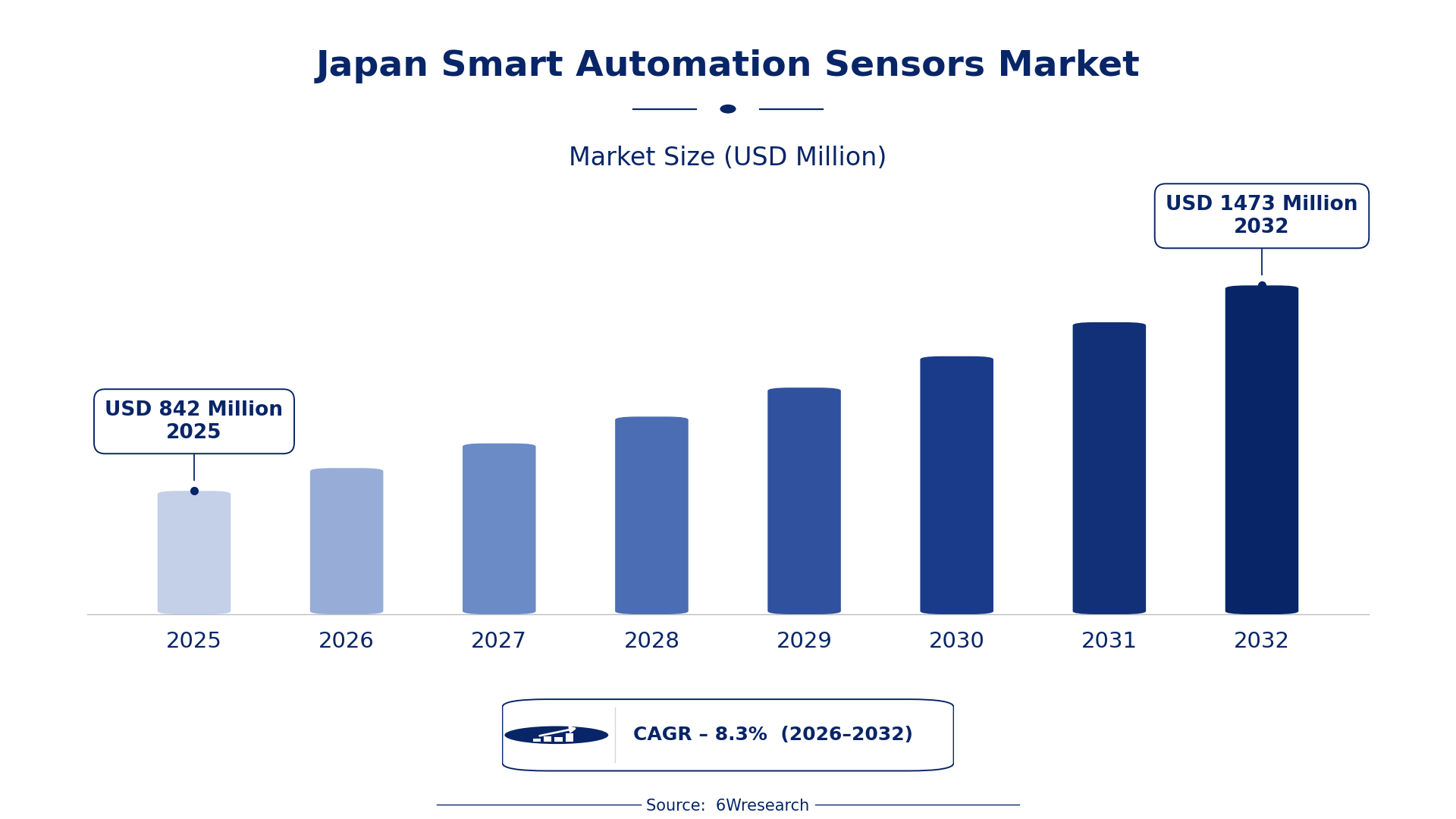
According to 6Wresearch internal database and industry insights, the Japan Smart Automation Sensors Market was valued at USD 842 Million in 2025 and is projected to reach USD 1,473 Million by 2032, growing at a CAGR of approximately 8.3% during 2026–2032.
Japan Smart Automation Sensors Market Highlights
| Report Metric | Details |
| Report Name | Japan Smart Automation Sensors Market (2026-2032) |
| Market Size 2025 | USD 842 Million |
| Market Size 2032 | USD 1,473 Million |
| Absolute Growth 2025–2032 | USD 631 Million |
| CAGR 2026–2032 | 8.3% |
| Peak Annual Growth | 9.2% in 2027 |
| Forecast Period | 2026–2032 |
| Historical Data | 2022–2025 |
| Base Year | 2025 |
| Leading Sensor Type, 2025 | Proximity Sensors (53% share) |
| Leading Automation Purpose, 2025 | Object Detection (39% share) |
| Leading Industry Application, 2025 | Factory Robotics (41% share) |
| Leading End User, 2025 | Industrial Automation (43% share) |
| Fastest-Growing Sensor Type | Temperature Sensors (11.8% CAGR) |
| Fastest-Growing Automation Purpose | Process Control (10.9% CAGR) |
| Fastest-Growing Industry Application | Food/Pharma Manufacturing (11.1% CAGR) |
| Fastest-Growing End User | Plant Operators (10.5% CAGR) |
| Growing Sector | Food/Pharma Manufacturing |
| Key End Users | Factory Robotics, Food/Pharma Manufacturing, Predictive Maintenance, Smart Buildings |
Japan Smart Automation Sensors Market Year-wise Growth Rate and Key Drivers (2022–2032)
This graph illustrates the annual growth rates of the market from 2022 to 2032, highlighting a steady upward trajectory and projected market expansion over the forecast period.
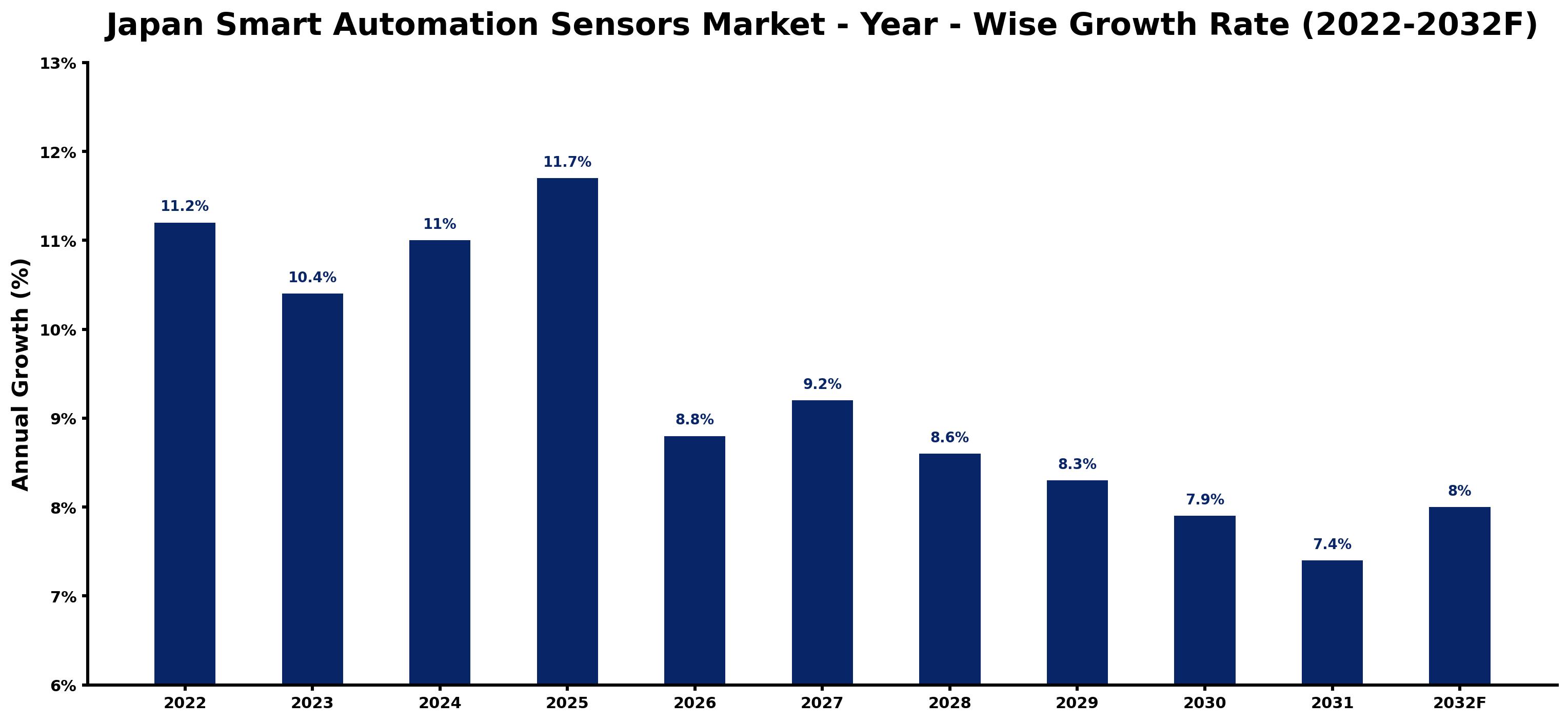
The following figures match every annual growth estimate with the main market development of that year, giving the reasoning behind each rise or slowdown.
| Year | Estimated Annual Growth (%) | Market Rationale |
| 2022 | 11.2 | The market showed strong activity driven by high domestic demand for automation solutions. |
| 2023 | 10.4 | Growth slowed slightly due to market saturation in certain sectors, yet demand remained strong. |
| 2024 | 11.0 | Increased investments in smart manufacturing technologies boosted growth beyond the previous year. |
| 2025 | 11.7 | The market peaked as industries accelerated automation efforts, leading to heightened sensor adoption. |
| 2026 | 8.8 | Growth is expected to slow as the market begins to stabilise after rapid expansion in prior years. |
| 2027 | 9.2 | A renewed focus on efficiency in manufacturing will spur a faster growth rate than before. |
| 2028 | 8.6 | The market is projected to experience a slight slowdown as competition intensifies among sensor providers. |
| 2029 | 8.3 | Growth is expected to continue to decelerate as market maturity sets in, affecting new investments. |
| 2030 | 7.9 | The market's growth rate will decrease as industries consolidate and optimise existing systems. |
| 2031 | 7.4 | A further slowdown is projected as companies prioritise cost management amid economic uncertainties. |
| 2032 | 8.0 | Growth is expected to rebound slightly as new technologies and applications emerge, stimulating demand. |
Note: Market size estimations and growth projections presented in this report are based on 6Wresearch's proprietary forecasting methodology, utilizing the latest available industry data, government publications, and primary research inputs.
Japan Smart Automation Sensors Market Synopsis
Smart automation sensors detect environmental changes and convert them into signals for automation systems, improving manufacturing processes and energy efficiency. Key industrial regions like Tokyo and Osaka are leading this growth, supported by government strategies promoting automation technologies and sustainability efforts targeting a 46% reduction in greenhouse gas emissions by 2030.
Market Dynamics Impact Analysis (2026–2032)
| Factor | Type | Impact | Primary Segment Affected |
| Growing demand for smart manufacturing solutions | Driver | High | Industrial Automation |
| Increased focus on energy efficiency in buildings | Driver | High | Smart Buildings |
| Rising investments in predictive maintenance technologies | Opportunity | Medium | Predictive Maintenance |
| Expansion of factory robotics applications | Opportunity | Medium | Factory Robotics |
| High competition among sensor manufacturers | Restraint | High | Proximity Sensors |
| Market saturation in certain automation sectors | Restraint | Medium | Temperature Sensors |
| Challenges in integrating new technologies | Challenge | High | Vibration Sensors |
| Shortage of skilled workforce in automation sectors | Challenge | Medium | Motion Sensors |
Evaluation of Drivers in Japan Smart Automation Sensors Market (2026–2032)
Key forces behind demand, with the segment each one moves most, are listed below.
| Drivers | Primary Segment Affected | Why It Matters (Evidence) |
| Increased investments in smart manufacturing | Industrial Automation | Japan's national strategy for digital transformation aims for JPY 150 trillion in decarbonisation investments over 10 years. |
| Growing focus on energy efficiency | Smart Buildings | The push for a 46% reduction in greenhouse gas emissions by 2030 drives demand for energy-efficient solutions. |
| Rising adoption of predictive maintenance | Predictive Maintenance | The installed base of industrial automation systems in Japan exceeds 5 million units, necessitating maintenance solutions. |
| Expansion of factory robotics | Factory Robotics | Proximity sensors are widely used in factory robotics for efficiency improvements, boosting production capabilities. |
| Increasing automation in food manufacturing | Food/Pharma Manufacturing | Temperature sensors are critical for safety compliance, driving demand in the food manufacturing sector. |
What keeps demand rising is the surge in investments towards smart manufacturing, with Japan targeting JPY 150 trillion for decarbonisation over the next decade. The commitment to a 46% reduction in greenhouse gas emissions by 2030 is driving energy efficiency in smart buildings, leading to higher sensor adoption. The installed base of over 5 million industrial automation systems necessitates predictive maintenance solutions, further boosting demand. Factory robotics increasingly rely on proximity sensors for operational efficiency, while the food manufacturing sector is prioritising temperature sensors to ensure safety compliance.
Evaluation of Restraints in Japan Smart Automation Sensors Market
These are the pressures that could keep growth below its potential.
| Market Restraint | Primary Segment Affected | Why It Matters (Evidence) |
| Intense competition among sensor manufacturers | Proximity Sensors | The high number of players in the market leads to price wars, impacting profit margins. |
| Market saturation in automation sectors | Temperature Sensors | With many companies already adopting automation, new growth opportunities are limited. |
| Integration challenges with legacy systems | Vibration Sensors | Many manufacturers struggle to incorporate advanced sensors into existing setups, delaying upgrades. |
| Shortage of skilled workforce | Motion Sensors | The lack of trained professionals in automation sectors hampers the implementation of new technologies. |
| Regulatory hurdles for new technology adoption | Object Detection | Manufacturers face stringent compliance requirements, slowing down the introduction of new solutions. |
Japan Smart Automation Sensors Market Challenges
Manufacturers face rising costs as Japan's national minimum wage reaches JPY 1,055 per hour, which pressures profit margins and may increase prices for buyers. Delays in adopting advanced automation technologies arise from the complexity of integration, hindering production timelines for producers and reducing their market competitiveness. Distributors encounter supply chain disruptions due to local production of smart automation sensors failing to keep pace with demand, resulting in longer lead times for buyers. A shortage of skilled workers in advanced manufacturing hampers the ability to implement and maintain these systems, leading to decreased operational efficiency for producers.
Trends in the Japan Smart Automation Sensors Market
The shifts below are changing how Japan Smart Automation Sensors Market products are bought and supplied.
- Shift from Traditional to Smart Manufacturing: Since 2023, Japan has seen a shift towards smart manufacturing, guided by the national digital transformation strategy. This trend is reflected in the allocation of JPY 200 million for smart factory initiatives, encouraging manufacturers to adopt advanced automation technologies.
- Transition from Manual to Automated Processes: The transition to automated processes began in 2023, with industries increasingly relying on automation for efficiency. The food manufacturing sector has seen an 11.1% CAGR in automation adoption, highlighting the growing reliance on smart sensors.
- Emergence of Predictive Maintenance Technologies: Starting in 2023, predictive maintenance has gained traction in automotive manufacturing, with a notable increase in sensor integration. This trend is supported by the installed base of over 5 million industrial automation systems, enhancing operational efficiency.
- Prioritisation of Energy Efficiency in Smart Buildings: In 2023, energy efficiency became a priority in smart buildings, driven by Japan's commitment to reduce greenhouse gas emissions. The Smart Building Association of Japan supports this initiative, promoting the integration of automation technologies.
Investment Opportunities in the Japan Smart Automation Sensors Market
The opportunities below stand out in the Japan Smart Automation Sensors Market for new entrants and existing suppliers.
- Current Demand for Smart Sensors: With the market expected to reach USD 1.5 billion by 2025, there is a pressing need for smart automation sensors. Industrial automation sectors in Tokyo are ideal for investments, focusing on partnerships with local manufacturers to meet rising demand.
- Investment in Predictive Maintenance Solutions: As predictive maintenance technologies gain traction, there is an opportunity to supply advanced sensors. The automotive sector is increasingly adopting these technologies, creating a pathway for collaboration with local firms in the Kansai region.
- Expansion into Smart Building Technologies: The push for energy efficiency in smart buildings presents an opportunity to supply automation solutions. Collaborating with building integrators in urban areas can facilitate market entry and meet compliance requirements.
- Growth in Food Manufacturing Sector: The food manufacturing industry is expanding its automation capabilities, necessitating temperature sensors for safety compliance. Suppliers can enter this market by partnering with local food manufacturers to provide tailored solutions.
Government Initiatives in the Japan Smart Automation Sensors Market
The New Robot Strategy (2015) enhances the capabilities of smart automation sensors by expanding their use across manufacturing, services, agriculture, and care. This strategy complements earlier efforts by establishing a framework for integrating advanced technologies across various sectors, promoting efficiency and innovation in automation processes.
The Ministry of Economy, Trade and Industry (METI) approves funding for smart factory initiatives, allocating 200 million JPY in 2023. This funding supports the development of automation technologies, facilitating the adoption of smart automation sensors in manufacturing processes.
Future Insight of the Japan Smart Automation Sensors Market
The investment pipeline for decarbonisation will create robust demand for smart automation sensors, driven by JPY 150 trillion in planned investments over the next decade. By 2032, advancements in IoT integration will streamline manufacturing processes, boosting productivity for suppliers. The national strategy for digital transformation will promote innovation in automation technologies, enhancing efficiency across multiple sectors. Comprehensive training programmes will prepare the workforce with essential skills, enabling producers to successfully implement new technologies.
Market Segmentation Analysis
Japan Smart Automation Sensors Market report covers a detailed analysis of the following market segments:
By Sensor Type – Proximity Sensors Lead, Temperature Sensors Expected to Grow Fastest
According to Saurav Kr Singh, Senior Research Analyst at 6Wresearch, Proximity Sensors accounted for 53% of the market by sensor type in 2025. Proximity sensors hold the largest share as they are extensively utilised in factory robotics, essential for detecting object presence during automation processes. Their widespread application is evident in key industrial regions like Tokyo and Osaka, which are hubs for sensor technologies. Over 2026–2032, Temperature Sensors are expected to post the fastest growth, at a CAGR of 11.8%. Temperature sensors are experiencing rapid growth due to their critical role in food manufacturing, where they ensure compliance with safety standards. The increasing emphasis on quality control in this sector is propelling their adoption significantly. Suppliers should focus on enhancing temperature sensor capabilities to align with the growing demand in the food manufacturing sector.
By Automation Purpose – Object Detection Leads, Process Control Expected to Grow Fastest
In 2025, Object Detection led the automation purpose split with a 39% share. Object detection leads the automation purpose segment as it is fundamental for robotics and manufacturing processes, ensuring operational efficiency. The strong reliance on these capabilities in Japan's industrial sector underscores its importance in automation. Process Control is projected to grow fastest, at a CAGR of 10.9% during 2026–2032. Process control is the fastest-growing purpose, vital for maintaining efficiency in production lines as industries seek to enhance productivity. The national strategy for digital transformation in industries is further accelerating this growth. Buyers should prioritise process control solutions to improve production efficiency and maintain a competitive edge.
By Industry Application – Factory Robotics Lead, Food/Pharma Manufacturing Expected to Grow Fastest
Factory Robotics took 41% of industry application revenue in 2025, more than any other category. Factory robotics is the dominant application for smart automation sensors, as they are integral to modern automation practices across various industries. The concentration of industrial activities in regions like Tokyo and Osaka supports this strong demand. The quickest growth will come from Food/Pharma Manufacturing, forecast to expand at a CAGR of 11.1% between 2026 and 2032. Food and pharma manufacturing is the fastest-growing application, driven by stringent quality and safety standards that necessitate advanced monitoring solutions. This sector's focus on compliance and efficiency is propelling the adoption of smart sensors. Suppliers must tailor their products to meet the specific requirements of the food and pharma sectors to seize growth opportunities.
By End User – Industrial Automation Leads, Plant Operators Expected to Grow Fastest
With 43% of end user revenue in 2025, Industrial Automation was the largest category. Industrial automation is the primary end user of smart sensors, significantly contributing to operational efficiency across various sectors. The extensive installed base of over 5 million automation systems in Japan highlights the critical nature of this segment. Plant Operators are set to record the highest CAGR in this split, 10.5% over 2026–2032. Plant operators are the fastest-growing end user group, heavily reliant on sensors for optimising operations and boosting productivity. The increasing complexity of plant operations necessitates advanced sensor technologies for enhanced performance. Suppliers should engage with plant operators to understand their specific needs and develop tailored solutions that enhance operational efficiency.
Key Attractiveness of the Report
- 10 Years of Market Numbers
- Historical Data Starting from 2022 to 2025
- Base Year 2025
- Forecast Data until 2032
- Key Performance Indicators Impacting the Market
- Major Upcoming Developments and Projects
Key Highlights of the Report:
- Japan Smart Automation Sensors Market Outlook
- Market Size of Japan Smart Automation Sensors Market, 2025
- Forecast of Japan Smart Automation Sensors Market, 2032
- Historical Data and Forecast of Japan Smart Automation Sensors Revenues & Volume for the Period 2022-2032F
- Japan Smart Automation Sensors Market Trend Evolution
- Japan Smart Automation Sensors Market Drivers and Challenges
- Japan Smart Automation Sensors Price Trends
- Japan Smart Automation Sensors Porter's Five Forces
- Japan Smart Automation Sensors Industry Life Cycle
- Historical Data and Forecast of Japan Smart Automation Sensors Market Revenues & Volume By Sensor Type for the Period 2022-2032F
- Historical Data and Forecast of Japan Smart Automation Sensors Market Revenues & Volume By Proximity Sensors for the Period 2022-2032F
- Historical Data and Forecast of Japan Smart Automation Sensors Market Revenues & Volume By Temperature Sensors for the Period 2022-2032F
- Historical Data and Forecast of Japan Smart Automation Sensors Market Revenues & Volume By Vibration Sensors for the Period 2022-2032F
- Historical Data and Forecast of Japan Smart Automation Sensors Market Revenues & Volume By Motion Sensors for the Period 2022-2032F
- Historical Data and Forecast of Japan Smart Automation Sensors Market Revenues & Volume By Automation Purpose for the Period 2022-2032F
- Historical Data and Forecast of Japan Smart Automation Sensors Market Revenues & Volume By Object Detection for the Period 2022-2032F
- Historical Data and Forecast of Japan Smart Automation Sensors Market Revenues & Volume By Process Control for the Period 2022-2032F
- Historical Data and Forecast of Japan Smart Automation Sensors Market Revenues & Volume By Equipment Health for the Period 2022-2032F
- Historical Data and Forecast of Japan Smart Automation Sensors Market Revenues & Volume By Security/Lighting Systems for the Period 2022-2032F
- Historical Data and Forecast of Japan Smart Automation Sensors Market Revenues & Volume By Industry Application for the Period 2022-2032F
- Historical Data and Forecast of Japan Smart Automation Sensors Market Revenues & Volume By Factory Robotics for the Period 2022-2032F
- Historical Data and Forecast of Japan Smart Automation Sensors Market Revenues & Volume By Food/Pharma Manufacturing for the Period 2022-2032F
- Historical Data and Forecast of Japan Smart Automation Sensors Market Revenues & Volume By Predictive Maintenance for the Period 2022-2032F
- Historical Data and Forecast of Japan Smart Automation Sensors Market Revenues & Volume By Smart Buildings for the Period 2022-2032F
- Historical Data and Forecast of Japan Smart Automation Sensors Market Revenues & Volume By End User for the Period 2022-2032F
- Historical Data and Forecast of Japan Smart Automation Sensors Market Revenues & Volume By Industrial Automation for the Period 2022-2032F
- Historical Data and Forecast of Japan Smart Automation Sensors Market Revenues & Volume By Plant Operators for the Period 2022-2032F
- Historical Data and Forecast of Japan Smart Automation Sensors Market Revenues & Volume By Maintenance Firms for the Period 2022-2032F
- Historical Data and Forecast of Japan Smart Automation Sensors Market Revenues & Volume By Building Integrators for the Period 2022-2032F
- Japan Smart Automation Sensors Import Export Trade Statistics
- Market Opportunity Assessment By Sensor Type
- Market Opportunity Assessment By Automation Purpose
- Market Opportunity Assessment By Industry Application
- Market Opportunity Assessment By End User
- Japan Smart Automation Sensors Top Companies Market Share
- Japan Smart Automation Sensors Competitive Benchmarking By Technical and Operational Parameters
- Japan Smart Automation Sensors Company Profiles
- Japan Smart Automation Sensors Key Strategic Recommendations
Market Covered
The study includes the following segmentation.
By Sensor Type
- Proximity Sensors
- Temperature Sensors
- Vibration Sensors
- Motion Sensors
By Automation Purpose
- Object Detection
- Process Control
- Equipment Health
- Security/Lighting Systems
By Industry Application
- Factory Robotics
- Food/Pharma Manufacturing
- Predictive Maintenance
- Smart Buildings
By End User
- Industrial Automation
- Plant Operators
- Maintenance Firms
- Building Integrators































