Japan Smart Aviation Systems Market Size & Growth Rate
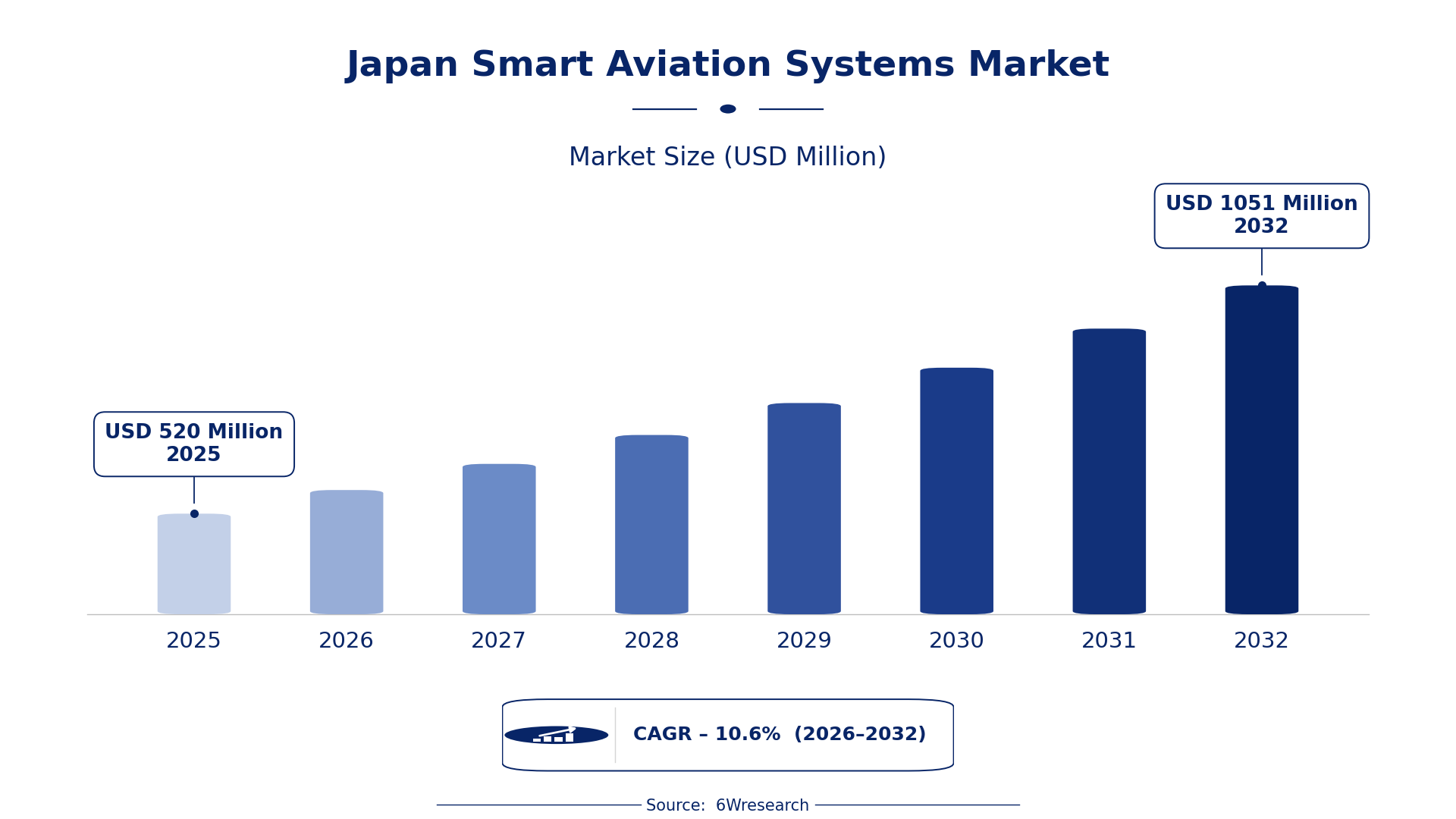
According to 6Wresearch internal database and industry insights, the Japan Smart Aviation Systems Market was valued at USD 520 Million in 2025 and is projected to reach USD 1,051 Million by 2032, growing at a CAGR of approximately 10.6% during 2026–2032.
Japan Smart Aviation Systems Market Highlights
| Report Metric | Details |
| Report Name | Japan Smart Aviation Systems Market (2026-2032) |
| Market Size 2025 | USD 520 Million |
| Market Size 2032 | USD 1,051 Million |
| Absolute Growth 2025–2032 | USD 531 Million |
| CAGR 2026–2032 | 10.6% |
| Peak Annual Growth | 11.5% in 2029 |
| Forecast Period | 2026–2032 |
| Historical Data | 2022–2025 |
| Base Year | 2025 |
| Leading System Type, 2025 | Predictive Maintenance (36% share) |
| Leading Smart Feature, 2025 | Sensor Data AI (37% share) |
| Leading Aircraft Type, 2025 | Commercial Aircraft (41% share) |
| Leading End User, 2025 | Airlines (41% share) |
| Fastest-Growing System Type | Flight Navigation (15.0% CAGR) |
| Fastest-Growing Smart Feature | Satellite + AI (14.9% CAGR) |
| Fastest-Growing Aircraft Type | Regional Jets/Private Planes (14.5% CAGR) |
| Fastest-Growing End User | Avionics Developers (13.1% CAGR) |
| Growing Sector | Aviation |
| Key End Users | Airlines, Avionics Developers, Defense OEMs |
Japan Smart Aviation Systems Market Year-wise Growth Rate and Key Drivers (2022–2032)
This graph illustrates the annual growth rates of the market from 2022 to 2032, highlighting a steady upward trajectory and projected market expansion over the forecast period.
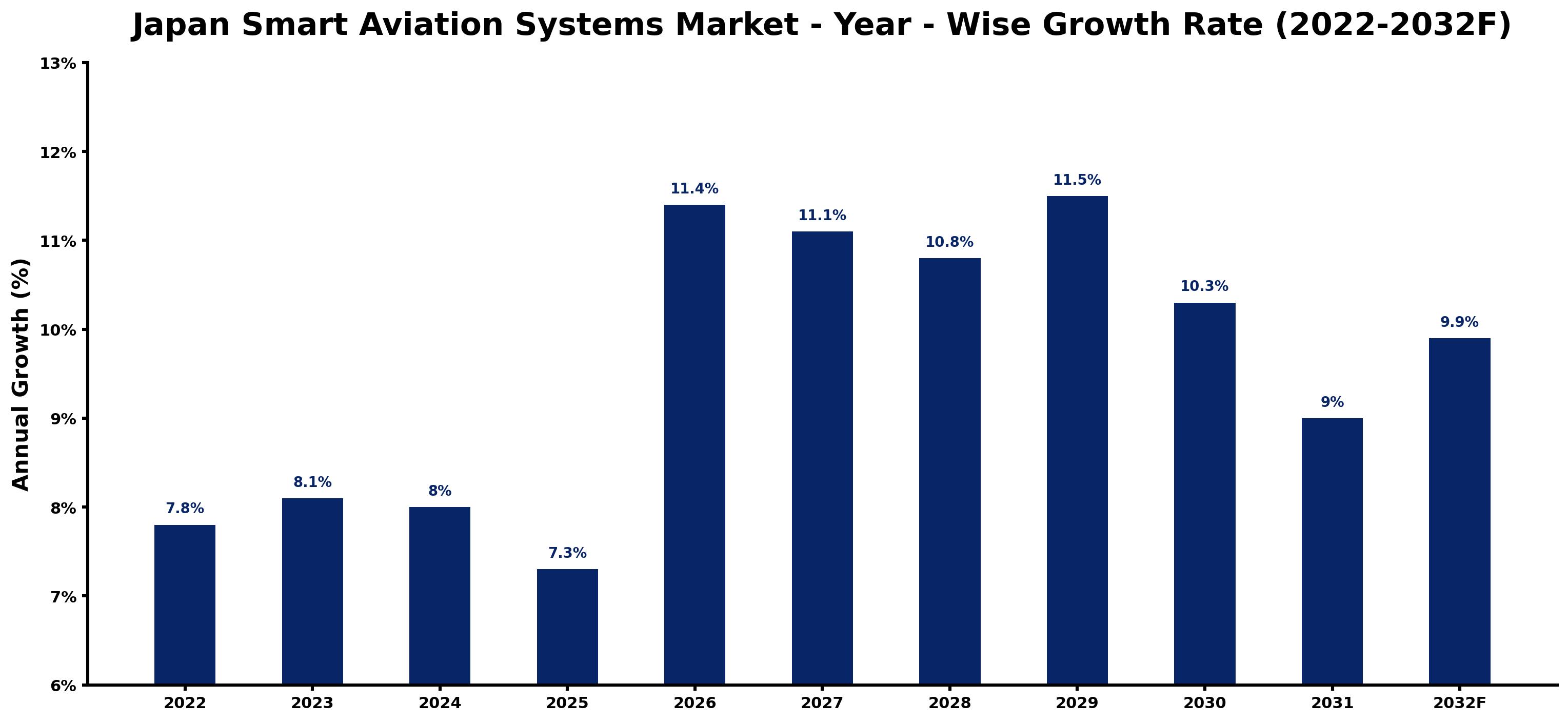
The table below sets out the estimated growth rate for each year and the main factor behind it.
| Year | Estimated Annual Growth (%) | Market Rationale |
| 2022 | 7.8 | The market experienced steady growth due to increased airline operations and demand for advanced systems. |
| 2023 | 8.1 | Growth accelerated as domestic airlines expanded fleets and upgraded technologies to improve efficiency. |
| 2024 | 8.0 | The market saw a slight slowdown as airlines adjusted to changing travel patterns and demand. |
| 2025 | 7.3 | Growth continued to decelerate as market saturation began to affect new system adoption rates. |
| 2026 | 11.4 | The pace of growth is expected to increase as investments in smart technologies gain traction. |
| 2027 | 11.1 | Growth is projected to slow slightly as the market stabilises following a surge in technology integration. |
| 2028 | 10.8 | The market is expected to continue growing, driven by ongoing upgrades to air traffic management systems. |
| 2029 | 11.5 | Growth is projected to peak as airlines adopt advanced technologies to improve operational efficiency. |
| 2030 | 10.3 | The growth rate is expected to slow as the market matures and competition intensifies. |
| 2031 | 9.0 | Growth will continue to decelerate as the market reaches a more stable phase of development. |
| 2032 | 9.9 | The market is expected to grow as airlines invest in next-generation systems and technologies. |
Note: Market size estimations and growth projections presented in this report are based on 6Wresearch's proprietary forecasting methodology, utilizing the latest available industry data, government publications, and primary research inputs.
Japan Smart Aviation Systems Market Synopsis
Smart Aviation Systems incorporate advanced technologies aimed at improving operational efficiency and safety in aviation. These systems combine software, hardware, and data analytics to facilitate predictive maintenance, navigation assistance, and improve passenger experiences. The Japan Smart Aviation Systems Market is expanding due to rising passenger numbers, with the aviation sector projected to support over 100 million passengers annually by 2025. Investments in smart technologies, driven by domestic airlines and the defence sector, are propelling market growth, as seen in the government's Economic Security Promotion Act which supports supply-chain resilience for critical products.
Market Dynamics Impact Analysis (2026–2032)
| Factor | Type | Impact | Primary Segment Affected |
| Increasing passenger traffic and airline fleet expansion drive demand for advanced aviation systems. | Driver | High | Predictive Maintenance |
| Growing focus on safety and efficiency in air travel boosts the adoption of smart navigation technologies. | Driver | High | Flight Navigation |
| The rise in domestic travel creates opportunities for regional jets and private planes. | Opportunity | Medium | Regional Jets/Private Planes |
| The push for enhanced passenger experiences opens avenues for cabin automation systems. | Opportunity | High | Cabin Automation |
| High costs associated with implementing advanced systems may deter smaller airlines from investing. | Restraint | High | Commercial Aircraft |
| The complexity of integrating new technologies into existing systems can hinder adoption rates. | Restraint | Medium | Smart Cockpit Displays |
| Supply chain disruptions can delay the availability of critical components for smart systems. | Challenge | High | Sensor Data AI |
| Intense competition among suppliers may lead to pricing pressures that affect profitability. | Challenge | Medium | Avionics Developers |
Evaluation of Drivers in Japan Smart Aviation Systems Market (2026–2032)
Key forces behind demand, with the segment each one moves most, are listed below.
| Drivers | Primary Segment Affected | Why It Matters (Evidence) |
| Rising airline operations and passenger traffic increase demand for predictive maintenance solutions. | Predictive Maintenance | Japan's aviation sector is projected to support over 100 million passengers annually by 2025. |
| The need for improved safety in air travel drives the adoption of advanced flight navigation systems. | Flight Navigation | The Tokyo region is a major hub for commercial aviation, necessitating improved navigation technologies. |
| Investment in smart technologies by domestic airlines boosts demand for cabin automation systems. | Cabin Automation | Cabin automation systems are increasingly integrated into new aircraft models, improving passenger experience. |
| Government initiatives promote the development of smart aviation technologies, stimulating market growth. | Sensor Data AI | The Economic Security Promotion Act supports supply-chain resilience for critical products and materials. |
| The upgrade of air traffic management systems encourages the adoption of AI technologies in aviation. | Smart Cockpit Displays | Japan's air traffic management system is being upgraded to incorporate AI technologies for better efficiency. |
The strongest pull on demand comes from rising airline operations and passenger traffic, with the aviation sector projected to support over 100 million passengers annually by 2025. This surge encourages airlines to invest in predictive maintenance solutions, improving operational efficiency. The need for enhanced flight navigation technologies ensures safety in the Tokyo region, a major hub for commercial aviation.
Evaluation of Restraints in Japan Smart Aviation Systems Market
Several factors work against faster growth; the main ones are summarised below.
| Market Restraint | Primary Segment Affected | Why It Matters (Evidence) |
| High implementation costs of advanced systems deter smaller airlines from investing. | Commercial Aircraft | Smaller airlines may struggle to allocate budget for costly smart aviation systems amidst rising operational expenses. |
| Complex integration of new technologies into existing systems can hinder adoption rates. | Smart Cockpit Displays | Many airlines face challenges in seamlessly incorporating advanced cockpit displays into their current aircraft. |
| Supply chain disruptions can delay the availability of critical components for smart systems. | Sensor Data AI | Recent global supply chain issues have affected the timely procurement of essential technology components. |
| Regulatory compliance requirements can slow down the introduction of new aviation technologies. | Cabin Automation | Compliance with JIS standards for safety and quality can complicate the rollout of new systems. |
| Market saturation limits new system adoption as airlines focus on upgrading existing technologies. | Flight Navigation | As airlines improve current systems, the demand for entirely new flight navigation solutions may decline. |
Japan Smart Aviation Systems Market Challenges
High integration costs for buyers arise from the need to modernise existing systems, often exceeding 20% of their initial investment. Regulatory hurdles slow down the approval of new technologies, leading to compliance timelines of up to 12 months for JIS standards. Delays in project timelines occur due to skills shortages in the workforce, extending deployment periods by an average of 6 months for domestic airlines. Supply chain disruptions stem from reliance on specific imported technologies, which can delay project delivery schedules for aviation operators.
Trends in the Japan Smart Aviation Systems Market
The trends below show where the Japan Smart Aviation Systems Market is heading.
- Shift from Traditional to Smart Navigation Systems: In 2023, airlines in Japan have increasingly adopted smart navigation systems, improving safety and efficiency. The integration of AI technologies into air traffic management is a key driver, with a projected investment of USD 520 million by 2025.
- Transition from Manual to Automated Cabin Systems: In 2023, airlines began transitioning to automated cabin systems, significantly improving passenger experience. The ongoing upgrades in cabin automation systems reflect a growing trend among major airports.
- Emergence of Predictive Maintenance Technologies: Starting in 2026, predictive maintenance technologies are gaining traction among airlines, reducing downtime and maintenance costs. The installed base of commercial aircraft in Japan, approximately 1,500 units, supports this trend.
- Growing Demand for Regional Jets: Since 2025, there has been a notable increase in demand for regional jets due to rising domestic travel. This shift is reflected in the growing interest from airlines to invest in smaller aircraft models.
Investment Opportunities in the Japan Smart Aviation Systems Market
Below are the investment opportunities with the strongest case in the Japan Smart Aviation Systems Market.
- Airlines Seeking Advanced Predictive Maintenance Solutions: Airlines are currently looking for predictive maintenance technologies to reduce downtime. The market gap for these solutions is significant, with a projected growth rate of 15.0% for Flight Navigation systems by 2032.
- Investment in Cabin Automation Systems: With the increasing focus on passenger experience, airlines are prioritising cabin automation systems. The Tokyo region, a major aviation hub, presents opportunities for suppliers to enter the market.
- Regional Jets Demand Surge: The timing is ripe for investing in regional jets, with demand increasing due to rising domestic travel. The market for regional jets is expected to grow by 14.5% by 2032.
- Smart Aviation Systems Integration: There is a growing need for integrating smart aviation systems across various platforms. The Semiconductor and Digital Industry Strategy supports this integration, with an expected funding of USD 100 million by 2025.
Government Initiatives in the Japan Smart Aviation Systems Market
The Semiconductor and Digital Industry Strategy, introduced in June 2021, supports domestic semiconductor manufacturing capabilities, essential for smart aviation systems. This measure complements existing regulations by ensuring a stable supply of essential components for aviation technologies.
The New Energy and Industrial Technology Development Organization funds R&D initiatives in smart aviation, supporting projects that improve operational efficiency. This agency plays a role in approving funding for innovative technologies, with an annual budget exceeding USD 50 million.
Future Insight of the Japan Smart Aviation Systems Market
Domestic airlines will benefit from improved operational efficiency by 2032 as air traffic management systems incorporate AI technologies. The installed base of approximately 1,500 commercial aircraft will create demand for upgraded cabin automation systems, improving passenger experiences. The government's 'Aviation Innovation Program' will drive the development of smart technologies in aviation, providing suppliers with new opportunities. Ongoing support for R&D through the New Energy and Industrial Technology Development Organization will further accelerate the adoption of advanced solutions.
Market Segmentation Analysis
Japan Smart Aviation Systems Market report covers a detailed analysis of the following market segments:
By System Type – Predictive Maintenance Leads, Flight Navigation Expected to Grow Fastest
According to Saurav Kr Singh, Senior Research Analyst at 6Wresearch, Predictive Maintenance held 36% of the Japan Smart Aviation Systems Market by system type in 2025. Predictive Maintenance holds the largest share as it is essential for minimising downtime and maintenance costs, which is critical for airlines operating approximately 1,500 commercial aircraft in Japan. This system's importance is underscored by its direct impact on operational efficiency and reliability. Flight Navigation is projected to grow fastest, at a CAGR of 15.0% during 2026–2032. Flight Navigation is growing rapidly due to its critical role in ensuring safe and efficient air travel, particularly with the anticipated increase in passenger numbers exceeding 100 million by 2025. This growth will likely drive further advancements and investments in navigation technologies. Suppliers should focus on enhancing predictive maintenance solutions to meet the operational demands of airlines.
By Smart Feature – Sensor Data AI Leads, Satellite + AI Expected to Grow Fastest
Sensor Data AI took 37% of smart feature revenue in 2025, more than any other category. Sensor Data AI is the leading feature as it is integral for real-time data analysis and decision-making in aviation operations. This capability is increasingly demanded by airlines seeking to optimise performance and safety. Over 2026–2032, Satellite + AI is expected to post the fastest growth, at a CAGR of 14.9%. Satellite + AI is experiencing rapid growth because it supports advanced navigation and communication systems, essential for modern aviation. The ongoing upgrades to air traffic management systems in Japan will further accelerate this trend. Buyers will benefit from investing in sensor data solutions to improve operational efficiency and safety.
By Aircraft Type – Commercial Aircraft Leads, Regional Jets/Private Planes Expected to Grow Fastest
The largest aircraft type category in 2025 was Commercial Aircraft, at 41% of revenue. Commercial Aircraft dominates the market as it serves as the primary focus for airlines and manufacturers in Japan's aviation sector. The substantial installed base highlights the ongoing demand for systems specifically designed for these aircraft. Regional Jets/Private Planes are set to record the highest CAGR in this split, 14.5% over 2026–2032. Regional Jets/Private Planes are seeing increased demand driven by a rise in domestic travel, prompting airlines to expand their fleets with smaller aircraft. This trend is expected to continue as travel preferences shift towards more regional options. Suppliers should develop customised solutions for regional jets to capitalise on this growing market segment.
By End User – Airlines Lead, Avionics Developers Expected to Grow Fastest
Airlines accounted for 41% of the market by end user in 2025. Airlines represent the largest user segment for smart aviation systems, relying on these technologies to enhance operational efficiency and ensure passenger safety. Government support for R&D further reinforces this segment's leading position in the market. The quickest growth will come from Avionics Developers, forecast to expand at a CAGR of 13.1% between 2026 and 2032. Avionics Developers are experiencing rapid growth as they are pivotal in the development and integration of smart aviation systems. Their role is increasingly important as airlines adopt advanced technologies to improve their operations. Suppliers must collaborate with avionics developers to ensure their products meet the evolving technological needs of airlines.
Key Attractiveness of the Report
- 10 Years of Market Numbers
- Historical Data Starting from 2022 to 2025
- Base Year 2025
- Forecast Data until 2032
- Key Performance Indicators Impacting the Market
- Major Upcoming Developments and Projects
Key Highlights of the Report:
- Japan Smart Aviation Systems Market Outlook
- Market Size of Japan Smart Aviation Systems Market, 2025
- Forecast of Japan Smart Aviation Systems Market, 2032
- Historical Data and Forecast of Japan Smart Aviation Systems Revenues & Volume for the Period 2022-2032F
- Japan Smart Aviation Systems Market Trend Evolution
- Japan Smart Aviation Systems Market Drivers and Challenges
- Japan Smart Aviation Systems Price Trends
- Japan Smart Aviation Systems Porter's Five Forces
- Japan Smart Aviation Systems Industry Life Cycle
- Historical Data and Forecast of Japan Smart Aviation Systems Market Revenues & Volume By System Type for the Period 2022-2032F
- Historical Data and Forecast of Japan Smart Aviation Systems Market Revenues & Volume By Predictive Maintenance for the Period 2022-2032F
- Historical Data and Forecast of Japan Smart Aviation Systems Market Revenues & Volume By Flight Navigation for the Period 2022-2032F
- Historical Data and Forecast of Japan Smart Aviation Systems Market Revenues & Volume By Smart Cockpit Displays for the Period 2022-2032F
- Historical Data and Forecast of Japan Smart Aviation Systems Market Revenues & Volume By Cabin Automation for the Period 2022-2032F
- Historical Data and Forecast of Japan Smart Aviation Systems Market Revenues & Volume By Smart Feature for the Period 2022-2032F
- Historical Data and Forecast of Japan Smart Aviation Systems Market Revenues & Volume By Sensor Data AI for the Period 2022-2032F
- Historical Data and Forecast of Japan Smart Aviation Systems Market Revenues & Volume By Satellite + AI for the Period 2022-2032F
- Historical Data and Forecast of Japan Smart Aviation Systems Market Revenues & Volume By HUD + AR for the Period 2022-2032F
- Historical Data and Forecast of Japan Smart Aviation Systems Market Revenues & Volume By Passenger Comfort for the Period 2022-2032F
- Historical Data and Forecast of Japan Smart Aviation Systems Market Revenues & Volume By Aircraft Type for the Period 2022-2032F
- Historical Data and Forecast of Japan Smart Aviation Systems Market Revenues & Volume By Commercial Aircraft for the Period 2022-2032F
- Historical Data and Forecast of Japan Smart Aviation Systems Market Revenues & Volume By Regional Jets/Private Planes for the Period 2022-2032F
- Historical Data and Forecast of Japan Smart Aviation Systems Market Revenues & Volume By Fighter Aircraft for the Period 2022-2032F
- Historical Data and Forecast of Japan Smart Aviation Systems Market Revenues & Volume By Commercial Jets for the Period 2022-2032F
- Historical Data and Forecast of Japan Smart Aviation Systems Market Revenues & Volume By End User for the Period 2022-2032F
- Historical Data and Forecast of Japan Smart Aviation Systems Market Revenues & Volume By Airlines for the Period 2022-2032F
- Historical Data and Forecast of Japan Smart Aviation Systems Market Revenues & Volume By Avionics Developers for the Period 2022-2032F
- Historical Data and Forecast of Japan Smart Aviation Systems Market Revenues & Volume By Defense OEMs for the Period 2022-2032F
- Historical Data and Forecast of Japan Smart Aviation Systems Market Revenues & Volume By Aerospace Interior Makers for the Period 2022-2032F
- Japan Smart Aviation Systems Import Export Trade Statistics
- Market Opportunity Assessment By System Type
- Market Opportunity Assessment By Smart Feature
- Market Opportunity Assessment By Aircraft Type
- Market Opportunity Assessment By End User
- Japan Smart Aviation Systems Top Companies Market Share
- Japan Smart Aviation Systems Competitive Benchmarking By Technical and Operational Parameters
- Japan Smart Aviation Systems Company Profiles
- Japan Smart Aviation Systems Key Strategic Recommendations
Market Covered
This report examines the market across the segments below.
By System Type
- Predictive Maintenance
- Flight Navigation
- Smart Cockpit Displays
- Cabin Automation
By Smart Feature
- Sensor Data AI
- Satellite + AI
- HUD + AR
- Passenger Comfort
By Aircraft Type
- Commercial Aircraft
- Regional Jets/Private Planes
- Fighter Aircraft
- Commercial Jets
By End User
- Airlines
- Avionics Developers
- Defense OEMs
- Aerospace Interior Makers






































