Japan Smart Battery Systems Market Size & Growth Rate
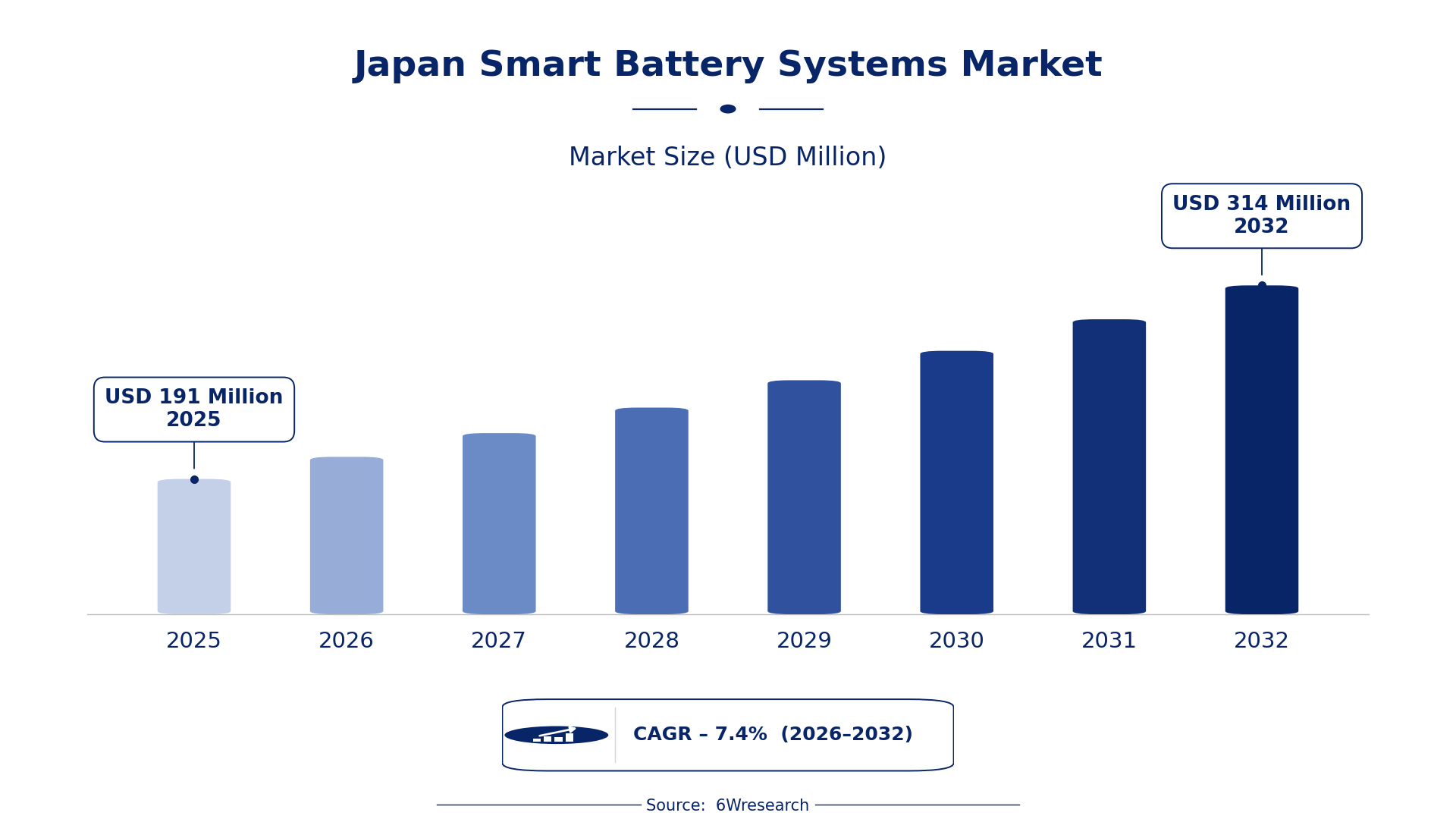
According to 6Wresearch internal database and industry insights, the Japan Smart Battery Systems Market was valued at USD 191 Million in 2025 and is projected to reach USD 314 Million by 2032, growing at a CAGR of approximately 7.4% during 2026–2032.
Japan Smart Battery Systems Market Highlights
| Report Metric | Details |
| Report Name | Japan Smart Battery Systems Market (2026-2032) |
| Market Size 2025 | USD 191 Million |
| Market Size 2032 | USD 314 Million |
| Absolute Growth 2025–2032 | USD 123 Million |
| CAGR 2026–2032 | 7.4% |
| Peak Annual Growth | 8.4% in 2028 |
| Forecast Period | 2026–2032 |
| Historical Data | 2022–2025 |
| Base Year | 2025 |
| Leading System Type, 2025 | Grid Storage Batteries (50% share) |
| Leading Core Function, 2025 | Renewable Integration (46% share) |
| Leading Application Area, 2025 | Utility Grids (44% share) |
| Leading End User, 2025 | Power Distribution Firms (44% share) |
| Fastest-Growing System Type | EV Smart Battery Packs (10.8% CAGR) |
| Fastest-Growing Core Function | Real-Time Telemetry (9.8% CAGR) |
| Fastest-Growing Application Area | Automotive (9.0% CAGR) |
| Fastest-Growing End User | Electric Vehicle OEMs (9.7% CAGR) |
| Growing Sector | Energy Storage Solutions |
| Key End Users | Power Distribution Firms, Electric Vehicle OEMs, Renewable Installers, Data Centers |
Japan Smart Battery Systems Market Year-wise Growth Rate and Key Drivers (2022–2032)
This graph illustrates the annual growth rates of the market from 2022 to 2032, highlighting a steady upward trajectory and projected market expansion over the forecast period.
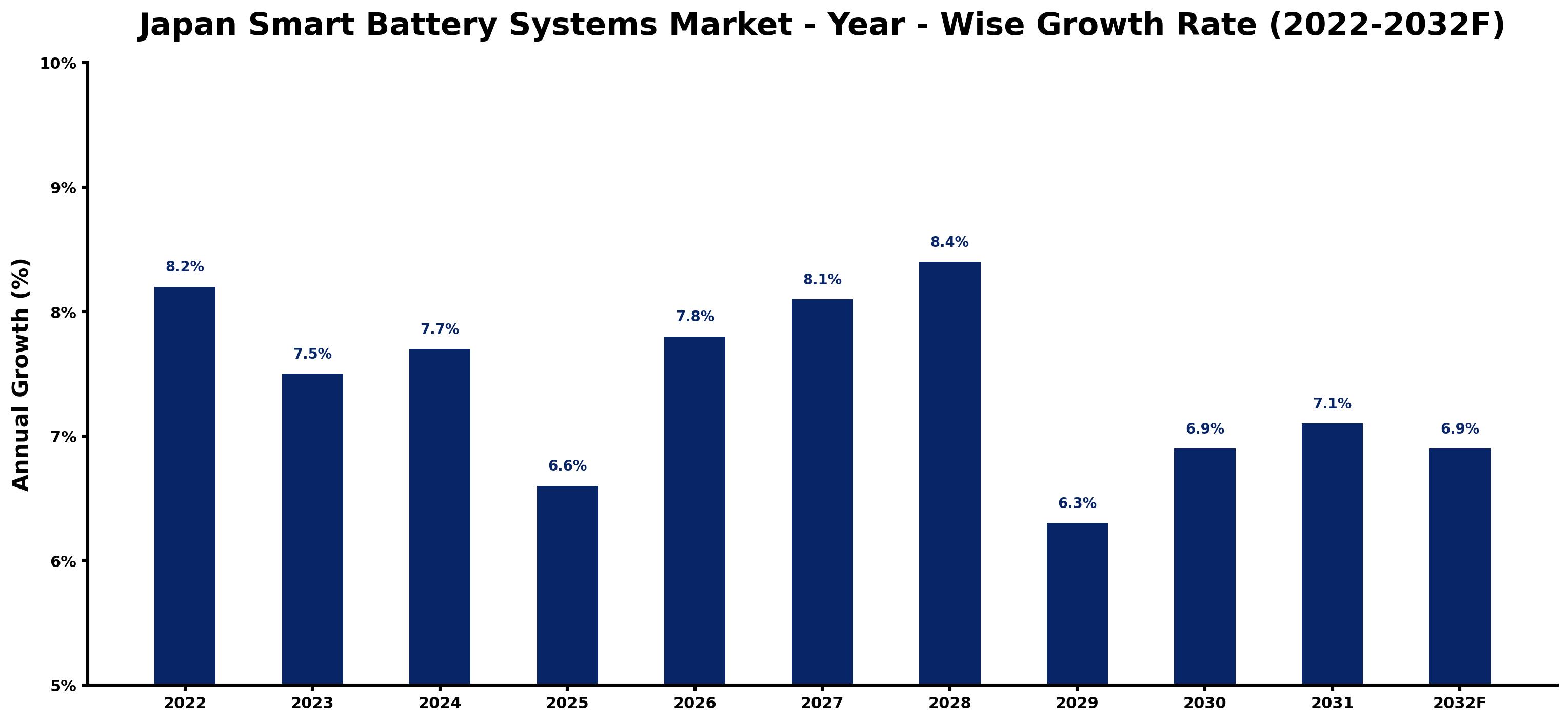
The following figures match every annual growth estimate with the main market development of that year, giving the reasoning behind each rise or slowdown.
| Year | Estimated Annual Growth (%) | Market Rationale |
| 2022 | 8.2 | The market showed strong demand due to increased energy storage needs. |
| 2023 | 7.5 | Growth slowed as the market adjusted to previous high levels of demand. |
| 2024 | 7.7 | Demand rose again as electric vehicle sales continued to increase. |
| 2025 | 6.6 | Market saturation began to impact new installations, leading to slower growth. |
| 2026 | 7.8 | Renewable energy integration is expected to drive demand higher. |
| 2027 | 8.1 | Investments in smart battery technologies will support market expansion. |
| 2028 | 8.4 | Peak growth is projected as electric vehicle adoption reaches new heights. |
| 2029 | 6.3 | Competition is expected to slow growth as new entrants emerge. |
| 2030 | 6.9 | The government aims for 30% renewable energy integration by 2030, boosting demand. |
| 2031 | 7.1 | Technological advancements will continue to drive market growth. |
| 2032 | 6.9 | Growth is expected to stabilise as market maturity sets in. |
Note: Market size estimations and growth projections presented in this report are based on 6Wresearch's proprietary forecasting methodology, utilizing the latest available industry data, government publications, and primary research inputs.
Japan Smart Battery Systems Market Synopsis
Smart Battery Systems are advanced energy storage solutions integrating lithium-ion technology with smart management systems. Their primary applications include energy storage for renewable sources, backup power for critical systems, and support for electric vehicles. The Japan Smart Battery Systems Market is expanding due to rising energy demands, government initiatives promoting renewable energy integration, and increased electric vehicle sales, with a target of 30% renewable energy integration by 2030 driving further adoption.
Market Dynamics Impact Analysis (2026–2032)
| Factor | Type | Impact | Primary Segment Affected |
| Increasing electric vehicle sales boost demand for battery packs. | Driver | High | EV Smart Battery Packs |
| Government targets for renewable energy integration increase market potential. | Driver | High | Renewable Integration |
| Investment in grid stability initiatives supports the growth of grid storage batteries. | Opportunity | High | Grid Storage Batteries |
| Growing demand for residential energy solutions creates opportunities for battery systems. | Opportunity | High | Residential Battery Units |
| Market saturation limits new installations in certain segments. | Restraint | High | UPS Battery Systems |
| High initial costs deter some potential buyers from investing. | Restraint | Medium | Residential Battery Units |
| Supply chain disruptions lead to delays in component availability. | Challenge | High | Grid Storage Batteries |
| Technological advancements require continuous investment from suppliers. | Challenge | Medium | Utility Grids |
Evaluation of Drivers in Japan Smart Battery Systems Market (2026–2032)
The table below links each growth driver to the segment it affects and the evidence for it.
| Drivers | Primary Segment Affected | Why It Matters (Evidence) |
| Rising electric vehicle sales increase demand for battery packs. | EV Smart Battery Packs | Electric vehicle sales exceeded 200,000 units in 2023, leading to higher demand for battery systems. |
| Government targets for renewable energy integration boost market potential. | Renewable Integration | Japan aims for 30% renewable energy by 2030, driving the need for smart battery solutions. |
| Growing data center energy efficiency initiatives enhance demand for backup systems. | UPS Battery Systems | Data centers are expected to improve energy efficiency by 20% by 2025 using smart batteries. |
| Rising consumer interest in energy management fuels residential battery adoption. | Residential Battery Units | Smart homes are projected to grow by 15% annually through 2026, increasing battery demand. |
| Investment in grid stability initiatives supports the growth of grid storage batteries. | Grid Storage Batteries | The total capacity of grid storage batteries reached 2.5 GWh in 2023, indicating strong demand. |
Buyers are adding capacity as electric vehicle sales surged, leading to higher demand for EV smart battery packs. The target of 30% renewable energy integration by 2030 drives the need for smart battery systems, particularly in renewable integration. Data centers are expected to improve energy efficiency by 20% by 2025, further boosting demand for UPS battery systems. The growth of smart homes, projected at 15% annually through 2026, increases interest in residential battery units. Total capacity of grid storage batteries reached 2.5 GWh in 2023, reflecting a strong market for grid storage solutions.
Evaluation of Restraints in Japan Smart Battery Systems Market
Several factors work against faster growth; the main ones are summarised below.
| Market Restraint | Primary Segment Affected | Why It Matters (Evidence) |
| Market saturation limits new installations in certain segments. | UPS Battery Systems | As the market matures, fewer new installations occur, impacting growth. |
| High initial costs deter some potential buyers from investing. | Residential Battery Units | The upfront investment required for residential systems can be a barrier. |
| Supply chain disruptions lead to delays in component availability. | Grid Storage Batteries | Disruptions in supply chains can hinder production timelines. |
| Technological advancements require continuous investment from suppliers. | Utility Grids | Suppliers must invest in new technologies to remain competitive. |
| Regulatory changes can impact operational costs for producers. | Renewable Integration | Changes in regulations may increase compliance costs for manufacturers. |
Japan Smart Battery Systems Market Challenges
Buyers face inflated costs due to rising lithium prices, which can increase production expenses by 30% and force manufacturers to pass these costs onto consumers. Technology integration issues arise from the complexity of smart management systems, often delaying installations by six months for contractors. Competition among suppliers intensifies, leading to aggressive pricing that can erode profit margins by 15% for smaller firms. Finally, limited availability of advanced systems can delay project completion by three months for end-users reliant on energy storage solutions.
Trends in the Japan Smart Battery Systems Market
Below are the shifts with the largest effect on the Japan Smart Battery Systems Market.
- Renewable Energy Target Driving Integration: Japan is increasingly integrating renewable energy sources into its grid, with a target of 30% by 2030. This shift is illustrated by the Smart Energy Japan program, which promotes smart battery systems for urban infrastructure.
- Rising Demand for Smart Home Technologies: Demand for smart home technologies is rising, with projections of 15% annual growth through 2026. This trend is driving the adoption of residential battery units, improving energy management capabilities.
- Data Centers Focusing on Energy Efficiency: Data centers are prioritising energy efficiency, aiming for a 20% improvement by 2025. This emphasis on efficiency is boosting demand for UPS battery systems to ensure reliable power supply.
- Accelerating Electric Vehicle Adoption: Electric vehicle adoption is accelerating, with sales exceeding 200,000 units in 2023. This trend is increasing the demand for EV smart battery packs.
Investment Opportunities in the Japan Smart Battery Systems Market
The following areas offer the clearest openings for investors and suppliers in the Japan Smart Battery Systems Market.
- Investment Gap in Residential Battery Solutions: Now is the time to invest in residential battery technologies, especially in urban areas like Tokyo, where demand is rising rapidly.
- Investment in Grid Storage Technologies: Partnerships with utility firms can facilitate entry into this segment, capitalising on the growing need for grid stability.
- Growing Demand for EV Battery Packs: Investing in EV battery technology development can yield substantial returns as electric vehicle sales continue to rise.
- Support for Renewable Integration Initiatives: Engaging with renewable energy installers can strengthen market presence, especially with government targets for renewable energy.
Government Initiatives in the Japan Smart Battery Systems Market
The Battery Industry Strategy, introduced by METI in August 2022, aims to enhance domestic battery manufacturing capacity significantly by 2030. This strategy supports local production and sourcing, ensuring that smart battery producers can maintain consistent access to necessary materials. The Green Growth Strategy, updated in 2021, identifies growth sectors and targets substantial investments to support decarbonisation efforts.
The Ministry of the Environment administers subsidies for smart battery initiatives, promoting their adoption among residential users and businesses. These subsidies can cover part of the installation costs, making smart battery systems more accessible to a wider range of buyers. In 2023, the government allocated considerable funding to support these initiatives, further driving market growth.
Future Insight of the Japan Smart Battery Systems Market
The Smart Energy Japan program will enhance urban infrastructure with advanced energy storage solutions, significantly improving efficiency. By 2032, the installed base of smart battery systems is expected to reach 3 million units, driven by increasing demand from residential and commercial sectors. The adoption of ISO 50001 will standardise energy management practices, benefiting facilities across the country. As electric vehicle sales continue to surge, the demand for efficient energy solutions will create substantial growth opportunities for suppliers.
Market Segmentation Analysis
Japan Smart Battery Systems Market report covers a detailed analysis of the following market segments:
By System Type – Grid Storage Batteries Lead, EV Smart Battery Packs Expected to Grow Fastest
According to Saurav Kr Singh, Senior Research Analyst at 6Wresearch, with 50% of system type revenue in 2025, Grid Storage Batteries was the largest category. Grid storage batteries hold the largest share as they are essential for large-scale energy storage in utility applications. Their established base of 1.5 million units installed in Japan facilitates effective renewable energy integration. The quickest growth will come from EV Smart Battery Packs, forecast to expand at a CAGR of 10.8% between 2026 and 2032. The rapid growth of EV smart battery packs is fuelled by electric vehicle sales exceeding 200,000 units in 2023. This surge indicates a strong demand for advanced battery technology that enhances vehicle performance and range, further solidifying the leader's position. Suppliers should focus on developing solutions that cater to both grid storage and electric vehicle sectors to maximise their market impact.
By Core Function – Renewable Integration Leads, Real-Time Telemetry Expected to Grow Fastest
The largest core function category in 2025 was Renewable Integration, at 46% of revenue. Renewable integration leads the core function segment as it is crucial for facilitating the adoption of renewable energy sources in Japan's energy framework. The government's target of 30% renewable energy integration by 2030 underscores its importance. Over 2026–2032, Real-Time Telemetry is expected to post the fastest growth, at a CAGR of 9.8%. Real-time telemetry is growing rapidly as it enhances monitoring capabilities essential for optimising energy management systems. This growth is driven by the increasing complexity of energy systems that necessitate improved data insights. Buyers will benefit from investing in systems that offer both renewable integration and advanced telemetry for superior energy management.
By Application Area – Utility Grids Lead, Automotive Expected to Grow Fastest
Utility Grids took 44% of application area revenue in 2025, more than any other category. Utility grids are the leading application area as they support grid stability and energy management, which are critical for Japan's energy infrastructure. The focus on decarbonisation and energy efficiency makes this segment vital for future developments. Automotive is set to record the highest CAGR in this split, 9.0% over 2026–2032. The automotive sector is the fastest-growing application area, driven by the increasing demand for electric vehicles and their associated battery technologies. This growth is propelled by the need for efficient energy systems in transportation. Suppliers must prioritise innovations in automotive applications to capitalise on the growing electric vehicle market.
By End User – Power Distribution Firms Lead, Electric Vehicle OEMs Expected to Grow Fastest
Power Distribution Firms held 44% of the Japan Smart Battery Systems Market by end user in 2025. Power distribution firms dominate the market as they utilise smart battery systems to enhance grid management and stability. Their role is vital for achieving Japan’s ambitious decarbonisation and energy efficiency goals. Electric Vehicle OEMs are projected to grow fastest, at a CAGR of 9.7% during 2026–2032. Electric vehicle OEMs represent the fastest-growing end user segment, reflecting the rapid expansion of the electric vehicle market and the rising demand for advanced battery solutions. This trend is expected to continue as consumer preferences shift towards electric vehicles. Suppliers should tailor their strategies to meet the specific needs of power distribution firms and electric vehicle manufacturers to capture market opportunities.
Key Attractiveness of the Report
- 10 Years of Market Numbers
- Historical Data Starting from 2022 to 2025
- Base Year 2025
- Forecast Data until 2032
- Key Performance Indicators Impacting the Market
- Major Upcoming Developments and Projects
Key Highlights of the Report:
- Japan Smart Battery Systems Market Outlook
- Market Size of Japan Smart Battery Systems Market, 2025
- Forecast of Japan Smart Battery Systems Market, 2032
- Historical Data and Forecast of Japan Smart Battery Systems Revenues & Volume for the Period 2022-2032F
- Japan Smart Battery Systems Market Trend Evolution
- Japan Smart Battery Systems Market Drivers and Challenges
- Japan Smart Battery Systems Price Trends
- Japan Smart Battery Systems Porter's Five Forces
- Japan Smart Battery Systems Industry Life Cycle
- Historical Data and Forecast of Japan Smart Battery Systems Market Revenues & Volume By System Type for the Period 2022-2032F
- Historical Data and Forecast of Japan Smart Battery Systems Market Revenues & Volume By Grid Storage Batteries for the Period 2022-2032F
- Historical Data and Forecast of Japan Smart Battery Systems Market Revenues & Volume By EV Smart Battery Packs for the Period 2022-2032F
- Historical Data and Forecast of Japan Smart Battery Systems Market Revenues & Volume By UPS Battery Systems for the Period 2022-2032F
- Historical Data and Forecast of Japan Smart Battery Systems Market Revenues & Volume By Residential Battery Units for the Period 2022-2032F
- Historical Data and Forecast of Japan Smart Battery Systems Market Revenues & Volume By Core Function for the Period 2022-2032F
- Historical Data and Forecast of Japan Smart Battery Systems Market Revenues & Volume By Renewable Integration for the Period 2022-2032F
- Historical Data and Forecast of Japan Smart Battery Systems Market Revenues & Volume By Real-Time Telemetry for the Period 2022-2032F
- Historical Data and Forecast of Japan Smart Battery Systems Market Revenues & Volume By Backup with Predictive Alerts for the Period 2022-2032F
- Historical Data and Forecast of Japan Smart Battery Systems Market Revenues & Volume By Solar Storage for the Period 2022-2032F
- Historical Data and Forecast of Japan Smart Battery Systems Market Revenues & Volume By Application Area for the Period 2022-2032F
- Historical Data and Forecast of Japan Smart Battery Systems Market Revenues & Volume By Utility Grids for the Period 2022-2032F
- Historical Data and Forecast of Japan Smart Battery Systems Market Revenues & Volume By Automotive for the Period 2022-2032F
- Historical Data and Forecast of Japan Smart Battery Systems Market Revenues & Volume By Data Centers for the Period 2022-2032F
- Historical Data and Forecast of Japan Smart Battery Systems Market Revenues & Volume By Smart Homes for the Period 2022-2032F
- Historical Data and Forecast of Japan Smart Battery Systems Market Revenues & Volume By End User for the Period 2022-2032F
- Historical Data and Forecast of Japan Smart Battery Systems Market Revenues & Volume By Power Distribution Firms for the Period 2022-2032F
- Historical Data and Forecast of Japan Smart Battery Systems Market Revenues & Volume By Electric Vehicle OEMs for the Period 2022-2032F
- Historical Data and Forecast of Japan Smart Battery Systems Market Revenues & Volume By Enterprise IT Facilities for the Period 2022-2032F
- Historical Data and Forecast of Japan Smart Battery Systems Market Revenues & Volume By Renewable Installers for the Period 2022-2032F
- Japan Smart Battery Systems Import Export Trade Statistics
- Market Opportunity Assessment By System Type
- Market Opportunity Assessment By Core Function
- Market Opportunity Assessment By Application Area
- Market Opportunity Assessment By End User
- Japan Smart Battery Systems Top Companies Market Share
- Japan Smart Battery Systems Competitive Benchmarking By Technical and Operational Parameters
- Japan Smart Battery Systems Company Profiles
- Japan Smart Battery Systems Key Strategic Recommendations
Market Covered
This report examines the market across the segments below.
By System Type
- Grid Storage Batteries
- EV Smart Battery Packs
- UPS Battery Systems
- Residential Battery Units
By Core Function
- Renewable Integration
- Real-Time Telemetry
- Backup with Predictive Alerts
- Solar Storage
By Application Area
- Utility Grids
- Automotive
- Data Centers
- Smart Homes
By End User
- Power Distribution Firms
- Electric Vehicle OEMs
- Enterprise IT Facilities
- Renewable Installers































