Japan Smart Battlefield Market Size & Growth Rate
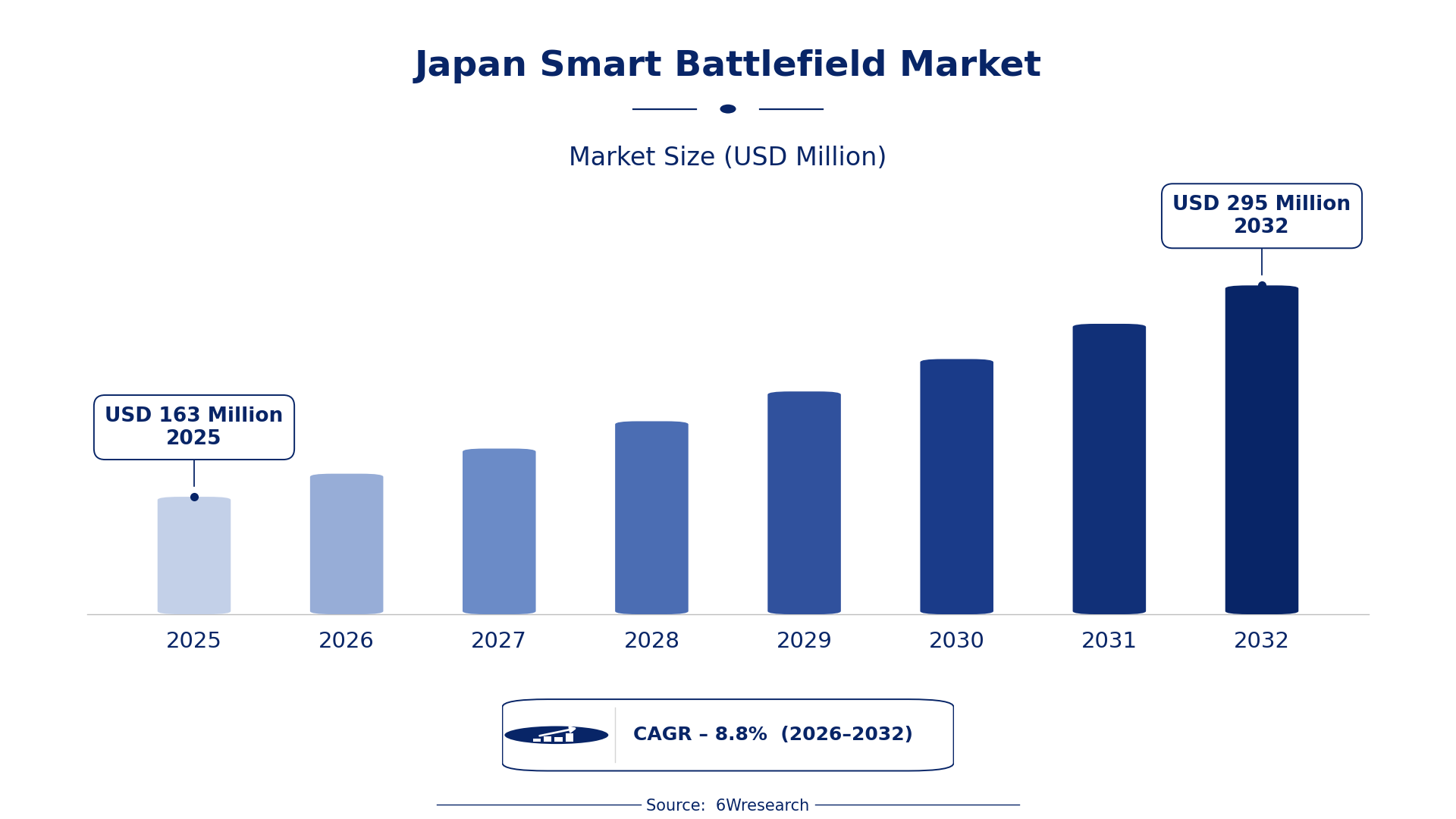
According to 6Wresearch internal database and industry insights, the Japan Smart Battlefield Market was valued at USD 163 Million in 2025 and is projected to reach USD 295 Million by 2032, growing at a CAGR of approximately 8.8% during 2026–2032.
Japan Smart Battlefield Market Highlights
| Report Metric | Details |
| Report Name | Japan Smart Battlefield Market (2026-2032) |
| Market Size 2025 | USD 163 Million |
| Market Size 2032 | USD 295 Million |
| Absolute Growth 2025–2032 | USD 132 Million |
| CAGR 2026–2032 | 8.8% |
| Peak Annual Growth | 9.9% in 2028 |
| Forecast Period | 2026–2032 |
| Historical Data | 2022–2025 |
| Base Year | 2025 |
| Leading Technology Category, 2025 | Smart Wearables (43% share) |
| Leading Smart Feature, 2025 | Health + Position Tracking (32% share) |
| Leading Tactical Use, 2025 | Soldier Situational Awareness (45% share) |
| Leading End User, 2025 | Defense Forces (47% share) |
| Fastest-Growing Technology Category | AI Surveillance Drones (12.9% CAGR) |
| Fastest-Growing Smart Feature | Reconnaissance (11.4% CAGR) |
| Fastest-Growing Tactical Use | Target Detection (11.6% CAGR) |
| Fastest-Growing End User | Military Intelligence (11.7% CAGR) |
| Growing Sector | Defense Technology |
| Key End Users | Defense Forces, Military Intelligence, Army Units |
Japan Smart Battlefield Market Year-wise Growth Rate and Key Drivers (2022–2032)
This graph illustrates the annual growth rates of the market from 2022 to 2032, highlighting a steady upward trajectory and projected market expansion over the forecast period.
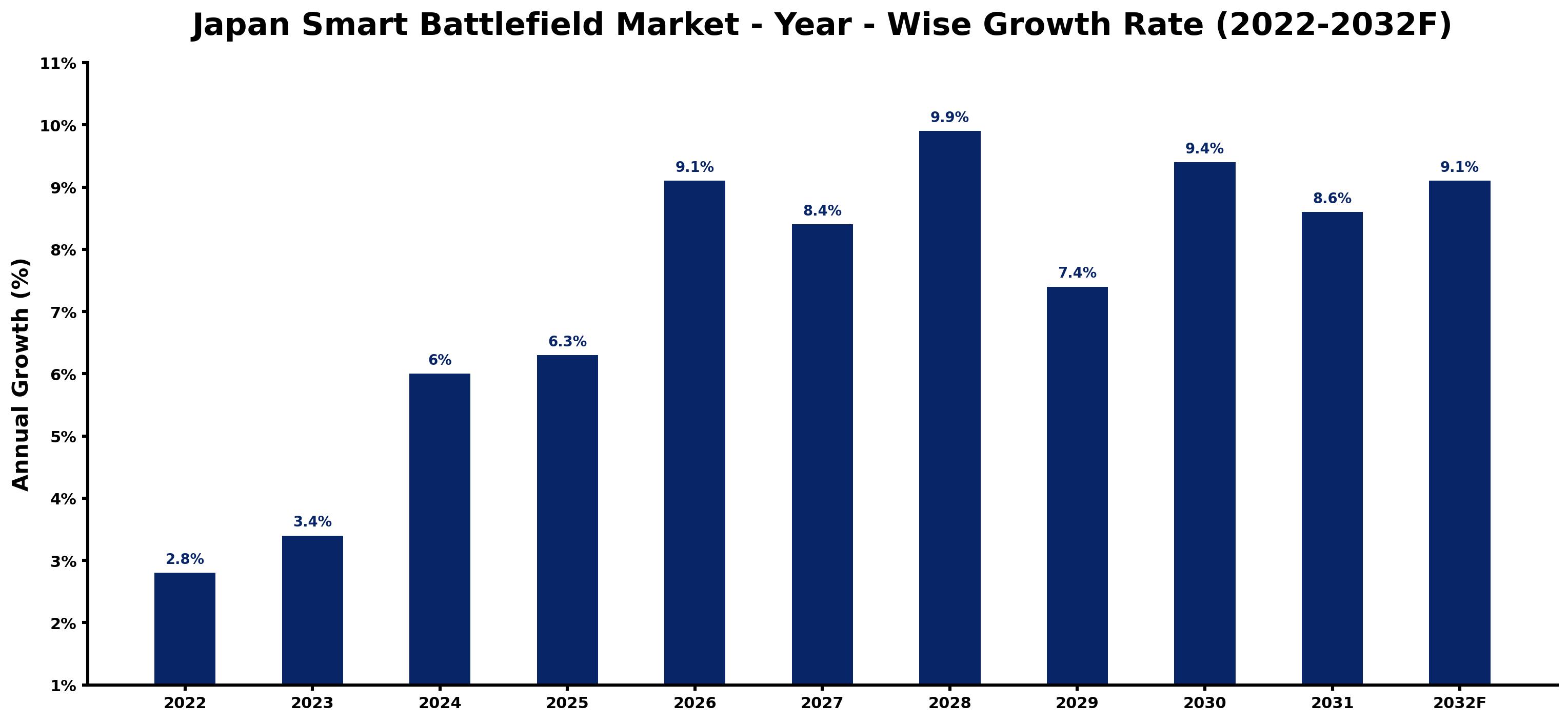
Annual growth estimates for each year appear below with the principal reason behind them, explaining the shifts that set the pace of the market.
| Year | Estimated Annual Growth (%) | Market Rationale |
| 2022 | 2.8 | The market experienced steady growth driven by increased military spending. |
| 2023 | 3.4 | Demand accelerated as Japan's defense budget expanded to 6.8 trillion yen. |
| 2024 | 6.0 | Technological advancements in AI surveillance contributed to a higher growth rate. |
| 2025 | 6.3 | The market peaked with a focus on soldier situational awareness technologies. |
| 2026 | 9.1 | Investment in smart communication gear is expected to boost market growth. |
| 2027 | 8.4 | Growth slows slightly as the market adjusts to previous rapid expansions. |
| 2028 | 9.9 | The introduction of advanced weapon systems drives a resurgence in growth rates. |
| 2029 | 7.4 | Growth decelerates as the market stabilizes after peak demand periods. |
| 2030 | 9.4 | Increased focus on precision strikes revitalizes interest in smart technologies. |
| 2031 | 8.6 | The market continues to grow, albeit at a slower pace than previous years. |
| 2032 | 9.1 | Continued investment in AI surveillance will ensure sustained market expansion. |
Note: Market size estimations and growth projections presented in this report are based on 6Wresearch's proprietary forecasting methodology, utilizing the latest available industry data, government publications, and primary research inputs.
Japan Smart Battlefield Market Synopsis
Smart Battlefield technologies encompass advanced military applications, including AI, communication systems, and surveillance tools, which improve situational awareness and operational effectiveness. The Japan Smart Battlefield Market is expanding due to a notable increase in defense spending, with a budget of approximately 6.8 trillion yen in 2023. Key drivers include the integration of smart communication gear by the Self-Defense Forces and the rising demand for AI surveillance drones, projected to increase by 30% in adoption by 2025.
Market Dynamics Impact Analysis (2026–2032)
| Factor | Type | Impact | Primary Segment Affected |
| Increased defense spending drives demand for advanced military technologies. | Driver | High | Smart Communication Gear |
| Growing focus on soldier health monitoring creates opportunities for smart wearables. | Opportunity | High | Smart Wearables |
| Integration of AI in military operations enhances reconnaissance capabilities. | Driver | High | AI Surveillance Drones |
| The need for enhanced targeting accuracy presents opportunities for smart ammunition. | Opportunity | Medium | Smart Ammunition |
| Challenges in technology integration may slow down adoption rates. | Restraint | Medium | Smart Communication Gear |
| High costs associated with advanced weapon systems may limit procurement. | Restraint | High | Advanced Weapon Systems |
| Talent shortages in defense technology development hinder progress. | Challenge | High | AI Surveillance Drones |
| Regulatory hurdles in defense procurement can delay project timelines. | Challenge | Medium | Smart Communication Gear |
Evaluation of Drivers in Japan Smart Battlefield Market (2026–2032)
The factors lifting demand, and the evidence behind each, are summarised below.
| Drivers | Primary Segment Affected | Why It Matters (Evidence) |
| Increased defense budget allocation for advanced military technologies. | Smart Communication Gear | Japan's defense budget of 6.8 trillion yen in 2023 supports the procurement of smart communication systems. |
| Growing need for AI surveillance capabilities in military operations. | AI Surveillance Drones | The Ministry of Defense aims for a 30% increase in AI surveillance drone adoption by 2025. |
| Focus on soldier health monitoring through smart wearables. | Smart Wearables | The government allocated 100 billion yen for defense technology innovation through 2025. |
| Integration of smart ammunition into existing platforms improves targeting accuracy. | Smart Ammunition | The Advanced Weapon Systems program focuses on integrating smart ammunition for improved performance. |
| Prioritisation of real-time communication systems in military exercises. | Smart Communication Gear | Real-time communication systems are being prioritised in military exercises across Japan. |
Orders keep climbing as Japan's defense budget reached approximately 6.8 trillion yen in 2023, enabling significant investments in advanced military technologies. The initiative for a 30% increase in AI surveillance drone adoption by 2025 will improve reconnaissance capabilities. The government has allocated 100 billion yen for defense technology innovation, driving demand for smart wearables. The Advanced Weapon Systems program is integrating smart ammunition into existing platforms, improving targeting accuracy. Military exercises prioritising real-time communication systems are increasing demand for communication gear.
Evaluation of Restraints in Japan Smart Battlefield Market
The main factors holding the market back are set out below.
| Market Restraint | Primary Segment Affected | Why It Matters (Evidence) |
| High costs associated with advanced weapon systems limit procurement. | Advanced Weapon Systems | The financial burden of advanced systems can deter investment from military units. |
| Integration challenges in technology may slow down adoption rates. | Smart Communication Gear | Complexity in integrating new technologies can hinder timely implementation. |
| Limited skilled workforce affects the pace of technological advancements. | AI Surveillance Drones | Talent shortages in defense technology development hinder progress. |
| Regulatory hurdles in defense procurement can delay project timelines. | Smart Communication Gear | Stringent regulations can extend the approval process for new technologies. |
| Budget constraints may limit investment in smart technologies. | Smart Wearables | Tightened budgets can restrict funding for new technology initiatives. |
Japan Smart Battlefield Market Challenges
Buyers in Japan's defense sector face regulatory hurdles due to the JIS Q 15001 standard, complicating the integration of new communication systems and potentially delaying projects by up to six months. A skills gap exists as the workforce lacks expertise in advanced military technologies, resulting in training costs increasing by 15% for suppliers. Local producers encounter intense competition, leading to price wars that can reduce profit margins by 20%, affecting sustainability for many. Technological advancements are sluggish, with full integration of smart targeting systems not anticipated until 2026, hindering operational readiness for military units.
Trends in the Japan Smart Battlefield Market
The following changes are redrawing the Japan Smart Battlefield Market.
- Shift from Traditional to Smart Communication Systems: Since 2023, Japan has been prioritising smart communication gear in military operations, focusing on real-time communication capabilities. The Self-Defense Forces are expected to fully integrate these systems by 2026, improving operational efficiency.
- Transition to AI-Driven Surveillance: The Ministry of Defense has initiated a program to enhance AI capabilities in surveillance by 2025, reflecting a shift towards technology-driven military operations. This move is set to increase the adoption of AI surveillance drones significantly.
- Emergence of Health Monitoring Technologies: In 2023, Japan launched a strategy to improve soldier health monitoring through smart wearables, indicating a growing emphasis on personnel welfare. This initiative is expected to drive demand for health and position tracking technologies.
- Prioritisation of Precision Strikes: The focus on precision strikes has intensified since 2023, with the Self-Defense Forces increasing investment in smart targeting systems. This trend aims to improve operational effectiveness while minimising collateral damage.
Investment Opportunities in the Japan Smart Battlefield Market
The openings below show where demand in the Japan Smart Battlefield Market is visible and how suppliers can enter.
- Timing for Investment in Smart Wearables: With Japan's defense budget reaching 6.8 trillion yen, there is an opportunity to invest in smart wearables for soldier health monitoring. The Self-Defense Forces are actively seeking solutions to improve personnel welfare.
- Entry into AI Surveillance Drone Market: Now is an ideal time to partner with local firms to supply AI surveillance drones, as the Ministry of Defense aims for a 30% increase in adoption by 2025. Collaborating with regional technology hubs can facilitate market entry.
- Supply of Smart Communication Gear: The urgency for real-time communication systems presents an opportunity to supply advanced communication gear. Military intelligence units are increasingly looking for secure and effective communication solutions.
- Investment in Smart Ammunition Technologies: The Advanced Weapon Systems program focuses on integrating smart ammunition, creating opportunities for suppliers. Engaging with defense contractors can provide pathways for market entry.
Government Initiatives in the Japan Smart Battlefield Market
The Clinical Trials Act and the Next-Generation Medical Infrastructure Act set the framework for advanced military technologies in Japan. These laws require rigorous testing and compliance for new defense technologies, impacting how producers develop and market their products. The government has allocated 100 billion yen for defense technology innovation through 2025, supporting the integration of battlefield technologies.
The Defense Technology Agency oversees the development of advanced weapon systems, funding projects that improve military capabilities. This agency's initiatives directly support the integration of battlefield technologies, ensuring that producers meet the necessary standards and requirements.
Future Insight of the Japan Smart Battlefield Market
The investment pipeline for Japan's defense technology will expand, driven by a 100 billion yen allocation aimed at innovation through 2025, generating strong demand for advanced battlefield solutions. Enhanced AI capabilities in surveillance will streamline military operations, creating new opportunities for suppliers to introduce cutting-edge technologies. The integration of advanced communication systems will improve coordination among military personnel, increasing operational efficiency. Focus on soldier health monitoring through new wearable technologies will elevate equipment standards, boosting the effectiveness of Japan's armed forces.
Market Segmentation Analysis
Japan Smart Battlefield Market report covers a detailed analysis of the following market segments:
By Technology Category – Smart Wearables Lead, AI Surveillance Drones Expected to Grow Fastest
According to Saurav Kr Singh, Senior Research Analyst at 6Wresearch, Smart Wearables held 43% of the Japan Smart Battlefield Market by technology category in 2025. Smart Wearables hold the largest share as they are essential for soldier health monitoring and situational awareness, directly impacting operational readiness. The Japanese Self-Defense Forces are increasingly integrating these technologies into their training and operational frameworks. Over 2026–2032, AI Surveillance Drones are expected to post the fastest growth, at a CAGR of 12.9%. AI Surveillance Drones are rapidly expanding due to their critical function in reconnaissance and intelligence gathering, with a government target of a 30% increase in adoption by 2025. This growth will further solidify the importance of Smart Wearables as both technologies complement each other in military operations. Suppliers should focus on developing integrated solutions that combine smart wearables with surveillance capabilities to meet military demands.
By Smart Feature – Health + Position Tracking Leads, Reconnaissance Expected to Grow Fastest
The largest smart feature category in 2025 was Health + Position Tracking, at 32% of revenue. Health + Position Tracking is the leading feature as it plays a crucial role in monitoring soldier status and location, which directly affects mission success. The emphasis on soldier health monitoring through smart wearables in the Japanese military underscores the importance of this feature. Reconnaissance is set to record the highest CAGR in this split, 11.4% over 2026–2032. Reconnaissance is the fastest-growing feature, driven by the increasing need for enhanced intelligence and battlefield assessment capabilities. The prioritisation of reconnaissance in military exercises will likely lead to a sharp rise in demand for this feature. Buyers must prioritise investments in advanced reconnaissance technologies to maintain operational effectiveness.
By Tactical Use – Soldier Situational Awareness Leads, Target Detection Expected to Grow Fastest
With 45% of tactical use revenue in 2025, Soldier Situational Awareness was the largest category. Soldier Situational Awareness is the leading tactical use because it directly enhances decision-making on the battlefield, which is crucial for mission success. The integration of smart technologies into military operations highlights the necessity of maintaining situational awareness for the Self-Defense Forces. The quickest growth will come from Target Detection, forecast to expand at a CAGR of 11.6% between 2026 and 2032. Target Detection is experiencing rapid growth as it is vital for effectively identifying and engaging targets. The focus on precision in military operations will drive continued investment in this critical area. Suppliers must develop advanced target detection systems to address the evolving requirements of military operations.
By End User – Defense Forces Lead, Military Intelligence Expected to Grow Fastest
In 2025, Defense Forces led the end user split with a 47% share. Defense Forces are the primary users of smart battlefield technologies, with their operational requirements significantly shaping demand for advanced military solutions. The substantial allocation in Japan's defense budget reflects a strong commitment to enhancing capabilities for these forces. Military Intelligence is projected to grow fastest, at a CAGR of 11.7% during 2026–2032. Military Intelligence is witnessing the fastest growth as it utilises technology for strategic planning and operational effectiveness. The increasing complexity of military operations necessitates sophisticated tools for effective intelligence gathering. Suppliers should customise their offerings to cater to the specific needs of military intelligence units to capture this expanding segment.
Key Attractiveness of the Report
- 10 Years of Market Numbers
- Historical Data Starting from 2022 to 2025
- Base Year 2025
- Forecast Data until 2032
- Key Performance Indicators Impacting the Market
- Major Upcoming Developments and Projects
Key Highlights of the Report:
- Japan Smart Battlefield Market Outlook
- Market Size of Japan Smart Battlefield Market, 2025
- Forecast of Japan Smart Battlefield Market, 2032
- Historical Data and Forecast of Japan Smart Battlefield Revenues & Volume for the Period 2022-2032F
- Japan Smart Battlefield Market Trend Evolution
- Japan Smart Battlefield Market Drivers and Challenges
- Japan Smart Battlefield Price Trends
- Japan Smart Battlefield Porter's Five Forces
- Japan Smart Battlefield Industry Life Cycle
- Historical Data and Forecast of Japan Smart Battlefield Market Revenues & Volume By Technology Category for the Period 2022-2032F
- Historical Data and Forecast of Japan Smart Battlefield Market Revenues & Volume By Smart Wearables for the Period 2022-2032F
- Historical Data and Forecast of Japan Smart Battlefield Market Revenues & Volume By AI Surveillance Drones for the Period 2022-2032F
- Historical Data and Forecast of Japan Smart Battlefield Market Revenues & Volume By Smart Ammunition for the Period 2022-2032F
- Historical Data and Forecast of Japan Smart Battlefield Market Revenues & Volume By Smart Communication Gear for the Period 2022-2032F
- Historical Data and Forecast of Japan Smart Battlefield Market Revenues & Volume By Smart Feature for the Period 2022-2032F
- Historical Data and Forecast of Japan Smart Battlefield Market Revenues & Volume By Health + Position Tracking for the Period 2022-2032F
- Historical Data and Forecast of Japan Smart Battlefield Market Revenues & Volume By Reconnaissance for the Period 2022-2032F
- Historical Data and Forecast of Japan Smart Battlefield Market Revenues & Volume By Guided Targeting for the Period 2022-2032F
- Historical Data and Forecast of Japan Smart Battlefield Market Revenues & Volume By Encrypted, Real-Time Comms for the Period 2022-2032F
- Historical Data and Forecast of Japan Smart Battlefield Market Revenues & Volume By Tactical Use for the Period 2022-2032F
- Historical Data and Forecast of Japan Smart Battlefield Market Revenues & Volume By Soldier Situational Awareness for the Period 2022-2032F
- Historical Data and Forecast of Japan Smart Battlefield Market Revenues & Volume By Target Detection for the Period 2022-2032F
- Historical Data and Forecast of Japan Smart Battlefield Market Revenues & Volume By Precision Strikes for the Period 2022-2032F
- Historical Data and Forecast of Japan Smart Battlefield Market Revenues & Volume By Battlefield Networks for the Period 2022-2032F
- Historical Data and Forecast of Japan Smart Battlefield Market Revenues & Volume By End User for the Period 2022-2032F
- Historical Data and Forecast of Japan Smart Battlefield Market Revenues & Volume By Defense Forces for the Period 2022-2032F
- Historical Data and Forecast of Japan Smart Battlefield Market Revenues & Volume By Military Intelligence for the Period 2022-2032F
- Historical Data and Forecast of Japan Smart Battlefield Market Revenues & Volume By Advanced Weapon Systems for the Period 2022-2032F
- Historical Data and Forecast of Japan Smart Battlefield Market Revenues & Volume By Army Units for the Period 2022-2032F
- Japan Smart Battlefield Import Export Trade Statistics
- Market Opportunity Assessment By Technology Category
- Market Opportunity Assessment By Smart Feature
- Market Opportunity Assessment By Tactical Use
- Market Opportunity Assessment By End User
- Japan Smart Battlefield Top Companies Market Share
- Japan Smart Battlefield Competitive Benchmarking By Technical and Operational Parameters
- Japan Smart Battlefield Company Profiles
- Japan Smart Battlefield Key Strategic Recommendations
Market Covered
Segments analysed in this report are listed below.
By Technology Category
- Smart Wearables
- AI Surveillance Drones
- Smart Ammunition
- Smart Communication Gear
By Smart Feature
- Health + Position Tracking
- Reconnaissance
- Guided Targeting
- Encrypted
- Real-Time Comms
By Tactical Use
- Soldier Situational Awareness
- Target Detection
- Precision Strikes
- Battlefield Networks
By End User
- Defense Forces
- Military Intelligence
- Advanced Weapon Systems
- Army Units






































